The Hidden Rituals of Ancient Greek Sanctuaries
💡 Fun fact: The ancient Greeks were so dedicated to sanctuary rituals that they declared sacred truces during major festivals, pausing conflicts so pilgrims could travel safely. Imagine pausing an entire region's schedule for a shared spiritual retreat.
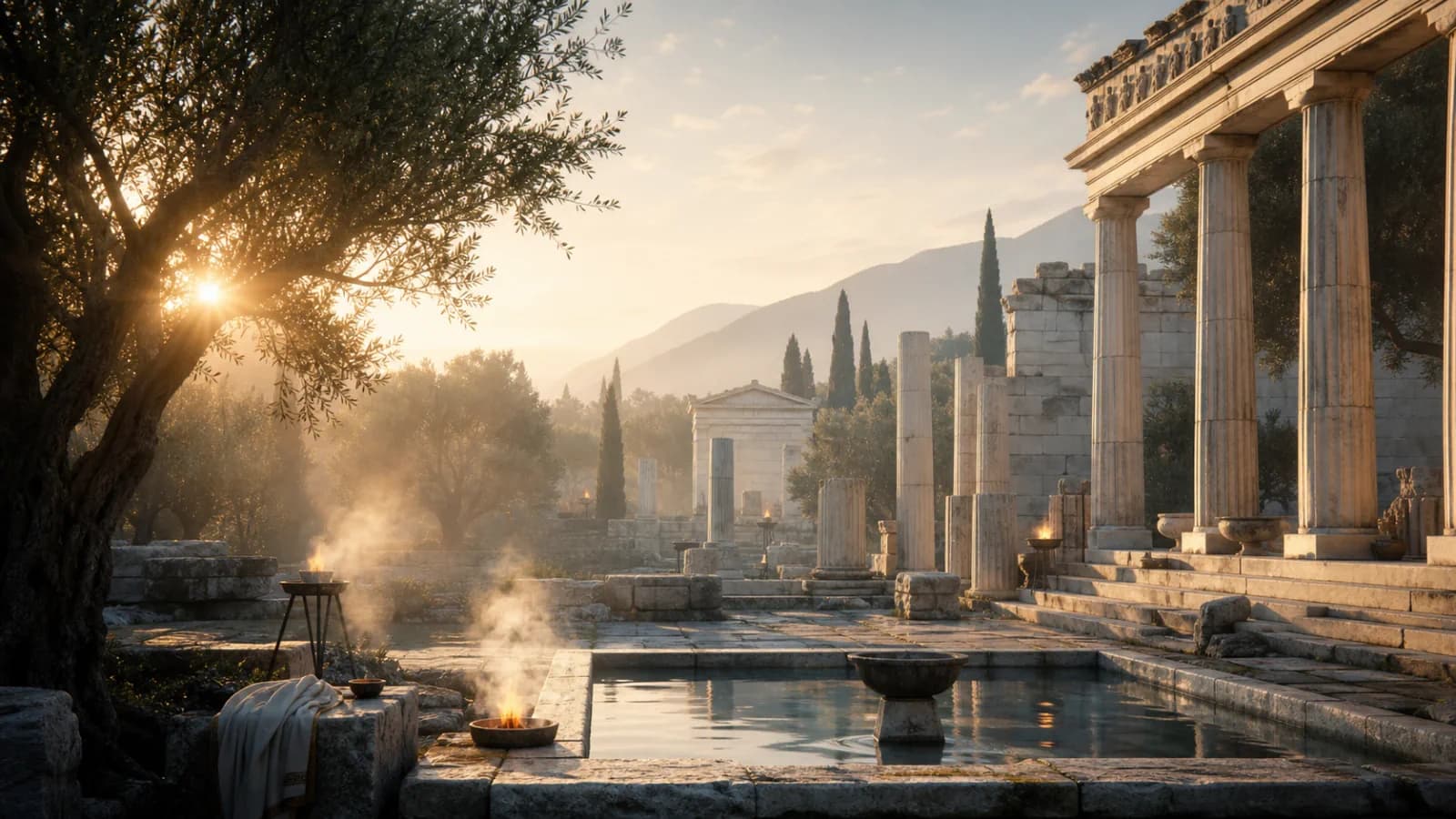
Imagine stepping through a gateway of polished marble into a grove of ancient olive trees, the air thick with incense and the distant sound of hymns echoing between stone walls. Before you stands a temple gleaming in the Mediterranean light, and all around you pilgrims prepare for rituals that have been performed for centuries. This was the world of the ancient Greek sanctuary: a place where the boundary between human and divine grew thin, and where hidden rituals shaped the spiritual life of an entire civilization.
The hidden rituals of ancient Greek sanctuaries encompassed a wide spectrum of sacred practices, from purification ceremonies and offerings to secret mystery initiations, oracle consultations, healing rites, music, dance, and festival processions. Sanctuaries such as the Acropolis of Athens, Delphi, Olympia, Eleusis, and Epidaurus served as spiritual centers where communities honored the gods, sought guidance, celebrated festivals, and entered experiences designed to change how they felt, thought, and remembered.
In this guide, you will explore the sacred geography that shaped sanctuary locations, the purification rituals required before entering sacred space, the mystery rites of Eleusis, the oracle traditions of Delphi, the healing practices of Asklepios, and the way these ancient traditions continue to echo in modern immersive audio and meditation experiences.
The ancient Greeks built sanctuaries so beautiful that even the gods seemed invited to visit. The point was never only belief; it was atmosphere, movement, sound, and memory working together.
Key Facts About Ancient Greek Sanctuary Rituals
- •• Sacred sites: Over 1,000 sanctuaries existed across the ancient Greek world, from major Panhellenic centers to small rural shrines.
- •• Eleusinian Mysteries: The most famous secret ritual tradition in the ancient world was practiced for nearly 2,000 years, from roughly 1500 BCE to 392 CE.
- •• Oracle of Delphi: Delphi was considered the center of the world by many Greeks and was consulted by individuals and city-states for over 1,000 years.
- •• Healing temples: The sanctuary of Asklepios at Epidaurus practiced dream-based healing, or incubation, in a controlled sacred environment.
- •• Sacred truces: Major festivals required the cessation of conflicts so pilgrims and competitors could travel safely to sanctuaries.
- •• Acoustic design: Sanctuary architecture, hymns, chanting, and processions worked together to create immersive ritual soundscapes.
Quick Answer
The hidden rituals of ancient Greek sanctuaries were elaborate sacred practices, including purification rites, mystery initiations, oracle consultations, healing ceremonies, and festival celebrations, performed at sacred sites such as Athens, Delphi, Olympia, Eleusis, and Epidaurus. These rituals connected Greek communities with the divine, shaped civic identity, and created transformative multi-sensory experiences that still inspire immersive meditation journeys today.
What Were Ancient Greek Sanctuaries?
Ancient Greek sanctuaries, known as temene or sacred precincts, were defined areas of land set apart from the everyday world and dedicated to the worship of one or more gods. Unlike modern religious buildings that primarily serve as gathering places, Greek sanctuaries were understood as dwelling places of the divine. The temple at the center of a sanctuary was the house of the god's cult statue, while most ritual activity happened outside, around open-air altars, processional pathways, sacred groves, springs, and gathering spaces.
The variety of Greek sanctuaries was extraordinary. Great Panhellenic sanctuaries such as Olympia, Delphi, Nemea, and Isthmia drew pilgrims from across the Greek-speaking world and included temples, treasuries, theaters, athletic spaces, and elaborate processional routes. Smaller rural shrines could be as simple as an altar beneath an ancient tree, a cave mouth, or a spring marked by stone. Between these extremes were civic sanctuaries that acted as the spiritual hearts of Greek cities.
What made sanctuaries truly remarkable was their role as total social institutions. They were places of worship, diplomatic meeting grounds, economic centers, artistic showcases, and archives of shared memory. Delphi, for example, functioned as an international news hub, diplomatic forum, and cultural stage. To understand Greek sanctuaries is to understand how ritual, story, architecture, and public life shaped Greek civilization from the inside out.
Key Insight
Greek sanctuaries were early immersive experiences. Through architecture, sound, scent, procession, landscape, and performance, they created multi-sensory environments designed to move participants from everyday awareness into sacred attention.
The Sacred Geography of Sanctuary Sites
The Greeks did not choose sanctuary locations randomly. Each sacred site was selected because the landscape itself was believed to reveal divine presence. Mountains, springs, caves, groves, river valleys, and coastal promontories all carried spiritual significance. The sanctuary of Apollo at Delphi stood on a dramatic mountainside cleft below Parnassus, while the sanctuary of Zeus at Olympia occupied a lush river valley where two rivers meet.
Water sources were especially powerful markers of sacred space. The Castalian Spring at Delphi was associated with purification and prophecy. Healing springs were central to the rituals of Asklepios at Epidaurus. In Athens, springs on the slopes of the Acropolis were sacred long before the monumental temples above them were built. Flowing water marked a threshold where transformation became possible.
Trees and groves also defined sacred boundaries. Athena's olive tree on the Acropolis was believed to have been planted by the goddess herself, while Zeus at Dodona spoke through the rustling leaves of an ancient oak. Groves of plane trees, laurels, and myrtles created living enclosures that separated ordinary space from sacred presence.
The Greeks understood sacred real estate differently: location mattered because the landscape itself was part of the ritual.
Rituals of Purification: Preparing to Enter Sacred Space
No one could enter a Greek sanctuary without first undergoing purification, or katharsis. This was more than physical cleanliness. Purification marked a change of state: a passage from the contamination and distraction of everyday life into the purity required for divine encounter. At sanctuary entrances, visitors used basins of lustral water to sprinkle or wash themselves before crossing into sacred ground.
More serious forms of ritual pollution required more elaborate preparation. Certain life events, contact with death, birth, or other powerful transitions could make a person temporarily unfit for sacred space. Purification might involve waiting periods, bathing in running water or seawater, burning sulfur or aromatic herbs, and offering preliminary sacrifices. At Delphi, visitors washed at the Castalian Spring before approaching Apollo's oracle.
Purification reveals how deeply the Greeks linked inner state with sacred experience. They understood that meaningful encounter required preparation. Modern meditation uses a similar principle: breath, intention, sound, and ritualized beginnings help the mind leave scattered awareness and enter a more receptive state.
The Art of Sacrifice and Offering
At the heart of Greek sanctuary ritual was offering, or thysia: giving something valuable to the gods as gratitude, devotion, or petition. Offerings could be simple libations of wine, milk, or honey poured at an altar, or elaborate public ceremonies built around consecrated meals shared by the community. The shared meal after an offering joined human and divine worlds in a symbolic act of communion.
Greeks also presented votive gifts in astonishing variety. Athletes dedicated wreaths and equipment at Olympia. Healed patients left terracotta models of the body parts restored by Asklepios. Warriors offered captured arms and armor. Wealthy individuals and city-states commissioned sculptures, vessels, and treasuries. The archaeological record of sanctuaries is filled with these gifts across centuries.
Offering was not merely transactional. It sustained relationship. The Greeks understood divine-human exchange through kharis, reciprocal grace or favor: gods bestowed blessings, humans responded with gratitude, and the cycle maintained cosmic and civic order.
The ancient Greeks offered their finest wine, oil, art, and labor to the gods. The point was not payment; it was relationship made visible.
Mystery Rites: The Secret Ceremonies of Eleusis
The most profound and closely guarded rituals of the Greek world were the Eleusinian Mysteries, secret initiation ceremonies held at the sanctuary of Demeter and Persephone in Eleusis near Athens. For nearly two millennia, initiates from across the Mediterranean came to participate. The penalty for revealing the mysteries was severe, and the central revelation remains debated by scholars today.
What can be reconstructed is a carefully staged progression. Initiates purified themselves in the sea, processed from Athens to Eleusis along the Sacred Way, fasted, prepared, and entered nighttime ceremonies in the Telesterion. There they encountered things done, things shown, and things said: dramatic actions, sacred objects, and spoken revelations arranged as a multi-sensory transformation.
Ancient testimony suggests that the Mysteries produced powerful emotional and spiritual insight. Their success across centuries shows how deeply humans respond to immersive narrative, controlled environment, shared anticipation, sound, darkness, movement, and revelation. In that sense, Eleusis prefigures the core logic of modern cinematic and audio-based inner journeys.
Why It Matters
The Eleusinian Mysteries show that immersive ritual is not a modern invention. Ancient communities already knew that story, setting, sound, suspense, and symbolic action could produce lasting psychological change.
Oracle Rituals: Communing with the Divine
The Oracle of Apollo at Delphi was the most prestigious oracle in the Greek world. Its power centered on the Pythia, a priestess who served as Apollo's human voice. On consultation days she entered the inner sanctum of the temple, sat on a sacred tripod, and delivered responses from a trance-like state interpreted by priests.
The consultation process was elaborate. Seekers purified themselves at the Castalian Spring, offered a sacred cake and fee, and waited for signs that Apollo was willing to speak. A question was then presented, sometimes orally and sometimes in writing. The answer passed through ritual layers: purification, offering, question, trance, interpretation, and response.
Other oracle sanctuaries used different methods. At Dodona, Zeus spoke through the rustling leaves of an oak and the resonance of bronze cauldrons. At the oracle of Trophonius, seekers descended into an underground chamber. At Claros, a priest drank from a sacred spring before prophecy. These practices show the Greek conviction that divine communication could emerge through earth, water, wind, sound, and altered perception.
The Pythia at Delphi may have been history's most influential consultant: difficult answers, high stakes, and clients who kept coming back.
Healing Sanctuaries: The Sacred Practices of Asklepios
Among the most fascinating sanctuary rituals were those practiced at healing sanctuaries of Asklepios, the divine physician and son of Apollo. The most famous, at Epidaurus, became one of the ancient world's leading centers for sacred healing. Patients came from across the Mediterranean seeking relief through a blend of physical treatment and spiritual experience.
The central practice was incubation, or enkoimesis: ritual sleep inside the sanctuary's sacred dormitory, the abaton. Patients prepared through bathing, fasting, offerings, and ritual instruction. They then lay down in a dim, carefully designed environment where Asklepios was believed to visit in dreams, diagnose illness, and prescribe cures.
The healing environment was part of the treatment. The scent of laurel and incense, the sound of nearby water, low light, ritual expectation, and the symbolic presence of sacred snakes created a powerful psychological setting. Modern scholars often read these practices through the lenses of placebo effect, environmental therapy, sleep science, and holistic medicine.
Festival Rituals and Sacred Celebrations
Greek sanctuaries came most vividly alive during festivals: multi-day celebrations that combined ritual, athletic competition, music, drama, procession, feasting, and communal gathering. Athens alone celebrated more than 120 festival days per year. The Olympic Games at Olympia, the Pythian Games at Delphi, the Panathenaia in Athens, and the Great Dionysia shaped Greek identity for centuries.
Festival rituals followed prescribed sequences. The Panathenaia culminated in a grand procession through Athens to the Acropolis, where a sacred robe was presented to Athena. The Great Dionysia featured dramatic and comic performances in the Theater of Dionysus, not simply as entertainment but as sacred offerings and collective emotional transformation.
These festivals integrated many sensory and emotional channels at once: visual spectacle, hymns, choral performance, music, dancing, incense, food, architectural setting, mythology, and shared crowd movement. This multi-modal approach is close to what immersive audio journeys try to recreate in a modern form: an environment that carries the mind into another rhythm.
Athens celebrated more than 120 festival days a year. The ancient calendar understood something modern productivity culture often forgets: shared ritual has social power.
Music, Dance, and Chanting in Sacred Spaces
Sound was the invisible architecture of Greek sanctuary ritual. Music, chanting, and rhythmic movement were not decorations added to worship; they were worship itself. The Greeks believed that music possessed spiritual power: modes, rhythms, and melodies could purify the soul, invoke gods, heal illness, produce prophetic states, and harmonize communities.
Choral performance was central. Paeans to Apollo, dithyrambs to Dionysus, and maiden songs for Artemis combined voice, instruments, and movement into carefully rehearsed acts of devotion. Sanctuaries and theaters were shaped to support this sound. Epidaurus remains famous for its astonishing acoustics, while colonnades and stone halls created resonance that made voices seem larger than human scale.
The link to modern spatial audio is more than metaphor. Neuroscience confirms what ritual designers intuited: carefully shaped sound environments alter attention, mood, memory, and awareness. Rhythmic entrainment, harmonic resonance, and spatial immersion are ancient techniques now carried through modern audio design.
Sanctuary Architecture as Ritual Framework
Greek sanctuary architecture was ritualistic by design. Every architectural element helped guide worshippers through spatial sequences that moved from ordinary life toward sacred encounter. A gateway marked the threshold. Processional routes, such as the Sacred Way at Delphi, built anticipation by revealing the temple gradually through movement, elevation, and changing sightlines.
The temple itself was the climax of this ritual narrative. Optical refinements, colonnades, porches, and dark inner chambers created a progression from public openness to intimate encounter with the cult statue. The experience was not just visual. It was bodily: walking, waiting, approaching, stopping, looking upward, and entering silence.
Greek architects also managed light, shadow, and acoustic resonance. The dark naos could make a gold-and-ivory statue appear to glow. Stone surfaces amplified prayers and hymns. These deliberate manipulations of sensory experience are among the earliest known examples of environmental design for consciousness transformation.
Greek temple architects were early experience designers. They shaped buildings not only to be seen, but to change how visitors felt inside them.
How Ancient Greek Rituals Inspire Modern Meditation
The connection between ancient Greek sanctuary rituals and modern meditation is deeper than surface resemblance. Ritual sound can entrain attention. Darkness and controlled lighting can heighten imagery. Narrative immersion can activate memory and imagination. Progressive spatial transitions can move awareness from scattered thought toward focused receptivity. The Greeks built physical environments that produced meditative states; modern technology can create virtual versions through guided visualization and spatial audio.
Several parallels stand out. Purification rituals resemble modern warm-up practices that shift the mind from distraction to intention. Asklepian incubation resembles guided visualization, where the practitioner rests in a prepared inner state while remaining aware. The Eleusinian sequence of purification, preparation, immersion, revelation, and integration mirrors the structure of effective audio journeys.
Most importantly, Greek ritual shows that immersive, narrative-based spiritual practice is not new. It is rooted in human cognition. We respond to place, sequence, rhythm, voice, symbol, and story. The technology has changed; the human capacity for transformative immersion has not.
Ritual Pattern
Purification becomes preparation. Sacred sound becomes spatial audio. Incubation becomes guided visualization. Mystery rites become narrative journeys. Ancient sanctuary practice gives modern meditation a deep historical mirror.
Experiencing Greek Sanctuaries Through Immersive Audio
Imagine closing your eyes and standing at the entrance to the Sanctuary of Apollo at Delphi. Behind you, the cliffs of Mount Parnassus rise into a bright sky. Before you, the Sacred Way winds upward between marble treasuries. You hear water from the Castalian Spring, distant chanting above, and wind moving through laurel groves. Spatial audio can place each sound around you, creating the sense of being present inside the ancient sanctuary.
This is what immersive audio journeys make possible: not merely learning about ancient sanctuaries, but imaginatively inhabiting them. A historically researched soundscape and guided narrative can walk listeners through purification, procession, oracle consultation, or mystery initiation in a way that feels embodied rather than abstract.
The result can be educational, emotional, and restorative. Imaginatively inhabiting meaningful spaces can reduce stress, support emotional regulation, and expand creative attention. Ancient sanctuaries were designed to produce these effects through physical architecture and ritual. Modern audio lets listeners access a version of that transformative potential wherever they are.
Two thousand years ago, Delphi required a long journey. Today, a pair of headphones can open a doorway into that same imagined sacred landscape.
The Bottom Line
The hidden rituals of ancient Greek sanctuaries reveal a civilization that understood how to design environments and experiences capable of transforming consciousness. From purification rites and offerings to festival celebrations, healing dreams, oracle trances, and mystery initiations, Greek sanctuary practice was one of humanity's most sustained experiments in experiential spiritual design.
This article explored Greek sanctuaries, their sacred geography, purification rituals, offering traditions, the Eleusinian Mysteries, oracle consultations at Delphi, healing practices of Asklepios, festival celebrations, sacred sound, ritual architecture, and the connection between ancient immersive practice and modern meditation.
For Visionaria, these sanctuaries matter because they show that story, sound, place, and ritual have always helped people enter deeper states of attention. The temple is no longer only stone. Sometimes it begins when the listener closes their eyes.
Step Inside the Story
Explore cinematic audio journeys inspired by ancient worlds, sacred spaces, and the psychology of immersive storytelling.