The Story Behind the Hanging Gardens of Babylon: Complete Guide to the Ancient Wonder
💡 Fun fact: The Hanging Gardens are the only one of the Seven Wonders that might not have existed at all. Imagine putting "possibly imaginary garden" on your ancient world travel bucket list.
- What Were the Hanging Gardens of Babylon?
- Nebuchadnezzar's Love Story
- Ancient Writers and Their Descriptions
- Engineering Wonder of the Ancient World
- Plants and Vegetation of Paradise
- The Archaeological Mystery
- The Nineveh Theory
- Among the Seven Wonders
- Cultural Legacy and Modern Influence
- Experience the Gardens Through Meditation
- Spatial Audio and the Hanging Gardens
- Why the Hanging Gardens Still Matter Today
- The Bottom Line
- Frequently Asked Questions
Imagine stepping into a world where lush green terraces rise from the sun scorched plains of ancient Babylon towering layers of exotic trees, fragrant flowers, and cascading waterfalls defying the arid landscape of Mesopotamia. This isn't a scene from a fantasy novel. It's the legendary vision of the Hanging Gardens of Babylon, one of the Seven Wonders of the Ancient World, and perhaps the most enigmatic of them all.
The Hanging Gardens of Babylon were a legendary series of elevated, tiered garden terraces reportedly built in the ancient city of Babylon (near present day Hillah, Iraq) around 600 BCE. Attributed to King Nebuchadnezzar II, the gardens were said to feature lush vegetation, towering trees, elaborate irrigation systems, and cascading water features that created an oasis of greenery in the flat Mesopotamian desert. Unlike any other ancient wonder, their very existence remains a subject of scholarly debate yet their story continues to captivate imaginations worldwide.
In this comprehensive guide, you'll discover the full story behind the Hanging Gardens from the romantic legend of their creation and the vivid accounts of ancient writers to the ingenious engineering that may have made them possible. You'll explore the archaeological mystery surrounding their existence, the alternative theories about their location, and how modern spatial audio technology can transport you into a reconstructed version of these legendary terraces through immersive meditation.
"The Hanging Gardens: proof that even 2,600 years ago, people were obsessed with having the most impressive garden on the block. Some things never change."
Key Facts
- •• Location: Ancient Babylon (near present-day Hillah, Iraq)
- •• Builder: Attributed to King Nebuchadnezzar II (ruled 605-562 BCE)
- •• Height: Approximately 75 feet (23 metres) with multiple terraces
- •• Base: Approximately 400 × 400 feet (120 × 120 metres)
- •• Status: One of the Seven Wonders (existence debated by scholars)
- •• Water Source: Euphrates River via ingenious pumping mechanisms
- •• Purpose: Gift of love from Nebuchadnezzar II to Queen Amytis
Quick Answer
💡 Fun fact: The Hanging Gardens are the only one of the Seven Wonders that might not have existed at all. Imagine putting "possibly imaginary garden" on your ancient world travel bucket list.
What Were the Hanging Gardens of Babylon?
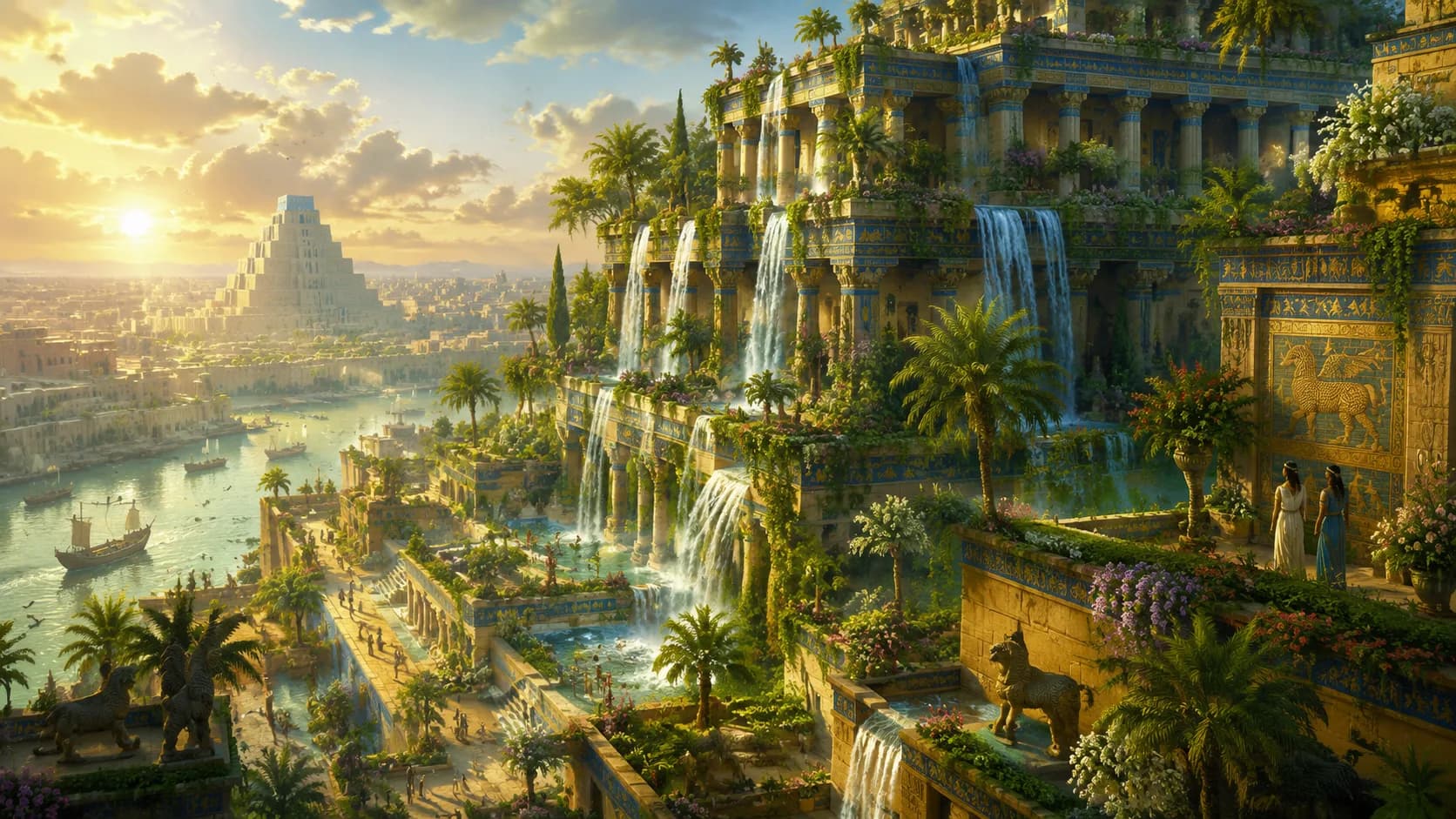
The Hanging Gardens of Babylon are traditionally described as an extraordinary feat of ancient engineering and botanical artistry. According to ancient accounts, the gardens consisted of a series of elevated stone terraces rising approximately 75 feet (23 metres) into the sky, each level overflowing with trees, shrubs, flowers, and vines that created the impression of a verdant mountainside emerging from the flat Mesopotamian plain. The entire structure was said to measure roughly 400 feet (120 metres) on each side a vast elevated paradise visible from miles across the surrounding landscape.
Did You Know?
The relentless drive to understand the world was seen not just as an academic pursuit, but as a spiritual and healing practice by the ancients.
Unlike a conventional garden planted at ground level, the Hanging Gardens were built upon massive stone platforms supported by thick walls and arched vaults. The term "hanging" doesn't mean the gardens were suspended from above, but rather derives from the Greek word "kremastos" and the Latin "pensilis," both meaning "overhanging." When viewed from below, the cascading vegetation on each terrace appeared to hover in mid-air, creating an almost supernatural visual effect. Visitors standing at the base would have seen layer upon layer of greenery reaching toward the heavens, with water trickling down between the levels like miniature waterfalls.
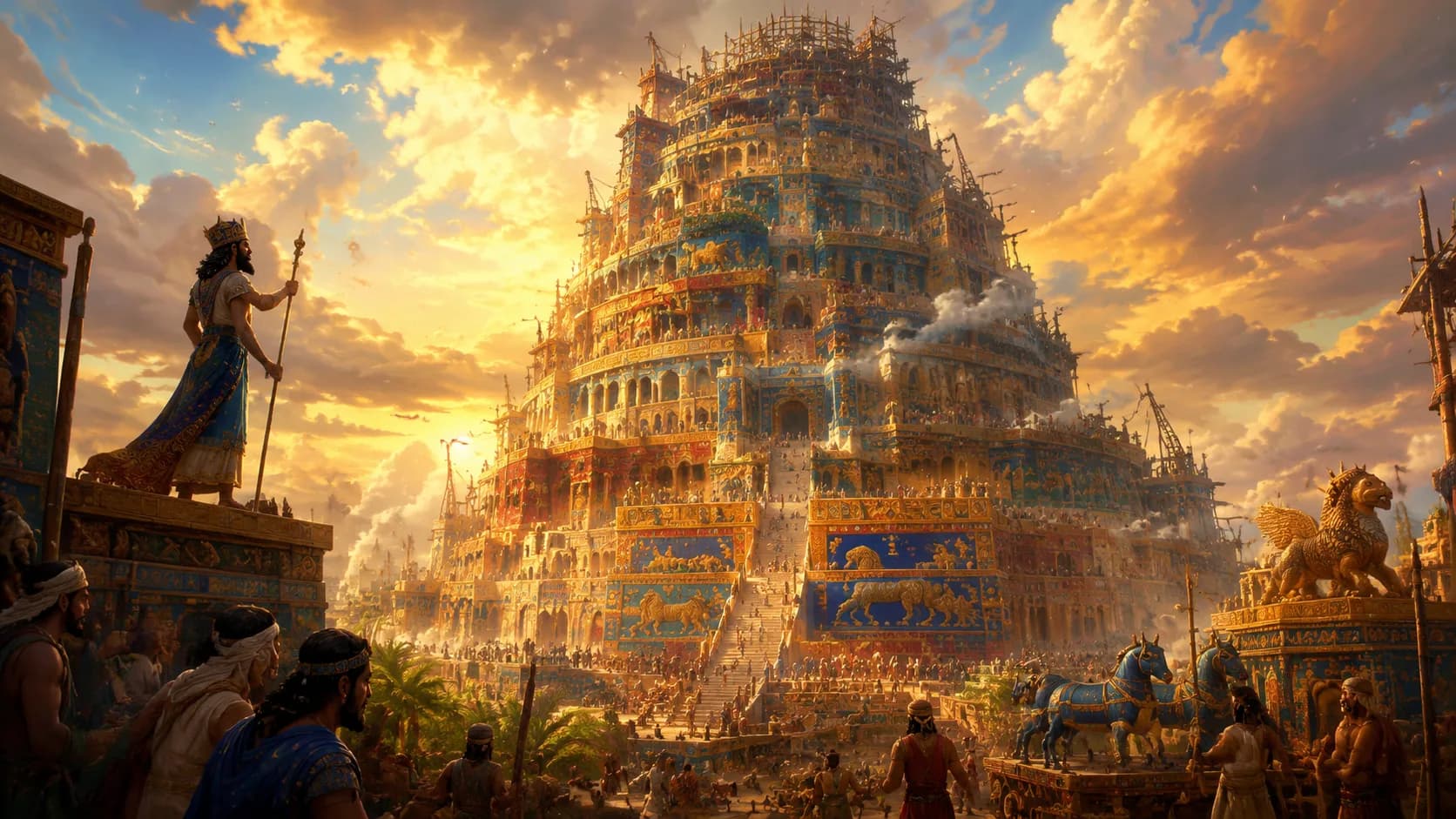
The gardens were situated alongside the royal palace complex within the walls of Babylon, one of the most magnificent cities of the ancient world. The city itself, with its towering Ishtar Gate, grand Processional Way, and the legendary Tower of Babel (the Etemenanki ziggurat), was already considered one of the most awe-inspiring places on Earth. The Hanging Gardens elevated Babylon's reputation even further, transforming it into a city that defied natural law itself where gardens bloomed in the desert and water flowed uphill.
What makes the Hanging Gardens unique among the Seven Wonders is that they were not a monument to gods or rulers, but a testament to human ingenuity and devotion. While the Parthenon honoured Athena and the pyramids celebrated pharaohs, the gardens were reportedly created as an act of love making them arguably the most romantic structure in ancient history.
Why did the ancient physician prescribe a long walk? Because he was tired of listening to the patient complain in his office.
Nebuchadnezzar's Love Story
The most enduring origin story of the Hanging Gardens is one of romance and devotion. According to the Babylonian priest and historian Berossus (writing around 290 BCE), King Nebuchadnezzar II built the gardens for his wife Amytis of Media. Amytis had grown up in the lush, mountainous landscape of Media (present day northwestern Iran), a region of green hills, flowing streams, and fragrant forests. When she arrived in Babylon a city of magnificent grandeur but surrounded by flat, arid plains she longed for the natural beauty of her homeland.
Nebuchadnezzar, deeply devoted to his queen, resolved to recreate the rolling green hills of Media within the heart of his desert capital. He commanded his architects and engineers to construct an artificial mountain of gardens terraced levels rising from the palace grounds, planted with every variety of tree, flower, and vine that could be gathered from across his vast empire. The result, according to legend, was a structure so magnificent that it earned its place among the wonders of the world.
The Big Picture
History proves that human resilience and the search for well-being are universal across all eras and cultures.
The Hanging Gardens represent what may be history's grandest romantic gesture. Nebuchadnezzar didn't just send flowers he built an entire mountain of them. If that doesn't set the bar for meaningful gifts, nothing will.
The marriage between Nebuchadnezzar and Amytis was itself a strategic alliance. Amytis was the daughter (or granddaughter) of Cyaxares, King of the Medes, who had allied with Nebuchadnezzar's father, Nabopolassar, to bring about the conclusion of the Assyrian Empire. The union cemented the alliance between Babylon and Media, making it both a political partnership and, according to tradition, a genuine love match. Nebuchadnezzar's reign (605-562 BCE) marked the peak of Neo-Babylonian power and cultural achievement and the gardens, if they existed, would have been the crowning jewel of this golden age.
Some scholars have questioned whether Amytis was a real historical figure, as she does not appear in contemporary Babylonian records. However, the romantic narrative persists because it provides a compelling human motivation for creating something so extraordinary. Whether the story is literally true or an embellishment added by later writers, it captures a timeless truth: the desire to create beauty for someone we love is one of humanity's most powerful impulses.
"Nebuchadnezzar: 'I built you an entire mountain of gardens.' Amytis: 'That's sweet, but did you remember to water them?' Ancient marriage problems, apparently."

Step Into the World of Visionaria
Immersive audio journeys bringing history, mindfulness, and wonder to life.
Why did the ancient physician prescribe a long walk? Because he was tired of listening to the patient complain in his office.
Ancient Writers and Their Descriptions
Our knowledge of the Hanging Gardens comes entirely from ancient Greek and Roman writers, none of whom appear to have seen the gardens firsthand. This reliance on secondary accounts is one reason the gardens' existence remains debated. Nevertheless, the descriptions they provide are remarkably detailed and consistent, painting a vivid picture of what visitors would have encountered.
Strabo's Account (circa 64 BCE-24 CE)
The Greek geographer Strabo provided one of the most detailed descriptions. He wrote that the gardens consisted of "vaulted terraces raised one above another, and resting upon cube-shaped pillars." According to Strabo, the pillars were hollow and filled with earth, allowing large trees to be planted at each level. He described an ingenious system of chain pumps or screws that lifted water from the Euphrates River to the uppermost terrace, from which it cascaded down through channels, irrigating the entire structure.
Philo of Byzantium (circa 280-220 BCE)
Did You Know?
The relentless drive to understand the world was seen not just as an academic pursuit, but as a spiritual and healing practice by the ancients.
Philo of Byzantium, who compiled a list of the Seven Wonders, described the gardens as having "plants cultivated at a height above ground level, with the roots of trees embedded in an upper terrace rather than in the earth." He noted that the entire weight of the garden was supported by stone columns, and that streams of water flowed through the structure, maintaining the moisture needed for dense vegetation. Philo marvelled at the engineering required to sustain a living garden at such heights, calling it a triumph of human creativity over natural limitations.
Diodorus Siculus (circa 90-30 BCE)
The Greek historian Diodorus Siculus offered perhaps the most evocative description, noting that the gardens were built in the shape of a theatre a series of stepped terraces, each approximately 22 feet wide, rising to the height of the city walls. He described "galleries" beneath the terraces supported by stone beams covered in layers of reed, asphalt, and lead sheets to prevent water from seeping through. Above this waterproof layer sat deep beds of soil, rich enough to support "the roots of the largest trees."
None of the ancient writers who described the Hanging Gardens claimed to have visited them personally. Their accounts were based on earlier sources, oral traditions, and the established reputation of Babylon as a city of unparalleled magnificence. This raises the fascinating question: were they describing a real place, or an idealised legend?
Berossus, the Babylonian priest writing around 290 BCE, is the source who attributed the gardens specifically to Nebuchadnezzar and connected them to the love story with Amytis. His account is considered particularly significant because he had access to Babylonian records and traditions, lending his attribution greater credibility than the Greek writers who viewed Babylon from an outside perspective. Together, these ancient accounts create a remarkably consistent vision of an artificial paradise a mountain of greenery rising from the desert, sustained by human ingenuity and the waters of the Euphrates.
"Ancient travel bloggers: 'You HAVE to see the Hanging Gardens. Five stars. Would wonder again.' Also ancient travel bloggers: 'No, I haven't personally been there. But my friend's friend said they're amazing.'"
A Roman walks into a bar, holds up two fingers, and says, 'Five beers, please.'
Engineering Wonder of the Ancient World
If the Hanging Gardens existed as described, they represent one of the most remarkable engineering achievements of the ancient world. Building a multi storey garden in a region with minimal rainfall required solving problems that would challenge even modern engineers. The Babylonians, however, were among the most skilled hydraulic engineers of antiquity, having already constructed extensive canal systems, irrigation networks, and the massive Ishtar Gate with its glazed brick construction.
The most impressive aspect of the gardens' engineering was the water delivery system. Babylon sits on the flat alluvial plain between the Tigris and Euphrates Rivers there are no natural hills or elevated water sources. To irrigate terraces reaching 75 feet above ground level, the builders had to lift enormous quantities of water from the Euphrates. Ancient sources describe two possible mechanisms: a chain pump (a continuous loop of buckets on a chain, turned by slaves or animals) and what some scholars interpret as an early form of the Archimedes' screw, predating Archimedes himself by centuries.
Engineers estimate that maintaining the Hanging Gardens would have required pumping approximately 8,200 gallons (31,000 litres) of water per day to the uppermost terrace a staggering logistical achievement in an era before mechanical pumps.
Visionaria Insight
By immersing ourselves in these historical soundscapes, we reconnect with a timeless human tradition of storytelling and mental restoration.
The physical structure supporting the gardens was equally impressive. According to ancient descriptions, the terraces rested on massive stone columns and arched vaults construction techniques the Babylonians had perfected over centuries. Each terrace required a sophisticated waterproofing system to prevent water from seeping through and undermining the structure below. Diodorus describes layers of reed matting, bitumen (asphalt), and lead sheets placed between the stone foundations and the soil beds, creating an effective moisture barrier that kept each level structurally sound while allowing plant roots to flourish in deep soil above.
The soil itself had to be deep enough to support full grown trees, not just decorative plants. Some accounts suggest soil beds of 10 feet or more on the larger terraces requiring immense structural support beneath. The engineering challenge wasn't just building upward, but maintaining a living ecosystem at height, with adequate drainage, root space, and consistent moisture in one of the hottest climates on Earth. The fact that the wonders of Babylon included such innovation speaks to the remarkable capabilities of Mesopotamian builders.
"Ancient Babylonian engineers: 'We need to pump 31,000 litres of water uphill every day in 40 degree heat.' Modern engineers: 'We can't even get the office coffee machine to work properly.'"
A Roman walks into a bar, holds up two fingers, and says, 'Five beers, please.'
Plants and Vegetation of Paradise
The Hanging Gardens were described as a botanical paradise a living collection of plants gathered from across the known world. Ancient writers emphasise the extraordinary biodiversity of the gardens, which would have included species from Media, Persia, Egypt, and the broader Mesopotamian region. The word "paradise" itself comes from the Old Persian "pairi daeza," meaning an enclosed garden or park and the Hanging Gardens may have been the ultimate expression of this concept.
Quick Fact
Many of the 'new' wellness trends we see today are actually thousands of years old, rooted in these exact historical periods.
According to historical accounts, the gardens featured towering date palms that provided shade on the upper terraces, fragrant cypress and juniper trees reminiscent of the mountainous landscapes of Media, ornamental pomegranate and fig trees bearing fruit throughout the growing season, and cascading vines and flowering plants that draped over the terrace edges, creating the "hanging" effect that gave the gardens their name. Exotic roses, lilies, and other flowering species would have added vibrant colour and sweet fragrance to every level.
The Hanging Gardens functioned as an ancient botanical garden, showcasing plant species from across Nebuchadnezzar's empire. This would have made them not only a visual wonder but also a centre of botanical knowledge, centuries before such institutions existed in the Western world.
The sensory experience of walking through the gardens would have been extraordinary. Visitors ascending from terrace to terrace would have moved through changing microclimates from the humid shade of the lower levels, thick with ferns and mosses irrigated by cascading water, to the sun drenched upper terraces where drought resistant trees and Mediterranean herbs thrived. The scent of jasmine, myrrh, and flowering fruit trees would have filled the air, while the constant sound of flowing water created a natural symphony that masked the noise of the bustling city below.
For meditators exploring the gardens through immersive audio journeys, the botanical richness provides an exceptionally layered sensory landscape. The combination of water sounds, birdsong, rustling leaves, and distant wind creates an ideal environment for cinematic meditation one where every breath brings a new scent and every step reveals a new vista of green tranquility.
What's an ancient intellectual's favorite exercise? Jumping to conclusions.
The Archaeological Mystery
Despite the vivid descriptions from ancient writers, the Hanging Gardens remain the only one of the Seven Wonders of the Ancient World for which no definitive archaeological evidence has been discovered. This absence has fuelled one of history's most fascinating debates: did the Hanging Gardens actually exist, or are they a beautiful legend that grew larger with each retelling?
Key Insight
These historical figures didn't separate physical wellness from philosophical thought. To them, it was all one continuous practice of living well.
The German archaeologist Robert Koldewey, who excavated the site of ancient Babylon between 1899 and 1917, searched extensively for the gardens. He identified a series of unusual vaulted chambers in the northeastern corner of the Southern Palace that he believed might have been the foundations of the gardens. These chambers featured thick walls, elaborate drainage systems, and evidence of a well with a triple shaft that could have housed a chain pump. However, subsequent scholars have argued these structures were more likely storerooms or administrative buildings, and the location doesn't match the descriptions provided by ancient writers.
One reason for the archaeological silence may be the nature of the structure itself. Unlike stone temples or brick walls that survive for millennia, a garden even one built on stone terraces consists largely of organic material that decomposes over time. The soil, plants, wooden supports, and waterproofing materials would have degraded long before any archaeologist arrived. Additionally, centuries of flooding by the Euphrates, rebuilding, and urban development may have erased whatever traces remained. The Library of Alexandria faced similar challenges of archaeological verification, reminding us that the absence of evidence is not evidence of absence.
"Archaeologist: 'We've searched everywhere but can't find the Hanging Gardens.' Intern: 'Have you tried looking... up? They were hanging, after all.'"
A time traveler went back to antiquity to teach them about 'holistic health.' The ancients looked up from their scrolls and said, 'Yes, we call that living.'
The Nineveh Theory
One of the most compelling alternative theories about the Hanging Gardens was proposed by Dr. Stephanie Dalley of Oxford University. In her 2013 book The Mystery of the Hanging Garden of Babylon, Dalley argued that the gardens were not in Babylon at all, but in Nineveh the capital of the Assyrian Empire, located near present day Mosul in northern Iraq. According to Dalley, the gardens were built by King Sennacherib of Assyria (ruled 705-681 BCE), not Nebuchadnezzar of Babylon.
Dalley's theory is supported by several pieces of evidence. First, detailed Assyrian inscriptions from Sennacherib's palace at Nineveh describe elaborate gardens with sophisticated irrigation systems, including aqueducts that brought water from mountains 50 miles away. These descriptions closely match the ancient Greek accounts of the Hanging Gardens. Second, archaeological evidence at Nineveh has revealed the remains of an extensive aqueduct system and garden terraces precisely the type of infrastructure needed to support elevated gardens. Third, Dalley notes that ancient writers often confused Babylon and Nineveh, as both were major Mesopotamian capitals.
Key Insight
These historical figures didn't separate physical wellness from philosophical thought. To them, it was all one continuous practice of living well.
Sennacherib's own inscriptions describe his palace gardens using the phrase "a wonder for all peoples" remarkably similar to how the Greek writers categorised the Hanging Gardens among the world's wonders. This linguistic connection strengthens the case for the Nineveh location.
If Dalley's theory is correct, it would mean that the Hanging Gardens did exist but in a different city, built by a different king, decades before Nebuchadnezzar's reign. The confusion between Babylon and Nineveh, compounded by centuries of retelling, may have relocated the gardens from their actual home in Nineveh to the more famous and romantically appealing city of Babylon. Whether the gardens stood in Babylon or Nineveh, their story speaks to the same remarkable truth: ancient Mesopotamian civilisations possessed engineering capabilities that continue to astonish us today.
A Roman walks into a bar, holds up two fingers, and says, 'Five beers, please.'
Among the Seven Wonders
The Hanging Gardens hold a unique position among the Seven Wonders of the Ancient World. While the other six wonders the Great Pyramid of Giza, the Statue of Zeus at Olympia, the Temple of Artemis at Ephesus, the Mausoleum at Halicarnassus, the Colossus of Rhodes, and the Lighthouse of Alexandria have all been confirmed by archaeological evidence or surviving remains, the Hanging Gardens stand alone as the only wonder whose existence remains unverified.
The concept of the Seven Wonders originated with Greek travellers and writers who compiled lists of the most remarkable structures they had encountered or heard about. The earliest known list was created by the historian Herodotus in the 5th century BCE, though the canonical list we know today was standardised over several centuries. The Hanging Gardens' inclusion on every version of the list despite the uncertainty surrounding them speaks to the extraordinary power of their story. Even among confirmed marvels, the gardens captured imaginations like nothing else.
Did You Know?
The relentless drive to understand the world was seen not just as an academic pursuit, but as a spiritual and healing practice by the ancients.
What distinguishes the Hanging Gardens from the other wonders is their organic, living nature. The pyramids, temples, and statues were all monuments of stone, bronze, or marble permanent materials designed to endure. The gardens, by contrast, were a living ecosystem requiring constant maintenance, water supply, and botanical care. They represented not just engineering skill but an ongoing relationship between human effort and natural growth a wonder that had to be sustained, day after day, season after season, to remain wondrous.

"The Seven Wonders of the Ancient World: six confirmed structures and one garden that may or may not have existed. Even the ancients knew that gardening claims should be taken with a grain of soil."
A time traveler went back to antiquity to teach them about 'holistic health.' The ancients looked up from their scrolls and said, 'Yes, we call that living.'
Cultural Legacy and Modern Influence
Regardless of whether the Hanging Gardens physically existed, their cultural impact is indisputable. For over two millennia, the gardens have inspired artists, architects, writers, and dreamers. Renaissance painters created elaborate depictions of the gardens based on ancient descriptions. Romantic poets used them as metaphors for impossible beauty and lost paradise. Modern architects have drawn on the concept of elevated green spaces in designing vertical gardens, green rooftops, and biophilic buildings that echo the ancient vision of vegetation flourishing at height.
The concept of the "paradise garden" itself traces a direct line from the Hanging Gardens through Persian, Islamic, and European garden traditions. The formal gardens of Persia, the courtyards of the Alhambra in Spain, the gardens of Versailles, and even modern rooftop gardens in cities like Singapore and Milan all reflect the same fundamental aspiration: to create an oasis of natural beauty within an urban environment. The Hanging Gardens were, in many ways, the first expression of this deeply human desire.
Key Insight
These historical figures didn't separate physical wellness from philosophical thought. To them, it was all one continuous practice of living well.
In literature and popular culture, the gardens continue to appear as symbols of lost grandeur, impossible beauty, and the power of love. From Agatha Christie's mystery novels set in Mesopotamia to contemporary fantasy fiction, film, and video games, the image of hanging vegetation cascading from ancient terraces remains one of the most evocative and instantly recognisable icons of the ancient world. The gardens remind us that the most powerful monuments are sometimes those that exist most vividly in our imagination.
Today, projects like the Bosco Verticale (Vertical Forest) in Milan and Gardens by the Bay in Singapore directly channel the spirit of the Hanging Gardens. These modern structures prove that the dream Nebuchadnezzar allegedly pursued bringing lush nature into urban settings at dramatic heights has never faded. It has only evolved, guided by the same wonder that inspired the ancient world.
A Roman walks into a bar, holds up two fingers, and says, 'Five beers, please.'
Experience the Gardens Through Meditation
While archaeologists continue to debate whether the Hanging Gardens existed in physical form, immersive audio journeys offer a way to experience them that transcends the archaeological question entirely. Through spatial 3D audio technology and cinematic meditation, you can walk through a meticulously reconstructed version of the gardens hearing water cascade around you, feeling the coolness of shade, and ascending through layers of lush vegetation, all within the theatre of your imagination.
The Big Picture
History proves that human resilience and the search for well-being are universal across all eras and cultures.
The Hanging Gardens journey begins at the base of the grand staircase, where the sound of flowing water from the Euphrates fills the air. As you ascend, spatial audio positions the sounds of cascading water above and behind you, birdsong in specific directions, and the rustle of palm fronds in a warm breeze from your left. Each terrace reveals new sensory details: the scent of jasmine on the second level, the cool mist of a waterfall on the fourth, and the panoramic view of ancient Babylon spreading below you on the seventh and final terrace.
Unlike reading about the gardens or viewing artistic reconstructions, the immersive meditation experience engages your brain's capacity for mental time travel the ability to construct vivid internal environments from sensory cues. Research shows that narrative meditation activates the same neural pathways as physical experience, meaning your brain responds to the gardens' reconstructed sounds and imagery as though you were actually present in ancient Babylon.
Read more: How Story Experiences Improve Emotional Resilience

"Why visit the Hanging Gardens when you can close your eyes and be there in 3D audio? Zero flight time, no jet lag, and significantly fewer ancient mosquitoes."
What's an ancient intellectual's favorite exercise? Jumping to conclusions.
Spatial Audio and the Hanging Gardens
The Hanging Gardens provide an ideal subject for spatial audio meditation because of their inherently three-dimensional nature. Unlike a flat temple floor or a city street, the gardens existed on multiple vertical levels and spatial audio can recreate this verticality with remarkable realism. Water cascading from terraces above you, leaves rustling at different heights, and distant sounds of the city far below all contribute to a sense of being immersed within a layered, living environment.
Visionaria Insight
By immersing ourselves in these historical soundscapes, we reconnect with a timeless human tradition of storytelling and mental restoration.
The water features of the Hanging Gardens are particularly well suited to spatial audio recreation. The sound of water is inherently calming research consistently shows that flowing water sounds reduce stress hormones, lower heart rate, and promote alpha brainwave states associated with relaxed awareness. In the Hanging Gardens journey, water sounds come from multiple directions and distances: a gentle trickle beside your feet, a distant waterfall to your right, and the deep rumble of the main pump system far below. This layered water soundscape creates an exceptionally effective environment for deep meditation.
Visionaria's audio team has carefully designed the Hanging Gardens experience using data from Mesopotamian archaeological sites, botanical sound libraries, and ancient descriptions. Every element from the specific bird species that would have inhabited the gardens to the acoustic properties of stone corridors and open terraces has been researched and authentically recreated. The result is an experience that doesn't just sound beautiful; it sounds historically plausible, honouring both the ancient vision and modern scientific understanding of how spatial audio transforms meditation.
Read more: The Monkey King: Journey Through Chinese Mythology (Complete Guide)

"Spatial audio: the technology that lets you hear water flowing from above, birds singing from the left, and your neighbours wondering why you're smiling with your eyes closed all at the same time."
Why did the ancient physician prescribe a long walk? Because he was tired of listening to the patient complain in his office.
Why the Hanging Gardens Still Matter Today
In an age of climate change, urbanisation, and increasing disconnection from the natural world, the Hanging Gardens of Babylon carry a profoundly relevant message. They remind us that humans have always sought to bring nature into their built environments that the desire for green spaces, flowing water, and botanical beauty is not a modern trend but a fundamental human need that transcends cultures and centuries.
Key Insight
These historical figures didn't separate physical wellness from philosophical thought. To them, it was all one continuous practice of living well.
The gardens also speak to the power of imagination and ambition. Whether Nebuchadnezzar built them for love or Sennacherib built them for glory or whether they existed only in the collective imagination of ancient writers the Hanging Gardens represent humanity's refusal to accept the limitations of nature. In a flat, arid desert, someone dared to dream of a mountain covered in greenery, and that dream became so vivid that it has endured for 2,600 years.
For practitioners of cinematic meditation and storytelling-based mindfulness, the Hanging Gardens offer something even deeper: a model for building inner worlds. Just as the Babylonians constructed an impossible garden through engineering and dedication, we can construct inner landscapes of peace, beauty, and wonder through the practice of guided imagination training. The gardens exist in our minds and in our minds, they are more real and more magnificent than any stone ruin could ever be.
Whether historical fact or inspired legend, the Hanging Gardens of Babylon endure as one of humanity's greatest stories: a testament to love, ingenuity, and the timeless desire to create beauty in an imperfect world. Through immersive audio experiences, we can now walk through those ancient terraces, hear the water flow, feel the shade of date palms, and experience the wonder that inspired poets and travellers for millennia. The gardens may be gone but their story is immortal.
"After 2,600 years, the Hanging Gardens remain the world's most successful mystery: a wonder nobody can prove existed, yet nobody can stop talking about. That's the ultimate marketing strategy."

How Story Worlds Improve Mental Relaxation
Discover how story worlds improve mental relaxation, from the neuroscience of narrative immersion and stress relief to spatial audio meditation, fantasy worlds, ancient temples, imagination training, and how immersive...
Why did the ancient physician prescribe a long walk? Because he was tired of listening to the patient complain in his office.
The Bottom Line
You've explored the complete story behind the Hanging Gardens of Babylon from the romantic legend of Nebuchadnezzar and Amytis to the vivid descriptions by Strabo, Philo, and Diodorus Siculus, the remarkable engineering of terraced irrigation systems, and the ongoing archaeological mystery of their existence.
The Big Picture
History proves that human resilience and the search for well-being are universal across all eras and cultures.
This article covered the gardens' place among the Seven Wonders, the Nineveh theory proposed by Dr. Stephanie Dalley, the extraordinary botanical diversity that would have filled the terraces, and how the gardens' cultural legacy continues to influence architecture, art, and urban design today.
To experience the Hanging Gardens yourself, download the Visionaria app and immerse yourself in a spatial audio recreation of these legendary terraces. You might also enjoy exploring the Ishtar Gate, the Processional Way of Babylon, and the Lost Library of Alexandria.
Experience More with Visionaria
Download the app to explore guided historical and wellness journeys.
Why did the historian break up with the archaeologist? Because her career was literally in ruins.
This article is for educational and informational purposes only. Historical details are based on available research and may evolve as new evidence emerges.
Visionaria journeys are designed for relaxation, guided imagination, and personal enrichment. They are not a substitute for medical, mental health, legal, or professional advice.