
A Walk on
Mars
"Where every day is a red-letter day. Literally."
Step onto Mars' rust-colored plains, feel how light you are at 38% of Earth's gravity, and walk toward Olympus Mons until the Sun sets blue. The wonder of standing on another world, informed by real planetary science.
🚀 What is A Walk on Mars?
A Walk on Mars is an episode in the Visionaria app, 7 minutes 34 seconds long. You take your first steps across red plains while Phobos and Deimos drift overhead, cross a ridge of rust-red stone where gravity is 38% of Earth's, follow a valley carved by ancient ice beneath a rare aurora, and climb toward the gentle terraces of Olympus Mons. From a quiet ledge you watch the Martian sunset turn blue.
Free to start • Available on iOS & Android
"No traffic, no crowds, just 225 million kilometers of personal space."
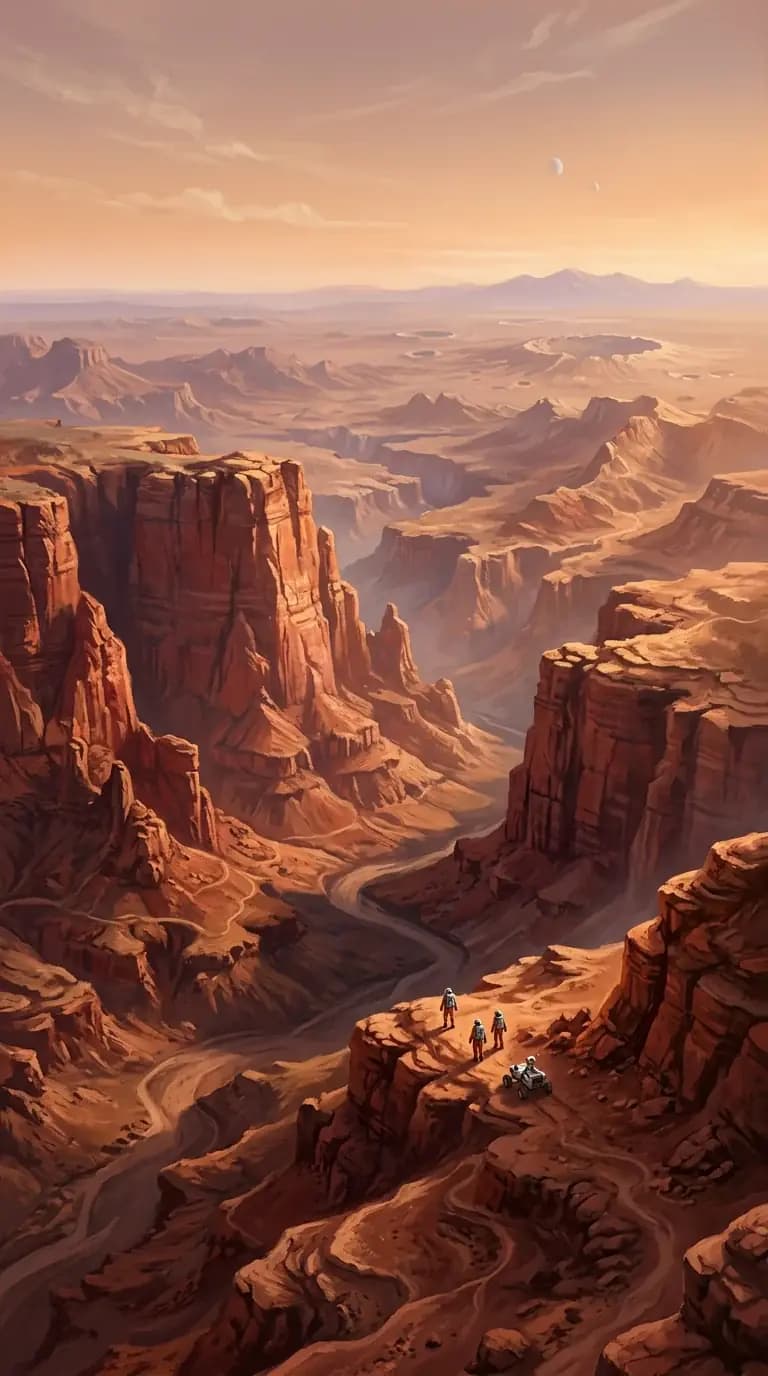
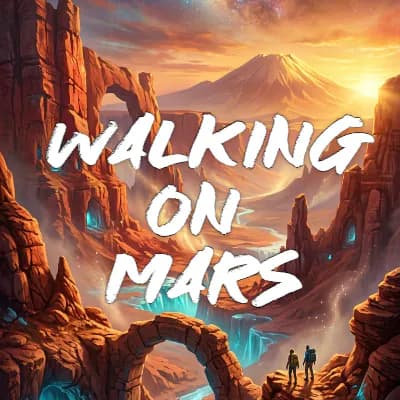
Earth's Neighboring World
Mars, Earth's neighboring red planet, lies approximately 225 million kilometers from our world and represents humanity's most studied extraterrestrial destination. At roughly half Earth's diameter with 38% of our gravity, Mars features a distinctive rust-red surface created by iron oxide covering ancient rocks and dunes. This 4.5-billion-year-old world showcases remarkable geology including Olympus Mons (solar system's largest volcano at 22 kilometers high), the vast Valles Marineris canyon system stretching 4,000 kilometers, dried riverbeds proving water's ancient presence, and polar ice caps mixing frozen water and carbon dioxide. According to NASA's rover missions (Curiosity, Perseverance, InSight) and decades of orbital observations, Mars once possessed a thicker atmosphere and liquid surface water, potentially supporting conditions favorable for microbial presence before solar winds stripped its protective magnetic field billions of years ago. A Walk on Mars turns a few of these facts into a walk you can feel, inviting reflection on planetary evolution, exploration and cosmic perspective.
Key Facts About Mars
- Distance from Earth: ~225 million km (varies with orbits)
- Size: 53% Earth's diameter, 38% gravity
- Atmosphere: 1% Earth's density, mostly CO₂
- Temperature: Average -60°C (-80°F)
- Notable Features: Olympus Mons (22km volcano), Valles Marineris canyon
- In the App: Yes: A Walk on Mars, one episode, 7:34
The walk follows real Martian features: two tiny moons, gravity at 38% of Earth's, valleys carved by ancient ice, Olympus Mons and the blue sunset that NASA's rovers have photographed. Unlike consuming images or reading facts, it invites you to feel what it means to stand on another world: the rustle of sand in thin air, the silence between gusts, rust-colored landscapes stretching to impossibly distant horizons, and geological timescales that dwarf human history. It pairs with the other two nature episodes, the descent of Journey to the Center of the Earth and the mountain calm of Temple of the Sky Monks.
Mars exploration represents humanity's most ambitious robotic achievement: dozens of missions since the 1960s, current rovers searching for signs of ancient microbial presence, and future crewed expeditions planned for the 2030s. This journey honors that exploratory spirit while offering something missions cannot: meditative encounter with planetary wonder. By slowing down to contemplate what dried riverbeds reveal about climate change across billions of years, or how a world can lose its atmosphere and transform from potentially habitable to frozen desert, we gain perspective applicable to Earth's current environmental challenges. Explore more transformative environments through our complete Nature & Places collection.
Traverse the Martian Surface
The episode begins with your first steps on the Martian surface: soft waves of red dust rise with every step, and faint traces of ancient winds mark a path across a vast plain. Overhead drift Phobos and Deimos, the two tiny moons, and Phobos slips across the face of the Sun, its quick shadow flashing over the ground.
The route climbs a wide ridge of rust-red stone, glinting with mineral crystals, where a faint rustle of sand sounds like the planet quietly exhaling. One jump shows how different this world is: gravity here is only 38% of Earth's, and your body lifts with almost no effort.
Beyond it opens a broad valley carved by ancient ice, its terrain rolling in waves and smoothed by the Martian wind. On the horizon a faint aurora flickers, not over the poles but over magnetic patches in the crust, one of the planet's quieter mysteries.
"Where 'getting some fresh air' requires bringing your own atmosphere."
Then Olympus Mons rises ahead, its gentle terraces climbing into thin, clear air, roughly two and a half times the height of Everest. A sunlit plateau shimmers from copper to gold, and from a natural ledge you watch the sky turn from orange to pink until, around the setting Sun, it glows a cool Martian blue.
"The only place where being a space case is actually accurate."
Real Science Meets Meditation
Rover Discoveries
The scenes follow what rovers and orbiters have shown: dust-covered plains, valleys shaped by ancient ice and water, and the blue sunset photographed by NASA's Curiosity rover.
Geological Accuracy
Terrain features (plains, stone ridges, ice-carved valleys and Olympus Mons) drawn from decades of planetary science research.
Martian Light
A thin atmosphere (about 1% of Earth's pressure), mostly CO₂, full of fine dust: the reason the Martian sky glows butterscotch by day and turns blue around the setting Sun.
Overview Effect
May give a small taste of the 'overview effect' astronauts describe: seeing Earth from space shifts consciousness. Experiencing Mars shifts perspective on Earth's preciousness, fragility, and uniqueness in supporting life.
Contemplative Exploration
Slowing down to 'walk' Mars versus consuming images cultivates intimate relationship with planetary geology, climate history, and exploratory wonder, transforming data into emotional understanding.
Perspective Scaling
Experiencing geological timescales (billions of years) and planetary distances (millions of kilometers) contextualizes daily concerns within cosmic perspective, putting daily concerns in perspective.
"Where rocket science meets inner peace."
Who Will Benefit
🚀 Space Enthusiasts
Anyone fascinated by space exploration, Mars missions, planetary science, or astronomy seeking immersive connection to scientific discoveries beyond consuming images and data.
🌍 Perspective Seekers
Those needing cosmic perspective on daily concerns: experiencing another world's vastness, silence, and timescales contextualizes personal challenges within broader scales of space and time.
🧠 Experienced Meditators
Experienced practitioners seeking sophisticated contemplative themes: planetary evolution, exploration ethics, cosmic consciousness, existential wonder, and humanity's relationship with the universe.
🌱 Environmental Advocates
People concerned about Earth's climate experiencing Mars' transformation from potentially habitable to frozen desert: a cautionary tale about planetary atmosphere loss and climate change.
🎧 Audio Experience Lovers
Listeners who love spatial audio and want to be carried, headphones on, to a completely alien environment.
🔭 Wonder Cultivators
Anyone seeking to reconnect with childhood sense of cosmic wonder, curiosity about distant worlds, and the awe that comes from contemplating humanity's place among the stars.
"For everyone who's ever looked at Mars through a telescope and wished they could visit."
Your Questions Answered
Everything you need to know about this journey
"No rocket fuel required, headphones recommended."
Ready for
A Walk on Mars?
Download Visionaria and start your journey today.
"Where every step is one small step for you, one giant leap for your meditation practice."