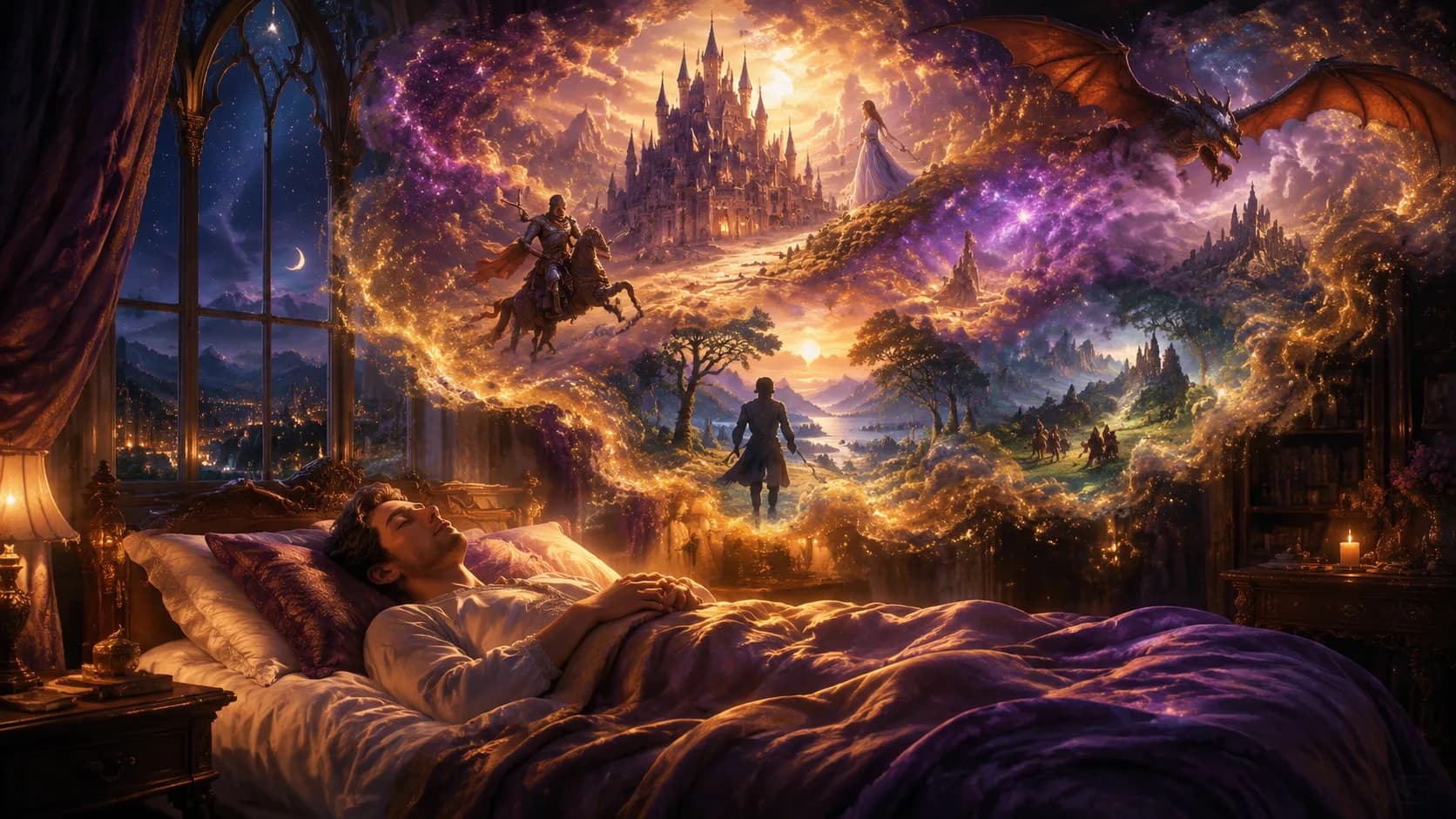
Mythology Sleep Stories: Why Ancient Tales Help You Rest
Carl Jung believed archetypal figures like the wise guide and the great garden were not learned but inherited, which may explain why a myth heard for the first time can still feel strangely familiar at bedtime.

- Why Mythology Sleep Stories Outperform Modern Fiction
- Jungian Archetypes and Why These Stories Feel Familiar
- The Cognitive Load Sweet Spot Between Boring and Stimulating
- Modern Fiction vs Mythology: Novelty Versus Ritual
- The Top 5 Mythological Themes for Falling Asleep
- Bringing Mythic Sleep Stories Into Your Own Night
- Conclusion: The Lasting Legacy of Mythology Sleep Stories
- Frequently Asked Questions
Mythology sleep stories work better than most contemporary fiction at easing the mind into rest because myths run on archetypal patterns the brain already recognizes, so it can follow the tale without the alert, prediction-hungry attention that a twisty modern plot demands.
Here is the thing nobody tells you about counting sheep: it fails because it gives the mind nothing to hold onto. A drifting narrative about a hero crossing a garden at dusk, on the other hand, gives it just enough structure to stop generating its own anxious plotlines.
Ask most people why an old Greek or Norse tale feels more calming at midnight than a bestselling thriller, and they will shrug. Ask a cognitive scientist, and you get a real answer, one rooted in how the brain processes novelty, familiarity, and narrative shape.
Key Facts About Mythology Sleep Stories
- •Core mechanismArchetypal familiarity lowers cognitive load
- •Key theoristCarl Jung, collective unconscious and archetypes
- •Narrative shapeThe monomyth, mapped by Joseph Campbell, 1949
- •Top themesGarden, ocean voyage, mountain ascent, celestial palace, forest
- •Best pacingSlow, spatial audio narration over silent reading
Quick Answer
Mythology sleep stories work because they use archetypal, ritualistic narrative patterns the brain already recognizes, keeping cognitive engagement in a gentle middle zone that redirects racing thoughts without triggering the alertness that unpredictable modern fiction creates.
Why Mythology Sleep Stories Outperform Modern Fiction
Pick up almost any contemporary thriller and the author's entire job is to keep you awake. Cliffhangers, unreliable narrators, twist endings, they are engineered tools of sleep science, built to spike attention exactly when you want it to fall.
Mythology does the opposite, almost by accident. A story about Persephone descending each year, or a hero rowing toward a distant shore, follows a shape the brain has heard a thousand times in a thousand forms. The mind does not need to work hard to predict what happens next, and that is precisely the point.
Quick Insight
Familiar narrative structure lowers cognitive load. A relaxed, low-effort mind is a mind that falls asleep faster, according to sleep researchers who study pre-sleep cognitive arousal.
Dr. Richard Wiseman, a psychologist at the University of Hertfordshire, wrote a popular book on sleep, Night School (2014), that covers practical techniques for winding down. Mythology, built from repeated patterns across thousands of years, is about as predictable as storytelling gets.
Read more: The Gods of Olympus and the Stories Behind Them

Why did the insomniac love Greek mythology? Because every myth eventually leads back to the same underworld, and nothing puts you to sleep faster than a familiar route home.
Jungian Archetypes and Why These Stories Feel Familiar
Carl Jung spent decades arguing that certain figures, the wise old man, the great mother, the trickster, the hero, are not cultural inventions so much as inherited structures of the human mind. He called them archetypes, and mythology is where they show up most nakedly.
This matters for sleep in a very practical way. When you hear about a god of wisdom guiding a lost traveler, or a guardian spirit watching over a garden, you are not decoding something new. You are recognizing something your mind has apparently been carrying since childhood, maybe since before language. Jung called this collection of inherited patterns the collective unconscious, and whether or not you buy the deeper theory, the practical effect on a tired brain is the same: less decoding, more drifting.
Key Insight
Jung's Collected Works (Princeton University Press, 1969 edition) describes archetypes as pre-existing narrative forms recognized rather than learned, which is why a myth heard for the first time can still feel oddly familiar.
Look at almost any bedtime myth and you will find the same cast in different clothes. A guide. A threshold. A trial that is really a transformation in disguise. Swap the names, Hermes for Odin, Persephone for Freya, and the shape barely changes. That underlying stability is a kind of psychological white noise, and white noise, as any sleep therapist will tell you, is a sedative.
Fall asleep inside a myth tonight
Cinematic mythology journeys, built for rest.
What did the Jungian analyst say to the insomniac? Stop counting sheep, start counting archetypes, at least they show up in the same order every time.
The Cognitive Load Sweet Spot Between Boring and Stimulating
Here is a real problem with most sleep content: it is either so bland that the mind wanders back to tomorrow's to-do list, or so gripping that it does the opposite of what you wanted. Mythology sits in a narrow, useful middle ground.
A myth has just enough incident, a task, a river crossing, a riddle, to give the mind a job. But because the ending is so often known in advance, at least in shape, there is no genuine suspense pulling you toward the next page. This is what researchers studying narrative transportation call an optimal engagement zone: engaged enough to displace worry, familiar enough to never spike alertness.
Why This Works
Cognitive load theory, first formalized by educational psychologist John Sweller in 1988, explains why overly novel material demands more working memory. Mythology's repeated structures keep that demand low, freeing the mind to relax.
Contrast this with a modern psychological thriller, where a reader's brain is actively holding multiple threads, who is lying, what happened at minute forty, who the narrator really is. That is wonderful for a plane ride. It is a terrible bedtime companion. Mythology asks so much less of you, and somehow gives you more.
An engineer once tried to fall asleep to a heist thriller and stayed up until three in the morning solving the plot. He switched to the myth of Theseus and was out before the labyrinth even opened.
Modern Fiction vs Mythology: Novelty Versus Ritual
Modern fiction is built on novelty. Editors and screenwriters are trained to avoid cliche, to subvert expectation, to make sure the reader cannot guess what happens next. That is genuinely good craft. It is also, biologically speaking, the opposite of what a tired nervous system wants at eleven at night.
Mythology runs on ritual rhythm instead. The hero leaves home, faces a trial, receives help from an unexpected guide, returns changed. This shape, sometimes called the monomyth, was mapped by Joseph Campbell in The Hero with a Thousand Faces (Pantheon Books, 1949), and it repeats across nearly every culture studied. Repetition, in this context, is not a flaw. It is the entire mechanism.
Quick Comparison
Modern fiction: unpredictable, suspense-driven, alertness-raising. Mythology: patterned, ritualistic, alertness-lowering. Same category, opposite nervous system effect.
And look, this is not an argument that novels are bad or that mythology is somehow superior as literature. It is an argument about what each form does to a brain that is trying to power down. A gripping novel is a caffeine drip. A myth, told slowly, is closer to a warm bath.
Read more: Why the Brain Experiences Stories as Reality
A novelist and a mythographer walked into a sleep clinic. The novelist kept the whole ward awake with a plot twist. The mythographer just said 'and then the sun set, as it always does,' and the room went quiet.
The Top 5 Mythological Themes for Falling Asleep
Not every myth works equally well as a sleep story. Some, frankly, are far too eventful, gods hurling thunderbolts across the sky are thrilling, but they are not restful. A handful of recurring settings do the actual sedative work, and they show up across nearly every mythic tradition on earth.
The garden, first. An enclosed, cultivated, blooming space appears from Eden to the Hanging Gardens of Babylon, and enclosed green spaces reliably calm the nervous system better than open, unbounded landscapes.
Key Insight
The five most reliable mythic sleep settings: the enclosed garden, the ocean voyage, the mountain ascent, the celestial palace, and the quiet forest. Each pairs a slow, known destination with gentle, repetitive motion.
Then comes the ocean voyage, a slow crossing under stars, and the mountain ascent, a gradual climb toward a peaceful summit, both borrowed from figures like Odysseus and countless unnamed pilgrims. The celestial palace, a hall among the clouds where a god of wisdom keeps watch, gives the mind a destination that feels safe precisely because it is unreachable and therefore unthreatening. And finally the forest, ancient and quiet, the setting of more fairy tales than any other, still doing the same gentle work it always has.
What do a garden, an ocean, a mountain, a palace, and a forest have in common? They are the five places every culture, independently, decided were safe enough to fall asleep in.
Bringing Mythic Sleep Stories Into Your Own Night
So how does someone actually use any of this tonight? Start small. Pick one theme, the garden or the forest tends to work best for first-timers, and let a single scene unfold slowly rather than reaching for an entire plot.
Pacing matters more than content. A story read or narrated too quickly recreates the very alertness mythology is supposed to avoid. Slow, spatial audio narration, the kind layered with distance and direction rather than flat stereo, tends to outperform silent reading for this exact reason, since the ear can relax into it without the eyes needing to track anything.
Try This Tonight
Choose one mythic setting, close your eyes, and imagine only the first ten minutes of arrival. Do not chase the plot. Let the scene stay still.
A useful rule of thumb: if a mythological detail makes you curious about what happens next, it is probably too stimulating for bedtime. If it simply makes you feel like you are already there, standing in the garden or drifting on the tide, it is doing its job.

Meditation for Sleep Using Storytelling Journeys
A closer look at how narrative journeys are structured specifically to guide the body toward rest.
A sleep therapist once asked a patient to describe his ideal bedtime story. He said 'nothing happens, slowly, in a beautiful place.' She said congratulations, you have just described every myth that actually works.
Conclusion: The Lasting Legacy of Mythology Sleep Stories
Put it all together and the case for mythology sleep stories stops sounding like nostalgia and starts sounding like design. Archetypal figures the mind already recognizes, a cognitive load calibrated to redirect rather than stimulate, and a small set of recurring settings, the garden, the voyage, the ascent, the palace, the forest, all point toward the same conclusion: these are not old stories that happen to be soothing. They are structures that were refined by centuries of retelling specifically because they worked.
Modern sleep science is, in a sense, just catching up to something oral storytellers understood intuitively. Predictable narrative shape lowers cognitive arousal. Familiar figures reduce the mental effort of prediction. And ritual rhythm, the steady, known cadence of myth after myth, seems to do for the nervous system what a metronome does for a musician learning tempo.
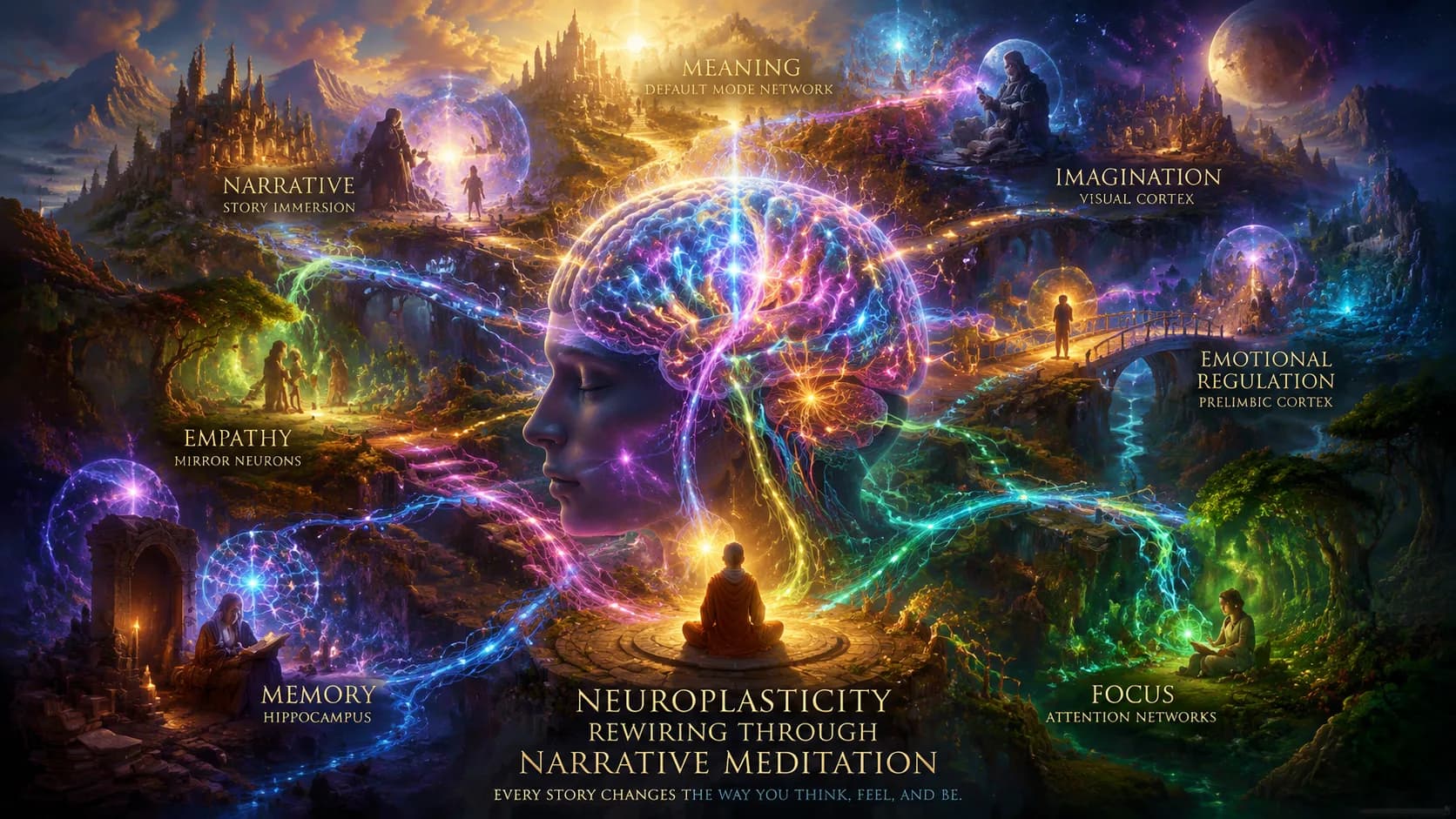
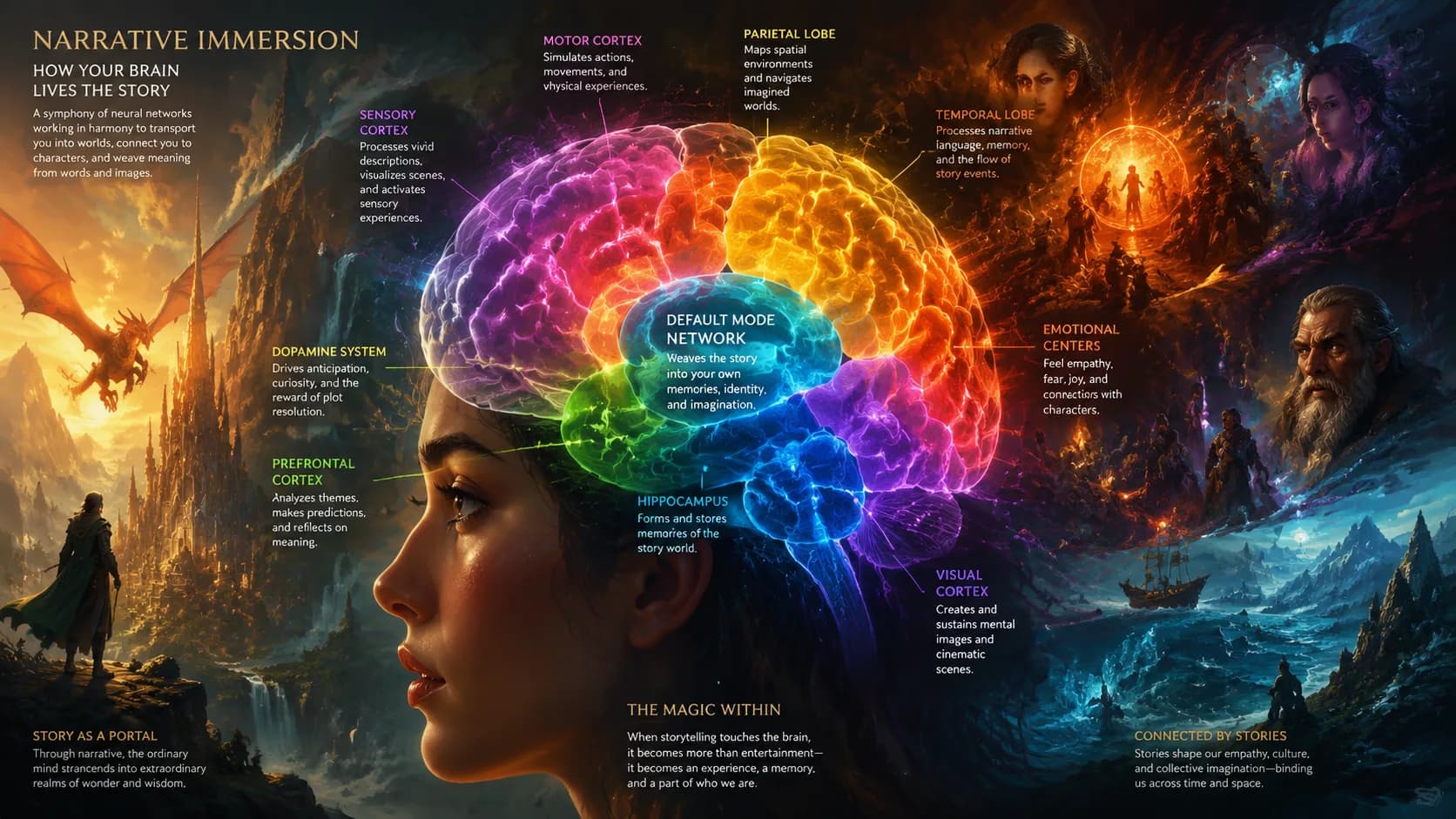
How Narrative Meditation Rewires the Brain
A deeper look at the neuroscience behind why narrative, more than silence, helps the brain settle.
None of this is a medical claim, and it should not replace care from a sleep specialist for anyone dealing with a persistent sleep condition. But for the ordinary, everyday difficulty of switching off a busy mind, there is something almost moving about the fact that the oldest stories humanity has may still be some of the best tools we have for rest. Across plus immersive journeys inside Visionaria, this is essentially the whole bet: that a garden at dusk, told slowly and well, can do more for a tired mind than another hour of scrolling ever could.
Walk into a myth tonight
Cinematic mythology journeys built for rest.
Why do mythologists make the best sleep experts? Because they have spent their whole careers proving that the same bedtime story, told for three thousand years, still works.
This article is for educational and informational purposes only. Historical details are based on available research and may evolve as new evidence emerges.
Visionaria journeys are designed for relaxation, guided imagination, and personal enrichment. They are not a substitute for medical, mental health, legal, or professional advice.
Homer. The Odyssey (primary historical text, trans. Robert Fagles, Viking, 1996; Penguin Classics, 1997).