The Gods of Olympus and the Stories Behind Them
💡 Fun fact: The ancient Greeks had a god for practically everything (wine, wisdom, the sea, even the forge). If they'd been around today, there'd probably be an Olympian god of Wi-Fi connectivity and another for finding parking.
- Who Are the Olympian Gods?
- Zeus: King of the Gods and Lord of the Sky
- Athena: Goddess of Wisdom and Strategic Courage
- Apollo and Artemis: The Divine Twins
- Poseidon: Ruler of the Seas and Shaker of the Earth
- Hermes and Aphrodite: Messengers and Enchantment
- Ares and Hephaestus: Conflict and Creation
- Hera and Demeter: Guardians of Family and Harvest
- Dionysus and Hestia: Celebration and Sacred Hearth
- Mount Olympus: The Sacred Home of the Gods
- Experiencing Olympus Through Immersive Audio Meditation
- The Bottom Line
- Frequently Asked Questions
The ancient Greeks looked up at stormy skies and saw Zeus hurling thunderbolts. They gazed across the wine dark sea and imagined Poseidon stirring the waves with his trident. Every sunrise was Apollo's golden chariot crossing the heavens, and every harvest was a gift from grateful Demeter. The gods of Olympus weren't distant abstractions they were vivid, deeply personal presences woven into every aspect of daily life.
The gods of Olympus are the twelve principal deities of ancient Greek mythology who inhabited the celestial palace atop Mount Olympus, the highest peak in Greece. Led by Zeus, the king of the gods, these divine beings governed everything from the oceans and the harvest to wisdom, love, music, and the forge. Their stories preserved in works by Homer, Hesiod, and countless ancient poets explore timeless themes of courage, transformation, jealousy, compassion, and the eternal tension between order and freedom. Today, these myths continue to shape literature, art, psychology, and cinematic meditation experiences that bring ancient worlds to life through spatial audio and guided visualization.
In this comprehensive guide, you'll meet every major Olympian god and goddess, discover the legendary tales that made them immortal in human memory, understand how their stories reflect universal truths about the human experience, and learn how interactive audio journeys can transport you to the very halls of Olympus through immersive sound and narrative. Whether you're a mythology enthusiast, a meditation practitioner, or simply curious about the stories that have captivated humanity for three thousand years, this guide is your gateway to the divine.
"Zeus had one rule for family gatherings on Olympus: no thunderbolts at the dinner table. It was the one rule he could never follow himself."
Key Facts About the Olympian Gods
- •• Number: Twelve principal Olympians (with Dionysus sometimes replacing Hestia)
- •• Residence: Mount Olympus, the highest peak in Greece (2,917 meters)
- •• Origin: Emerged after the Titanomachy, the cosmic challenge against the Titans
- •• Primary Sources: Homer's Iliad and Odyssey, Hesiod's Theogony
- •• Cultural Impact: Shaped Western literature, art, philosophy, and psychology for 3,000+ years
- •• Modern Legacy: Olympian names used for planets, space missions, psychology terms, and brands
Quick Answer
💡 Fun fact: The ancient Greeks had a god for practically everything (wine, wisdom, the sea, even the forge). If they'd been around today, there'd probably be an Olympian god of Wi-Fi connectivity and another for finding parking.
Who Are the Olympian Gods?
The Olympian gods are the twelve principal deities who, according to ancient Greek mythology, overthrew the primordial Titans and established their divine court on the summit of Mount Olympus. This celestial revolution known as the Titanomachy represented the triumph of a new cosmic order over the raw, untamed forces of the previous age. After their victory, the Olympians divided the universe among themselves: Zeus received the sky, Poseidon the seas, and Hades the underworld, while the remaining gods took dominion over specific aspects of nature, human endeavor, and the mysteries of existence.
What makes the Olympian pantheon extraordinary is its deeply human quality. Unlike the distant, all powerful deities of some traditions, the Greek gods experienced jealousy, love, rivalry, compassion, and occasional pettiness. They quarreled over mortals' affections, competed in contests of skill and beauty, and sometimes made catastrophic errors of judgment. This complexity made them endlessly fascinating to the ancient Greeks and continues to captivate modern audiences who find in these divine stories a mirror of their own human struggles and aspirations.
Did You Know?
The relentless drive to understand the world was seen not just as an academic pursuit, but as a spiritual and healing practice by the ancients.
Key Facts About the Olympian Gods
The twelve Olympians typically include Zeus, Hera, Poseidon, Demeter, Athena, Apollo, Artemis, Ares, Aphrodite, Hephaestus, Hermes, and either Hestia (goddess of the hearth) or Dionysus (god of wine and celebration). Their stories were not mere entertainment for the ancient Greeks they were explanations for natural phenomena, moral instruction, and a framework for understanding the human condition. Through interactive audio journeys, these divine tales now come alive in ways Homer himself could scarcely have imagined.
Why did the historian break up with the archaeologist? Because her career was literally in ruins.
Zeus: King of the Gods and Lord of the Sky
Zeus, son of the Titans Cronus and Rhea, is the undisputed ruler of the Olympian gods and the most powerful figure in Greek mythology. His story begins with a dramatic rescue: when Cronus, fearing a prophecy that his children would surpass him, swallowed each of his offspring at their first breath, Rhea hid the infant Zeus on the island of Crete. There, raised in secret by nymphs and fed on the milk of the divine goat Amalthea, Zeus grew strong enough to challenge his father and free his siblings from their celestial imprisonment.
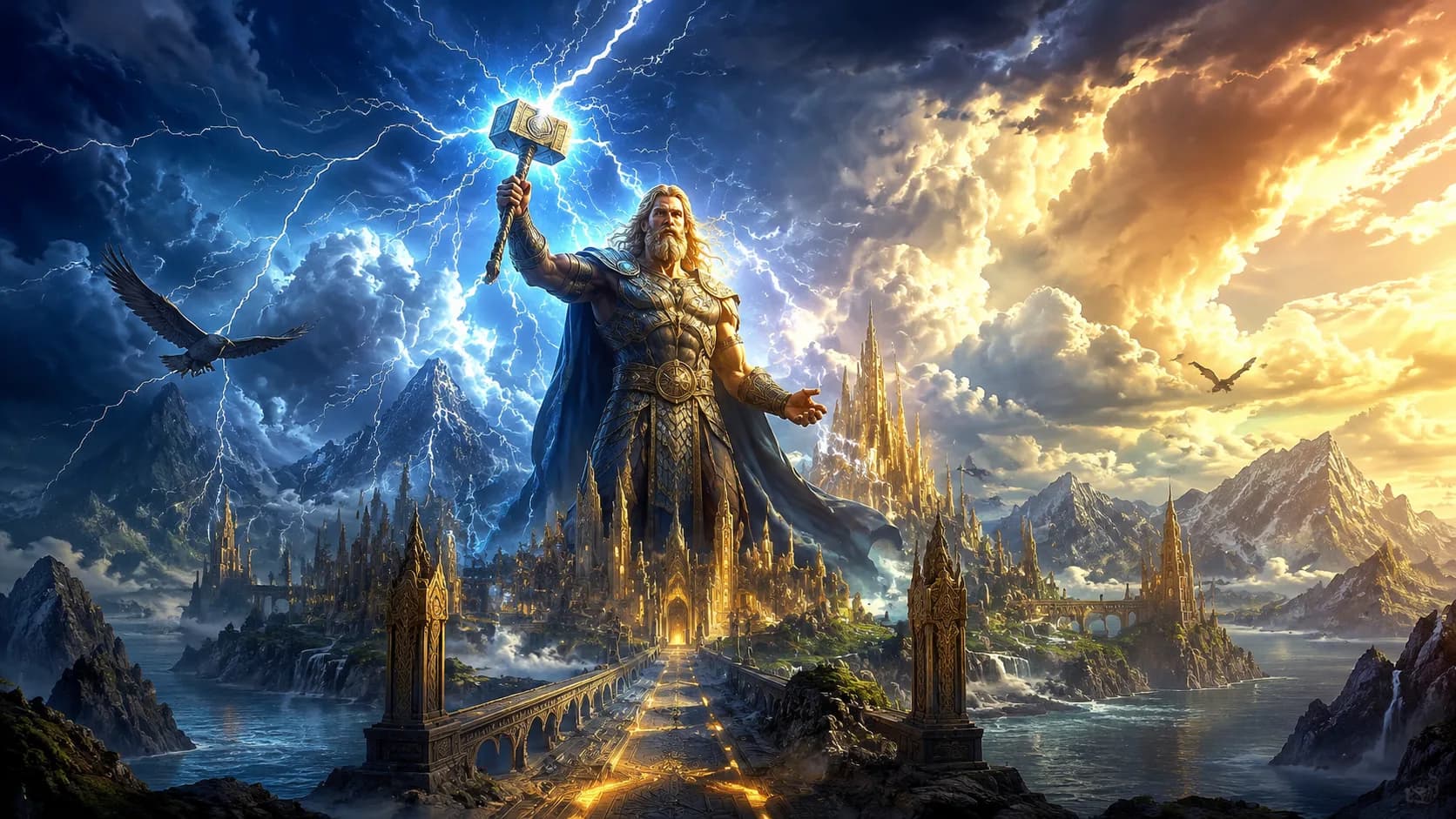
After the Titanomachy the great challenge against the old order Zeus drew lots with his brothers Poseidon and Hades and received dominion over the sky. He wielded the thunderbolt, forged by the Cyclopes, as his primary symbol of authority. From his throne on Mount Olympus, Zeus governed both gods and mortals, dispensing justice, maintaining cosmic order, and somewhat notoriously pursuing romantic interests across the mortal and divine worlds.
Zeus's thunderbolt wasn't just a weapon it was a symbol of divine justice. The ancient Greeks believed that lightning strikes were Zeus's direct interventions in human affairs, punishing oath breakers and rewarding the righteous. This connection between weather and morality shaped Greek legal and political thinking for centuries.
Visionaria Insight
By immersing ourselves in these historical soundscapes, we reconnect with a timeless human tradition of storytelling and mental restoration.
Zeus's character embodies the Greek understanding of leadership: powerful yet flawed, authoritative yet susceptible to emotional impulses. His countless love affairs produced legendary heroes like Hercules, Perseus, and Helen of Troy. His judgments sometimes wise, sometimes impulsive drove many of mythology's greatest narratives. In the Iliad, Homer portrays Zeus weighing the fates of heroes on golden scales, torn between his divine obligations and his personal attachments.
The sacred sites of Zeus included Olympia, where the Olympic Games were held in his honor every four years, and Dodona, home to his most ancient oracle. Worshippers sought his guidance through the rustling of sacred oak leaves, believing that the wind itself carried Zeus's voice. Today, spatial audio technology can recreate the experience of standing in these sacred groves, hearing the whisper of divine oak leaves in three-dimensional soundscapes.
"Zeus's family tree is less of a tree and more of a tangled web genealogists have been trying to untangle it for three thousand years and still need more coffee."

Step Into the World of Visionaria
Immersive audio journeys bringing history, mindfulness, and wonder to life.
Why did the inventor of the wheel win an award? Because his idea really got things rolling.
Athena: Goddess of Wisdom and Strategic Courage
Athena is perhaps the most remarkable of all the Olympians a goddess who sprang fully formed and armored from the head of Zeus himself. According to Hesiod's Theogony, Zeus swallowed the Titaness Metis (Wisdom personified) when she was expecting Athena. When a splitting headache ensued, Hephaestus obligingly struck Zeus's skull with an axe, and out leaped Athena, clad in gleaming armor, shouting a triumphant cry that shook the heavens.
Athena represented the ideal fusion of intellect and action. While Ares embodied the chaotic, unpredictable nature of armed conflict, Athena personified strategic thinking, disciplined courage, and calculated wisdom. She was the patron goddess of Athens, the city that bore her name after she gifted the Athenians an olive tree a symbol of peace, prosperity, and civilization that Poseidon's dramatic saltwater spring couldn't match.
Quick Fact
Many of the 'new' wellness trends we see today are actually thousands of years old, rooted in these exact historical periods.
Athena's role in mythology extends far beyond the city of Athens. She was Odysseus's greatest ally throughout the Odyssey, guiding him with disguises, clever strategies, and divine protection during his decade-long journey home from Troy. She helped Perseus slay Medusa by lending him her polished shield as a mirror. She judged the weaving contest against Arachne a tale about the consequences of hubris and the transformative power of divine skill.
Read more: How Spatial Audio Transforms Meditation Experiences

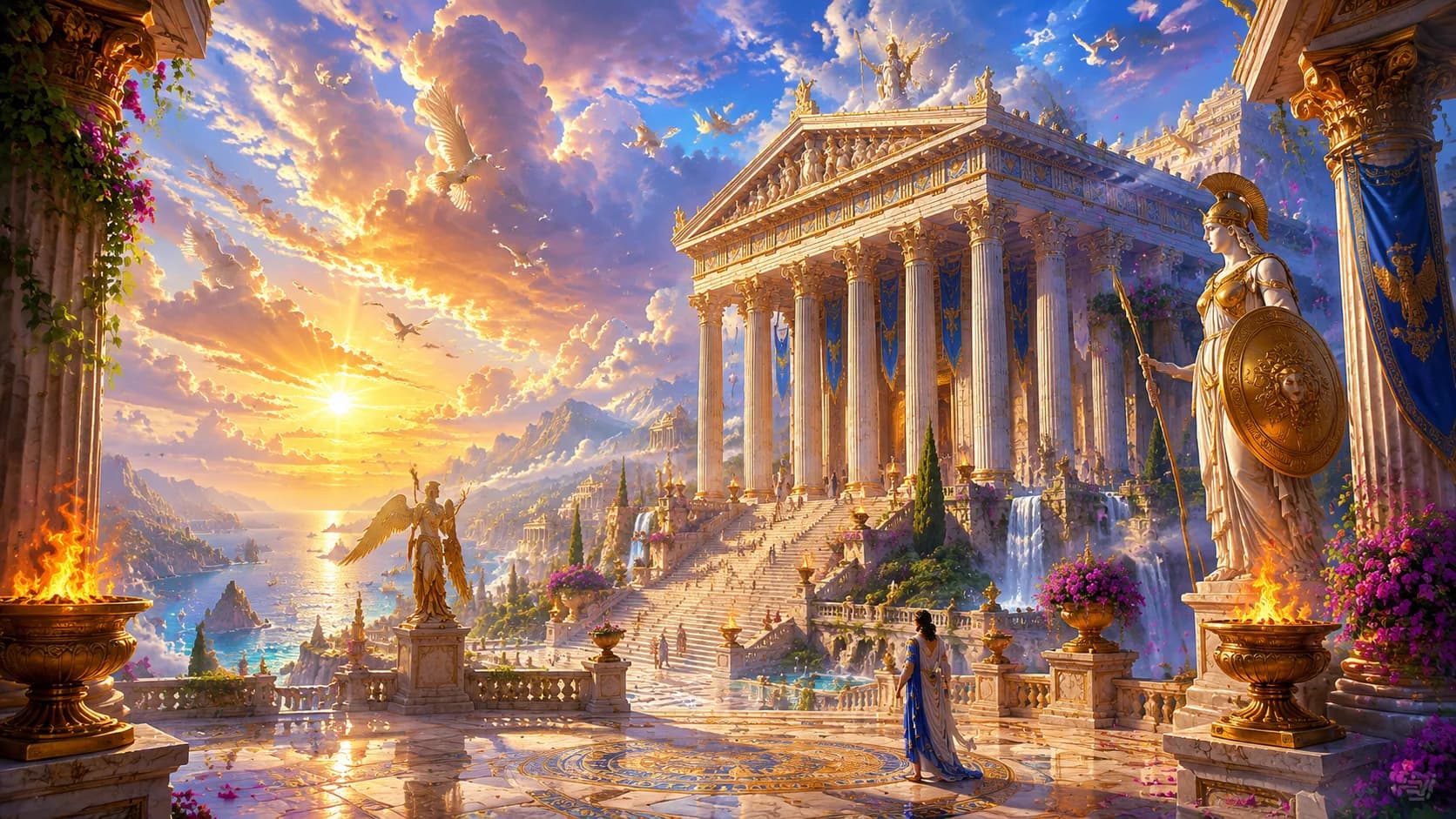
The Parthenon, built between 447 and 432 BCE on the Athenian Acropolis, housed a massive gold and ivory statue of Athena Parthenos by the sculptor Phidias. This temple remains one of the most recognized architectural achievements in human history a testament to the goddess who championed wisdom, craft, and the creative intellect. Through cinematic meditation, modern seekers can experience the grandeur of this sacred space in vivid, immersive detail.
A philosopher walked into a wall. His students asked if it hurt. He replied, 'The wall is an illusion, but my headache is quite real.'
Apollo and Artemis: The Divine Twins
Apollo and Artemis, the luminous twins born to Zeus and the Titaness Leto, embody two complementary aspects of divine power. Apollo governed the sun, music, poetry, prophecy, healing, and rational order he was the god of harmony and civilization. Artemis commanded the moon, the hunt, wilderness, and the protection of young creatures she was the goddess of untamed nature and fierce independence.
Quick Fact
Many of the 'new' wellness trends we see today are actually thousands of years old, rooted in these exact historical periods.
Apollo's most famous sanctuary was Delphi, where the Pythia his oracle delivered prophecies that guided the decisions of kings, generals, and ordinary citizens for centuries. The inscription "Know Thyself" adorned his temple entrance, encapsulating the Greek belief that self-knowledge was the foundation of all wisdom. Apollo's lyre, a gift from the clever infant Hermes, produced music so beautiful it could calm storms, heal the afflicted, and make even the gods weep with joy.
Over 500 ancient temples were dedicated to Apollo across the Greek world, from Delphi and Delos to the far reaches of Greek colonies in Sicily and Asia Minor. His worship spanned more than 1,500 years and influenced Roman, medieval, and Renaissance culture.
Artemis, by contrast, roamed the wild forests and mountain peaks with her band of devoted nymphs. She demanded absolute respect for the natural world and was fiercely protective of her independence. The Temple of Artemis at Ephesus one of the Seven Wonders of the Ancient World stood as a monument to her power and beauty. Artemis's connection to the moon made her a symbol of cyclical renewal, and her role as protector of young animals and children reflected the Greek reverence for the vulnerable stages of life.
Together, Apollo and Artemis represented the balance between civilization and wilderness, reason and instinct, light and shadow. Their complementary natures taught the ancient Greeks that harmony required embracing both sides of existence. In Visionaria's interactive audio journeys, you can experience the majesty of Apollo's Delphi at sunrise and the mysterious beauty of Artemis's moonlit forest two sides of the same divine coin.
Read more: The Science Behind Immersive Audio Meditation

"Apollo once challenged Hermes to a music contest. Hermes played a stolen lyre, Apollo played his golden one, and the judges gave it to Apollo proving that in ancient Greece, even divine talent competitions needed better rules."
Why did the ancient physician prescribe a long walk? Because he was tired of listening to the patient complain in his office.
Poseidon: Ruler of the Seas and Shaker of the Earth
Poseidon, brother of Zeus and Hades, drew the oceans as his domain when the three brothers divided the cosmos. Known as the "Earth Shaker" for his power to cause earthquakes by striking his trident against the ground, Poseidon was one of the most revered and feared gods in the Greek pantheon. Sailors, fishermen, and coastal communities offered him elaborate sacrifices before every voyage, knowing that his moods determined whether ships reached harbor or vanished beneath the waves.
Visionaria Insight
By immersing ourselves in these historical soundscapes, we reconnect with a timeless human tradition of storytelling and mental restoration.
Poseidon's most celebrated mythological role is in Homer's Odyssey, where his relentless pursuit of Odysseus drives the entire narrative. After Odysseus blinded the Cyclops Polyphemus Poseidon's son the sea god vowed to make the hero's journey home as treacherous as possible. For ten years, Poseidon sent storms, sea monsters, and disorienting currents to prevent Odysseus from reaching Ithaca. This conflict between mortal cunning and divine power remains one of literature's greatest explorations of perseverance.
Beyond the seas, Poseidon was also the god of horses legend held that he created the first horse by striking a rock with his trident. The Isthmian Games at Corinth were held in his honor, featuring chariot racing as their centerpiece. His contest with Athena for patronage of Athens where he offered a saltwater spring while she offered the olive tree demonstrated the Greek preference for practical wisdom over raw power.
Poseidon's underwater palace, described in ancient texts as a shimmering domain of coral, gold, and luminous sea creatures, has inspired artists and storytellers for millennia. Through spatial 3D audio, modern listeners can experience the sensation of descending into Poseidon's realm hearing the muffled roar of distant waves, the song of dolphins, and the deep, resonant voice of the sea god himself echoing through underwater halls.
Why did the inventor of the wheel win an award? Because his idea really got things rolling.
Hermes and Aphrodite: Messengers and Enchantment
Hermes, the swift footed messenger of the gods, was the divine patron of travelers, merchants, thieves, and orators. Born in a cave on Mount Cyllene, Hermes demonstrated his extraordinary nature within hours of arriving in the world he crawled from his cradle, stole Apollo's sacred cattle, and invented the lyre from a tortoise shell before lunchtime. When confronted by an outraged Apollo, the infant Hermes charmed his way out of trouble with such skill that Zeus himself couldn't help but laugh.
Hermes's winged sandals and caduceus (a staff entwined with two serpents) became symbols of speed, communication, and negotiation. He served as the guide of souls to the Underworld, escorting the recently departed on their final journey. He also facilitated communication between gods and mortals, acting as the divine interpreter who could bridge any gap. In modern terms, Hermes was the original "people person" fluent in every language, comfortable in every setting, and impossibly quick on his feet.
Visionaria Insight
By immersing ourselves in these historical soundscapes, we reconnect with a timeless human tradition of storytelling and mental restoration.
Listening to mythological audio journeys about Hermes and Aphrodite activates both the analytical and emotional centers of the brain, creating a dual processing meditation that enhances creativity, empathy, and narrative thinking skills increasingly valued in today's world.
Aphrodite, goddess of love, beauty, and desire, was born from the sea foam near the island of Cyprus a birth so dramatic and beautiful that flowers bloomed on the shore where she first stepped. Her power was arguably the most potent on Olympus: even Zeus himself was not immune to her influence. Aphrodite's golden girdle made its wearer irresistibly attractive, and her sacred doves, roses, and myrtle adorned temples across the Greek world.
Aphrodite's most consequential mythological act was awarding the golden apple of discord to Paris of Troy, an event that set in motion the legendary Trojan conflict the most celebrated narrative cycle in Western literature. Her love affair with Ares, the god of conflict, and her marriage to the industrious Hephaestus created one of mythology's most complex love triangles, exploring themes of attraction, compatibility, and the heart's unpredictable nature.
"Hermes invented the lyre on his first day alive and stole Apollo's cattle by dinnertime. Modern parents can barely get their newborns to sleep through the night."
What's an ancient intellectual's favorite exercise? Jumping to conclusions.
Ares and Hephaestus: Conflict and Creation
Ares, son of Zeus and Hera, represented the raw, untamed energy of armed conflict the chaos of the battlefield, the surge of adrenaline, the primal drive of physical confrontation. Unlike Athena, who embodied strategic, disciplined action, Ares symbolized the visceral, uncontrollable aspect of human aggression. The ancient Greeks had a complicated relationship with him they acknowledged his necessity but generally preferred Athena's more measured approach to challenges.
Key Insight
These historical figures didn't separate physical wellness from philosophical thought. To them, it was all one continuous practice of living well.
Ares was often depicted in the company of Phobos (Fear) and Deimos (Terror), his sons, and his sister Enyo (goddess of devastation). Despite his fearsome reputation, Ares was not invincible Homer describes him being wounded and crying out with the voice of ten thousand men. His vulnerability made him surprisingly relatable: even the god of conflict felt pain, experienced setbacks, and sometimes retreated to Olympus to nurse his wounds.
Hephaestus, by contrast, channeled his divine energy into creation rather than confrontation. The god of the forge, fire, and metalworking, Hephaestus was the master craftsman of Olympus, responsible for creating some of mythology's most legendary objects: Achilles's shield (described in extraordinary detail in the Iliad), Zeus's thunderbolts, Hermes's winged sandals, and Aphrodite's golden girdle. Despite being the only Olympian with a physical imperfection a lame leg Hephaestus was among the most admired gods, proving that skill, perseverance, and creative genius transcend physical limitations.
The contrast between Ares and Hephaestus offered the Greeks a profound meditation on the nature of power. Ares represented force that consumes; Hephaestus represented force that creates. Together, they illustrated a fundamental truth: the same energy that can be channeled into confrontation can also be directed toward building something beautiful and lasting. This insight remains as relevant today as it was three thousand years ago, making these mythological figures powerful subjects for personal growth meditation.
Why did the ancient physician prescribe a long walk? Because he was tired of listening to the patient complain in his office.
Hera and Demeter: Guardians of Family and Harvest
Hera, queen of the gods and wife of Zeus, presided over marriage, family, and childbirth. She was one of the most powerful Olympians, revered across Greece with magnificent temples at Argos, Samos, and Olympia. Hera's character in mythology is complex and often misunderstood while she is frequently portrayed as jealous and vindictive toward Zeus's lovers, this narrative actually reflects her role as the divine protector of marital fidelity and family bonds. Hera represented the sacredness of commitment in a culture that valued loyalty above almost everything else.
Hera's most famous mythological involvement was in the Trojan conflict, where she actively supported the Greek side after Paris of Troy awarded the golden apple to Aphrodite instead of her. Her determination and political cunning made her a formidable force on Olympus even Zeus thought twice before openly defying her. The peacock, with its magnificent display of iridescent feathers, was Hera's sacred animal, symbolizing her majesty, watchfulness, and pride.
Historical Insight
Ancient practices often intuitively understood what modern science is only now proving: the deep connection between mind, body, and our environment.
Demeter, goddess of the harvest, agriculture, and the fertility of the earth, was among the most beloved deities in the Greek world. Her story centers on the most emotionally powerful myth in Greek mythology: the taking of her daughter Persephone by Hades to the Underworld. When Persephone vanished, Demeter's grief was so profound that she withdrew her blessings from the earth crops withered, flowers perished, and an eternal winter descended upon the world.
The myth of Demeter and Persephone is one of the most powerful themes for seasonal meditation. Use Visionaria's Demeter journey during autumn to reflect on cycles of letting go and renewal, or in spring to celebrate rebirth and new beginnings.
Eventually, Zeus intervened and brokered a compromise: Persephone would spend part of the year with Hades and part with Demeter. This arrangement explained the seasons when Persephone returned to her mother, Demeter's joy brought spring and summer; when Persephone descended to the Underworld, Demeter's sorrow brought autumn and winter. The Eleusinian Mysteries, secret initiation ceremonies held near Athens for over a thousand years, celebrated this story and promised participants a blessed afterlife.
"Demeter basically invented seasonal depression and the seasons themselves. No wonder the Greeks built her so many temples: they needed someone to talk to about the weather."
A Roman walks into a bar, holds up two fingers, and says, 'Five beers, please.'
Dionysus and Hestia: Celebration and Sacred Hearth
Dionysus, the god of wine, theater, ecstasy, and ritual madness, was the youngest of the Olympians and the only one with a mortal mother Semele, a princess of Thebes. His origin story is one of mythology's most dramatic: when Semele was persuaded by a disguised Hera to ask Zeus to reveal his true divine form, the sight of the god's full power consumed her in celestial radiance. Zeus rescued the unborn Dionysus and sewed him into his own thigh until the infant was ready to emerge making Dionysus the "twice arrived," a god who literally experienced transformation before he was even fully in the world.
Dionysus represented the ecstatic, transformative power of surrender the liberation that comes from releasing rational control and embracing the mysterious, creative forces within. His festivals, the Dionysia, gave rise to Greek theater itself both tragedy and comedy emerged from rituals honoring this god who embodied the full spectrum of human emotion. The greatest playwrights of antiquity Aeschylus, Sophocles, Euripides, Aristophanes all premiered their masterworks at Dionysian festivals, making this god the unexpected patron of humanity's greatest literary achievements.
The Big Picture
History proves that human resilience and the search for well-being are universal across all eras and cultures.
Hestia, goddess of the hearth, home, and domestic life, represents the quiet, stabilizing center around which all other divine activities orbit. She was the firstborn child of Cronus and Rhea and paradoxically, the last to be freed from her father's imprisonment (making her both oldest and youngest). Hestia voluntarily gave up her seat among the twelve Olympians to Dionysus, choosing instead to tend the eternal flame at the center of Olympus. This act of gracious sacrifice perfectly encapsulates her character: selfless, devoted, and fundamentally essential.
Every Greek household maintained a sacred fire dedicated to Hestia, and every meal began with an offering to her. Public buildings, city halls, and temples all contained a hearth flame in her honor. While she has fewer dramatic myths than the other Olympians, Hestia's quiet presence was perhaps the most essential she represented the warmth, stability, and sense of belonging that made civilization possible. In cinematic meditation, Hestia's hearthfire becomes a powerful focal point for mindfulness practices centered on gratitude, home, and inner peace.
"Dionysus invented wine and theater in the same century. Coincidence? Every playwright in history would disagree."
Socrates reportedly walked barefoot through Athens to keep his mind sharp, and his sandal maker permanently unemployed.
Mount Olympus: The Sacred Home of the Gods
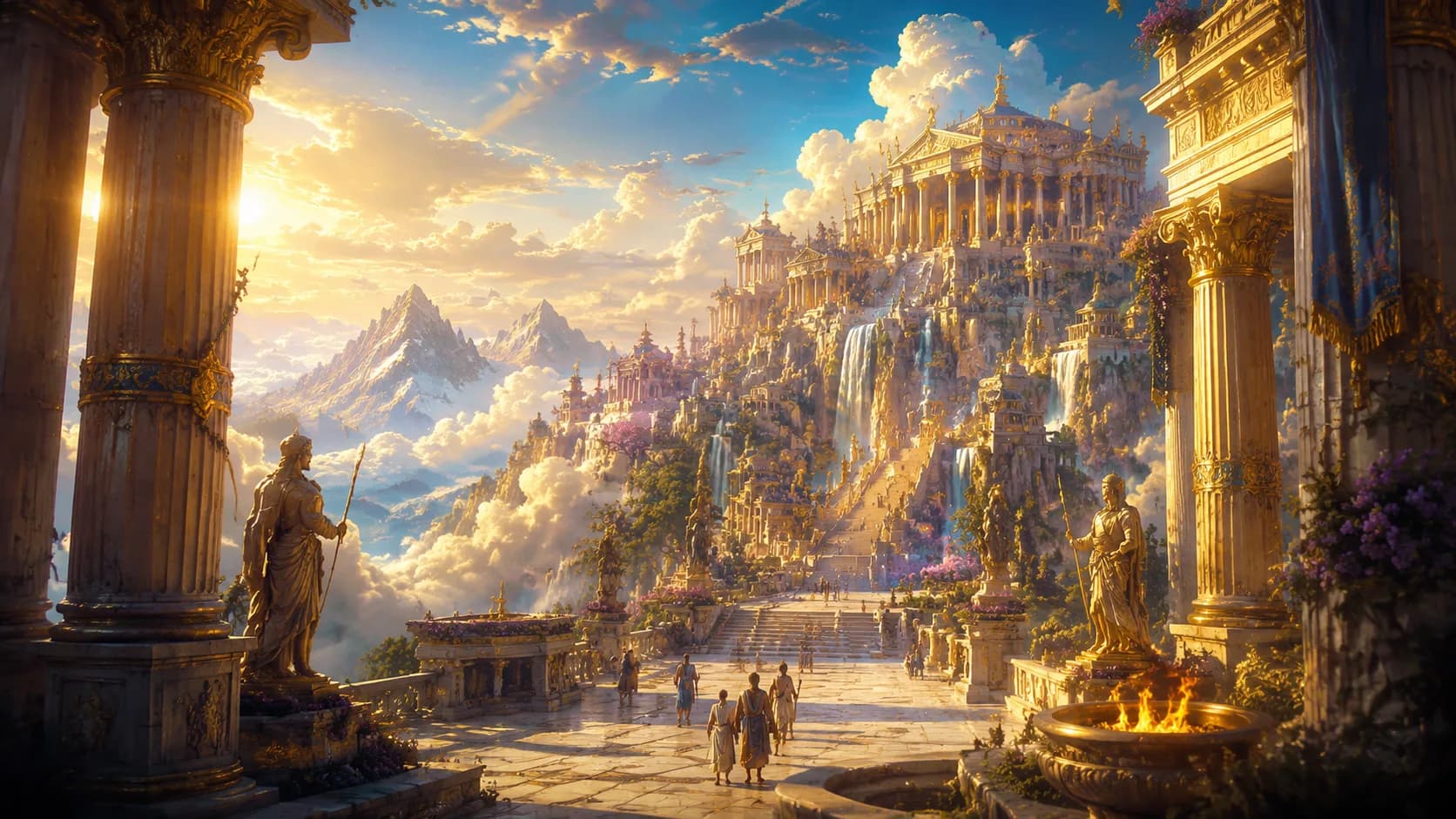
Mount Olympus, rising 2,917 meters above sea level in northern Greece, was the cosmic axis around which the entire mythological universe revolved. The ancient Greeks believed its highest peak, Mytikas, pierced the boundary between the mortal world and the divine realm, where the gods lived in eternal splendor. Homer described the summit as a place where "the gods sit in council" a celestial palace untouched by wind, rain, or snow, bathed in perpetual golden light.
Did You Know?
The relentless drive to understand the world was seen not just as an academic pursuit, but as a spiritual and healing practice by the ancients.
The divine court of Olympus was a place of breathtaking beauty and dramatic tension. The gods gathered in Zeus's grand hall to feast on ambrosia and nectar the food and drink of immortality while Hephaestus's automata served them with mechanical precision. Apollo played his golden lyre, the Muses sang, and Ganymede poured wine from vessels of burnished gold. But beneath this surface of celestial elegance lay constant political maneuvering, romantic entanglements, and philosophical debates about the fate of mortals below.
Mount Olympus was chosen as the gods' home because it was the highest point the ancient Greeks could see its summit was often shrouded in clouds, creating the perfect sense of mystery and otherworldly grandeur. The Greeks interpreted those clouds as the veil between mortal and divine worlds.
What makes Olympus particularly fascinating is that it's a real mountain you can visit today. Modern hikers who summit Mytikas often report a sense of awe that transcends ordinary mountain experiences the combination of mythological significance, dramatic geology, and the sheer scale of the vistas creates a profound sense of connection to the ancient world. Through Visionaria's spatial audio journeys, you can experience the mythological Olympus hearing the thunder of Zeus, the music of Apollo's lyre, and the whispered conversations of gods without leaving your living room.
The mountain's ecology is as remarkable as its mythology. Mount Olympus is home to over 1,700 plant species, including 23 that are found nowhere else on Earth. It was designated Greece's first national park in 1938 and became a UNESCO Biosphere Reserve. The same natural grandeur that inspired the ancient Greeks to place their gods here continues to awe visitors three millennia later, creating an unbroken chain of wonder connecting the modern world to the mythological past.
"Mount Olympus has a gift shop now. Zeus would probably be confused by the refrigerator magnets, but he'd definitely approve of the lightning bolt keychains."
Why did the historian break up with the archaeologist? Because her career was literally in ruins.
Experiencing Olympus Through Immersive Audio Meditation
The stories of the Olympian gods aren't just fascinating historical narratives they're powerful tools for meditation, self-reflection, and personal growth. Each deity represents archetypal patterns that psychologists like Carl Jung identified as fundamental to the human psyche. When you immerse yourself in Apollo's story, you're exploring your own relationship with creativity and truth. When you meditate on Athena's wisdom, you're strengthening your capacity for strategic thinking and measured action.
Visionaria's mythology journeys use spatial 3D audio technology to create experiences that go far beyond traditional meditation or passive storytelling. Imagine closing your eyes and hearing the echo of footsteps on marble in the halls of Olympus, with Zeus's throne room to your right and the distant sound of Apollo's lyre drifting from the left. The spatial positioning of sounds creates a genuine sense of physical presence your brain responds as if you're actually standing in the mythological realm.
Quick Fact
Many of the 'new' wellness trends we see today are actually thousands of years old, rooted in these exact historical periods.
Research in narrative neuroscience shows that when we engage with mythological stories through immersive audio, our brains activate the same neural pathways used during real life social interactions and emotional processing. This means that meditating on the courage of Athena or the creative determination of Hephaestus doesn't just entertain it actually strengthens the neural circuits associated with those qualities in your own mind.
Whether you're drawn to the leadership lessons of Zeus, the creative resilience of Hephaestus, the strategic wisdom of Athena, or the communicative brilliance of Hermes, there's an Olympian archetype that speaks to your current life challenges. Through interactive audio journeys, these three thousand year old stories become living, breathing experiences that transform not just your meditation practice, but your understanding of yourself.
"The ancient Greeks meditated by visiting temples. We meditate by putting on headphones. Either way, the gods are listening or at least Hermes is, because he's always eavesdropping."

The Power of Guided Visualization Stories: How Narrative Imagery Transforms Meditation, Focus & Emotional Resilience Through Sound
Discover the power of guided visualization stories: how narrative-driven mental imagery combined with spatial audio transforms meditation, strengthens focus, builds emotional resilience, and unlocks creative potential...
Why did the Stoic cross the road? Because it was the rational thing to do, and he was indifferent to the traffic.
The Bottom Line
The gods of Olympus are far more than ancient curiosities they represent timeless archetypes of human experience that continue to resonate across three millennia. From Zeus's complex leadership to Athena's strategic wisdom, from Apollo's creative harmony to Hephaestus's determined craftsmanship, each Olympian offers insights into the challenges and aspirations we all share.
Did You Know?
The relentless drive to understand the world was seen not just as an academic pursuit, but as a spiritual and healing practice by the ancients.
This article explored all twelve major Olympians, their legendary tales, sacred sites, symbols, and the cultural significance that made Greek mythology the foundation of Western storytelling. You've discovered how these ancient narratives connect to modern psychology, personal growth, and immersive meditation experiences.
"After reading about all twelve Olympians, you might feel like you've just survived a family reunion on Mount Olympus. Don't worry even Zeus needed a break sometimes."
Experience More with Visionaria
Download the app to explore guided historical and wellness journeys.
A philosopher walked into a wall. His students asked if it hurt. He replied, 'The wall is an illusion, but my headache is quite real.'
This article is for educational and informational purposes only. Historical details are based on available research and may evolve as new evidence emerges.
Visionaria journeys are designed for relaxation, guided imagination, and personal enrichment. They are not a substitute for medical, mental health, legal, or professional advice.