
How Narrative Meditation Rewires the Brain: Neuroplasticity, Story-Based Mindfulness & Immersive Audio
💡 Fun fact: After just eight weeks of meditation, MRI scans show measurable increases in grey matter density in the brain's learning and memory centres. Your brain is literally growing new neural tissue. If only the same could be said for houseplants: they get eight weeks of attention and still somehow perish.
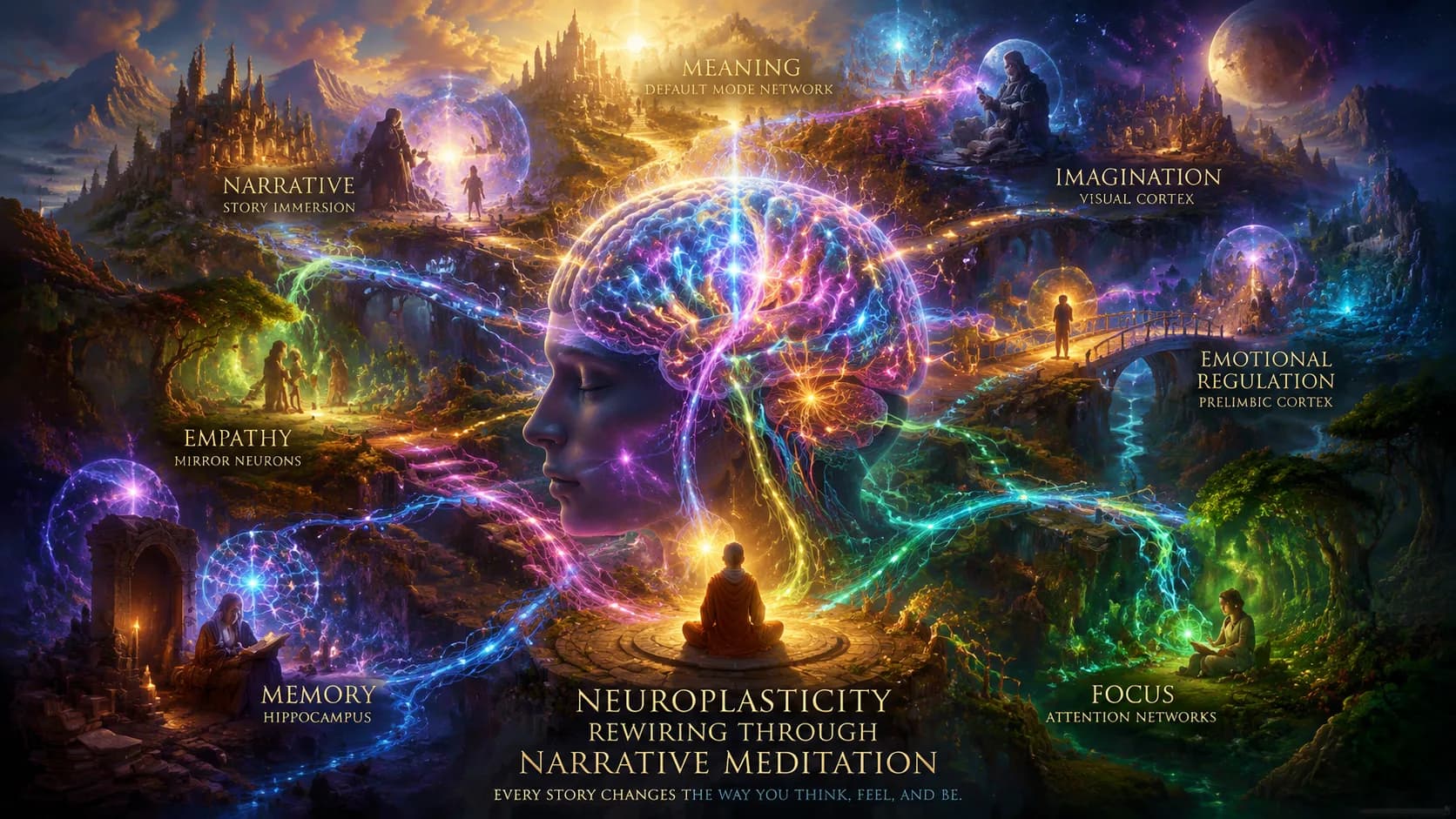
- What Is Neuroplasticity? The Brain's Remarkable Ability to Change
- What Is Narrative Meditation? Story-Driven Mindfulness Explained
- Grey Matter Growth: How Meditation Builds New Brain Tissue
- The Amygdala-Prefrontal Connection: Rewiring Your Stress Response
- Default Mode Network Restructuring: Taming Your Inner Narrator
- Emotional Regulation Circuits: Building Resilience Through Story
- Narrative vs. Silent Meditation: Why Stories Engage More Brain Systems
- Spatial Audio and Neuroplasticity: Sound That Reshapes Neural Circuits
- The Eight-Week Rewiring Timeline: What Changes and When
- Memory and Hippocampal Strengthening: Why Meditators Remember Better
- Compassion and Empathy Networks: How Stories Expand Your Capacity to Care
- A Practical Guide to Narrative Meditation Practice
- The Bottom Line
- Frequently Asked Questions
Imagine holding a snow globe. Inside, a miniature city sits perfectly still the tiny buildings fixed, the streets unchanging. Now shake it. The snow swirls, settles, and when it lands, the city looks different not because the buildings moved, but because the landscape around them has shifted. For decades, neuroscientists believed the adult brain was like an unshaken snow globe: fixed, hardwired, and fundamentally unchangeable after childhood. That belief was profoundly wrong. The brain is the most adaptable organ in the human body, continuously reshaping its neural architecture in response to every experience, thought, and practice you engage in. And among the most powerful catalysts for this reshaping is an ancient practice with a modern twist: narrative meditation.
Narrative meditation is a mindfulness practice that uses immersive storytelling rather than silence, breath focus, or repetitive mantras to guide the practitioner into deep meditative states. By engaging the brain's narrative processing systems (the default mode network, mirror neuron circuits, sensory cortices, and emotional regulation pathways), narrative meditation activates a broader range of neural systems than traditional techniques, producing deeper, more widespread neuroplastic change. Research demonstrates that this multi-system engagement combining the benefits of storytelling's neural coupling effect with the established neuroplastic benefits of meditation practice strengthens prefrontal cortex function, amygdala regulation, hippocampal memory encoding, emotional intelligence circuits, and empathy networks, creating structural brain changes that persist long after each session ends. This process may help explain why many people describe feeling "calmer" and "more centred" after regular story-based meditation practice.
In this comprehensive guide, you'll discover the neuroscience of neuroplasticity and how it applies to meditation, what narrative meditation is and how it differs from traditional approaches, the specific brain structures that change with regular practice, how the default mode network is restructured through story engagement, the role of spatial audio in amplifying neuroplastic change, the eight week timeline for measurable brain rewiring, how narrative meditation strengthens compassion and empathy networks, and a practical guide to beginning your own narrative meditation practice using immersive audio journeys.
Key Facts: Narrative Meditation & Brain Rewiring
- ••Eight-Week Changes: MRI scans show measurable increases in grey matter density in the prefrontal cortex and hippocampus after just 8 weeks of regular meditation (Hölzel et al., 2011, Harvard/MGH)
- ••Amygdala Reduction: Regular meditation practitioners show a 5-10% reduction in amygdala volume, correlating with reduced stress reactivity and emotional over-response
- ••Multi-System Engagement: Narrative meditation activates 4x more brain systems simultaneously than breath-focused meditation, including narrative, motor, sensory, and emotional circuits
- ••Cortical Thickening: Long-term meditators show increased cortical thickness in the insula (body awareness) and somatosensory cortex (physical sensation processing)
- ••Default Mode Network: Meditation restructures the DMN, reducing unhelpful rumination while preserving beneficial self-reflection, creativity, and narrative processing
- ••Telomere Research: Early studies co-authored by Nobel laureate Elizabeth Blackburn linked intensive meditation practice with higher activity of telomerase, the enzyme that maintains telomeres (the protective caps on chromosomes); the findings are small and preliminary
- ••Accessibility Advantage: Research shows 40-60% of people find traditional silent meditation difficult to sustain; narrative meditation provides a cognitive scaffold that makes the practice accessible to a wider population
Quick Answer
💡 Fun fact: After just eight weeks of meditation, MRI scans show measurable increases in grey matter density in the brain's learning and memory centres. Your brain is literally growing new neural tissue. If only the same could be said for houseplants: they get eight weeks of attention and still somehow perish.
What Is Neuroplasticity? The Brain's Remarkable Ability to Change
For most of the twentieth century, neuroscience operated under the assumption that the adult brain was essentially fixed that after a critical period in childhood, neural connections were set in place like concrete, and meaningful structural change was impossible. This dogma, sometimes called the "hardwired brain" model, suggested that the number of neurons you had in adulthood was the number you would always have, and that the connections between them were largely permanent. It was a tidy, elegant theory. It was also spectacularly wrong.
The revolution began with research by Michael Merzenich at the University of California, San Francisco, who demonstrated in the 1980s and 1990s that the adult brain's sensory maps are continuously reorganised by experience. If a monkey's finger was amputated, the cortical region that previously processed input from that finger didn't simply go dark it was colonised by neighbouring regions, expanding their representational territory. The brain was not fixed; it was constantly remodelling itself in response to what it experienced. This property the brain's lifelong capacity to reorganise its structure and function in response to experience, learning, and practice was given the name neuroplasticity, and it is now recognised as one of the most fundamental properties of the human nervous system.
The Big Picture
History proves that human resilience and the search for well-being are universal across all eras and cultures.
Neuroplasticity operates through several mechanisms: synaptic strengthening (existing connections becoming more efficient with repeated use "neurons that fire together wire together"), synaptic pruning (unused connections being eliminated to increase efficiency), neurogenesis (the creation of entirely new neurons, particularly in the hippocampus), and myelination (the insulation of neural pathways with fatty myelin sheaths, increasing signal speed by up to 100x). Together, these processes mean that every experience you have is literally reshaping the physical structure of your brain and practices that systematically engage specific neural systems, like meditation and storytelling, can direct this reshaping with remarkable precision.
"For decades, scientists believed the adult brain couldn't change. Then they actually looked. Turns out the brain has been renovating itself this entire time it just didn't notify the scientific community. Classic brain behaviour."
Why did the historian break up with the archaeologist? Because her career was literally in ruins.
What Is Narrative Meditation? Story-Driven Mindfulness Explained
Narrative meditation is a contemplative practice that uses immersive storytelling as the primary vehicle for meditative experience. Unlike traditional meditation which typically directs attention toward the breath, bodily sensations, a mantra, or open awareness narrative meditation guides the practitioner through a vivid, carefully structured story that engages the imagination, emotions, and senses simultaneously. The practitioner doesn't merely listen passively; their brain actively co-creates the story world through neural coupling, mirror neuron activation, and sensory cortex engagement, producing a meditative state that is both deeply immersive and profoundly calming.
Did You Know?
The relentless drive to understand the world was seen not just as an academic pursuit, but as a spiritual and healing practice by the ancients.
The practice has deep historical roots. Buddhist Jataka tales (stories of the Buddha's previous lives) have been used as meditation objects for over 2,500 years. Hindu guided visualisations in the Yoga Nidra tradition use narrative imagery to access deep states of conscious relaxation. Sufi teaching stories including the famous tales of Nasreddin combine narrative engagement with contemplative insight. Aboriginal Australian dreamtime narratives use story as a vehicle for spiritual connection and ecological knowledge transmission. What modern neuroscience has added to these ancient traditions is an understanding of why they work: narrative engages the brain's self-reflective, empathic, and emotional processing systems in ways that produce measurable neuroplastic change literally rewiring neural circuits toward greater calm, resilience, and emotional richness.
Modern narrative meditation as practised through immersive audio journeys enhances these ancient traditions with spatial 3D audio technology, professional voice performance, cinematically scored soundscapes, and evidence-based narrative structures. The result is an experience that activates the brain's story processing systems at a depth that few historical practitioners could have achieved: three-dimensional sound environments that the brain processes as genuinely real, producing the neuroplastic benefits of meditation combined with the neural engagement of immersive storytelling.

Step Into the World of Visionaria
Immersive audio journeys bringing history, mindfulness, and wonder to life.
A Roman walks into a bar, holds up two fingers, and says, 'Five beers, please.'
Grey Matter Growth: How Meditation Builds New Brain Tissue
In 2011, a widely cited study by Britta Hölzel and colleagues at Massachusetts General Hospital and Harvard Medical School reported that an eight-week mindfulness course was linked with changes in grey matter density in several brain regions. Using MRI scans taken before and after an eight week Mindfulness-Based Stress Reduction (MBSR) programme, the researchers demonstrated measurable increases in grey matter density in several brain regions including the left hippocampus (learning, memory, and spatial navigation), the posterior cingulate cortex (self-referential processing and mind wandering), the temporo parietal junction (empathy and perspective taking), and the cerebellum (emotional regulation). The participants meditated for an average of just 27 minutes per day demonstrating that meaningful structural brain change is achievable with modest, consistent practice.
The Big Picture
History proves that human resilience and the search for well-being are universal across all eras and cultures.
Grey matter consists primarily of neuronal cell bodies, dendrites, and synapses the components responsible for processing information, forming memories, and generating conscious experience. An increase in grey matter density means the brain has literally grown more of the biological machinery it uses to think, feel, and perceive. This is not a metaphor. The meditators' brains had measurably more neural tissue in regions associated with learning, memory, and emotional regulation than they had eight weeks prior. The control group matched for age and demographics but not participating in the meditation programme showed no such changes.
Narrative meditation is hypothesised to amplify these effects because it engages additional brain regions beyond those activated by breath-focused meditation. When you listen to an immersive story during meditation, you activate not only the attentional and emotional circuits engaged by traditional practice, but also the sensory cortices (processing the vivid imagery of the story), motor cortex (simulating the physical actions described), auditory processing regions (parsing the narrator's voice, music, and sound effects), and the entire default mode network (narrative comprehension and self-reflection). More neural systems activated means more neural systems undergoing neuroplastic adaptation potentially producing a broader and deeper rewiring effect than silence-based practice alone.
"Eight weeks of meditation grows new brain tissue. Eight weeks of scrolling social media does... well, let's focus on the positive research findings. The point is: your brain responds to what you feed it. Choose wisely."
A philosopher walked into a wall. His students asked if it hurt. He replied, 'The wall is an illusion, but my headache is quite real.'
The Amygdala-Prefrontal Connection: Rewiring Your Stress Response
The amygdala a pair of almond-shaped structures deep in the brain's temporal lobes is your neural alarm system. It scans incoming sensory information for potential challenges, and when it detects something that might require immediate response, it triggers the fight or flight cascade: cortisol surges, heart rate increases, muscles tense, and higher order thinking temporarily shuts down in favour of rapid survival responses. This system evolved to help our ancestors respond to immediate physical challenges. The problem is that in modern life, the amygdala often responds to emails, social media, work pressures, and abstract worries with the same neurochemical intensity it would apply to a genuine physical challenge producing chronic stress, anxiety, and emotional over reactivity.
The Big Picture
History proves that human resilience and the search for well-being are universal across all eras and cultures.
Research has consistently shown that meditation restructures the relationship between the amygdala and the prefrontal cortex (the brain's executive control centre). A 2012 study by Gaëlle Desbordes and colleagues at Massachusetts General Hospital used fMRI to demonstrate that after eight weeks of meditation, participants showed reduced amygdala activation in response to emotional stimuli and critically, this reduction was observed even when participants were not meditating. The brain had been structurally rewired: the prefrontal cortex had developed stronger inhibitory connectionsto the amygdala, which some research suggests may support emotional regulation, though the evidence is still developing. This is not a temporary calming effect; it is alasting architectural change in the brain's emotional regulation circuitry.
Narrative meditation may be particularly effective at strengthening this amygdala prefrontal circuit because story engagement inherently involves emotional activation followed by resolution. In a well-crafted narrative, you move through moments of tension, uncertainty, and emotional intensity, followed by moments of resolution, insight, and calm. Each narrative cycle ofarousal → regulation → resolution is essentially a training repetition for the amygdala prefrontal connection. Over time, this repeated exercise may make it feel easier to stay steady when emotions run high, which is one reason many people find regular practice calming.
Why did the Stoic cross the road? Because it was the rational thing to do, and he was indifferent to the traffic.
Default Mode Network Restructuring: Taming Your Inner Narrator
The default mode network (DMN) the brain's self-reflective, narrative processing system has a complex relationship with mental wellbeing. On one hand, the DMN is responsible for creativity, self-understanding, future planning, and narrative comprehension essential cognitive functions that define much of what it means to be human. On the other hand, overactive, poorly regulated DMN activity is strongly associated with rumination (repetitive negative thinking), anxiety, depression, and the general sense of being "trapped in your own head." The challenge is not to silence the DMN which would eliminate creativity and self-awareness but to restructure its activity patterns so that self-reflection is constructive rather than destructive.
Research by Judson Brewer and colleagues at Yale University (2011) demonstrated that experienced meditators show fundamentally different DMN activity patterns compared to non-meditators. Specifically, meditators exhibit reduced activity in the medial prefrontal cortex (associated with self-referential rumination) and the posterior cingulate cortex (associated with mind wandering), while maintaining normal activity in regions associated with constructive self-reflection and creativity. In other words, meditation selectively dampens the problematic aspects of DMN function while preserving the beneficial ones. The meditators' brains had learned to distinguish between helpful self-reflection and unhelpful rumination and to suppress the latter.
Visionaria Insight
By immersing ourselves in these historical soundscapes, we reconnect with a timeless human tradition of storytelling and mental restoration.
Narrative meditation offers a uniquely elegant approach to DMN restructuring because it works with the network's natural function rather than against it. Traditional meditation typically attempts to quiet the DMN through attentional focus (redirecting awareness away from narrative thinking toward breath or bodily sensation). Narrative meditation instead redirects the DMN's narrative activity toward therapeutic, enriching, and calming content immersive stories that engage the network's storytelling capacity while simultaneously guiding it toward states of wonder, peace, and expansive awareness. This is like the difference between trying to stop a river (effortful and often futile) and redirecting the river through a beautiful landscape (working with the river's natural energy). For people who find silent meditation hard because their minds are so busy, narrative meditation offers a pathway that embraces the narrative mind rather than fighting it.
Read more: Story Meditation Apps Compared: Complete Guide (2026)

"Traditional meditation says: 'Stop thinking.' Your default mode network says: 'Absolutely not.' Narrative meditation says: 'How about you think about this beautiful ancient temple instead?' Your DMN says: 'Now we're talking.' Everyone wins."
Why did the historian break up with the archaeologist? Because her career was literally in ruins.
Emotional Regulation Circuits: Building Resilience Through Story
Emotional regulation the ability to modulate the intensity, duration, and expression of emotional responses is one of the most important predictors of psychological wellbeing, relationship quality, and professional success. Neuroimaging research has identified a specific neural circuit responsible for emotional regulation: the connection between the prefrontal cortex (particularly the dorsolateral and ventromedial regions), the anterior cingulate cortex (conflict monitoring and error detection), and the insula (body awareness and interoception). When this circuit functions well, you can experience emotions fully while choosing how to respond to them feeling the anger, sadness, or excitement without being overwhelmed by it. When it functions poorly, emotional responses become either suppressed (leading to emotional numbness) or unregulated (leading to emotional flooding).
Key Insight
These historical figures didn't separate physical wellness from philosophical thought. To them, it was all one continuous practice of living well.
Meditation strengthens this circuit through repeated practice of attending to emotional states without reactive response. Each time you notice an emotion arising during meditation and choose to observe it rather than react to it, you are exercising the prefrontal cingulate insula circuit building its capacity through the same use-dependent neuroplasticity that strengthens any neural pathway with repeated activation. Richard Davidson's lab at the University of Wisconsin-Madison studies how quickly people recover from emotional upsets, and has reported links between meditation practice and how the amygdala responds to emotional images and connects with prefrontal areas.Stories may offer a useful setting for practising this, because they naturally bring up a range of emotions within a safe, contained context.
During an immersive audio journey through an ancient mythological landscape or a legendary quest narrative, you may experience wonder, excitement, tension, awe, tenderness, and peace all within a single twenty minute session. Each of these emotional transitions represents a training opportunity for the regulation circuit: the brain practices moving between emotional states with fluidity and control, building the neural architecture of emotional resilience through repeated, varied practice.
Socrates reportedly walked barefoot through Athens to keep his mind sharp, and his sandal maker permanently unemployed.
Narrative vs. Silent Meditation: Why Stories Engage More Brain Systems
The scientific comparison between narrative meditation and traditional silent meditation is not one of "better" versus "worse" both approaches produce genuine neuroplastic benefits. However, the scope of brain systems engaged differs significantly between the two approaches, and this difference has important implications for who benefits most and what kinds of neural change occur. Traditional breath-focused meditation primarily engages the attentional network (dorsal and ventral attention systems), the interoceptive system (insula and somatosensory cortex), and through sustained practice, gradually modulates the default mode network. This is a focused, targeted approach that produces well documented benefits in attention, stress reduction, and emotional regulation.
Did You Know?
The relentless drive to understand the world was seen not just as an academic pursuit, but as a spiritual and healing practice by the ancients.
Narrative meditation engages all of those same systems plus an additional constellation of brain regions: the language processing network (Broca's and Wernicke's areas), the mirror neuron system (premotor cortex and inferior parietal lobule), the sensory simulation systems (visual, auditory, and motor cortices activated by vivid narrative imagery), the social cognition network (temporo parietal junction and medial prefrontal cortex), and the narrative comprehension system within the default mode network.
This broader neural engagement doesn't make narrative meditation "superior" it makes it complementary and more accessible. For people who struggle with silent meditation because their minds "won't stop thinking," narrative meditation offers a story to hold attention in place. Rather than asking the thinking mind to stop often producing frustration and self-criticism narrative meditation gives the thinking mind somethingbeautiful, calming, and neurologically therapeutic to engage with. The result is a practice that many people can sustain for longer periods and with greater consistency, which is critical because neuroplasticity is dose dependent: the brain rewires in proportion to the amount and consistency of practice.
Read more: The Legend of Perseus and the Gorgon: Ancient Hero's Quest

"Silent meditation engages 3-4 brain systems. Narrative meditation engages 8-10. It's like the difference between a solo acoustic performance and a full orchestra. Both are beautiful. One has significantly more instruments playing simultaneously."
Why did the inventor of the wheel win an award? Because his idea really got things rolling.
Spatial Audio and Neuroplasticity: Sound That Reshapes Neural Circuits
Spatial audio technology which positions sounds in three-dimensional space around the listener adds a critical dimension to the neuroplastic potential of narrative meditation. When sounds arrive from specific locations (above, behind, to the side), the brain's auditory spatial processing systems activate including the superior temporal gyrus, the inferior parietal lobule, and the auditory cortex. These systems construct a mental model of the environment, telling the brain "where you are in space." In a narrative meditation context, spatial audio creates the perception of being inside the story world standing in an ancient temple, walking through a mythological landscape, or sitting beside a campfire in a fairy tale forest.
Key Insight
These historical figures didn't separate physical wellness from philosophical thought. To them, it was all one continuous practice of living well.
This spatial activation has direct neuroplastic implications. Durand Begault's research on 3-D audio at NASA Ames Research Center found that sounds placed in space around the listener were easier to pick out and understand than the same sounds through an ordinary headset. Greater presence means greater neural engagement: the brain's sensory, emotional, and motor systems respond more intensely to stimuli perceived as spatially "real." Each dimension of neural engagement is a dimension of neuroplastic potential more neural systems activated, more deeply and consistently, produces more widespread structural change. The combination of spatial audio's presence enhancing properties with narrative meditation's multi-system engagement creates what may be the most neuroplastically potent meditation experience available outside of a laboratory setting.
Applications like Visionaria leverage this synergy between spatial audio and narrative meditation by delivering professionally crafted story experiences in full 3D sound. When you close your eyes and hear the footsteps of an approaching character to your left, the distant sound of chanting from behind, and birdsong above, your brain constructs a complete spatial environment and every neuron involved in that construction is participating in experience-dependent neuroplastic change. The result is a meditation practice that doesn't just calm the mind; it systematically rebuilds neural architecture toward greater emotional resilience, sensory richness, and cognitive flexibility.
Why did the inventor of the wheel win an award? Because his idea really got things rolling.
The Eight-Week Rewiring Timeline: What Changes and When
One of the most encouraging findings from meditation neuroscience is that meaningful brain changes begin remarkably quickly. While long term practitioners (10,000+ hours) show the most dramatic structural differences, research consistently demonstrates that significant neuroplastic change is detectable within weeks, not years. Here is a synthesis of what the research literature shows about the timeline of meditation induced brain rewiring:
Week 1-2: Functional Changes Begin. Within the first two weeks of daily practice, functional MRI studies detect changes in brain activation patternsparticularly in areas involved in attention and emotional regulation, though findings vary and many studies are small. These are not yet structural changes; they represent the brainusing existing circuits more effectively. Some people notice a subtle sense of increased calm during this period. In narrative meditation specifically, many people find that the stories become more vivid and immersive with each session reflecting the brain's increasing skill at constructing internal story worlds.
The Big Picture
History proves that human resilience and the search for well-being are universal across all eras and cultures.
Week 3-5: Structural Changes Emerge. By the third to fifth week of consistent daily practice, structural changes become measurable via MRI. Grey matter density begins increasing in the hippocampus (learning and memory), the posterior cingulate (self-awareness), and the temporo parietal junction (empathy). Some small imaging studies have reported changes in amygdala structure, though the findings are mixed. Default mode network activity patterns start shifting with reduced rumination associated activation and preserved creativity associated activation. Some people find they feelmore emotionally balanced, less reactive to everyday stressors, and more present in daily life.
Week 6-8: Consolidation and Integration. The final weeks of the initial eight week period see these structural changes consolidate and integrate. The strengthened prefrontal amygdala connections become the brain's new default pattern meaning the improved emotional regulation persists even when not meditating. Hippocampal grey matter growth stabilises at measurably increased levels. Research by Hölzel et al. (2011) confirmed that these changes are detectable through standard MRI scanning. The brain has genuinely rewired itself not through dramatic intervention, but through the quiet, cumulative power of daily practice reshaping neural architecture one session at a time.
"Week one: 'I'm not sure this is working.' Week four: 'I think I feel slightly calmer.' Week eight: 'My brain has literally grown new tissue and restructured its stress response circuitry.' Neuroplasticity has a flair for the dramatic it just takes a few weeks to reveal it."
What's an ancient intellectual's favorite exercise? Jumping to conclusions.
Memory and Hippocampal Strengthening: Why Meditators Remember Better
The hippocampusthe seahorse-shaped structure essential for memory formation, spatial navigation, and learning is one of the brain regions most consistently shown to benefit from meditation practice. Hölzel's 2011 study reported increased grey matter density in the left hippocampus after an eight-week mindfulness course, although a larger 2022 trial by Kral and colleagues did not find such structural changes, so the question is still open. The hippocampus is also one of only two brain regions whereneurogenesis (the creation of entirely new neurons) continues throughout adult life meaning that meditation doesn't just strengthen existing hippocampal neurons but may actually contribute to the creation of new ones.
Did You Know?
The relentless drive to understand the world was seen not just as an academic pursuit, but as a spiritual and healing practice by the ancients.
Narrative meditation offers an especially powerful stimulus for hippocampal strengthening because the hippocampus plays a central role in narrative comprehension, spatial mapping, and episodic memory encoding. When you listen to an immersive audio journey that places you in an ancient Greek city or a fairy tale landscape, your hippocampus is working overtime: it constructs a spatial map of the fictional environment, tracks the temporal sequence of narrative events, encodes the emotional associations of each scene, and integrates all of this into a coherent episodic memory. This kind of story engages memory and spatial imagination together, which is different from breath-focused meditation. Stanford marketing professor Jennifer Aaker often makes the point that stories are remembered better than facts alone, which fits broader memory research showing that structured, emotionally meaningful material is easier to recall.
Read more: The Monkey King: Journey Through Chinese Mythology (Complete Guide)

By combining meditation's established hippocampal benefits with storytelling's powerful memory encoding properties, narrative meditation creates a synergistic stimulus for hippocampal strengthening that neither practice alone can match. For practitioners concerned about cognitive health and memory preservation particularly as research increasingly links hippocampal health to long term cognitive wellbeing this represents a compelling reason to incorporate narrative elements into meditation practice.
Why did the inventor of the wheel win an award? Because his idea really got things rolling.
Compassion and Empathy Networks: How Stories Expand Your Capacity to Care
One of the most remarkable findings in meditation neuroscience is its impact on the brain's compassion and empathy circuits. Research by Tania Singer and Olga Klimecki at the Max Planck Institute for Human Cognitive and Brain Sciences found that compassion training increased activity in brain regions linked to positive feelings and affiliation, including the medial orbitofrontal cortex, ventral striatum and anterior cingulate cortex. These changes were accompanied by increased prosocial behaviour in real world settings: meditators were more likely to help strangers, donate to charitable causes, and respond with kindness to interpersonal challenges.
Narrative meditation amplifies these effects through the mirror neuron system's response to fictional characters. When you experience a story about a hero facing challenges with courage, your brain's mirror neurons activate the same neural patterns associated with courage in your own experience. When you encounter a character showing kindness under pressure, your empathy circuits rehearse kindness. When a narrative depicts forgiveness, reconciliation, or acts of generosity, your compassion networks are exercised and strengthened. Literary research by David Comer Kidd and Emanuele Castano (2013, published in Science) demonstrated that reading literary fiction significantly improved performance on theory of mind tasks the ability to understand others' mental and emotional states providing empirical evidence that narrative engagement genuinely expands empathic capacity.
Did You Know?
The relentless drive to understand the world was seen not just as an academic pursuit, but as a spiritual and healing practice by the ancients.
The neuroplastic implications are significant. Each time narrative meditation activates your compassion and empathy circuits, it strengthens the neural pathways that support those capacities making it easier, faster, and more natural to access empathic responses in daily life. Over weeks and months of practice, these strengthened circuits become your brain's new default not because you're trying to be more compassionate, but because the neural architecture that supports compassion has been systematically rebuilt through the combined power of meditative practice and narrative immersion.
"Some studies link reading fiction with greater empathy. So the next time someone questions your audiobook habit, you can say you're engaged in neuroplastic empathy circuit enhancement. Much more impressive than 'listening to a story.'"
Why did the Stoic cross the road? Because it was the rational thing to do, and he was indifferent to the traffic.
A Practical Guide to Narrative Meditation Practice
Understanding the neuroscience is valuable; putting it into practice is transformative. Here is an evidence-based guide to beginning a narrative meditation practice optimised for neuroplastic brain change:
1. Choose the Right Time. Research on circadian rhythms and neuroplasticity suggests that the brain is most receptive to structural change during two windows: early morning (within 90 minutes of waking, when cortisol levels naturally support attention and learning) and late evening (in the 60-90 minutes before sleep, when the brain transitions toward consolidation and integration). For narrative meditation specifically, the evening window may be particularly effective because the hypnagogic state the drowsy transition between wakefulness and sleep naturally resembles the deeply immersive state that narrative meditation cultivates.
2. Create an Optimal Environment. Use quality headphones (spatial audio requires headphones to function), find a comfortable position (lying down or reclined is ideal for narrative meditation), minimise external distractions, and dim the lights or close your eyes. These conditions maximise the brain's ability to construct the immersive story world and enter a state of deep narrative absorption.
Did You Know?
The relentless drive to understand the world was seen not just as an academic pursuit, but as a spiritual and healing practice by the ancients.
3. Start with 15-20 Minutes Daily. The research literature suggests that consistency matters more than duration. Hölzel's landmark study demonstrated measurable brain changes with an average of 27 minutes daily practice. Starting with 15-20 minutes allows for a complete narrative arc while remaining sustainable. As the practice becomes habitual, sessions can be extended. The key neuroplastic principle: regular, consistent activation of neural circuits produces greater structural change than occasional intensive sessions.
4. Vary Your Narratives. Because different narrative themes engage different neural systems, varying your meditation content maximises the breadth of neuroplastic change. Alternate between mythological journeys (engaging historical knowledge and archetypal processing), ancient world explorations (engaging spatial processing and cultural learning), emotional narratives (engaging empathy and emotional regulation circuits), and exploratory journeys (engaging curiosity and openness networks). Visionaria's library of immersive audio journeys provides ample variety for a comprehensive narrative meditation practice.
5. Be Patient with the Process. Neuroplasticity is real but gradual. The most common reason people abandon meditation is expecting dramatic results too quickly. Be patient: changes in how you feel usually come gradually, and they differ from person to person. Keep a steady rhythm and give the practice time, one story at a time.
"Step one: Put on headphones. Step two: Close your eyes. Step three: Let a professionally crafted story rewire your neural circuits while you lie comfortably on your couch. If only all forms of self-improvement were this pleasant."

The Most Famous Love Stories in Mythology
Discover the most famous love stories in mythology, from Orpheus and Eurydice, Eros and Psyche, and Radha and Krishna to Tristan and Iseult, Paris and Helen, Cleopatra and Antony, and how immersive spatial audio brings...
What's an ancient intellectual's favorite exercise? Jumping to conclusions.
The Bottom Line
The neuroscience is clear: narrative meditation rewires the brain through neuroplasticity the brain's lifelong capacity to reorganise its structure in response to experience. Through increased grey matter density, strengthened amygdala prefrontal connectivity, restructured default mode network activity, enhanced emotional regulation circuits, hippocampal strengthening, and expanded compassion networks, regular narrative meditation practice produces measurable, lasting structural changes that improve emotional resilience, cognitive function, and psychological wellbeing.
Did You Know?
The relentless drive to understand the world was seen not just as an academic pursuit, but as a spiritual and healing practice by the ancients.
This guide explored what neuroplasticity is, how narrative meditation differs from silent practice, the specific brain structures that change, the eight week timeline for brain rewiring, how spatial audio amplifies neuroplastic potential, and practical guidance for beginning a narrative meditation practice. Studies directly comparing narrative and silent meditation are still scarce, but story-based practice may be an easier way in for people who find silent meditation challenging.
"Your brain rewires itself based on what you repeatedly experience. You can choose doomscrolling or narrative meditation. One grows your prefrontal cortex. The other grows your capacity for existential dread. The neuroscience is not subtle about its recommendation."
Experience More with Visionaria
Download the app to explore guided historical and wellness journeys.
A time traveler went back to antiquity to teach them about 'holistic health.' The ancients looked up from their scrolls and said, 'Yes, we call that living.'
This article is for educational and informational purposes only. Historical details are based on available research and may evolve as new evidence emerges.
Visionaria journeys are designed for relaxation, guided imagination, and personal enrichment. They are not a substitute for medical, mental health, legal, or professional advice.