
Why the Brain Experiences Stories as Reality: The Neuroscience of Narrative Immersion
💡 Fun fact: When you read the sentence "the singer had a pleasing voice," your auditory cortex activates—even though you heard nothing. Your brain literally rehearses the sound of a voice that doesn't exist. Neuroscience: making everyone hallucinate since the dawn of storytelling.
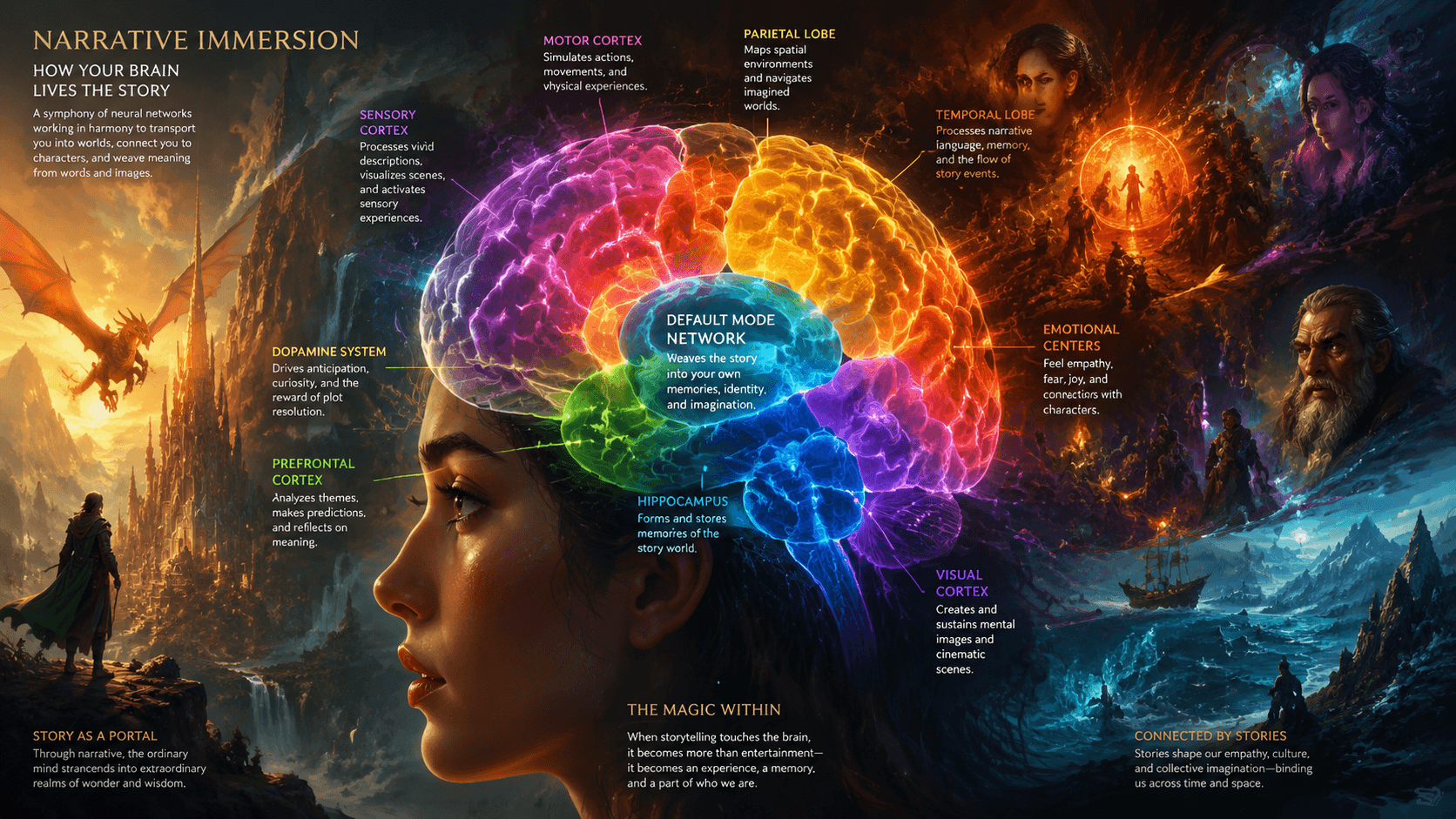
Close your eyes and imagine biting into a lemon. Feel the weight of it in your hand, the rough texture of the rind beneath your fingers. Now imagine the knife cutting through the bright, tangy smell rising from the cut surface. Imagine lifting a wedge to your lips, the sour juice hitting your tongue. If you followed those instructions with any degree of vividness, your mouth is now watering. Your salivary glands activated in response to a lemon that does not exist. There is no fruit, no knife, no juice only words on a screen and the remarkable machinery of your brain, which treated a few sentences of narrative description as though they were reality itself.
The brain's experience of stories as reality refers to the well documented neuroscientific phenomenon in which narrative immersion activates the same neural regions, neurochemical pathways, and physiological responses as direct, lived experience. When a person hears, reads, or watches a compelling story, their motor cortex, sensory cortices, emotional processing centres, and memory systems respond as though the fictional events are genuinely occurring a process driven by neural coupling (brain to brain synchronisation between storyteller and listener), mirror neuron activation, narrative transportation, and the coordinated release of neurochemicals including oxytocin, cortisol, dopamine, and endorphins. This phenomenon explains why stories can make us cry, laugh, feel our hearts race, and even change our beliefs and behaviours and it forms the scientific foundation for story based meditation, imagination training, and immersive audio experiences that use narrative to produce genuine psychological and physiological transformation.
In this comprehensive guide, you'll discover the neuroscience behind neural coupling, the default mode network's role as your brain's inner storyteller, how mirror neurons create narrative empathy, the neurochemical cocktail that stories trigger, transportation theory, why your brain cannot reliably distinguish vivid imagination from lived experience, the ancient power of oral storytelling, how spatial audio technology amplifies the brain's story response, the convergence of story based meditation and mindfulness science, memory consolidation through narrative, the therapeutic applications of storytelling, and how modern immersive audio journeys are harnessing these discoveries to create experiences that your brain genuinely treats as reality.
Key Facts: The Brain and Stories
- ••Neural Coupling: Princeton research (Uri Hasson, 2010) demonstrated that a listener's brain activity mirrors the storyteller's brain patterns—with the listener's brain sometimes anticipating the storyteller's next neural state
- ••Motor Cortex Activation: Reading action words like "kick," "run," or "grasp" activates the same motor cortex regions used to physically perform those actions (Hauk et al., 2004)
- ••Stress Reduction: A University of Sussex study (2009) found that reading for just 6 minutes reduced stress levels by up to 68%—more effective than music (61%), walking (42%), or tea (54%)
- ••Oxytocin Release: Character-driven stories trigger oxytocin—the "trust and bonding" neurochemical—increasing empathy and cooperative behaviour (Zak, 2014)
- ••Memory Advantage: Stories are up to 22 times more memorable than facts alone (Stanford research), because narrative engages multiple brain systems simultaneously
- ••Default Mode Network: The brain's "resting state" network—active during daydreaming, self-reflection, and future planning—is the same network that processes narrative fiction
- ••Spatial Audio Enhancement: Three-dimensional audio increases the brain's sense of "presence" in a narrative environment by up to 300% compared to stereo (Begault, 1994)
Quick Answer
💡 Fun fact: When you read the sentence "the singer had a pleasing voice," your auditory cortex activates—even though you heard nothing. Your brain literally rehearses the sound of a voice that doesn't exist. Neuroscience: making everyone hallucinate since the dawn of storytelling.
What Is Neural Coupling? How Stories Sync Your Brain
In 2010, Princeton neuroscientist Uri Hasson published research that transformed our understanding of what happens when one person tells a story and another listens. Using functional magnetic resonance imaging (fMRI), Hasson's team recorded the brain activity of a woman telling a personal story and then played the recording to listeners while scanning their brains. The results were extraordinary: the listener's brain activity mirrored the storyteller's brain patterns not just in language processing areas, but across the entire brain, including regions responsible for emotion, sensory experience, and motor planning. Hasson called this phenomenon neural coupling: the literal synchronisation of two brains through the medium of narrative.
Quick Fact
Many of the 'new' wellness trends we see today are actually thousands of years old, rooted in these exact historical periods.
What made the finding even more remarkable was the discovery of predictive coupling. In the most engaged listeners those who reported the highest levels of comprehension and connection the listener's brain actually anticipated the storyteller's next neural state, firing patterns before the storyteller's brain did. This suggests that deep story engagement isn't passive reception but active co creation: your brain is running a real time simulation of the story world, generating predictions about what will happen next and comparing those predictions against incoming information. When the story confirms your predictions, you experience satisfaction; when it surprises you, you experience the delicious jolt of narrative surprise that keeps you engaged. This predictive mechanism is the same system your brain uses to navigate physical reality further evidence that your brain treats stories and lived experience with the same fundamental machinery.
The implications for story based meditation and immersive audio are profound. If a well told narrative literally synchronises the listener's brain with the storyteller's, then the quality, vividness, and emotional depth of the storytelling directly determines the depth of the neurological experience. A flat, generic narrative produces weak coupling; a richly detailed, emotionally authentic narrative produces coupling so deep that the listener's brain effectively enters the storyteller's world. This is why professionally crafted immersive audio journeys with careful attention to narrative structure, sensory language, and emotional arc produce such qualitatively different experiences from simple guided meditations.
"Your brain synchronises with the storyteller's brain. So technically, every time someone reads you a bedtime story, you're engaged in a neuroscientific mind meld. No wonder children insist on the same story seventeen times they're perfecting their neural coupling."
Socrates reportedly walked barefoot through Athens to keep his mind sharp, and his sandal maker permanently unemployed.
The Default Mode Network: Your Brain's Inner Storyteller
One of the most significant neuroscientific discoveries of the past two decades is the default mode network (DMN) a constellation of brain regions that becomes active when you are not focused on the external world. Discovered accidentally by Marcus Raichle and colleagues at Washington University in 2001, the DMN activates during daydreaming, self reflection, imagining future scenarios, recalling autobiographical memories, and critically processing narrative fiction. This network, centred on the medial prefrontal cortex, posterior cingulate cortex, and temporal parietal junction, is essentially your brain's internal storytelling engine: the system that constantly weaves fragments of memory, imagination, and self concept into the ongoing narrative you experience as your sense of self.
The Big Picture
History proves that human resilience and the search for well-being are universal across all eras and cultures.
The connection between the DMN and fictional narrative is not coincidental it is structural. Research by Raymond Mar (2011) at York University demonstrated that reading fiction activates the same DMN regions involved in social cognition, empathy, and theory of mind (the ability to understand that other people have beliefs, desires, and perspectives different from your own). This means that when you become absorbed in a story, you are engaging the same neural machinery you use to navigate real social relationships understanding characters' motivations, predicting their behaviour, and emotionally resonating with their experiences. The DMN doesn't distinguish between "real" social interactions and fictional ones; it processes both using the same cognitive architecture.
For practitioners of imagination training and narrative meditation, this is extraordinarily significant. The DMN is the network most closely associated with self understanding, emotional processing, and psychological integration. When you engage this network through immersive storytelling, you're not escaping reality you're accessing the deepest level of self related processing your brain possesses. This is why story based meditation often produces insights, emotional breakthroughs, and shifts in perspective that simple breath focused meditation may not because narrative directly engages the brain's self reflective infrastructure in ways that silence alone cannot.
Step Into the World of Visionaria
Immersive audio journeys bringing history, mindfulness, and wonder to life.
Why did the Stoic cross the road? Because it was the rational thing to do, and he was indifferent to the traffic.
Mirror Neurons and Narrative Empathy: Feeling What Characters Feel
In the early 1990s, a team led by Giacomo Rizzolatti at the University of Parma made a discovery that would reshape our understanding of empathy, imitation, and social cognition. They found that certain neurons in the premotor cortex of macaque monkeys fired both when the monkey performed an action and when it observed another individual performing the same action. These "mirror neurons" appeared to create an internal representation of observed behaviour allowing the observer to understand another's actions by simulating them internally. Subsequent research has identified analogous mirror systems in the human brain, active not only during action observation but during emotional observation as well. When you see someone smile, your mirror system activates the neural patterns associated with your own smiling; when you see someone in distress, your brain partially simulates that distress.
Did You Know?
The relentless drive to understand the world was seen not just as an academic pursuit, but as a spiritual and healing practice by the ancients.
The mirror system's role in narrative experience is especially powerful. When you read or hear a description of a character performing an action running through a forest, climbing a mountain, lifting a golden chalice your motor cortex activates the same neural patterns it would use if you were performing those actions yourself. This is not metaphorical; it is measurable via fMRI. Research by Olaf Hauk and colleagues (2004) at the Medical Research Council Cognition and Brain Sciences Unit demonstrated that reading action verbs like "kick," "pick," and "lick" activates somatotopically organised regions of the motor cortex the "kick" region for leg actions, the "pick" region for hand actions, the "lick" region for mouth actions. Your brain rehearses the physical reality of the story as it unfolds, creating an embodied simulation that makes fictional experience feel genuine.
This embodied simulation extends to emotion. When a well crafted story describes a character experiencing joy, grief, wonder, or fear, your emotional processing centres including the amygdala, insula, and anterior cingulate cortex activate in sympathetic resonance. You don't merely understand that the character feels something; you feel a version of it yourself. This is the neural basis of what literary scholars call "narrative empathy" the capacity of fiction to expand our emotional range by allowing us to safely experience states of being that lie outside our ordinary life experience. For mythological narratives and therapeutic storytelling, this mechanism is transformative: it means that experiencing a well told hero's journey doesn't just entertain it literally exercises and expands the brain's capacity for courage, resilience, and emotional complexity.
"Mirror neurons mean your brain physically rehearses what characters do in stories. So every time you read about someone running a marathon, your motor cortex gets a tiny workout. Unfortunately, this does not count as actual exercise. Neuroscience has its limits."
A time traveler went back to antiquity to teach them about 'holistic health.' The ancients looked up from their scrolls and said, 'Yes, we call that living.'
Cortisol, Oxytocin, and Dopamine: The Neurochemistry of Story
Stories don't just activate brain regions they trigger a precise cocktail of neurochemicals that shape attention, emotion, memory, and behaviour. Research by neuroeconomist Paul Zak at Claremont Graduate University has revealed a remarkable neurochemical sequence that unfolds during effective storytelling. First, narrative tension and uncertainty trigger the release of cortisol the arousal hormone that focuses attention and heightens alertness. This is why a well crafted story opening hooks you immediately: the uncertain situation activates your stress attention system, making it neurochemically difficult to look away. Your brain interprets narrative tension the same way it interprets real-world uncertainty because, as far as your neurochemistry is concerned, they are processed through identical pathways.
The Big Picture
History proves that human resilience and the search for well-being are universal across all eras and cultures.
As the story develops and characters are revealed their hopes, vulnerabilities, struggles the brain releases oxytocin, often called the "trust and bonding" hormone. Oxytocin is the same neurochemical released during physical touch, breastfeeding, and social bonding; its release during storytelling literally creates a sense of connection between the listener and fictional characters. Zak's research showed that participants who experienced the highest oxytocin levels during story exposure were more empathetic, more generous, and more cooperative in subsequent tasks demonstrating that fictional narratives produce real, measurable changes in social behaviour. This discovery validates what ancient cultures understood intuitively: that shared stories build community, trust, and social cohesion.
Finally, satisfying narrative resolution the hero succeeding, the mystery solved, the lovers reunited triggers dopamine release in the brain's reward system (the ventral tegmental area and nucleus accumbens). Dopamine produces pleasure, reinforces the behaviour that produced it (encouraging you to seek more stories), and critically, enhances memory consolidation. This is why the endings of stories matter so much neurochemically: a satisfying conclusion doesn't just feel good it literally stamps the entire narrative experience into long term memory with greater fidelity. The combination of cortisol (attention), oxytocin (connection), and dopamine (reward) creates what Zak calls the "narrative arc of neurochemistry" a precisely calibrated sequence that explains why storytelling is humanity's oldest, most effective technology for transmitting knowledge, values, and emotional understanding.
Why did the ancient physician prescribe a long walk? Because he was tired of listening to the patient complain in his office.
Transportation Theory: The Science of Getting "Lost" in a Story
Have you ever been so absorbed in a book that you didn't hear someone calling your name? Or emerged from a film feeling disoriented, as though you'd travelled to another place and time? Psychologists Melanie Green and Timothy Brock coined the term "narrative transportation" to describe this state a measurable psychological phenomenon in which a person becomes so cognitively and emotionally immersed in a story that they mentally "leave" their physical surroundings and enter the story world. Their Transportation Imagery Model (2000) demonstrated that transported individuals experience real emotional responses, genuine attitude changes, reduced critical analysis, and decreased awareness of their immediate physical environment all hallmarks of an experience the brain is processing as actually happening.
Green and Brock's research identified several factors that increase transportation: narrative quality (vivid sensory details, emotional depth, compelling characters), individual transportability (some people are more easily transported than others), and crucially modality. Audio stories, with their intimate, voice in your head quality, consistently produce higher transportation scores than text in controlled studies. The human brain evolved to process spoken narrative long before written language existed; the auditory processing system has a 60,000 year head start on the visual reading system, making it neurologically "native" territory for story absorption. This evolutionary heritage explains why audio meditation experiences and podcast storytelling feel so naturally immersive.
Did You Know?
The relentless drive to understand the world was seen not just as an academic pursuit, but as a spiritual and healing practice by the ancients.
The real world implications of transportation research are significant. Transported individuals report attitude changes that persist even when they know the story is fictional; they are more likely to adopt the beliefs and values demonstrated by sympathetic characters; and they show increased empathy and perspective taking in subsequent social interactions. This means that narrative transportation is not merely entertaining escapism it is a genuine mechanism of psychological change, capable of reshaping beliefs, expanding emotional capacity, and building new cognitive frameworks. For meditation practitioners and anyone seeking personal growth, this research provides a scientific foundation for what ancient traditions always understood: the stories you immerse yourself in literally shape who you become.
"Scientists have confirmed what every bookworm already knew: when you're truly absorbed in a story, the real world basically ceases to exist. Your commute, your inbox, your laundry all temporarily deleted from conscious awareness. Narrative transportation: the original productivity hack."
Why did the historian break up with the archaeologist? Because her career was literally in ruins.
Why Your Brain Cannot Distinguish Vivid Imagination from Experience
Perhaps the most profound implication of narrative neuroscience is the discovery that your brain's distinction between "real" and "imagined" is far more fragile than common sense suggests. Research in cognitive neuroscience has consistently demonstrated that vivid mental imagery activates approximately 90% of the same neural pathways as actual perception and action. When you vividly imagine walking through a sunlit forest, your visual cortex activates patterns similar to those it would produce if you were actually seeing the forest; your motor cortex activates walking related patterns; your olfactory cortex may respond to imagined scents of pine and earth. The brain's sensory processing systems do not have a reliable "reality tag" that distinguishes between externally generated signals and internally generated imagery both are processed through overlapping neural architecture.
Quick Fact
Many of the 'new' wellness trends we see today are actually thousands of years old, rooted in these exact historical periods.
This principle known as "functional equivalence" was extensively studied by Stephen Kosslyn at Harvard, who demonstrated that mental imagery and visual perception share neural substrates in the primary visual cortex. Athletes have long exploited this principle: research shows that mental rehearsal of physical skills activates motor learning pathways and produces measurable improvements in performance, even without physical practice. A landmark study by Guang Yue at the Cleveland Clinic found that participants who imagined exercising a muscle over twelve weeks increased muscle strength by 13.5% without ever moving a muscle. The brain's motor system genuinely cannot distinguish between a vividly imagined movement and a physically executed one at the level of neural activation.
For imagination training and story based meditation, functional equivalence is transformative. It means that when you vividly imagine yourself in an ancient Greek temple, standing on the Acropolis, or journeying through a fairy tale landscape, your brain is genuinely building new neural pathways, processing new emotional experiences, and consolidating new memories as though you had physically visited those places. The richer and more immersive the narrative stimulus, the more complete the neural simulation. This is why spatial audio technology which surrounds the listener with three dimensional sound produces qualitatively deeper experiences than flat, stereo audio: it provides the brain with more sensory data, enabling more complete simulation.
A Roman walks into a bar, holds up two fingers, and says, 'Five beers, please.'
The Neuroscience of Oral Storytelling: From Campfire to Headphones
For at least 60,000 years and likely much longer humans have gathered in groups to tell and listen to stories. Long before the invention of writing (approximately 5,000 years ago), oral storytelling was humanity's primary technology for transmitting knowledge, cultural values, survival information, and emotional wisdom across generations. The human brain did not evolve to read text on screens; it evolved to process spoken narrative in social contexts around campfires, in ceremonial spaces, under the stars. This evolutionary heritage means that the auditory processing of narrative is among the brain's most ancient and deeply wired capabilities, engaging neural pathways that predate literacy by tens of thousands of years.
Research by anthropologist Polly Wiessner (2014) at the University of Utah studied the storytelling practices of the Ju/'hoansi Bushmen of the Kalahari one of the world's oldest continuous cultures and found that 81% of nighttime campfire conversations were stories, compared to only 34% of daytime conversations (which focused on practical, economic, and social matters). Wiessner argued that firelight storytelling served a specific evolutionary function: it extended the social day beyond productive hours, creating a dedicated time for the narrative activities myth, legend, personal experience stories, and imaginal journeys that build social cohesion, transmit cultural knowledge, and regulate communal emotions. The campfire, in this sense, was humanity's first meditation chamber: a darkened, intimate space where the voice of the storyteller and the flickering of flames created the conditions for deep narrative immersion.
Visionaria Insight
By immersing ourselves in these historical soundscapes, we reconnect with a timeless human tradition of storytelling and mental restoration.
Modern headphone based audio experiences recreate these ancestral conditions with remarkable fidelity. When you put on headphones, close your eyes, and listen to an immersive audio journey, you are essentially creating a personal campfire: a darkened, intimate space where the storyteller's voice enters your consciousness without visual distraction, and the brain's ancient narrative processing systems engage at full depth. The intimacy of headphone audio the sensation of a voice speaking directly inside your awareness activates the same neural proximity circuits that evolved to process stories from a trusted companion sitting close beside you. This is why audio storytelling consistently produces deeper emotional engagement and stronger neural coupling than visual media: it speaks to the oldest, most fundamental story processing systems in the human brain.
"Humans have been gathering around fires to tell stories for 60,000 years. Now we gather around smartphones with wireless earbuds. The technology has changed considerably. The brain's response? Essentially identical. Evolution moves at its own pace."
Why did the Stoic cross the road? Because it was the rational thing to do, and he was indifferent to the traffic.
How Spatial Audio Amplifies the Brain's Story Response
Spatial audio technology which positions sounds in three dimensional space around the listener using head related transfer functions (HRTFs) and binaural processing represents a quantum leap in the brain's narrative experience. Traditional stereo audio presents sound on a flat plane between two speakers; spatial audio creates a 360 degree acoustic environment in which sounds emanate from specific locations: above, below, behind, and around the listener. Research by Durand Begault at NASA's Ames Research Center demonstrated that three dimensional audio increases the brain's sense of "presence" the subjective feeling of actually being in a described environment by up to 300% compared to conventional stereo.
Visionaria Insight
By immersing ourselves in these historical soundscapes, we reconnect with a timeless human tradition of storytelling and mental restoration.
This dramatic increase in presence occurs because spatial audio provides the brain with the acoustic cues it uses to construct its model of physical reality. In ordinary life, your brain continuously processes interaural time differences (the microsecond delay between sound arriving at each ear), interaural level differences (the slight volume difference between ears), and spectral filtering by the outer ear (which changes based on the angle of incoming sound). These cues tell your brain where you are in space the size of the room, the distance to walls, the presence of other beings. When spatial audio reproduces these cues accurately within a narrative context placing a character's voice to your left, birdsong above, footsteps approaching from behind your brain constructs a spatial model of the story world using the same mechanisms it uses to construct your model of physical reality.
The combination of neural coupling + mirror neuron activation + neurochemical release + spatial audio presence creates what may be the most immersive storytelling experience humans have ever had access to outside of direct lived experience. Applications like Visionaria leverage this neuroscience to create story world experiences that the brain processes with extraordinary depth producing not just relaxation but genuine emotional processing, expanded perspective, and the kind of embodied knowledge that comes from having "been somewhere" rather than merely having heard about it.
Why did the Stoic cross the road? Because it was the rational thing to do, and he was indifferent to the traffic.
Story-Based Meditation: Where Neuroscience Meets Mindfulness
The convergence of narrative neuroscience and contemplative practice has given rise to what may be the most significant development in meditation since the introduction of guided visualisation: story based meditation. Traditional mindfulness meditation typically asks practitioners to focus on the breath, bodily sensations, or a simple mantra techniques that work by quieting the default mode network and reducing mental chatter. Story based meditation takes a fundamentally different approach: rather than quieting the narrative mind, it redirects the narrative mind toward therapeutic and enriching content immersive stories that engage the DMN, trigger neural coupling, activate mirror neuron empathy, and release the neurochemical cascade of cortisol, oxytocin, and dopamine in a carefully structured sequence.
Research supports the effectiveness of this approach. A 2020 study published in Frontiers in Psychology found that narrative based interventions produced greater reductions in anxiety and rumination than silent meditation in populations that found traditional mindfulness challenging including individuals with high trait anxiety, ADHD, and those new to meditation. The researchers suggested that narrative provides a "cognitive scaffold" that holds attention in place, preventing the wandering and self critical spirals that many beginners experience during silent practice. For the approximately 40 60% of people who find traditional meditation difficult to sustain, story based approaches offer an alternative pathway to the same neurological benefits: reduced cortisol, increased parasympathetic activation, improved emotional regulation, and enhanced default mode network coherence.
Did You Know?
The relentless drive to understand the world was seen not just as an academic pursuit, but as a spiritual and healing practice by the ancients.
The integration of storytelling and meditation is not new it has roots in ancient Buddhist Jataka tales, Hindu guided visualisations, Sufi teaching stories, and Aboriginal dreamtime narratives. What is new is the scientific understanding of why these traditions work: they exploit the brain's inability to distinguish vivid narrative from reality, using carefully crafted stories to produce genuine neurological states of calm, insight, and emotional processing. Modern immersive audio technology simply removes the barriers that previously limited these practices creating experiences of unprecedented sensory richness, narrative depth, and neurological engagement accessible to anyone with a pair of headphones.
Read more: Underground Worlds and the Center of the Earth: Mythology, Science & Imagination (2026)

"Traditional meditation: 'Clear your mind.' Story based meditation: 'Fill your mind with something so beautiful that the anxiety packed its bags and left voluntarily.' Both valid approaches. One involves significantly more ancient temples."
An Epicurean, a Stoic, and a Cynic walk into a garden. The bartender says, 'Is this some kind of philosophical joke?'
Memory Consolidation: Why We Remember Stories Better Than Facts
Stanford cognitive psychologist Jennifer Aaker demonstrated that stories are up to 22 times more memorable than facts alone. This extraordinary memory advantage is not a quirk of human psychology it is a direct consequence of how the brain encodes, stores, and retrieves information. When you encounter an isolated fact (e.g., "the Parthenon was built in 447 432 BCE"), it is processed primarily by the hippocampus and stored as a declarative memory a fragile, easily overwritten trace that requires rehearsal to maintain. When you encounter the same information embedded in a story a narrative about Athenian architects debating design choices, Phidias overseeing the marble carving, the Parthenon rising against the blue Aegean sky the information is encoded across multiple brain systems simultaneously: sensory cortices (the visual imagery), motor cortex (imagined actions), emotional processing centres (the drama of creation), and the hippocampus (contextual and spatial mapping).
This multi system encoding creates what neuroscientists call a "rich" or "deep" memory trace one that is connected to the broader neural network through numerous associative pathways. The more pathways connect to a memory, the easier it is to retrieve and the more resistant it is to forgetting. Stories naturally create these rich traces because they engage emotion, sensory imagery, causal reasoning, social cognition, and temporal sequencing simultaneously weaving a web of neural connections that makes the information part of your experiential memory rather than a mere fact stored in cognitive isolation. This is why oral cultures which transmitted all knowledge through narrative could maintain vast libraries of cultural, ecological, and historical information across generations without writing.
Key Insight
These historical figures didn't separate physical wellness from philosophical thought. To them, it was all one continuous practice of living well.
For educational and personal growth applications, this memory advantage is transformative. Mythological narratives, historical reconstructions, and legendary quest stories don't just entertain they encode knowledge into long term memory with a fidelity and durability that textbook learning cannot match. When you experience the rise of Athena through an immersive audio journey, you don't memorise mythology you remember an experience, and the historical and psychological knowledge comes along for the ride, woven into the narrative fabric of that experience.
Read more: Orpheus and Eurydice: Love That Crossed the Underworld

"Stories are 22 times more memorable than facts. Which means the most efficient way to study for an exam would be to turn your textbook into an epic saga. Chapter 5: 'The Mitochondria's Quest for ATP.' Hollywood, please take note."
A philosopher walked into a wall. His students asked if it hurt. He replied, 'The wall is an illusion, but my headache is quite real.'
The Therapeutic Power of Narrative: Stories as Mental Health Tools
The neuroscience of narrative immersion has profound implications for mental health and therapeutic practice. If the brain genuinely processes stories as lived experience, then carefully crafted narratives can serve as therapeutic tools providing safe spaces for emotional processing, cognitive restructuring, and psychological growth. This principle underlies several established therapeutic approaches, including narrative therapy (developed by Michael White and David Epston), bibliotherapy (the use of reading for therapeutic purposes), and guided imagery therapy (which uses vivid narrative visualisation to address anxiety, trauma, and chronic conditions).
Did You Know?
The relentless drive to understand the world was seen not just as an academic pursuit, but as a spiritual and healing practice by the ancients.
Research supports the therapeutic efficacy of narrative interventions across a range of conditions. A meta analysis published in Clinical Psychology Review (2019) found that narrative based therapies produced significant reductions in depression symptoms, anxiety, and post traumatic stress, with effect sizes comparable to cognitive behavioural therapy in several populations. The mechanism appears to involve narrative reframing the capacity of stories to help individuals see their experiences from new perspectives, assign new meanings to challenging events, and construct more adaptive personal narratives. When you experience a story in which a character faces adversity, discovers inner resources, and emerges transformed, your brain's mirror system, empathy circuits, and DMN process that arc as though you are living it yourself potentially catalysing similar psychological shifts in your own self narrative.
Read more: The Mythological World of Zeus Explained: Origins, Symbols, Legacy & the King of the Greek Gods

The combination of therapeutic narrative and spatial audio immersion represents what many researchers consider the next frontier in accessible mental health support. Unlike traditional therapy (which requires a trained professional, appointments, and significant cost), immersive audio narratives can deliver evidence based therapeutic elements emotional regulation, perspective taking, narrative reframing, relaxation response activation to anyone, anywhere, at any time. While not a replacement for professional care in cases of severe mental health challenges, narrative audio experiences offer a powerful complementary and preventive tool that makes the brain's innate capacity for story driven healing available as a daily practice.
A Roman walks into a bar, holds up two fingers, and says, 'Five beers, please.'
Experiencing Stories as Reality: Immersive Audio Journeys
Everything we've explored in this article converges in a single, extraordinary application: immersive audio journeys that harness the brain's narrative processing systems to create experiences indistinguishable from memory. When you put on headphones and enter a Visionaria journey walking through the halls of Mount Olympus, exploring ancient Greek sanctuaries, or journeying through the landscapes of classic fairy tales your brain engages every mechanism described in this article simultaneously. Neural coupling synchronises your brain with the narrator's. Mirror neurons rehearse the physical movements described. Your neurochemistry shifts: cortisol focuses your attention, oxytocin builds connection to characters, dopamine rewards the unfolding narrative arc. Spatial audio constructs a three dimensional environment around you. And your default mode network your inner storyteller processes the entire experience through the same self reflective systems it uses for lived reality.
Did You Know?
The relentless drive to understand the world was seen not just as an academic pursuit, but as a spiritual and healing practice by the ancients.
The result is not "listening to a story." It is being inside one. And because your brain processes the experience using the same neural architecture it uses for direct reality, the benefits are equally real: genuine relaxation (measurable reductions in cortisol and heart rate), authentic emotional processing (the mirror neuron and empathy circuits completing their therapeutic work), expanded perspective (the DMN integrating new viewpoints into your self narrative), and durable memory formation (multi system encoding creating experiences you will remember as vividly as places you've physically visited). The science is clear: your brain was built to experience stories as reality. Immersive audio technology simply provides the most complete stimulus for activating this extraordinary capacity.
"Your brain has spent 60,000 years perfecting its ability to experience stories as reality. It would be a shame to waste all that evolutionary effort on commute podcasts alone. Give it an Olympian temple to work with."

Storytelling as Meditation: Ancient Practice, Modern Technology
Explore how storytelling has served as a meditation practice for millennia—from ancient oral traditions and campfire rituals to modern spatial audio technology—and discover how narrative mindfulness engages the brain...
Why did the historian break up with the archaeologist? Because her career was literally in ruins.
The Bottom Line
The neuroscience is unambiguous: your brain experiences stories as reality. Through neural coupling, mirror neuron activation, neurochemical cascades, narrative transportation, and the functional equivalence of imagination and perception, storytelling engages the same brain systems as lived experience producing genuine emotional responses, physiological changes, memory formation, and psychological growth.
Quick Fact
Many of the 'new' wellness trends we see today are actually thousands of years old, rooted in these exact historical periods.
This guide explored the complete neuroscience of narrative immersion: how stories synchronise brains through neural coupling, why the default mode network is your inner storyteller, how mirror neurons create embodied empathy, the cortisol oxytocin dopamine sequence of narrative neurochemistry, transportation theory, functional equivalence research, the 60,000 year evolutionary heritage of oral storytelling, spatial audio's amplification of presence, story based meditation's convergence with mindfulness science, the 22x memory advantage of narrative encoding, and the therapeutic potential of immersive storytelling.
"Your brain has been experiencing stories as reality since the first human sat beside a fire and said, 'Let me tell you what happened.' The only thing that's changed is the audio quality. And the seating. The seating has improved considerably."
Experience More with Visionaria
Download the app to explore 150+ guided historical and wellness journeys.
Why did the inventor of the wheel win an award? Because his idea really got things rolling.