Sun Wukong's Powers and Abilities: How Strong Is the Monkey King?
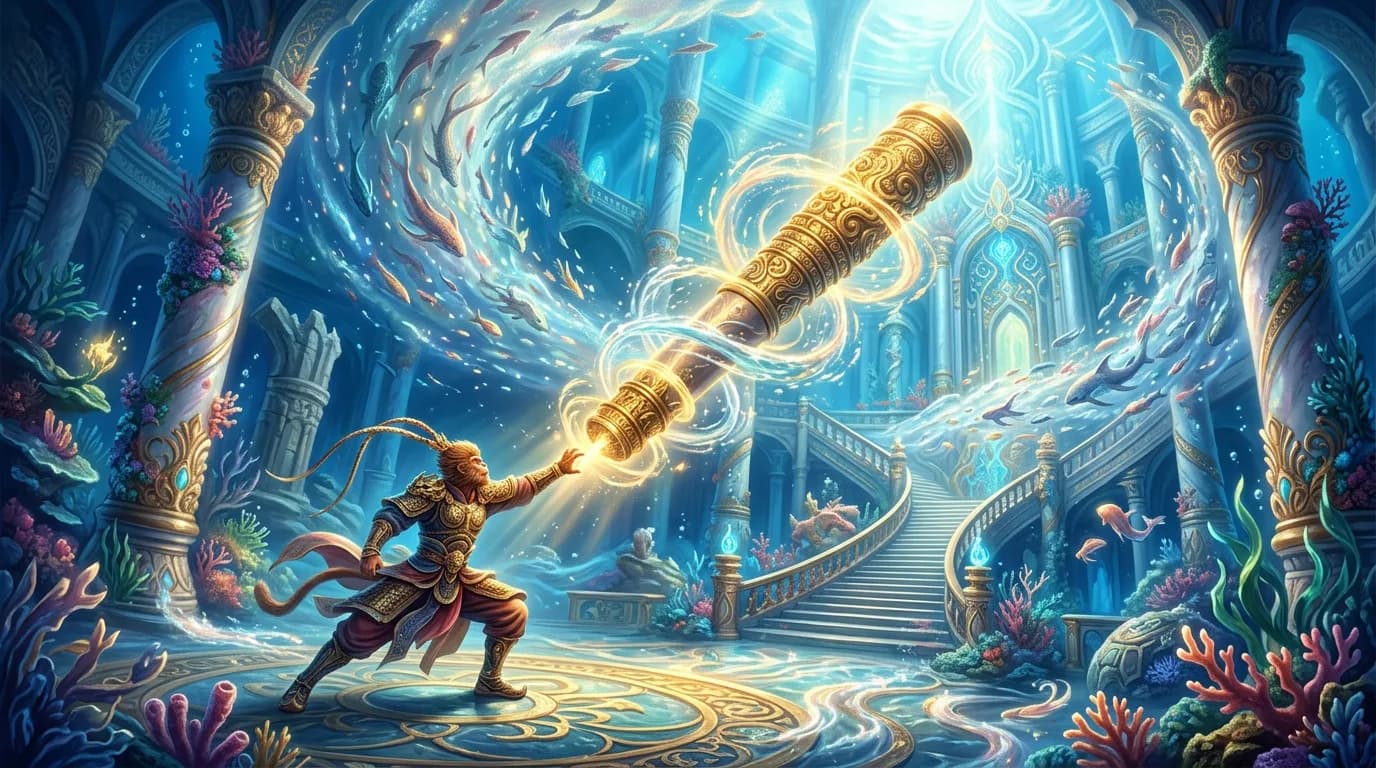
Sun Wukong's somersault cloud carries him 108,000 li in one leap, yet he walks the whole pilgrimage on foot beside his master.
In a single leap, Sun Wukong covers 108,000 li, roughly 54,000 kilometres, far enough to circle the Earth more than once. That is only one of the gifts the Monkey King gathers in the first chapters of Journey to the West, the 16th century Chinese novel usually attributed to Wu Cheng'en. By the time Heaven tries to bring him under control, he can change into almost anything, turn his hair into a crowd of copies, freeze his opponents in place, and see through every disguise.
Key Facts About Sun Wukong's Powers
- •Sun Wukong's best known powers are the 72 transformations, the somersault cloud, fiery golden eyes, and the ability to turn his 84,000 hairs into copies of himself.
- •The Taoist master Puti Zushi taught Sun Wukong the 72 transformations and the somersault cloud before sending him away for showing off.
- •Sun Wukong's somersault cloud carries him 108,000 li in one leap, which is about 54,000 kilometres or 34,000 miles.
- •Sun Wukong gained his fiery golden eyes after 49 days inside Laozi's furnace, where he hid in the corner of the wind trigram.
- •In Journey to the West only the Buddha fully stops Sun Wukong, by winning a wager that the Monkey King cannot leave the Buddha's palm.
Quick Answer
Sun Wukong's best known powers are the 72 transformations, the somersault cloud, fiery golden eyes, and the ability to turn his 84,000 hairs into copies of himself.
Where Sun Wukong's Powers Come From
Sun Wukong is born from a stone egg on the Mountain of Flowers and Fruit and becomes king of the monkeys by leaping through a waterfall. Then he realises that even a king grows old and sets out across the sea to find a teacher who can show him how to live forever.
He finds the Taoist sage Puti Zushi, who gives him his religious name, Sun Wukong, meaning roughly "monkey awakened to emptiness". Under this master he learns the secret of long life and then the great skills that define him. These powers are learned, not inherited, and he loses his place with his teacher as soon as he shows them off.
The rest of his powers come from things he takes: a staff from the Dragon King's treasury, the Peaches of Immortality, the wine of a royal banquet, and the pills of longevity the sage Laozi had been refining. The Monkey King legend page on Visionaria follows that whole rise and fall.
The 72 Transformations
The power most people know is the ability to change shape. Puti Zushi offers his student a choice between two sets of changes: 36, called the Heavenly Ladle, or 72, called the Earthly set. Sun Wukong chooses 72, and with them he can become birds, insects, fish, trees, temples, and other people.
The number is not a strict list. In Chinese tradition 72 suggests completeness, and in the story Sun Wukong takes far more than 72 shapes.
The tail problem
The transformations have one famous weakness: his tail. When Sun Wukong turns himself into a small temple to fool his rival Erlang Shen, he has nowhere to put it, so he turns it into a flagpole standing behind the building. Erlang notices at once, because no temple has a flagpole at the back. Even his greatest power depends on his wits.
The Somersault Cloud
Sun Wukong's second great skill is travel. His teacher notices that he leaps like a monkey when he flies, so instead of the slow cloud flight other immortals use, he teaches him the somersault cloud (筋斗雲). With one somersault Sun Wukong travels 108,000 li.
That is the point of the joke. The pilgrimage to the West takes the monk Tang Sanzang fourteen years on foot, yet his disciple could reach the destination in a moment. The scriptures cannot simply be fetched: the pilgrims have to walk the road themselves, so the fastest traveller in the story spends years walking beside a horse.
Translations write it both ways, somersault cloud and cloud somersault.
Fiery Golden Eyes and the Diamond Body
After Sun Wukong is finally captured in Heaven, the gods try to punish him and fail: blades, lightning and fire leave no mark on him. Laozi then places him inside his Eight Trigrams Furnace, where he refines his elixirs, and leaves him there for 49 days.
The plan does not work. Sun Wukong hides in the corner of the furnace marked by the wind trigram, where there is wind but less fire, and the smoke only reddens his eyes. When the furnace is opened he leaps out with fiery golden eyes (火眼金睛) that can see through any disguise. On the journey west this becomes one of his most useful gifts: demons who appear as harmless travellers, old women, or monks cannot hide their real form from him.
After the peaches, the wine and Laozi's pills, his body is nearly impossible to harm, which is why Heaven runs out of ways to punish him.
His 84,000 Hairs and the Body-Fixing Spell
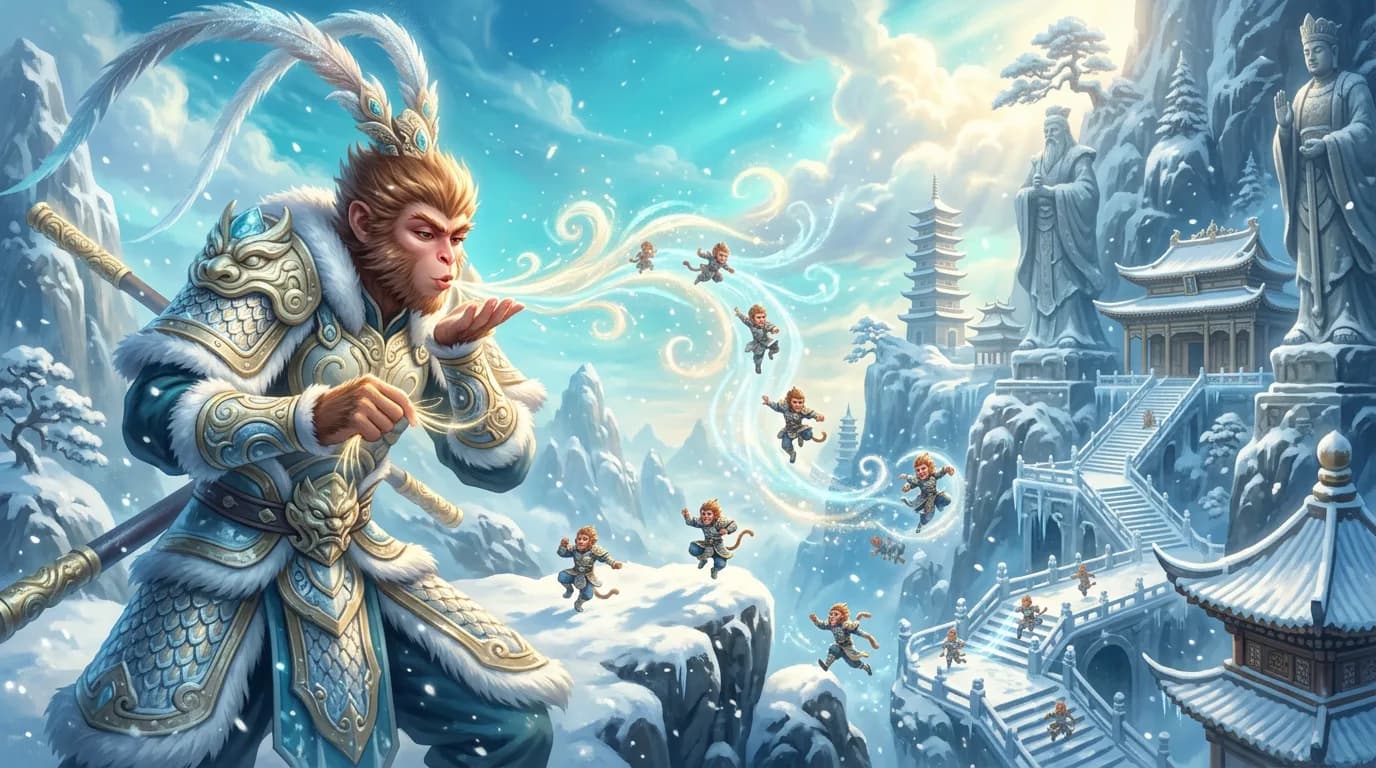
Sun Wukong carries a crowd with him at all times. He has 84,000 hairs, and he can pluck a handful, chew them, blow them out and shout "Change!" Each hair becomes whatever he wishes, most often a copy of himself, so a single monkey can suddenly become hundreds.
He also knows the Body-Fixing Method, a spell that freezes humans, gods and spirits in place for up to a day. He uses it to freeze guards or demons and simply walk past them, winning by wit rather than strength.
His staff, the Ruyi Jingu Bang, completes the set. It weighs 13,500 jin, obeys his thoughts, and shrinks to a needle he keeps in his ear. We cover its name, origin and weight in our guide to Sun Wukong's staff.
How Powerful Is Sun Wukong?
Within the story, Sun Wukong is one of the strongest beings in Heaven and on Earth. He can carry two mountains on his shoulders and still run. His staff is so heavy that the Dragon King's servants could not move it. When he rebels, the Jade Emperor sends wave after wave of heavenly soldiers, and the Monkey King sends every one of them home.
His strength is never only physical, though. His real advantage is the mix of powers: he can change shape to slip past a guard, see through a disguise, fly away in an instant, or freeze a whole hall of opponents. Greek heroes such as Hercules, whose labours are told in our guide to the myth of Hercules and the hero's journey, are mostly famous for strength alone.
Even Sun Wukong has limits
The novel is careful to give him weaknesses. He is clumsy underwater and needs a spell even to travel through it. His spell against fire fails against the True Samadhi Fire of the demon Red Boy. And when the monk Tang Sanzang recites a special sutra, the golden headband on Sun Wukong's head tightens until he begs him to stop, which is how a gentle monk keeps the most powerful disciple in the story in line.
Who Can Beat Sun Wukong?
Only a few figures in Journey to the West ever get the better of him.
Erlang Shen. The heavenly general Erlang is the only rival who matches Sun Wukong evenly. Their contest turns into a chase of transformations: Sun Wukong becomes a sparrow and Erlang a hawk, he becomes a fish and Erlang a fishing bird. Erlang finally captures him only with help, when Laozi throws his Diamond Jade ring from above and knocks the monkey off his feet.
The Buddha. After Sun Wukong escapes Laozi's furnace and storms toward the Jade Emperor's throne, Heaven calls on the Buddha. The Buddha offers a wager: if Sun Wukong can leap out of his palm, he may rule Heaven. The monkey somersaults to the end of the world, sees five great pillars, and writes his name on one to prove he was there. When he returns, the Buddha shows him the writing on his own finger. The five pillars were the Buddha's fingers all along.
The Buddha then turns his hand into a mountain and seals the monkey beneath it for 500 years, the turning point of his whole story.
Is Sun Wukong a God?
Sun Wukong begins as a monkey born from stone, and through study and stolen treasures he becomes an immortal. Heaven gives him official ranks to keep him calm: first the lowly post of Keeper of the Heavenly Horses, the Bimawen, which he rejects as an insult, and later the empty title he names himself, Great Sage Equal to Heaven.
At the end of Journey to the West, after the pilgrims bring the scriptures home, the Buddha raises him to Buddhahood with the title Victorious Fighting Buddha (鬥戰勝佛). So in the novel he finishes the story as a Buddha, not a god in the Greek sense. In Chinese folk religion, however, he is worshipped as a deity in temples, especially in southern China, Taiwan and Southeast Asia. Unlike the gods of Olympus in the mythological world of Zeus, who are born divine, the Monkey King earns his place.
Hearing the Monkey King's World
Much of Sun Wukong's appeal is sensory: the rush of air on the somersault cloud, the glow inside Laozi's furnace. That is the idea behind cinematic imagination, the way Visionaria tells stories: a narrator places you inside the scene and spatial audio builds the world around you.
There is no Monkey King episode in the Visionaria app yet. Its journeys today take you through five ancient cities, including Troy, Sparta and Babylon. If you would like to try the feeling of stepping inside a legend, you can start a free Visionaria journey with headphones on and your eyes closed.
This article is for educational and informational purposes only. Historical details are based on available research and may evolve as new evidence emerges.
Visionaria journeys are designed for relaxation, guided imagination, and personal enrichment. They are not a substitute for medical, mental health, legal, or professional advice.