Sun Wukong's Staff: The Ruyi Jingu Bang, From Sea Pillar to Needle
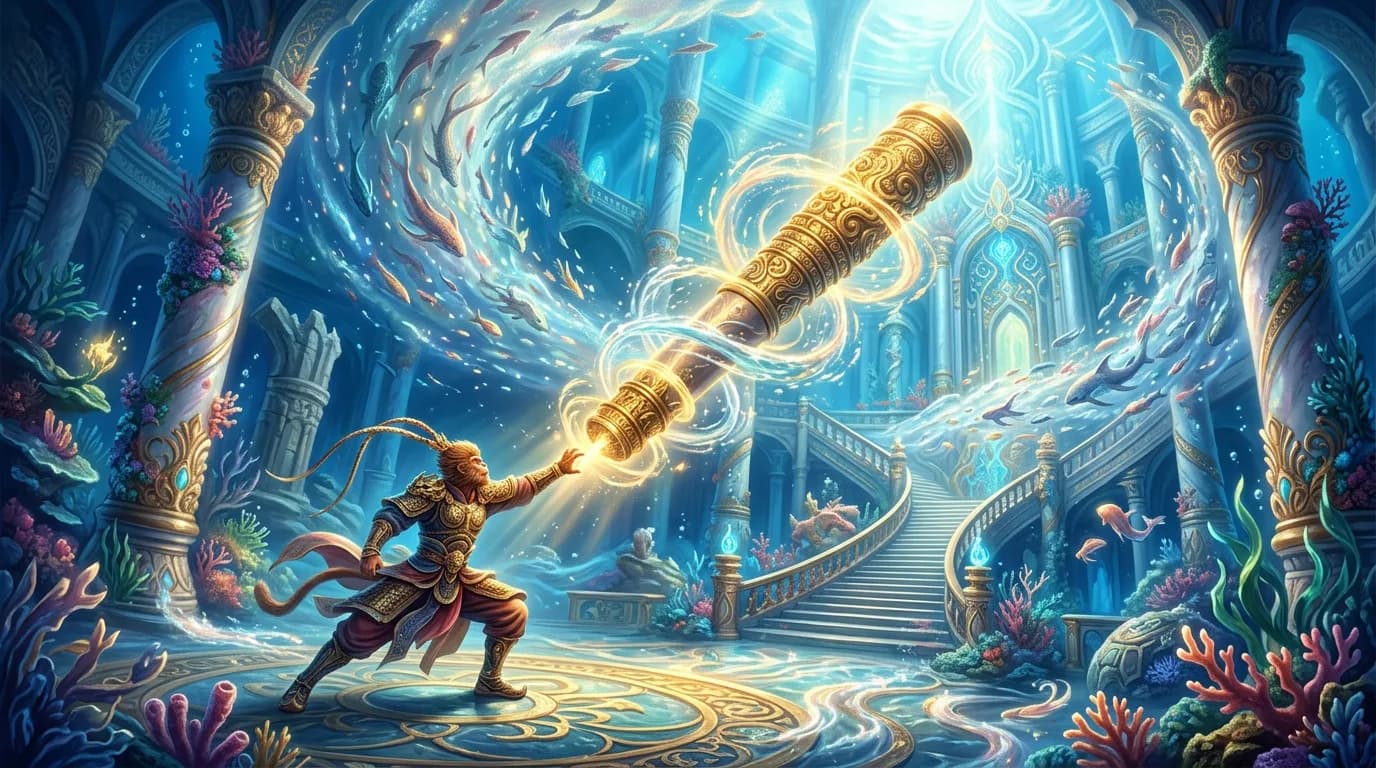
Between adventures Sun Wukong shrinks his staff to the size of a needle and keeps it tucked inside his ear.
- What Is Sun Wukong's Staff Called?
- Where Did Sun Wukong Get His Staff?
- How Heavy Is Sun Wukong's Staff?
- What Can the Ruyi Jingu Bang Do?
- Why the Staff Matters to the Story
- The Staff Before Journey to the West
- A Sun Wukong Staff Replica: What Makes One Faithful
- Hearing the Legend Instead of Reading It
- Frequently Asked Questions
The most famous staff in Chinese literature spends most of its time as a needle tucked inside a monkey's ear. Its owner, Sun Wukong, found it standing in a dragon's treasury at the bottom of the Eastern Sea, where it had stood since a legendary emperor used it to measure the great flood. In Journey to the West it weighs 13,500 jin, answers to its owner's thoughts, and can stretch from the ocean floor to the sky.
Key Facts About Sun Wukong's Staff
- •Sun Wukong's staff is called the Ruyi Jingu Bang, which means roughly "as-you-wish golden-hooped rod" in Chinese.
- •The Monkey King takes the Ruyi Jingu Bang from the undersea treasury of Ao Guang, the Dragon King of the East Sea, in chapter 3 of Journey to the West.
- •The inscription on the Ruyi Jingu Bang gives its weight as 13,500 jin, about 7,960 kilograms by a Ming dynasty jin of roughly 590 grams.
- •The Ruyi Jingu Bang can grow, shrink, and multiply at its owner's will, and between adventures Sun Wukong keeps it as a needle in his ear.
- •A faithful Ruyi Jingu Bang replica has a dark iron shaft, a gold band at each end, and the inscription with the staff's name and weight.
Quick Answer
Sun Wukong's staff is called the Ruyi Jingu Bang, which means roughly "as-you-wish golden-hooped rod" in Chinese.
What Is Sun Wukong's Staff Called?
The staff's full name is 如意金箍棒, written in pinyin as Rúyì Jīngū Bàng. Each part of the name describes it. Rúyì means "as you wish" or "as you will": the staff does what its holder wants. Jīngū means "golden hoop", for the gold band at each end. Bàng is a rod or cudgel.
English translators have handled the name in different ways. Anthony C. Yu, whose four volume translation from the University of Chicago Press is the standard scholarly English edition, calls it the "Compliant Golden-Hooped Rod". W. J. F. Jenner renders it as the "As-You-Will Gold-Banded Cudgel". Readers and fans usually shorten it to Ruyi Bang, Jingu Bang, or simply the Monkey King's staff, and in Japanese it is the nyoi bō.
The staff has a second name that comes from its first job. Before Sun Wukong took it, it was known as the Dinghai Shenzhen (定海神針), the "divine needle that steadies the sea". The Wikipedia entry on Sun Wukong records both names together, and the second one explains why a dragon kept a giant iron pillar in his treasury at all.
Where Did Sun Wukong Get His Staff?
The story of the staff begins in chapter 3 of Journey to the West, the 16th century novel usually attributed to Wu Cheng'en. Sun Wukong has just returned from years of study with a Taoist master. He has learned the 72 transformations and the cloud somersault, and he has become king of the monkeys on the Mountain of Flowers and Fruit. What he lacks is something worthy to carry.
He dives into the Eastern Sea and visits Ao Guang, the Dragon King, in his crystal palace. The Dragon King, anxious to please this strange and powerful guest, has his servants bring out a series of fine pieces from the armoury. Sun Wukong lifts each one and puts it down again. Every one of them is too light.
The answer comes from the Dragon Queen. She reminds her husband of the iron pillar in the treasury, which for some days had been glowing with a strange light. Perhaps, she suggests, it has been waiting for this visitor. The Dragon King doubts that anyone can move it, but he lets the monkey try.
The pillar that measured the flood
The pillar has a history older than the Dragon King's palace. According to the novel, it was used by Yu the Great, the legendary ruler who tamed China's great flood, to measure the depth of the rivers and seas. When the work was done it stayed under the ocean, steadying the waters. That is the "divine needle that steadies the sea".
The novel never says how the pillar was made or who forged it. It simply stands in the treasury, dark iron with a gold band at each end, about twenty feet tall and as thick as a barrel, according to the Wikipedia summary of the staff and the novel's third chapter.
The moment it shrinks
Sun Wukong grips the pillar and says it is a little too big. It shrinks. He says it again, and it shrinks again, until it is a little taller than he is and about as thick as a rice bowl. Only then does he notice the inscription along its side, which in Yu's translation reads: "The Compliant Golden-Hooped Rod. Weight: thirteen thousand five hundred catties."
The Monkey King is delighted. The Dragon King is less so, and his mood does not improve when his guest asks for clothes to match. Ao Guang calls his three brothers, the Dragon Kings of the other seas, and together they give Sun Wukong a cap of phoenix feathers, a shirt of golden chain mail, and cloud-walking boots. He leaves the sea fully dressed, carrying the pillar that once held the ocean still.
How Heavy Is Sun Wukong's Staff?
The inscription answers the question directly: 13,500 jin (一萬三千五百斤). A jin is a traditional Chinese unit of weight, and its value has changed over the centuries. Using a Ming dynasty jin of about 590 grams, the period when the novel was written, the staff weighs roughly 7,960 kilograms, or about 17,550 pounds.
The number matters in the story, not just as trivia. The weight is the reason the Dragon King's other pieces fail: Sun Wukong needs something that matches his own strength, and nothing lighter will do. It also tells the reader something about the monkey himself. A hero who can swing nearly eight tonnes of iron as easily as a bamboo pole is not an ordinary trickster.
One curiosity surrounds the English versions. Early English editions of Yu's translation gave the weight in pounds, which made the staff sound far lighter than the Chinese text intends. Because the original uses jin, a heavier unit, the wording in English editions was later adjusted, according to the Ruyi Jingu Bang article. If you have seen the staff described as weighing "13,500 pounds", that older rendering is the reason.
What Can the Ruyi Jingu Bang Do?
The word ruyi, "as you wish", is the key to every power the staff has. It obeys its owner's will, and the novel uses that idea in several different ways.
Grow and shrink at a word
The staff can stretch to almost any size. In the novel it grows tall enough to reach from the sea to the heavens, and it can shrink until it is no bigger than an embroidery needle. Sun Wukong usually keeps it in that tiny form tucked inside his ear, so he never has to carry it. When he needs it, he pulls it out, says the word, and it becomes a full rod in his hand.
Multiply and move on its own
Like its owner, the staff can become many. The inscription and the story describe it obeying commands to multiply and to move, so one rod can turn into a crowd of rods. Sun Wukong can also pull hairs from his body and turn them into copies of himself, so in some scenes a small army of monkeys, each with its own staff, fills the page.
Draw a protective circle
One of the gentlest uses of the staff comes later in the journey. When Sun Wukong has to leave his master, the monk Tang Sanzang, alone for a while, he draws a circle on the ground around him with the tip of the staff. The novel describes the circle as a ward as strong as an iron wall: as long as the monk stays inside, tigers, wolves and demons cannot reach him. The story turns on what happens when the travellers step out of it.
Why the Staff Matters to the Story
The staff is more than a powerful object. It mirrors the Monkey King's own path through Journey to the West.
At the start, Sun Wukong takes it the way he takes everything: by insisting. He refuses every lighter offer, he ignores the Dragon King's discomfort, and he leaves wearing borrowed finery. The staff becomes the symbol of his early pride, the tool he carries when he names himself Great Sage Equal to Heaven and storms the Jade Emperor's palace. The Monkey King legend page on Visionaria follows that rebellion and the 500 years he spends trapped beneath a mountain by the Buddha.
On the pilgrimage west, the same staff takes on a different meaning. It still answers to his will, but his will has changed. He uses it to clear the road and to guard the monk he has sworn to protect, so a tool that once steadied the sea becomes a guardian again. Like the twelve labours that shape Hercules in Greek myth, told in our guide to the myth of Hercules and the hero's journey, the journey turns raw power into something steadier.
A tool among the gods' great objects
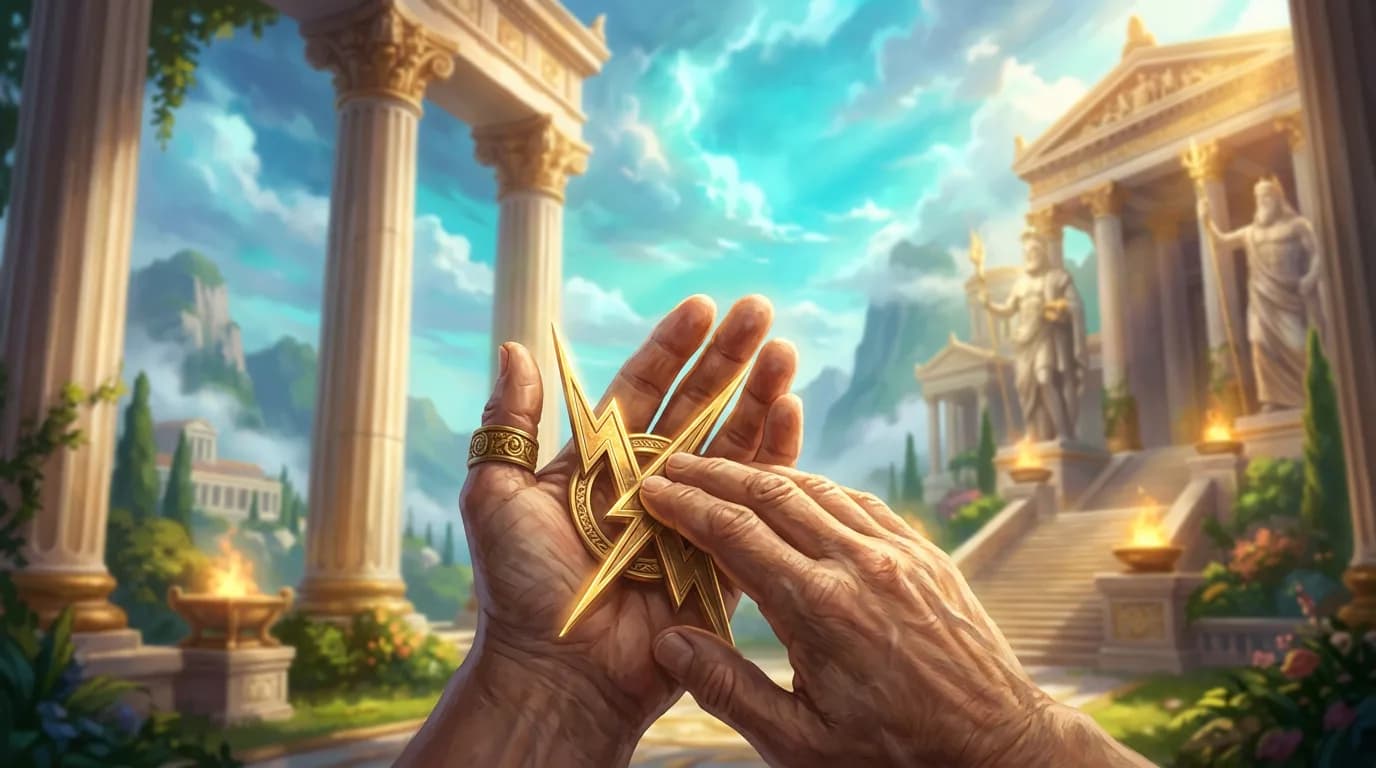
World mythology is full of objects that belong to a single hero or god: Zeus and his thunderbolt, Thor and his hammer. What sets the Ruyi Jingu Bang apart is that it comes from the sea and from a dragon. Chinese dragons rule rain, rivers and oceans, and our article on the origins of dragons across world mythology explains why the Dragon Kings, rather than a smith or a sky god, are the ones who hold the staff. Compare it with the symbols in the mythological world of Zeus and the contrast is clear: the thunderbolt falls from the sky, the staff rises from the deep.
The Staff Before Journey to the West
The staff in the novel we read today was not always an iron pillar. In an earlier version of the pilgrimage story, a 13th century text known as the Kōzanji version, the monkey carries a golden monk's staff of the kind Buddhist pilgrims used, a gift from the deity Brahma. That staff could even turn into a guardian spirit carrying a club.
An iron cudgel also appears in an earlier Ming dynasty version of the story, and the Ruyi Jingu Bang article suggests its rings may have influenced the gold bands on the later staff. By the time the 100 chapter novel took shape in the 16th century, the staff had become the dark iron rod with golden ends that readers know today.
A Sun Wukong Staff Replica: What Makes One Faithful
The staff's popularity has grown far beyond the novel. It appears in Chinese opera, where performers spin a light stage rod, and in modern anime, games and comics around the world. Many fans look for a Sun Wukong staff replica of their own, and the novel gives a clear checklist for one that is true to the source.
The shaft. In the novel the staff is dark iron, so a replica true to the book has a dark shaft rather than a painted one.
The bands. A gold band at each end is the one detail every version shares, and it is the "golden hoop" in the staff's name.
The inscription. A faithful replica carries the staff's name and weight, 如意金箍棒重一萬三千五百斤, along the shaft.
The proportions. When Sun Wukong first shrinks it, the staff is a little taller than he is and as thick as a rice bowl, so a full size piece should stand slightly above the person holding it.
Hearing the Legend Instead of Reading It
Part of the staff's appeal is how physical it is: the glowing pillar in a green underwater palace, the creak of iron as it shrinks, the soft sound of a needle slipping into an ear. Those are details you feel more than read. That is the idea behind cinematic imagination, the way Visionaria tells stories: a narrator places you inside the scene, and spatial audio builds the space around you while your mind paints the rest.
There is no Monkey King episode in the Visionaria app yet. Its journeys today take you through five ancient cities, from Troy and Sparta to Babylon and Alexandria, and our guide to meditation for history and mythology lovers explains how they work. If the undersea palace of the Dragon King is the kind of place you want to stand in, you can try a free Visionaria journey tonight with headphones on and your eyes closed.
This article is for educational and informational purposes only. Historical details are based on available research and may evolve as new evidence emerges.
Visionaria journeys are designed for relaxation, guided imagination, and personal enrichment. They are not a substitute for medical, mental health, legal, or professional advice.