
The Myth of Hercules and the Hero's Journey: Complete Guide to Greek Mythology's Greatest Legend
💡 Fun fact: Hercules was so strong that as an infant in his cradle, he overcame two serpents sent by Hera. Most babies can barely hold a rattle. Clearly, some overachievers start early.
- Who Is Hercules? The Greatest Hero of Greek Mythology
- The Twelve Labors: A Journey of Transformation
- Hercules and Campbell's Hero's Journey Framework
- The Call to Adventure: How Hercules Began His Path
- Trials and Transformation: The Labors as Inner Growth
- The Nemean Lion: Facing the Impossible
- The Hydra: Confronting Challenges That Multiply
- The Underworld Journey: Facing the Deepest Realms
- Hercules as a Symbol of Human Resilience
- The Hero's Journey in Modern Storytelling and Meditation
- Immersive Audio and the Hero's Journey
- Embracing Your Own Hero's Journey
- The Bottom Line
- Frequently Asked Questions
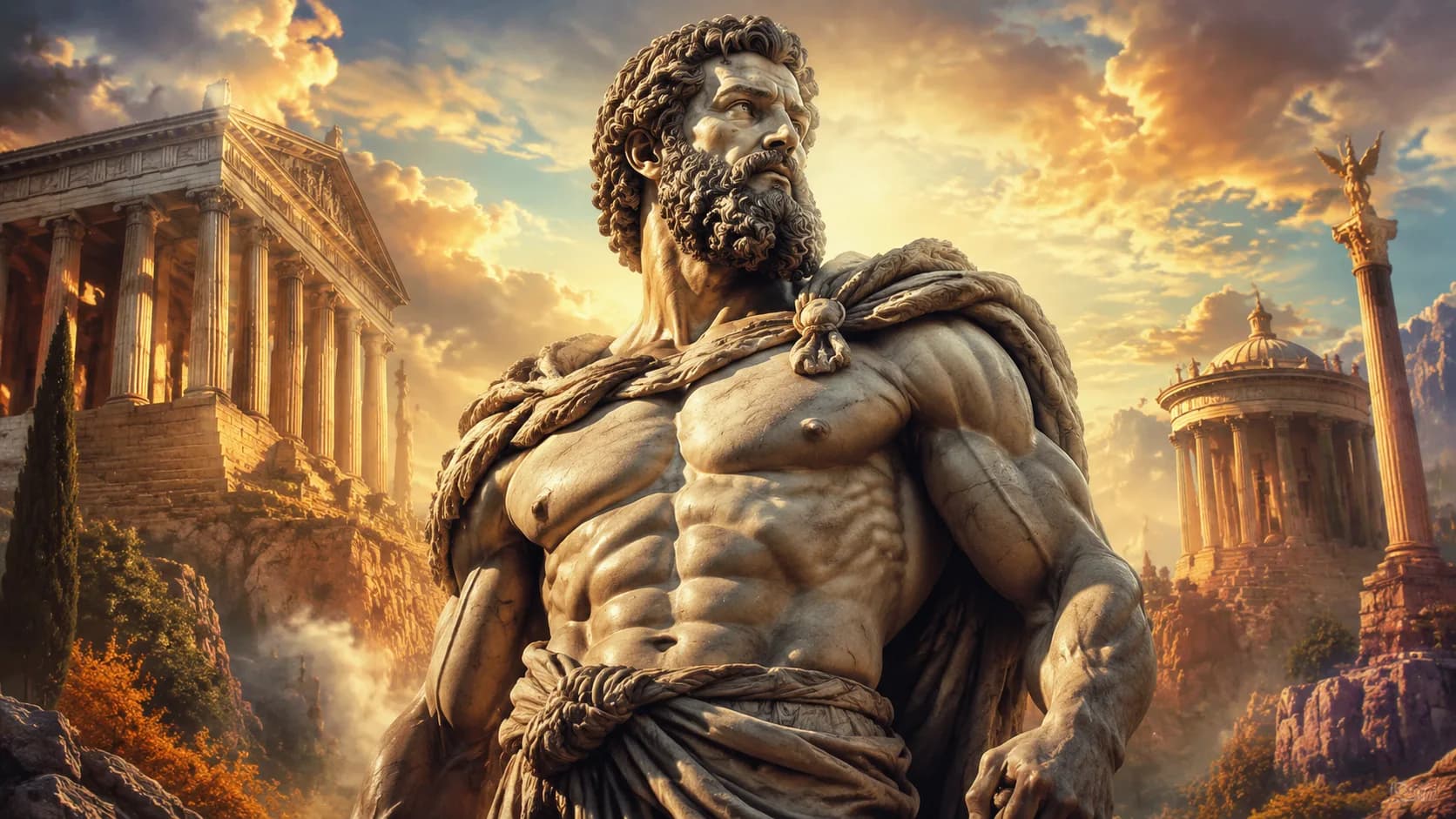
Close your eyes and imagine standing at the base of Mount Olympus, where the mortal world meets the realm of the gods. Above you, clouds swirl around divine palaces. Before you stretches a path marked by impossible challenges a lion impervious to any weapon, a serpent that grows two new heads for every one removed, and a journey into the deepest realms below the earth. This is the path of Hercules (Heracles in Greek), the greatest hero of ancient mythology, whose twelve legendary labors represent the most famous hero's journey ever told.
The myth of Hercules and the hero's journey tells the story of Zeus's mortal son who, burdened by circumstances beyond his control, was assigned twelve seemingly impossible labors that took him to the ends of the known world and beyond. Through each labor, Hercules evolved from a man defined by raw strength into a figure of wisdom, endurance, and transcendence embodying what mythologist Joseph Campbell would later identify as the universal "monomyth": the pattern of departure, initiation, and return that underlies heroic narratives across all cultures. The Hercules myth continues to shape story-based experiences and modern storytelling to this day.
In this comprehensive guide, you'll explore each phase of Hercules' legendary journey, understand how his twelve labors map onto Campbell's hero's journey framework, discover the symbolic meaning behind each challenge, and learn how the ancient Greek understanding of heroic transformation connects to modern meditation and inner world expansion. Whether you're a mythology enthusiast, a student of narrative structure, or someone seeking inspiration for your own journey of personal growth, the story of Hercules offers timeless wisdom about what it means to face the impossible and transform through the effort.
"Hercules had to clean the Augean stables housing 3,000 cattle that hadn't been cleaned in 30 years. And you thought your Monday morning was rough."
Key Facts About Hercules and the Hero's Journey
- ••Greek Name: Heracles (Ἡρακλῆς), meaning "Glory of Hera", ironically named after the goddess who opposed him throughout his life
- ••Parentage: Son of Zeus (king of the gods) and Alcmene (mortal queen of Tiryns), making him a demigod of extraordinary power
- ••Twelve Labors: Assigned by King Eurystheus as tasks of atonement, each representing a different aspect of heroic growth and inner transformation
- ••Cultural Impact: Hercules appears in the mythology of Greece, Rome, Etruria, and later Western art, literature, and philosophy spanning over 3,000 years
- ••Hero's Journey: Joseph Campbell's 1949 work The Hero with a Thousand Faces identified the Hercules myth as a prime example of the universal monomyth pattern
- ••Legacy: The word "herculean" in modern English means "requiring enormous strength or effort", testament to the myth's enduring power
Quick Answer
💡 Fun fact: Hercules was so strong that as an infant in his cradle, he overcame two serpents sent by Hera. Most babies can barely hold a rattle. Clearly, some overachievers start early.
Who Is Hercules? The Greatest Hero of Greek Mythology
Hercules known as Heracles in the original Greek stands as the preeminent hero of ancient Greek mythology. Born to Zeus, king of the Olympian gods, and Alcmene, a mortal queen of exceptional virtue, Hercules embodied the fundamental tension at the heart of Greek heroism: the meeting of divine potential and human limitation. His extraordinary strength was a gift from his divine father, but his challenges, his labors, and his ultimate transformation were entirely the product of his mortal experience. This dual nature half god, half man made Hercules uniquely relatable to the ancient Greeks, who saw in him a reflection of their own struggles between aspiration and circumstance.
From the moment of his remarkable arrival in the world, Hercules was marked by both extraordinary gifts and extraordinary opposition. Hera, Zeus's divine consort, viewed the child as a living reminder of her husband's infidelity and pursued Hercules with relentless hostility throughout his life. When he was still an infant, Hera sent two enormous serpents to his cradle only to have the prodigious baby overcome them with his bare hands. This foundational episode established the pattern that would define Hercules' entire existence: challenge met with courage, adversity transformed into triumph. Every obstacle Hera placed in his path ultimately served to strengthen him, forging the raw material of divine inheritance into the refined gold of earned heroism.
Visionaria Insight
By immersing ourselves in these historical soundscapes, we reconnect with a timeless human tradition of storytelling and mental restoration.
What distinguishes Hercules from other mythological figures is not merely his strength but his capacity for growth through adversity. He was not a perfect being who descended to perform miracles he was a deeply flawed individual who made profound mistakes and then devoted his life to making amends through action. This narrative of transformation through effort rather than inherent perfection is precisely what made Hercules the most worshipped hero in the ancient world. Temples and sanctuaries dedicated to Hercules spread across the entire Mediterranean, from Athens to Rome to the Pillars of Hercules (modern Gibraltar), because his story spoke to something universal: the belief that human beings can transcend their limitations through perseverance, courage, and the willingness to face what seems impossible.
Hercules wasn't loved because he was perfect he was loved because he was imperfect and kept going anyway. The ancient Greeks understood that true heroism isn't the absence of struggle but the decision to persist through it. This insight forms the psychological foundation of modern imagination training for resilience.
Why did the Stoic cross the road? Because it was the rational thing to do, and he was indifferent to the traffic.
The Twelve Labors: A Journey of Transformation
The Twelve Labors of Hercules (Dodekathlos) form the central narrative of his myth and the backbone of his hero's journey. Assigned by King Eurystheus of Tiryns as tasks of atonement Hercules needed to redeem himself after a period of madness inflicted by Hera caused him to bring great harm to those he loved most these labors took Hercules from the familiar landscape of the Peloponnese to the furthest edges of the known world and beyond. Each labor escalated in difficulty, geographical scope, and symbolic significance, creating a narrative arc of progressive transformation that ancient audiences recognized as a map of the soul's journey toward wholeness.
Did You Know?
The relentless drive to understand the world was seen not just as an academic pursuit, but as a spiritual and healing practice by the ancients.
The labors divide naturally into three phases. The first six labors take place in the Peloponnese the known world and involve confronting tangible, physical challenges: the Nemean Lion, the Lernaean Hydra, the Ceryneian Hind, the Erymanthian Boar, the Augean Stables, and the Stymphalian Birds. The next three labors send Hercules to increasingly distant lands Crete, Thrace, and the realm of the Amazons expanding his geographical and psychological horizons. The final three labors take Hercules to the very boundaries of reality itself: the western edge of the world (Geryon's cattle), the Garden of the Hesperides (the apples of immortality), and ultimately the Underworld (capturing Cerberus). This progressive expansion from local to cosmic mirrors the hero's journey pattern described by narrative psychology: the hero must venture ever further from the familiar to discover what truly lies within.
What makes the Twelve Labors so narratively powerful and so enduringly relevant is that each labor demanded a different kind of excellence. The Nemean Lion required courage and ingenuity (conventional weapons failed; Hercules had to find another way). The Hydra demanded strategic thinking and collaboration (he couldn't succeed alone). The Ceryneian Hind required patience (he chased it for an entire year). The Augean Stables demanded creative problem solving (he redirected two rivers). This variety of challenges mirrors the imagination training principle that genuine growth requires engaging all dimensions of human capability physical, intellectual, emotional, and spiritual.
"Hercules had twelve labors. You have twelve months in a year. He captured the Cretan Bull; you can probably manage your inbox. Perspective is everything."

Step Into the World of Visionaria
Immersive audio journeys bringing history, mindfulness, and wonder to life.
What's an ancient intellectual's favorite exercise? Jumping to conclusions.
Hercules and Campbell's Hero's Journey Framework
In 1949, mythologist Joseph Campbell published The Hero with a Thousand Faces, identifying a universal narrative pattern the monomyth that appears across mythologies, religions, and storytelling traditions worldwide. Campbell's hero's journey follows a three act structure: Departure (the hero leaves the ordinary world), Initiation (the hero undergoes trials and transformation), and Return (the hero comes back transformed, bearing gifts for the community). The myth of Hercules maps onto this framework with remarkable precision, which is why Campbell himself referenced Heracles as one of the pattern's clearest expressions.
Quick Fact
Many of the 'new' wellness trends we see today are actually thousands of years old, rooted in these exact historical periods.
In the Departure phase, Hercules experiences the "Call to Adventure" (the oracle at Delphi instructs him to serve Eurystheus), the "Refusal of the Call" (his initial resistance to serving a lesser king), the "Supernatural Aid" (Athena and Hermes provide guidance and tools), and the "Crossing of the First Threshold" (leaving his home to face the Nemean Lion). The Initiation phase encompasses the twelve labors themselves each representing a "Road of Trials" that tests and transforms the hero. And the Return phase culminates in Hercules' apotheosis his elevation to divine status on Mount Olympus representing the hero's ultimate return as a being who has integrated both the mortal and divine aspects of his nature.
Read more: Meditation for Creativity and Imagination Expansion

Campbell's framework reveals something profound about why the Hercules myth has endured for over three millennia: it speaks to a universal psychological pattern that every human being recognizes. We all face calls to adventure (new challenges, life transitions, unexpected demands). We all undergo trials that test our capabilities. And we all have the potential to return from these experiences transformed carrying wisdom, resilience, and capacity we didn't possess before. This is precisely why interactive audio journeys and cinematic meditation are so effective: they allow participants to experientially inhabit the hero's journey, activating the same psychological processes that mythic narratives have engaged for thousands of years.
A time traveler went back to antiquity to teach them about 'holistic health.' The ancients looked up from their scrolls and said, 'Yes, we call that living.'
The Call to Adventure: How Hercules Began His Path
Every hero's journey begins with a call to adventure a disruption of ordinary life that demands response. For Hercules, the call came in the most devastating form imaginable. After Hera inflicted a period of temporary madness upon him, Hercules emerged to discover he had caused irreparable harm to his own family the people he loved most in the world. Consumed by grief and seeking redemption, he traveled to the Oracle at Delphi, where the Pythia delivered his fate: he must serve King Eurystheus of Tiryns and complete whatever tasks were demanded of him. Only through service, endurance, and perseverance could he atone and discover his true purpose.
This origin of the hero's journey is strikingly honest about the relationship between pain and transformation. Hercules doesn't set out on his quest because he wants glory he sets out because he has caused harm and needs to heal both himself and the world around him. The Greeks understood that the most powerful transformations often begin not with ambition but with the honest acknowledgment of failure. Hercules' willingness to accept responsibility, submit to service, and face impossible challenges as the price of redemption elevates his story from adventure tale to spiritual parable one that resonates with anyone who has ever needed to rebuild after a devastating setback.
Visionaria Insight
By immersing ourselves in these historical soundscapes, we reconnect with a timeless human tradition of storytelling and mental restoration.
The figure of Eurystheus the weak, fearful king who assigns the labors adds another layer of meaning to the call. In Campbell's framework, the "threshold guardian" is an apparently hostile force that actually serves the hero's development. Eurystheus, terrified of Hercules and determined to give him impossible tasks, unwittingly becomes the instrument of Hercules' greatest growth. Every labor designed to overwhelm him instead expanded his capabilities. This insight that the forces opposing us often serve our development is a foundational principle of both emotional resilience training and narrative-based wellness practices.
"Hercules' boss gave him impossible deadlines and unreasonable expectations. Sound familiar? The difference is, Hercules' performance reviews involved actual lions."
Why did the Stoic cross the road? Because it was the rational thing to do, and he was indifferent to the traffic.
Trials and Transformation: The Labors as Inner Growth
Ancient Greek audiences didn't experience the Twelve Labors merely as adventure stories they understood them as allegorical representations of the soul's development. The Stoic philosophers, who deeply admired Hercules, interpreted each labor as a stage of moral and spiritual refinement. Cleaning the Augean Stables, for instance, represented the cleansing of the soul from accumulated impurities a task that required not brute force but intelligence (redirecting river waters) and a willingness to do unglamorous but necessary work. Capturing the Ceryneian Hind, sacred to Artemis and uncatchable, represented the cultivation of patience and respect Hercules pursued it for an entire year without harming it, learning restraint where previously he had known only action.
Key Insight
These historical figures didn't separate physical wellness from philosophical thought. To them, it was all one continuous practice of living well.
The progressive structure of the labors reflects a psychological journey from external to internal mastery. The early labors are primarily physical confrontations overcoming the Nemean Lion, confronting the Hydra, capturing the Erymanthian Boar. These require courage, strength, and tactical skill. But as the labors progress, they increasingly demand wisdom, diplomacy, and spiritual depth. Obtaining the Belt of Hippolyta required negotiation (which failed due to Hera's interference, teaching Hercules about forces beyond individual control). Fetching the Apples of the Hesperides required enlisting the Titan Atlas learning to delegate and trust others. And the final labor entering the Underworld demanded confrontation with the deepest mysteries of existence itself.
This pattern of progressive internalization mirrors what modern meditation research reveals about personal development: genuine growth moves from mastering external challenges to transforming internal landscapes. Just as Hercules' journey takes him from physical confrontations to metaphysical encounters, effective meditation practice progresses from managing external stress to exploring and expanding the rich interior world of imagination, emotion, and self-understanding. The Twelve Labors, read symbolically, constitute one of humanity's earliest and most sophisticated roadmaps for inner transformation.
Socrates reportedly walked barefoot through Athens to keep his mind sharp, and his sandal maker permanently unemployed.
The Nemean Lion: Facing the Impossible
The First Labor overcoming the Nemean Lion established the template for every challenge that followed and contains some of the myth's most powerful symbolic content. The Nemean Lion was no ordinary beast: its hide was impervious to all weapons arrows, swords, and spears simply bounced off. This seemingly invincible creature terrorized the valley of Nemea, and Eurystheus sent Hercules against it expecting certain failure. The labor's genius lies in what it demanded: when conventional approaches failed, Hercules had to abandon his weapons entirely and rely on his own unaided strength, intelligence, and courage ultimately overcoming the lion through direct physical engagement in its own cave.
Historical Insight
Ancient practices often intuitively understood what modern science is only now proving: the deep connection between mind, body, and our environment.
The symbolic meaning runs deep. The Nemean Lion represents the challenges in life that cannot be solved by conventional means the problems that resist every familiar strategy you throw at them. Hercules' breakthrough came not from finding a bigger weapon but from recognizing that the situation demanded a completely different approach. This is the essence of creative problem solving: the willingness to abandon what isn't working and discover what will, even when the new approach feels uncomfortable or frightening. After his triumph, Hercules wore the lion's skin as armor for the rest of his journey meaning the very challenge that seemed impossible became his greatest source of protection and identity.
This transformation of obstacle into asset is one of the most powerful psychological truths embedded in the Hercules myth. Modern imagination training and resilience research confirm what the ancient Greeks intuited: the challenges that most threaten us, once faced and integrated, become our most reliable sources of strength. The Nemean Lion teaches that impossibility is often a perception rather than a fact and that the way through is frequently the one we haven't tried yet.
Why did the Stoic cross the road? Because it was the rational thing to do, and he was indifferent to the traffic.
The Hydra: Confronting Challenges That Multiply
The Second Labor confronting the Lernaean Hydra introduces one of mythology's most psychologically astute metaphors. The Hydra was a multi headed serpent dwelling in the swamps of Lerna, and it possessed a terrifying ability: for every head removed, two new heads grew in its place. Attacking the problem directly only made it worse. One head was immortal and couldn't be removed at all. The swamp itself was toxic. And to compound matters, Hera sent a giant crab to attack Hercules' feet while he engaged the serpent additional complications arriving precisely when he was most overwhelmed.
Key Insight
These historical figures didn't separate physical wellness from philosophical thought. To them, it was all one continuous practice of living well.
The Hydra is the perfect metaphor for problems that multiply the more you attack them anxiety that grows the more you fight it, conflicts that escalate with every confrontation, tasks that seem to spawn three new items for every one you complete. The myth's solution is equally instructive: Hercules could not overcome the Hydra alone. He enlisted his nephew Iolaus, who cauterized each stump with fire before new heads could grow. The immortal head, which couldn't be removed, was buried under a massive stone contained, not eliminated. This nuanced approach teaches several profound lessons: some problems require collaboration (Hercules needed Iolaus); some problems require changing strategy (cauterization instead of cutting); and some problems can only be managed, not eliminated (the immortal head buried but never gone).
For modern practitioners of visualization meditation and imagination training, the Hydra offers profound guidance. The myth teaches that brute force approaches to internal challenges trying to suppress anxiety, eliminate fear, or muscle through resistance often make things worse. True mastery requires intelligent strategy, support from others, and the wisdom to accept that some challenges are permanent companions to be managed rather than problems to be solved. This is precisely what modern cognitive behavioral approaches and narrative-based relaxation practices teach.
Why did the Stoic cross the road? Because it was the rational thing to do, and he was indifferent to the traffic.
The Underworld Journey: Facing the Deepest Realms
The Twelfth and Final Labor descending to the Underworld to bring back Cerberus, the three headed guardian of the realm below represents the ultimate test of the hero's journey and the most symbolically rich episode in the entire Hercules myth. Campbell identified the "descent to the underworld" as the supreme ordeal of the monomyth: the moment when the hero must confront the deepest, most hidden aspects of existence and emerge transformed. For Hercules, this meant entering the realm from which no mortal was supposed to return the domain of Hades himself and facing its guardian not with weapons but with bare-handed courage and the wisdom accumulated through all previous labors.
Before reaching Cerberus, Hercules first underwent the Eleusinian Mysteries the famous secret initiation rites at Eleusis as spiritual preparation for the descent. This detail is significant: even the greatest hero needed ritual preparation before facing the depths. Within the Underworld, Hercules encountered the shades of departed heroes and freed the Athenian king Theseus, who had been trapped there demonstrating that the hero's journey benefits not only the hero but those encountered along the way. When he finally confronted Cerberus, Hades granted permission for Hercules to take the beast on one condition: he must overcome it using no weapons. Hercules wrapped the three headed guardian in his lion skin arms and held on until Cerberus submitted strength tempered by restraint, power guided by wisdom.
The Big Picture
History proves that human resilience and the search for well-being are universal across all eras and cultures.
The Underworld journey symbolizes the confrontation with our deepest fears, our shadow selves, and the aspects of existence we most wish to avoid. In Jungian psychology, which draws heavily on mythological symbolism, the descent represents the process of making the unconscious conscious bringing hidden material into the light of awareness. Modern story-based meditation engages this same psychological process in a safe, guided format: through immersive audio experiences, participants can symbolically "descend" into their inner world, confront challenging material, and return with new understanding and emotional integration. The myth of Hercules' final labor affirms that facing the depths is not destruction but transformation the essential prerequisite for the hero's ultimate return.
Hercules' final labor descending to the Underworld and returning was the ancient Greek model for the ultimate human achievement: facing the deepest darkness and emerging not diminished but enlarged. This archetype drives the transformative power of modern cinematic meditation: immersive experiences that take listeners through challenging emotional landscapes toward insight and renewal.
Why did the inventor of the wheel win an award? Because his idea really got things rolling.
Hercules as a Symbol of Human Resilience
Beyond the individual labors, the complete arc of Hercules' life tells the story of resilience as the defining human virtue. Hercules faced opposition from before he was born (Hera's enmity began during Alcmene's pregnancy), experienced the deepest personal loss imaginable (harming his own family during Hera induced madness), endured years of servitude to a lesser man, traveled to the ends of the earth and beyond, and ultimately achieved something no other hero in Greek mythology accomplished: full divine transformation ascending to Mount Olympus as an immortal god. His journey demonstrates that greatness is not a starting condition but an emergent property of persistent effort through adversity.
Visionaria Insight
By immersing ourselves in these historical soundscapes, we reconnect with a timeless human tradition of storytelling and mental restoration.
The Stoic philosophers particularly Epictetus, Seneca, and Marcus Aurelius repeatedly invoked Hercules as the model of the ideal life. They argued that Hercules' labors were not punishments but opportunities for excellence, and that the universe itself (personified by Zeus's plan) had arranged precisely the challenges needed to bring out Hercules' highest potential. "It is difficulties that show what men are," wrote Epictetus, citing Hercules as proof. This Stoic interpretation anticipated modern positive psychology's concept of post-traumatic growth: the well-documented phenomenon that people who face and work through significant challenges often emerge not merely recovered but genuinely enhanced stronger, more empathetic, and more purposeful than before.
Hercules' story also teaches that resilience is not solitary endurance but a communal process. Throughout his labors, Hercules received help: Athena provided wisdom and gifts, Hermes offered guidance, Iolaus helped with the Hydra, and even Atlas cooperated (briefly) to help with the Apples of the Hesperides. The hero's journey, properly understood, is never a solo performance it is a collaborative effort in which allies, mentors, and even adversaries contribute to the hero's transformation. This insight resonates powerfully with modern understanding of how guided meditation apps and spatial audio experiences serve as modern "allies" on the inner journey.
Read more: How to Build a Daily Visualization Meditation Habit: Complete Guide

"The Stoic philosophers used Hercules as a life coach before life coaches existed. His motivational speeches were just… less verbal and more 'redirecting rivers with bare hands.'"
A philosopher walked into a wall. His students asked if it hurt. He replied, 'The wall is an illusion, but my headache is quite real.'
The Hero's Journey in Modern Storytelling and Meditation
Campbell's identification of the hero's journey pattern exemplified so powerfully by Hercules has had an enormous impact on modern storytelling. Filmmakers have openly credited Campbell's work as the framework for a famous space saga. The boy wizard of modern wizard-school stories, the small brave traveller of classic high fantasy, and countless other beloved characters follow the same monomyth pattern: the ordinary world disrupted, the threshold crossed, trials faced, the ultimate ordeal survived, and the return with new wisdom. What's remarkable is not that modern creators use this pattern consciously but that it continues to resonate so powerfully with audiences confirming Campbell's insight that the hero's journey reflects a deep structure in human psychology itself.
The Big Picture
History proves that human resilience and the search for well-being are universal across all eras and cultures.
This psychological depth is precisely what makes the hero's journey so effective as a framework for meditation and personal development. When you engage with a well-designed interactive audio journey that follows the monomyth structure leaving the ordinary world, entering a mythological landscape, facing challenges, experiencing moments of insight, and returning to everyday awareness your brain engages the same neural networks that process real experience. Research on narrative transportation shows that deeply immersive stories produce genuine physiological and psychological changes: a sense of calm, a feeling of connection, a spark of creative thinking, and a little more emotional perspective. The hero's journey, experienced through spatial audio, becomes not just entertainment butgenuine inner practice.
Modern meditation applications like Visionaria leverage this insight by designing guided experiences that follow mythological narrative structures. When you close your eyes and enter an audio journey to ancient Athens or a quest for legendary treasures, you're not just relaxing you're participating in the same transformative pattern that Hercules' audiences experienced three thousand years ago. The medium has changed from firelit storytelling to spatial audio technology; the human capacity for transformation through narrative remains exactly the same.
A time traveler went back to antiquity to teach them about 'holistic health.' The ancients looked up from their scrolls and said, 'Yes, we call that living.'
Immersive Audio and the Hero's Journey
Imagine closing your eyes and finding yourself standing at the entrance to the Nemean cave, the lion's low growl reverberating through stone walls around you. Spatial audio technology places every sound in three-dimensional space: the distant rumble of thunder from the Peloponnesian mountains behind you, the crunch of gravel under your sandals, the drip of water from the cave ceiling overhead. You feel the weight of the moment the threshold between the ordinary world and the extraordinary one and then you step forward. This is what modern immersive audio meditation makes possible: not merely hearing about Hercules' journey but experientially inhabiting it.
Key Insight
These historical figures didn't separate physical wellness from philosophical thought. To them, it was all one continuous practice of living well.
The power of this approach lies in what neuroscience calls narrative transportation the phenomenon where deeply engaging stories produce physiological states identical to those of actual experience. When spatial audio places you inside the Augean Stables and you hear the rush of diverted river waters sweeping around you, your brain processes the experience with many of the same neural pathways it would use for a real environmental event. This means that the psychological benefits of heroic narrative increased courage, enhanced problem solving capacity, improved stress resilience aren't merely inspirational. They're neurologically real. Participants in narrative meditation consistently report feeling braver, more creative, and more resilient after immersive mythological experiences.
The hero's journey structure proves especially powerful for audio meditation because it provides a natural arc of emotional engagement. The departure phase creates anticipation and openness. The trials phase generates focused attention and flow states. The ordeal produces peak emotional intensity. And the return phase facilitates integration and reflection exactly the sequence that meditation science identifies as optimal for producing lasting psychological change. By walking Hercules' path through interactive audio, you don't just learn his story you activate your own hero's journey within the safe, guided container of the meditation experience.
Read more: The Vision of Abraham Lincoln and Leadership: Timeless Lessons

"Ancient Greeks sat around fires listening to Hercules' adventures. You sit on your couch with headphones doing the same thing. Three thousand years of technological progress, same goosebumps."
Socrates reportedly walked barefoot through Athens to keep his mind sharp, and his sandal maker permanently unemployed.
Embracing Your Own Hero's Journey
The ultimate message of the Hercules myth is not about ancient heroes and mythological monsters it's about you. Campbell insisted that every individual is living their own hero's journey: facing calls to adventure (career changes, relationship challenges, creative aspirations), crossing thresholds (stepping into the unknown), enduring trials (the difficult work of growth), confronting deep fears (the personal "underworld"), and returning transformed (integrating new wisdom into daily life). The myth of Hercules doesn't tell you to be superhuman it tells you that the challenges you're already facing are your labors, and that the person you become through facing them is your heroic self.
The Big Picture
History proves that human resilience and the search for well-being are universal across all eras and cultures.
Practical engagement with the hero's journey through daily meditation practice offers a structured way to access these transformative dynamics. Five core practices emerge from Hercules' example: Accept the call don't avoid challenges but recognize them as invitations to grow. Find your allies seek guidance, mentorship, and community. Face each labor directly bring full attention and creative engagement to every challenge. Descend when necessary be willing to explore the difficult, shadowed aspects of your inner landscape. And return with gifts integrate what you learn and share your wisdom with others. These five principles, practiced consistently through meditation and self-reflection, constitute a modern adaptation of the hero's journey for everyday life.
"You don't need divine parentage, supernatural strength, or a lion skin cape to be heroic. You just need headphones, five quiet minutes, and the willingness to step into the story. The rest writes itself."
Odin and the Search for Knowledge: Norse Mythology Explored
Explore Odin's legendary quest for wisdom in Norse mythology, from sacrificing his eye at Mimir's Well to hanging from Yggdrasil for nine nights.
A Roman walks into a bar, holds up two fingers, and says, 'Five beers, please.'
The Bottom Line
The myth of Hercules is far more than an ancient adventure story it's a universal map of human transformation that has guided storytellers, philosophers, and seekers for over three thousand years. Through his twelve labors, Hercules demonstrated that greatness emerges not from divine privilege but from the willingness to face impossible challenges, learn from failure, seek help from allies, and persist when everything seems lost.
Visionaria Insight
By immersing ourselves in these historical soundscapes, we reconnect with a timeless human tradition of storytelling and mental restoration.
This guide explored Hercules' identity and dual nature, the structure and symbolism of the Twelve Labors, Joseph Campbell's hero's journey framework, the call to adventure and its relationship to personal crisis, the progressive deepening from physical to spiritual challenges, the Nemean Lion as a metaphor for creative problem solving, the Hydra as a model for managing multiplying challenges, the Underworld descent as confrontation with deepest fears, Hercules as a symbol of resilience, connections to modern storytelling and meditation, and how immersive audio brings these archetypal experiences to life.
"Hercules carried the weight of the heavens on his shoulders. You carry the weight of your to do list. Both are heroic in their own way. The point is: keep carrying."
Experience More with Visionaria
Download the app to explore guided historical and wellness journeys.
A philosopher walked into a wall. His students asked if it hurt. He replied, 'The wall is an illusion, but my headache is quite real.'
This article is for educational and informational purposes only. Historical details are based on available research and may evolve as new evidence emerges.
Visionaria journeys are designed for relaxation, guided imagination, and personal enrichment. They are not a substitute for medical, mental health, legal, or professional advice.