
Alexandria's
Royal District
"A city within the city, built one palace at a time."
Enter the Basileia, the royal quarter of the Ptolemies, where palaces, gardens and a private harbour lined Alexandria's Eastern Harbour, with the Library and Alexander's tomb close by.
👑 What is the Royal District experience?
A spatial audio meditation of about 15 minutes set in the palace quarter of Ptolemaic Alexandria. Walk past fountains fed by Nile water and through gardens by the sea into a palace shimmering with fabrics from distant lands, where Heron's devices open the doors, ancient passages seem to whisper below and a secret chamber marks the place where the realm of Cleopatra begins.
Free to start • Available on iOS & Android
"Palaces: several. Fountains: plenty."
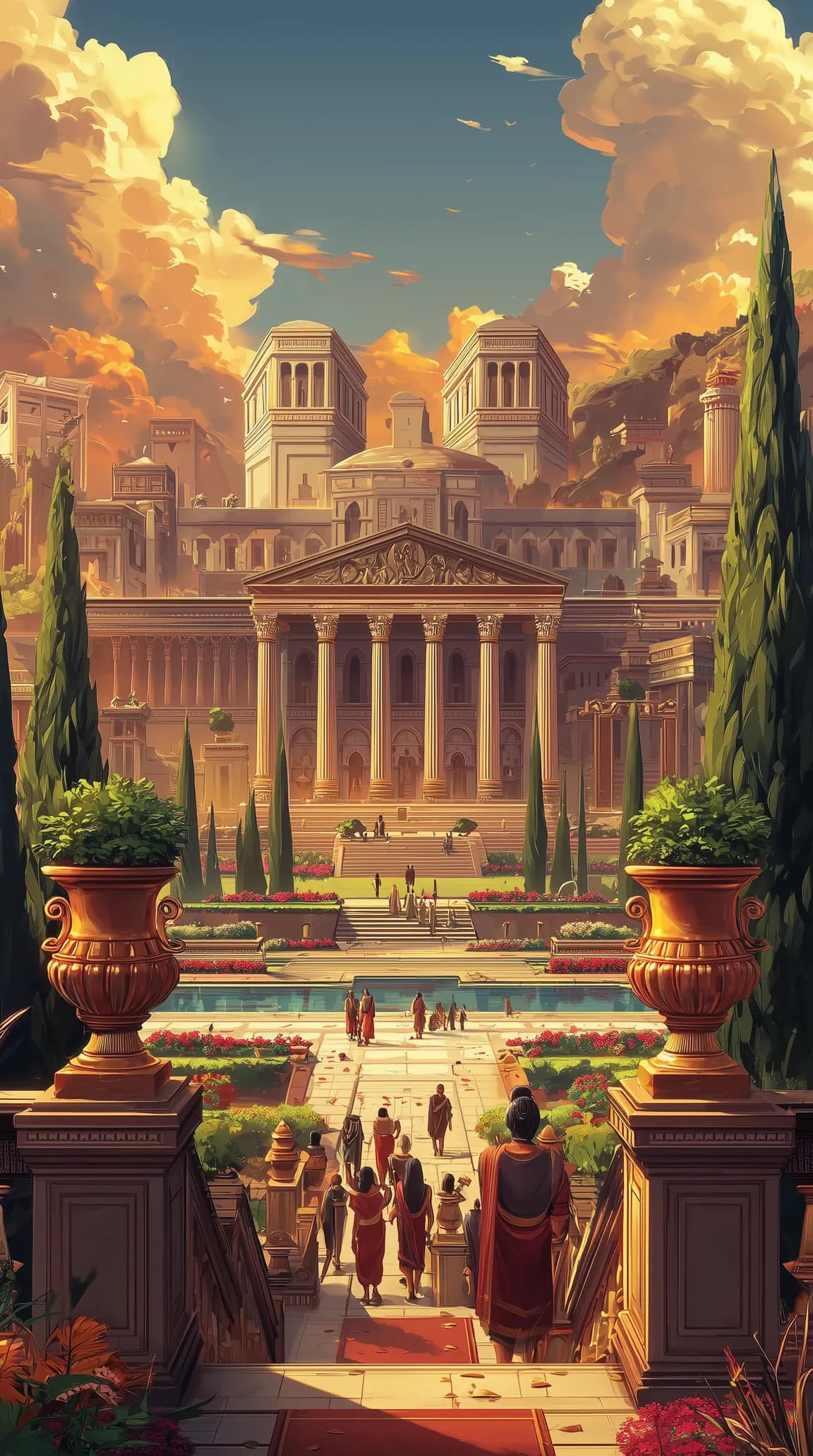
The Palace Quarter of Ptolemaic Alexandria
The Royal District of Alexandria, called the Basileia ("the royal quarter") and later the Brucheion, was the palace quarter of the Ptolemies, the Greek-Macedonian dynasty that ruled Egypt from Alexander the Great's death in 323 BCE until 30 BCE. It stretched along the Eastern Harbour toward the promontory of Cape Lochias. The geographer Strabo, who saw Alexandria around 25 BCE, wrote that the palaces filled a quarter or even a third of the city, because each ruler added a new residence to those of his ancestors. Besides the palaces, the quarter held gardens, a private royal harbour, the Mouseion with its famous Library and the Sema, the tomb of Alexander.
Key Facts About the Royal District
- Location: Eastern Harbour and Cape Lochias, Alexandria, Egypt
- Names: Basileia (royal quarter), later Brucheion
- Built by: The Ptolemies, each adding palaces (Strabo)
- Status: Partly under the modern city, partly under the harbour
- Sources: Strabo, accounts of Caesar's Alexandrian War, underwater archaeology (1990s to present)
Little of the quarter survives above ground. The historian Ammianus Marcellinus wrote that the Brucheion was ruined in fighting under the emperor Aurelian in the 270s CE, and earthquakes, subsidence and the tsunami of 365 CE sank much of the waterfront, Cape Lochias and the small island of Antirhodos into the harbour. Underwater surveys since the 1990s have mapped paved floors, columns, sphinxes and statues there. The quarter's most famous neighbours have pages of their own: the Library of Alexandria, the Tomb of Alexander the Great and Cleopatra's Royal Residence, the palace of the last Ptolemaic queen.
From its terraces the quarter looked across the water to the Great Lighthouse on Pharos and along the quays of the Alexandria Port. Through this immersive spatial audio journey you walk it as a guest of the Ptolemies: past fountains and gardens, into halls hung with fabrics from distant lands, and on toward the secret chamber where Cleopatra's own story begins.
Perfect For
Curious Explorers
Whether you're drawn to ancient Alexandria and the Hellenistic world, curious about how kings built a city to display their power, fascinated by early engineering and machines that looked like magic, fond of legends of hidden passages and living statues, following what divers find under Alexandria's harbour, or simply want to wander a palace garden by the sea for a quarter of an hour:
This journey offers a vivid walk through a lost royal quarter, grounded in history and open to its legends.
Ancient Alexandria Enthusiasts
Explore the heart of Ptolemaic power: the quarter where kings and queens lived, received envoys and paid the scholars of the Mouseion. Perfect for anyone who wants to see how the palaces, the Library, Alexander's tomb and the harbour fitted together into one royal city by the sea, before Rome and the sea itself swept most of it away.
Engineering & Invention Fans
Alexandria was a city of inventors. Ctesibius built water clocks and pumps under the early Ptolemies, and Heron later described a steam-driven spinning sphere and temple doors that opened on their own. The episode borrows Heron's devices for its palace doors. Perfect for anyone who loves the long history of clever machines.
Architecture & City Lovers
Alexandria was laid out on a grid soon after its founding in 331 BCE, and its royal quarter grew palace by palace along the shore. Perfect for those who enjoy picturing how a capital was planned: colonnades, gardens, harbours, temples and a theatre arranged around the water.
Legend & Mystery Seekers
Stories cling to the quarter: underground passages said to lead to the Library and to temple halls, and a statue of Isis that legend says could move, perhaps by one of Heron's mechanisms. Perfect for those who enjoy legends told as legends, side by side with what the evidence shows.
Underwater Archaeology Followers
Much of the royal waterfront now lies under the Eastern Harbour. Since the 1990s divers have mapped the sunken coastline, the island of Antirhodos and Cape Lochias, finding paving, columns and statues. Perfect for anyone who follows how a lost quarter is found again, one survey at a time.
"This quarter had a harbour just for the royals."
A Walk Through the Royal Quarter
This cinematic meditation of about 15 minutes takes you through the gates of the Ptolemies' palace quarter, from its gardens and fountains to the chamber where Cleopatra's realm begins.
Palace Garden Spatial Immersion
Through 3D spatial audio, you'll enter the quarter from its gardens. Fountains play around you, fed, the narration says, by Nile water carried through reservoirs and channels. Ahead rises the palace of the Ptolemies, both the royal home and the political and cultural centre of the city.
Picture columns of purple marble, mosaics of Serapis, Isis and Asclepius, and the sound of an aulos drifting from a courtyard (the double pipe of Greek music). The spatial acoustics give the open gardens and the echoing halls each their own space.
"A palace where the doors open on their own"
Picture the quarter in layers: the murmur of fountains in the gardens, fabrics from distant lands stirring in the palace halls, doors moved by Heron's devices, and below it all the passages that, legend says, lead toward the Library and the temple halls.
Imagine the edge of the quarter where a temple of Poseidon looks over the water, and a shaded garden where the light softens before you reach the inner palace.
Greek columns and Egyptian gods side by side in the palace mosaics
Cool fountain spray and sea air moving through the garden paths
The hush of a hidden chamber at the end of the walk
Every detail leads you from the public splendour of a royal capital toward its quieter, hidden rooms, where Alexandria's last queen will take up the story in a later episode of the series. The focus on place and atmosphere makes this a walk through a city, rather than a portrait of one ruler.
History & Legend in the Royal Quarter
What the sources say, and what the stories add
Alexander the Great founded Alexandria in 331 BCE on the strip of land between Lake Mareotis and the sea, and the city was laid out on a regular grid. After his death, his general Ptolemy I took Egypt, made Alexandria his capital and brought Alexander's body to Egypt (it came to rest in Alexandria, in the tomb known as the Sema). The royal quarter grew along the Eastern Harbour, sheltered by the island of Pharos and its causeway and within sight of the lighthouse (completed under Ptolemy II).
For nearly three centuries the Ptolemies ruled from this quarter. According to Strabo, each ruler added a residence of his own, so that the palaces became "building upon building", joined to one another and to the harbour.
The court was also a centre of learning. The Mouseion, inside the royal quarter, housed scholars who lived and ate together at royal expense, and the Library grew beside it. Festivals, processions and receptions turned the palaces into a stage for the dynasty's wealth, until Cleopatra VII, the last of the line, lost Egypt to Rome in 30 BCE.
The journey keeps legends as legends. Tales of underground passages running from the palaces to the Library and the temple halls are not supported by any excavation, though Alexandria did have real underground channels and cisterns for Nile water. The story of a statue of Isis that came to life, said to be one of Heron's mechanisms, belongs to legend too.
Heron's inventions are real: his writings describe temple doors that opened when a fire was lit on the altar, and a sphere spun by steam. He worked in Roman Alexandria, so the episode's doors are a nod to the city's long tradition of engineers rather than a claim about a Ptolemaic palace.
Exact plans of the palaces are unknown. Strabo's description, a few ancient accounts and the finds from the harbour floor give the outline; the episode fills in the rest with imagination.
"Mind the fountains. And the self-opening doors."
How We Know the Royal District
An eyewitness, a siege and the harbour floor
Strabo's Eyewitness Account
The fullest description comes from the Greek geographer Strabo, who lived in Alexandria around 25 BCE, soon after Egypt became Roman. He describes the palaces running from Cape Lochias along the harbour, a closed harbour that belonged to the kings, the island of Antirhodos with its own palace and small harbour, a theatre, and the Mouseion and the Sema inside the royal quarter.
48-47 BCE: Caesar's Siege
When Julius Caesar took Cleopatra's side against her brother, he was besieged inside the royal quarter for months. Accounts of this Alexandrian War describe him fortifying the palaces, burning ships in the harbour and seizing Pharos to keep the sea open.
Ancient writers add that the fire spread to buildings near the docks, possibly including stores of books, one of several stories later told about the loss of the Library.
Loss & Rediscovery
Ammianus Marcellinus wrote that the Brucheion was destroyed in fighting under the emperor Aurelian in the 270s CE. Earthquakes, the slow sinking of the coast and the tsunami of 365 CE then carried much of the waterfront under the sea.
Since the 1990s, underwater surveys in the Eastern Harbour have mapped the ancient shoreline, Antirhodos and Cape Lochias, recording paved floors, columns, sphinxes and statues.
Some finds have been lifted and shown in museums and exhibitions. Most of the quarter's story, though, still lies under water and under the streets of the modern city.
"Strabo took notes. Lucky us."
Palaces as Statecraft
How the Ptolemies used their quarter
The Ptolemies were Macedonian kings ruling Egypt, and their quarter spoke to both worlds. Greek colonnades, gardens and a theatre stood alongside Egyptian sculpture, sphinxes and statues of the rulers as pharaohs.
Royal patronage was part of the display. By funding the Mouseion and the Library, the dynasty made its capital a magnet for poets, mathematicians and astronomers, and the scholars' home sat inside the palace quarter itself.
Ceremony did the rest. Under Ptolemy II a great procession for the Ptolemaia festival paraded golden statues, exotic animals and treasures through the city, and the writer Callixenus described a banqueting pavilion in the palace grounds with room for 130 couches.
The quarter was also a fortress. With its own closed harbour and quays, the royal household could come and go by sea, and in 48-47 BCE Caesar held out there against the Alexandrian army for months.
A Dynasty's Home by the Sea
323-30 BCE
From Ptolemy I to Cleopatra VII, the royal quarter was the seat of a dynasty that ruled Egypt for nearly three centuries. Each generation built on the last, so that by Strabo's day the palaces filled a large part of the city.
Its end came in stages: Roman rule from 30 BCE, destruction in the 270s CE, and the sea that rose over the waterfront. What remains lies under the harbour and under the streets of the modern city.
Yet the quarter's legacy outlived its buildings. The Library and the Mouseion made Alexandria a byword for learning, and the waterfront that sank beneath the harbour has become a celebrated site of underwater archaeology.
The palaces went under the sea; the quarter's story did not.
"Every king wanted a bigger palace. Relatable."
Marvels & Legends
of the Palace Quarter
Alongside the history, the Royal District gathered stories: machines that seemed alive, passages under the gardens and a goddess's statue that moved. Here is what lies behind them.
Heron's Marvels
Engineering that looked like magic
Alexandria was home to a long line of engineers. Ctesibius, working under the early Ptolemies, built water clocks and a force pump. Centuries later Heron of Alexandria wrote books describing automatic temple doors, singing mechanical birds and a sphere spun by steam, often credited as the first recorded steam device.
Heron lived in Roman Alexandria, after the last Ptolemy. The episode borrows his devices to evoke the city's inventive spirit.
One of Heron's best-known designs opened temple doors when a fire was lit on the altar: heated air pushed water into a vessel, and its weight swung the doors open. To worshippers it could look like the god's own power. Machines like these made the city famous as a place where craft and wonder met.
No machine from the palaces survives, but the texts of Alexandria's engineers still show how they made doors, statues and fountains move.
"Passages said to lead to the Library."
Why the passages feel believable: Alexandria really did have channels and cisterns running under its streets to store Nile water. No excavation has found a secret royal tunnel to the Library.
Secret Passages & a Living Isis
Local legend says that passages beneath the palace quarter led to the Library and to the halls of the temples. The episode lets you hear them whisper below the gardens, as a story rather than a map.
Another legend tells of a statue of Isis that seemed to come alive. Some versions credit Heron's mechanisms. Moving statues were a real part of Alexandrian engineering, but this particular one is known only from legend.
Gardens, Fountains & Nile Water
Fresh Water on a Salt Coast
Alexandria sat between the sea and a salt lake, so fresh water had to come from the Nile. A canal brought river water to the city, and ancient accounts of Caesar's siege describe underground channels feeding cisterns beneath the houses.
In the royal quarter, that water kept gardens green and fountains playing, a luxury in a dry coastal city. The episode's fountains are fed the same way: by Nile water carried through reservoirs and channels.
Gardens and shaded walks linked the palaces with the Mouseion, where scholars walked and talked. Water, shade and learning belonged together in the Ptolemies' capital.
During Caesar's siege, his opponents are said to have spoiled the water supply of the royal quarter by pumping in seawater, and his men dug wells to find fresh water. Even in war, the quarter's life depended on its water.
Lost Beneath the Harbour
From 365 CE to Today
On 21 July 365 CE an earthquake and tsunami struck the eastern Mediterranean, and ancient writers describe ships in Alexandria carried onto the rooftops. Together with subsidence, such disasters lowered the royal waterfront beneath the sea. The harbour kept what the land lost.
Today divers work where the Ptolemies had their quays. Surveys since the 1990s have charted the sunken coastline of the Eastern Harbour, the island of Antirhodos and Cape Lochias, and found paved floors, columns, sphinxes and statues of the royal quarter.
Yet the quarter is still being found. Each survey adds a street line, a quay or a statue to the map. And the stories that grew around it, of passages, living statues and self-opening doors, keep the Royal District alive in the imagination, where this journey takes you.
The palaces sank; the quarter still speaks.
"Legends included, clearly labelled."
Advanced Technology Meets Ancient Splendour
Spatial audio and careful storytelling combine to take you through the lost royal quarter of Ptolemaic Alexandria
3D Palace Quarter Spatial Audio
Spatial audio creates the space, and your imagination adds the rest: fountains murmuring in the gardens, fabrics stirring in the palace halls, doors swinging open on Heron's devices, the sea beyond the colonnades and passages whispering below, all around you, placing you inside the royal quarter of the Ptolemies.
Grounded in the Sources
The history draws on Strabo's description of the royal quarter, accounts of Caesar's Alexandrian War and what underwater archaeology has found in the Eastern Harbour. The Nile-fed fountains, the palace of the Ptolemies, Heron's inventions and the temple of Poseidon at the edge of the quarter come from that history, while the passages and the living statue of Isis are told as legends.
Gardens & Fountains
Beyond sensory immersion, the journey lingers in the quarter's gardens: fresh Nile water in a city between the sea and a salt lake, fountains in shaded courts and a garden of shadows before the inner palace. It is a slow, calm walk rather than a race through monuments.
Heron's Devices
Designed around the city of inventors. Doors that open on their own and a statue that seems to move bring Alexandria's engineering tradition into the story, from Ctesibius's water clocks under the early Ptolemies to Heron's steam-spun sphere and automatic temple doors.
From Quarter to Chamber
Multiple layers create depth: the open gardens, the palace halls with mosaics of Serapis, Isis and Asclepius, the passages below and finally a secret chamber where the realm of Cleopatra begins. The walk leads naturally into the next episodes of the Alexandria series.
A Lost Royal City
Beyond historical education, the journey lets you picture a place that no longer exists on land: a royal city beside the Library and Alexander's tomb, facing the Great Lighthouse across the harbour. Perfect for exploring how a dynasty turned its capital into a showcase, and how the sea and time took it back.
"Royal splendour detected."
Complete Your Alexandrian Journey
Explore more of ancient Alexandria's legendary wonders with these related cinematic meditation experiences

Cleopatra's Royal Residence
Continue your journey through ancient Alexandria

Library of Alexandria
Continue your journey through ancient Alexandria
Tomb of Alexander the Great
Continue your journey through ancient Alexandria
"The Ptolemies had excellent neighbours."
Your Questions Answered
Everything you need to know about this journey
"Royal intrigue included."
From the blog
Ready to Enter
Alexandria's Royal Quarter?
Download Visionaria and start your journey today.
"Where Alexandria's royal heart once beat."