Launch special: Visionaria Premium is free—all cinematic journeys with spatial 3D audio.
🇺🇦 Support Ukrainian creators on Patreon — help us make a difference
Launch special: Visionaria Premium is free—all cinematic journeys with spatial 3D audio.
🇺🇦 Support Ukrainian creators on Patreon — help us make a difference
"700,000 scrolls. Zero Dewey Decimal System. Ancient librarians: clearly masters of organizational chaos."
The Library of Alexandria (Greek: Βιβλιοθήκη της Αλεξάνδρειας) was the largest and most significant library of the ancient world, located in Alexandria, Egypt, founded during the reign of Ptolemy II Philadelphus (r. 283-246 BCE) as part of the Mouseion (Museum) research institution. The library aimed to collect all the world's knowledge, eventually housing an estimated 400,000 to 700,000 papyrus scrolls covering Greek, Egyptian, Persian, Indian, and other civilizations' texts. Famous scholars who studied here include Euclid (geometry), Archimedes (mathematics and physics), Eratosthenes (calculated Earth's circumference), Hipparchus (astronomy), and Galen (medicine). The library's systematic approach to acquiring texts—including confiscating and copying books from ships docking in Alexandria's harbor—and its scholarly community made it the intellectual center of the Hellenistic world. Its destruction (likely gradual, between 48 BCE and 642 CE) represents one of history's greatest losses of ancient knowledge.
📚 What is the Library of Alexandria experience?
A 12-minute Intermediate spatial audio meditation exploring the legendary Library at its peak. Walk through reading rooms with 700,000 scrolls, witness scholars like Euclid and Archimedes at work, and experience humanity's quest to collect all knowledge through immersive 3D soundscapes.
Explore reading rooms containing nearly all human knowledge. Hear great scholars debating, scribes copying texts from across civilizations, and the Musaeum community pursuing learning. Experience the reverence for wisdom that made this history's greatest intellectual center.
Free to download • No subscription required
"Intermediate difficulty: contemplating lost knowledge. Emotional preparation: tissues recommended for library lovers."
Whether you're a student or educator seeking academic inspiration, passionate about books and libraries, fascinated by ancient intellectual history, drawn to philosophical contemplation of knowledge's value, interested in how civilizations preserve learning, or simply experiencing reverence for wisdom and scholarship, this Intermediate journey offers profound connection to humanity's noblest pursuit - the quest for understanding.
Find inspiration in history's greatest intellectual center. Perfect for students seeking motivation for learning, teachers contemplating education's importance, researchers connecting to scholarly traditions, or anyone who values the pursuit of knowledge for its own sake.
Experience the ultimate library - 700,000 scrolls representing nearly all ancient knowledge. Connect emotionally to why libraries matter, what's lost when they burn, and the sacred responsibility of preserving learning across generations. Warning: may cause profound feelings.
Walk where Euclid wrote Elements, where Archimedes developed physics, where Eratosthenes calculated Earth's size. Experience the community of scholars that advanced human understanding in mathematics, astronomy, medicine, philosophy, and every field of ancient knowledge.
Find inspiration in systematic knowledge organization and scholarly community. Perfect for information professionals, archivists, researchers, writers, or anyone whose work involves collecting, organizing, and sharing information - connecting modern pursuits to ancient traditions.
Explore Intermediate contemplation themes: Why do we seek knowledge? What makes learning sacred? How does wisdom transcend cultural boundaries? What's lost when libraries burn? This journey invites deeper philosophical reflection alongside historical immersion.
Connect to humanity's eternal curiosity. Whether learning new skills, pursuing personal development, exploring new fields, or simply maintaining intellectual curiosity, this journey celebrates the mindset that learning itself is among life's greatest pursuits - just as the ancients believed.
"Six perfect audiences. Late fees for 2,000-year-overdue scrolls: probably substantial even by ancient standards."
This 12-minute Intermediate cinematic meditation transports you to the Library of Alexandria at its zenith around 250 BCE, when it represented humanity's greatest collection of knowledge.
Through advanced 3D spatial audio technology, you'll experience the Library's intellectual atmosphere as if physically walking its halls. Hear papyrus scrolls rustling from specific shelf positions in vast reading rooms organized by subject - mathematics, astronomy, medicine, philosophy, poetry, history. The spatial acoustics recreate the scale of humanity's knowledge collected in one sacred space, with sounds positioned to convey towering shelves, echoing stone halls, and the reverent quiet of scholarship.
Experience the community of scholars through layered soundscapes: Greek philosophers debating from one research area, Egyptian priests translating ancient texts from another position, Babylonian astronomers calculating celestial movements from a third location. Hear scribes' pens scratching papyrus from precise copying stations - the Library mandated that all books arriving in Alexandria's port be copied, originals often kept for the collection. The head librarian moves through spaces cataloging new acquisitions using the Pinakes system, the world's first library catalog.
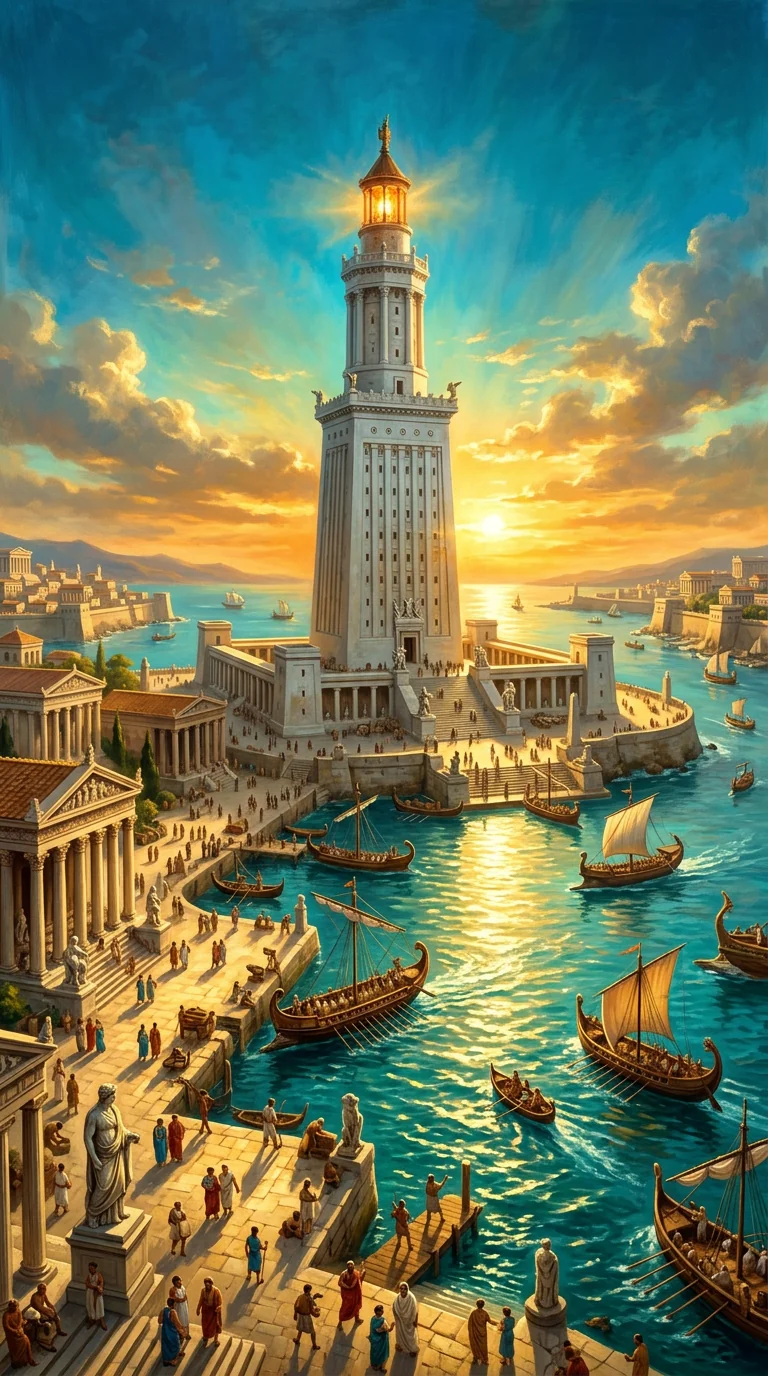
The journey engages all imaginative senses: visualize hundreds of thousands of scrolls lining walls from floor to ceiling, imagine the scent of papyrus and ink mixing with Mediterranean air through high windows, sense the cool stone beneath sandaled feet, feel the weight of nearly all human knowledge surrounding you, connect with the reverence for learning that made this place sacred. Every detail creates profound immersion in the intellectual heart of the ancient world, where wisdom was pursued as humanity's noblest endeavor.
Every element in this journey is grounded in ancient sources and scholarly research. Founded around 295 BCE by Ptolemy I Soter (one of Alexander the Great's generals), the Library was part of the larger Musaeum - a research institution where scholars lived, received royal stipends, and devoted themselves entirely to learning. Ancient writers including Strabo, Plutarch, and later sources describe its vast holdings: estimates range from 400,000 to 700,000 scrolls at peak, representing nearly all significant texts from Greek, Egyptian, Persian, Indian, and other civilizations.
The Ptolemies' commitment to collecting all knowledge was systematic and aggressive. Ships arriving in Alexandria's port had their books confiscated for copying - expensive copies returned to owners while originals stayed in the Library. Royal agents traveled the Mediterranean purchasing texts. The Library famously borrowed Athens' official state copies of the great tragedies, providing huge monetary deposits as guarantee, then kept the originals and returned costly copies, forfeiting the deposits. This unprecedented effort to gather universal knowledge wouldn't be matched until the internet age.
The scholars who worked here shaped human knowledge permanently. Euclid wrote Elements (geometry foundation still taught today). Archimedes developed physics principles and engineering. Eratosthenes calculated Earth's circumference with remarkable accuracy. Aristarchus proposed heliocentrism 1,800 years before Copernicus. Callimachus created systematic cataloging. The Library functioned for roughly 600 years before gradual decline through fires, decreased funding, and political instability. Its loss symbolizes the fragility of knowledge, making preservation sacred across generations.
As the ancient world's supreme knowledge center, the Library of Alexandria formed an intellectual network with other centers of learning like Athens' Parthenon (where philosophers gathered in the shadow of Athena, goddess of wisdom), the Temple of Marduk in Babylon (housing astronomical tablets and mathematical innovations), and the Theatre of Dionysus (where dramatic competitions advanced literary arts)—together creating a Mediterranean-wide culture of inquiry that laid the foundations for Western science, philosophy, and scholarship.
"Scholarly atmosphere: historically verified. Modern library quiet policy enforcement: probably less aggressive than Ptolemaic standards."
The Library attracted and enabled history's greatest minds, creating a community of scholars whose discoveries still shape human knowledge today.
Euclid (c. 300 BCE) systematized geometry in Elements, creating mathematics' most influential textbook - still taught 2,300 years later. Archimedes (c. 287-212 BCE) developed physics principles (buoyancy, levers, compound pulleys) and engineering marvels (Archimedes screw still used today). These weren't isolated geniuses but benefited from the Library's resources and scholarly community. Access to previous mathematical texts plus dialogue with peers enabled breakthroughs impossible in isolation.
Eratosthenes (c. 276-194 BCE) calculated Earth's circumference with remarkable accuracy using geometry and measurements from different locations - possible only because Library resources documented geographical data systematically. He also created geography as a discipline, mapped the known world, and invented latitude/longitude. Apollonius worked on conic sections. Hero invented early steam engines and automated devices. The Library enabled mathematics and science to advance systematically, building on previous discoveries.
Callimachus (c. 310-240 BCE) created the Pinakes - the world's first library catalog, organizing 120,000+ scrolls by subject, author, and content summaries. This wasn't mere bookkeeping but knowledge architecture. By categorizing all learning systematically (mathematics, astronomy, medicine, literature, history, philosophy), Callimachus created frameworks scholars still use. The concept that knowledge should be organized, searchable, and accessible originated here.
This systematic approach enabled cross-disciplinary work. Scholars could find all texts on specific subjects, identify knowledge gaps, and build on previous work deliberately rather than accidentally. The Library demonstrated that advancing human knowledge required not just individual brilliance but institutional support - organized collections, dedicated scholars, funding, and community. Modern universities and research institutions descend directly from this model.
Aristarchus of Samos (c. 310-230 BCE) proposed heliocentrism - that Earth orbits the Sun - 1,800 years before Copernicus. His work wasn't accepted (the geocentric model seemed more intuitive), but it demonstrates the intellectual freedom scholars enjoyed. Hipparchus (c. 190-120 BCE) created star catalogs, developed trigonometry, and discovered Earth's precession. Their astronomy was possible only with Library resources documenting centuries of observations from multiple civilizations.
The Library enabled scholars to synthesize knowledge across cultures. Greek geometry combined with Babylonian astronomical observations and Egyptian calendar systems. This cross-cultural approach - valuing learning regardless of origin - made Alexandria's scholarship uniquely powerful. The Ptolemies understood that gathering all knowledge meant respecting all sources, creating cosmopolitan intellectual environment unmatched in antiquity.
The Library was history's first major translation center. The famous Septuagint - translation of Hebrew Bible to Greek - was produced here around 250 BCE, making Jewish scripture accessible to Greek-speaking world. Scholars translated Egyptian religious texts, Persian wisdom literature, Indian mathematical treatises, and Babylonian astronomical tables. This wasn't cultural appropriation but respectful preservation, recognizing that wisdom transcends national boundaries.
The translation work created lasting cultural impact. Greek became the scholarly lingua franca, allowing knowledge exchange across the Mediterranean and Near East. Ideas flowed between civilizations in unprecedented ways. The Library demonstrated that advancing human understanding requires valuing diverse perspectives - a lesson still relevant in our interconnected world. True scholarship recognizes that wisdom appears in all cultures and languages.
"Scholarly achievements: world-changing. Modern academic publishing timelines: probably slower than ancient scroll production."
Cutting-edge spatial audio and cinematic storytelling combine to create an unforgettable walk through history's greatest library
Our proprietary spatial audio technology positions you inside the Library's intellectual spaces. Hear scrolls rustling from specific shelf positions in vast reading rooms, scholars debating from different research areas, scribes copying texts from precise stations, footsteps echoing through stone halls, the head librarian cataloging from his workspace, multilingual voices from the translation center - all in full 360-degree spatial audio creating unparalleled immersion in the scholarly atmosphere that advanced human knowledge for 600 years.
Every detail - organizational system, scholar activities, translation work, manuscript collection - is drawn from ancient sources and modern scholarship. Experience the Library as historical documentation describes it: vast holdings organized systematically, community of scholars from across civilizations, aggressive text collection, multilingual translation center. Authenticity grounded in decades of research on Hellenistic intellectual culture and library history.
Unlike Beginner journeys focusing on sensory immersion, this Intermediate experience invites deeper contemplation: Why do we pursue knowledge? What makes learning sacred? How does wisdom transcend cultural boundaries? What's lost when libraries burn? The vivid historical setting serves as foundation for philosophical reflection on knowledge's meaning to civilization and individuals.
Designed to honor intellectual pursuit and knowledge preservation. Walking among history's greatest book collection creates contemplation of learning's value, the fragility and importance of preserving wisdom, and scholarship as noble endeavor. Perfect for students, educators, researchers, librarians, or anyone who believes that pursuing understanding is among humanity's highest callings.
Multiple audio layers create unprecedented intellectual immersion: reading room organization by subject, scholars from different civilizations collaborating, scribes copying arriving texts, translation work between languages, cataloging creating first library system, great minds developing discoveries. Every element meticulously researched and spatially positioned for maximum historical and emotional connection to humanity's quest for universal knowledge.
Beyond historical education, this journey explores universal concepts: curiosity as virtue, knowledge transcending cultural boundaries, preservation's sacred responsibility, scholarly community enabling breakthroughs, learning for its own sake. Perfect for contemplating your own relationship with knowledge, why education matters, or experiencing emotional connection to humanity's eternal quest for understanding - the Library's true legacy.
"Six immersive features. Complete ancient librarian certification: would require papyrus expertise and excellent memory for scroll locations."
Explore more of ancient Alexandria's legendary wonders with these related cinematic meditation experiences
Continue your journey through ancient Alexandria
Continue your journey through ancient Alexandria
Continue your journey through ancient Alexandria
"Three featured journeys. Complete Alexandria collection: six legendary locations including two more waiting discovery."
Everything you need to know about this journey
"Questions about ancient libraries? Our answers are cataloged with Callimachus-level organization."
Download Visionaria and start your journey today.
"Where wisdom was sacred, knowledge transcended borders, and humanity's quest for understanding changed the world."