The Royal District of Cleopatra's Alexandria
👑 Fun fact: Cleopatra's royal palace was so vast it occupied one-quarter of Alexandria, roughly the size of 300 modern football fields! Talk about living large in ancient times!
- The Palace Quarter: Heart of Ptolemaic Power
- Architecture of the Royal Enclosure
- The Great Library and Museum Complex
- Royal Harbor and Maritime Magnificence
- Cleopatra's Private Chambers and Gardens
- The Lighthouse: Guiding Light of the Mediterranean
- Religious Sanctuaries Within the Royal District
- Daily Life in Alexandria's Royal Court
- Cultural Fusion: Greek Meets Egyptian
- Maritime Trade and Royal Commerce
- Experiencing the Royal District Through Visionaria
- The Bottom Line
- Frequently Asked Questions
In the ancient Mediterranean world where great cities competed for cultural supremacy, one urban district stood as the unrivaled pinnacle of learning, luxury, and power the Royal Quarter of Alexandria, where Egypt's final and most legendary pharaoh, Cleopatra VII, ruled from a palace complex so magnificent that its splendor impressed even Rome's hardened generals and shaped the course of Western civilization.
The Royal District of Cleopatra's Alexandria, known in antiquity as the Bruchion, encompassed approximately one quarter of the entire city a sprawling waterfront enclave of marble palaces, legendary libraries, sacred temples, lush gardens, and bustling harbors where the accumulated wisdom of human civilization met the political power that controlled the Mediterranean's grain supply. This wasn't merely a residential quarter for Egypt's ruling family; it represented the ancient world's premier fusion of intellectual achievement, architectural grandeur, and strategic importance.
Founded by Alexander the Great in 331 BCE and transformed by Ptolemaic rulers into antiquity's most cosmopolitan metropolis, Alexandria's royal district reached its zenith during Cleopatra's reign (51-30 BCE). Here, within marble columned halls, the Great Library housed humanity's collected knowledge. In lavish banquet chambers, Cleopatra entertained Julius Caesar and Mark Antony. From strategic harbors, trade ships carried Egyptian grain that fed Rome's millions while scholarly vessels brought philosophers from Athens and mathematicians from Babylon.
This comprehensive exploration journeys through Cleopatra's royal domain from the Great Library's wisdom filled halls to private chambers where history's most famous queen shaped destiny, from harbors teeming with international commerce to gardens where Greek philosophy merged with Egyptian tradition. Through immersive historical experiences, we reconstruct this vanished world (now largely underwater due to earthquakes and subsidence), revealing how one extraordinary urban district became the Mediterranean's intellectual and cultural capital while housing history's most legendary ruler.
Key Facts About Cleopatra's Royal District
- •Occupied 25% of Alexandria: the Royal Quarter covered approximately 300 acres of prime waterfront
- •Great Library housed 400,000-700,000 scrolls: antiquity's largest knowledge collection
- •Pharos Lighthouse stood 330-450 feet tall: one of Seven Wonders of the Ancient World
- •Royal Harbor handled 10,000+ ships annually at ancient Mediterranean's busiest port
- •Museum employed 100+ scholars in permanent residence conducting groundbreaking research
- •Palace complex included 20+ buildings: temples, theaters, gardens, administrative centers
- •Most ruins now lie 20-30 feet underwater due to earthquakes and sea level changes
Quick Answer
Explore the magnificent palace quarter where Cleopatra ruled, from the Great Library's wisdom halls to royal harbors where history's greatest minds gathered in Egypt's legendary capital.
The Palace Quarter: Heart of Ptolemaic Power
The Bruchion Alexandria's Royal Quarter occupied the most strategically valuable real estate in the ancient Mediterranean: the eastern promontory commanding the Great Harbor, where land met sea in a configuration perfect for both defensive strength and commercial dominance. Stretching from waterfront palaces to inland gardens, this district within a city functioned as autonomous realm where Ptolemaic pharaohs, culminating in Cleopatra VII, wielded power that rivaled Rome itself.
Ancient sources describe the Royal Quarter as encompassing approximately one quarter of Alexandria's total area modern archaeological estimates suggest 250-350 acres of intensively developed waterfront property. Unlike other ancient palaces built on hills or mountains for defensive purposes (like Athens' Acropolis or Babylon's ziggurat crowned citadel), Alexandria's royal district claimed prime harbor frontage a bold choice reflecting confidence in naval power rather than fortified walls.
Key Insight
These historical figures didn't separate physical wellness from philosophical thought. To them, it was all one continuous practice of living well.
The quarter's layout followed Hellenistic urban planning principles perfected by Alexander the Great's architect Dinocrates. Wide, perpendicular streets created a grid pattern, with the main thoroughfare the Canopic Way running east west through the entire city at 100 feet wide, bordered by covered colonnades protecting pedestrians from Mediterranean sun. Cross streets divided the district into insulas (blocks), each dedicated to specific functions: palace buildings, administrative centers, scholarly institutions, temples, gardens, barracks, storage facilities.
At the quarter's heart stood the primary royal palace the Basileia where Cleopatra maintained her throne room, private chambers, and ceremonial spaces. Ancient descriptions suggest this central structure alone covered several acres, featuring hundreds of rooms arranged around peristyle courtyards in classic Mediterranean style. Strabo, the Greek geographer who visited Alexandria shortly after Cleopatra's era, wrote that the palace buildings occupied "not less than a fourth or even a third of the whole circuit of the city."
The palace complex's waterfront orientation served multiple strategic purposes. Maritime access enabled rapid communication with fleet elements throughout the Mediterranean critical for maintaining control over grain shipments to Rome that gave Egypt extraordinary political leverage. Harbor visibility allowed pharaohs to personally oversee arrivals and departures of diplomatic missions, trading vessels, and military expeditions. The cooling sea breezes provided natural climate control in Egypt's heat, making waterfront palaces more comfortable than inland alternatives.
Security measures, while less obvious than traditional fortress walls, proved sophisticated and effective. The Royal Harbor itself provided natural moat like protection on one side, while walls separated the quarter from the rest of Alexandria. Elite guards including Cleopatra's famous Germanic and Gallic bodyguards maintained checkpoints at district entrances. The naval base within the Royal Harbor ensured military force remained immediately accessible, while underground passages supposedly connected palace buildings, enabling discreet movement during emergencies.
"Cleopatra's palace was so large that visiting Romans kept getting lost trying to find the dining hall. Eventually, she installed directional mosaics. Ancient GPS!" 🏛️🗺️😄
Socrates reportedly walked barefoot through Athens to keep his mind sharp, and his sandal maker permanently unemployed.
Architecture of the Royal Enclosure
The architectural magnificence of Alexandria's Royal Quarter represented the zenith of Hellenistic design a fusion of Greek architectural principles with Egyptian grandeur and Near Eastern opulence that created built environments unlike anything else in antiquity. Using materials sourced from across the Mediterranean and beyond, Ptolemaic architects constructed palace complexes that impressed even Rome's wealthiest patricians and Athens' most cultured philosophers.
Primary construction materials reflected Alexandria's role as Mediterranean trade hub. White marble from Greek quarries (Paros, Pentelicus) clad major buildings, creating dazzling exteriors that blazed in Egyptian sunlight. Pink granite from Aswan in Upper Egypt formed massive columns and obelisks linking Ptolemaic rulers to pharaonic tradition. Limestone from local quarries provided structural cores, while precious stones porphyry, basalt, alabaster decorated interiors with polychrome splendor. Wood imported from Lebanon (cedars) and North Africa (citrus) created elaborate ceiling treatments and carved decorative elements.
Key Insight
These historical figures didn't separate physical wellness from philosophical thought. To them, it was all one continuous practice of living well.
Architectural styles blended Hellenic and Egyptian elements with remarkable sophistication. Exterior colonnades followed Greek orders Doric, Ionic, Corinthian but often at scales exceeding anything in Greece itself. Some palace buildings featured columns 60-80 feet tall, supporting elaborate entablatures decorated with Greek motifs (acanthus leaves, egg and dart patterns, meanders). Yet these same structures incorporated Egyptian elements: cavetto cornices, lotus and papyrus capitals, hieroglyphic inscriptions, and colossal statues of pharaohs in traditional Egyptian style.
Interior spaces showcased luxury that stunned ancient visitors. Floor mosaics depicted mythological scenes, geometric patterns, and naturalistic landscapes using tesserae (small colored stones) sourced from across the known world creating artworks underfoot that would later inspire Roman villa mosaics. Wall frescoes employed Egyptian pigments and Greek techniques to illustrate literary scenes, historical moments, and allegorical compositions. Ceiling coffering carved from Lebanese cedar and gilded with gold created overhead spectacles that demonstrated wealth and artistic refinement.
Water features integrated throughout the palace complex demonstrated sophisticated hydraulic engineering. Fountains in peristyle courtyards provided cooling effects and pleasant soundscapes while displaying technical mastery. Artificial cascades created by elevated water channels mimicked natural waterfalls. Private bath complexes rivaling later Roman thermae offered hot, warm, and cold bathing facilities using advanced heating systems (hypocausts) and plumbing networks that distributed Nile water throughout the quarter.
Gardens represented crucial architectural elements, not mere landscaping additions. Following Persian paradise garden traditions transmitted through Alexander's conquests, royal gardens featured geometric layouts with intersecting water channels, exotic plantings from Africa and Asia, shaded walkways beneath imported trees, and strategically placed pavilions for outdoor entertaining. These green spaces provided relief from urban density while demonstrating control over nature transforming Egypt's desert climate into verdant paradises through irrigation mastery that recalled Babylon's legendary hanging gardens.
"Ancient contractor to Cleopatra: 'The marble you ordered from Greece, the granite from Aswan, the cedar from Lebanon shipping costs are insane!' Cleopatra: 'I control the Mediterranean grain supply. I think we're good.'" 💰⛵

Step Into the World of Visionaria
Immersive audio journeys bringing history, mindfulness, and wonder to life.
A philosopher walked into a wall. His students asked if it hurt. He replied, 'The wall is an illusion, but my headache is quite real.'
The Great Library and Museum Complex
Within Alexandria's Royal Quarter stood antiquity's most legendary intellectual institution the Great Library and its associated Museum (Mouseion, literally "shrine of the Muses") a knowledge complex that functioned as the ancient world's premier research university, attracting brilliant minds from Athens, Babylon, Persia, and beyond to pursue scholarship under royal patronage in facilities unmatched anywhere in human civilization.
Founded by Ptolemy I Soter around 295 BCE and expanded by his successors, the Great Library pursued an audacious mission: collect every book in the known world. Royal agents scoured Mediterranean ports, purchasing or copying manuscripts in Greek, Egyptian, Persian, Hebrew, and other languages. Ships arriving in Alexandria faced mandatory book inspection any volumes found aboard were confiscated for copying, with owners receiving copies while originals entered the Library's collection (a practice that outraged visitors but built the collection rapidly).
At its height under Ptolemy II Philadelphus, the Library reportedly housed 400,000-700,000 scrolls (ancient "books") estimates vary, but even conservative figures suggest a collection dwarfing any other ancient library. The catalog alone the famous Pinakes compiled by the poet scholar Callimachus filled 120 scrolls, organizing works by author, subject, and genre in humanity's first comprehensive bibliography. This organizational system influenced library science for millennia, establishing classification principles still recognizable in modern systems.
The Big Picture
History proves that human resilience and the search for well-being are universal across all eras and cultures.
The physical structure occupied extensive space within the Royal Quarter, though exact location and layout remain archaeologically uncertain (most remains now lie underwater). Ancient descriptions suggest multiple connected buildings around colonnaded courtyards reading rooms with natural lighting from high windows, storage chambers with carefully controlled humidity to preserve papyrus scrolls, copying workshops where scribes reproduced texts, and lecture halls where scholars presented research findings.
The associated Museum functioned as residential research institute rather than display gallery (the modern museum concept didn't exist). Here, up to 100 scholars received royal stipends, free housing, tax exemptions, and research support in exchange for pursuing knowledge. These residents included history's intellectual giants: Euclid (geometry), Archimedes (mathematics and engineering), Eratosthenes (calculated Earth's circumference), Aristarchus (proposed heliocentric solar system), Herophilus (pioneered human anatomy), Callimachus (poetry and bibliography), and countless others whose work shaped Western civilization.
Research facilities within the Museum complex demonstrated remarkable specialization. Astronomical observatories equipped with advanced instruments tracked celestial movements. Anatomical theaters enabled medical research (Alexandria was one of few ancient cities permitting human dissection). Botanical gardens cultivated plants from across the known world for pharmacological study. Zoological collections (menageries) facilitated animal research. Mechanical workshops allowed engineering experiments where Archimedes reportedly designed his war machines and Hero of Alexandria invented the first steam engine (the aeolipile).
During Cleopatra's reign, the Library maintained its scholarly prestige despite political turbulence. Cleopatra herself fluent in nine languages and intellectually accomplished patronized scholarship, reportedly donating Pergamon's 200,000 scroll library to Alexandria. She hosted intellectual salons where scholars, philosophers, and visiting dignitaries (including Julius Caesar) discussed philosophy, science, and statecraft continuing the Ptolemaic tradition of linking political power with intellectual cultivation that made Alexandria civilization's knowledge capital.
Read more: The Architecture of the Acropolis Explained
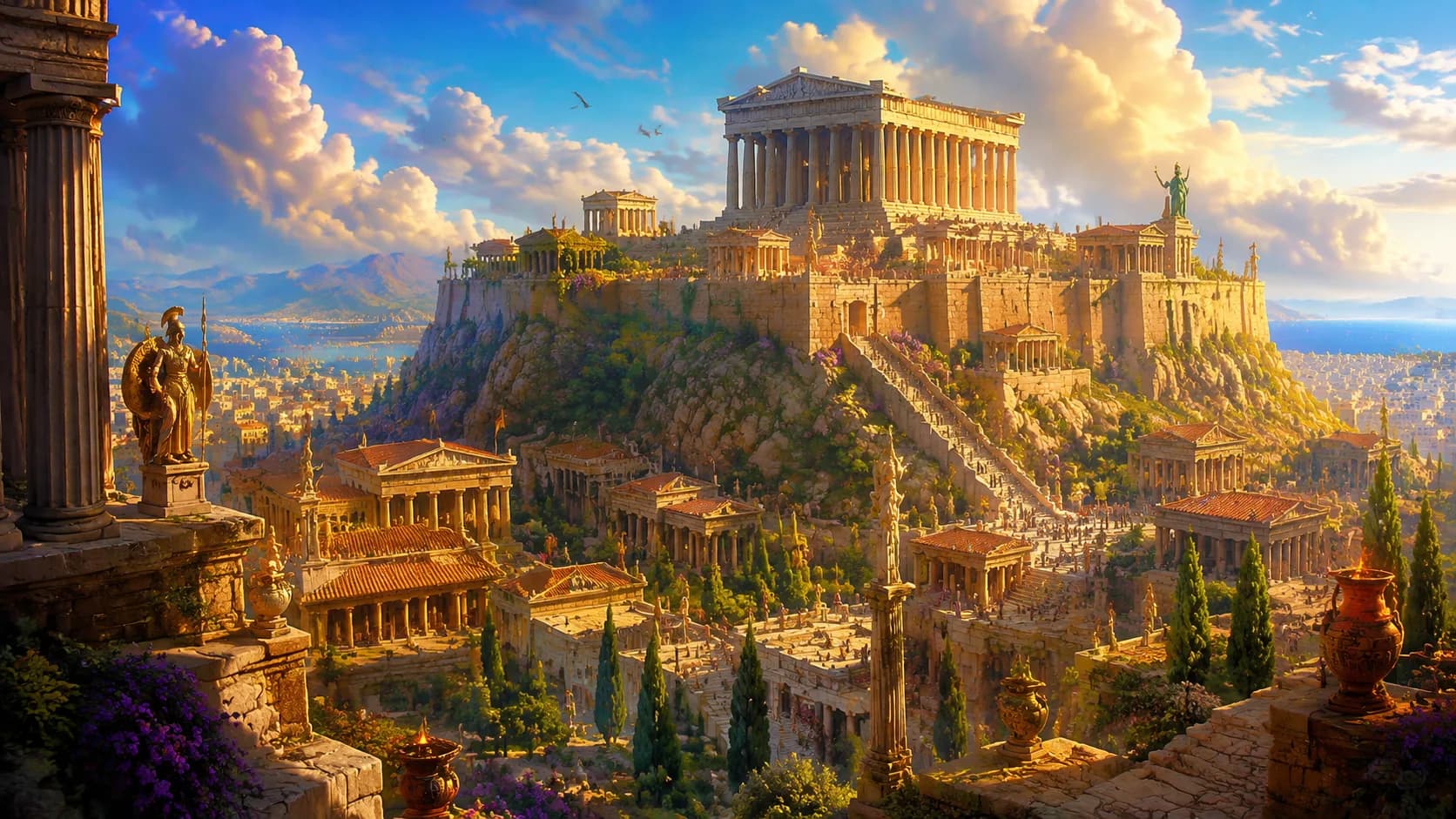
"Ancient scholar arriving at the Great Library: 'So this is every book ever written?' Librarian: 'Working on it! We confiscate any new ones that arrive by ship.' Scholar: 'That's... actually terrifying and awesome.'" 📚⚓
Why did the ancient physician prescribe a long walk? Because he was tired of listening to the patient complain in his office.
Royal Harbor and Maritime Magnificence
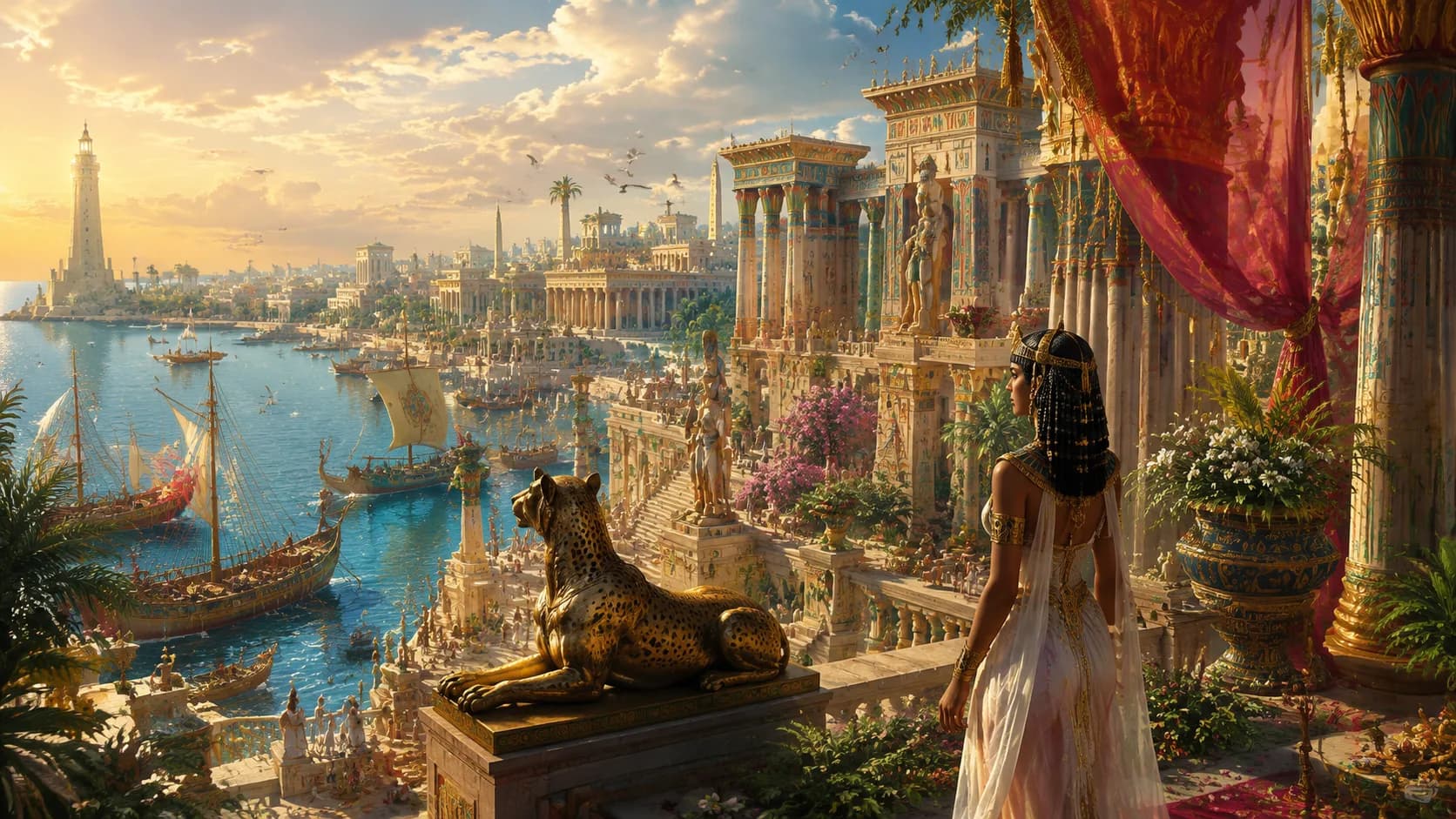
Alexandria's Great Harbor the Mediterranean's largest and most strategically important anchorage served dual functions as commercial port handling international trade and royal naval base projecting Ptolemaic sea power throughout the ancient world. The Royal Harbor (Portus Magnus), occupying the harbor's eastern section adjacent to the palace quarter, provided Cleopatra with direct maritime access that proved crucial to Egypt's political independence and economic dominance.
The harbor's configuration demonstrated brilliant engineering adapted to Mediterranean conditions. A massive breakwater (the Heptastadion) stretched seven stadia (approximately 4,000 feet) from mainland to Pharos Island, creating two harbor basins while supporting the causeway connecting island lighthouse to city. This artificial barrier calmed wave action, enabling ships to load and unload regardless of weather a critical advantage that made Alexandria function year round while seasonal storms closed other Mediterranean ports.
Harbor facilities matched the scale of operations. Stone quays extended hundreds of yards along the waterfront, equipped with bronze mooring rings, loading cranes, and covered warehouses protecting goods from elements. Shipyards capable of constructing and maintaining large vessels occupied the eastern shore where Cleopatra's fleet of warships and pleasure barges received construction and refitting. Private royal docks connected directly to palace buildings, enabling pharaohs to board vessels without passing through public areas essential for both security and ceremonial propriety.
Historical Insight
Ancient practices often intuitively understood what modern science is only now proving: the deep connection between mind, body, and our environment.
Naval forces based in the Royal Harbor included formidable fleets that controlled eastern Mediterranean shipping lanes. Ptolemaic Egypt maintained standing navy of 200+ warships primarily triremes (three banked oared galleys) and larger quinqueremes (five banked vessels) crewed by professional sailors and marines. These ships patrolled sea lanes, protected grain convoys to Rome, and projected power throughout the region. During Cleopatra's era, her naval alliance with Mark Antony briefly created Mediterranean's most powerful combined fleet.
Commercial traffic through the harbor reached extraordinary volumes. Ancient sources suggest 10,000+ merchant vessels annually visited Alexandria, arriving from ports throughout the Mediterranean, Red Sea, and beyond. These ships carried grain from Nile Delta to Rome (Egypt supplied one third of Rome's grain), luxury goods from India and Arabia, olive oil from Greece, wine from Aegean islands, timber from Lebanon, textiles from Syria, and exotic items from Sub Saharan Africa via Nile trade routes.
The harbor's visual spectacle impressed ancient visitors as much as its functional efficiency. Hundreds of ships of diverse designs crowded the anchorage massive grain carriers from Egypt's breadbasket, sleek warships bristling with rams and soldiers, merchant vessels from distant lands, royal barges gilded and decorated for ceremonial processions. The famous Pharos Lighthouse dominated the skyline, its fire visible 30+ miles at sea. Palace buildings gleamed white along the eastern shore. The constant activity loading, unloading, repairing, provisioning created perpetual motion that Strabo described as "continuous fair" operating without pause.
"Harbor master to ship captain: 'Welcome to Alexandria! We handle 10,000 ships yearly.' Captain: 'Impressive! Where do I dock?' Harbor master: 'Take a number. Current wait time: three days.'" ⚓😅
Why did the ancient physician prescribe a long walk? Because he was tired of listening to the patient complain in his office.
Cleopatra's Private Chambers and Gardens
Beyond the public throne rooms and ceremonial spaces where Cleopatra VII received ambassadors and presided over state functions lay her private residential quarters intimate spaces where history's most famous queen studied, relaxed, entertained close confidants, and raised her children away from court formality. Though archaeological evidence remains limited (most palace ruins lie underwater), ancient literary sources and comparative analysis with other Hellenistic royal residences reveal sophisticated living environments befitting a sophisticated, intellectually accomplished ruler.
Cleopatra's personal chambers likely occupied palace buildings with optimal harbor views and cooling sea breezes essential considerations in Egypt's climate. These private apartments would have included bedroom suites, bathing facilities, dining areas for intimate meals, study spaces filled with scrolls from the nearby Great Library, and audience chambers for private meetings with advisors, scholars, and romantic partners like Julius Caesar and Mark Antony.
Interior decoration reflected Cleopatra's unique cultural position Greek by dynasty but pharaoh by title. Rooms likely blended Hellenistic luxury (frescoed walls, mosaic floors, carved furniture) with Egyptian royal symbolism (hieroglyphic inscriptions, statuary depicting her as traditional pharaoh, religious imagery connecting her to goddess Isis). The famous description of Cleopatra's pearl dissolving dinner with Antony suggests dining spaces decorated with extraordinary opulence gold and silver vessels, purple fabrics (expensive Tyrian dye), exotic flowers, elaborate lighting from countless oil lamps.
Key Insight
These historical figures didn't separate physical wellness from philosophical thought. To them, it was all one continuous practice of living well.
Gardens attached to private residential areas provided essential refuges from palace formality and Egyptian heat. Following Persian and Hellenistic garden traditions, these carefully landscaped spaces featured geometric layouts with water channels, imported plants creating verdant oases, shaded walkways beneath trees, and secluded pavilions for private contemplation or confidential discussions. Ancient sources describe Ptolemaic royal gardens housing exotic animals (menageries), rare botanical specimens, and artistic sculptures creating environments that demonstrated mastery over nature while providing sensory delight.
Cleopatra's renowned intellectual pursuits shaped her private spaces. Unlike many royal residences designed purely for luxury and display, her chambers likely included substantial personal library collections, scientific instruments reflecting her interest in alchemy and medicine, and accommodations for visiting scholars with whom she reportedly conversed fluently in nine languages. The famous anecdote of her testing poisons on condemned prisoners suggests laboratory spaces where she conducted experiments a remarkable detail revealing a scientifically minded ruler unprecedented among ancient monarchs.
Security arrangements for private quarters balanced accessibility with protection. Trusted servants, carefully vetted by palace security, staffed residential areas. Elite bodyguards Cleopatra famously employed Germanic and Gallic warriors whose loyalty wasn't compromised by local political factions maintained discreet presence. Underground passages supposedly connected private chambers to harbor docks, enabling emergency evacuation if necessary (a wise precaution given Alexandria's periodic political violence). These security measures allowed Cleopatra to conduct both state business and personal life with confidence despite the constant intrigues surrounding her throne.
"Cleopatra's interior decorator: 'Greek or Egyptian style for your bedroom?' Cleopatra: 'Yes.' Decorator: 'That's not ' Cleopatra: 'I'm the pharaoh AND a Ptolemy. Both. Make it work.'" 🏛️🔺✨
An Epicurean, a Stoic, and a Cynic walk into a garden. The bartender says, 'Is this some kind of philosophical joke?'
The Lighthouse: Guiding Light of the Mediterranean
Rising from Pharos Island at Alexandria's harbor entrance stood one of antiquity's most iconic structures the Pharos Lighthouse, classified among the Seven Wonders of the Ancient World alongside the Hanging Gardens of Babylon and the Colossus of Rhodes. This architectural marvel, constructed around 280 BCE during Ptolemy II's reign and still functioning during Cleopatra's era three centuries later, served practical navigation purposes while symbolizing Alexandria's role as beacon of Mediterranean civilization.
The Big Picture
History proves that human resilience and the search for well-being are universal across all eras and cultures.
Ancient descriptions and archaeological evidence suggest the Pharos stood approximately 330-450 feet tall (estimates vary) making it one of the tallest human-made structures in the ancient world, surpassed only by Egypt's Great Pyramids. The tower's three-tiered design demonstrated sophisticated engineering: a square base section approximately 180 feet high, an octagonal middle section of roughly 90 feet, and a cylindrical top section of 60 feet, crowned with a statue (possibly Poseidon or Zeus, later perhaps Ptolemaic ruler imagery).
Construction materials reflected both functional requirements and symbolic significance. The primary structure used local limestone blocks, while white marble cladding created dazzling exterior visible for miles. The architect Sostratus of Cnidus supposedly embedded his name in the foundation beneath the official dedication to Ptolemy II a bold move discovered only after marble covering eroded centuries later. The massive scale required revolutionary construction techniques, including foundations extended into harbor waters and sophisticated masonry to withstand Mediterranean storms and occasional earthquakes.
The lighthouse's operational mechanism demonstrated remarkable technological sophistication. At the tower's summit, a large fire (fed by wood and possibly petroleum products from Egypt's desert wells) burned continuously, tended by staff living in the structure. An ingenious mirror system possibly polished bronze or silver reflected and intensified the light, creating a beam visible reportedly 30+ miles at sea. During daylight hours, the mirror's reflections served as visual signal, while at night, the fire provided guidance. Some ancient sources claim the mirror could focus sunlight to ignite enemy ships likely exaggeration, but suggesting impressive optical engineering.
Beyond navigation, the Pharos functioned as observation post, military signaling station, and symbolic representation of Ptolemaic power. Guards stationed in the tower could spot approaching vessels hours before harbor arrival, providing advance notice of friend or foe. Signal fires coordinated with other coastal stations enabled rapid communication along Egypt's Mediterranean coast. The structure's visibility from vast distances announced Alexandria's presence to all maritime travelers a permanent advertisement of the city's importance and the dynasty's engineering prowess.
The lighthouse's cultural impact extended far beyond its functional role. The structure became so famous that "pharos" (from the island's name) became the root word for lighthouse in Romance languages (French "phare," Italian "faro," Spanish "faro"). Artists throughout the Mediterranean world depicted it on coins, mosaics, and murals. Travelers from across the known world visited Alexandria partly to witness this Wonder firsthand. Its endurance through centuries surviving until medieval earthquakes finally brought it down around 1300-1400 CE testified to Hellenistic engineering excellence that Rome would later emulate but rarely surpass.
"Ancient sailor: 'How will we find Alexandria in the dark?' Pharos Lighthouse: 'Allow me to introduce myself I'm 400 feet tall and ON FIRE. You'll see me.'" 🔥🗼⛵
Why did the historian break up with the archaeologist? Because her career was literally in ruins.
Religious Sanctuaries Within the Royal District
The Royal Quarter's religious architecture reflected Alexandria's unique position as cultural crossroads where Greek, Egyptian, and other Mediterranean traditions merged into distinctive synthesis. Unlike cities dominated by single cult traditions (like Athens' Athena worship or Babylon's Marduk cult), Alexandria's royal temples honored diverse deities through architectural programs that legitimized Ptolemaic rule while accommodating the city's cosmopolitan population.
The most politically significant sanctuary honored Serapis a syncretic deity deliberately created by Ptolemy I combining Greek Zeus, Egyptian Osiris, and other divine aspects to unite Greek and Egyptian subjects under common religious framework. The Serapeum within the Royal Quarter (distinct from the later, larger Serapeum in Alexandria's western quarter) featured colossal cult statue depicting Serapis as Greek god with Egyptian attributes, housed in temple designed in Greco-Egyptian architectural fusion. This religious innovation demonstrated Ptolemaic genius for cultural synthesis that maintained dynasty's legitimacy with both population groups.
Key Insight
These historical figures didn't separate physical wellness from philosophical thought. To them, it was all one continuous practice of living well.
Traditional Egyptian temples within the royal enclave maintained pharaonic religious obligations crucial to Ptolemaic rulers' claims as legitimate successors to ancient Egyptian kings. Temples dedicated to Isis (with whom Cleopatra particularly identified), Osiris, Horus, and other traditional deities followed Egyptian architectural forms pylons, hypostyle halls, inner sanctuaries while incorporating Greek decorative elements. Cleopatra, unlike earlier Ptolemies, emphasized her Egyptian identity, personally participating in traditional rituals and presenting herself as living incarnation of Isis religious positioning that strengthened domestic support while fascinating Roman observers like Caesar and Antony.
Greek religious traditions maintained strong presence through temples honoring Olympian deities. Sanctuaries dedicated to Zeus, Poseidon (especially important for maritime city), Dionysus (patron of theater and revelry), and the Muses (connected to the Museum complex) followed Hellenistic temple design colonnaded structures with sculptural programs depicting mythological narratives. These Greek temples served both religious functions and cultural purposes, hosting festivals, theatrical performances, and philosophical discussions that maintained Alexandria's connection to broader Hellenic world centered in Athens and other Greek cities.
The royal cult worship of living and deceased Ptolemaic rulers as divine beings occupied central position in the quarter's religious landscape. Following practices established by Alexander the Great and common in Hellenistic kingdoms, Ptolemies received divine honors during life and apotheosis (transformation to godhood) after passing. Temples within the palace complex honored dynastic founders and recent rulers, with priesthoods maintaining cult rituals. Cleopatra herself received divine honors as "New Isis," while her relationship with Caesar (deified after his final days) and Antony (who styled himself as Dionysus) involved complex divine associations that blurred lines between religion and politics.
Religious festivals transformed the Royal Quarter into theatrical stages for spectacular processions and ceremonies. The Ptolemaia (celebrating dynasty founder Ptolemy I) featured massive parades with hundreds of performers, exotic animals, enormous floats displaying mythological scenes, and lavish public feasting. The Isis festival involved water processions in the harbor, with decorated barges carrying cult statues and priestesses (including Cleopatra herself) performing traditional Egyptian rituals while crowds gathered along waterfront. These religious spectacles reinforced royal legitimacy while entertaining populations sophisticated political theater disguised as divine worship.
"Ancient Alexandrian: 'Are we worshiping Greek gods or Egyptian gods today?' Ptolemaic priest: 'Yes.' Alexandrian: 'That's not ' Priest: 'Welcome to Alexandria. We have options!'" 🏛️⚡🔱
Why did the Stoic cross the road? Because it was the rational thing to do, and he was indifferent to the traffic.
Daily Life in Alexandria's Royal Court
Life within Alexandria's Royal Quarter operated according to rhythms and protocols dramatically different from the bustling commercial city beyond its gates. The thousands of people inhabiting this privileged enclave from Cleopatra herself to high officials, scholars, servants, guards, and artisans participated in complex daily routines shaped by court ceremony, administrative necessity, intellectual pursuit, and luxury unprecedented in the ancient world.
The pharaoh's day began with elaborate morning rituals combining Greek and Egyptian traditions. Trusted attendants assisted with bathing (in marble tubs filled with perfumed water), grooming, and dressing in garments befitting royal station Greek chitons and himatia for Hellenistic occasions, traditional Egyptian linen robes and royal regalia for pharaonic ceremonies. Cleopatra, renowned for her personal presentation, reportedly devoted considerable attention to appearance not from vanity but recognizing that royal image constituted political tool in maintaining authority over diverse populations and impressing foreign visitors.
Administrative duties consumed much of royal attention. Cleopatra personally reviewed reports from provincial governors throughout Egypt, correspondence from foreign rulers, financial accounts from tax collectors, and petitions from subjects seeking royal intervention. Unlike ceremonial monarchs who delegated actual governance to ministers, Cleopatra actively managed her kingdom mastering complex bureaucratic systems inherited from pharaonic Egypt and refined by Ptolemaic administration. Her fluency in multiple languages (Egyptian, Greek, Aramaic, Hebrew, and others) enabled direct communication without interpreters unusual capability that enhanced her political effectiveness.
Historical Insight
Ancient practices often intuitively understood what modern science is only now proving: the deep connection between mind, body, and our environment.
Court life revolved around elaborate dining traditions combining symposium culture from Greece with Egyptian royal feasting customs. Evening banquets in palace halls featured multiple courses of exotic foods game from African hunts, fish from Mediterranean and Nile, fruits from royal orchards, imported delicacies from across the known world served on gold and silver vessels while musicians, dancers, and entertainers performed. These weren't mere meals but political theater where Cleopatra demonstrated wealth, cultured sophistication, and generous hospitality that bound attendees through reciprocal obligation techniques she famously employed entertaining Caesar and Antony.
Intellectual activities distinguished Alexandria's court from other ancient royal centers. Scholars from the Museum regularly attended court, presenting research findings, debating philosophical questions, and discussing literary works. Cleopatra herself participated in these learned conversations her education surpassed most ancient monarchs, male or female. The court atmosphere valued wit, erudition, and cultural sophistication as highly as martial valor or political cunning creating environment where philosophers felt as comfortable as generals, reflecting Alexandria's identity as intellectual capital rather than purely military power.
For the thousands of servants, guards, artisans, and administrators supporting court operations, daily routines involved specialized labor maintaining the enormous palace complex. Servants managed household operations cooking in vast kitchens, cleaning countless rooms, tending gardens, maintaining water systems, laundering linens. Guards rotated through watch duties at gates, harbor docks, and palace buildings. Artisans created and repaired luxury goods jewelry, furniture, textiles, ceramics. Scribes copied documents, maintained archives, and recorded daily transactions. This elaborate support structure hundreds or thousands of specialized workers enabled the luxury and ceremonial grandeur that defined royal life while providing employment for significant portion of Alexandria's population.
"Palace scheduler to Cleopatra: 'Today you have: morning audience, administrative meetings, library visit, banquet for 200 guests, AND you're ruling an entire kingdom.' Cleopatra: 'Sounds light. Add some philosophy debates.'" 📅👑😄
Why did the Stoic cross the road? Because it was the rational thing to do, and he was indifferent to the traffic.
Cultural Fusion: Greek Meets Egyptian
Alexandria's Royal Quarter represented antiquity's most successful experiment in cultural synthesis a deliberate fusion of Greek intellectual traditions with Egyptian pharaonic heritage, seasoned with influences from across the Mediterranean and beyond, creating distinctive Alexandrian culture that transcended simple multiculturalism to forge genuinely new civilization. This cultural alchemy, nurtured through three centuries of Ptolemaic rule and perfected during Cleopatra's sophisticated reign, shaped intellectual and artistic developments that influenced Western civilization for millennia.
Language exemplified this fusion. While Greek served as court language and literary medium (following Ptolemaic policy maintaining Hellenistic culture), Egyptian remained essential for administration, religious ritual, and communication with native population. Cleopatra stood unique among Ptolemaic rulers in mastering both languages along with several others enabling her to read hieroglyphic inscriptions, participate in Egyptian temple ceremonies, converse with Greek philosophers, and negotiate with Roman generals without interpreters. This linguistic versatility reflected and reinforced cultural synthesis that defined Alexandria.
Religious syncretism blending Greek and Egyptian deities into hybrid forms created theological innovations that spread throughout the Hellenistic world. Serapis combined Zeus and Osiris. Isis absorbed attributes of Greek Demeter and Aphrodite while maintaining Egyptian characteristics. Horus merged with Greek Apollo. These syncretic deities weren't confused mixtures but deliberate theological constructs satisfying both Greek philosophical concepts and Egyptian religious traditions. The resulting religious system influenced later Roman religion and even early Christianity, which adopted similar techniques fusing Jewish monotheism with Hellenistic philosophy.
Did You Know?
The relentless drive to understand the world was seen not just as an academic pursuit, but as a spiritual and healing practice by the ancients.
Artistic and architectural styles achieved remarkable synthesis visible throughout the Royal Quarter. Sculptors created works combining Greek naturalism with Egyptian frontality and idealization producing portraits like those depicting Ptolemaic rulers simultaneously as Greek kings (realistic facial features, natural poses) and Egyptian pharaohs (traditional regalia, rigid postures). Architecture merged Greek orders (columns, pediments, entablatures) with Egyptian forms (pylons, hypostyle halls, hieroglyphic decoration). This wasn't eclecticism but coherent hybrid style expressing Alexandria's unique cultural position.
Intellectual life demonstrated similar fusion. Greek rational philosophy met Egyptian mystical traditions, creating new schools of thought like Neoplatonism and Hermeticism that combined Platonic idealism with Egyptian cosmology. Greek scientific empiricism employed Egyptian practical knowledge medical texts fusing Greek anatomical theory with Egyptian surgical techniques, astronomical observations combining Greek mathematical models with Egyptian star catalogs accumulated over millennia. The Great Library facilitated this intellectual synthesis by housing both Greek philosophical works and Egyptian wisdom literature, enabling scholars to study and compare traditions.
This cultural fusion extended beyond Greek Egyptian binary to incorporate influences from across the known world. Jewish communities contributed biblical traditions and philosophical works (like Philo of Alexandria's writings merging Greek philosophy with Jewish theology). Persian influences arrived via trade routes. Indian astronomical knowledge reached Alexandria through maritime commerce. Syrian, Phoenician, and Arabian elements enriched the cultural mix. The result was genuinely cosmopolitan civilization where diverse traditions coexisted and cross fertilized anticipating modern multiculturalism by two millennia while demonstrating that cultural diversity, properly managed, creates strength rather than division.
Read more: What Is Exploration Meditation? Complete Guide (2026)

"Greek philosopher in Alexandria: 'Should we do this the Greek way or Egyptian way?' Alexandrian: 'How about both, plus some Persian influence and a dash of Indian astronomy?' Philosopher: 'That's... actually brilliant.'" 🌍🤝✨
An Epicurean, a Stoic, and a Cynic walk into a garden. The bartender says, 'Is this some kind of philosophical joke?'
Maritime Trade and Royal Commerce
Alexandria's position at the Mediterranean's southeastern corner, connecting three continents through maritime and overland routes, transformed the Royal Quarter's harbors into antiquity's most lucrative commercial hub generating enormous wealth that financed the palace's luxury, the Library's scholarship, and Egypt's political independence. Control over this trade network gave Cleopatra economic leverage rivaling Rome's military might, enabling her to finance armies, bribe politicians, and maintain Egypt's sovereignty longer than any other Hellenistic kingdom.
The grain trade formed Alexandria's commercial foundation. Egypt's Nile Delta produced surplus grain feeding one third of Rome's population making Egypt strategically indispensable to Roman politics. Massive grain ships (some carrying 1,000+ tons) loaded at Alexandria's wharves, sailed to Italian ports, and returned with payment in silver, manufactured goods, and political concessions. This grain dependency gave Ptolemaic rulers extraordinary bargaining power: threaten grain shipments, and Rome faced starvation and riots. Cleopatra exploited this leverage masterfully, using grain as diplomatic weapon alongside her famous personal charisma.
Luxury trade generated even higher profits than bulk grain. Alexandria served as entrepôt (trading center) for exotic goods from three continents: African ivory, gold, and incense arriving via Nile routes; Indian spices, gems, and textiles transported across Arabian Sea and Red Sea; Chinese silk traveling along routes later called the Silk Road; Arabian perfumes and pearls; Persian carpets; European amber and tin. Royal warehouses in the palace quarter stored these treasures before redistribution throughout the Mediterranean, with customs duties and royal monopolies on certain goods (like papyrus production) enriching Ptolemaic coffers enormously.
Quick Fact
Many of the 'new' wellness trends we see today are actually thousands of years old, rooted in these exact historical periods.
The spice trade particularly enriched Alexandria. Cinnamon, pepper, frankincense, myrrh, and other aromatics commanded prices equivalent to gold in European markets. Egyptian merchants controlled sea routes connecting India's Malabar Coast with Mediterranean ports a lucrative monopoly that persisted until Roman times. Greek sailors employed monsoon wind patterns (discovered by Alexandrian navigator Hippalus) to sail directly across Arabian Sea, reducing journey time and increasing profit margins. This maritime knowledge, developed through Alexandrian navigational science, gave Egypt commercial advantages competitors couldn't match.
Banking and financial services complemented physical trade. Alexandria's banks (some operated from the Royal Quarter) provided loans to merchants, changed currency from dozens of different coinages into standard denominations, and transferred funds across vast distances through sophisticated credit instruments. The Ptolemaic government maintained royal banks (trapezai) managing state finances, collecting taxes, and funding royal expenditures. This financial infrastructure enabled commercial transactions on scales impossible in less developed economies, while generating additional revenue through banking fees and interest.
Royal control over commerce extended through monopolies, tariffs, and licensing requirements that channeled wealth toward the palace while maintaining order in chaotic marketplace. Certain goods papyrus, salt, oils, textiles could only be produced under royal license. Import/export duties taxed goods entering or leaving Egypt. Harbor fees charged for docking privileges. These regulations, while sometimes resented by merchants, created predictable commercial environment that actually facilitated trade by reducing piracy, fraud, and commercial disputes demonstrating how effective governance could enhance rather than stifle economic activity.
"Ancient merchant: 'I sailed from India with spices worth a fortune!' Alexandria customs official: 'Wonderful! That'll be 25% import duty, docking fees, and royal monopoly charges.' Merchant: 'Still profitable!' Official: 'We know.'" 💰⛵📦
Why did the Stoic cross the road? Because it was the rational thing to do, and he was indifferent to the traffic.
Experiencing the Royal District Through Visionaria
Most of Cleopatra's magnificent Royal Quarter now lies beneath Mediterranean waters, claimed by earthquakes and subsidence that gradually submerged Alexandria's ancient shoreline. While underwater archaeology reveals tantalizing glimpses fallen columns, palace foundations, colossal statues resting on sandy seabeds experiencing this vanished world in its original glory requires imaginative reconstruction powered by historical scholarship and modern technology. Visionaria's immersive audio experiences resurrect Cleopatra's Alexandria, enabling modern audiences to walk palace halls, explore the Great Library, and witness harbor life as ancient visitors experienced this legendary city.
The cinematic meditation approach transforms historical education into experiential journey. Rather than reading about Alexandria's architecture, you hear marble colonnades' echoes, fountains' splashing in peristyle courtyards, and harbor waves lapping against royal docks. Instead of studying Cleopatra abstractly, you encounter her as living presence hearing her voice (speaking period appropriate Greek), witnessing her interactions with Caesar and Antony, understanding her political genius through dramatized historical moments. This experiential learning creates emotional connections impossible through traditional historical narratives.
Did You Know?
The relentless drive to understand the world was seen not just as an academic pursuit, but as a spiritual and healing practice by the ancients.
Spatial audio technology proves essential for recreating Alexandria's sensory richness. Three-dimensional soundscapes place you within reconstructed environments: scholars debating in the Library's reading rooms (voices echoing off marble walls), merchants negotiating in harbor warehouses (multilingual conversations surrounding you), ceremonial processions passing through palace courtyards (music and footsteps moving through space). Your brain processes these directional sounds as actual environments creating profound sense of presence that flat historical descriptions cannot achieve.
Historical accuracy underlies every detail. Visionaria collaborates with leading Egyptologists, classicists, and archaeologists to ensure reconstructions reflect current scholarly consensus. Architectural descriptions follow archaeological evidence from underwater excavations and ancient literary sources (Strabo, Philo, Josephus, others). Character portrayals incorporate historical personality details Cleopatra's linguistic abilities, intellectual interests, political strategies. Even ambient sounds (ship types, animal species, musical instruments) match historical evidence, creating authentic experience that educates while entertaining.
The approach particularly benefits those seeking curiosity-driven meditation. Exploring Alexandria satisfies intellectual curiosity about ancient history while cultivating mindful present moment awareness. Unlike meditation practices requiring mental emptiness (difficult for active minds), Alexandrian exploration channels attention toward genuinely interesting content architectural marvels, historical figures, cultural achievements making mindfulness feel natural rather than forced. This combination of learning and meditation creates uniquely satisfying experience.
Accessibility represents core Visionaria principle. While visiting underwater archaeological sites requires specialized diving equipment and permits, experiencing Alexandria through immersive audio requires only smartphone or tablet and headphones (preferably spatial audio-capable for optimal immersion). This democratization of historical experience enables millions worldwide to access knowledge and wonder previously available only to specialist scholars fulfilling Alexandria's original mission as knowledge center serving humanity broadly rather than privileged elite exclusively.
"Ancient Alexandrian: 'To see our city, you must travel months across dangerous seas!' Modern Visionaria user: 'I'm experiencing it from my couch in spatial audio.' Ancient Alexandrian: 'That's... actually kind of amazing.'" 🎧🏛️✨

How Natural Landscapes Inspired Ancient Mythology
Discover how natural landscapes inspired ancient mythology, from the sacred peaks of Mount Olympus and Mount Kailash to enchanted forests, sacred rivers, volcanic underworlds, and mysterious islands that shaped the gre...
Why did the ancient physician prescribe a long walk? Because he was tired of listening to the patient complain in his office.
The Bottom Line
Cleopatra's Royal District represented more than luxurious palace complex it embodied the pinnacle of Hellenistic civilization, where Greek intellectual traditions merged with Egyptian pharaonic heritage to create culture that influenced Western civilization for millennia. The Great Library's scholars laid foundations for modern science and mathematics. The harbor's commercial networks prefigured global trade systems. The architectural synthesis of Greek and Egyptian styles created models for monumental building. The political sophistication demonstrated in managing diverse populations offered lessons in cultural integration still relevant today.
Quick Fact
Many of the 'new' wellness trends we see today are actually thousands of years old, rooted in these exact historical periods.
Though earthquakes and subsidence claimed most physical remains, consigning Cleopatra's magnificent palace to Mediterranean depths, the Royal Quarter's legacy endures in intellectual achievements, architectural principles, and cultural innovations that shaped subsequent civilizations. Modern scholarship and technology enable us to resurrect this vanished world exploring virtually what we cannot visit physically understanding how one extraordinary urban district became antiquity's knowledge capital while housing history's most legendary queen.
Read more: The Origins of Dragons Across World Mythology

Ultimately, Alexandria's Royal Quarter reminds us that true power combines military might with intellectual cultivation, political authority with cultural sophistication, and material wealth with wisdom's pursuit lessons Cleopatra embodied and which remain surprisingly relevant millennia after her palaces sank beneath the waves.
Experience More with Visionaria
Download the app to explore guided historical and wellness journeys.
Why did the ancient physician prescribe a long walk? Because he was tired of listening to the patient complain in his office.
This article is for educational and informational purposes only. Historical details are based on available research and may evolve as new evidence emerges.
Visionaria journeys are designed for relaxation, guided imagination, and personal enrichment. They are not a substitute for medical, mental health, legal, or professional advice.
Ancient Sources: Strabo, Geography (17.1); Philo of Alexandria, Against Flaccus; Josephus, Jewish Antiquities; Plutarch, Life of Antony; Caesar, Civil Wars.
Modern Scholarship: Goddio, F., & Bernand, A. (2004). Sunken Egypt: Alexandria. London: Periplus.
Ptolemaic Egypt: Hölbl, G. (2001). A History of the Ptolemaic Empire. London: Routledge.
Alexandria Architecture: McKenzie, J. (2007). The Architecture of Alexandria and Egypt, 300 BC-AD 700. New Haven: Yale University Press.
Great Library: MacLeod, R. (Ed.). (2000). The Library of Alexandria: Centre of Learning in the Ancient World. London: I.B. Tauris.
Cleopatra Biography: Schiff, S. (2010). Cleopatra: A Life. New York: Little, Brown and Company.
Underwater Archaeology: La Riche, W. (1996). Alexandria: The Sunken City. London: Weidenfeld & Nicolson.