
Egyptian Myths
for Adults
"Four thousand years of afterlife planning, and it still beats most retirement plans."
The story of Osiris and Isis, Ra crossing the night sky and the weighing of the heart, told for grown-up readers, with the texts and tombs the stories come from.
What are the main Egyptian myths?
The best-known Egyptian myths are the creation of the world from the primeval waters, the murder of Osiris by his brother Set and the revenge of his son Horus, and the journey of the sun god Ra through the underworld each night. Together they explain kingship, death and renewal. This page is a guide to them; it is not an episode in the Visionaria app.
Free to start • Available on iOS & Android
"A heart lighter than a feather: the original wellness goal."
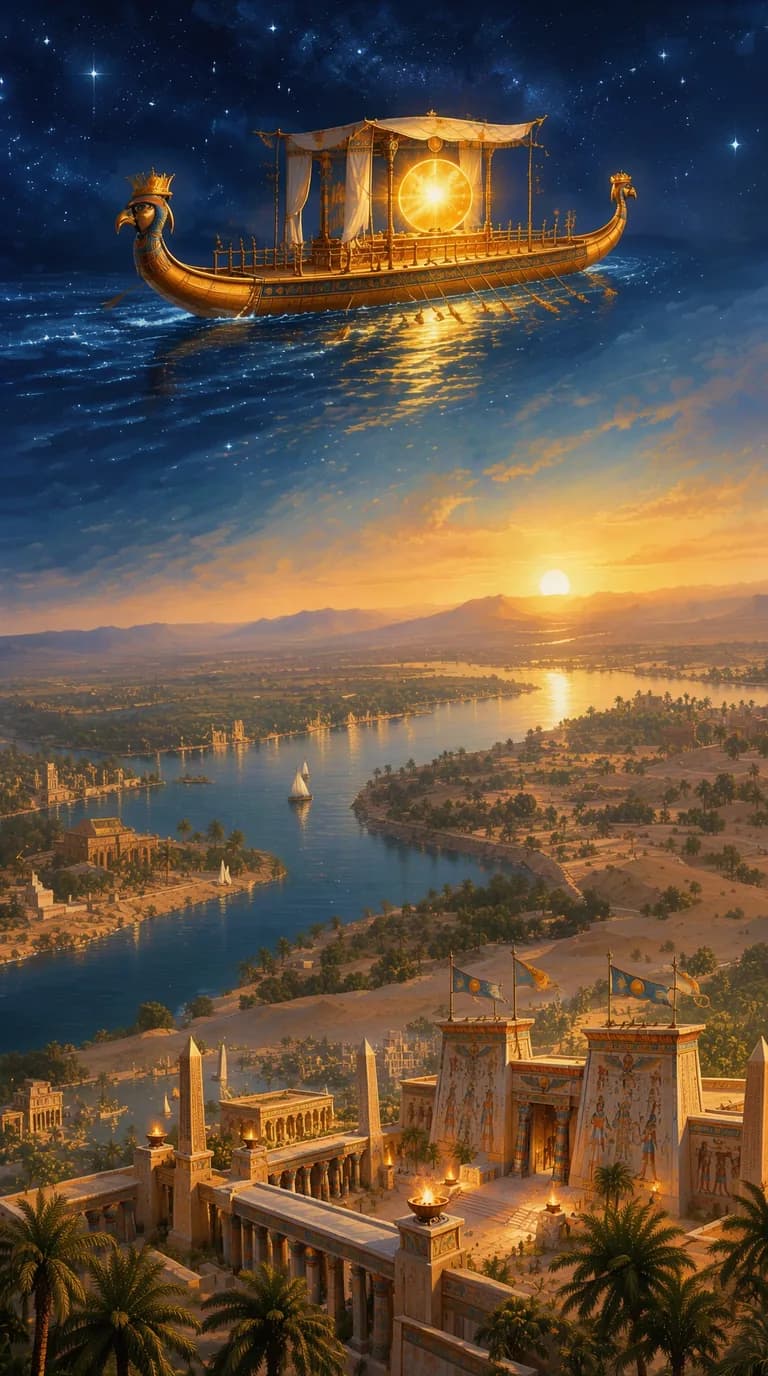
Gods of the Nile
Egyptian mythology is the body of stories told about the gods of ancient Egypt over some three thousand years, from the Old Kingdom to the Roman period. There was no single official scripture. The stories survive in temple walls, pyramid and coffin inscriptions, funerary papyri such as the Book of the Dead, and late retellings, and details differ by region and period. Most Egyptian myths are about order, kingship and the cycle of death and rebirth, not about the adventures of individual heroes.
Key Facts About Egyptian Myth
The oldest religious writing from Egypt is the Pyramid Texts, spells carved inside royal pyramids at the end of the Old Kingdom, around 2400 to 2300 BCE. They mention Osiris, Ra and the sky goddess Nut, but they are ritual texts rather than stories. The tale of Osiris as one connected narrative reaches us mostly through the Greek writer Plutarch, who wrote about Isis and Osiris in the early second century CE, long after the pharaohs. Reading Egyptian myth means piecing it together from fragments.
In Plutarch's account, Osiris is a good king who rules Egypt and teaches farming. His brother Set tricks him into a chest and throws it into the Nile. His wife Isis searches for him, finds the body, and Set later tears it into pieces. Isis gathers the pieces, and Osiris becomes ruler of the dead. Their son Horus grows up, fights Set, and is accepted as rightful king of Egypt. Each living pharaoh was identified with Horus, and each dead one with Osiris, which is why this story sits at the center of Egyptian kingship.
The other great story is the sun's own. By day, Ra crosses the sky in his boat. At night the boat enters the Duat, the underworld, where Ra meets the dead and faces the serpent Apep, an enemy of order that must be defeated every night. At dawn the sun is reborn. Texts such as the Amduat map this journey hour by hour on the walls of royal tombs. For a modern reader, it is one of the oldest stories about surviving the dark.
"Several heads, several names, one very busy pantheon."
The Journey After Death
The best-known picture of the Egyptian afterlife is the weighing of the heart, shown in many copies of the Book of the Dead from the New Kingdom onward, roughly 1550 BCE. The dead person is brought before Osiris and forty-two divine judges. Their heart is placed on a scale against the feather of Ma'at, the goddess who stands for truth, balance and justice. The god Anubis checks the scale and Thoth, the god of writing, records the result.
If the heart is balanced, the person is admitted to a blessed afterlife, often pictured as a green and fertile field, the Field of Reeds. If the heart is heavier, it is eaten by the creature Ammit, the devourer, and the person ceases to exist. There is no hell in the Christian sense. The danger is oblivion. The spells in the Book of the Dead exist to help the dead answer the judges, which is why they were buried with the person.
Egyptian myths are rarely about heroes in the Greek sense. Their gods are forces: Ra is the sun, Nut the sky, Geb the earth, Isis a protector, Thoth the keeper of knowledge. A god can have several names and combine with another, as with Amun-Ra. When you read these myths, expect symbolic rather than strictly linear stories, and expect different versions to sit side by side without one replacing the other.
Egypt also stayed part of the later story of the Mediterranean. After Alexander the Great founded Alexandria in 331 BCE, Greek rulers governed Egypt for nearly three centuries, and Isis was worshipped across the Roman world. The Greek and Egyptian traditions met in the cult of Serapis, a god created under the Ptolemies. In that sense the myths did not end with the pharaohs.
"The only judgment where your heart is your résumé."
Hearing It in the App
Alexandria Series
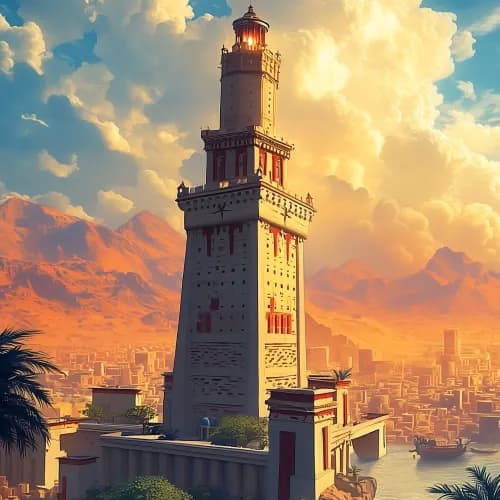
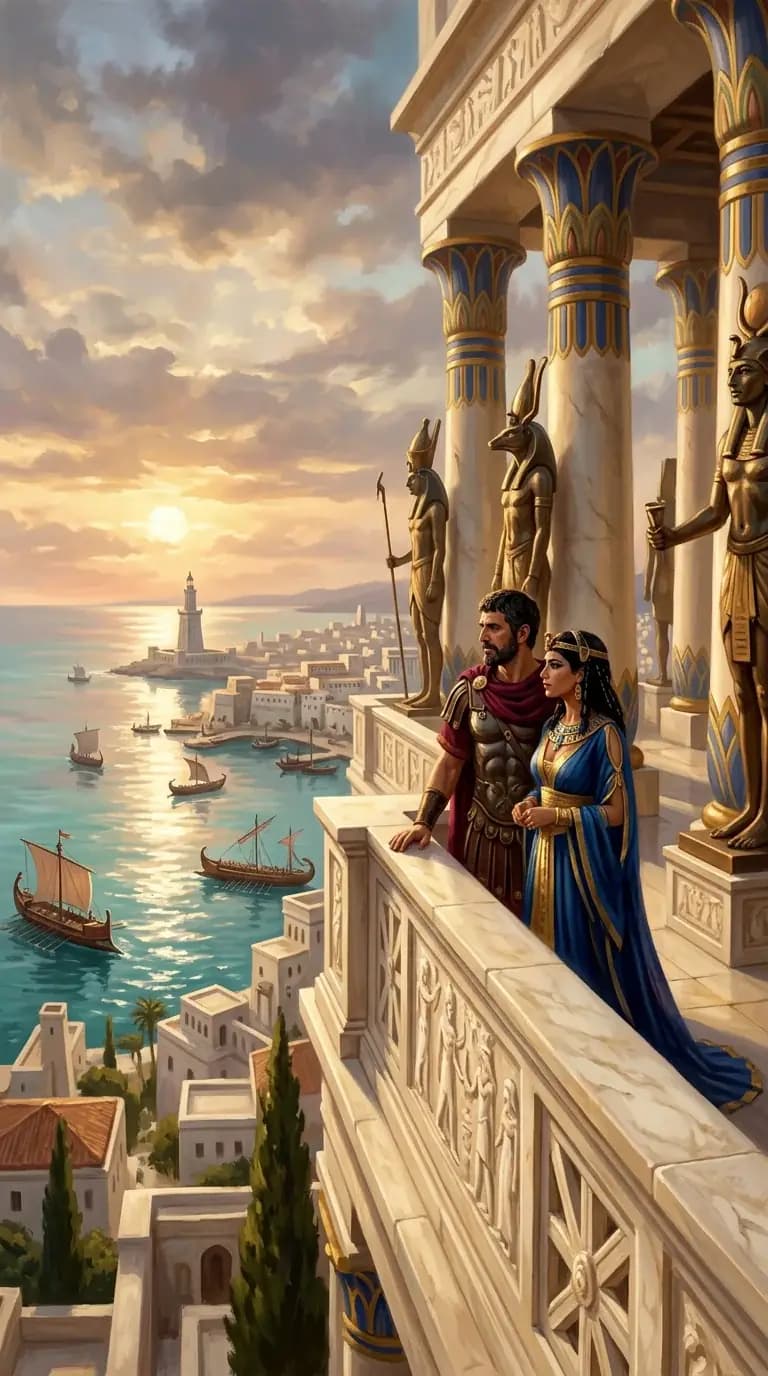
Visionaria does not have an episode about Egyptian myth. Its closest setting is Alexandria, the Greek-founded city in Egypt, with episodes such as the Pharos lighthouse, the Library, and Cleopatra's palace.
First-Person Audio
The Alexandria episodes are first-person audio journeys with narration, music and spatial (3D) sound. Headphones give the best effect.
Read, Then Listen
Use this page to understand the myths. Use an episode if you want to spend time in the place where Greek and Egyptian worlds met.
Calm Pacing
The episodes are slow and atmospheric, written for evenings and breaks rather than study.
These Egyptian myths are not in the app, but Alexandria is. See the Pharos Lighthouse, the Library of Alexandria and Cleopatra's Royal Residence. The format is explained under cinematic meditation.
"Not an Egyptian myth episode, but the lighthouse stands on the Egyptian coast."
Who This Guide Is For
Curious Readers
You know Ra, Isis and Anubis by name and want to know how the stories fit together, without a children's version.
Museum and Travel Planners
Tomb paintings and temple reliefs are easier to read once you know the judgment scene and the night journey of the sun.
Students
A map of the main sources, from the Pyramid Texts to Plutarch, and of what each one tells us.
Evening Readers
Myths about death and rebirth can be calming to read slowly. They were meant to be comforting.
Fans of Cleopatra's Era
Cleopatra ruled an Egypt in which Isis was a living cult. Our Antony and Cleopatra page covers the other side of that world.
Comparative Readers
Compare with the Greek view of death and the gods on our Greek gods guide.
Note for beginners: you do not need any background to start. If you want to hear a place connected to this world, try the Pharos Lighthouse in the app.
"Beginners welcome. Mummies, please wait outside."
More to Explore
"One Nile, many myths. Start anywhere."
Your Questions Answered
Everything you need to know about Egyptian myth
"Asked on the Nile for several thousand years."
Ready to Visit
Alexandria?
Download Visionaria and explore the Greek-founded city on the Egyptian coast.
"Cleopatra left no reviews, but the palace is worth the trip."