
Launch special: Visionaria Premium is free—all cinematic journeys with spatial 3D audio.
🇺🇦 Support Ukrainian creators on Patreon — help us make a difference
Launch special: Visionaria Premium is free—all cinematic journeys with spatial 3D audio.
🇺🇦 Support Ukrainian creators on Patreon — help us make a difference
Journey Through Story, Sound, and Imagination
Cinematic meditation is a form of guided mental exploration that combines storytelling, spatial sound design, and imaginative visualization to create immersive inner experiences. Unlike traditional meditation that emphasizes silence and stillness, cinematic meditation uses narrative environments and spatial audio to guide listeners through ancient cities, mythical realms, and legendary tales—transforming meditation from a static exercise into an active journey through richly detailed mental worlds.
Activate Your Imagination
Visual journeys that awaken creativity
3D Spatial Audio
Sound that surrounds and transports you
Active Relaxation
Calm your mind while staying engaged
Just 10-25 Minutes
Transformative journeys that fit your day
🎭 What is cinematic meditation?
It's meditation that feels like a movie for your mind—using storytelling and 3D audio to transport you to ancient cities and mythical realms instead of sitting in silence.
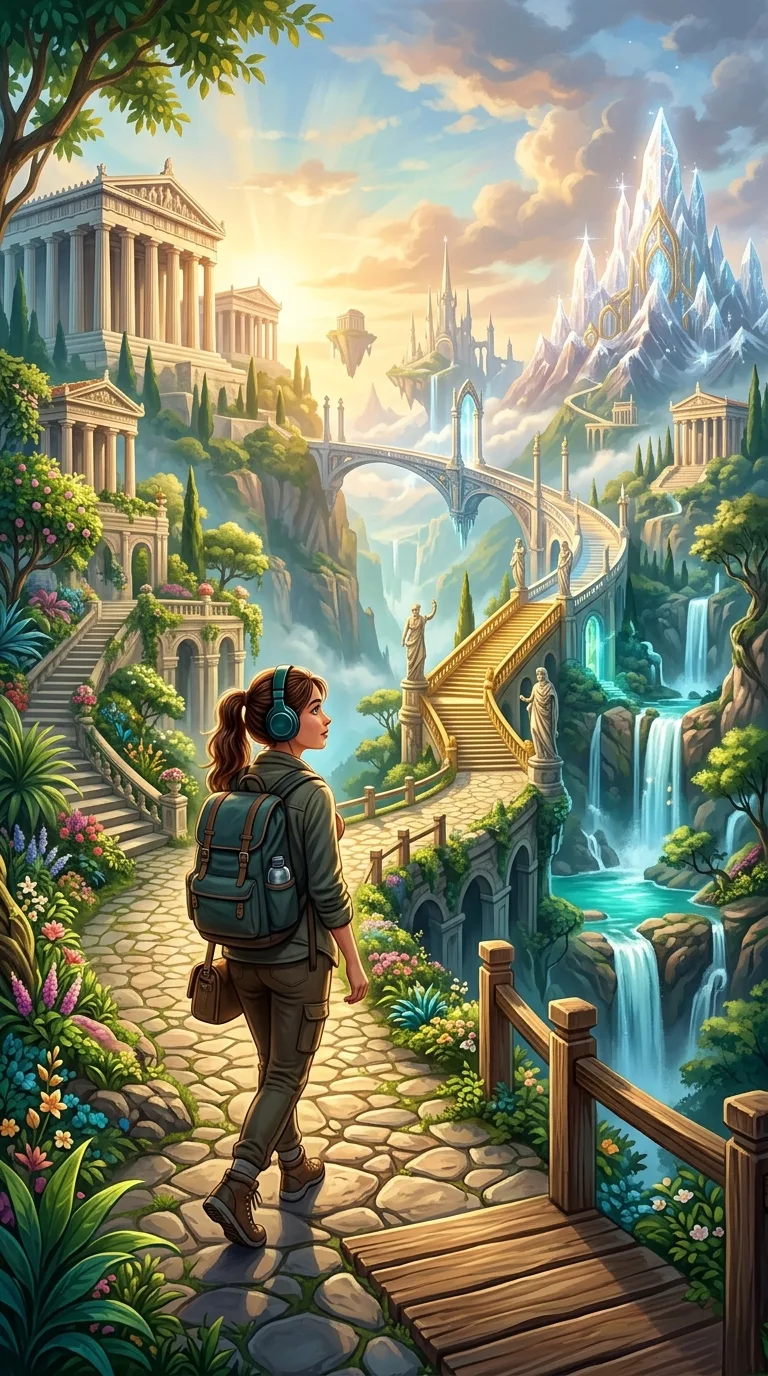
"Warning: Side effects may include accidentally trying to meditate on the subway and ending up in ancient Athens instead of Brooklyn. Please exit at the correct stop."
Now that you've seen examples, here's the comprehensive definition
Through professionally crafted soundscapes featuring precise spatial audio placement, narrative guidance providing context and direction, and visualization techniques engaging the mind's eye, cinematic meditation creates the sensation of actually traveling through story rather than merely listening to instructions. This approach emerged from recognizing that many people struggle with traditional meditation's emphasis on mental silence but thrive when given narrative structure and sensory detail to anchor their attention.
Cinematic meditation represents a new category of guided mental practice that honors the mind's natural affinity for story and imagination while achieving traditional meditation's goals of relaxation, focus, and inner exploration.
By weaving these elements together, cinematic meditation offers an accessible, engaging approach to mental training that works particularly well for creative individuals, visual thinkers, and those who find abstract meditation challenging. The practice acknowledges that the human mind naturally thinks in stories and images—rather than fighting this tendency, cinematic meditation harnesses it as the foundation for deep relaxation, imaginative development, and emotional engagement with archetypal themes.
Whether exploring the marble halls of ancient Athens, standing in Babylon's legendary gardens, or encountering mythological figures in symbolic landscapes, practitioners experience meditation as journey rather than static exercise, making the practice more intuitive, sustainable, and emotionally resonant for many modern practitioners seeking both relaxation and imaginative enrichment.
"Fun fact: 73% of our users report their imagination getting stronger. The other 27% are still trying to visualize where they put that statistic."
Understanding the unique approach that sets cinematic meditation apart from traditional practices
Emphasis on Silence
Focus on quieting mental chatter, observing thoughts without engagement
Stillness & Breath
Attention anchored to breathing, body sensations, or mantras
Present Moment
Cultivation of moment-to-moment awareness without narrative
Minimal Guidance
Brief instructions followed by silent practice periods
Abstract Focus
No specific content or imagery—attention on awareness itself
Rich Soundscapes
Spatial audio creates immersive environments with precise sound positioning
Active Imagination
Mind engaged in visualizing detailed environments and narratives
Journey Structure
Movement through story arcs, symbolic landscapes, historical settings
Continuous Narration
Guided throughout with context, description, and directional cues
Specific Content
Rich sensory details, historical contexts, mythological themes
Traditional meditation excels at developing present-moment awareness, reducing reactivity to thoughts, cultivating equanimity, and building concentration through sustained attention to simple objects. Its minimalist approach strips away narrative complexity to reveal fundamental mental processes. For many practitioners, this directness is precisely what makes traditional meditation powerful.
Cinematic meditation offers different benefits: it harnesses the mind's natural affinity for story and imagery rather than fighting it, provides structure that prevents mental wandering for those who struggle with open meditation, develops imaginative and visualization abilities that enhance creativity, and creates emotional engagement through archetypal narratives. Neither approach is superior—they serve different needs and suit different temperaments. Many practitioners benefit from both, using traditional meditation for some goals and cinematic meditation for others.
"Traditional meditation teacher: 'Focus on the breath.' Cinematic meditation: 'Focus on that dragon landing on Mount Olympus.' Both work. One's just cooler."
The foundation of every cinematic meditation experience
Narrative provides emotional direction and meaningful context. When you enter the Parthenon in Athens, you're not just visualizing marble columns—you're experiencing the cultural significance of democracy's birthplace, wisdom embodied in architecture, and philosophical inquiry that shaped Western civilization. The story gives your imagination a framework: Who built this temple? What did they believe? Why does this space matter? Narrative context transforms abstract visualization into purposeful mental journey.
Story creates emotional resonance that pure description cannot. Walking through Babylon's Hanging Gardens becomes meaningful when you understand Nebuchadnezzar created them for his homesick queen—love manifested in architecture. Encountering Zeus on Olympus carries weight when you grasp his role as cosmic order-bringer, not just powerful deity. These narrative layers give depth to sensory experience, making meditation emotionally engaging rather than mentally mechanical.
The story arc provides natural rhythm: arrival and orientation, exploration and discovery, climax or revelation, integration and departure. This structure mirrors traditional meditation's phases (settling in, deepening focus, sustained attention, returning awareness) but wraps them in journey rather than abstract process. Your mind follows the narrative flow, making sustained attention feel effortless because you're engaged with what happens next.
Spatial audio creates presence by positioning sounds in three-dimensional space. When you hear footsteps behind you, voices to your left, wind above, or water flowing to your right, your brain processes these as coming from specific real-world locations. This triggers the same neural pathways activated when experiencing actual environments. Your mind automatically constructs spatial context, making you feel present in the location rather than merely thinking about it.
Environmental soundscapes provide sensory richness that guides imagination without dictating it. The ambient sound of an ancient marketplace—distant conversations, pottery being shaped, merchants calling, footsteps on stone—gives your mind sensory material to work with. You don't have to consciously remember to imagine these details; the audio does the work, letting your imagination fill in visual elements naturally. This division of labor makes visualization easier and more immersive.
Spatial audio enhances narrative believability. When a narrator's voice comes from a specific position (a guide walking beside you, Athena speaking from her temple statue's location), your mind accepts the scenario more readily. The technical precision of sound positioning creates subconscious conviction: "This feels real." That sense of reality deepens relaxation and imaginative engagement, making the meditation both more effective and more enjoyable.
Imagination is the active component that completes the experience. While narrative provides context and audio creates sensory framework, your imagination constructs the actual visual experience. You mentally see the marble columns, visualize the faces in the marketplace, picture the sunset over Babylon's walls. This active engagement is what makes cinematic meditation different from passive entertainment—you're creating the experience, not just receiving it.
Visualization ability develops with practice. Early journeys might produce hazy, incomplete mental images—that's completely normal. Your imagination strengthens like a muscle. After multiple sessions, most practitioners find their visualizations become richer, more detailed, more spontaneous. Colors appear more vivid, environments feel more coherent, transitions between scenes flow more smoothly. This progressive development makes each journey more immersive than the last.
The beauty is that "correctness" doesn't matter. Your mental image of the Parthenon doesn't need to match archaeological reconstructions precisely. What matters is that you're engaged, present, and experiencing something meaningful. Your imagination adapts the narrative to your personal visual language. This flexibility makes cinematic meditation accessible—there's no wrong way to visualize, only your unique interpretation of the journey's sensory and narrative cues.
None of these elements works in isolation. Narrative without sound lacks sensory presence. Sound without story feels aimless. Imagination without guidance can wander into distraction. But when all three elements combine—story providing meaning, spatial audio creating presence, imagination constructing the experience—they produce something greater than their sum: the visceral sensation of journeying through inner worlds. This synergy is what makes cinematic meditation uniquely immersive and effective as both relaxation practice and imaginative training.
"Storytelling + Spatial Audio + Imagination = Meditation that feels like Netflix for your mind. Except you're the director, actor, and entire crew."
Journey through ancient cities, mythical realms, and legendary tales — the best way to understand is to see examples first
Historically authentic, spatially immersive
Visionaria transforms historical settings into environments for guided mental exploration. When you select a journey through Athens, you're not listening to a history lecture—you're ascending the Acropolis, hearing your footsteps echo on marble stairs, feeling Mediterranean breeze carrying olive-tree scents, watching the Parthenon's columns rise before you. The historical authenticity provides rich context while the spatial audio creates immersive presence.
Specific locations within cities become meditation focal points. Standing in the Parthenon's inner chamber before Athena's statue. Walking through Babylon's Hanging Gardens as water cascades through terraced greenery. Approaching the Great Library of Alexandria as scribes preserve humanity's wisdom. These aren't generic "ancient temple" experiences but carefully researched, specifically realized environments bringing history and mythology to vivid life.
"Our Athens journey is so realistic, users have started demanding falafel afterwards. We're working on smell-o-vision next."
Archetypal themes through symbolic environments
Beyond historical cities, Visionaria explores mythical realms and legendary narratives. Experience Mount Olympus as Zeus's domain, walk through Atlantis before its mythical decline, explore Asgard's golden halls, stand in enchanted forests from fairy tales, or encounter dragons and phoenixes in fantasy landscapes. These journeys engage archetypal themes—power, wisdom, transformation, courage—through symbolic environments and mythological narratives.
Receive wisdom from Athena in her temple, hear Zeus's perspective on leadership and power, experience Orpheus's legendary love story, or walk alongside heroes from classical mythology. These aren't one-sided lectures but immersive dialogues where you feel addressed personally, making ancient wisdom feel immediate and relevant.
Fantasy elements spark creativity and wonder. Journeys through imagined realms—flying castles, crystal mountains, whispering forests—free your imagination from historical constraint. These experiences especially appeal to creative individuals seeking inspiration, visual thinkers exploring mental imagery, or anyone wanting to exercise imagination in structured, guided ways. The fantastical settings demonstrate that cinematic meditation serves creativity as much as relaxation.
"Yes, you can meet Zeus. No, he won't help with your taxes. We asked."
Explore these immersive experiences

Ascend the Acropolis and experience the grandeur of ancient Athens through spatial audio and guided visualization

Walk through the legendary blue-tiled gateway into the heart of ancient Mesopotamia

Stand among the scrolls in the greatest repository of ancient knowledge ever assembled
"Choose your adventure: Ancient wisdom in Athens, hanging gardens in Babylon, or just hanging out in Atlantis. All equally wet. (Kidding about the last part.)"
The unique benefits of combining story, sound, and imagination
Experience calm not from emptying the mind but from focusing it. Narrative engagement naturally quiets mental chatter because your attention is absorbed in the journey. You relax by becoming immersed in the story rather than struggling to suppress thoughts.
Regular practice strengthens your capacity to visualize detailed environments, imagine spatial relationships, and construct rich mental imagery. This skill transfers to creative work, problem-solving, and memory enhancement—you're training imagination as a practical faculty.
Experiencing diverse environments, narratives, and symbolic themes stimulates creative thinking. Many users report breakthrough ideas, fresh perspectives on problems, and renewed creative energy after journeys. The practice opens mental pathways by exposing you to varied imaginative contexts.
Archetypal narratives and mythological themes resonate emotionally in ways abstract meditation doesn't. Experiencing Orpheus's love, Athena's wisdom, or heroes' courage creates emotional engagement that feels personally meaningful, making the practice more motivating and sustainable long-term.
Following a 15-20 minute narrative journey trains sustained attention without the difficulty of maintaining focus on breath or silence. The engaging content makes concentration feel effortless, strengthening your ability to sustain attention that transfers to work, study, and daily tasks.
Experiential learning through immersive journeys makes history, mythology, and cultural contexts feel personally relevant rather than academically abstract. You gain understanding through experience—walking ancient streets, standing in legendary temples—making knowledge more memorable and meaningful.
These benefits emerge naturally from regular practice—you don't have to force them or follow complex techniques. The engaging nature of cinematic meditation makes it easier to maintain consistent practice compared to traditional approaches that many find challenging. Users often report looking forward to sessions rather than viewing them as discipline or obligation. This sustainability is perhaps the greatest benefit: a meditation practice you actually enjoy and want to continue becomes part of your life rather than another abandoned self-improvement attempt.
"Benefits include: relaxation, creativity boost, and casually dropping 'So when I was meditating in ancient Babylon...' into conversations."
"Frequently Asked Question: 'Is this real meditation?' Answer: If your stress disappears and creativity returns, does it matter what we call it?"
Everything you need to know about cinematic meditation
"Step 1: Download app. Step 2: Put on headphones. Step 3: Become time traveler. Step 4: Forget what you were stressing about."
Download Visionaria and begin your journey through ancient worlds today.
"The only meditation app where ancient Athens, legendary tales, and 3D spatial audio conspire to make relaxation feel like an epic adventure."