Hanuman vs Sun Wukong: The Two Great Monkey Heroes of Asia
As a child Hanuman leapt toward the rising sun because he thought it was a ripe fruit.
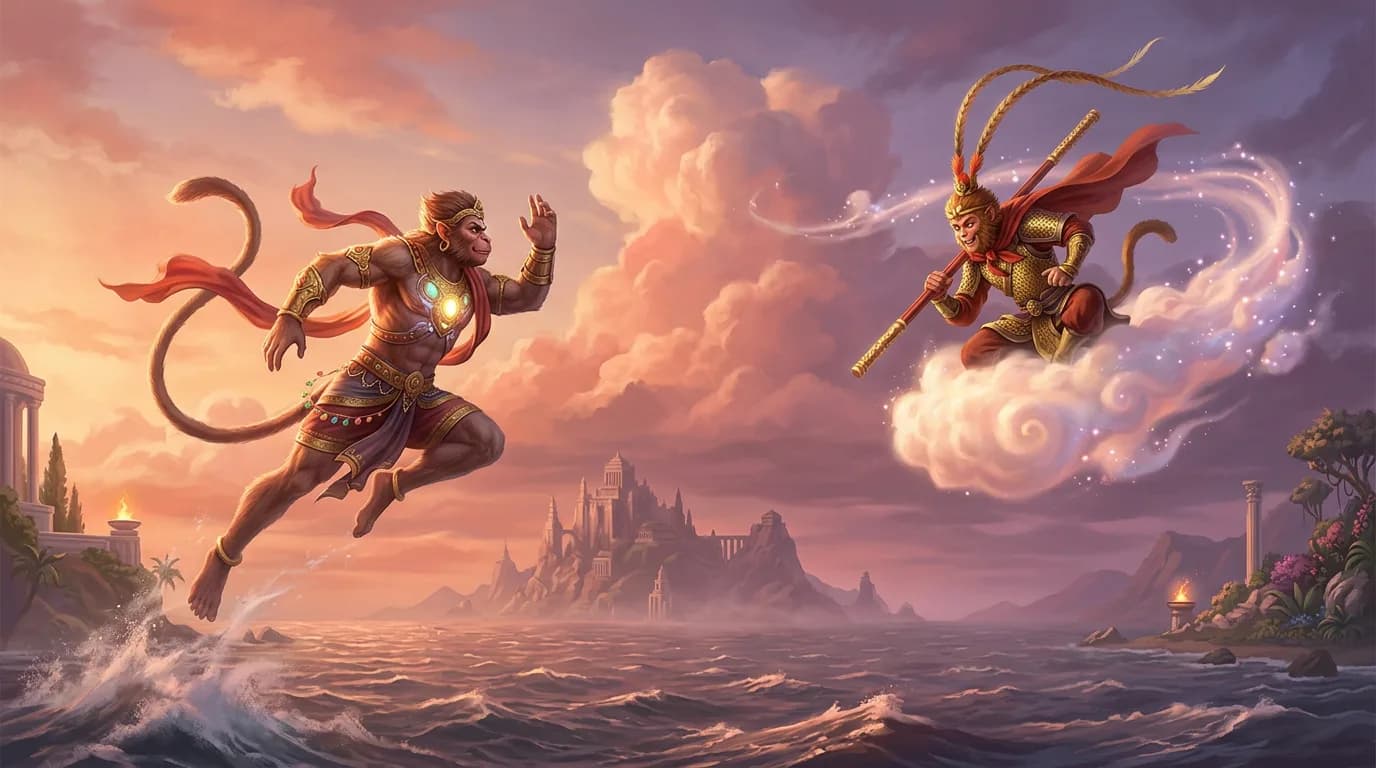
Both leap across the sky as children, both can grow as tall as a mountain or shrink to the size of an insect, and both spend their greatest adventure serving someone gentler than themselves. Hanuman, the hero of the Indian epic the Ramayana, and Sun Wukong, the Monkey King of the Chinese novel Journey to the West, are the two most famous monkey heroes in world myth. They are so alike that scholars have argued for a century about whether one inspired the other.
Key Facts About Hanuman and Sun Wukong
- •Hanuman is the devoted ally of the prince Rama in the Ramayana, an Indian epic usually dated to around the 3rd century BCE or earlier.
- •Sun Wukong is the rebellious Monkey King of Journey to the West, a Chinese novel published in the 16th century and usually attributed to Wu Cheng'en.
- •Hanuman and Sun Wukong share many gifts, including great leaps, changing size, enormous strength and a very long life.
- •The scholar Hu Shih was the first to suggest that Hanuman inspired Sun Wukong, while the writer Lu Xun traced the Monkey King to a Chinese water spirit called Wuzhiqi.
- •Hanuman is worshipped as a deity across India and beyond, while Sun Wukong is mainly a literary hero who is also honoured in some Chinese folk temples.
Quick Answer
Hanuman is the devoted ally of the prince Rama in the Ramayana, an Indian epic usually dated to around the 3rd century BCE or earlier.
Who Is Hanuman?
Hanuman is the son of Anjana and Kesari, and the Ramayana calls him the son of Vayu, the god of the wind. That heritage explains his most famous gift: like the wind, he can travel anywhere.
His story begins with a childhood leap. Seeing the rising sun, the young Hanuman mistakes it for a ripe fruit and jumps into the sky to take it. The king of the gods, Indra, stops him with his thunderbolt, which strikes the child's jaw. One reading of the name Hanuman is "the one with the marked jaw", a reminder of that day. When Vayu grieves, the gods make amends by giving the child gifts: a body as strong as Indra's thunderbolt and protection from fire, water and the wind.
As a boy Hanuman plays so many pranks on the forest sages that one of them makes him forget his powers. He only remembers them years later, when the wise bear Jambavan reminds him who he is, just before the most important leap of his life.
Who Is Sun Wukong?
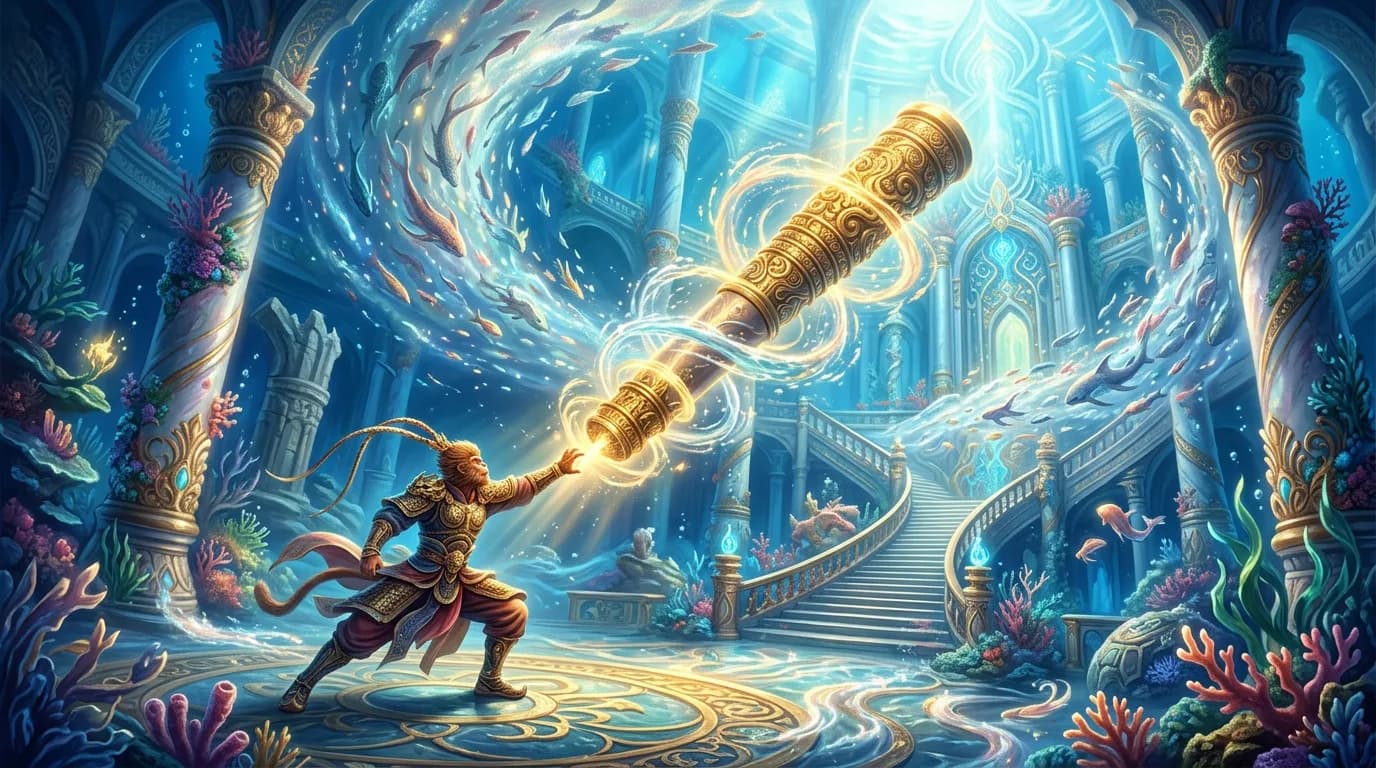
Sun Wukong is born from a stone egg on the Mountain of Flowers and Fruit. He becomes king of the monkeys, then travels across the sea to study with the Taoist master Puti Zushi, who teaches him the 72 transformations and the somersault cloud, a leap that covers 108,000 li.
He takes a staff from the Dragon King's treasury, eats the Peaches of Immortality in Heaven's garden, and names himself Great Sage Equal to Heaven. Only the Buddha stops him, by winning a wager that the monkey cannot leap out of his palm, and Sun Wukong spends 500 years under a mountain. He is freed on one condition: he must guard the monk Tang Sanzang on his long pilgrimage to India to bring back Buddhist scriptures. We cover his gifts in detail in our guide to Sun Wukong's powers and abilities, and the Monkey King legend page on Visionaria follows the whole story.
Hanuman vs Sun Wukong: The Powers Side by Side
On paper, the two heroes share a remarkable number of gifts.
Great leaps. Hanuman: crosses the sea to the island of Lanka in one leap; Sun Wukong: the somersault cloud covers 108,000 li.
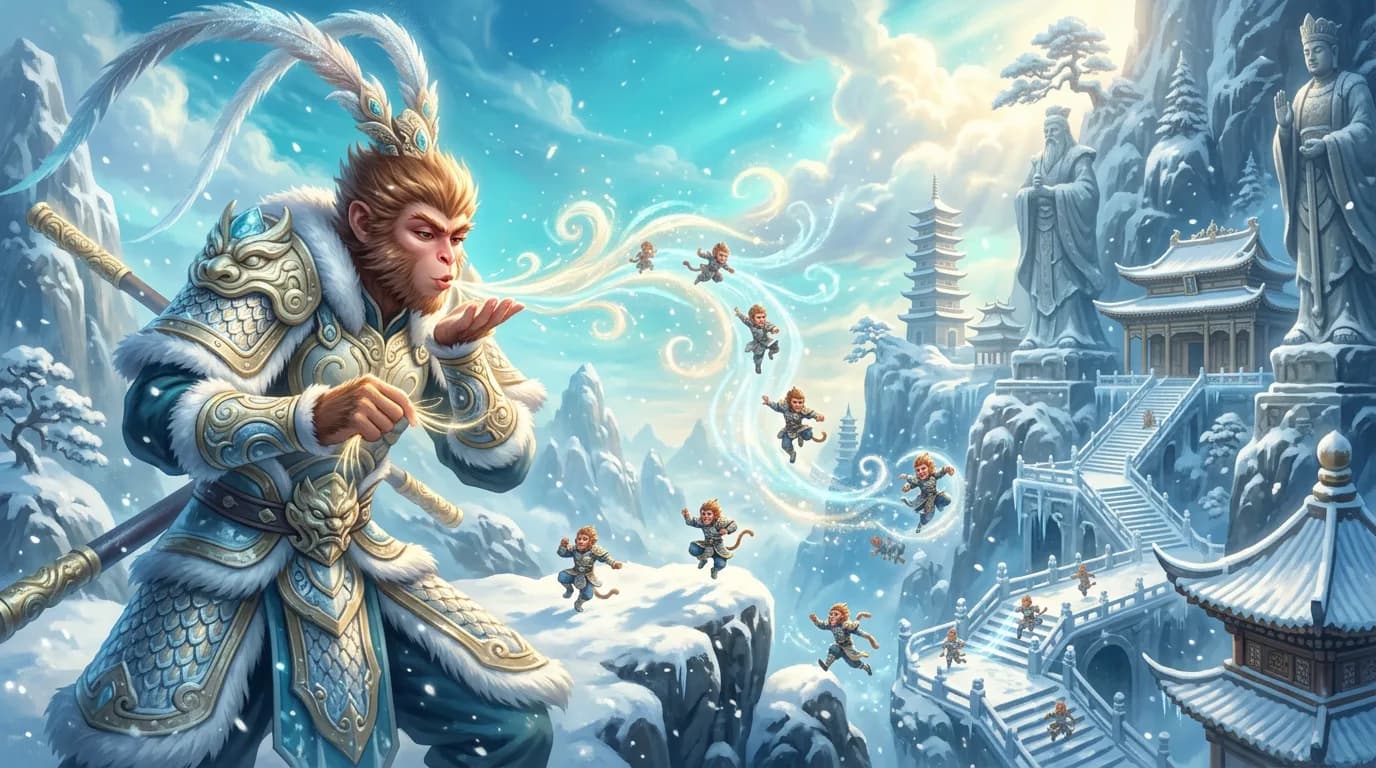
Changing size. Hanuman: grows as tall as a mountain, shrinks to slip into Lanka; Sun Wukong: changes size and shape through the 72 transformations.
Strength. Hanuman: carries a whole mountain back from the Himalayas; Sun Wukong: carries two mountains on his shoulders.
Signature object. Hanuman: A mace (gada); Sun Wukong: the Ruyi Jingu Bang, a staff that grows and shrinks.
Long life. Hanuman: A chiranjivi, one of the long-lived ones who remain on Earth; Sun Wukong: immortal after the peaches, the wine and Laozi's pills.
Origin of powers. Hanuman: gifts from the gods after his childhood leap; Sun Wukong: study with a Taoist master, then things he takes.
Where they differ
The deepest difference is not in the powers but in where they come from. Hanuman's gifts are given to him: by his father the wind, and by the gods who make amends after Indra's thunderbolt. Sun Wukong earns his skills through study and then grabs the rest, from the Dragon King's treasury to the peaches of Heaven.
Hanuman's great feats are acts of service; Sun Wukong's early feats are acts of pride, and only later, with a golden headband on his head and a monk at his side, does he learn to use them for someone else.
Hanuman vs Sun Wukong: Character and Devotion
The heart of Hanuman's story is devotion. When the demon king Ravana carries off Sita, the wife of Prince Rama, Hanuman becomes Rama's most trusted helper. He leaps across the sea to Lanka, shrinks to enter the city unseen, and finds Sita in a grove. When Ravana's guards set his tail alight to humble him, Hanuman shrinks free, leaps from roof to roof and sets much of the city ablaze.
Later Rama's brother Lakshmana is badly hurt and needs a healing herb that grows on a mountain in the Himalayas. Unable to tell which plant is the right one, Hanuman lifts the entire mountain and carries it back. That image is one of the best known in Indian art. In Hindu tradition Hanuman is the model of bhakti, loving devotion to the divine.
Sun Wukong begins at the opposite end. He is proud, funny and unwilling to bow to anyone, and his story is about learning restraint. On the journey west he protects a monk who often misjudges him, and he stays loyal even when he is sent away. Readers remember him for his wit and mischief as much as his loyalty.
Both stories follow the shape of the hero's journey, which we explore in our guide to the myth of Hercules and the hero's journey.
Is Sun Wukong Based on Hanuman?
The Chinese scholar Hu Shih was the first to suggest that the Monkey King was modelled on Hanuman. Stories from India reached China along with Buddhism, and Chinese Buddhist texts mention Hanuman.
The writer Lu Xun disagreed. He traced Sun Wukong to Wuzhiqi, a monkey-like water spirit of the Huai River whom the hero Yu the Great imprisoned under Turtle Mountain, much as the Monkey King is held under a mountain for 500 years. On this view the Monkey King grew out of Chinese folklore. A full Chinese translation of the Ramayana did not appear until the 20th century, long after Journey to the West was written.
There is also a third thread. The novel is based on a real journey: the monk Xuanzang travelled from China to India in 629 and returned around 645 with Buddhist scriptures. Over the following centuries storytellers turned his journey into legend, and a Song dynasty storyteller's text already gives the monk a Monkey Pilgrim as his helper. Many scholars today see Sun Wukong as a mix: a Chinese hero shaped by local legends, Taoist and Buddhist ideas, and perhaps a memory of the Indian monkey hero who arrived with Buddhist stories.
Who Is Stronger, Hanuman or Sun Wukong?
This is the question people ask most online, and the two stories cannot settle it. The two heroes never meet, and each tale gives its hero the strength the story needs.
Both heroes have limits. Hanuman forgets his powers until Jambavan reminds him. Sun Wukong cannot escape the Buddha's palm and is held in line by the golden headband. In both stories great strength is never the point. Hanuman's power matters because of his devotion to Rama. Sun Wukong's power matters because he learns to use it for someone other than himself.
The two are also different kinds of figure today. Hanuman is a living object of devotion for many millions of people in India, Nepal and around the world, honoured with temples, festivals and the hymn known as the Hanuman Chalisa, attributed to the 16th century poet Tulsidas. Sun Wukong is first of all a hero of literature, the star of operas, novels and countless retellings, though he is also honoured in some Chinese folk temples. Comparing their stories is a joy; ranking them is not the point.
Two Monkey Heroes Across Asia
Both heroes travelled far beyond the books that made them famous. Hanuman appears in the Thai Ramakien, where he is bolder and more playful than in the Indian epic, in the Cambodian Reamker, in the carvings of Angkor Wat and in the temple reliefs of Prambanan in Java. Sun Wukong became a favourite of Chinese opera and later of stories, comics and games across East Asia.
Like the Greek gods described in the mythological world of Zeus, they live on because each generation tells their stories again.
Hearing the Legends
Stories like these were told aloud long before they were written down. That is the idea behind cinematic imagination, the way Visionaria tells stories: a narrator places you inside the scene and spatial audio builds the world around you.
There is no Hanuman or Monkey King episode in the Visionaria app yet. Its journeys today take you through five ancient cities, including Troy, Sparta and Babylon. If you would like to try the feeling of stepping inside a legend, you can start a free Visionaria journey with headphones on and your eyes closed.
This article is for educational and informational purposes only. Historical details are based on available research and may evolve as new evidence emerges.
Visionaria journeys are designed for relaxation, guided imagination, and personal enrichment. They are not a substitute for medical, mental health, legal, or professional advice.