
Island Meditation: Why Water Surrounds You With Peace
Ancient Greek physicians on the island of Kos, including the followers of Hippocrates around 400 BCE, prescribed walks along the shoreline as a formal treatment for anxiety and melancholy, believing the sound of waves and the salt air carried genuine restorative properties.
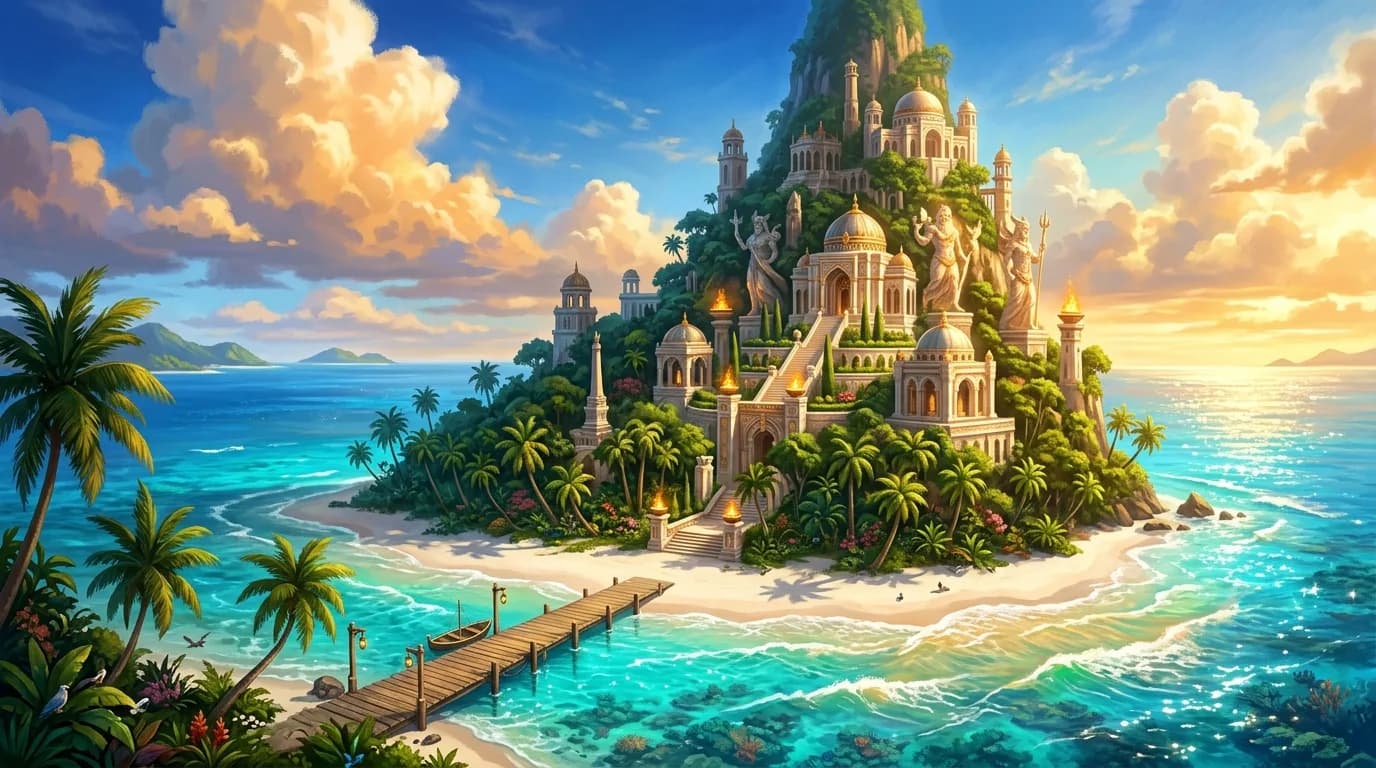
- Islands and the Psychology of Containment
- The Island Effect: Water as a Psychological Boundary
- Why Island Holidays Restore More Than Mainland Trips
- Spatial Audio Island Journey: Surrounded by Sound
- The Mental Island Technique: A Tool for Daily Stress
- Island Meditation in Practice: How to Begin
- Island Meditation and the Long Game: Why It Compounds
- Island Meditation: Your Portable Sanctuary
- Frequently Asked Questions
Island meditation is a mindfulness practice rooted in environmental psychology, using the image and sound of being completely surrounded by water to trigger a state of calm, containment, and psychological safety. Unlike standard cinematic meditation, which can take you anywhere, the island format works on a specific principle: water is a boundary that stress cannot cross.
Most people have felt it. You arrive on an island, whether it is a Greek rock in the Aegean, a quiet lake island in Finland, or a strip of sand in the Pacific, and something in your chest just... loosens. It happens faster than it should. Faster than a mountain retreat, faster than a forest walk. And for a long time, we assumed it was just the scenery. Turns out, it is far more interesting than that.
What follows is an exploration of why islands produce such a distinctive psychological state, what science says about water as a mental boundary, and how a well-designed sensory imagination practice can put you on that island in under three minutes, wherever you happen to be sitting right now.
Key Facts About Island Meditation
- •Primary effect: Psychological separation from daily stress through physical (or imagined) water boundaries
- •Core mechanism: Water acts as a symbolic and sensory boundary that the anxious mind cannot easily cross
- •Key research: Dr. Wallace J. Nichols, marine biologist, 'Blue Mind' (2014) documents measurable cognitive and emotional benefits of proximity to water
- •Audio enhancement: 360-degree spatial audio of waves, seabirds, and wind amplifies the felt sense of water-based separation
- •Technique: The mental island method: visualize problems remaining on the mainland shore while you sail to your private island
Quick Answer
Island meditation is a guided mindfulness practice that uses the psychological power of being surrounded by water to create a sense of complete separation from everyday stress. Many people find coastal and island environments especially restful, and environmental psychology has long explored why time near water can feel calming and refreshing.
Islands and the Psychology of Containment
Ask any environmental psychologist what makes an island feel different from every other natural setting, and the answer comes down to one word: containment. An island is one of the few places on earth where your physical environment has a clear, absolute edge. You can see where the land ends. You can hear where the world stops. And your nervous system, which is constantly scanning for threats from every direction, suddenly has nothing to scan on three hundred and sixty degrees of horizon except water, sky, and the sound of waves.
Dr. Roger Ulrich, an environmental psychologist at Texas A&M University, has spent decades documenting how natural settings affect stress physiology. His 1991 study in the Journal of Environmental Psychology found that people who watched videos of natural settings, including one featuring water, recovered from a stressful film faster on physiological measures than those who watched urban scenes. An island, surrounded on all sides by water, is essentially the ultimate version of that bounded natural environment. Your brain stops scanning for problems because it has been given a clean, legible perimeter.
Key Insight: Why Containment Calms
Contained environments signal safety to the brain's threat-detection system. When visual and auditory cues confirm that all edges are 'accounted for,' the mind can relax its watchfulness and settle into calmer, clearer thought. Islands do this naturally. Meditation tries to replicate it artificially.
And here is what makes islands genuinely unusual compared to other contained spaces, like a walled garden or a cozy room: the boundary itself is alive. Water moves, reflects light, produces rhythmic sound. It is not a static fence. It is a dynamic, breathing edge that keeps engaging your senses in a soft, non-threatening way. Your attention has somewhere to go. It does not turn inward and spiral.
Psychologists call this soft fascination, a concept developed by Rachel and Stephen Kaplan at the University of Michigan in their 1989 Attention Restoration Theory. Soft fascination holds your attention effortlessly without demanding cognitive effort, and it is precisely what allows mental fatigue to dissolve. The gentle, endlessly varied motion of ocean water is perhaps the most perfect soft fascination trigger in nature. Anyone who has ever stared at the sea for twenty minutes and felt inexplicably better already knows this in their bones. Explore more about how mental reset and cognitive clarity emerge from exactly this kind of gentle, directed attention.
Ancient Greek philosophers insisted that islands were where the gods went to think. Given how restful many people find the sight and sound of water, it turns out the gods had excellent taste in workspace ergonomics.
The Island Effect: Water as a Psychological Boundary
Here is the thing most stress-relief content gets completely wrong: your worries do not care about geography. You can go to a beautiful forest, a stunning mountain, a luxurious spa, and your anxious mind will follow you there, replaying the same conversations and to-do lists with equal persistence. But water is different. Psychologically, water functions as a categorical boundary, a line the ruminating mind finds genuinely difficult to cross.
Dr. Wallace J. Nichols, a marine biologist, spent years compiling neuroscience, psychology, and personal testimony for his 2014 book 'Blue Mind'. His central finding is striking: proximity to water, whether ocean, river, lake, or even a fountain, consistently shifts the brain from a state of high-alert 'red mind' activation to a mildly meditative 'blue mind' state characterized by calm, creativity, and reduced emotional reactivity. Nichols ties this to several factors, including the rhythmic sound of waves, which can make it easier to slow your breathing, and the calm many people associate with the colour blue.
Quick Answer: Why Can't Worries Cross Water?
Water triggers a multi-sensory shift in brain state that other environments cannot match. Sound, color, movement, and air quality all change near water simultaneously. When the brain receives all four cues at once, it registers a fundamental change of context, and context is how the mind separates 'safe now' from 'at-risk then.'
Now, consider what an island does specifically. It does not just put water nearby. It puts water everywhere. On all sides. Behind you and in front of you. Your problems, your emails, your arguments, your anxieties, exist on the mainland, which is now not just in a different direction but across an actual body of water. Symbolically, that is remarkably powerful. Practically, your nervous system registers it as a clean break from the context in which stress was born. Practices like exploration meditation use exactly this context-switching mechanism to move a practitioner from one mental state to another.

Find Your Island in Three Minutes
Visionaria's spatial audio island journeys place you in the center of 360-degree ocean sound, warm wind, and birdsong, so your nervous system can feel the water all around you.
A Roman senator once complained that island retreats were making the aristocracy 'uselessly calm.' His colleagues reportedly moved their villas to the coast immediately.
Why Island Holidays Restore More Than Mainland Trips
Most people have had the experience of returning from a beach holiday on an island feeling genuinely, profoundly refreshed in a way that a road trip through equal scenery simply did not produce. And then they shrug and say 'well, it was the weather.' No. The weather was part of it. But the psychology of being on an island runs much deeper. A 2012 study by Ben Wheeler, Mathew White and colleagues at the European Centre for Environment and Human Health, published in Health & Place, found that people living closer to the English coast were somewhat more likely to report good health.
A separate 2013 study by George MacKerron and Susana Mourato, using smartphone mood reports from thousands of UK volunteers, found people were happiest in marine and coastal settings, even after accounting for weather, activity and company. Being near water was not just pleasant. It was measurably and specifically more restorative than equivalent time in other natural settings. Pair that effect with the contained geometry of an island, and the restoration compounds. For those exploring how story worlds improve mental relaxation, island environments represent one of the most potent settings available.
Key Insight: The Compound Effect of Island Settings
Islands stack multiple restorative mechanisms simultaneously: Attention Restoration Theory's 'soft fascination' from moving water, Blue Mind's serotonin and calm-state activation, and the psychological separation created by an all-around water boundary. No other natural environment combines all three in a single experience.
There is also something worth mentioning about self-sufficiency. Islands produce a subtle but powerful feeling of being complete, of having everything you need within a bounded space. Psychologists describe this as a sense of environmental mastery, one of the six dimensions of psychological wellbeing identified by Carol Ryff at the University of Wisconsin-Madison. You arrive on an island and your brain quietly registers: this is manageable. I can hold this in my mind. That cognitive legibility, knowing where all the edges are, is profoundly settling in a world that usually feels too large and too fast to comprehend.
And then there is the social permission to slow down. On an island, rushing feels strange, almost rude to the environment. The water sets the pace. Waves arrive on their own schedule. Tide comes in when tide comes in. That external pacing, outside of your control and entirely unhurried, gives the overworked mind a permission structure it rarely gets anywhere else. You are not slacking. You are simply moving at the speed of the island.
A Victorian explorer once wrote that island air made him 'constitutionally unable to worry.' His doctor noted dryly that the same effect was absent when the explorer returned to London, which suggests the cure was geographic rather than constitutional.
Spatial Audio Island Journey: Surrounded by Sound
Picture this: you put on headphones, close your eyes, and within moments you hear waves arriving from your left, moving under you, rolling away to your right. A seabird calls from somewhere high and behind you. Wind moves through palm fronds directly ahead. Another wave lifts from the south, curls, and settles. You are, as far as your auditory cortex is concerned, standing on a small island in the middle of the ocean.
This is not ambient background music. 360-degree spatial audio, also called binaural or ambisonics audio, encodes directional sound information in a way that your brain reads as genuine three-dimensional space. When researchers at the University of Sussex, led by Dr. Cassandra Gould van Praag, published findings in 2017 in Scientific Reports, they found that listening to natural sounds, compared with artificial ones, was linked to a shift toward a more relaxed state and to changes in brain activity associated with inward-focused attention. The study did not compare surround sound with stereo, so whether spatial audio adds to the effect is still an open question. Read more about how immersive audio creates mental worlds
Read more: How Spatial Audio Transforms Meditation Experiences

Quick Answer: What Does 360 Island Audio Actually Do?
When wave sounds arrive from all directions simultaneously, your auditory cortex registers them as a genuine environmental surround, not a recording. This triggers the same 'water boundary' psychological effect as physically being on an island, activating the Blue Mind calm state even in a city apartment.
Add warm wind across the right channel, the rustle of palm leaves slightly ahead and above, and a distant seabird arcing from left to right, and the meditation experience stops being symbolic and becomes something much closer to physiological. Your breathing slows to match the wave rhythm. Your shoulders drop. Your inner monologue goes quiet, not because you forced it to, but because your sensory environment has given it nowhere urgent to be. This is the specific power that Visionaria's island journeys are designed to create, placing you at the center of a living sound environment rather than in front of it.
Early radio engineers were baffled that ocean recordings made listeners 'unreasonably tranquil.' They considered it a design flaw. History has since concluded it was the best feature.
The Mental Island Technique: A Tool for Daily Stress
Now for the practical part. Because you cannot always book a flight to a Greek island when your Tuesday afternoon goes sideways.
The mental island technique is a structured cognitive distancing visualization, a method of using imagined geography to create psychological separation from stressors. Here is the core sequence: you close your eyes and picture the thing that is troubling you, whether it is an unresolved conversation, a looming deadline, or a general sense of overwhelm, and you place it, physically place it, on a shoreline. Not buried. Not gone. Just sitting on the shore, visible, real. Then you imagine yourself stepping into a small wooden boat and rowing out toward an island in the middle of a calm, sun-lit bay. As the distance grows, the shore, and everything on it, gets smaller. Not erased. Just smaller. You arrive at your island and the water is between you and all of it.
Key Insight: Distance Is Not Denial
The mental island technique does not pretend problems do not exist. It creates deliberate psychological distance, which research by Dr. Ethan Kross at the University of Michigan has found can reduce emotional reactivity and support wiser reasoning about personal problems.
Dr. Ethan Kross, a psychologist at the University of Michigan, has published extensively on the concept of self-distancing and its effects on emotional regulation. In studies with Ozlem Ayduk, he found that reflecting on an upsetting memory from a 'fly on the wall' perspective, or talking to yourself in the third person, reduced distress and, in one 2008 study, blood-pressure reactivity, without requiring people to suppress their feelings. The island technique operationalizes exactly this, and the audio layer makes the distance visceral rather than merely conceptual. When your headphones are playing the sound of water lapping at your island shore, the symbolic separation becomes a sensory reality.
What makes the boat journey itself so valuable is the transition. You do not just teleport to the island. You row. You feel the water beneath you, hear the oars dipping, watch the shore recede. That gradual separation matters because your nervous system needs time to shift gears. The mind does not move from 'stressed' to 'calm' in an instant, but it can move fluidly when given a sensory story to follow. Practices rooted in guided imagination journeys understand this intuitively: the journey to the calm place is itself part of the calming.
A Zen monk was once asked how he remained calm during difficult negotiations. He replied: 'I put the other person on a distant island in my mind.' His assistant noted that the monk owned no boat and had never been to sea, which suggests imagination is the superior vessel.
Island Meditation in Practice: How to Begin
Starting an island meditation practice does not require any equipment, any prior meditation experience, or a particularly long session. Start with five minutes. Sit comfortably, close your eyes, and build your island from the inside out. Begin with a single sound: waves. Place them all around you, not in front. Let them be irregular, as real waves are. Now add warmth on your face, sunlight from above, a suggestion of salt in the air.
If your mind wanders, and it will, do not treat that as failure. Simply return to the water. Pick up the sound of a distant wave forming on the left. Follow it as it moves toward you, reaches your shore, and retreats. That is your anchor in this practice. Not a breath, not a mantra, but a wave. Something alive and always arriving. The science behind why this works connects directly to what researchers studying imagination training with meditation have documented: vivid sensory imagery activates the same neural pathways as the real experience, and those pathways carry the same calming physiological outcomes.
Quick Answer: What Is the Minimum Effective Dose?
Research from the Kaplan Attention Restoration framework suggests that even brief exposure to restorative nature imagery, as little as five minutes, begins to replenish directed attention capacity. For island meditation with spatial audio, five to ten minutes is a fully effective session for most adults.
For those who find unguided visualization difficult, which is most people at first, a structured audio journey makes an enormous difference. Visionaria's library of immersive nature journeys, which spans experiences across environments including island settings, coastal cliffs, and open-ocean passages, uses layered spatial audio to do the scene-building for you so that your imagination can simply follow rather than strain to construct. This complements, but does not replace, professional care for clinical anxiety or stress-related conditions.
Over time, consistency builds something valuable: a mental anchor. Your island becomes a place your mind already knows, a place it can reach more quickly with each visit, the way you can close your eyes and picture your childhood home with no effort at all. The first time you visit, you build the island. By the twentieth time, the island builds itself the moment you close your eyes. Developing that kind of consistent practice connects naturally to the guidance in building a daily visualization meditation habit, which offers a structured framework for making this stick.

How Sensory Imagination Enhances Mindfulness: Complete Guide
Discover how engaging all five senses in your imagination practice creates measurably deeper states of calm and focus.
A 17th-century Dutch sailor wrote in his diary that the sea was 'the only remedy I know for a cluttered mind.' He had unknowingly described cognitive distancing theory three hundred years before the term was coined.
Island Meditation and the Long Game: Why It Compounds
Here is something the wellness industry rarely tells you about any meditation practice: the first session is the least powerful one you will ever have. Not because you did it wrong. Because the mind needs repetition to build a reliable internal space. Every time you return to your island, you are strengthening a neural pathway, quite literally thickening the connections between sensory memory, emotional regulation, and voluntary attention.
This is what neuroscientists mean when they discuss neuroplasticity through visualization. Dr. Sara Lazar at Harvard Medical School published research in 2005 in NeuroReport showing that long-term meditators had measurable increases in cortical thickness in regions associated with attention, interoception, and sensory processing. The brain does not know, at a structural level, whether the experience it is processing was real or vividly imagined. Both produce synaptic change. Which means your island, visited regularly, becomes as neurologically real as any place you have physically been. For a deeper look at the mechanics behind this, the research on how imagination training improves mental health offers a compelling scientific framework.
Key Insight: Your Island Becomes Real
Dr. Sara Lazar's 2005 Harvard research found that long-term meditators had thicker cortex in attention and sensory-processing regions than non-meditators, though a single snapshot like this cannot prove meditation caused the difference. A vivid, repeatedly visited mental island builds genuine neural real estate over time.
And there is a broader point here about what we are actually building when we practice island meditation consistently. We are not just learning to relax. We are creating a stable, portable psychological refuge: a place that exists entirely inside us and cannot be taken away by any external circumstance. Stoic philosophers called this the inner citadel. Psychologists today call it a secure base for emotional regulation. Call it what you like. After enough visits, it is simply home.
Island meditation, at its most developed, is a practice of island meditation that extends beyond the session itself. You begin to carry the island with you. A difficult meeting becomes, briefly, just another thing on the mainland shore. You notice the water. You feel the distance. And you row, even for a moment, back to your island. That is not escapism. That is a genuine, evidence-backed form of emotional healing through narrative experience, and it is one of the most quietly powerful tools available to anyone willing to build it.
Marcus Aurelius reportedly described his mental practice as 'retreating to the island within.' Historians note he never actually lived on an island, which strongly implies he discovered the technique before we had a name for it.
Island Meditation: Your Portable Sanctuary
What makes island meditationso quietly revolutionary is not the technique itself but what it reveals about the mind. You do not need a passport, a flight, or two weeks of saved vacation days to access a state of genuine psychological containment. You need a boundary, a body of water in the imagination, and the sensory permission to step away from whatever is waiting on the mainland shore. Researchers including Mathew White at the European Centre for Environment and Human Health (University of Exeter) have linked living near the coast with fewer symptoms of mental distress, and a 2016 New Zealand study found that simply being able to see the sea from home was associated with lower psychological distress. Your nervous system responds to the idea of water almost as readily as it responds to the real thing, which means the island was always partly a mental construction. We just needed science to tell us it was acceptable to use it that way.
Modern psychology has been slowly catching up to something island-dwelling cultures understood intuitively for centuries: that spatial separation and psychological separation are deeply intertwined. Practices like narrative meditation and story-based visualizationwork precisely because the brain does not maintain a strict firewall between what is physically real and what is vividly imagined. Psychologist Ethan Kross at the University of Michigan has shown across multiple studies, including a 2014 paper on third-person self-talk, that stepping back psychologically from a stressful situation can reduce the intensity of emotional reactions. An island is not escapism in the pejorative sense. It is a structured form ofcognitive reframing, one that happens to come with waves, warm wind, and birdsong.

The Best Audio Meditation Experiences in 2026
A curated guide to the most immersive, science-backed audio meditation experiences available right now, from spatial soundscapes to full narrative journeys.
And here is the part that genuinely excites me: the more you practice the mental island technique, the faster and more effortlessly it works. Neuroplasticity research by Richard Davidson's group at the University of Wisconsin-Madison suggests that repeated mental training can change how the brain responds to emotional situations, one more reason to return to the practice regularly. What starts as a five-minute guided journey can become, over weeks and months, an almost instantaneous internal shift, a breath, a closing of the eyes, a sound of waves, and suddenly the mainland and all its noise is somewhere else entirely. Visionaria was built on exactly this principle: thatimmersive guided visualization through spatial audio is not a luxury or a novelty but a trainable cognitive skill with compounding returns. Your island is not a destination. It is a capacity. And like any capacity, it grows stronger every time you use it. Island meditation, practiced consistently, does not just restore you in the moment. It gradually rewires the speed at which your nervous system can find its way back to calm, and that, more than any single session, is the real gift.
Find Your Island. Start Listening Today.
Immersive audio journeys that take you there instantly.
A 17th-century cartographer, upon finishing yet another map of a remote island no one had visited: 'I have now drawn every island in the known world. Sadly, I have never left my desk.' Some people discover their island without ever leaving the room. That was always the point.
This article is for educational and informational purposes only. Historical details are based on available research and may evolve as new evidence emerges.
Visionaria journeys are designed for relaxation, guided imagination, and personal enrichment. They are not a substitute for medical, mental health, legal, or professional advice.
White, Mathew P. et al. 'Spending at least 120 minutes a week in nature is associated with good health and wellbeing.' Scientific Reports, Nature Publishing Group, 2019.
Kross, Ethan, and Ozlem Ayduk. 'Self-Distancing: Theory, Research, and Current Directions.' Advances in Experimental Social Psychology, Vol. 55, Elsevier, 2017.
Davidson, Richard J., and Sharon Begley. The Emotional Life of Your Brain. Hudson Street Press, 2012.
Kaplan, Stephen. 'The Restorative Benefits of Nature: Toward an Integrative Framework.' Journal of Environmental Psychology, Vol. 15, Academic Press, 1995.
Ulrich, Roger S. 'View Through a Window May Influence Recovery from Surgery.' Science, Vol. 224, American Association for the Advancement of Science, 1984.