
What Is Cinematic Meditation? A New Era of Mindfulness
💡 Fun fact: Traditional meditation asks you to think about nothing. Cinematic meditation asks you to think about ancient temples, enchanted forests, and mythological kingdoms. If your brain refuses to be empty, cinematic meditation says: "Fine, let's fill it with something spectacular instead."

- What Is Cinematic Meditation?
- The Science Behind Cinematic Meditation
- How Cinematic Meditation Differs from Traditional Mindfulness
- The Role of Spatial Audio in Cinematic Meditation
- Narrative-Driven Mindfulness: Why Stories Transform Practice
- The Immersive Environments of Cinematic Meditation
- Benefits of Cinematic Meditation for Modern Life
- Who Is Cinematic Meditation For?
- How to Start Your Cinematic Meditation Practice
- The Future of Mindfulness: Where Cinematic Meditation Is Heading
- The Bottom Line
- Frequently Asked Questions
Close your eyes and imagine this: you're standing at the entrance of an ancient temple. Cool stone beneath your feet. The faint scent of incense carried on a warm breeze. Around you, the sound of distant chanting resonates through towering columns, and as you step forward, the acoustic space shifts sounds moving behind you, above you, enveloping you in a three-dimensional world created entirely through sound. This isn't a movie scene or a virtual reality simulation. This is cinematic meditation a groundbreaking approach to mindfulness that is fundamentally transforming how millions of people experience guided meditation, relaxation, and inner exploration.
For decades, meditation has been associated with a single paradigm: sit still, close your eyes, empty your mind, and focus on your breathing. While this approach has profound benefits supported by extensive research, it also presents a significant barrier most people find it extraordinarily difficult. Many people who try traditional meditation find it hard to stick with, often citing boredom, frustration with wandering thoughts, and difficulty maintaining focus. Cinematic meditation addresses this challenge directly by taking an entirely different approach: instead of asking your mind to be empty, it gives your mindsomething magnificent to focus on. Through the combination of spatial audio technology, carefully crafted narratives, and interactive storytelling, cinematic meditation achieves the same neurological benefits as traditional mindfulness reduced stress, improved focus, enhanced emotional regulation while being dramatically more engaging and accessible.
Cinematic meditation is an innovative mindfulness methodology that merges the immersive qualities of cinema rich soundscapes, compelling narratives, vivid environmental detail with the therapeutic principles of meditation and guided visualization. Pioneered by platforms like Visionaria, cinematic meditation uses spatial 3D audio technology to place practitioners inside carefully constructed auditory environments from historically reconstructed ancient cities and mythological realms to fantasy kingdoms and natural landscapes creating a meditation experience that engages the imagination as the primary vehicle for achieving mindfulness, relaxation, and personal transformation. Unlike traditional meditation, which relies on the suppression of mental activity, cinematic meditation harnesses the brain's natural storytelling capacity to achieve deep states of calm through narrative engagement, sensory immersion, and imaginative participation.
In this comprehensive guide, you'll discover everything about cinematic meditation how it works, the neuroscience behind it, how it compares to traditional mindfulness practices, and why experts believe it represents the most significant evolution in meditation technology since the invention of guided audio. Whether you're a seasoned meditator looking to deepen your practice or someone who has tried and struggled with conventional meditation, cinematic meditation offers a pathway to mindfulness that works with your mind rather than against it.
"Traditional meditation: 'Empty your mind.' Your brain: 'Okay, but first let me remind you about that embarrassing thing you said in 2014.' Cinematic meditation: 'Here, think about exploring an ancient temple instead.' Your brain: 'Oh, this is WAY better.'"
Key Facts About Cinematic Meditation
- ••Definition: A mindfulness approach combining spatial audio, narrative storytelling, and immersive environments to create meditation experiences that engage the imagination
- ••Technology: Uses binaural and spatial 3D audio processing to create realistic three-dimensional soundscapes through standard headphones
- ••Retention rate: There is no published data yet, but many people find a story easier to stay with than a traditional guided meditation
- ••Sessions: Typically range from 10 to 25 minutes, with environments spanning historical locations, mythological realms, and natural landscapes
- ••Benefits: Stress reduction, improved focus, enhanced creativity, better sleep quality, and strengthened imagination capacity
- ••Accessibility: Requires only headphones and a smartphone (no VR headsets, special equipment, or prior meditation experience needed)
- ••Experience it: Visionaria offers 24 cinematic meditation journeys with spatial audio, set in five ancient cities and free to start on iOS and Android
Quick Answer
💡 Fun fact: Traditional meditation asks you to think about nothing. Cinematic meditation asks you to think about ancient temples, enchanted forests, and mythological kingdoms. If your brain refuses to be empty, cinematic meditation says: "Fine, let's fill it with something spectacular instead."
What Is Cinematic Meditation?
At its core, cinematic meditation is a paradigm shift in how we approach mindfulness. Traditional meditation methods rooted in ancient Buddhist, Hindu, and Taoist traditions generally operate on the principle of reducing mental stimulation: quieting the mind, releasing thoughts, focusing on a single point of awareness such as the breath. These methods are powerful and well documented. But cinematic meditation takes an entirely different philosophical approach: instead of subtracting stimulation, it redirects your cognitive attentionthrough carefully designed immersive experiences that aim for the same calm, focused state as traditional practice while being far more accessible to the modern, stimulus adapted mind.
Think of it this way: traditional meditation is like trying to create silence in a noisy room by asking everyone to stop talking. Cinematic meditation is like replacing the noise with beautiful music the chaos disappears not because it was suppressed, but because it was transformed. When you put on headphones and begin a cinematic meditation session through Visionaria, you're transported into a fully realized auditory environment. You might find yourself walking through the streets of ancient Athens, hearing merchants call out their wares, feeling the sun-warmed stone beneath your feet, listening to philosophers debating in the Agora. Or you might find yourself in a mythological landscape standing before the gates of Valhalla, walking through an enchanted forest where dragons murmur in the distance, or exploring the legendary halls of Camelot.
Quick Fact
Many of the 'new' wellness trends we see today are actually thousands of years old, rooted in these exact historical periods.
The key innovation is that these experiences are not passive they're designed to engage your imagination as an active participant in the meditation. The narrator guides you, spatial audio creates the three-dimensional environment, and your own imagination fills in the visual details. This engagement of the imagination is what makes cinematic meditation both deeply relaxing and cognitively enriching. You're not just resting you're building and strengthening your capacity for mental imagery, creative thinking, and focused attention while simultaneously achieving the stress reduction benefits traditionally associated with mindfulness practice. Through imagination expansion techniques, cinematic meditation trains cognitive abilities that benefit every area of your life.
🎬 Cinema + Meditation = Transformation
Read more: The Mythological World of Zeus Explained: Origins, Symbols, Legacy & the King of the Greek Gods

The term "cinematic" is intentional: just as cinema uses sound, narrative, and visual composition to create emotional experiences, cinematic meditation uses the same principles but with your imagination as the screen. The result is a meditation practice that feels less like discipline and more like an adventure.
What's an ancient intellectual's favorite exercise? Jumping to conclusions.
The Science Behind Cinematic Meditation
The effectiveness of cinematic meditation is grounded in well established neuroscience and cognitive psychology research. When you engage with a cinematic meditation experience, multiple brain regions activate simultaneously in ways that closely mirror the neural patterns observed during deep traditional meditation but through a fundamentally different cognitive pathway. Understanding this science helps explain why cinematic meditation works so effectively, even for people who have struggled with conventional mindfulness approaches.
The first key mechanism is attentional absorption. Research in cognitive psychology has identified a state called "narrative transportation" when a person becomes so absorbed in a story that they temporarily lose awareness of their immediate surroundings. This state, which psychologists Melanie Green and Timothy Brock at Ohio State University studied as 'narrative transportation', describes being so absorbed in a story that your attention, imagery and feelings are drawn into its world. These are precisely the same neural signatures observed during deep meditation. The difference is that narrative transportation achieves these states through engagement rather than suppression making it accessible to a much wider population.
Historical Insight
Ancient practices often intuitively understood what modern science is only now proving: the deep connection between mind, body, and our environment.
The second mechanism is spatial audio processing and embodied cognition. When cinematic meditation uses spatial 3D audio to create realistic environmental soundscapes, the brain's auditory cortex processes these sounds as if they were real physical experiences. Neuroscience research shows that imagining a scene engages some of the same brain areas as perceiving it the same neural pathways fire in both cases. This means that when you "walk through" an ancient city in a cinematic meditation, your brain responds with genuine relaxation, reduced stress hormones, and enhanced neuroplasticity. The experience isn't "pretend relaxation" it produces real, measurable physiological changes that are equivalent to those achieved through traditional meditation practice.
"Scientists found that vividly imagining a relaxing experience engages some of the same brain areas as actually having one. This is great news for cinematic meditators and terrible news for anyone trying to convince their brain that a Monday morning commute is acceptable."

Step Into the World of Visionaria
Immersive audio journeys bringing history, mindfulness, and wonder to life.
Why did the ancient physician prescribe a long walk? Because he was tired of listening to the patient complain in his office.
How Cinematic Meditation Differs from Traditional Mindfulness
Understanding the differences between cinematic meditation and traditional mindfulness isn't about declaring one superior to the other it's about recognizing that different minds respond to different approaches, and that expanding the toolkit of available meditation methods makes mindfulness accessible to far more people. Traditional meditation and cinematic meditation share the same fundamental goals stress reduction, enhanced focus, emotional regulation, present moment awareness but they approach those goals through radically different cognitive strategies.
Quick Fact
Many of the 'new' wellness trends we see today are actually thousands of years old, rooted in these exact historical periods.
Traditional mindfulness meditation works through subtraction. The practitioner systematically reduces mental stimulation closing eyes, sitting still, minimizing sensory input and then practices observing thoughts without attachment, returning attention to the breath or a mantra whenever the mind wanders. This approach trains the capacity for meta cognition (awareness of your own thinking) and develops the ability to create space between stimulus and response. The challenge is that this subtractive approach requires significant willpower, patience, and tolerance for discomfort qualities that the most stressed, anxious, or overstimulated individuals (the people who need meditation most) often struggle to sustain.
Cinematic meditation works through transformation. Rather than asking the mind to empty itself, cinematic meditation redirects cognitive attention into immersive narrative experiences that naturally achieve the same relaxation response. Your thoughts don't need to be suppressed they're channeled into constructive imagination. The wandering mind isn't a problem it becomes an asset, filling in sensory details of the immersive environment. Anxiety and stress don't need to be "released" they're naturally displaced by the absorbing narrative experience. Through platforms like Visionaria, practitioners can access interactive audio journeys that make this transformation effortless from historical explorations to mythological adventures.
"Traditional meditation says: 'When thoughts arise, gently let them go.' Cinematic meditation says: 'When thoughts arise, redirect them toward ancient Greek architecture.' Both work. One of them involves significantly cooler mental scenery."
A philosopher walked into a wall. His students asked if it hurt. He replied, 'The wall is an illusion, but my headache is quite real.'
The Role of Spatial Audio in Cinematic Meditation
Spatial audio is the technological backbone that makes cinematic meditation possible. Unlike traditional stereo sound, which distributes audio between left and right channels, spatial audio uses advanced processing algorithms including Head-Related Transfer Functions (HRTFs) and binaural recording techniques to create a fully three-dimensional sound field that surrounds the listener. Sounds can come from above, below, behind, and in front moving dynamically through space as the narrative unfolds. This creates an acoustic environment so realistic that the brain processes it as a genuine physical space.
The impact of spatial audio on the meditation experience is profound. When you hear footsteps echoing through a cathedral sized space, birdsong moving through a forest canopy above you, or waves breaking on a shore that seems to extend around you in every direction, your brain responds with genuine spatial awareness and environmental presence. This phenomenon known as "acoustic presence" or "auditory immersion" triggers the same relaxation responses as actually being in a peaceful natural environment. Many people find natural soundscapes calming, and some research links listening to nature sounds with lower reported stress, though the evidence is limited. Spatial audio recreates these environments with sufficient fidelity thatthe neurological response is virtually identical to the real thing.
Key Insight
These historical figures didn't separate physical wellness from philosophical thought. To them, it was all one continuous practice of living well.
For cinematic meditation specifically, spatial audio serves multiple functions beyond simple immersion. It guides attention and narrative flow a sound approaching from behind naturally causes you to "turn" mentally, creating a sense of movement and exploration. It provides environmental grounding the ambient sounds of a particular location (temple bells, forest streams, marketplace chatter) anchor your imagination in a specific place and time. And it creates emotional resonance the sonic texture of an environment communicates mood, scale, and atmosphere in ways that narration alone cannot achieve. Combined with skilled voice narration and guided imagination techniques, spatial audio transforms meditation from an abstract mental exercise into a lived sensory experience.
"Spatial audio can make you feel like you're standing in an ancient temple without the inconvenience of actual time travel, passport requirements, or airline food. Your ears are basically teleportation devices. Scientists are still figuring out how to add the smell of freshly baked Mediterranean bread."
An Epicurean, a Stoic, and a Cynic walk into a garden. The bartender says, 'Is this some kind of philosophical joke?'
Narrative-Driven Mindfulness: Why Stories Transform Practice
Humans are, at the deepest level of their cognitive architecture, storytelling creatures. Long before the invention of writing, before agriculture, before permanent settlements, our ancestors sat around fires and told stories. Narrative is not merely something we enjoy it is the fundamental mechanism through which the human brain organizes experience, processes emotions, encodes memories, and constructs meaning. Cinematic meditation taps into this ancient cognitive infrastructure, using narrative as the delivery vehicle for mindfulness working with the brain's natural tendencies rather than against them.
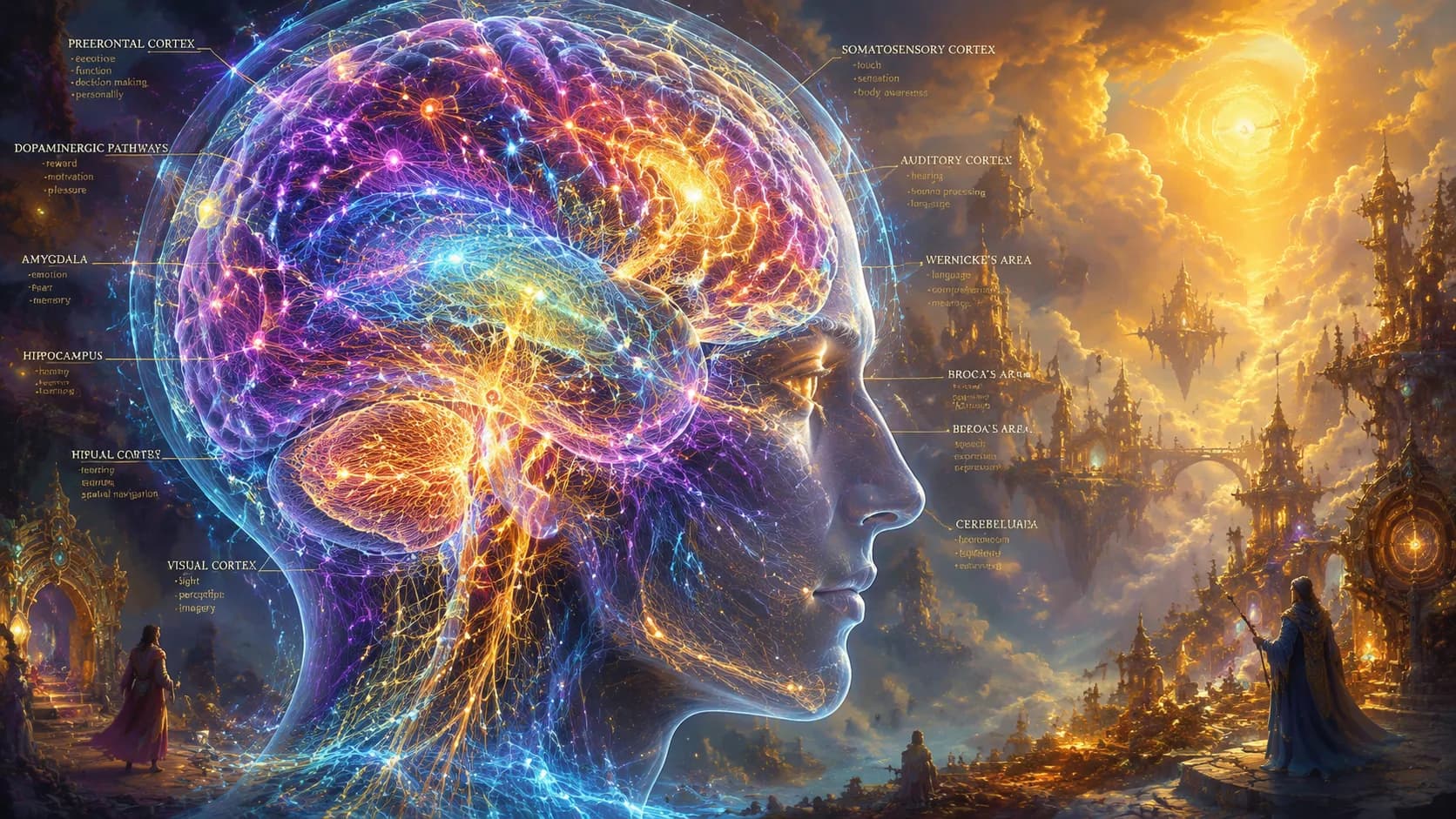
When you engage with a narrative during cinematic meditation, your brain activates a remarkable constellation of neural networks simultaneously. The language processing areas interpret the narrator's words. The sensory cortices generate mental imagery visual, auditory, tactile. The emotional processing centers (amygdala and insula) respond to the narrative's emotional texture. The motor planning regions subtly activate as you imagine movement through space. And critically, the prefrontal cortex the brain's executive center coordinates all of this activity while simultaneously entering a state of relaxed alertness that mirrors deep meditation. This multi network engagement is why narrative-driven meditation feels so effortlessly absorbing: you're not forcing your brain into an unfamiliar state you're inviting it to do what it does best.
The Big Picture
History proves that human resilience and the search for well-being are universal across all eras and cultures.
The narratives used in cinematic meditation are carefully designed to promote specific mindfulness outcomes. Historical narratives exploring ancient Athens or walking through Mesopotamian temples promote perspective and temporal awareness, helping practitioners feel connected to something larger than their immediate concerns. Mythological narratives encountering legendary creatures or exploring Arthurian landscapes stimulate creative imagination and symbolic thinking. Nature narratives forest walks, ocean shores, mountain vistas promote sensory grounding and physiological calm. Each narrative category addresses different aspects of wellbeing, allowing practitioners to choose experiences that match their current needs.
Princeton neuroscientist Uri Hasson's research shows that when a listener becomes absorbed in a story, their brain activity literally synchronizes with the storyteller's a phenomenon called "neural coupling." In cinematic meditation, this means your brain patterns align with the carefully calibrated calm of the narrator, creating a powerful resonance effect.
A Roman walks into a bar, holds up two fingers, and says, 'Five beers, please.'
The Immersive Environments of Cinematic Meditation
One of the most distinctive features of cinematic meditation is the extraordinary range and richness of the environments it can create. Traditional guided meditation typically takes place in abstract or minimal settings "imagine a peaceful place" or "visualize a calm lake." Cinematic meditation, by contrast, constructs fully realized, historically and culturally detailed worlds that reward exploration and repeated visits. Each environment is designed not just to relax but to educate, inspire, and expand the practitioner's understanding of human history, mythology, and the natural world.
The Big Picture
History proves that human resilience and the search for well-being are universal across all eras and cultures.
Visionaria's library of cinematic meditation environments spans multiple categories. Historical environments transport you to meticulously researched ancient locations walking through the Athenian Agora at its height, standing before the Ishtar Gate of Babylon, exploring the terraces of Machu Picchu shrouded in morning mist. These environments are constructed using archaeological evidence and historical scholarship to create experiences that are both meditative and educational you learn about ancient civilizations while achieving deep relaxation.
Mythological environments draw from the world's great mythological traditions to create fantastical landscapes of wonder and discovery. You might explore the halls of Camelot, stand on the rainbow bridge of Asgard, walk through the enchanted forests where dragons dwell, or visit the architecture of magical kingdoms. These mythological journeys tap into the brain's capacity for symbolic thinking and archetypal experience a form of meditation that connects you to the shared human imagination that has produced stories and sacred narratives across every culture. Natural environments primeval forests, alpine meadows, ocean depths, desert oases complete the library with pure sensory immersion experiences designed for maximum physiological relaxation.
"Most meditation apps offer you a generic 'calm ocean' sound. Cinematic meditation offers you the ancient port of Alexandria, complete with merchants, seabirds, and the distant sound of one of the Seven Wonders of the Ancient World. It's like comparing a screen saver to an IMAX documentary for your ears."
What's an ancient intellectual's favorite exercise? Jumping to conclusions.
Benefits of Cinematic Meditation for Modern Life
The benefits of cinematic meditation extend far beyond simple relaxation. Because this approach engages multiple cognitive systems simultaneously narrative processing, spatial awareness, emotional response, creative imagination the benefits are broader and more multidimensional than those typically reported for traditional meditation alone. Research and user data from platforms like Visionaria consistently show improvements across five major domains: stress management, cognitive performance, creative capacity, sleep quality, and emotional wellbeing.
Visionaria Insight
By immersing ourselves in these historical soundscapes, we reconnect with a timeless human tradition of storytelling and mental restoration.
Stress managementis the most immediately noticeable benefit. Cinematic meditation sessions can feel as calming as traditional meditation, and many people find them easier to stick with. Because the immersive narrative holds attention naturally, practitioners are less likely to cut sessions short or become frustrated meaning they actually receive the full dose of relaxation benefit. Many people find that after a 15 minute cinematic meditation session,their stress levels feel dramatically reduced and their capacity to handle subsequent challenges is significantly enhanced.
Cognitive performance and creativity represent perhaps the most exciting benefit category. Because cinematic meditation actively exercises the imagination building mental imagery, navigating spatial environments, processing narrative information it strengthens cognitive capacities that transfer to everyday life. With regular practice, some people notice enhanced creative problem solving, improved memory, better spatial reasoning, and increased capacity for sustained focus. The connection between meditation and creativity is well documented, but cinematic meditation accelerates this benefit because imagination training is built into the practice itself. Some people like to use a cinematic meditation session before bed as a calm, absorbing way to wind down instead of replaying the day.
Side effects may include an unexpected interest in ancient history, an irrational desire to visit Greece, and the ability to describe Mesopotamian architecture at dinner parties. Consult your imagination if symptoms persist."
Why did the ancient physician prescribe a long walk? Because he was tired of listening to the patient complain in his office.
Who Is Cinematic Meditation For?
One of the most remarkable qualities of cinematic meditation is its extraordinary accessibility. While traditional meditation sometimes carries an implicit message that "this might not be for everyone" (requiring patience, discipline, and comfort with stillness), cinematic meditation is designed to work with virtually any personality type, cognitive style, or experience level. The narrative-driven approach means that anyone who has ever been absorbed in a book, a film, a podcast, or a daydream already possesses the foundational skill needed for cinematic meditation: the ability to engage with a story.
Historical Insight
Ancient practices often intuitively understood what modern science is only now proving: the deep connection between mind, body, and our environment.
Meditation newcomers find cinematic meditation especially valuable as an entry point. Rather than confronting the intimidating prospect of "emptying the mind" a concept that causes many beginners to give up in frustration newcomers can simply put on headphones, press play, and let the experience guide them. The narrative structure provides a natural framework for attention, the spatial audio creates an immersive environment that holds focus, and the guided imagination prompts make participation effortless. If traditional meditation has felt hard for you, a story-led approach may be an easier way in.Experienced meditators may also enjoy it as a change of pace from their usual practice.
Experienced meditators find that cinematic meditation adds a powerful dimension to their existing practice. The imagination training strengthens visualization capacity, the narrative engagement develops new forms of cognitive flexibility, and the rich environments provide novel territory for exploration and discovery that keeps the practice fresh and engaging over time. Creative professionals writers, artists, designers, musicians are particularly drawn to cinematic meditation because it directly exercises the imaginative faculties they rely on professionally. Parents appreciate it as a tool for children who benefit from guided imagination but cannot yet engage with traditional meditation instructions. And anyone experiencing high stress, anxiety, or difficulty sleeping can use cinematic meditation as a powerful, accessible tool for immediate relief.
"Cinematic meditation is for anyone who has ever tried traditional meditation and spent the entire time making a mental grocery list. If your brain is a hyperactive golden retriever that refuses to sit still, cinematic meditation is the equivalent of giving it a really interesting bone to chew on."
Why did the historian break up with the archaeologist? Because her career was literally in ruins.
How to Start Your Cinematic Meditation Practice
Beginning a cinematic meditation practice is remarkably straightforward far simpler than most people expect. Unlike traditional meditation, which often requires instruction in specific techniques, postures, and breathing patterns, cinematic meditation asks very little of the practitioner beyond putting on headphones, finding a comfortable position, and pressing play. The technology and narrative design do the heavy lifting, guiding your experience from the first moment. Here's a practical framework for getting started:
Historical Insight
Ancient practices often intuitively understood what modern science is only now proving: the deep connection between mind, body, and our environment.
Step two: Optimize your physical setup. Use the best headphones available to you over ear headphones with good bass response provide the most immersive spatial audio experience, though any stereo headphones or earbuds will work. Find a comfortable position sitting in a chair, lying on your back, or any posture where you can relax without discomfort for the session duration. Minimize visual distractions by closing your eyes or using a sleep mask. The darker the visual field, the more vividly your imagination will construct the cinematic environment. Step three: Let go and participate. Unlike traditional meditation, where you might worry about "doing it right," cinematic meditation has no wrong way to practice. Simply listen, allow the spatial audio to surround you, follow the narrator's guidance, and let your imagination fill in the visual details. If your mind wanders, the narrative naturally draws it back no effort or willpower required. With regular practice, you'll find your absorption deepening, your imagination strengthening, and the benefits compounding over time.
"Starting cinematic meditation requires: headphones, a comfortable spot, and the ability to press play. If you can operate a smartphone and a couch simultaneously, you're already overqualified. No incense, no yoga pants, no pretending to enjoy sitting on the floor just press play and let the ancient temples come to you."
What's an ancient intellectual's favorite exercise? Jumping to conclusions.
The Future of Mindfulness: Where Cinematic Meditation Is Heading
Cinematic meditation represents not just a new product category but a fundamental shift in how humanity approaches mental wellness. As spatial audio technology continues to advance, as our understanding of narrative neuroscience deepens, and as artificial intelligence enables ever more personalized and responsive experiences, the potential for cinematic meditation to transform the wellness landscape is extraordinary. We are, quite possibly, witnessing the early stages of a revolution in mindfulness practice comparable to the moment guided meditation first moved from monasteries to mainstream culture in the 1960s and 1970s.
Several technological developments are poised to dramatically enhance cinematic meditation in the coming years. Adaptive narrative systems powered by AI will soon be able to adjust the pace, content, and emotional trajectory of meditation experiences in real time based on biometric feedback from wearable devices. Imagine a cinematic meditation that senses your heart rate increasing and automatically deepens the calming environmental sounds, or detects that your mind is particularly active and introduces more absorbing narrative elements. Expanded spatial audio capabilities including haptic feedback and bone conduction technology will create even more immersive environments. And advances in imagination training research will enable meditation experiences specifically designed to strengthen particular cognitive abilities.
Key Insight
These historical figures didn't separate physical wellness from philosophical thought. To them, it was all one continuous practice of living well.
Perhaps most exciting is the potential for cinematic meditation to serve as a gateway that brings mindfulness to populations who have never before engaged with meditation. By wrapping profound wellbeing practices in engaging, story-driven experiences, cinematic meditation removes the cultural, psychological, and practical barriers that have limited meditation's reach. Young people who would never download a traditional meditation app might eagerly explore mythological worlds or historical civilizations. People struggling with anxiety who find traditional meditation too confronting might find relief through the gentle redirection of narrative immersion. The future of mindfulness isn't about choosing between traditional and cinematic approaches it's about having a rich toolkit of practices that can serve every mind, every mood, and every moment. Through Visionaria and platforms like it, that future is already unfolding.
"In ten years, cinematic meditation will probably know you're stressed before you do, automatically transport you to a Polynesian beach, and have you feeling calmer by the time you realize what happened. Meanwhile, the 'sit still and think about nothing' approach will still be telling you to focus on your breathing. Both are valid. One involves significantly better scenery."

How to Train Your Imagination With Meditation
Learn how to train your imagination with meditation, from visualization techniques and guided imagery to sensory expansion, spatial audio, narrative meditation, creative thinking, emotional resilience, daily routines,...
Why did the historian break up with the archaeologist? Because her career was literally in ruins.
The Bottom Line
Cinematic meditation represents a genuine paradigm shift in how we approach mindfulness and mental wellness. By combining the immersive power of spatial audio, the brain's natural affinity for narrative engagement, and carefully designed environmental soundscapes, this approach achieves the neurological benefits of traditional meditation while being dramatically more accessible, engaging, and sustainable for the modern mind.
Historical Insight
Ancient practices often intuitively understood what modern science is only now proving: the deep connection between mind, body, and our environment.
Read more: How Visualization Strengthens Neural Pathways
Whether you're a meditation newcomer looking for an approach that actually works with your brain, an experienced practitioner seeking to expand your toolkit, or simply someone curious about the intersection of technology and ancient wisdom, cinematic meditation offers something genuinely transformative. The science supports it, the technology enables it, and platforms like Visionaria make it available to anyone with headphones and a smartphone.
Experience More with Visionaria
Download the app to explore guided historical and wellness journeys.
Why did the historian break up with the archaeologist? Because her career was literally in ruins.
This article is for educational and informational purposes only. Historical details are based on available research and may evolve as new evidence emerges.
Visionaria journeys are designed for relaxation, guided imagination, and personal enrichment. They are not a substitute for medical, mental health, legal, or professional advice.