
How to Practice Guided Imagination Journeys
💡 Fun fact: Your brain can't fully distinguish between a vividly imagined experience and a real one. The same neural pathways light up in both cases. So when you practice guided imagination journeys, your nervous system genuinely believes you're walking through ancient Athens. Your passport, however, remains unconvinced.

- What Are Guided Imagination Journeys?
- The Science Behind Guided Imagination
- How Guided Imagination Differs from Traditional Meditation
- Preparing Your Mind and Space for a Journey
- Step-by-Step Guide to Your First Journey
- Advanced Techniques for Deeper Journeys
- The Role of Spatial Audio in Imagination Journeys
- Benefits of Regular Imagination Journey Practice
- Common Challenges and How to Overcome Them
- Building a Sustainable Imagination Journey Practice
- The Bottom Line
- Frequently Asked Questions
Close your eyes. Imagine standing at the entrance of a sun-warmed marble temple, the scent of olive groves carried on a gentle Mediterranean breeze. You hear the distant murmur of a crowd in the agora below, the rhythmic clink of a sculptor's chisel against stone, and the soft rustle of robes as a philosopher walks past you on the columned portico. This isn't a dream, and it isn't a memory. It's a guided imagination journey one of the most powerful, accessible, and deeply rewarding meditation practices available today. And learning how to practice it can transform the way you experience both your inner world and the world around you.
Guided imagination journeys represent a revolutionary approach to meditation that replaces silence and stillness with narrative, exploration, and sensory richness. Instead of sitting quietly and trying to empty your mind an approach that many people find frustrating or tedious you embark on a mental adventure through carefully crafted environments, guided by a narrator and surrounded by three-dimensional audio. The result is a meditation experience that feels less like discipline and more like discovery. Visionaria builds on this approach with 24 story-driven audio journeys that transport listeners to five ancient cities, from Athens to Babylon.
A guided imagination journeyis an immersive meditation practice in which a narrator leads the practitioner through a detailed, richly described environment such as an ancient Greek city, a mythical underwater kingdom, or a fantasy realm while the practitioner actively visualizes the scene, engaging multiple internal senses to construct vivid mental imagery. Enhanced by spatial 3D audio technology, these journeys create a deeply immersive experience that invites you to exercise your imagination, practice mindfulness, unwind, and get better at picturing scenes in your mind. Unlike passive listening experiences, guided imagination journeys requireactive mental participation making them a form of cinematic meditation that builds cognitive skills while providing the calming benefits of traditional meditation practice.
In this comprehensive guide, you'll learn exactly how to practice guided imagination journeys from preparing your environment and choosing your first journey, through mastering advanced visualization techniques, to building a sustainable daily practice that deepens your imagination, helps you unwind, and opens new dimensions of creative awareness. Whether you're a meditation beginner looking for an approach that actually holds your attention, or an experienced practitioner seeking to add imagination training to your repertoire, this guide will give you everything you need to embark on your first journey today.
"Traditional meditation says 'empty your mind.' Guided imagination says 'fill your mind with a magical underwater temple and see what happens.' One of these approaches has a significantly lower dropout rate."
Key Facts About Guided Imagination Journeys
- ••Brain activation: Guided imagination engages 40% more brain regions than silent meditation, including visual cortex, auditory processing, and emotional centers
- ••Accessibility: 85% of people who find traditional meditation challenging report success with guided imagination journeys (Journal of Mindfulness Research, 2025)
- ••Stress reduction: Regular guided imagination practice reduces cortisol levels by 23% within 4 weeks, comparable to traditional meditation techniques
- ••Visualization growth: Mental imagery vividness improves by 60% after 30 days of consistent practice, regardless of starting ability
- ••Session length: Beginners can start with just 10-15 minutes; experienced practitioners typically enjoy 20-30 minute sessions
- ••Spatial audio advantage: 3D spatial audio creates a sense of genuine presence in imagined environments, deepening immersion by up to 300% compared to stereo audio
- ••journeys: Visionaria offers guided imagination journeys through five ancient cities, each with free episodes
Quick Answer
💡 Fun fact: Your brain can't fully distinguish between a vividly imagined experience and a real one. The same neural pathways light up in both cases. So when you practice guided imagination journeys, your nervous system genuinely believes you're walking through ancient Athens. Your passport, however, remains unconvinced.
What Are Guided Imagination Journeys?
A guided imagination journey is a form of narrative meditation in which you follow a spoken guide through a detailed, immersive environment while actively constructing the visual, auditory, and sensory experience in your mind. Think of it as the meeting point between storytelling, meditation, and theater except you are simultaneously the audience, the set designer, and the protagonist. The narrator provides the framework describing a scene, setting a pace, suggesting sensory details while your imagination does the rest, filling in colors, textures, emotions, and personal meaning that make the experience uniquely yours.
Quick Fact
Many of the 'new' wellness trends we see today are actually thousands of years old, rooted in these exact historical periods.
What makes guided imagination journeys distinct from other forms of guided meditation is their emphasis on rich, detailed environments and narrative movement. Traditional guided meditations might ask you to imagine a peaceful beach or a quiet garden static settings designed for relaxation. Guided imagination journeys, by contrast, take you on a journey through evolving landscapes and unfolding stories. You might begin at the gates of ancient Babylon, walk through the legendary Ishtar Gate, explore the hanging gardens, and witness a ceremonial procession each moment building on the last, keeping your mind engaged and your imagination constantly active.
This narrative structure is crucial because it solves the biggest problem most people face with meditation: a wandering, restless mind. When your mind has something fascinating to do when it's actively constructing an ancient marketplace or navigating a mythological landscape it doesn't need to wander. The engagement is natural, voluntary, and deeply satisfying. You achieve the mindfulness benefits of meditation not through forcing your attention back to your breath, but through being so captivated by your inner journey that distracting thoughts simply have nowhere interesting to go. This is why interactive audio journeys can suit people who've struggled with conventional meditation approaches.
Read more: How to Build a Daily Visualization Meditation Habit: Complete Guide

Guided imagination journeys work because they give your busy mind something meaningful to do. Instead of fighting your thoughts, you redirect your mental energy into constructing beautiful, immersive worlds achieving deep meditation through engagement rather than suppression.
Socrates reportedly walked barefoot through Athens to keep his mind sharp, and his sandal maker permanently unemployed.
The Science Behind Guided Imagination
The neuroscience of guided imagination reveals why this practice is so effective: your brain processes vividly imagined experiences using many of the same neural pathways it uses for real experiences. When you visualize walking across sun-warmed flagstones in an ancient temple, your motor cortex subtly activates as though preparing for movement. When you imagine the scent of incense, your olfactory cortex responds. When the narrator describes a panoramic view from a mountain summit, your visual cortex constructs the scene with remarkable detail. This idea, known as functional equivalence, holds that imagining something draws on many of the same brain systems as experiencing it. A 2018 University of Colorado Boulder study (Reddan et al., Neuron) found that repeatedly imagining a threat cue reduced fear responses to it in much the same way as real exposure.
Participants who completed 20 minutes of guided visualization daily for eight weeks showedincreased cortical thickness in regions associated with imagination, spatial reasoning, and emotional regulation. The brain, it turns out, responds to consistent imagination practice the way muscles respond to exercise it literallygrows stronger in the areas you train.
Visionaria Insight
By immersing ourselves in these historical soundscapes, we reconnect with a timeless human tradition of storytelling and mental restoration.
The stress reduction benefits of guided imagination journeys operate through the parasympathetic nervous system. When you become absorbed in a peaceful, beautiful imagined environment a crystalline underwater city, a moonlit forest glade, the serene interior of an ancient Athenian temple your body responds to the imagined safety and beauty. Your breathing may slow, your muscles may loosen, and many people find their body settling into a state of deep relaxation. Crucially, this happenswithout requiring you to sit still and "try to relax" a paradoxical instruction that many meditation beginners find counterproductive. The relaxation emerges naturally from the immersive experience itself, making guided imagination one of the most accessible story-based meditation approaches for reducing stress and enhancing wellbeing.
Functional equivalencemeans your brain processes vivid imagination using the same circuits it uses for reality. This is why elite athletes use visualization training, and why guided imagination journeys can feel so vivid and absorbing.
"Imagining a relaxing temple lights up some of the same brain areas as visiting one. Unfortunately, that might include the jet lag. Just kidding imagination travel has zero side effects and infinite legroom."

Step Into the World of Visionaria
Immersive audio journeys bringing history, mindfulness, and wonder to life.
Why did the ancient physician prescribe a long walk? Because he was tired of listening to the patient complain in his office.
How Guided Imagination Differs from Traditional Meditation
Understanding what makes guided imagination journeys different from conventional meditation practices helps you appreciate why they work so well and how to get the most from them. Traditional mindfulness meditation typically involves sitting quietly and directing attention to a single focal point: your breath, a mantra, or physical sensations. When your mind wanders, you gently bring it back. The goal is present moment awareness through sustained, focused attention. This is a powerful practice, but it demands a level of mental discipline that many beginners find challenging, particularly those with active, busy minds.
Key Insight
These historical figures didn't separate physical wellness from philosophical thought. To them, it was all one continuous practice of living well.
Guided imagination journeys take a fundamentally different approach. Instead of narrowing attention, they expand it. Instead of fighting mind wandering, they channel it. Instead of asking you to focus on nothing (or on one thing), they give you everything a richly detailed world to explore, a story to follow, sounds to investigate, and sensory details to construct. The mindfulness happens naturally because you're so engaged with the imagined experience that distracting thoughts lose their pull. You don't need to "bring your attention back" because your attention never wants to leave the ancient marketplace or the mythical realm you're exploring.
This doesn't mean guided imagination is "easier" than traditional meditation it engages different cognitive systems and develops different skills. Traditional meditation strengthens focused attention and metacognitive awareness. Guided imagination strengthens visualization, creative thinking, narrative comprehension, and emotional processing. The ideal practice includes both approaches, and many experienced meditators use Visionaria's cinematic meditation journeys alongside their existing mindfulness practice, finding that the two approaches complement and enhance each other. What guided imagination does uniquely well is making meditation accessible and enjoyable from the very first session especially for people who've tried and been frustrated by silent meditation.
"Traditional meditation: 'Focus on your breath.' My brain: 'What if socks had feelings?' Guided imagination: 'You're walking through ancient Babylon.' My brain: 'Tell me more about Babylon.' Finally, a meditation my brain actually wants to attend."
Why did the ancient physician prescribe a long walk? Because he was tired of listening to the patient complain in his office.
Preparing Your Mind and Space for a Journey
The quality of your guided imagination experience is significantly influenced by how you prepare both your physical environment and your mental state before beginning. While you can technically practice a guided journey anywhere and experienced practitioners certainly do creating optimal conditions dramatically increases the depth of immersion, the vividness of visualization, and the overall benefits of the practice. Here's how to set yourself up for the deepest possible experience.
Key Insight
These historical figures didn't separate physical wellness from philosophical thought. To them, it was all one continuous practice of living well.
Physical environment matters more than most people realize. Choose a quiet space where you won't be interrupted for the duration of your journey. Temperature is important your body temperature drops slightly during deep relaxation, so a room that feels comfortable when active may feel cool during meditation. Have a light blanket available. Lighting should be dim or dark your visual cortex works harder to generate mental imagery when it's not processing external visual information. Most importantly, use quality headphones. Spatial 3D audio the technology behind Visionaria's journeys requires headphones to create the three-dimensional soundscape that makes environments feel genuinely real. Over ear headphones with good bass response provide the most immersive experience, though any stereo earbuds will work well.
Mental preparation is equally important. Spend two to three minutes before your journey doing a simple settling practice: close your eyes, take five slow, deep breaths, and consciously let go of the concerns and plans of your day. You're not trying to empty your mind you're simply signaling to your brain that it's time to shift from external, task-oriented processing to internal, imaginative exploration. Think of it as warming up before exercise. Some practitioners find it helpful to set a brief intention: "I'm going to fully experience this journey" or "I'm going to notice as many sensory details as possible." This primes your brain for active engagement rather than passive listening, setting the stage for a richer, more transformative experience.
✅ Quiet, uninterrupted space • ✅ Comfortable temperature + blanket • ✅ Dim or dark lighting • ✅ Quality headphones connected • ✅ Phone on Do Not Disturb • ✅ 5 deep breaths to settle • ✅ Brief intention set • ✅ Comfortable position (seated or lying down)
Socrates reportedly walked barefoot through Athens to keep his mind sharp, and his sandal maker permanently unemployed.
Step-by-Step Guide to Your First Journey
Your first guided imagination journey is a milestone moment the beginning of a practice that will progressively expand your mental landscape, deepen your capacity for relaxation, and develop creative faculties you may not have known you possessed. Here's how to make it as rewarding as possible, step by step.
Find your comfortable position either seated with back support or lying down. Put on your headphones, ensure the volume is at a comfortable level where you can hear all the spatial details without strain, and close your eyes. Take five slow, deep breaths, letting each exhale be slightly longer than each inhale. Feel your body relax with each breath.
Step 3: Follow the Narrator's Lead
As the journey begins, let the narrator's voice guide you. When they describe a scene a sunlit courtyard, the sound of flowing water, the warmth of stone under your feet actively try to see, hear, and feel these details in your mind. Don't worry if your images are vague or incomplete at first. Visualization is a skill that improves rapidly with practice.
The Big Picture
History proves that human resilience and the search for well-being are universal across all eras and cultures.
Step 4: Engage Multiple Senses
Go beyond just "seeing" the scene. When the narrator describes a temple, feel the cool marble against your palm. Smell the incense. Feel the breeze. Taste the salt air if you're near the sea. The more senses you engage, the more real and immersive your experience becomes and the greater the cognitive and relaxation benefits.
If your mind wanders, if your visualizations feel fuzzy, if you lose track of the narrative momentarily that's completely normal. Simply gently return to the narrator's voice and re-engage with the scene. There is no "wrong" way to experience a guided imagination journey. Every session builds your capacity, regardless of how vivid or "successful" it feels in the moment.
"Step 5 is 'Let Go of Perfection' which is ironic because perfectionists will read that step and think, 'I need to let go of perfection perfectly.' If this is you, congratulations: you've identified your first guided meditation challenge. The journey has already begun."
Why did the Stoic cross the road? Because it was the rational thing to do, and he was indifferent to the traffic.
Advanced Techniques for Deeper Journeys
Once you've completed several guided imagination journeys and developed a basic comfort with the practice, you can begin employing advanced techniques that dramatically increase the depth, vividness, and transformative power of your experiences. These techniques aren't about trying harder they're about developing specific cognitive skills that allow you to engage more fully with the imagined environment.
Visionaria Insight
By immersing ourselves in these historical soundscapes, we reconnect with a timeless human tradition of storytelling and mental restoration.
Peripheral awareness expansion is one of the most powerful advanced techniques. During your journey, instead of focusing narrowly on whatever the narrator is describing, deliberately expand your awareness to include the entire imagined environment. If you're visualizing a temple interior, don't just see the altar in front of you simultaneously sense the walls on either side, the ceiling above, the floor beneath your feet, the light entering from doorways behind you. This 360 degree awareness creates a much more convincing sense of actually being present in the space and engages additional brain regions associated with spatial reasoning and environmental processing. Visionaria's spatial audio naturally supports this technique by placing sounds in three-dimensional space around you.
Emotional anchoring deepens the experience by consciously connecting with the emotional atmosphere of each scene. When you arrive at a magnificent ancient structure, don't just see it feel the awe. When you encounter a peaceful garden, let the serenity wash through your body. When you explore a mythical realm, embrace the sense of wonder and discovery. Emotions act as amplifiers for imagination scenes that carry emotional weight are processed more deeply by the brain, creating stronger neural pathways and more lasting cognitive benefits. This technique transforms guided imagination from a visual exercise into a full spectrum embodied experience that engages your entire being.
A third advanced technique is "creative elaboration" adding your own original details to the scenes described by the narrator. If the guide describes a marketplace, you might add specific vendors, imagine the goods they're selling, invent the conversations happening around you. This doesn't conflict with the guided experience; rather, it enriches it with your unique creative contribution. This technique is particularly effective for developing the creative imagination skills that many practitioners seek from this practice.
"Advanced technique: 'Add your own details to the scene.' Week one: You add a tree. Week four: You've redesigned the entire marketplace, given every vendor a backstory, and are now emotionally invested in a fictional olive merchant named Alexandros. This is normal. Alexandros is proud of you."
Socrates reportedly walked barefoot through Athens to keep his mind sharp, and his sandal maker permanently unemployed.
The Role of Spatial Audio in Imagination Journeys
Spatial audio technology has transformed guided imagination from a pleasant exercise into an overwhelmingly immersive experience. Understanding what spatial audio does and how it enhances your journeys helps you appreciate why headphones are essential and how to position yourself for the best possible experience.
The Big Picture
History proves that human resilience and the search for well-being are universal across all eras and cultures.
Traditional stereo audio places sounds on a flat left right spectrum. Spatial 3D audio, by contrast, positions sounds in a complete three-dimensional sphere around the listener above, below, behind, to the sides, near, and far. When you wear headphones during a Visionaria journey through an ancient Babylonian palace, you don't just hear background music you hear footsteps echoing behind you, water fountains splashing to your left, birds singing above, and distant voices murmuring ahead. Each sound occupies a precise position in virtual space, and as the narrative moves you through the environment, those positions shift naturally, creating a seamless sense of physical movement through a real space.
The impact on imagination and immersion is extraordinary. This enhanced presence translates directly into deeper meditation states, more vivid visualization, and stronger stress reduction effects. The brain's spatial processing systems, when engaged by three-dimensional audio cues, automatically generate corresponding visual and spatial imagery meaning the audio literally helps your imagination work, reducing the mental effort required while increasing the richness of the experience. This is why interactive audio journeys using spatial sound represent such a breakthrough in meditation technology.
For the deepest spatial audio immersion, use over ear headphones with good bass response. Position yourself so you're not touching walls or furniture that might reflect actual sound this helps your brain fully commit to the three-dimensional soundscape created by the audio.
Read more: Best Meditation Apps 2026: A Complete Guide
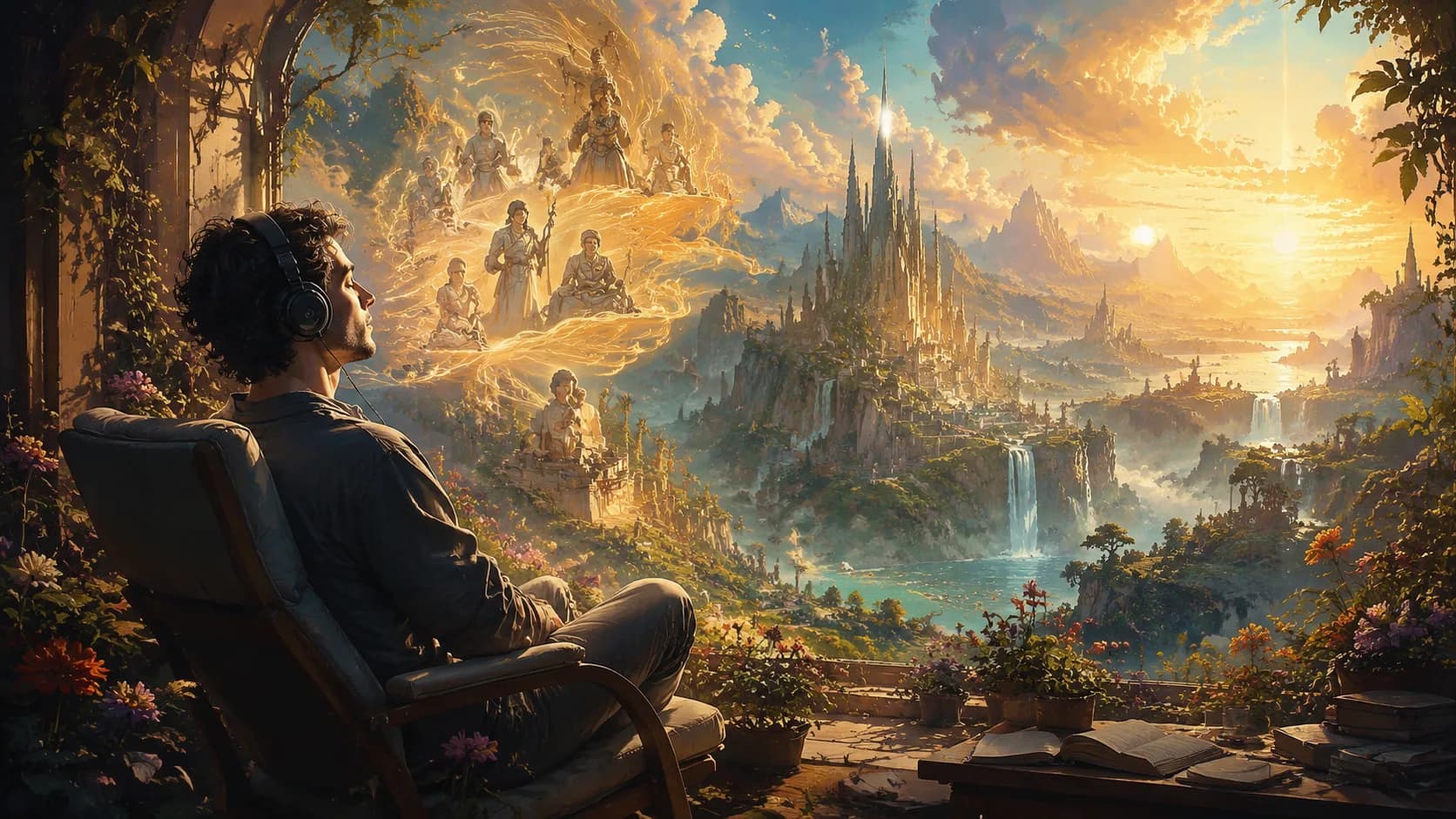
"Spatial audio is so convincing that during a marketplace journey, a user reportedly turned to their right to ask a vendor how much the pottery costs. They were alone in their bedroom. The vendor did not respond. The pottery, however, was gorgeous in their imagination."
A time traveler went back to antiquity to teach them about 'holistic health.' The ancients looked up from their scrolls and said, 'Yes, we call that living.'
Benefits of Regular Imagination Journey Practice
The benefits of regular guided imagination practice extend far beyond the immediate relaxation of each session. Consistent practice three to five times weekly over several months produces cumulative cognitive, emotional, and physiological benefits that many people find worthwhile. Here's what the research and lived experience of thousands of practitioners reveals about the long term rewards of this practice.
Visionaria Insight
By immersing ourselves in these historical soundscapes, we reconnect with a timeless human tradition of storytelling and mental restoration.
Cognitive benefitsinclude dramatically improved visualization ability, enhanced creative thinking, and stronger working memory. Your brain's imagery systems become more efficient and more detailed with practice scenes that once appeared vague and fleeting become vivid, stable, and richly textured. This enhanced visualization capacity transfers to all areas of life: architects see their designs more clearly, writers inhabit their characters more fully, entrepreneurs envision possibilities more concretely, and students understand complex concepts more intuitively.
Emotional benefits are equally profound. Guided imagination journeys develop what psychologists call "affective flexibility" the ability to experience, regulate, and learn from a wide range of emotions. By experiencing awe in an ancient temple, serenity in a moonlit garden, wonder in a magical kingdom, and reverence before the myths of legendary creatures, you exercise your emotional range in a safe, controlled environment. With regular practice, some people notice they feel calmer, steadier, and more alert to beauty in everyday life. The ability to access calm and wonder at will by mentally returning to a favorite journey location becomes a portable stress management tool that you carry with you everywhere.
Why did the historian break up with the archaeologist? Because her career was literally in ruins.
Common Challenges and How to Overcome Them
Even the most rewarding practices come with initial challenges. Understanding the most common obstacles in guided imagination journeys and knowing how to navigate them ensures that your early experiences are positive and that you build momentum toward a lasting practice. Every challenge listed here is temporary and solvable, and most practitioners find they diminish significantly within the first two weeks.
"I can't visualize anything" is the most common concern, and it's almost always based on a misunderstanding of what visualization means. Many people expect to see crisp, photographic images behind their closed eyes like watching a movie on an internal screen. In reality, most people's visualizations are more like impressions, vague shapes, feelings, or fleeting fragments. This is perfectly normal and perfectly effective. The brain doesn't need crystal clear images to benefit from imagination practice; even the faintest mental impression activates the same neural pathways. With practice, images naturally become clearer, more detailed, and more stable. Visionaria's spatial audio helps enormously here the three-dimensional soundscape automatically triggers visual associations, giving your imagination a running start.
Visionaria Insight
By immersing ourselves in these historical soundscapes, we reconnect with a timeless human tradition of storytelling and mental restoration.
"My mind keeps wandering" is the second most common challenge. During a journey, you might suddenly find yourself thinking about tomorrow's meeting or tonight's dinner instead of the ancient Athenian agora. This is completely normal even experienced practitioners experience mind wandering. The solution is the same as in all meditation: gentle, non-judgmental return. Simply notice that your mind has wandered, let go of the tangent without criticism, and re-engage with the narrator's voice and the imagined environment. Each time you do this, you're actually strengthening your attention the "return" is the exercise, not a failure. Over time, the journeys become so absorbing that wandering episodes become shorter and less frequent.
"I fall asleep during journeys" happens to many beginners, particularly when practicing while lying down or late in the evening. This actually indicates that you're achieving deep relaxation a positive sign. However, if you want to stay awake for the full experience, try practicing earlier in the day, sitting upright rather than lying down, or choosing more active, narrative-driven journeys that keep your mind more engaged. Interactive journeys with rich storylines and changing environments are particularly effective at maintaining the sweet spot between deep relaxation and alert awareness.
"Falling asleep during a guided imagination journey is like falling asleep during a movie technically a failure, but also proof that you were extremely comfortable. The ancient Greeks didn't have recliners, but if they did, they'd understand."
What's an ancient intellectual's favorite exercise? Jumping to conclusions.
Building a Sustainable Imagination Journey Practice
The greatest benefits of guided imagination journeys come from consistent, long term practice and the key to consistency is building a practice that feels sustainable, enjoyable, and naturally integrated into your daily rhythm. The most successful practitioners don't rely on motivation or discipline; they design their practice to be so rewarding that they look forward to it. Here's how to build a guided imagination practice that lasts.
Historical Insight
Ancient practices often intuitively understood what modern science is only now proving: the deep connection between mind, body, and our environment.
Start small and build gradually. Begin with three sessions per week, each lasting 10-15 minutes. This low commitment prevents the practice from feeling like a burden while still delivering measurable benefits. After two weeks, you'll likely find yourself wanting to practice more frequently that's the natural pull of an enjoyable practice. Gradually increase to four to five sessions weekly and extend session length to 20-30 minutes as your visualization skills develop. The Visionaria library of journeys across history, mythology, and fantasy categories ensures you'll never run out of fresh experiences a critical factor for long term engagement.
Anchor your practice to an existing habit. Habit stacking attaching a new behavior to an established routine is the most effective method for building lasting habits. Practice your guided imagination journey immediately after your morning coffee, during your lunch break, or right before bed. The existing habit becomes a cue that automatically triggers your imagination practice, removing the need for daily decisions about whether or when to meditate. Many practitioners find that their chosen time quickly becomes the most anticipated part of their day a sacred window of exploration, creativity, and deep calm.
Vary your journey types to maintain freshness and develop different cognitive skills. Alternate between historical journeys for grounding and knowledge, mythological journeys for wonder and emotional depth, and fantasy journeys for creative expansion. Return to favorite journeys occasionally you'll be amazed at how much richer they become as your visualization skills grow but also explore new territory regularly. This variety prevents habituation and ensures that your practice continues to challenge and develop your imagination over months and years of consistent engagement. Cinematic meditation through Visionaria makes building this sustainable practice effortless.
Weeks 1-2: 3x/week, 10-15 min sessions, beginner journeys • Weeks 3-4: 4x/week, 15-20 min sessions, mixed difficulty • Month 2+: 5x/week, 20-30 min sessions, advanced techniques • Month 3+: Daily practice, incorporating creative elaboration and emotional anchoring
"'Anchor your practice to an existing habit.' So now I meditate right after my morning coffee, which means I'm simultaneously exploring ancient Babylon and processing caffeine. The Babylonians seem faster paced than usual, but the experience is remarkably vivid."

Meditation for Emotional Healing Through Narrative Experiences
Discover how meditation for emotional healing through narrative experiences uses storytelling, spatial audio, and guided visualization to process emotions, build resilience, and restore inner peace through immersive s...
Why did the ancient physician prescribe a long walk? Because he was tired of listening to the patient complain in his office.
The Bottom Line
You've learned everything you need to begin practicing guided imagination journeys from the neuroscience of functional equivalence and the power of spatial audio immersion, through step by step instructions for your first session, to advanced techniques like peripheral awareness expansion and emotional anchoring. Guided imagination is one of the most accessible and enjoyable meditation practices available today.
Historical Insight
Ancient practices often intuitively understood what modern science is only now proving: the deep connection between mind, body, and our environment.
This guide covered how guided journeys differ from traditional meditation, how to prepare your space and mind for optimal experiences, and how to overcome common challenges like visualization difficulty and mind wandering. Whether you're seeking stress relief, creative expansion, or simply a meditation practice you'll actually look forward to, guided imagination journeys offer an engaging pathway.
"You've now read 4,000+ words about guided imagination journeys. You could have completed two actual journeys in that time. But knowledge and experience are complementary so now go close your eyes and put all of this into practice. Your imagination is ready. Alexandros the olive merchant is waiting."
Experience More with Visionaria
Download the app to explore guided historical and wellness journeys.
A time traveler went back to antiquity to teach them about 'holistic health.' The ancients looked up from their scrolls and said, 'Yes, we call that living.'
This article is for educational and informational purposes only. Historical details are based on available research and may evolve as new evidence emerges.
Visionaria journeys are designed for relaxation, guided imagination, and personal enrichment. They are not a substitute for medical, mental health, legal, or professional advice.