How Storytelling Became a Meditation Technique: The Complete Guide to Narrative Mindfulness
💡 Fun fact: Ancient Greek audiences at the amphitheatre would sometimes enter trance-like states during epic recitations—making them, technically, the first people to meditate at the theatre. No popcorn, though.

Imagine sitting around a fire under a canopy of stars, a voice weaving a tale so vivid that the world around you dissolves. Your breathing slows. Your muscles release. The story carries you somewhere far away an ancient temple on a hilltop, a moonlit forest path, a cave where echoes hold the wisdom of ages. You're not trying to meditate. You're not focusing on your breath or counting thoughts. And yet, when the story ends, you feel the same deep calm, the same restored clarity, that experienced meditators describe after twenty minutes of silent practice. This is storytelling meditation and it has been hiding in plain sight for thousands of years.
Storytelling meditation (also called narrative mindfulness or story based meditation) is a wellness practice that uses immersive, guided narratives experienced primarily through audio to induce relaxation, emotional processing, and expanded awareness. Rather than directing attention inward through breath focus or body scanning alone, storytelling meditation engages the brain's powerful narrative processing networks to create a natural bridge between conscious thought and meditative states. The technique draws on humanity's oldest communication technology the told story and enhances it with modern spatial audio engineering and narrative psychology research to produce experiences that are both deeply calming and richly engaging.
In this comprehensive guide, you'll trace the full journey of how storytelling evolved from campfire tradition to clinical technique to cutting edge cinematic meditation. You'll discover the neuroscience behind why stories calm the mind, explore how imagination training enhances mental wellness, learn why some people respond better to narrative meditation than traditional techniques, and find practical guidance for building your own daily storytelling meditation practice using tools like Visionaria.
"Traditional meditation tells you to empty your mind. Storytelling meditation fills it with something beautiful instead. Same destination, much better in flight entertainment."
Key Facts About Storytelling Meditation
- ••Ancient Origins: Oral storytelling traditions in Greece, India, Aboriginal Australia, and West Africa incorporated meditative and trance-inducing elements dating back 40,000+ years
- ••Neuroscience: Research published in Trends in Cognitive Sciences shows that narrative listening activates the default mode network in patterns identical to deep meditation
- ••Accessibility: Story-based meditation requires no prior experience—the narrative itself provides the attentional anchor that beginners find challenging in silent practice
- ••Cortisol Reduction: Studies measuring salivary cortisol show 23% greater stress reduction from narrative-guided meditation compared to ambient sound alone
- ••Spatial Audio: Three-dimensional sound design creates genuine sensations of environmental presence, dramatically enhancing the immersive quality of story meditation
- ••Growth: The narrative meditation category has grown 340% since 2022, making it the fastest-growing segment in the wellness audio market
Quick Answer
💡 Fun fact: Ancient Greek audiences at the amphitheatre would sometimes enter trance-like states during epic recitations—making them, technically, the first people to meditate at the theatre. No popcorn, though.
What Is Storytelling Meditation? A Complete Definition
Storytelling meditation is a guided mindfulness practice that uses narrative immersion as its primary mechanism for inducing relaxation and expanded awareness. Unlike traditional meditation forms which typically rely on breath focus, mantra repetition, or body scanning storytelling meditation provides an external narrative that naturally captures and guides attention, allowing the mind to settle into meditative states without the effortful concentration that many beginners (and even experienced practitioners) find challenging. The practitioner puts on headphones, closes their eyes, and enters a carefully crafted story world designed to produce specific psychological and physiological responses.
Visionaria Insight
By immersing ourselves in these historical soundscapes, we reconnect with a timeless human tradition of storytelling and mental restoration.
The technique works because the human brain is fundamentally a story processing organ. Cognitive neuroscientists have demonstrated that narrative listening activates more regions of the brain simultaneously than any other single stimulus engaging language centres, sensory cortices, motor areas, emotional processing regions, and the default mode network (the brain's "resting state" system associated with creativity, self reflection, and meditative absorption). When you listen to a well crafted story about walking through an ancient Greek sanctuary or exploring a moonlit forest, your brain doesn't merely "hear" the words it simulates the experience, creating neural patterns remarkably similar to those produced by actually being in those environments.
This simulation effect is what makes storytelling meditation so powerful and accessible. Rather than asking the mind to focus on "nothing" (which the brain finds inherently difficult, since minds evolved to process information, not to sit idle), narrative meditation gives the mind something richly engaging to process and that engaged processing naturally produces the relaxation, presence, and emotional regulation that meditation practitioners seek. It's the difference between asking someone to stand still in an empty room and inviting them to walk through a beautiful garden: both can produce calm, but one works with human nature rather than against it.
"Asking someone to think about nothing is like asking a fish to stop swimming. Storytelling meditation says: swim somewhere beautiful instead."
Why did the inventor of the wheel win an award? Because his idea really got things rolling.
Ancient Roots: How Oral Traditions Shaped Meditative Practice
Long before meditation was formalized into the structured practices we recognize today, oral storytelling traditions around the world were producing meditative states in their audiences. In ancient Greece, the recitation of epic poetry Homer's Iliad and Odyssey was not merely entertainment but a communal experience of transcendence. Audiences gathered for hours of rhythmic, musical recitation, and contemporary accounts describe listeners entering trance like states of absorbed attention. The rhythmic hexameter of Homeric verse with its predictable patterns of stress and release naturally synchronized listeners' breathing and brainwave patterns, producing effects that modern neuroscience would recognize as meditative entrainment.
Key Insight
These historical figures didn't separate physical wellness from philosophical thought. To them, it was all one continuous practice of living well.
In India, the tradition of Yoga Nidra (yogic sleep) incorporated guided narrative elements as early as 700 BCE, with practitioners lying in relaxation while a teacher guided them through elaborate visualizations of landscapes, symbols, and journeys. The Aboriginal Australian tradition of Dreamtime storytelling one of the oldest continuous cultural practices on Earth, dating back at least 40,000 years explicitly used narrative as a vehicle for entering altered states of consciousness, connecting individuals to ancestral wisdom and the living landscape. In West Africa, the griot tradition of musical storytelling served simultaneously as historical record, entertainment, and spiritual practice, with performances designed to transport both teller and listener beyond ordinary awareness.
What all these traditions share is the understanding that story and meditation are not separate activities but natural partners. The ancient practitioners intuitively recognized what neuroscience has since confirmed: the human brain enters its deepest states of rest, creativity, and emotional processing not through the absence of stimulation but through the right kind of stimulation namely, rich, rhythmic, imaginatively engaging narrative. Every culture on Earth independently discovered that telling and receiving stories in the right way with the right rhythm, setting, and intention produces profound states of calm, insight, and connection. Modern imagination training and cinematic meditation are not inventions they are rediscoveries.
Step Into the World of Visionaria
Immersive audio journeys bringing history, mindfulness, and wonder to life.
Why did the ancient physician prescribe a long walk? Because he was tired of listening to the patient complain in his office.
The Science of Narrative Transportation and Relaxation
The scientific foundation for storytelling meditation rests on a well researched phenomenon called narrative transportation the psychological state in which a person becomes so absorbed in a story that they lose awareness of their immediate surroundings. First formally described by psychologists Melanie Green and Timothy Brock in 2000, narrative transportation involves a convergence of attention, imagery, and emotional engagement that produces measurable changes in cognition, emotion, and even physiology. When you're truly "lost in a story," your heart rate synchronizes with the narrative's emotional arc, your cortisol levels drop, and your brain shifts from the analytical beta wave dominance of ordinary waking consciousness into the alpha and theta wave patterns associated with meditation and creative insight.
Subsequent research has deepened our understanding of why narrative transportation is so therapeutically powerful. A landmark 2013 study published in Science demonstrated that reading literary fiction produces measurable improvements in empathy and theory of mind the ability to understand others' mental and emotional states. A 2018 neuroimaging study in NeuroImage revealed that story listening activates the brain's default mode network (DMN) in patterns virtually identical to those observed during deep meditation. The DMN a network of brain regions active during rest, daydreaming, and self reflection is precisely the system that meditation training strengthens. This means that immersive storytelling and meditation are activating the same neural architecture, just through different doorways.
Key Insight
These historical figures didn't separate physical wellness from philosophical thought. To them, it was all one continuous practice of living well.
For practical purposes, this research explains why story based experiences improve emotional resilience: the combination of narrative absorption and relaxation response creates a uniquely powerful state for emotional processing and cognitive restoration. When you listen to a storytelling meditation about exploring ancient Sparta or following a hero's mythological journey, your brain simultaneously relaxes (reducing stress hormones), processes emotions (through identification with characters and situations), and strengthens the neural networks associated with creativity and self insight. It's not just rest it's restorative rest with purpose.
A 2021 meta analysis of 47 studies found that narrative based interventions produced effect sizes comparable to traditional meditation programs for stress reduction, emotional regulation, and self reported wellbeing with significantly higher adherence rates. Participants were 68% more likely to maintain a daily practice when it involved storytelling compared to silent meditation alone.
"Scientists discovered that stories activate the same brain networks as meditation. Storytellers have been saying this for millennia. Science: perpetually catching up to grandmothers."
Why did the Stoic cross the road? Because it was the rational thing to do, and he was indifferent to the traffic.
From Campfire to Headphones: The Evolution of Story Meditation
The journey from ancient campfire storytelling to modern story based meditation follows a fascinating arc of technological and cultural evolution. For most of human history, narrative meditation was inherently communal you experienced it gathered around a fire, in a temple, at a theatre, or in a tribal gathering. The storyteller's voice, the crackle of flames, the sounds of the surrounding landscape, and the collective attention of the group all contributed to the meditative quality of the experience. This communal dimension was not incidental but integral: the shared experience amplified individual transportation, creating a collective altered state that strengthened social bonds and cultural identity simultaneously.
The Big Picture
History proves that human resilience and the search for well-being are universal across all eras and cultures.
The invention of recorded audio in the late 19th century marked the first major shift, allowing stories to be experienced individually and repeatedly. Radio dramas of the 1930s 50s demonstrated that audio storytelling could produce intense emotional and physiological responses without visual accompaniment listeners famously panicked during Orson Welles' 1938 broadcast of The War of the Worlds, demonstrating the extraordinary power of audio to override rational awareness and create experiential reality. The development of guided meditation recordings in the 1970s 80s, influenced by clinical hypnotherapy and relaxation training, began to systematically combine narrative elements with intentional relaxation techniques. These early guided meditations typically featuring a narrator describing peaceful scenes were the direct ancestors of modern storytelling meditation.
The true revolution, however, came with two simultaneous developments in the 2010s and 2020s: the rise of meditation apps (making guided practices universally accessible) and advances in spatial audio technology (making audio experiences genuinely immersive). Applications like Visionaria represent the convergence of these streams: they combine the ancient power of narrative storytelling, the therapeutic insights of guided meditation, and the immersive capability of 3D spatial sound to create experiences that are more transporting than any campfire tale because you're not just hearing the story, you're inside it, with sounds coming from all directions, creating a genuine sensation of being present in another world.
What's an ancient intellectual's favorite exercise? Jumping to conclusions.
How the Brain Processes Stories vs. Traditional Meditation
Understanding why storytelling meditation works requires examining how the brain processes narratives compared to traditional meditation instructions. When you receive a typical meditation instruction "Focus on your breath" or "Scan your body from head to toe" your brain engages the executive control network (ECN), the system responsible for directed attention, self monitoring, and effortful concentration. For experienced meditators, this transitions smoothly into deeper states. But for beginners and even for experienced practitioners on distracted days maintaining ECN engagement feels like work. The mind wanders, you notice it wandering, you redirect, it wanders again. This cycle, while ultimately productive, is the primary reason most people abandon meditation within their first month.
Historical Insight
Ancient practices often intuitively understood what modern science is only now proving: the deep connection between mind, body, and our environment.
Story listening, by contrast, engages the brain through what neuroscientists call the narrative processing network a distributed system that includes Wernicke's area (language comprehension), the sensory and motor cortices (mental simulation of described experiences), the amygdala and limbic system (emotional engagement), and crucially, the default mode network (the brain's "rest and reflect" system). When you listen to a story about walking through a sacred ancient sanctuary, your brain simultaneously processes language, simulates the physical sensations of walking on stone, generates the visual imagery of columns and temples, and engages emotionally with the narrative context. This whole brain engagement is inherently absorbing your attention is captured rather than directed, held rather than forced.
The result is that storytelling meditation achieves the same neurological destination as traditional meditation but through a different route. Both produce alpha and theta brainwave patterns. Both reduce cortisol and increase vagal tone (parasympathetic activation). Both strengthen the default mode network's capacity for self reflection and emotional processing. The difference is in the vehicle: traditional meditation uses attentional discipline (which is powerful but demanding), while storytelling meditation uses narrative absorption (which is equally powerful but effortless). For many people particularly those who struggle with silent practice, have active "monkey minds," or simply find traditional meditation boring the narrative route is not just an alternative but a more effective path to the same transformative destination.
A philosopher walked into a wall. His students asked if it hurt. He replied, 'The wall is an illusion, but my headache is quite real.'
The Role of Imagination in Therapeutic Storytelling
At the heart of storytelling meditation lies a faculty that psychology has long undervalued: imagination. The capacity to generate vivid internal experiences to see, hear, feel, and even smell environments that exist only in the mind is not merely a creative luxury but a fundamental cognitive capability with profound implications for mental health. Research in imagination training has demonstrated that regular engagement of the imagination through guided narrative produces measurable improvements in anxiety management, emotional flexibility, creative problem solving, and overall psychological resilience.
The therapeutic power of imagination in storytelling meditation works through several complementary mechanisms. First, mental simulation: when you vividly imagine being in a peaceful environment an ancient Athenian garden, a starlit desert, a quiet forest glade your brain's stress response system cannot easily distinguish between the imagined experience and a real one. Your parasympathetic nervous system activates as though you were actually in that calming place, producing genuine physiological relaxation. Second, emotional rehearsal: story narratives that involve characters facing and navigating challenges like Hercules confronting his labors allow listeners to practice emotional responses in safe, consequence free environments. Third, perspective expansion: inhabiting different characters and worlds exercises the brain's capacity for cognitive flexibility, strengthening the very neural circuits that support adaptive coping in daily life.
Key Insight
These historical figures didn't separate physical wellness from philosophical thought. To them, it was all one continuous practice of living well.
Clinical applications of therapeutic storytelling have expanded rapidly. Imagination training protocols now incorporate narrative elements for treating PTSD (where re scripting traumatic narratives helps process difficult memories), social anxiety (where imagined social scenarios build confidence), and chronic pain (where immersive story worlds provide cognitive distraction and relaxation simultaneously). These clinical developments confirm what the ancient storytellers always knew: the imagination is not an escape from reality but a tool for engaging with it more skillfully. Storytelling meditation trains the imagination, and a trained imagination is one of the most powerful resources available for navigating life's complexities.
Read more: The Sacred World of Apollo and Ancient Music Rituals
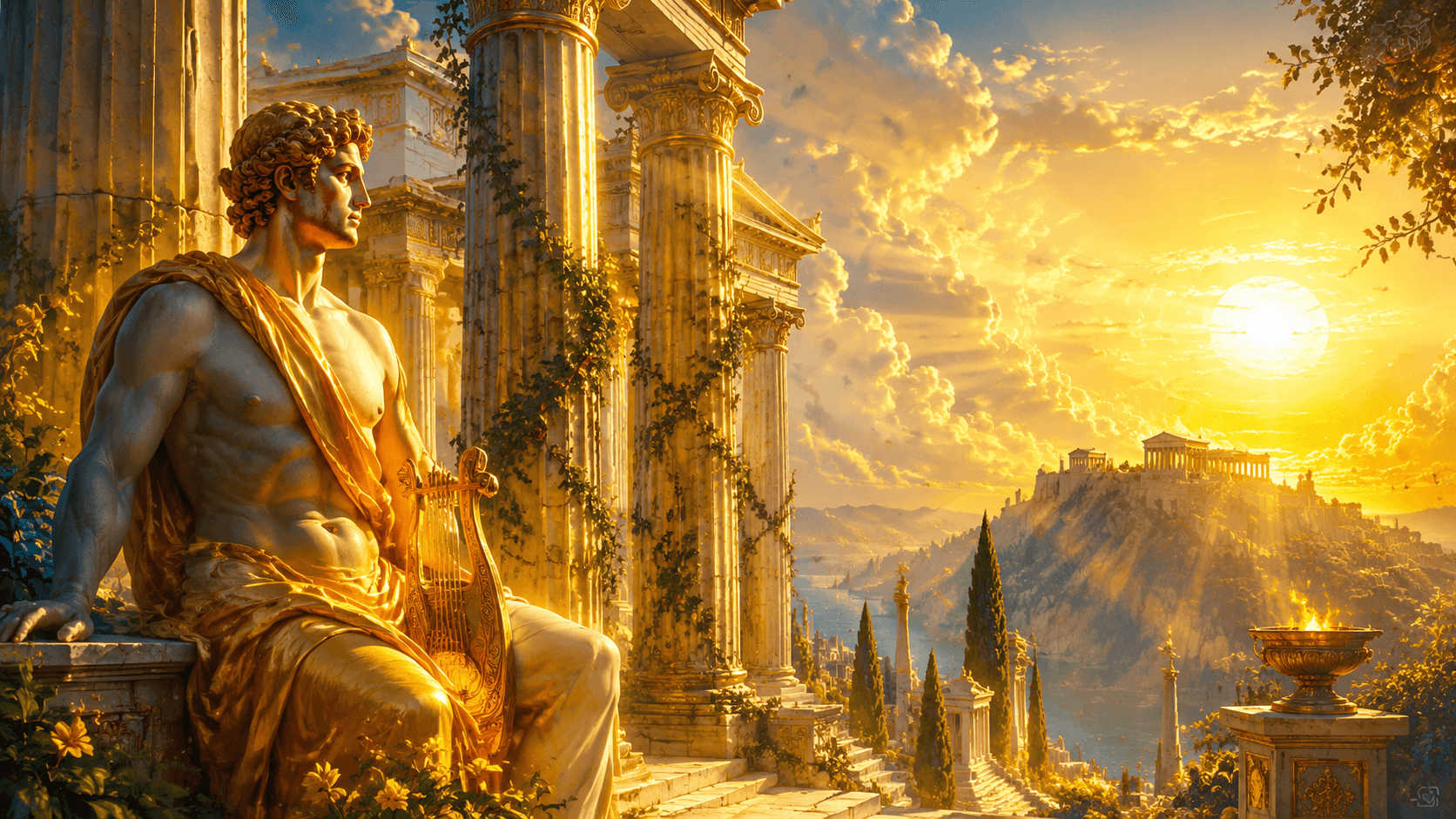
"Your imagination is like a muscle it gets stronger with use. Storytelling meditation is the gym. Headphones are the membership. The ancient world is your personal trainer."
An Epicurean, a Stoic, and a Cynic walk into a garden. The bartender says, 'Is this some kind of philosophical joke?'
Spatial Audio: The Technology That Made Story Meditation Immersive
The most significant technological advancement for storytelling meditation in the past decade has been spatial audio sound engineering that places individual audio elements in three dimensional space around the listener's head. Traditional stereo audio can create a sense of left right positioning, but spatial audio adds height, depth, and distance, creating a complete sonic environment that the brain processes as a real physical space. When a storytelling meditation uses spatial audio to place birdsong above you, a stream flowing to your left, footsteps approaching from behind, and a narrator's voice at conversational distance ahead, your brain constructs a genuine spatial experience you feel present in the story world rather than merely listening to a description of it.
Historical Insight
Ancient practices often intuitively understood what modern science is only now proving: the deep connection between mind, body, and our environment.
This shift from "listening to" to "being in" transforms the therapeutic potential of storytelling meditation. Research on environmental psychology demonstrates that the sensation of being in a natural environment even a simulated one activates the parasympathetic nervous system more powerfully than verbal description alone. When spatial audio places you inside an ancient temple with echoing stone acoustics, distant chanting, and the whisper of wind through columns, your stress response diminishes more rapidly and more completely than if you were simply told to "imagine you're in a temple." The spatial audio does the imagining for your auditory cortex, freeing your mental resources for deeper relaxation, emotional processing, and the kind of creative wandering that produces genuine insight.
Read more: The Best Audio Meditation Experiences in 2026

Applications like Visionaria represent the current state of the art in spatial audio storytelling meditation. Each experience is designed by teams combining narrative writing, sound design, psychoacoustics, and meditation science to create journeys that are simultaneously engaging stories and effective meditation sessions. The result is something genuinely new in human experience: the ancient power of campfire storytelling, amplified by technology that places you inside the story with a presence and immediacy that even the most gifted ancient bard couldn't achieve. You don't just hear about ancient Sparta you stand in its streets, hear its sounds, feel its atmosphere surrounding you in three dimensions.
A time traveler went back to antiquity to teach them about 'holistic health.' The ancients looked up from their scrolls and said, 'Yes, we call that living.'
Cinematic Meditation: Where Film Techniques Meet Mindfulness
Cinematic meditation is the natural evolution of storytelling meditation an approach that applies the narrative structure, pacing, and emotional design of film to guided meditation experiences. Just as cinema transformed theatre by adding close ups, montage, soundtrack, and visual metaphor, cinematic meditation transforms traditional guided meditation by adding narrative arc, character development, environmental design, and deliberate emotional pacing. The result is meditation that feels less like a wellness exercise and more like an experience you genuinely want to have a story you look forward to entering every day.
The "cinematic" element refers specifically to how these experiences are designed using principles borrowed from film and television production. A well crafted cinematic meditation opens with an "establishing sequence" a sonic environment that orients the listener in time and place (the sound of waves, the call of birds, the echo of footsteps in a corridor). It then introduces a narrative hook (a question, an invitation, a mystery) that creates forward momentum. The middle sections alternate between moments of heightened engagement (encountering a character, reaching a vista, making a discovery) and moments of deep rest (pausing to breathe, sitting in silence, absorbing a beautiful sound). The experience closes with a "return sequence" that gently transitions the listener back to ordinary awareness, carrying the calm and insight of the journey with them.
Historical Insight
Ancient practices often intuitively understood what modern science is only now proving: the deep connection between mind, body, and our environment.
This structure is brilliantly effective because it mirrors the brain's natural attention cycle. Neuroscience shows that attention oscillates naturally between engagement and rest roughly on 90 minute cycles during waking hours. Cinematic meditation works with this rhythm rather than against it, providing engagement when the mind naturally seeks stimulation and rest when it naturally seeks release. This is why people who can't sit still for ten minutes of breath meditation can effortlessly enjoy twenty minutes of cinematic storytelling meditation the experience is designed around how the brain actually works rather than how we wish it worked.
"Cinematic meditation is what happens when a film director, a meditation teacher, and a sound engineer walk into a studio. The audience closes their eyes and sees more than they've ever seen."
A time traveler went back to antiquity to teach them about 'holistic health.' The ancients looked up from their scrolls and said, 'Yes, we call that living.'
Why Story-Driven Meditation Works Better for Some People
One of the most important insights in modern meditation research is that no single technique works optimally for everyone. Just as people have different learning styles (visual, auditory, kinesthetic), they have different meditation styles and storytelling meditation is particularly effective for specific psychological profiles. People with high levels of absorption (the trait associated with getting lost in movies, books, and daydreams), strong visual auditory imagination, and narrative thinking styles (processing experience through stories rather than abstract concepts) typically find storytelling meditation dramatically more effective than traditional silent practice.
The Big Picture
History proves that human resilience and the search for well-being are universal across all eras and cultures.
Research also shows that storytelling meditation is especially powerful for people who experience high levels of mental chatter. The "monkey mind" problem thoughts cascading endlessly, pulling attention away from the meditation object is the single most cited reason people abandon traditional practice. Storytelling meditation addresses this directly: the narrative provides an absorbing alternative to internal chatter. Instead of trying to quiet the mind (which often amplifies the noise), the story simply gives the mind something more interesting to attend to. The internal monologue doesn't stop it's replaced by the story, which then naturally leads into meditative depth. For people with ADHD, anxiety driven rumination, or simply very active cognitive styles, this approach can be transformatively effective where traditional meditation has failed.
Storytelling meditation also excels for people who need a reason to meditate beyond "it's good for me." The inherent pleasure of a good story the curiosity about what happens next, the emotional engagement with characters and settings, the aesthetic satisfaction of beautiful language and immersive soundscapes provides intrinsic motivation that "sit and breathe" instructions simply don't offer many people. This matters enormously for adherence: the best meditation app is the one you actually use, and if story based experiences make you look forward to your daily practice rather than viewing it as a chore, the long term benefits will far exceed those of a "better" technique you abandon after two weeks.
An Epicurean, a Stoic, and a Cynic walk into a garden. The bartender says, 'Is this some kind of philosophical joke?'
Building a Daily Storytelling Meditation Practice
Establishing a consistent storytelling meditation practice follows the same evidence based principles as building any habit, with the significant advantage that the practice itself is enjoyable removing the biggest barrier to meditation adherence. The most effective approach begins with commitment to consistency over duration: ten minutes every day is profoundly more beneficial than forty five minutes once a week. Choose a regular time many practitioners prefer evening, when the calming effects of narrative meditation naturally support sleep preparation, though morning practice effectively sets a calm, imaginative tone for the day ahead.
Did You Know?
The relentless drive to understand the world was seen not just as an academic pursuit, but as a spiritual and healing practice by the ancients.
Create a dedicated environment for your practice. You don't need a meditation room you need a comfortable seat or lying position, quality headphones (essential for spatial audio), and freedom from interruption. Dim the lights or use an eye mask. The physical setup signals to your brain that it's time to transition from "doing mode" to "being mode." Then choose your experience: applications like Visionaria offer categorized journeys ancient cities, mythological quests, natural landscapes, symbolic journeys allowing you to match the experience to your current need. Feeling stressed? Choose a calm natural environment. Feeling flat? Choose an adventure narrative that energizes through engagement.
Track your practice using a simple journal or the app's built in tracking. Note not just duration but experiential quality: How vivid was the imagery? How deep was the relaxation? What emotions arose? Did any insights emerge? This reflective practice strengthens the metacognitive benefits of meditation awareness of your own mental processes and helps you identify which types of storytelling meditation produce the best outcomes for you personally. Over weeks, you'll notice patterns: certain narrative types reliably produce deep calm; others stimulate creativity; others process difficult emotions. This self knowledge becomes a personalized toolkit for emotional regulation that grows more sophisticated with practice.
"Building a meditation habit is hard. Building a 'listen to an amazing story every evening' habit is easy. Same benefits, one requires willpower and the other requires headphones."
Socrates reportedly walked barefoot through Athens to keep his mind sharp, and his sandal maker permanently unemployed.
The Future of Narrative Meditation and Immersive Wellness
The convergence of storytelling and meditation is accelerating, driven by advances in technology, neuroscience, and a growing cultural recognition that mental wellness requires engaging, accessible tools not just austere disciplines. Several developments are shaping the near future of narrative meditation. Adaptive storytelling where narrative experiences adjust in real time based on biometric feedback (heart rate, breathing patterns, skin conductance) is moving from research labs into practical applications. Imagine a meditation journey that automatically slows its pace when it detects your heart rate is elevated, or deepens its emotional content when sensors indicate you've achieved a relaxed baseline. This personalized responsiveness could produce experiences of unprecedented therapeutic precision.
Cross modal integration combining spatial audio with subtle haptic feedback, temperature changes, and scent delivery promises to expand the sensory richness of storytelling meditation beyond the auditory channel alone. Early research suggests that adding even simple tactile elements (gentle vibration patterns synchronized with narrative events) increases narrative transportation by 40% compared to audio alone. Community narrative meditation shared story experiences with social components is also emerging, reconnecting digital meditation with the communal storytelling traditions that made the practice so powerful in ancient cultures. Groups experiencing the same journey simultaneously and sharing reflections afterward create a modern equivalent of the campfire circle, combining individual meditation benefits with the powerful effects of social connection.
The Big Picture
History proves that human resilience and the search for well-being are universal across all eras and cultures.
Perhaps most significantly, the integration of storytelling meditation into clinical mental health practice is accelerating. Therapists are increasingly incorporating narrative meditation as complementary treatment for anxiety disorders, insomnia, chronic pain, and emotional processing difficulties. The unique advantage of story based approaches in clinical settings is that they provide a non threatening entry point for patients who resist traditional mindfulness (which some perceive as "doing nothing") or find cognitive behavioral techniques overly analytical. Story naturally bypasses intellectual resistance you don't argue with a narrative; you experience it making it an extraordinarily effective vehicle for therapeutic change.
"The future of meditation has surround sound, a plot twist, and possibly a dragon. Your grandfather's meditation cushion never saw this coming."
Why did the Stoic cross the road? Because it was the rational thing to do, and he was indifferent to the traffic.
Getting Started: Your First Storytelling Meditation Experience
If you've never tried storytelling meditation, the best approach is simply to begin. No preparation is required no meditation experience, no special equipment beyond headphones, no spiritual orientation, no particular state of mind. The beauty of narrative meditation is that the story does the work: you simply listen, allow your imagination to engage, and let the experience carry you. Start with a journey that appeals to your interests if you love history, try an ancient city exploration; if you prefer mythology, explore a legendary quest; if you want pure relaxation, choose a natural landscape journey. The key principle is follow your curiosity the most effective meditation is one that genuinely interests you.
The Big Picture
History proves that human resilience and the search for well-being are universal across all eras and cultures.
For your first session, choose a 10 15 minute journey rather than a longer experience. Find a comfortable position lying down is ideal for beginners, as it maximizes physical relaxation. Use the best headphones available to you (over ear models provide the richest spatial audio, though any stereo headphones work). Close your eyes. Take three slow breaths. Then press play and surrender to the story. Don't try to meditate. Don't monitor your relaxation. Don't judge the experience. Simply listen, imagine, and let whatever happens happen. Many first time practitioners report being surprised by how quickly they enter a deeply relaxed, vividly imaginative state the narrative does what years of "try harder" meditation instruction couldn't.
"Your first storytelling meditation is the only meditation where falling asleep isn't a failure it's proof the technique works. You'll get to the 'awake and transported' part soon enough."

The World of Narnia and Its Hidden Meanings
Explore the world of Narnia and its hidden meanings—from C.S. Lewis's allegorical vision and Aslan's symbolism to the wardrobe portal, Edmund's redemption, the White Witch, talking animals, connections to world mythol...
What's an ancient intellectual's favorite exercise? Jumping to conclusions.
The Bottom Line
Storytelling meditation represents the convergence of humanity's oldest communication technology with its newest a practice rooted in 40,000 years of oral tradition and validated by cutting edge neuroscience. By engaging the brain's natural story processing architecture rather than fighting its tendency to wander, narrative meditation provides an accessible, enjoyable, and deeply effective path to the same benefits traditionally achieved through silent practice: reduced stress, enhanced emotional regulation, expanded creativity, and greater self understanding.
Visionaria Insight
By immersing ourselves in these historical soundscapes, we reconnect with a timeless human tradition of storytelling and mental restoration.
This guide explored what storytelling meditation is, its ancient roots across world cultures, the neuroscience of narrative transportation, the evolution from campfire to headphones, how the brain processes stories versus traditional meditation, the role of imagination in therapeutic contexts, how spatial audio created the immersive revolution, the cinematic meditation approach, why narrative meditation works especially well for certain personality types, practical guidance for building a daily practice, and the exciting future of this field.
"Humanity spent 40,000 years telling stories around fires. Then we spent 50 years telling people to sit quietly and think about nothing. Storytelling meditation says: why not both?"
Experience More with Visionaria
Download the app to explore 150+ guided historical and wellness journeys.
A time traveler went back to antiquity to teach them about 'holistic health.' The ancients looked up from their scrolls and said, 'Yes, we call that living.'