
How to Train Your Imagination With Meditation
✨ Fun fact: Albert Einstein once said, "Imagination is more important than knowledge." What he didn't mention—possibly because the research hadn't been published yet—is that meditation is one of the most effective ways to strengthen your imagination. Neuroscientists have discovered that the same brain network responsible for daydreaming, creative visualization, and imagining future scenarios (the default mode network) becomes measurably stronger through regular meditation practice. In other words, you can literally train your imagination like a muscle—and meditation is the gym. The difference is that this gym requires no membership fee, no special equipment, no uncomfortable lycra, and the only sweat involved is the gentle mental effort of picturing yourself somewhere extraordinary. Which, come to think of it, sounds considerably more appealing than most gym experiences.

Imagination is one of the most remarkable capacities of the human mind and one of the least deliberately trained. We exercise our bodies, study to sharpen our intellect, and practice skills to improve our performance but most people never think to actively develop the faculty that Einstein, Tesla, and countless other visionaries identified as the foundation of all creative achievement. The result is that most adults operate with an imagination that peaked in childhood and has been gradually dimming ever since, like a muscle that weakens from disuse. Research in neuroscience now confirms what contemplative traditions have known for centuries: imagination is not a fixed trait but a trainable capacity and meditation is one of the most powerful methods for strengthening it.
Training your imagination with meditation refers to the deliberate practice of using meditation techniques including visualization, guided imagery, sensory expansion, narrative immersion, and spatial audio to strengthen the brain's capacity for vivid, controllable, and emotionally resonant mental imagery. This practice engages and strengthens the default mode network (the brain's imagination center), the visual cortex (responsible for internal imagery), the sensory processing areas (which generate internal sounds, textures, and spatial awareness), and the prefrontal cortex (which provides control and direction to imaginative experiences). Unlike traditional meditation approaches that emphasize emptying the mind or focusing on a single point, imagination meditation actively fills the mind with rich, structured, multi sensory experiences training the brain to generate increasingly vivid and detailed inner worlds. This approach is supported by growing research in neuroplasticity, mental imagery science, and creative cognition, which collectively demonstrate that regular imaginative practice creates measurable changes in brain structure and function.
This article is your complete guide to training imagination through meditation from the neuroscience of why it works to practical techniques you can start today, from visualization fundamentals to advanced world building practices, and from daily routine design to understanding how spatial 3D audio transforms imagination meditation from a useful practice into an extraordinary immersive experience. Whether you're a complete beginner wondering how to start or an experienced meditator looking to deepen your creative capacity, this guide will give you the understanding, techniques, and confidence to make your imagination one of the most powerful tools in your mental repertoire.
"Training your imagination with meditation is essentially the mental equivalent of going from watching movies on a cracked phone screen to experiencing them in a state of the art IMAX theatre. The movie doesn't change but the resolution, the surround sound, the emotional impact, and the sheer immersive quality of the experience transform completely. Most people's imaginations are operating on a cracked phone screen. Not because they lack capacity, but because nobody ever showed them how to upgrade. Meditation is the upgrade. And the best part? Unlike IMAX tickets, it doesn't cost fifteen dollars plus the inexplicable three dollar 'convenience fee' for buying your own ticket yourself."
Key Facts: Imagination Training Through Meditation
- ••Neuroscience Foundation: The default mode network (DMN)—responsible for imagination, daydreaming, and creative visualization—becomes measurably stronger through regular meditation practice, with fMRI studies showing increased connectivity and activation after as little as 8 weeks of consistent practice
- ••Visualization Power: Mental imagery activates approximately 90% of the same brain regions as actual sensory experience—meaning that vividly imagining a scene produces nearly the same neural activity as actually being there, which is why athletes, musicians, and performers use visualization as a core training tool
- ••Narrative Advantage: Narrative meditation (story-based meditation) engages more brain regions simultaneously than any other meditation type—activating language, emotion, sensory processing, motor simulation, and imagination centers all at once, providing the most comprehensive imagination workout available
- ••Spatial Audio Enhancement: Spatial 3D audio provides the brain with directional environmental cues that trigger automatic scene-building, reducing the mental effort required for visualization by up to 40% and allowing meditators to reach deeper levels of imaginative immersion more quickly
- ••Creative Benefits: Regular imagination meditation practice has been linked to improved creative problem-solving, enhanced emotional intelligence, stronger empathy, better memory consolidation, and increased capacity for innovation—benefits that extend far beyond the meditation session itself
- ••Accessibility: Unlike many advanced meditation practices, imagination training requires no prior experience, no special posture, and no spiritual framework—anyone who can close their eyes and picture an apple can begin, and measurable improvements typically appear within 2-4 weeks of consistent daily practice
Quick Answer
✨ Fun fact: Albert Einstein once said, "Imagination is more important than knowledge." What he didn't mention—possibly because the research hadn't been published yet—is that meditation is one of the most effective ways to strengthen your imagination. Neuroscientists have discovered that the same brain network responsible for daydreaming, creative visualization, and imagining future scenarios (the default mode network) becomes measurably stronger through regular meditation practice. In other words, you can literally train your imagination like a muscle—and meditation is the gym. The difference is that this gym requires no membership fee, no special equipment, no uncomfortable lycra, and the only sweat involved is the gentle mental effort of picturing yourself somewhere extraordinary. Which, come to think of it, sounds considerably more appealing than most gym experiences.
What Does It Mean to Train Your Imagination?
Most people think of imagination as something you either have or don't a natural gift that some people receive in abundance and others simply lack. This is one of the most widespread and damaging misconceptions about the human mind. Imagination is not a fixed trait, any more than physical strength or musical ability is a fixed trait. It is a capacity a set of neural processes that can be deliberately developed, refined, and expanded through targeted practice. Just as a person who has never exercised can build significant strength through consistent training, a person whose imagination has been dormant since childhood can reawaken and strengthen it through the right kind of mental practice.
Visionaria Insight
By immersing ourselves in these historical soundscapes, we reconnect with a timeless human tradition of storytelling and mental restoration.
Training your imagination means deliberately engaging the brain's visualization, sensory simulation, and creative synthesis systems through structured practice. It means moving from passive, fragmentary daydreaming the mental equivalent of channel surfing to active, vivid, controlled imaginative experience the mental equivalent of directing and starring in your own film. When you train your imagination, you develop the ability to create increasingly detailed, stable, and emotionally rich mental images; to engage all five internal senses (sight, sound, touch, smell, taste) rather than just visual fragments; to sustain complex imaginary scenes for extended periods without losing focus; and to use imagination as a practical tool for creativity, emotional processing, problem solving, and personal growth.
The connection between meditation and imagination training is not accidental it is neurologically fundamental. Meditation practices that involve visualization, narrative immersion, and guided imagery directly activate and strengthen the brain networks responsible for imagination. Unlike traditional mindfulness meditation, which often emphasizes reducing mental activity, imagination meditation works by increasing the quality and vividness of mental activity training the brain to generate richer, more detailed, more controllable inner experiences. This is why contemplative traditions from Tibetan Buddhist visualization practices to Ignatian spiritual exercises to Aboriginal Australian Dreamtime practices have all used structured imagination as a core method for centuries they discovered, through long experience, what neuroscience is now confirming through brain imaging.
A Roman walks into a bar, holds up two fingers, and says, 'Five beers, please.'
The Science Behind Imagination and Meditation
The neuroscience of imagination has advanced dramatically in the past two decades, and the findings are remarkable. The brain does not have a single "imagination center" instead, imagination emerges from the coordinated activity of multiple brain networks working in concert, much like an orchestra produces music through the synchronized performance of many different instruments. The primary network involved is the default mode network (DMN) a collection of brain regions (including the medial prefrontal cortex, posterior cingulate cortex, and angular gyrus) that activates when you daydream, remember the past, imagine the future, or engage in any form of mental simulation.
Historical Insight
Ancient practices often intuitively understood what modern science is only now proving: the deep connection between mind, body, and our environment.
Here is where meditation enters the picture: regular meditation practice has been shown to increase both the structural connectivity and the functional efficiency of the default mode network. A landmark study published in NeuroImage found that experienced meditators showed significantly greater DMN connectivity than non meditators meaning their imagination networks were literally better wired. Another study from Harvard Medical School demonstrated that just eight weeks of meditation practice produced measurable increases in gray matter density in brain regions associated with imagination, learning, and emotional processing. These are not subtle effects they are visible structural changes in the brain, comparable to the muscle development you'd see after two months of consistent physical exercise.
What makes imagination meditation particularly powerful is its engagement of the visual cortex. When you vividly imagine a scene during meditation, your visual cortex activates with approximately 90% of the intensity it would show if you were actually seeing that scene with your eyes. This means that practiced visualization doesn't just feel real to your brain, it is functionally almost identical to real experience. Athletes have used this principle for decades (a basketball player who visualizes free throws improves almost as much as one who physically practices them), and narrative meditation applies the same principle to emotional growth, creative development, and psychological resilience. Every time you vividly imagine yourself in a detailed scene during meditation, you are quite literally training your brain to imagine better.
"The neuroscience of imagination meditation essentially says this: your brain cannot tell the difference between a vividly imagined experience and an actual one. Which means every time you close your eyes and picture yourself standing in an ancient temple, walking through a medieval forest, or sitting beside a waterfall, your brain processes that experience as if it's real. This is simultaneously the most wonderful and most terrifying thing about the human mind. Wonderful because it means you can give yourself extraordinary experiences without leaving your sofa. Terrifying because it means every time you've vividly imagined something embarrassing you said at a party three years ago, your brain experienced that embarrassment again as if it were actually happening. The lesson? Train your imagination to take you somewhere beautiful, because it's going to take you somewhere either way."

Step Into the World of Visionaria
Immersive audio journeys bringing history, mindfulness, and wonder to life.
What's an ancient intellectual's favorite exercise? Jumping to conclusions.
Visualization: The Foundation of Imaginative Training
Visualization is the most accessible entry point for imagination training the foundational skill upon which all other imaginative practices build. At its simplest, visualization means creating and sustaining mental images with deliberate intention. But there is an enormous difference between casual, fragmentary mental pictures (which everyone produces automatically) and trained, vivid, multi layered visualization (which produces genuine cognitive and emotional effects). The goal of visualization training is to move along this spectrum from dim, flickering mental sketches to rich, stable, detailed inner scenes that engage your emotions, your senses, and your full creative capacity.
Did You Know?
The relentless drive to understand the world was seen not just as an academic pursuit, but as a spiritual and healing practice by the ancients.
The most effective visualization training follows a progressive approach, much like physical training. You begin with simple, static images a single object, a specific color, a familiar face. As these become vivid and stable, you add complexity: multiple objects, spatial relationships, movement. Then you add sensory layers: sound, texture, temperature, smell. Then emotional tone: the feeling of the scene, the atmosphere, the mood. Each layer you add engages additional brain networks, creating richer and more comprehensive neural activation. This progressive approach is important because trying to visualize complex scenes before mastering simple ones is like trying to run a marathon before learning to jog it leads to frustration, not progress.
A powerful beginner exercise is the "Golden Apple" visualization: close your eyes and imagine a golden apple resting on a white surface. See its color the specific shade of gold, the way light reflects off its surface. Notice its shape is it perfectly round or slightly irregular? Now add weight imagine picking it up, feeling its heft in your hand. Add texture the smooth, cool skin beneath your fingers. Add scent the faint, sweet fragrance of fresh fruit. This single, simple exercise engages visual, tactile, proprioceptive, and olfactory imagination simultaneously, and practicing it for even five minutes a day will produce noticeable improvements in visualization vividness within two weeks.
Why did the ancient physician prescribe a long walk? Because he was tired of listening to the patient complain in his office.
Guided Imagery: Letting Stories Shape Your Inner World
While independent visualization builds the fundamental skills of imagination, guided imagery accelerates development by providing structure, narrative, and emotional depth that most people cannot generate independently especially at the beginning. Guided imagery meditation involves following a narrator's voice through a detailed, carefully crafted scene or story, allowing the external guidance to scaffold your internal visualization. This is not a crutch it is a training method, analogous to learning music by following sheet music before improvising, or learning a language through structured conversation before freestyle dialogue.
The power of guided imagery lies in its ability to take you places your independent imagination hasn't yet learned to go. A skilled narrative guide can describe environments with such sensory precision that your brain automatically constructs the scene you don't need to deliberately generate each detail because the words trigger your visual and sensory systems directly. This is why stories feel so vivid even when you're not consciously "trying" to imagine them. Guided imagery meditation harnesses this natural process and directs it toward specific imaginative goals: building richer inner environments, developing emotional awareness, strengthening sensory detail, and creating the kind of immersive experiences that train every dimension of imagination simultaneously.
Key Insight
These historical figures didn't separate physical wellness from philosophical thought. To them, it was all one continuous practice of living well.
Cinematic meditation a more advanced form of guided imagery that combines professional narration with spatial 3D audio, ambient soundscapes, and carefully designed story arcs represents the state of the art in guided imagination training. When you put on headphones and close your eyes during a cinematic meditation journey, the combination of narrative, environmental sound, and spatial positioning creates an experience so immersive that your brain treats it as functionally equivalent to being physically present in another environment. This is imagination training at its most effective: your brain is building vivid, detailed, emotionally resonant inner worlds with every session, and the spatial audio provides environmental scaffolding that makes the process feel effortless rather than strenuous.
"Guided imagery meditation is like having a personal trainer for your imagination someone who knows exactly which mental muscles need work, designs the perfect exercises, and provides just enough support to push you beyond what you could achieve alone. The key difference between guided imagery and trying to visualize on your own is the same as the difference between cooking from a recipe and staring at a pile of ingredients hoping inspiration strikes. Both can work, but one of them is vastly more likely to produce something edible. And when the recipe is really good when the narration is vivid, the soundscape is immersive, and the story draws you in you don't even notice you're training. You just notice that your inner world has become remarkably more vivid, detailed, and alive."
Why did the inventor of the wheel win an award? Because his idea really got things rolling.
Sensory Expansion: Training All Five Inner Senses
Most people, when they think about imagination, think almost exclusively about visual imagery pictures in the mind. But human imagination encompasses all five senses, and training only visual imagination is like exercising only your arms while ignoring your legs, core, and cardiovascular system. True imaginative fluency involves the ability to generate vivid internal experiences across all sensory modalities: sight (internal visual imagery), sound (auditory imagination), touch (tactile and proprioceptive imagination), smell (olfactory imagination), and taste (gustatory imagination). The richest, most immersive imaginative experiences the ones that feel genuinely real engage multiple senses simultaneously.
Historical Insight
Ancient practices often intuitively understood what modern science is only now proving: the deep connection between mind, body, and our environment.
Auditory imagination is often the easiest sense to develop after visual, because the human brain has powerful auditory processing capabilities that respond readily to training. Can you hear your mother's voice in your mind? The melody of your favorite song? The sound of rain on a window? These are all exercises in auditory imagination, and they can be systematically strengthened. Spatial 3D audio meditation is particularly powerful for auditory imagination training because it provides directionally precise sound that teaches your brain to process imagined sounds in three dimensional space building the capacity to "hear" not just sounds but their location, distance, and spatial character.
Tactile imagination the ability to feel textures, temperatures, pressure, and bodily sensations in your mind is crucial for deep immersion but often neglected. Practice begins with simple exercises: imagine the feeling of warm sand beneath your bare feet, cold water flowing over your hands, the rough bark of an ancient tree under your fingertips. Olfactory imagination (smell) and gustatory imagination (taste) are the most challenging senses to develop because they have fewer dedicated neural pathways, but they add extraordinary richness to imaginative experience. The scent of pine forests, the taste of salt air near the ocean, the fragrance of ancient incense in a temple corridor when these sensory layers join your visual and auditory imagination, the result is an inner experience of remarkable depth and presence.
A Roman walks into a bar, holds up two fingers, and says, 'Five beers, please.'
The Role of Spatial Audio in Imagination Training
Spatial 3D audio represents a revolution in imagination meditation a technology that transforms meditation from a purely internal exercise into a hybrid experience where real auditory input and internal imagination work together to create extraordinarily vivid mental environments. Traditional meditation asks your brain to generate an entire world from nothing. Spatial audio meditation provides your brain with rich environmental scaffolding directionally precise sounds that come from specific locations in three dimensional space allowing your imagination to build on a foundation of real sensory input rather than starting from scratch.
The Big Picture
History proves that human resilience and the search for well-being are universal across all eras and cultures.
The cognitive science behind this is compelling. Human spatial awareness is primarily auditory: even with your eyes closed, you can locate objects, judge distances, and navigate environments using sound alone. When spatial 3D audio places the sound of birdsong above and to your left, a stream flowing past on your right, and distant thunder rolling from the horizon, your brain automatically constructs a three dimensional environment to match these auditory cues. Your visual imagination doesn't need to work from a blank canvas it has a spatial framework to fill in. This is why spatial audio meditation feels so much more immersive than traditional guided meditation: your brain is receiving genuine environmental signals that make the imaginative world feel spatially real.
Visionaria's spatial audio journeys are designed specifically to maximize this imagination training effect. Each journey combines professional narration with hundreds of individually positioned sound elements every bird, every footstep, every gust of wind placed at a specific point in three dimensional space creating environments so detailed that your brain processes them as genuinely present. This matters for imagination training because every session is essentially a guided workout for your spatial, sensory, and visual imagination systems. Over time, regular spatial audio meditation doesn't just create enjoyable experiences during sessions it permanently strengthens your brain's capacity to generate vivid, spatially coherent, emotionally engaging imaginary worlds independently.
Why did the inventor of the wheel win an award? Because his idea really got things rolling.
From Passive Dreaming to Active Imagination
One of the most important distinctions in imagination training is the difference between passive imagination (daydreaming, mind wandering, automatic mental imagery) and active imagination (deliberate, controlled, directed mental creation). Most people spend their imaginative lives in passive mode images and scenarios arise spontaneously, drift without direction, and dissolve before developing any depth. Active imagination, by contrast, is a conscious, intentional engagement with your mental imagery: you choose what to imagine, you sustain it deliberately, you add detail and complexity, and you engage emotionally with the experience you're creating.
Did You Know?
The relentless drive to understand the world was seen not just as an academic pursuit, but as a spiritual and healing practice by the ancients.
The Swiss psychologist Carl Jung introduced the term "active imagination" to describe a practice in which the conscious mind deliberately engages with spontaneous mental imagery neither suppressing it (as in some meditation traditions) nor passively observing it (as in daydreaming), but actively participating in it while maintaining full awareness. Jung considered active imagination one of the most powerful psychological tools available, and modern neuroscience supports his intuition: active engagement with mental imagery produces significantly greater neural activation, emotional processing, and cognitive benefit than passive daydreaming.
Meditation provides the ideal conditions for developing active imagination because it creates a state of relaxed alertness the body is calm and the mind is focused, but without the narrowing of attention that comes from concentration on a single point. In this state, imagination flourishes because the brain has the energy (from alertness) and the space (from relaxation) to generate vivid, complex mental experiences. The progression from passive to active imagination through meditation typically follows a natural arc: first you learn to notice your mental imagery (mindfulness), then to sustain it (concentration), then to direct it (visualization), and finally to participate in it (narrative immersion) a progression that naturally develops through regular practice with story based meditation.
Why did the Stoic cross the road? Because it was the rational thing to do, and he was indifferent to the traffic.
Building an Imagination Practice: Daily Routines That Work
The single most important factor in imagination training is consistency regular daily practice produces dramatically better results than occasional intense sessions. Ten minutes of imagination meditation every day for a month will transform your imaginative capacity more than a single two hour session followed by three weeks of nothing. This is because neuroplasticity the brain's ability to rewire itself responds to repeated, consistent stimulation. Each session reinforces the neural pathways involved in imagination, and over time those pathways become stronger, faster, and more richly connected.
A practical daily imagination routine might look like this: Morning (5 10 minutes): Begin with simple visualization warm ups the Golden Apple exercise, or visualizing a familiar place in increasing detail. This primes your imaginative systems for the day ahead. Midday (10 15 minutes): Engage with a guided imagery or narrative meditation session ideally using spatial audio for maximum immersive training. This is the core workout, engaging all your imaginative systems simultaneously. Evening (5 minutes): Reflect on your day using imaginative replay revisit a positive moment from your day and re experience it with enhanced sensory detail, essentially practicing the skill of transforming memory into vivid imaginative experience.
Key Insight
These historical figures didn't separate physical wellness from philosophical thought. To them, it was all one continuous practice of living well.
For beginners, the most important principle is to start small and build gradually. Five minutes a day of focused visualization practice is infinitely more effective than an ambitious plan to meditate for an hour that you abandon after three days. The habit matters more than the duration. As your capacity grows, you'll naturally want to extend your sessions because the experiences become increasingly vivid, enjoyable, and rewarding. Within a month of consistent practice, most people report a significant increase in the clarity and richness of their mental imagery; within three months, the changes are typically dramatic enough that friends and colleagues notice increased creativity, expressiveness, and emotional depth.
"Building a daily imagination practice is like learning to play a musical instrument the first few sessions feel awkward, uncertain, and slightly embarrassing. You close your eyes and try to imagine a forest, and what you get is a vague green blur that dissolves the moment you try to add a tree. But if you keep showing up ten minutes a day, every day something remarkable happens around week three. The blur starts to solidify. Trees appear. You begin to hear birds. The air has a temperature. And one day, you close your eyes and find yourself standing in a forest so vivid, so detailed, so present that opening your eyes feels like waking from a dream you didn't want to leave. That's when you know the training is working. That's when you realize your imagination has been waiting for you to give it permission to run at full capacity."
Why did the historian break up with the archaeologist? Because her career was literally in ruins.
How Narrative Meditation Strengthens Creative Thinking
Narrative meditation meditation built around stories, characters, and immersive scenarios is the most comprehensive form of imagination training because it engages more distinct brain systems simultaneously than any other meditation type. When you follow a story during meditation, your brain activates language processing, emotional regulation, sensory simulation, motor planning, social cognition, spatial reasoning, and creative synthesis all at once. No other single activity produces such broad, simultaneous neural activation. This is why storytelling has been the primary method for developing human imagination across every culture in history.
Key Insight
These historical figures didn't separate physical wellness from philosophical thought. To them, it was all one continuous practice of living well.
The connection between narrative meditation and creative thinking operates through several mechanisms. First, narrative builds associative networks the web of connections between concepts, images, emotions, and ideas that is the raw material of creative thought. Every story you imaginatively experience adds new nodes and connections to this network, giving your creative mind more material to work with. Second, narrative trains flexible perspective taking the ability to see situations from multiple viewpoints, which is one of the core cognitive skills underlying creative problem solving. When you imaginatively inhabit a character's experience during story based meditation, you are literally practicing the skill of seeing the world through different eyes.
Read more: How Story-Based Meditation Improves Focus

Third, and perhaps most importantly, narrative meditation trains the capacity for mental simulation the ability to run complex "what if" scenarios in your mind. This is the cognitive operation that underlies all planning, strategic thinking, and innovation. Every story is a mental simulation: a series of events unfolding in imagined time and space, with consequences that must be tracked, characters whose motivations must be understood, and outcomes that must be anticipated. Regular practice with narrative meditation makes your mental simulation engine faster, more detailed, and more accurate skills that transfer directly to creative work, professional problem solving, and everyday decision making.
A Roman walks into a bar, holds up two fingers, and says, 'Five beers, please.'
Imagination Training for Emotional Resilience
One of the most profound and underappreciated benefits of imagination training through meditation is its impact on emotional resilience the capacity to navigate challenging experiences, recover from setbacks, and maintain psychological flexibility in the face of stress. Research demonstrates that people with stronger imaginative capacity show greater emotional resilience, and that imagination training through meditation directly strengthens the neural circuits involved in emotional regulation.
The mechanism is elegant: imagination allows you to rehearse emotional experiences in a safe context. When you imaginatively experience a challenging scenario during meditation navigating a storm at sea during a mythological quest, facing uncertainty in an unfamiliar landscape, or encountering a character who challenges your perspective your brain processes the emotions involved (uncertainty, courage, perseverance) without the real world consequences. This is emotional strength training: you develop the capacity to experience and manage difficult emotions in a controlled environment, building resilience that transfers to real world situations. Psychologists call this "stress inoculation" and narrative meditation is one of the most enjoyable forms of stress inoculation available.
Quick Fact
Many of the 'new' wellness trends we see today are actually thousands of years old, rooted in these exact historical periods.
Imagination training also strengthens emotional resilience by developing what psychologists call "prospection" the ability to imagine positive future scenarios. Research published in the Journal of Positive Psychology found that people who regularly practice positive imaginative visualization show lower anxiety, greater optimism, and better recovery from stressful events. This makes sense: if your imagination naturally generates vivid positive scenarios, you carry an internal resource for hope and motivation that sustains you through difficult periods. Meditation provides the ideal context for developing prospection because the relaxed, focused state allows your positive imagination to operate without the interference of everyday worry and distraction.
"Imagination training for emotional resilience works on the same principle as flight simulators for pilots. A flight simulator doesn't expose you to the actual danger of a thunderstorm at thirty thousand feet but it gives your brain the experience of navigating one, so that when you encounter real turbulence, your nervous system has already practiced staying calm and responding skillfully. Narrative meditation is an emotional flight simulator. When you imaginatively navigate a challenging quest, face an uncertain journey, or encounter the unexpected during an immersive audio experience, your emotional system gets the practice of handling difficulty without any of the actual risk. The result? When real life delivers its inevitable turbulence, you've already practiced the landing."
Why did the historian break up with the archaeologist? Because her career was literally in ruins.
Advanced Techniques: Lucid Visualization and World-Building
Once you've developed foundational visualization skills through consistent practice, advanced techniques allow you to reach levels of imaginative experience that most people don't know are possible. Lucid visualization a state in which you maintain full conscious awareness while experiencing deeply immersive, dream like imagery represents the peak of imagination training. In this state, your mental imagery is so vivid and detailed that it approaches the quality of actual sensory experience, while your conscious mind remains present, directing and participating in the experience with full agency.
Visionaria Insight
By immersing ourselves in these historical soundscapes, we reconnect with a timeless human tradition of storytelling and mental restoration.
World building meditation is an advanced practice in which you construct and inhabit an entire imaginary environment over multiple sessions developing not just visual scenes but a complete, internally consistent world with its own geography, atmosphere, history, and character. This practice draws on the same cognitive skills used by novelists, game designers, and filmmakers, and it represents one of the most comprehensive imagination workouts available. You might build an ancient temple complex, a fantasy realm with its own mythology, or a peaceful natural sanctuary returning to the same world in each meditation session, adding detail, exploring new areas, and deepening your relationship with the environment.
Read more: Unicorns and Their Meaning in Medieval Legends

The neurological benefits of advanced imagination practice are substantial. Research on expert meditators and trained visualizers shows increased cortical thickness in brain regions associated with imagination and creativity, enhanced connectivity between the default mode network and the executive control network (producing the rare combination of creative freedom and focused direction), and measurable improvements in creative output, emotional intelligence, and cognitive flexibility. These are not marginal improvements advanced practitioners show brain structures and functions that are measurably different from untrained individuals, demonstrating that sustained imagination training produces genuine, lasting neurological development.
What's an ancient intellectual's favorite exercise? Jumping to conclusions.
Getting Started: Your First Imagination Meditation Session
If you've read this far and are ready to begin training your imagination through meditation, here is a simple, evidence based protocol for your first session. You need nothing except a quiet space, comfortable seating, and 10 15 minutes. Headphones are recommended but not required for your first session (though spatial audio will dramatically enhance the experience once you're ready for guided journeys).
Step 1: Settle (2 minutes). Sit comfortably, close your eyes, and take five slow, deep breaths. Let your body relax and your mind quiet. You're not trying to eliminate thoughts you're creating a calm foundation from which imagination can emerge. Step 2: Simple Visualization (3 minutes). Imagine a door in front of you. See its color, material, handle. Open it and step through into any environment that appeals to you a forest, a beach, a mountain peak, an ancient library. Don't force specific images let them emerge naturally and gently add detail. Step 3: Sensory Expansion (3 minutes). Once you're in your environment, systematically engage each sense. What do you see? (Colors, shapes, light.) What do you hear? (Birds, wind, water, silence.) What do you feel? (Temperature, ground beneath your feet, air on your skin.) What do you smell? (Earth, flowers, salt, stone.) Step 4: Explore (3 minutes). Begin to move through your environment. Walk along a path. Look around. Notice what draws your attention. Let your imagination surprise you. Step 5: Return (2 minutes). Gently walk back through your door. Feel yourself back in your chair. Take three deep breaths and open your eyes.
Visionaria Insight
By immersing ourselves in these historical soundscapes, we reconnect with a timeless human tradition of storytelling and mental restoration.
This simple session engages your visual, auditory, tactile, and olfactory imagination, practices both directed visualization and spontaneous discovery, and introduces the fundamental pattern that all imagination meditation follows: settle, enter, explore, return. For your next session, try using Visionaria's spatial 3D audio journeys the environmental sound will provide scaffolding that makes visualization significantly easier and more vivid, and the narrative guidance will take you to places your independent imagination hasn't yet discovered. With consistent daily practice, you'll find that your imaginative capacity grows steadily producing benefits that extend into every area of your creative, emotional, and psychological life.
"Your first imagination meditation session might feel a bit like trying to tune an old radio you'll get static, fragments, and the occasional surprisingly clear signal that vanishes before you can lock onto it. This is completely normal. Your imagination is not broken; it's simply out of practice. The neural pathways that produce vivid mental imagery are still there they just need consistent use to regain their full capacity. Think of it this way: if you hadn't walked for ten years and then tried to run a marathon, you wouldn't conclude that you've permanently lost the ability to walk. You'd start with a short walk, then a longer walk, then a jog, and eventually you'd be running. Imagination works the same way. Start with the short walk. The marathon will come."
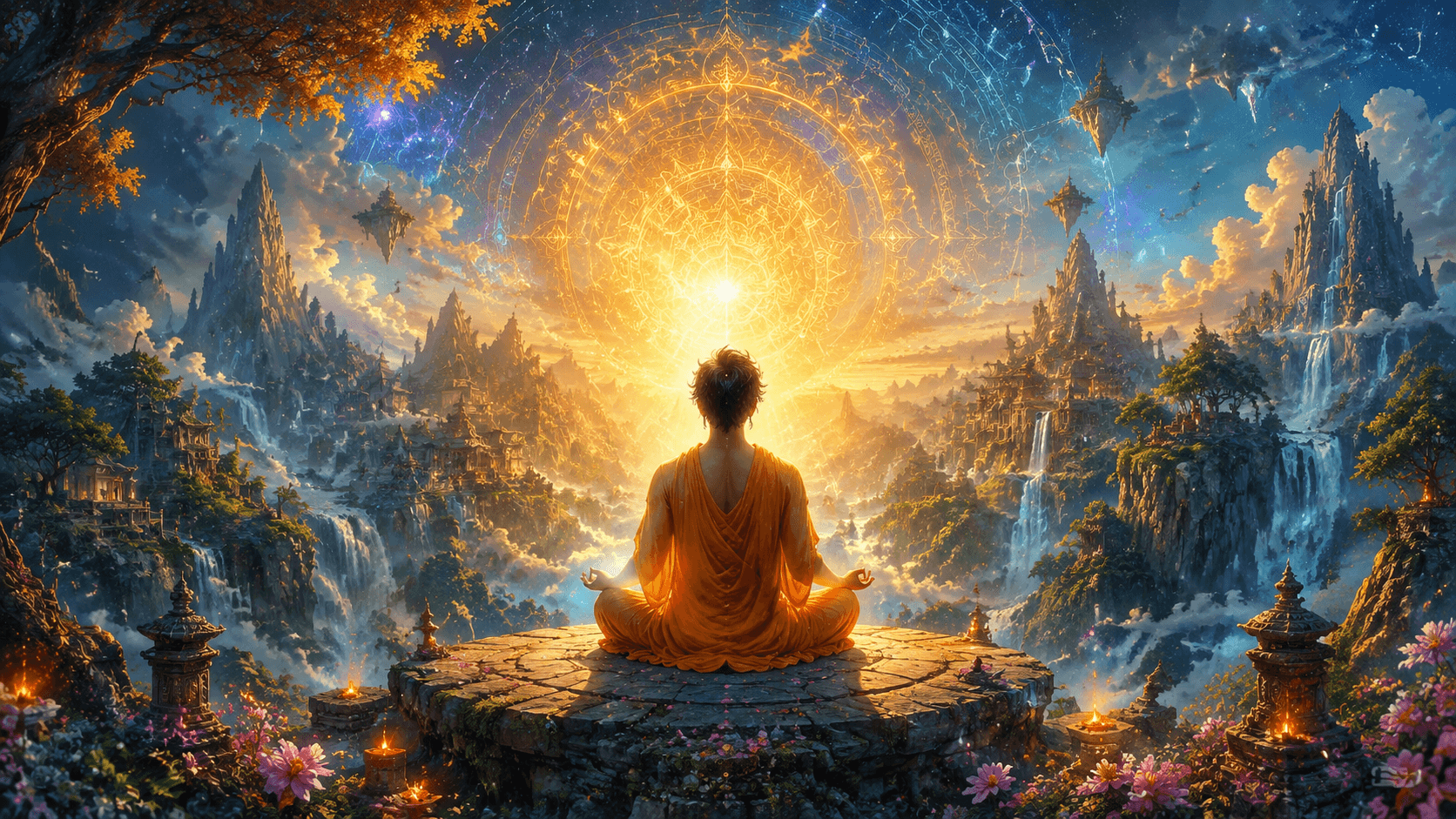
Meditation for Expanding Inner Worlds: Complete Guide to Growing Your Imagination
Discover how meditation expands your inner worlds—building richer mental landscapes, deeper emotional intelligence, and boundless creative potential through visualization, spatial audio, and cinematic storytelling tec...
Why did the Stoic cross the road? Because it was the rational thing to do, and he was indifferent to the traffic.
The Bottom Line
Your imagination is not a fixed trait it is a trainable capacity that responds powerfully to consistent meditation practice. Visualization builds the foundation, guided imagery accelerates development, sensory expansion creates depth, and narrative meditation provides the most comprehensive imagination workout available. The neuroscience is clear: regular imagination meditation strengthens the default mode network, increases neural connectivity, and produces measurable improvements in creative thinking, emotional resilience, and cognitive flexibility. Combined with spatial 3D audio, the training becomes an immersive experience that makes development feel effortless and enjoyable.
Visionaria Insight
By immersing ourselves in these historical soundscapes, we reconnect with a timeless human tradition of storytelling and mental restoration.
Read more: What Are Interactive Audio Journeys? A Complete Guide

For those ready to begin, Visionaria offers 150+ immersive spatial 3D audio journeys through mythological realms, ancient civilizations, and enchanted worlds free to download on iOS and Android. Continue exploring: discover How Imagination Training Improves Mental Health, learn about The Link Between Imagination and Creativity, or explore Cinematic Meditation: A New Era of Mindfulness.
Experience More with Visionaria
Download the app to explore 150+ guided historical and wellness journeys.
Why did the historian break up with the archaeologist? Because her career was literally in ruins.