
The Odyssey
Story Explained
"Ten years to get home. Most of us complain about the commute."
What happens in Homer's Odyssey, in which order, and why does it begin near the end? A clear guide for adults who never finished it, or never started.
What is the story of the Odyssey?
The Odyssey is the Greek epic poem about Odysseus, king of Ithaca, who needs ten years to get home after the fall of Troy. On the way he meets the Cyclops Polyphemus, the sorceress Circe, the Sirens and the monsters Scylla and Charybdis, and he is held for years by the nymph Calypso. At home, his wife Penelope has been holding off suitors who want his throne. He returns in disguise and takes back his house. This page is a guide; it is not one episode in the app.
Free to start • Available on iOS & Android
"Home is the hardest destination to reach, and the oldest one."
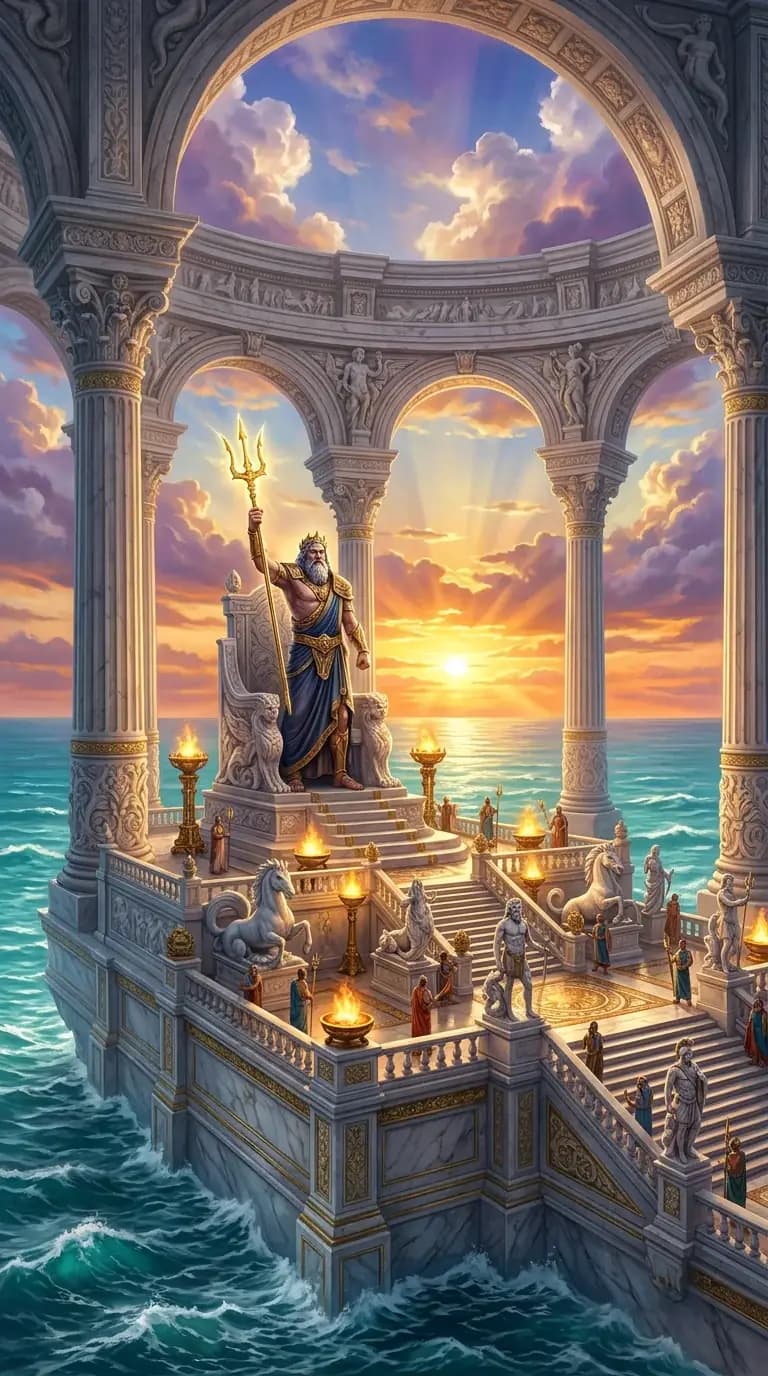
The Long Way Home
The Odyssey is an ancient Greek epic poem, traditionally ascribed to Homer, in twenty-four books of verse. It follows the Greek hero Odysseus on his return from the Trojan War, and it was composed around the late eighth or early seventh century BCE, shortly after the Iliad. The word odyssey now means any long, difficult journey. Who Homer was, and whether one poet wrote both epics, is still discussed by scholars.
Key Facts About the Odyssey
The poem does not start at the beginning. It opens in the tenth year after Troy, when Odysseus has already been away for twenty years, and the gods are deciding at last to let him go home. In the first four books the focus is his son Telemachus, who is grown and has to deal with a house full of suitors who are eating the family's food and each hoping to marry Penelope and take the throne. Athena, disguised, sends the young man to ask for news of his father in the courts of Nestor and Menelaus.
Odysseus himself appears in book five, a captive of the nymph Calypso on the island of Ogygia. Hermes brings Zeus's order to release him, and he builds a raft, only to be wrecked by Poseidon and washed up among the Phaeacians. Their princess Nausicaa finds him on the shore. At the court of King Alcinous, Odysseus is asked who he is, and in books nine to twelve he tells, in his own voice, the story of his wanderings since leaving Troy. These are the famous adventures, and they are told as a story within the story.
The rest of the poem is the homecoming. Odysseus lands on Ithaca, disguised by Athena as an old beggar. His loyal swineherd Eumaeus shelters him, he meets Telemachus in secret, and only his old dog and his nurse Eurycleia recognize him, the nurse by a scar on his leg. Penelope sets the suitors a contest with Odysseus's great bow. They fail, the beggar succeeds, and the suitors are killed. The poem ends after Penelope tests her husband with a question about their bed and the two are reunited.
"The oldest cliffhanger in literature: the hero has a flashback at dinner."
The Journey, Episode by Episode
Troy to the lotus and the Cyclops. After sacking a city of the Cicones, Odysseus and his crews are blown off course. The Lotus-Eaters offer a fruit that makes men forget home, and Odysseus has to drag his men back to the ships. Next comes the island of the Cyclops Polyphemus. Trapped in his cave, Odysseus tells the giant that his name is Nobody, blinds him and escapes under a ram. When he boasts of his real name, Polyphemus prays to his father Poseidon, and the sea god's anger drives the rest of the journey.
Winds, giants and a sorceress. King Aeolus gives Odysseus a bag of winds, but his crew open it and are blown back. The Laestrygonians, giants who destroy most of the fleet, are followed by Circe, who turns the men into pigs until Odysseus, with Hermes's help, forces her to turn them back. They stay with her for a year. She tells Odysseus he must go to the land of the dead for advice.
The dead, the Sirens and the monsters. In the underworld, Odysseus speaks with the prophet Tiresias, his mother and the shade of Achilles. Returning, he hears Circe's advice: he plugs his crew's ears with wax and has himself tied to the mast so he can hear the Sirens and live. Then comes the narrow strait between the six-headed Scylla and the whirlpool Charybdis, which costs him six men. On the island of Thrinacia his hungry men eat the cattle of the sun god Helios, and Zeus destroys their ship with a thunderbolt. Odysseus alone survives and reaches Calypso's island.
What it all means. Readers have taken the poem in many ways: as a story about the pull of home, about cunning against force, about the cost of pride, or about the loyalty of those who wait. Its subject is also hospitality, since nearly every episode is a meeting between a stranger and a host who behaves well or badly. The poem takes no single side, and that is much of its lasting appeal.
"Nobody blinded the Cyclops. Nobody is very good at the job."
Hearing It in the App
The Plan at Troy
The Odyssey begins where the Trojan War ends. Visionaria's Troy series has an episode on the Trojan Horse of about 14 minutes, the plan that, in the tradition, belongs to Odysseus.
First-Person Audio
The episodes are told in the first person with narration, music and spatial (3D) sound, so you are inside the scene rather than hearing a summary. Headphones work best for the spatial effect.
Story, Not Textbook
The episodes are dramatized meditations, not a reading of the poem. Use this page for the sequence and the sources, and the episodes for the atmosphere.
Good for Evenings
The episodes are paced slowly enough to wind down with, which is the reason they exist. This page is the reading side; the app is the listening side.
There is no Odyssey episode in the app, so this page is a reading guide. To hear the setting that comes just before it, try the Trojan Horse and read the guide to the Trojan War. For the god who stands in Odysseus's way, see Poseidon. The approach is explained under cinematic meditation.
"Please keep your ears unwaxed. This is a safe app."
Who This Guide Is For
First-Time Readers
You want the shape of the poem before opening it, and a map of which episode comes where, since the order is not chronological.
Students
A fast route to the structure, the main characters and the themes, with the primary text as the thing to cite.
Travelers to Greece
Ithaca and the Ionian islands are part of many trips. The poem is easier to enjoy on a ferry if you know who is who.
Audio Listeners
You like to take stories in through your ears. This guide helps you choose where to start, in the app or in an audiobook of the poem.
Readers of Homecoming
Penelope's long patience and Odysseus's return are the emotional centre of the poem, and many adults find it moves them more than the adventures do.
Readers of Myth
For the gods who send storms and give help, see our guide to the Greek gods.
Note for beginners: you do not need to know the Iliad first. If you want the background, the guide to the Trojan War covers it in a few minutes.
"Spoiler: he gets home. Homer tells you in the first lines."
Continue the Story
"Same war, different road home."
Your Questions Answered
Everything you need to know about the Odyssey
"Questions asked since the poem was recited at feasts."
Ready to Set
Sail for Troy?
Download Visionaria and begin with the Troy series, where the Odyssey's hero first makes his name.
"Tie yourself to the mast. Or just lie back."