Launch special: Visionaria Premium is free—all cinematic journeys with spatial 3D audio.
🇺🇦 Support Ukrainian creators on Patreon — help us make a difference
Launch special: Visionaria Premium is free—all cinematic journeys with spatial 3D audio.
🇺🇦 Support Ukrainian creators on Patreon — help us make a difference
Dive deep with the God of the Seas for oceanic insights and wisdom
Experience Poseidon, God of the Seas and Earthshaker, in this immersive underwater journey through oceanic power, marine wisdom, and the depths of consciousness.
🌊 What is the Poseidon Under the Waves experience?
A 22-minute Advanced spatial audio meditation that transports you to Poseidon's underwater palace for a dialogue about emotional depth, power, and transformation. Experience oceanic wisdom through immersive 3D soundscapes featuring underwater currents, marine life, and the voice of the Earthshaker himself.
"Warning: May cause sudden urge to dramatically gesture with a fork while shouting 'I am lord of the seas!' (Poseidon takes no responsibility for confused dinner guests.)"
"Side effects include profound respect for the ocean, questioning whether you've been suppressing emotional earthquakes, and googling 'how to be more like water.'"
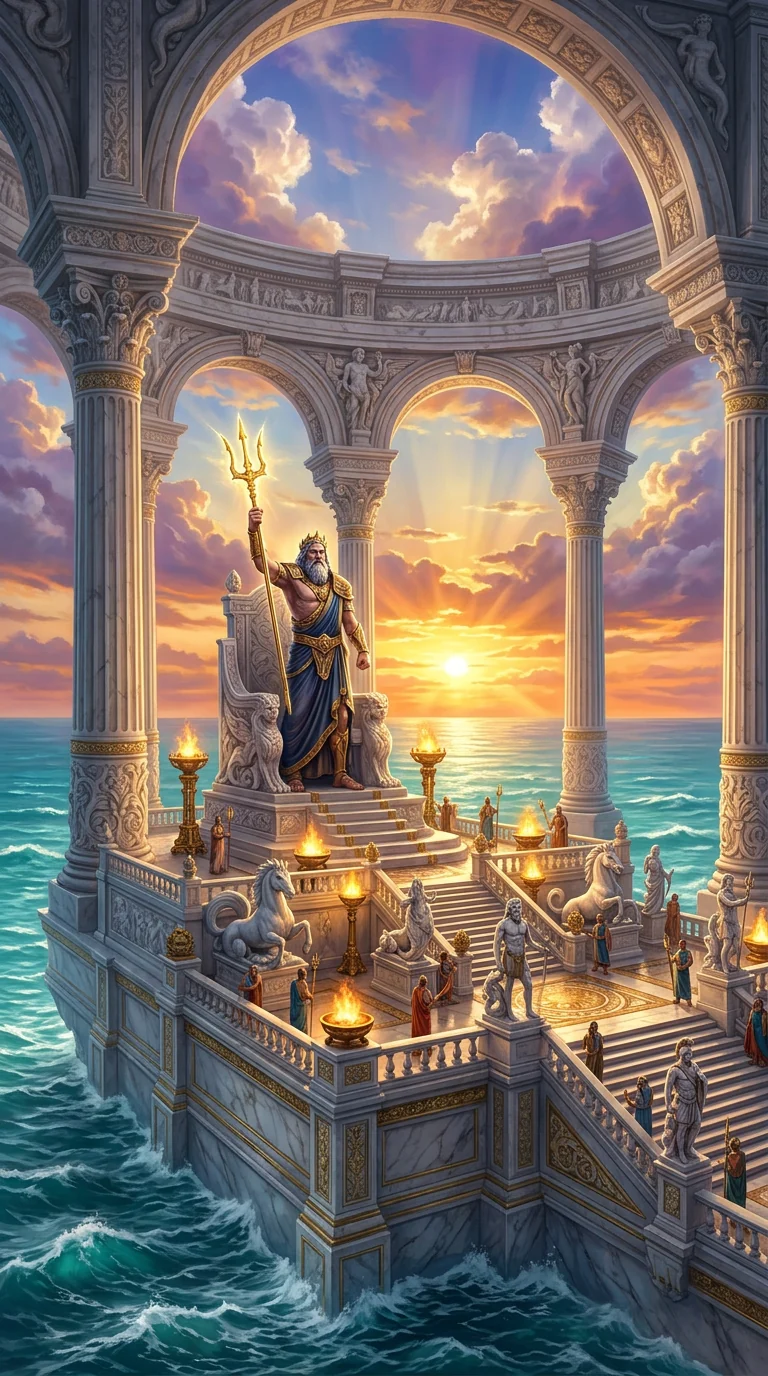
Poseidon (Greek: Ποσειδῶν) is the God of the Seas, Earthquakes, Storms, and Horses in Greek mythology, ruler of all waters and marine life. Brother to Zeus (lord of sky) and Hades (lord of underworld), son of the Titans Cronus and Rhea, Poseidon received dominion over the oceans when the Olympians divided the cosmos following their victory over the Titans around 2000 BCE in mythological chronology. His symbols—the trident (three-pronged spear), horses, and dolphins—represented his authority over both waters and the earth-shaking power beneath. Known as the Earthshaker (Enosichthon), he could cause earthquakes and tsunamis by striking the ground or sea with his mighty trident. Father to numerous beings including Triton (messenger of the sea), Polyphemus the Cyclops, and the winged horse Pegasus, Poseidon's children reflected his diverse nature. According to Homer's Odyssey and Hesiod's Theogony, Poseidon dwelled in a magnificent golden palace beneath the Aegean Sea, maintaining the delicate balance between nurturing waters that give life and destructive storms that reshape coastlines. As the second most powerful Olympian after Zeus, Poseidon embodied the ocean's paradox—simultaneously creative and destructive, calm and tempestuous, depth and surface.
Poseidon's realm extends far beyond the ocean's surface—his dominion encompasses all waters, from the deepest oceanic trenches to freshwater springs, from peaceful harbors to storm-wracked seas. When the Olympians divided the cosmos after overthrowing the Titans, Poseidon received the waters while his brother Zeus claimed the sky. This division wasn't mere territory but represented fundamental aspects of existence: Zeus embodying rational order and law, Poseidon representing emotional depth and primal power.
Ancient Greeks understood Poseidon as simultaneously life-giver and destroyer. The same seas that provided fish, enabled trade, and connected civilizations could transform without warning into devastating force. Sailors prayed to Poseidon before voyages, not just for safe passage but for his temperament to remain calm. His earthquakes—triggered by striking his trident against the earth—reminded mortals that solid ground itself could become liquid, that what seems stable might suddenly shift.
"Poseidon's relationship status: It's complicated. With literally everything, including his own emotions."
His association with horses reveals another dimension of his character. In some myths, Poseidon created the first horse by striking rock with his trident—a gift combining power, beauty, and untamed nature. Horses, like the sea, resist complete control. They can be partnered with but never fully dominated, mirroring Poseidon's own philosophy about power: work with natural forces rather than attempting to conquer them.
Homer's Odyssey portrays Poseidon's complex nature through his pursuit of Odysseus, who blinded Poseidon's son Polyphemus. For ten years, Poseidon prevented Odysseus's return home through storms and obstacles—not random cruelty but protective rage on behalf of his child. This reveals the god's capacity for both fierce loyalty and sustained intensity, traits that made him beloved by some, feared by many, and misunderstood by most.
Yet beneath his reputation as temperamental and dangerous lies a different truth: Poseidon represents authentic feeling in a world that often demands emotional suppression. When honored and approached with respect, he granted safe passage, bountiful catches, and protected harbors. His so-called temperament wasn't capriciousness but rather honest response—the ocean doesn't pretend calm when storms gather, and neither did the god who embodied it.
Poseidon's underwater palace symbolizes authentic self beneath social masks—the depths where truth dwells versus the surface we present to the world.
When we suppress powerful feelings, they emerge as earthquakes in other life areas—Poseidon teaches that honoring emotion prevents destructive eruptions.
The ocean cannot be dominated, only understood—true power lies in working with natural currents rather than fighting them.
"Poseidon's leadership style: 'Be like water.' (Bruce Lee totally borrowed this. The god is cool with it.)"
Descend into Poseidon's oceanic realm through cutting-edge 3D audio that places you physically underwater
Your journey begins at the ocean's surface, where sunlight dances on waves and seabirds call overhead. The spatial audio tracks your descent—surface sounds fading, light dimming, pressure gradually increasing. You pass through the twilight zone where scattered rays create ethereal blue-green glow, then into deeper waters where bioluminescent creatures provide the only illumination.
The soundscape transforms with depth: whale songs echoing from miles away, schools of fish creating collective swish as they pass, thermal vents releasing bubbles that rise past your position, underwater currents flowing with distinct directional sound. Each layer of descent brings new acoustic characteristics—the ocean isn't uniform but rather complex ecosystem of sounds positioned precisely in 3D space around you.
Then you enter Poseidon's domain: a palace of coral and pearl, where marine architecture defies surface-world physics. His voice resonates through water with quality impossible in air—deeper, more resonant, carrying harmonic frequencies that make your entire body awareness shift. When he speaks, currents respond. When he gestures, marine life moves in coordinated patterns. The spatial audio captures this interconnection.
"Our audio team recorded actual ocean depths, added mythological resonance, and consulted with dolphins. The dolphins had notes."
Unlike surface-world conversation, dialogue underwater takes on different rhythms. Poseidon doesn't rush—he has eternity, and the depths teach patience. Strategic silences hold meaning as much as words. The soundscape supports contemplation: gentle currents flowing, distant whale songs, the creak of coral structures settling, all creating space for genuine reflection.
Poseidon addresses sophisticated emotional themes: the difference between suppression and integration, how to honor intensity without drowning in it, the relationship between vulnerability and strength, what it means to be called "too much" or "too intense," how depth work requires descending rather than staying safe at the surface. He doesn't offer simple techniques but rather invites you into the complexity itself.
The dialogue includes powerful metaphors drawn from oceanic reality: pressure that increases with depth (like emotional work's intensity), currents that follow patterns beyond conscious control (like feeling's natural rhythms), the way light dims as you descend (confronting what's hidden), and how the ocean supports rather than fighting against your presence when you stop struggling.
Background soundscapes enhance the teaching: when discussing suppressed emotions, you hear distant rumblings—earthquakes building beneath the ocean floor. When exploring flow versus force, currents shift around you demonstrating effortless power. When contemplating authentic versus performed calm, the difference between still water and held breath becomes acoustically apparent through subtle spatial cues.
Coral halls and pearl chambers create unique acoustics impossible on land
Flowing water positioned in 3D space demonstrates power through allowing
Dolphins, whales, and fish moving through three-dimensional soundscape
Poseidon's words resonate through water with primal authority
"We considered adding a 'create earthquake' button but decided that might be irresponsible. (Poseidon disagreed.)"
Poseidon shares perspectives earned across millennia of embodying the ocean's paradoxes
Poseidon explores the fundamental difference between the face we show the world and the truth we carry in our depths. The ocean's surface might appear calm while powerful currents flow beneath, or seem stormy while deep waters remain still. Most people, he observes, live entirely at the surface—responding to immediate circumstances without connecting to deeper emotional currents.
"Depth work requires descent," Poseidon teaches. "You cannot understand the ocean from a boat. You must go down, allow pressure to increase, let light dim, and discover what exists beyond the surface's reach." This applies to emotional life: real understanding requires venturing into uncomfortable depths rather than staying in the shallows of superficial calm.
As the Earthshaker, Poseidon understands how suppressed force inevitably erupts. When we deny powerful feelings—pushing them down, rationalizing them away, performing calm we don't feel—they don't disappear. Instead, they accumulate pressure until suddenly releasing as "earthquakes" in other life areas: sudden rage at minor inconveniences, inexplicable anxiety, physical illness, relationship ruptures.
"The tectonic plates of emotion move whether you acknowledge them or not," Poseidon explains. "Suppression doesn't prevent earthquakes—it ensures you won't recognize the warning signs before they strike." He teaches that honoring feelings as they arise, rather than forcing them into the depths, prevents destructive eruptions. Authentic expression channels intensity constructively rather than letting it build until explosion becomes inevitable.
Perhaps Poseidon's most profound teaching: true power flows rather than forces. The ocean doesn't fight against obstacles—water finds the path, shapes around resistance, erodes through persistence rather than violence. Yet this flowing quality contains tremendous force: ocean currents move continents, tides reshape coastlines, waves carve stone.
"Humans confuse control with strength," Poseidon observes. "They build walls against the tide, then wonder why walls crumble. Learn from water: adapt around obstacles while maintaining your essential nature." This applies to emotional life and leadership alike—rigid control creates brittleness, while flowing adaptation demonstrates genuine strength. The ocean's power lies not in dominating but in understanding its own nature and working with it rather than against it.
Poseidon addresses directly those who've been labeled too intense, too emotional, too deep, too much. Throughout mythology, he was feared for his intensity—mortals preferred the rational order of Zeus to Poseidon's passionate nature. Yet this intensity wasn't flaw but authentic expression of oceanic reality. The sea doesn't apologize for storms.
"When they call you 'too much,'" Poseidon reflects, "they mean 'more than I can comfortably witness.' This is their limitation, not yours. The ocean's depth isn't diminished because some prefer puddles." He doesn't advocate careless expression—the ocean's power comes with responsibility—but rather encourages honoring your full emotional spectrum rather than performing a diminished version acceptable to those uncomfortable with depth. Your intensity, properly channeled, becomes your greatest strength.
"Poseidon's therapy approach: 'Have you tried just being honest about your feelings and seeing what happens?' (Revolutionary stuff.)"
Anyone who's been told they feel too deeply, care too much, or bring too much intensity to situations. Poseidon validates powerful emotional nature while teaching how to channel intensity constructively rather than suppressing it to satisfy others' comfort levels.
Therapists, counselors, coaches, and anyone engaged in psychological work exploring beneath surface symptoms to root causes. Poseidon's underwater realm metaphorically represents the descent required for genuine therapeutic change versus surface-level behavioral adjustments.
Those who feel deep connection to water—ocean lovers, sailors, swimmers, anyone who finds their most authentic self near water. Poseidon articulates what water teaches non-verbally: flow, depth, power through adaptation, and the relationship between surface and hidden currents.
Anyone working to shift from rigid control toward flowing adaptation—leaders learning collaborative approaches, perfectionists exploring good-enough, type-A personalities investigating surrender. Poseidon demonstrates that power and letting go aren't opposites but complementary forces.
Those noticing patterns of suppression followed by explosive release—anger management challenges, sudden anxiety, inexplicable relationship ruptures. Poseidon teaches to recognize emotional tectonic movement before earthquakes strike, honoring feelings before they demand attention through disruption.
Greek mythology enthusiasts and ocean admirers seeking deeper engagement with Poseidon beyond surface-level god-of-the-sea descriptions. This journey brings his complex psychology alive—the misunderstood intensity, the fierce protectiveness, the embodiment of depth work that mainstream culture often avoids.
"Also perfect for anyone who's ever wanted to dramatically emerge from a pool while declaring 'I have returned from the depths.' (No judgment.)"
Everything you need to know about this journey with Poseidon
"We asked Poseidon to answer these questions, but he said 'Just dive in and find out.' (We translated this to actual answers for you.)"
Explore more conversations with the Olympian gods and goddesses
Download Visionaria and begin your dialogue with the God of the Seas today.
"The only app where emotional depth comes with actual ocean sounds. (Poseidon approves this message.)"