
The Twelve Labours
of Heracles
"Twelve jobs, one employer, no holiday pay."
What were the twelve labours of Heracles, in which order, and why did the greatest hero of Greece have to serve a lesser king? The full list, with the sources that tell it.
What are the twelve labours of Heracles?
In the usual list, Heracles must kill the Nemean Lion and the Lernaean Hydra, capture the Ceryneian Hind and the Erymanthian Boar, clean the Augean Stables, drive off the Stymphalian Birds, capture the Cretan Bull, bring back the Mares of Diomedes, fetch the girdle of Hippolyta and the cattle of Geryon, take the apples of the Hesperides, and finally bring up Cerberus from the underworld. This page is a guide; it is not one episode in the app.
Free to start • Available on iOS & Android
"The twelfth labour was the one nobody volunteers for: meeting the dog."
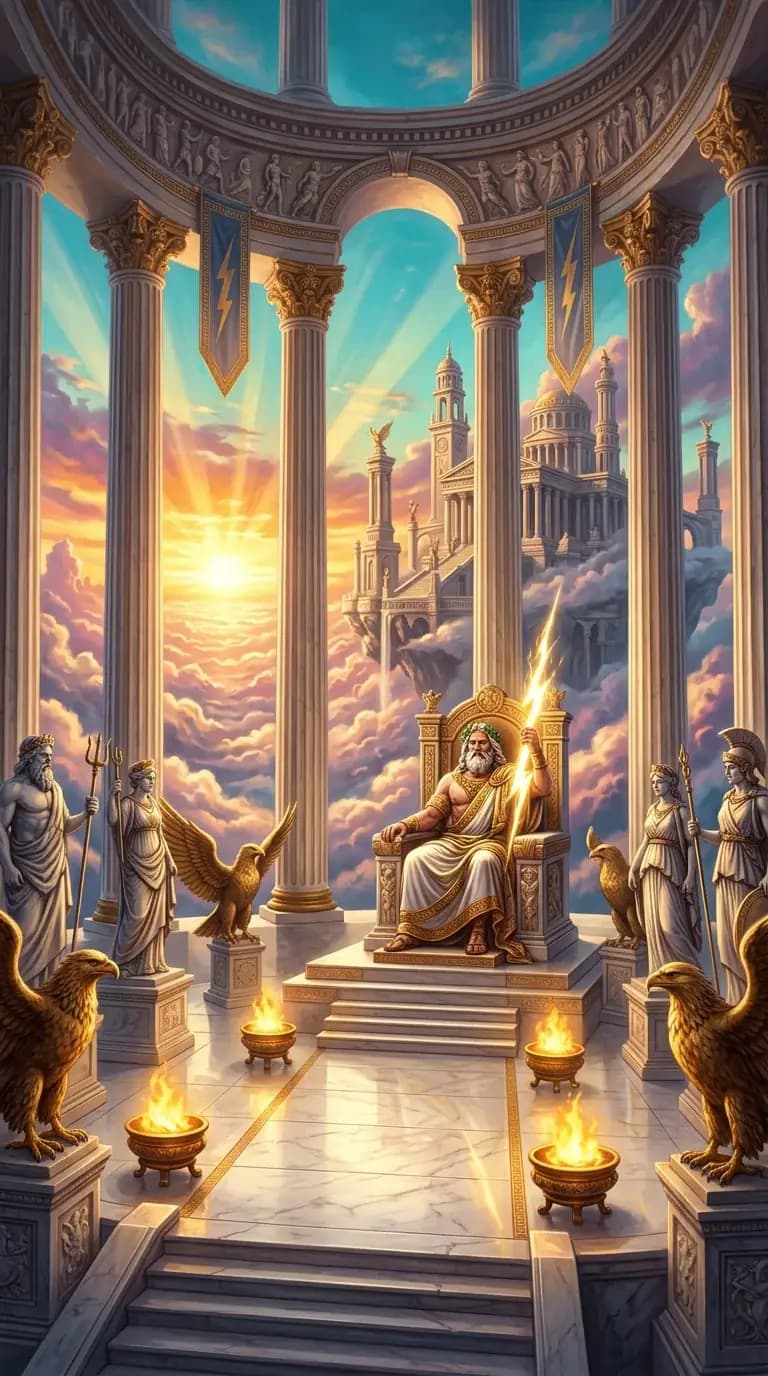
Twelve Tasks, One Hero
The twelve labours of Heracles are the best-known set of tasks in Greek myth. Heracles, a son of Zeus and the mortal Alcmene, performs them in the service of King Eurystheus, usually as a penance for a crime he committed in a fit of madness sent by Hera. The Romans called him Hercules. The labours were told in many versions across the centuries, and the fixed list of twelve is clearest in a handbook of myth from the Roman period.
Key Facts About the Labours
The story begins with a grudge. Hera, the wife of Zeus, hated the child her husband had with Alcmene, and she pursued Heracles all his life. In the version told by the tragedian Euripides, she sends a fit of madness in which Heracles kills his own wife and children. When he recovers, he goes to the oracle at Delphi, which tells him to serve King Eurystheus and carry out whatever tasks he is given. The number of labours is then set at ten, and later at twelve.
The list is not as old as the hero. Early poets and artists know many of his deeds, the lion, the Hydra and Cerberus among them, but they do not always treat them as one cycle. In the handbook of myth attributed to Apollodorus, which comes from the Roman period, the full sequence of twelve is laid out in order. According to that account, Eurystheus refused to count two of the first ten, the Hydra because Heracles had help from his nephew Iolaus, and the Augean Stables because Heracles asked for payment, so two more were added.
The labours were also carved in stone. At Olympia, the metopes of the Temple of Zeus, from around the middle of the fifth century BCE, show the twelve labours, centuries before the fullest written list we have. Ancient readers knew them as a set long before they were summarized in prose.
"The only hero whose commute included the underworld."
The Twelve Labours, in Order
The Peloponnese: labours one to six. First, the Nemean Lion, whose hide no weapon could pierce. Heracles strangles it and wears the pelt. Second, the Lernaean Hydra, a many-headed water serpent, whose heads grew back unless the stumps were burned. Third, the Ceryneian Hind, a deer with golden horns sacred to Artemis, which he must take alive. Fourth, the Erymanthian Boar, captured on a mountain. Fifth, the Augean Stables, a huge herd's stalls that had not been cleaned for years, which he clears by turning the course of rivers through them. Sixth, the Stymphalian Birds, a flock that plagued a marsh and was driven out with noise.
Crete and Thrace: labours seven and eight. The seventh is the Cretan Bull, brought alive back to Greece. The eighth is the Mares of Diomedes, horses of a Thracian king that, in the myth, ate human flesh. Heracles overcomes the king and the herd, though the story costs him a friend in some versions.
The far edges of the world: labours nine to twelve. The ninth is the girdle of Hippolyta, queen of the Amazons, a task given to please Eurystheus's daughter. The tenth is the cattle of Geryon, a three-bodied giant who lived in the far west. The eleventh is the apples of the Hesperides, golden fruit in a garden at the edge of the world, guarded by a dragon. The twelfth and last is Cerberus, the hound of Hades, whom Heracles must bring up to the living world and return.
After the labours. The tales of his later life vary. In Sophocles's play Women of Trachis, Heracles is killed when his wife Deianira, believing it a love charm, sends him a shirt smeared with the blood of the centaur Nessus, which is in truth a poison. He builds his own pyre on Mount Oeta. Later tradition says that he was taken up among the gods, reconciled with Hera and married to Hebe, the goddess of youth.
"Some heroes get a sword. Heracles got a to-do list."
Hearing the Greek Hero World
First-Person Audio
Visionaria's episodes are told in the first person with narration, music and spatial (3D) sound, so you are inside the scene rather than hearing a summary. Headphones work best for the spatial effect.
Cities of the Heroes
The app's journeys are set mostly in five ancient cities: Athens, Alexandria, Babylon, Sparta and Troy. Heracles is not one of the episodes, but his world is the background of the Greek stories you hear there.
A Spartan Link
Spartan kings traced their descent from Heracles. Herodotus gives the family line of King Leonidas back to him, which is one reason the hero matters in Sparta.
Good for Evenings
The episodes are paced slowly enough to wind down with, which is the reason they exist. This page is the reading side; the episodes are the listening side.
This page is a reading guide, not an episode. For the setting of the heroic age, hear Sparta, where Heracles was claimed as an ancestor, or meet the king of the gods on the Zeus page. The approach is explained under cinematic meditation.
"No labours required. You can listen lying down."
Who This Guide Is For
Curious Adults
You remember some of the labours and want the whole list in order, with the parts the usual summaries leave out.
Students and Readers
A quick route to the sequence, the main characters and the primary sources to cite, before opening Apollodorus or Euripides.
Travelers to Greece
Olympia, Nemea, Lerna and Mycenae are all on the map of the labours. A little preparation makes a visit richer.
Careful Readers
You want to know which version of a labour belongs to which ancient source, and where the sources disagree.
Fans of Epic Heroes
Heracles is one of the oldest heroes in Western literature. Compare him with the heroes of the Trojan War.
Readers of Myth
For his father and the family behind the grudge, see our guide to the Greek gods.
Note for beginners: you do not need any background. If you want a place to start with Greek myth in general, the guide to the Greek gods gives the family tree in a few minutes.
"Spoiler: he finishes all twelve. The stables are the hard part."
More Greek Myth
"One hero, many cousins."
Your Questions Answered
Everything you need to know about the twelve labours
"Asked in Greece for about two and a half thousand years."
Ready to Step
Into Greek Myth?
Download Visionaria and walk through Sparta, Athens and the other ancient cities where the heroes were remembered.
"Twelve labours for him. One easy evening for you."