Ancient Rome Meditation: Walking the Eternal City
Ancient Rome had over 1,300 public fountains and 11 massive aqueducts feeding the city by 226 CE, meaning a Roman citizen was never more than a few steps from the sound of running water, a natural acoustic anchor that modern neuroscience now recognizes as a powerful stress-reduction tool.
- Rome at Its Peak: A City of One Million, Built for People
- A Roman Morning: The Via Sacra at Dawn
- What Ancient Rome Meditation Sounds Like: The Sonic City
- Roman Urban Wellness: The City Designed for Human Experience
- Spatial Audio and the Forum: Ancient Rome Meditation in Practice
- Ascending the Palatine: Ancient Rome Meditation at Its Most Profound
- Ancient Rome Meditation: A Legacy Still Worth Listening To
- Frequently Asked Questions
Ancient Rome meditation is the practice of using guided imagery, spatial audio, and reconstructed historical soundscapes to mentally inhabit the streets, temples, and forums of imperial Rome. At its height around 100 CE, Rome was a city of nearly one million people, deliberately designed for walking, pausing, and human-scale experience, making it one of history's most surprisingly contemplative urban environments. Engaging with its spaces through experiential meditation activates the brain's deep visualization systems, deepening calm in ways that silence-only techniques often cannot reach.
Most people picture ancient Rome as noisy, overwhelming, and chaotic. And sure, parts of it were. But here is the thing most modern accounts miss: Rome was, at the same time, a city saturated with designed contemplative space. Porticoes built for shaded walking. Gardens open to any citizen. Fountains placed at intersections not just for water, but for the sound. Romans understood something about urban wellness that most cities forgot for nearly two thousand years and are only now beginning to rediscover. If you want to understand what walking through an ancient city in your mind can do for your nervous system, Rome is one of the most powerful starting points available to us.
Key Facts About Ancient Rome at Its Peak
- •PopulationApproximately 1 million residents at its height circa 100 CE (historian Tertius Chandler, 'Four Thousand Years of Urban Growth', 1987)
- •Aqueducts11 major aqueducts delivering roughly 1 billion liters of fresh water daily (Frontinus, 'De Aquaeductu', 97 CE)
- •Sacred spacesOver 400 temples, shrines, and sacred precincts within the city by the 2nd century CE
- •Via SacraRome's oldest and most sacred road, used for triumphal processions, daily commerce, and morning philosophical walks
- •Urban designRome banned wheeled cart traffic inside the city walls during daylight hours, making it among the first pedestrian-priority cities in history
Quick Answer
Ancient Rome meditation refers to the contemplative practice of mentally walking through the streets, forums, and sacred spaces of Rome at its imperial peak, using reconstructed soundscapes, spatial audio, and guided imagery to engage the brain's deep relaxation and visualization systems.
Rome at Its Peak: A City of One Million, Built for People
Forget every crowd scene in every film. Yes, Rome was dense. Historian Tertius Chandler, in his 1987 work 'Four Thousand Years of Urban Growth', placed Rome's population at approximately one million people by the early 2nd century CE, making it the most populous city on earth for centuries. But what those films never show you is the extraordinary sophistication of its urban design, a design that, frankly, prioritized human beings in ways most modern cities still cannot manage.
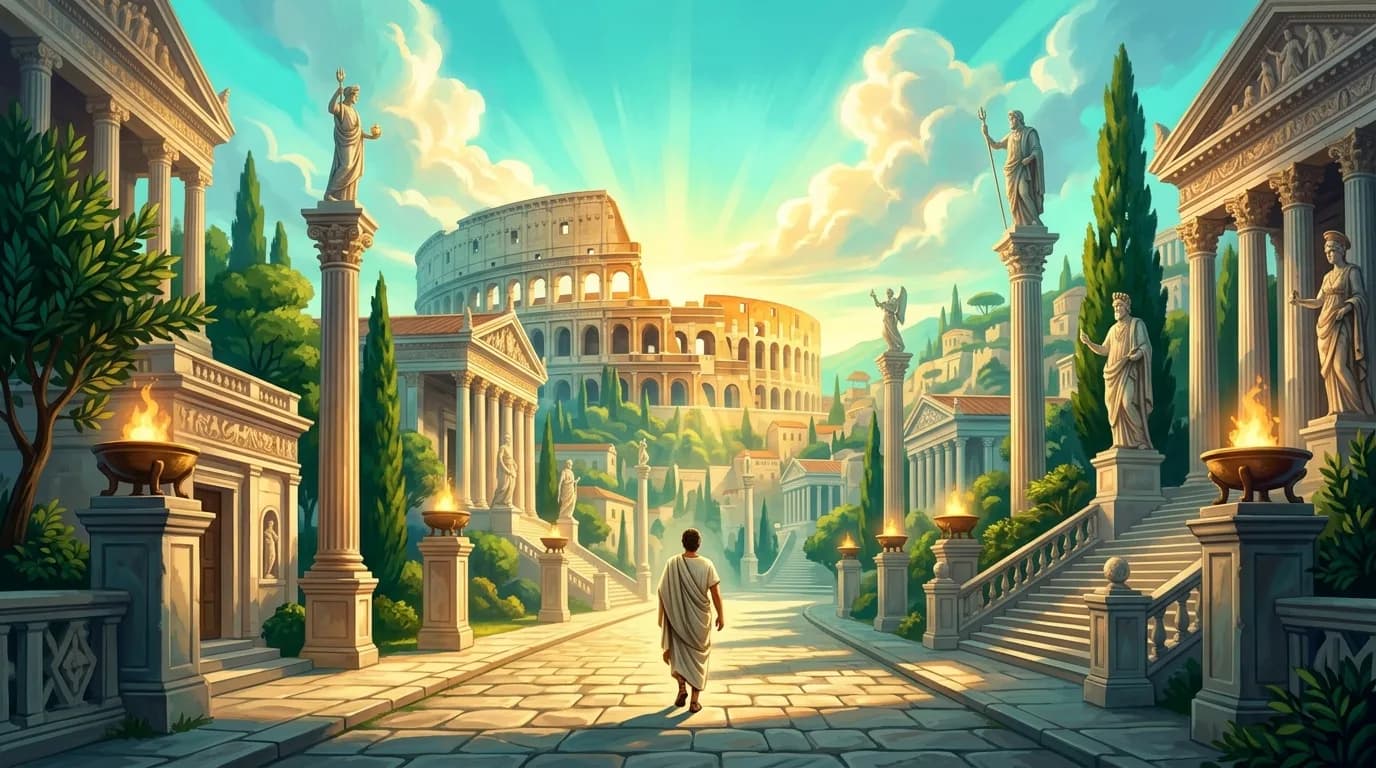
Julius Caesar passed one of history's first traffic ordinances, banning wheeled vehicle movement within the city walls during daylight hours. What this meant in practice was remarkable: from sunrise until dusk, the streets of Rome belonged entirely to people on foot. Merchants, philosophers, citizens, children. All of them walking at human pace through a city whose entire infrastructure, its porticoes, its fountains, its shaded colonnades, had been calibrated to make that walking pleasurable. Add to this the more than 400 sacred precincts and temples scattered through every neighborhood, and you start to see a city that was less a logistics problem and more a living meditation path.
Key Insight: Rome's Pedestrian Priority
Caesar's Lex Iulia Municipalis (45 BCE) banned wheeled traffic in Rome from sunrise to two hours before sunset, creating one of history's earliest pedestrian-priority urban environments and making contemplative walking the default mode of daily Roman life.
What is astonishing, when you sit with it, is how deliberately all of this was constructed. Rome's urban planners understood that a city is not just infrastructure. It is an experience. Every garden, every covered walkway, every fountain placed at a corner where two streets met, was an intentional act of civic design aimed at the quality of attention a citizen brought to their day. In a 1984 study in the journal Science, Roger Ulrich (then at the University of Delaware) found that hospital patients whose windows looked out on trees had somewhat shorter post-surgery stays and needed fewer strong painkillers than patients whose windows faced a brick wall. Romans had been applying this principle architecturally for centuries before the science existed to name it.
And then there is the sheer scale. Standing in the Forum at noon, surrounded by gilded temples rising forty, fifty, sixty feet into the sky, you were not just a person running an errand. You were inside something intentionally grand. Grandeur, it turns out, is not just aesthetic. Research by psychologist Dacher Keltner at UC Berkeley has shown that experiences of awe and architectural scale measurably reduce self-referential thinking and activate prosocial calm. Rome, at its peak, was delivering that experience to one million people every single day. The connections to what we now explore in experiential and immersive meditation are striking.
A Roman senator reportedly complained that the Forum had become 'too crowded with philosophers blocking the path.' His solution? Build more porticoes. Apparently Rome's answer to every problem was more shaded walkways.
A Roman Morning: The Via Sacra at Dawn
Picture this. You wake before sunrise in a city that is, for once, quiet. Not because it is empty, but because the wheeled carts that rumbled through all night have just rolled to a stop. From your window, the faint sound of water, always water, trickling from a street-corner fountain into a stone basin worn smooth by ten thousand morning washings. You put on your sandals and step into air that is cool and faintly fragrant, carrying incense from the nearby Temple of Vesta where the sacred flame has burned without interruption for centuries.
Dawn on the Via Sacra was genuinely one of the great contemplative experiences the ancient world had to offer, and almost nobody talks about it. Rome's oldest road, running the spine of the Forum valley from the Capitoline Hill to the Arch of Titus, was used for processions and ceremony, yes, but its daily life was something quieter and more intimate. Priests moved between temples in the early morning light, their white robes catching the first gold of sunrise. Philosophers gathered in the porticoes of the Basilica Aemilia for what amounted to informal outdoor seminars. Merchants arranged their stalls slowly, unhurriedly, in that particular early-morning pace that feels almost meditative even to watch.
Historical Insight: Temple Smoke as Sensory Anchor
Roman temples burned incense continuously from dawn. Frankincense (olibanum) was the most common, and modern aromatherapy research has confirmed its anxiolytic properties. A Roman citizen's morning walk was, chemically speaking, also an aromatherapy session.
Temples steamed in the morning. Literally. The combination of cool dawn air, warm stone that had absorbed the previous day's heat, and the constant water released by fountains and the many nymphaea (decorative water shrines) created a gentle mist that hung at ankle and knee height across the lower Forum, particularly near the Temple of Saturn and the Lacus Curtius, the ancient sacred pool at the Forum's center. Archaeological reconstructions based on climate data from the period, published by the Rome Archaeological Project in 2019, suggest that morning temperature differentials between paved stone and open sky were significant enough to create this visible phenomenon reliably during spring and autumn. The Forum at dawn was, in a quite literal sense, wreathed in atmospheric beauty.

Step Into Ancient Rome Tonight
Visionaria's spatial audio journeys place you on the Via Sacra at dawn, with reconstructed temple bells, fountain water, and Latin murmurs guiding your breath and mind toward genuine rest.
Cicero wrote that he preferred to take his morning walk before any meetings because 'the Forum at dawn belongs to the gods and the philosophers, and briefly to those wise enough to arrive before the lawyers do.'
What Ancient Rome Meditation Sounds Like: The Sonic City
Here is where it gets genuinely fascinating, and where the ancient Rome meditation practice has its deepest modern foundation. Rome was not silent. But its soundscape was radically different from any modern city, and understanding that difference is the key to why mentally inhabiting it is so restorative.
No engines. No electrical hum. No amplified noise. What Rome had instead was an extraordinary layered acoustic environment built from natural and human-generated sounds at a scale the human ear evolved to process comfortably. Latin conversations, the particular rhythm of a language with its rolling vowels and crisp consonants, echoing slightly in the covered porticoes. Iron-rimmed cart wheels grinding on basalt stone cobbles at night, then sudden silence at dawn. And always, always, the water. Frontinus, the Roman water commissioner who wrote De Aquaeductu in 97 CE, documented over 1,300 public fountains active in the city, fed by 11 aqueducts delivering nearly one billion liters of water daily. You were, at no point in ancient Rome, more than a short walk from the sound of flowing water.
Quick Answer: Why Water Sound Is So Calming
A small 2017 study at Brighton and Sussex Medical School found that listening to natural sounds, compared with artificial ones, was linked to a modest shift toward the body's resting (parasympathetic) state. Ancient Rome's fountain network was, accidentally, a city-wide source of calming background sound.
Then there were the temple bells. Each major temple rang small bronze bells at dawn, midday, and dusk, a practice documented across multiple Roman sources including Ovid's Fasti. The result, across a city with over 400 sacred sites, was a kind of distributed sonic architecture, a city-wide bell chorus that gently marked the passage of time without urgency. Add the morning cries of swifts, which still fill Roman skies in spring, and the distant sound of the Tiber moving over its broad gravel bed, and you have a soundscape that a modern sound designer would struggle to improve upon for the purpose of guided immersive audio meditation. Nature knew what it was doing. Rome, unusually, listened.
Read more: The Science Behind Immersive Audio Meditation
A Roman poet once complained that the water from the Trevi precursor fountain was so loud he could not hear himself think. His neighbor replied that this was, in fact, the whole point of living next to it.
Roman Urban Wellness: The City Designed for Human Experience
While we are here, let us take a brief turn that is worth the detour. Most discussions of Roman engineering focus on roads, aqueducts, and concrete. Fair enough. But the aspect of Roman urban design that most directly connects to modern wellness thinking is something far less discussed: the city's intentional relationship with the human nervous system. Romans did not have a word for 'wellness.' But they had otium, a concept that roughly translates as productive leisure, the kind of restorative rest that renews rather than empties. And the city was literally built to enable it.
Public baths, the thermae, served not just hygiene but social and psychological restoration. Gardens like the Horti Lucullani on the Pincian Hill were opened to citizens during certain periods. Porticoes, covered columned walkways, ran for miles through the city's most trafficked districts, providing shade in summer and shelter in rain, always with the implicit invitation to slow down, to linger, to let your thoughts settle. Philosopher and statesman Cicero wrote extensively about the value of walking in colonnade gardens for clear thinking, a practice he described in De Officiis as essential to what we might today call mental hygiene. His letters mention specific walkways in Rome and at his villa where particular thoughts had arrived, as if geography and cognition were inseparable, which, for him, they clearly were.
Key Insight: Otium and Modern Rest Science
Roman 'otium' has a loose modern echo in what psychologist Sabine Sonnentag at the University of Mannheim calls 'psychological detachment': mentally switching off from work during leisure time, which her research links to lower exhaustion and better well-being.
What strikes me most, revisiting this, is how far the assumption of 'noise and chaos' has distorted our sense of what Roman daily life felt like. Yes, Rome was dense. But density is not the same as disorder. A city of one million pedestrians, moving through designed gardens, past 1,300 fountains, under shaded colonnades, past 400 temple precincts, past public libraries (Rome had at least 29 by the 4th century CE, according to the Regionary Catalogues), is not a hostile environment. It is a richly layered human environment, one that modern urban psychology is only now beginning to articulate design principles for. The practice of connecting ancient environments to modern contemplative practice is, in this sense, a genuine act of historical recovery.
Marcus Aurelius reportedly walked the length of the Palatine portico every morning before any official business. His personal physician Galen noted this in his medical records, adding that he considered the emperor's habit 'the most effective medicine I cannot prescribe.'
Spatial Audio and the Forum: Ancient Rome Meditation in Practice
Now here is where the ancient and the neuroscientific actually converge in a way that should change how you think about both. When you close your eyes and allow a well-crafted spatial audio environment to place you inside a reconstructed ancient city, your brain does not process it as imagination. It processes it as presence. Research led by neuroscientist Uri Hasson at Princeton, published in PNAS in 2010, found that when someone listens to a spoken story, their brain activity comes to mirror the storyteller's, and the closer the match, the better they understood the story. The Forum you hear is, to a measurable extent, the Forum you are in.
Picture ascending the Palatine Hill as the city wakes around you. Below, the Forum begins its gentle morning hum: the clink of amphora being set on stone, a snatch of Latin conversation carried up on warm air, the ever-present fountain song from the Lacus Iuturnae at the Forum's edge. Above you, the imperial palaces with their terrace gardens release the scent of rosemary and fig onto the breeze. Visualization strengthens neural pathways in ways that pure abstract thought cannot, and placing that visualization inside a historically rich environment supercharges the effect. You are not just relaxing. You are exercising the mind's capacity for spatial and sensory attention, which is itself a form of contemplative training.
Quick Answer: What Makes Rome Ideal for Audio Meditation
Rome's pedestrian streets, layered water sounds, temple bell rhythms, and architectural grandeur create a historically inspired sonic and visual environment that can hold your attention and leave many people feeling both calm and a little awed. This triple activation is what makes it so effective as a meditation anchor.
Across Visionaria's journeys, experiences set in ancient environments invite a quality of attention that can feel different from standard breath-focused practice: more embodied, more directional, more present. And the neuroscience suggests why. When the brain is given a rich spatial environment to inhabit, including specific sounds at specific distances, architectural scale cues, ambient temperature metaphors, it stops generating the anxious self-referential chatter associated with the default mode network and redirects attention outward into the simulated space. The Forum, in other words, does the hard work of quieting the mind for you.
Read more: What Is a Visualization Journey? Complete Guide to Guided Mental Imagery
A Roman architect once said that the Forum was designed so that no matter where you stood, you could hear water. When asked if that was for practical reasons, he allegedly replied: 'Yes. The practical reason is that it is good for the soul.'
Ascending the Palatine: Ancient Rome Meditation at Its Most Profound
And then you climb. Not metaphorically. One of the most grounding and transformative elements of any ancient Rome meditation practice is the ascent of the Palatine Hill, Rome's oldest settlement hill, rising about 40 meters above the Forum floor. As you climb, the soundscape shifts. Street noise fades. The fountain sound below becomes a soft ambient murmur. Up here, the wind moves differently through the pine and cypress trees that terraced the hill's gardens. Up here, at dawn, you could watch the entire city materialize out of morning mist below you, one million human lives organizing themselves into a day. If that is not a meditative experience, the word has no meaning.
The Palatine was also the location of the Lupercal cave, considered by Romans to be the city's most sacred origin point, the cave where, according to tradition, the city's founders had been sheltered and nurtured before going on to build what would become the world's greatest civilization. Romans visited it. They sat near it. They brought offerings to it. This was not superstition so much as a profound civic act of remembering where you came from, a practice of grounding in origin and continuity that we would today recognize as a psychologically sophisticated wellness ritual. The parallels with how sacred high places have inspired meditation across cultures are hard to ignore.
Ancient Rome Meditation: A Legacy Still Worth Listening To
What ancient Rome offered its citizens was, at its core, a city that understood the human nervous system before neuroscience had a name for it. The Forum Romanum, the Via Sacra, the fountains fed by eleven aqueducts supplying roughly 1 million people with a continuous acoustic backdrop of moving water: these were not accidental design choices. Roman urban planners, working within a tradition stretching back to Vitruvius and his first-century BCE treatise 'De Architectura,' understood that proportion, flow, and sound shaped the quality of a person's inner life. A city that moves people on foot, fills their ears with water and birds and stone, and organises their morning around sacred ritual is, frankly, doing more for collective wellbeing than most modern urban environments manage today.
Modern psychology has been slowly catching up. Attention Restoration Theory, developed by Rachel and Stephen Kaplan at the University of Michigan and set out in their 1989 book, proposes that settings with gently engaging features, such as flowing water, open skies and soft natural sound, can help people recover from mental fatigue. Rome, at its peak, was essentially a city-scale application of that principle. Centuries before the Kaplans published their research, Roman architects were embedding those very qualities into stone and mortar. Mental time travel through immersive environments is not a new-age invention. Romans were practicing it every morning, in sandals, on the Palatine Hill, watching the sun lift above the Alban Hills while incense drifted from the Temple of Vesta below.

What Is Story Meditation and Why It Is the Future of Mindfulness
Story meditation uses cinematic narrative and immersive sound to guide the mind into deep stillness, and the science behind it is surprisingly robust.
Here is what stays with you, long after the history lesson ends. Rome was loud, crowded, and relentlessly alive, and yet it produced a culture of profound contemplation. Marcus Aurelius wrote the 'Meditations' while governing an empire of 70 million people, according to estimates by historian Peter Heather ('The Fall of the Roman Empire,' 2006). Seneca composed letters of breathtaking inner calm while living inside the noise of the largest city on earth. The lesson is not that you need silence to find stillness. The lesson is that immersive, intentional sensory experience (the right sounds, the right spatial context, the feeling of moving through a meaningful place) is itself a form of ancient Rome meditation. Today, with spatial audio technology reconstructing the precise acoustic geometry of the Forum at dawn, anyone can step into that experience and let the city do what it always did: quiet the mind by filling the senses with something genuinely worth attending to. Guided visualization through historical soundscapes carries that Roman tradition forward, placing it in your ears wherever you happen to be, and reminding you that the impulse to pause, breathe, and be present is as old as the Eternal City itself. Visionaria's library of narrative journey experiences brings exactly this kind of grounded, historically rooted immersion to modern listeners, no sandals required.
Step Into Ancient Rome. Just Press Play.
Walk the Forum at dawn with spatial audio.
A Roman senator, upon hearing a philosopher explain the benefits of morning walks for mental clarity, reportedly replied: 'We have been doing that for 400 years. We just called it going to buy bread.'
This article is for educational and informational purposes only. Historical details are based on available research and may evolve as new evidence emerges.
Visionaria journeys are designed for relaxation, guided imagination, and personal enrichment. They are not a substitute for medical, mental health, legal, or professional advice.
Vitruvius. De Architectura. Rome, c. 15 BCE.
Kaplan, Rachel and Stephen Kaplan. The Experience of Nature: A Psychological Perspective. Cambridge University Press, 1989.
Heather, Peter. The Fall of the Roman Empire: A New History of Rome and the Barbarians. Oxford University Press, 2006.
Stambaugh, John E. The Ancient Roman City. Johns Hopkins University Press, 1988.
Favro, Diane. The Urban Image of Augustan Rome. Cambridge University Press, 1996.