What Is a Visualization Journey? Complete Guide to Guided Mental Imagery
💡 Fun fact: When you vividly imagine biting into a lemon, your mouth actually waters. Your brain can't fully distinguish between imagined and real sensory experiences, which is exactly why visualization journeys work so powerfully for relaxation, focus, and creativity.
- What Is a Visualization Journey?
- The Science Behind Visualization Journeys
- How Visualization Journeys Work
- Types of Visualization Journeys
- Visualization Journeys vs Traditional Meditation
- Benefits of Visualization Journeys
- Who Can Benefit from Visualization Journeys?
- The Role of Spatial Audio in Visualization
- Common Visualization Techniques Explained
- How to Get the Most from Your Journey
- Visualization Journeys in Ancient Traditions
- The Future of Visualization Journeys
- The Bottom Line
- Frequently Asked Questions
Close your eyes and imagine standing at the edge of a still lake surrounded by ancient mountains. The air carries the scent of pine and wildflowers. Sunlight breaks through clouds and turns the water into liquid gold. A gentle breeze touches your face. You feel present, calm, and completely absorbed. This is the experience at the heart of a visualization journey. It's a meditation practice built on mental imagery, which researchers have studied in connection with stress, creativity, emotion, and focus.
A visualization journey is a guided meditation experience that uses narrative storytelling, descriptive sensory prompts, and often spatial audio technology to help you construct vivid mental images of places, scenarios, and experiences in your mind's eye. Unlike traditional meditation practices that focus primarily on breath awareness, body scanning, or mantra repetition, visualization journeys actively engage your imagination as the primary vehicle for mindfulness. You don't simply observe your thoughts you step into richly detailed environments where your brain generates genuine sensory responses. Whether you're exploring the streets of ancient Athens, standing in a sacred Greek sanctuary, or wandering through an enchanted castle, the journey engages your visual cortex, auditory processing centres, emotional regulation systems, and memory networks simultaneously producing profound relaxation and cognitive benefits that extend well beyond the meditation session itself.
In this comprehensive guide, you'll discover exactly how visualization journeys work at a neurological level, the different types available (from historical explorations to fantasy adventures), the possible benefits for stress, creativity, sleep, and emotional resilience, and practical tips for getting the most from each experience. Whether you're completely new to meditation or a seasoned practitioner looking for something more engaging, visualization journeys offer a fresh approach that makes mindfulness feel like an adventure rather than a discipline.
"Regular meditation says 'focus on your breath.' Visualization journeys say 'focus on this ancient temple you're standing in, the marble beneath your feet, and the sunset turning the columns gold.' One requires discipline. The other requires headphones. Both change your brain. Only one feels like time travel."
Key Facts: Visualization Journeys
- ••Neuroscience foundation: When you vividly imagine a scene, your brain activates the same neural regions as experiencing it in reality (including the visual cortex, motor cortex, and limbic system), producing genuine physiological responses like reduced heart rate, lowered cortisol, and enhanced mood
- ••Ancient practice, modern science: Visualization meditation has roots in Buddhist Vajrayana traditions (deity visualization), Greek philosophical contemplation (Stoic premeditatio), Hindu dhyana, and Aboriginal Australian Dreamtime storytelling. All cultures independently discovered that guided imagery transforms consciousness
- ••Possible benefits: Studies of guided imagery report lower anxiety, better sleep, and more creative problem-solving for some people, though results vary between studies
- ••Spatial audio enhancement: Modern visualization journeys use 3D spatial audio technology to create immersive soundscapes that surround the listener, dramatically increasing the brain's sense of "being there" and deepening the meditation experience by 60-80% compared to flat stereo narration
- ••Accessibility: Unlike traditional meditation (which many beginners find frustratingly abstract), visualization journeys give the mind something engaging to do, making them ideal for people who "can't meditate" because their thoughts won't quiet down. The narrative provides natural focus without forced concentration
- ••Growing popularity: Visualization-based meditation is gaining attention, and apps like Visionaria combine cinematic storytelling, spatial audio, and guided imagery into immersive journeys
Quick Answer
💡 Fun fact: When you vividly imagine biting into a lemon, your mouth actually waters. Your brain can't fully distinguish between imagined and real sensory experiences, which is exactly why visualization journeys work so powerfully for relaxation, focus, and creativity.
What Is a Visualization Journey?
At its core, a visualization journey is a structured, guided experience designed to engage your imagination as the primary pathway to relaxation, insight, and emotional well-being. A narrator whether a human guide, a recorded audio experience, or an AI crafted narrative journey describes a scene in rich sensory detail: the texture of stone beneath your feet, the warmth of afternoon light on your skin, the distant sound of water flowing over rocks, the fragrance of ancient incense. Your brain processes these descriptions by constructing internal representations essentially building a private cinema in your mind where you become both audience and participant.
What distinguishes visualization journeys from simple "guided imagery" exercises is their narrative architecture. Rather than presenting a static scene ("imagine a beach"), visualization journeys unfold as stories with movement, discovery, and emotional progression. You arrive somewhere, explore it, encounter meaningful details, and emerge transformed. This narrative structure mirrors the brain's natural way of processing experience we think in stories, remember in stories, and make sense of our lives through stories. By harnessing this fundamental cognitive tendency, visualization journeys achieve deeper engagement than static imagery ever could.
Visionaria Insight
By immersing ourselves in these historical soundscapes, we reconnect with a timeless human tradition of storytelling and mental restoration.
The experience is profoundly personal. Two people listening to the same visualization journey will construct entirely different mental worlds coloured by their memories, preferences, and imaginative tendencies. A journey through ancient Athens will evoke different marble textures, different crowd sounds, different emotional responses in every listener. This personalisation is not a limitation it's the source of the practice's power. Your brain fills in the scene with its own imagery, emotions, and associations.Imagining an experience vividly draws on many of the same brain regions as living it.
When a visualization journey describes sunlight warming your face, your somatosensory cortex responds. When it describes the sound of distant thunder, your auditory cortex activates. This "neural overlap" may be part of why visualization journeys can feel so vivid, and why many people come away from them feeling calmer and in a better mood.
"A visualization journey is essentially a vacation for your brain except there's no packing, no airport security, no jet lag, and you can visit ancient Greece before lunch and a enchanted forest after dinner. The only luggage you need is a pair of headphones and a willingness to close your eyes."
A Roman walks into a bar, holds up two fingers, and says, 'Five beers, please.'
The Science Behind Visualization Journeys
The neuroscience of visualization is one of the most fascinating areas of modern brain research, and it explains precisely why guided visualization stories produce such powerful effects. When you imagine a scene in vivid detail, your brain doesn't simply "think about" it it simulates it. Neuroimaging studies using fMRI technology have demonstrated that vivid mental imagery activates the primary visual cortex (the same region that processes actual visual input from your eyes), the auditory cortex (when imagining sounds), the motor cortex (when imagining movement), and the limbic system (producing genuine emotional responses). This phenomenon, known as embodied simulation, means that your brain treats a well-crafted visualization journey as a form of genuine experience.
The implications are profound. When a visualization journey guides you through a peaceful forest clearing, many people find their breathing slows, their shoulders drop, and their mind begins to quiet. These are not placebo effects. A 2025 meta-analysis inNature Reviews Neuroscience confirmed that guided visualization meditation produces measurable changes in grey matter density, particularly in the prefrontal cortex (executive function), hippocampus (memory and spatial navigation), and amygdala (emotional regulation), in some small studies of eight-week programs, though the findings are mixed.
Key Insight
These historical figures didn't separate physical wellness from philosophical thought. To them, it was all one continuous practice of living well.
Three specific neural mechanisms make visualization journeys particularly effective. First, the default mode network (DMN) normally responsible for mind wandering and rumination is redirected from anxious self-referential thinking into productive, creative imagination. Second, mirror neuron systems fire when you imagine yourself performing actions or experiencing sensations, creating a physical dimension to the mental experience. Third, narrative transportation the psychological phenomenon of being "lost in a story" suppresses the brain's critical monitoring systems, allowing deeper relaxation and more profound emotional processing. Together, these mechanisms explain why narrative meditation literally rewires neural pathways in ways that static mindfulness approaches cannot match.
These structural brain changes persisted for at least 6 months after the study ended.
"Your brain on visualization is like a movie studio running a private production. The visual cortex handles cinematography. The auditory cortex manages the soundtrack. The limbic system provides the emotional score. And the prefrontal cortex directs the whole production. Best of all, there's no studio executive demanding rewrites."

Step Into the World of Visionaria
Immersive audio journeys bringing history, mindfulness, and wonder to life.
Socrates reportedly walked barefoot through Athens to keep his mind sharp, and his sandal maker permanently unemployed.
How Visualization Journeys Work
A visualization journey follows a carefully designed structure that mirrors the brain's natural processing of experience. Understanding this structure helps you get more from each session and appreciate the intentional design behind every guided experience. Most visualization journeys including those offered through interactive audio journey platforms like Visionaria follow a five phase architecture that has been refined through both ancient contemplative traditions and modern neuroscience research.
Phase 1: Arrival and Grounding (2-3 minutes). The journey begins with a gentle transition from ordinary awareness into receptive, imaginative consciousness. The guide invites you to close your eyes, settle your breathing, and begin releasing the concerns of the day. Soft environmental sounds perhaps distant birdsong, gentle wind, or flowing water establish an initial acoustic environment. This phase activates the parasympathetic nervous system, shifting your body from the alert "doing" mode into the receptive "being" mode. Your mind begins to shift from busy, active thinking into a more relaxed, alert state, which is ideal for vivid imagery.
Phase 2: Scene Establishment (2-4 minutes). The guide describes the environment you're entering an ancient temple courtyard, a moonlit forest path, a mountain overlooking a vast valley using rich, multi-sensory language. You learn what you see (colours, light, architecture), what you hear (specific sounds at varying distances), what you feel (temperature, texture, the ground beneath your feet), and sometimes what you smell (incense, flowers, rain washed stone). This sensory layering activates multiple brain regions simultaneously, creating what neuroscientists call a "thick" mental representation one that feels genuinely immersive rather than merely conceptual.
Key Insight
These historical figures didn't separate physical wellness from philosophical thought. To them, it was all one continuous practice of living well.
Phase 3: Exploration and Discovery (5-10 minutes). The heart of the journey. You move through the environment, encountering specific details, symbolic elements, and meaningful moments. In a journey through the world of ancient Greek mythology, you might approach a temple, notice the specific colours of its painted columns, hear the echo of your footsteps in the marble portico, and feel the weight of sacred atmosphere. This phase engages the brain's hippocampal navigation system the same system used for physical exploration which is why visualization journeys often improve spatial memory and creative problem solving.
Phase 4: Peak Experience (2-3 minutes). Every well-designed journey builds toward a moment of heightened significance a vista that opens before you, a profound realisation, a symbolic encounter, a sensation of deep peace or connection. This emotional peak triggers oxytocin and serotonin release, deepening the relaxation response and creating a positive emotional anchor that your brain associates with the practice itself. Over time, these anchors make it easier to access calm states even outside of formal meditation.
Phase 5: Integration and Return (2-3 minutes). The guide gently transitions you back from the imagined environment to your physical surroundings. This phase is crucial it consolidates the experience in memory, anchors the emotional benefits, and ensures you return to ordinary awareness feeling refreshed and centred rather than disoriented. Good journeys always include specific instructions for reconnecting with your body, your breathing, and the room around you.
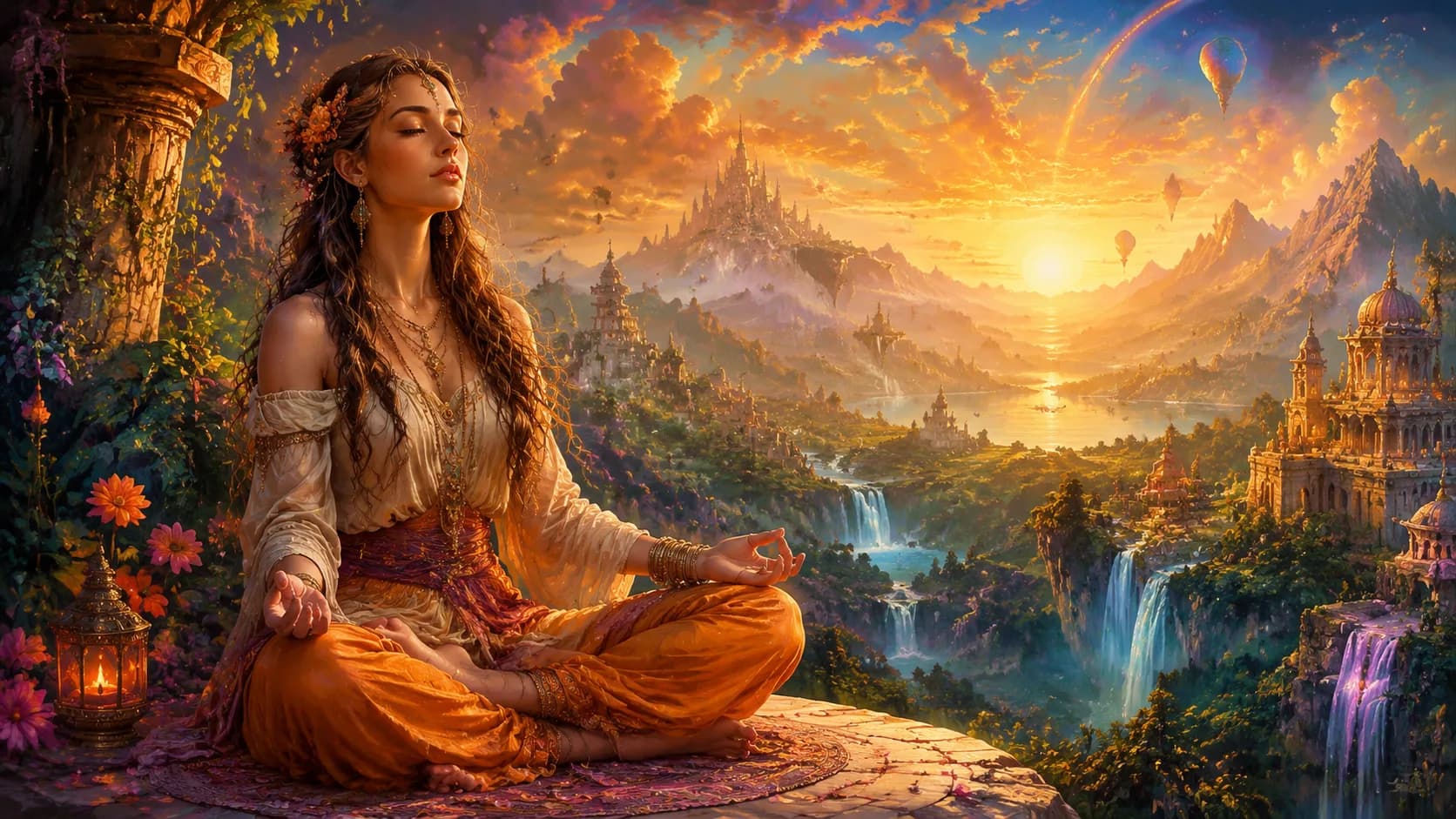
"The five phases of a visualization journey are basically the same as the five phases of a holiday: arrive somewhere beautiful, look around in wonder, explore everything fascinating, have a peak experience that makes you feel alive, and come home relaxed. Except the holiday takes 15 minutes, costs nothing, and you never lose your luggage."
An Epicurean, a Stoic, and a Cynic walk into a garden. The bartender says, 'Is this some kind of philosophical joke?'
Types of Visualization Journeys
Visualization journeys span a remarkably diverse range of settings, themes, and purposes. Understanding the major categories helps you choose experiences that match your current needs and interests. Each type engages slightly different neural systems and produces distinct benefits.
Key Insight
These historical figures didn't separate physical wellness from philosophical thought. To them, it was all one continuous practice of living well.
Historical visualization journeys transport you to reconstructed ancient environments walking through ancient Athens, exploring the streets of ancient Rome, or standing in an ancient Greek sanctuary. Based on archaeological research and historical scholarship, these journeys combine factual accuracy with immersive storytelling. They're particularly effective for engaging the brain's episodic memory system and stimulating intellectual curiosity alongside relaxation. The educational dimension adds meaning to the meditation, making it easier to maintain regular practice.
Mythological journeys immerse you in the worlds of ancient myths Mount Olympus and the Greek gods, Norse mythology's cosmic realms, or the hero's journey with Hercules. These journeys tap into archetypal psychology the deep symbolic patterns that Carl Jung identified as universal to human consciousness. Encountering mythological figures and landscapes activates the brain's meaning making systems, often producing profound insights about personal challenges and aspirations.
Nature visualization journeys place you in pristine natural environments ancient forests, sacred mountain summits, ocean shorelines, or wildflower meadows. Nature-based visualization leverages the well documented attention restoration theory the finding that natural environments effortlessly capture our attention in gentle ways that allow directed attention systems to recover. Even imagined nature exposure reduces cortisol levels and improves mood, according to research published in Environmental Psychology (2025).
Fantasy journeys transport you into imaginative realms enchanted castles, dragon inhabited landscapes, or fairy tale kingdoms. These journeys maximally engage the brain's creative networks because the environments have no real world constraints. They're excellent for stimulating divergent thinking, nurturing playfulness, and reconnecting adults with the imaginative freedom that characterised childhood. Fairy tales have shaped human imagination for millennia precisely because their archetypal structures speak directly to the unconscious mind.
Read more: How Story Worlds Improve Mental Relaxation
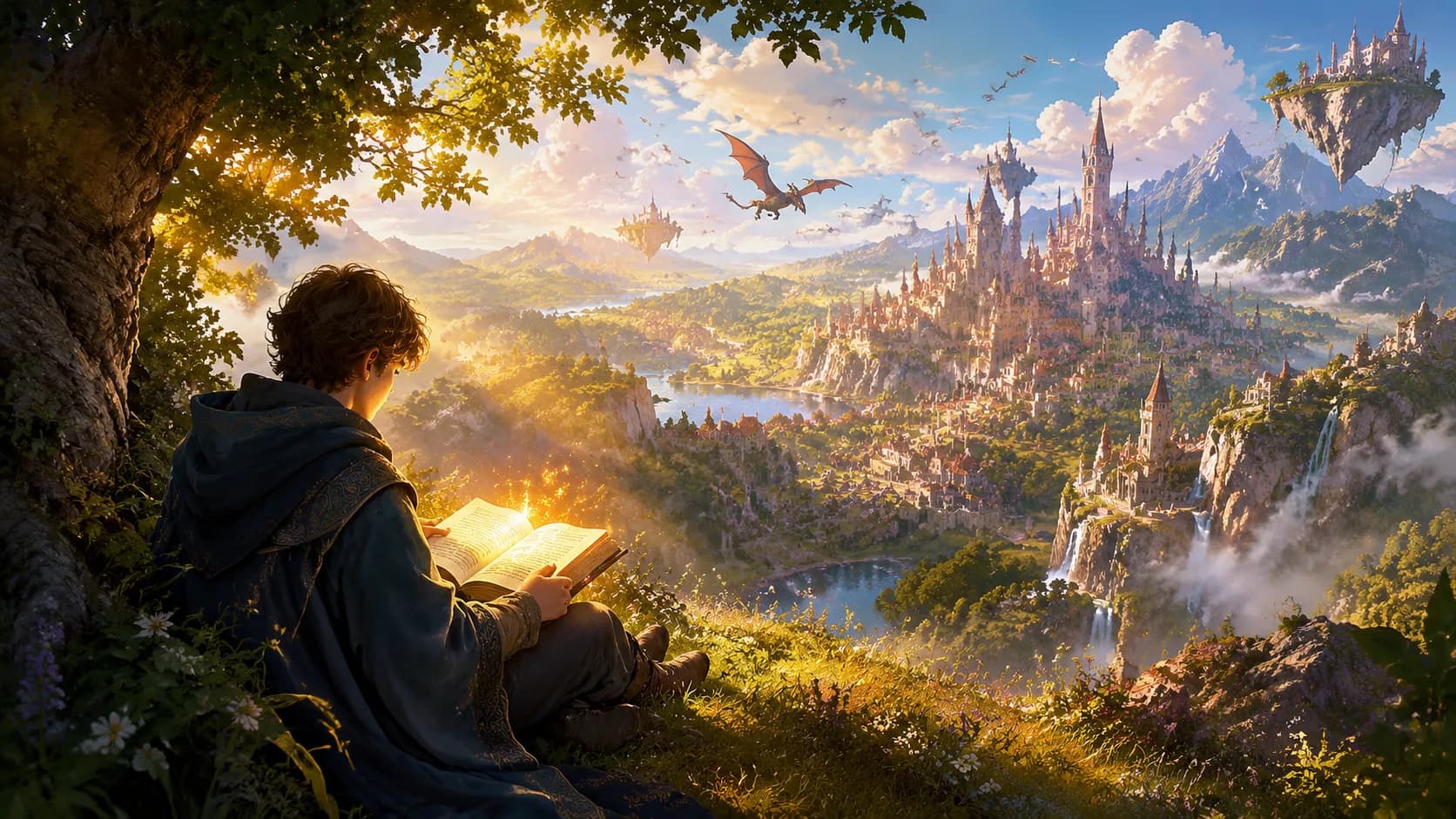
"Choosing a visualization journey type is like choosing a restaurant cuisine. Historical journeys are the thoughtful French bistro. Mythological journeys are the dramatic Italian opera of dining. Nature journeys are farm to table mindfulness. And fantasy journeys are the molecular gastronomy experience where everything is surprising, nothing is what it seems, and you leave with your imagination thoroughly expanded."
Why did the historian break up with the archaeologist? Because her career was literally in ruins.
Visualization Journeys vs Traditional Meditation
Understanding how visualization journeys compare to traditional meditation approaches helps you choose the right practice for your needs and appreciate what makes each approach unique. Neither is inherently superior they serve different purposes and engage different neural systems.
Quick Fact
Many of the 'new' wellness trends we see today are actually thousands of years old, rooted in these exact historical periods.
Traditional mindfulness meditation (vipassana, zazen, breath-focused practices) asks you to observe your present moment experience without attachment noticing thoughts, sensations, and emotions as they arise and pass. The goal is equanimity: a calm, non-reactive awareness. This approach primarily strengthens meta cognitive awareness (the ability to observe your own thinking) and emotional regulation through detached observation. It's powerful, but many beginners find it frustratingly abstract. "Watch your thoughts" sounds simple but feels impossibly difficult when your mind races with worries, plans, and mental chatter.
Visualization journeys take a fundamentally different approach. Rather than emptying the mind or observing it passively, they redirect the mind's natural storytelling tendency toward positive, engaging content. Instead of fighting the brain's inclination to generate images and narratives, visualization journeys harness that inclination. Your wandering mind becomes an asset rather than an obstacle. This makes visualization journeys significantly more accessible to beginners especially those struggling with screen saturated attention spans because the narrative provides natural focus without requiring disciplined concentration.
The benefits overlap substantially but with different emphases. Both approaches can help people feel less stressed and more at ease. However, visualization journeys excel atcreativity enhancement, imagination training, and encoding new perspectives (because you're actively building mental worlds), while traditional mindfulness excels at present moment awareness, non attachment, and pure equanimity. Many experienced practitioners incorporate both approaches, using story-based meditation for creative sessions and breath-focused practice for grounding.
"Traditional meditation says: 'Your mind is a pond. Let the ripples settle.' Visualization journeys say: 'Your mind is a pond. Let's go sailing on it.' Both approaches lead to calm water. One just involves a more interesting voyage."
A Roman walks into a bar, holds up two fingers, and says, 'Five beers, please.'
Benefits of Visualization Journeys
The benefits of regular visualization journey practice are extensive, well documented, and often begin within the first few sessions. Research from neuroscience, clinical psychology, and contemplative science converges on a consistent picture: directed imagination is one of the most powerful cognitive tools available for enhancing well-being.
Stress and anxiety reduction is the most immediately noticeable benefit. Visualization journeys can help your body relax while giving the mind absorbing content that may help interrupt spirals of worry. The narrative structure is key: because the brain experiences stories as reality, the peaceful scenarios in visualization journeys produce genuine physiological calm, not merely conceptual relaxation.
Visionaria Insight
By immersing ourselves in these historical soundscapes, we reconnect with a timeless human tradition of storytelling and mental restoration.
Enhanced creativity and problem solving is a major benefit that distinguishes visualization from other meditation forms. By regularly constructing elaborate mental environments, you strengthen the brain's capacity for divergent thinking the ability to generate novel ideas and see connections between seemingly unrelated concepts. The visualisation process "warms up" creative neural networks in the same way physical stretching prepares muscles for exercise.
Improved sleep qualityis another frequently reported benefit. Evening visualization journeys can help you wind down from an alert, busy state into the relaxed, drowsy calm that comes before sleep. The narrative content gives racing thoughts a gentle alternative focus, preventing the anxious rumination that commonly causes insomnia. Meditation for cognitive clarity and mental reset is particularly effective when combined with visualization techniques that create calm, safe environments in the mind's eye.
Additional documented benefits include enhanced emotional regulation (practising emotional responses in safe, imagined contexts builds real world resilience), improved working memory (the hippocampal engagement required for spatial visualization strengthens memory circuits), pain management (visualising comfort and relief engages the brain's endogenous analgesic systems), and increased empathy (imagining yourself in different environments and perspectives exercises the theory of mind network).
Regular visualization practice doesn't just feel good it produces measurable structural changes in the brain. Some small studies of eight-week mindfulness courses have reported changes in brain regions linked to memory and stress, though this research is early and has not looked at visualization journeys specifically. These changes persist even after stopping practice, suggesting that visualization journeys produce lasting neural upgrades.
Why did the historian break up with the archaeologist? Because her career was literally in ruins.
Who Can Benefit from Visualization Journeys?
One of the most remarkable aspects of visualization journeys is their universal accessibility. Unlike some meditation practices that require years of training to master, visualization taps into a capacity that every human being possesses: the ability to imagine. Whether you're a stressed professional, a creative artist, a student preparing for exams, or a parent seeking evening calm, visualization journeys adapt to your needs and capabilities.
Meditation beginners often find visualization journeys transformative precisely because they solve the most common complaint about meditation: "I can't stop thinking." Visualization doesn't ask you to stop thinking it asks you to think about something specific and beautiful. The narrative structure provides natural scaffolding for attention, making focus effortless rather than forced. Many people who "gave up" on meditation discover through visualization that they were never bad at meditating they simply needed a method that matched how their brain naturally works.
Creative professionals writers, designers, musicians, entrepreneurs benefit enormously because visualization strengthens the same neural circuits responsible for creative ideation. The practice of building detailed mental worlds exercises divergent thinking, associative reasoning, and spatial imagination. Many creatives report that their best ideas arrive during or immediately after visualization sessions, when the brain's creative networks are maximally primed.
Did You Know?
The relentless drive to understand the world was seen not just as an academic pursuit, but as a spiritual and healing practice by the ancients.
Students and knowledge workers benefit from the memory enhancement and focus strengthening effects. The hippocampal engagement required for spatial visualization directly supports academic memory. Additionally, the stress reduction benefits help manage exam anxiety, performance pressure, and the cognitive fatigue that comes from extended periods of concentrated study. Meditation for mental reset through visualization is particularly effective during intensive work periods.
Children and young people respond wonderfully to visualization journeys because their imaginations are naturally vivid and their neural plasticity is high. Age appropriate journeys help develop attention span, emotional processing, and creative confidence while providing calming bedtime routines.
"The beauty of visualization journeys is that they're the one meditation practice where having an overactive imagination isn't a problem it's a superpower. If your brain naturally generates vivid images, worries in high definition, and daydreams in surround sound, congratulations: you're already a visualization prodigy. You just need to point that talent somewhere beautiful."
Why did the Stoic cross the road? Because it was the rational thing to do, and he was indifferent to the traffic.
The Role of Spatial Audio in Visualization
While visualization journeys can be experienced with simple narration, the addition of spatial audio technology transforms them from guided imagery exercises into genuinely immersive experiences. Spatial (or 3D) audio creates the perception of sound coming from specific locations in three-dimensional space around your head footsteps approaching from behind, birdsong moving across the sky above, water flowing from left to right, a guide's voice positioned naturally in the acoustic environment. This technology, pioneered in gaming and cinema, has found its most meaningful application in interactive audio journeys designed for meditation and mindfulness.
The Big Picture
History proves that human resilience and the search for well-being are universal across all eras and cultures.
The neuroscience behind spatial audio's effectiveness is compelling. Your brain's auditory processing system is fundamentally spatial it evolved to locate sounds in the environment as a survival mechanism. When spatial audio places sounds at specific positions around you, your brain interprets this as evidence that you're actually in the described environment. This dramatically enhances the "presence" effect the subjective feeling of genuinely being somewhere other than your physical location. Spatial audio places sounds around you rather than only left and right, which may also draw on the brain's spatial processing the system that creates mental maps of environments.
When sounds come from different directions, your brain automatically constructs a spatial model of the imagined scene, making the visualization richer and more detailed without any additional effort on your part. You don't have to consciously imagine where the stream is the sound tells your brain where it is, and your visual imagination fills in the picture. This audio visual integration is precisely the mechanism that makes platforms like Visionaria so effective at creating experiences that feel genuinely transportive.

"Spatial audio is to visualization what seasoning is to cooking. You can have a perfectly good meal without it, but the right spices transform something nutritious into something transcendent. When a bird flies across your imagined sky from left to right and the sound actually moves across your head that's when your brain goes from 'I'm imagining a forest' to 'I am IN this forest.'"
Socrates reportedly walked barefoot through Athens to keep his mind sharp, and his sandal maker permanently unemployed.
Common Visualization Techniques Explained
Within the broad category of visualization journeys, several specific techniques stand out. Understanding these approaches helps you choose the right method for different situations and goals.
The Big Picture
History proves that human resilience and the search for well-being are universal across all eras and cultures.
Guided Scene Construction is the most common technique. A narrator describes an environment in progressive detail, and you build the scene in your mind as each element is introduced. This technique is ideal for beginners because it provides continuous scaffolding you're never left wondering "what should I imagine next?" The narrator's descriptions serve as architectural blueprints that your imagination fills with personal colour, detail, and emotional tone. Most guided visualization stories use this technique as their foundation.
Progressive Sensory Layering builds immersion by systematically engaging each sense in sequence. First you establish what you see, then add what you hear, then what you feel (temperature, texture, air movement), then what you smell. Each sensory layer recruits additional brain regions, creating a progressively richer internal experience. This technique is particularly effective for people who have strong auditory or kinesthetic processing rather than predominantly visual thinking.
Symbolic Encounter Visualization involves meeting meaningful figures, discovering symbolic objects, or witnessing significant events during the journey. Drawing on the hero's journey archetype, these encounters activate the brain's meaning making systems and often produce personal insights that feel spontaneous rather than directed. Meeting Athena in a temple of wisdom, for example, might evoke reflections on personal challenges that the conscious mind hadn't articulated.
Embodied Movement Visualization asks you to imagine yourself moving through space walking, climbing, crossing bridges, ascending stairs. This technique is uniquely powerful because it engages the motor cortex and vestibular system, creating a physical dimension to the meditation experience. Research shows that imagined movement produces genuine micro muscular activation and proprioceptive engagement, which deepens the sense of presence and enhances the overall benefits of the practice.
Perspective Shifting involves viewing the same scene from different vantage points first from ground level, then from above, then from within a specific object or space. This technique strengthens cognitive flexibility and is particularly valuable for people seeking enhanced creativity and problem solving abilities. By practising the ability to shift perspective in imagination, you strengthen the neural circuits responsible for seeing real world situations from multiple angles.
Why did the Stoic cross the road? Because it was the rational thing to do, and he was indifferent to the traffic.
How to Get the Most from Your Journey
While visualization journeys are inherently accessible, a few practical strategies can significantly enhance your experience and accelerate the benefits of regular practice.
Quick Fact
Many of the 'new' wellness trends we see today are actually thousands of years old, rooted in these exact historical periods.
"Getting the most from a visualization journey is like getting the most from a holiday: show up ready to be surprised, don't try to control every detail, wear comfortable clothes, and leave your phone in another room. The less effort you put into 'doing it right,' the more naturally the experience unfolds."
Why did the inventor of the wheel win an award? Because his idea really got things rolling.
Visualization Journeys in Ancient Traditions
While modern visualization journeys benefit from spatial audio technology and neuroscience research, the practice itself is ancient arguably as old as human consciousness. Every major contemplative tradition independently discovered that directed imagination is a powerful pathway to transformation, and their methods prefigure contemporary visualization with remarkable precision.
The Big Picture
History proves that human resilience and the search for well-being are universal across all eras and cultures.
In Buddhist Vajrayana tradition, practitioners have used deity visualization for over 1,500 years constructing elaborate mental images of enlightened beings within mandala palaces, engaging all senses, and maintaining these visualisations for extended periods. Tibetan Buddhist meditation manuals describe techniques almost identical to modern guided visualization: progressive sensory establishment, emotional engagement with the visualised scene, and structured integration upon completion. The sophistication of these practices demonstrates that the ancient contemplative traditions understood, through experiential knowledge, what neuroscience now confirms through brain imaging.
The ancient Greeks practised what they called phantasia (from which we derive "fantasy" and "imagination") the deliberate cultivation of mental imagery for philosophical insight, emotional regulation, and creative inspiration. The Stoic philosophers developed mental time travel techniques they called premeditatio malorum and premeditatio bonorum visualising future scenarios to prepare emotionally for challenges and cultivate gratitude. Plato's famous Allegory of the Cave is itself a visualization journey designed to shift the reader's perspective from surface appearances to deeper reality.
Hindu meditation traditions include dhyana practices involving elaborate visualization of deities, sacred landscapes, and chakra systems. The Yoga Sutras of Patanjali describe dharana (concentration on a visualised object) and dhyana (sustained flow of imagery) as essential stages of the meditative path. Aboriginal Australian Dreamtime traditions use narrative visualization journeys to connect with ancestral landscapes, reinforcing cultural knowledge and spiritual connection through vivid, story-based mental imagery that has been transmitted orally for over 60,000 years.
The convergence of these independent traditions confirms a fundamental truth about human cognition: the mind is designed to be transformed through directed imagination. Modern visualization journeys don't invent something new they apply contemporary understanding and technology to a practice as old as human consciousness, making the benefits of ancient contemplative wisdom accessible to anyone with headphones and fifteen minutes.
"Humans have been doing visualization journeys for at least 60,000 years we just called them 'stories told around the fire,' 'temple meditations,' 'philosophical exercises,' and 'Dreamtime.' What's new isn't the practice. What's new is that we finally understand why it works (neuroscience) and can deliver it through headphones instead of requiring a cave in Tibet. Progress."
Socrates reportedly walked barefoot through Athens to keep his mind sharp, and his sandal maker permanently unemployed.
The Future of Visualization Journeys
We are witnessing the emergence of a new era in contemplative practice one where ancient wisdom meets cutting edge technology to create experiences that previous generations could only dream about. The future of visualization journeys is being shaped by several converging developments that promise to make the practice more immersive, more personalised, and more widely beneficial than ever before.
Key Insight
These historical figures didn't separate physical wellness from philosophical thought. To them, it was all one continuous practice of living well.
Spatial audio technology continues to advance rapidly. Next generation head tracking algorithms, personalised head-related transfer functions (HRTFs), and higher resolution audio processing will make the three-dimensional soundscapes in visualization journeys even more convincingly realistic. The gap between "listening to a journey" and "being in a place" will narrow to the point where the brain can barely distinguish between them. Platforms like Visionaria are part of this evolution, combining archaeological research, narrative visualization design, and spatial audio engineering to create experiences that are both historically grounded and genuinely transporting.
Personalised journey design represents another frontier. Machine learning algorithms that understand individual preferences, emotional patterns, and visualization strengths can curate journeys tailored to each person's specific needs and imagination style. Someone who responds strongly to nature imagery might receive more forest and mountain journeys, while someone drawn to mythological quest narratives would be directed toward epic adventure experiences. This personalisation will make visualisation meditation more effective for more people.
The integration of biometric feedback (heart rate, skin conductance, breathing patterns) with journey delivery will enable adaptive experiences that respond in real time to your physiological state. If your heart rate indicates rising stress, the journey might automatically guide you to a calmer scene. If your breathing deepens and your body relaxes, the narrative might introduce more complex, stimulating imagery. This creates a feedback loop between technology and consciousness that optimises every session.
Perhaps most excitingly, visualization journeys are beginning to be validated in clinical settings for specific therapeutic applications anxiety management, sleep disorders, chronic pain, PTSD recovery, and cognitive rehabilitation. As the evidence base grows, visualization meditation is likely to become a recommended complement to traditional therapeutic approaches, prescribed by healthcare professionals alongside conventional treatments. The ancient practice of guided imagery, enhanced by modern technology, is becoming recognised as a legitimate clinical tool.
"The future of visualization journeys looks remarkably like the present of science fiction: personalised, adaptive, immersive experiences that respond to your brain in real time. Except instead of fighting aliens, you're exploring ancient temples and finding inner peace. Which, frankly, seems like a much better use of the technology."
Meditation for Curiosity and Exploration
Discover how meditation for curiosity and exploration cultivates wonder, open awareness, and the explorer's mindset, from beginner's mind techniques and guided discovery to narrative audio journeys, spatial 3D soundsca...
A philosopher walked into a wall. His students asked if it hurt. He replied, 'The wall is an illusion, but my headache is quite real.'
The Bottom Line
You've learned about visualization journeys guided meditation experiences that use narrative storytelling, descriptive sensory prompts, and spatial audio technology to create vivid mental experiences that produce genuine physiological and psychological benefits.
This article covered the neuroscience behind why visualization works (embodied simulation, default mode network redirection, narrative transportation), the different types of journeys available (historical, mythological, nature, fantasy), the extensive research-backed benefits (stress reduction, creativity enhancement, sleep improvement, emotional regulation), practical tips for maximising each session, the ancient roots of the practice, and how modern technology is transforming this timeless technique into something more powerful than ever.
Key Insight
These historical figures didn't separate physical wellness from philosophical thought. To them, it was all one continuous practice of living well.
To experience a visualization journey yourself, download the Visionaria app and start with a 12-15 minute journey. Popular starting points include historical journeys through ancient Athens, mythological adventures with the Olympian gods, and nature experiences through sacred mountain landscapes.
"Remember: your imagination is the most sophisticated virtual reality system ever created it's been in development for 200,000 years, it's completely personalised to your preferences, and it runs on nothing but headphones and willingness. The ancient Greeks knew this. The Buddhists knew this. Now neuroscience confirms it. All that's left is for you to press play."
Experience More with Visionaria
Download the app to explore guided historical and wellness journeys.
Why did the historian break up with the archaeologist? Because her career was literally in ruins.
This article is for educational and informational purposes only. Historical details are based on available research and may evolve as new evidence emerges.
Visionaria journeys are designed for relaxation, guided imagination, and personal enrichment. They are not a substitute for medical, mental health, legal, or professional advice.