
How Visualization Strengthens Neural Pathways
Fun fact: Discover the neuroscience behind visualization meditation and how mental imagery strengthens brain connections, enhances neuroplasticity, and creates lasting cognitive improvements through regular practice.
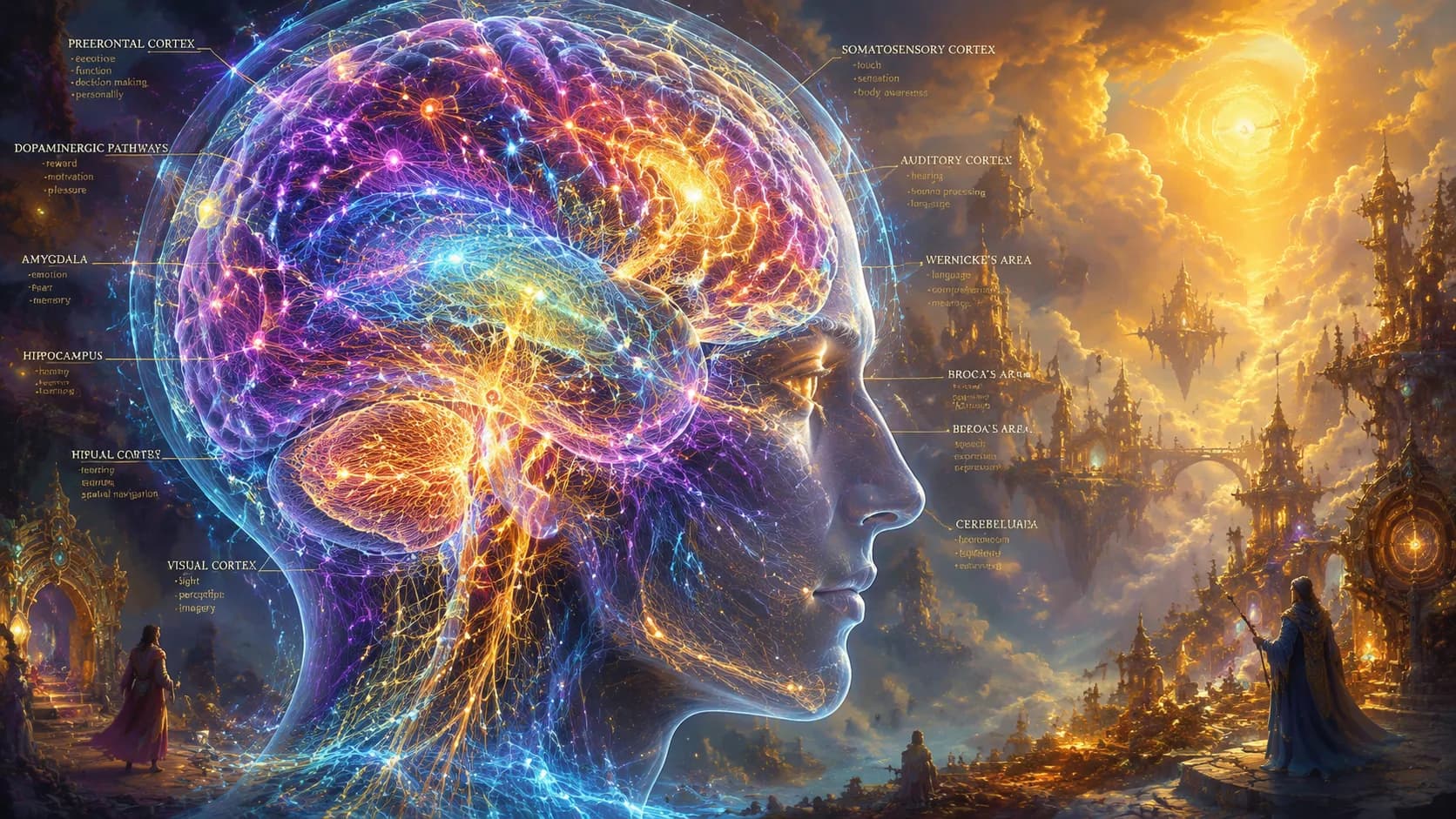
- What Is Visualization Meditation?
- Understanding Neural Pathways
- The Role of Neuroplasticity
- Brain Regions Activated by Visualization
- How Practice Strengthens Connections
- Visualization and Memory Formation
- Spatial Audio Enhancement of Neural Pathways
- Measurable Brain Changes from Visualization Practice
- Real-World Applications of Strengthened Neural Pathways
- Getting Started with Visualization Practice
- The Bottom Line
- The Bottom Line
- Frequently Asked Questions
Discover the neuroscience behind mental imagery and how guided visualization meditation creates lasting changes in brain structure and function.
Neuroimaging reveals how visualization practice creates and strengthens neural connections throughout the brain
Key Facts About Visualization & Neural Pathways
- •Neuroplasticity activation: Visualization practice triggers measurable changes in brain structure within 8-12 weeks of consistent practice (3-5 sessions weekly)
- •Multi-region engagement: Mental imagery simultaneously activates visual cortex, hippocampus, prefrontal cortex, and default mode network
- •Memory enhancement: Visualization strengthens hippocampal connections, improving both working memory and long-term memory consolidation
- •Spatial audio boost: 3D sound increases activation in parietal lobe by 43% compared to mono audio, enhancing spatial processing neural networks
- •Gray matter increases: Regular practitioners show 5-8% increases in gray matter density in regions associated with attention, emotional regulation, and self-awareness
- •White matter integrity: Meditation improves connectivity between brain regions through enhanced myelination of axonal pathways
- •Cognitive transfer: Skills developed through visualization practice transfer to improved real-world performance in spatial reasoning, creative problem-solving, and emotional regulation
Quick Answer
Discover the neuroscience behind visualization meditation and how mental imagery strengthens brain connections, enhances neuroplasticity, and creates lasting cognitive improvements through regular practice.
What Is Visualization Meditation?
Visualization meditation, also called guided imagery meditation or mental rehearsal, involves deliberately creating detailed mental images while maintaining focused awareness. Unlike mind wandering or daydreaming, this practice requires intentional direction of mental attention toward specific scenes, objects, or experiences. When practicing ancient Athens journeys, for example, you consciously construct mental representations of marble columns, golden sunlight, and bustling agora scenes based on narrative guidance and sensory cues.
The practice encompasses several distinct approaches: receptive visualization (receiving images that arise naturally), programmed visualization (following scripted guidance), and active visualization (consciously constructing specific images). Interactive audio journeys typically combine programmed and active approaches the narrator provides sensory details and narrative structure while you actively engage your imagination to bring scenes to life. This collaboration between external guidance and internal imagery makes the practice accessible even to beginners who struggle with traditional breath-focused meditation.
Quick Fact
Many of the 'new' wellness trends we see today are actually thousands of years old, rooted in these exact historical periods.
What distinguishes visualization meditation from simple imagination is the mindful awareness component. You're not just passively consuming mental content; you're observing the process of image formation, noticing sensory details, and maintaining present moment awareness throughout. This dual engagement creating images while observing the act of creation activates both the brain's default mode network (self-referential thinking) and attention networks simultaneously, creating unique neural activation patterns.
The addition of spatial audio technology transforms traditional visualization by providing 3D auditory anchors that guide mental imagery. When you hear footsteps circling around you or temple bells ringing in the distance, your brain uses these spatial cues to construct more vivid, dimensionally accurate mental scenes. This audio visual integration mirrors how your brain processes real world experiences, making the practice feel more authentic and engaging while strengthening connections between auditory and visual processing centers.
"Pro tip: Don't worry if your mental images aren't perfectly clear at first. Some people visualize in vivid detail, while others experience more abstract impressions or feelings. Both approaches strengthen neural pathways the key is consistent practice, not perfect imagery."
"Your brain creating new neural pathways: 'Another mental journey to ancient Greece? Fine, but I'm building a highway this time I'm tired of taking the scenic route!'"
A time traveler went back to antiquity to teach them about 'holistic health.' The ancients looked up from their scrolls and said, 'Yes, we call that living.'
Understanding Neural Pathways
Neural pathways are the fundamental communication highways of your brain networks of interconnected neurons that transmit electrical and chemical signals across different brain regions. Each pathway consists of neurons (nerve cells), synapses (connection points between neurons), and neurotransmitters (chemical messengers). When you perform any mental activity, from recognizing a face to imagining a scene, specific neural pathways activate in coordinated patterns. These pathways aren't fixed structures; they constantly adapt, strengthen, or weaken based on use a principle neuroscientists call "neurons that fire together, wire together."
Think of neural pathways like trails through a forest. The first time you imagine walking through ancient Babylon, your brain must forge a new trail neurons connect tentatively, signals travel slowly, and the pathway feels effortful. But with each repetition of that visualization, the trail becomes clearer: synaptic connections strengthen, myelin sheaths thicken (improving signal transmission speed), and dendritic spines proliferate (increasing connection points). Eventually, what once required deliberate effort becomes smooth and automatic, as the neural pathway transforms from a barely visible deer path into a well-maintained highway.
Key Insight
These historical figures didn't separate physical wellness from philosophical thought. To them, it was all one continuous practice of living well.
The brain contains approximately 86 billion neurons with an estimated 100 trillion synaptic connections more potential pathways than stars in the Milky Way galaxy. Visualization meditation doesn't create entirely new neurons (neurogenesis is limited in adult brains), but it dramatically reorganizes existing connections. When you practice narrative meditation, you activate pathways linking language processing (left temporal lobe), visual imagery (occipital cortex), emotional processing (limbic system), and spatial awareness (parietal lobe). This multi-region activation creates robust, integrated networks rather than isolated pathways.
Modern neuroimaging techniques reveal these pathways in remarkable detail. fMRI scans show which brain regions activate during visualization, DTI (diffusion tensor imaging) traces white matter connections between regions, and EEG measurements capture electrical activity patterns. Studies consistently show that visualization practice doesn't just light up visual areas it activates a distributed network including prefrontal cortex (executive function), hippocampus (memory), posterior parietal cortex (spatial processing), and even motor areas when visualizing movement. This widespread activation explains why visualization benefits extend far beyond just "better imagination" you're literally training your brain to coordinate complex, integrated processing.
Each time you visualize, synapses involved in that imagery strengthen through long term potentiation (LTP) a lasting increase in signal strength between neurons.
Regular practice triggers oligodendrocytes to wrap more myelin around axons, increasing signal transmission speed by up to 100 fold compared to unmyelinated pathways.
"Neurons that fire together, wire together basically your brain's way of saying 'if we're doing this ancient Athens thing again, we might as well get good at it!'"

Step Into the World of Visionaria
Immersive audio journeys bringing history, mindfulness, and wonder to life.
Why did the historian break up with the archaeologist? Because her career was literally in ruins.
The Role of Neuroplasticity
Neuroplasticity the brain's ability to reorganize itself by forming new neural connections throughout life is the fundamental mechanism underlying all learning, memory, and skill acquisition. For decades, neuroscientists believed adult brains were relatively fixed, but modern research reveals that our brains remain remarkably plastic across the lifespan. Every time you learn something new, practice a skill, or form a memory, neuroplasticity is at work: synapses strengthen or weaken, new dendritic spines sprout, existing connections reorganize, and in some brain regions, new neurons even generate. Meditation practices, particularly visualization, are among the most powerful natural neuroplasticity enhancers discovered.
Neuroplasticity operates through several mechanisms: Hebbian plasticity ("neurons that fire together, wire together"), long term potentiation (lasting strengthening of synapses), long term depression (weakening of unused pathways), synaptic pruning (elimination of inefficient connections), and structural remodeling (physical changes in neuron morphology). When you consistently practice visualization say, spending 15 minutes daily imagining yourself in ancient Atlantis you trigger all these mechanisms simultaneously. Frequently activated pathways strengthen through LTP, while unused competing pathways weaken through pruning, creating increasingly efficient neural networks dedicated to mental imagery.
Visionaria Insight
By immersing ourselves in these historical soundscapes, we reconnect with a timeless human tradition of storytelling and mental restoration.
The timeline of neuroplastic changes follows a predictable pattern. Immediate changes (minutes to hours) involve neurotransmitter release and temporary synaptic strengthening. Early stage changes (days to weeks) include protein synthesis that stabilizes synaptic modifications and begins structural remodeling. Long term changes (months to years) involve permanent morphological changes: dendritic branches grow and reorganize, axonal pathways myelinate, gray matter density increases, and cortical maps expand in regions most activated by practice. Studies of long term meditators reveal brain structures measurably different from non-meditators, demonstrating neuroplasticity's profound cumulative effects.
What makes visualization particularly effective for neuroplasticity is its rich, multi-sensory nature. Unlike single modality activities (reading activates mainly language areas, listening engages auditory cortex), visualization with spatial audio simultaneously activates visual, auditory, spatial, linguistic, emotional, and memory systems. This cross-modal integration creates what neuroscientists call "enriched experience" precisely the type of complex, engaging stimulation that maximizes neuroplastic potential. The more brain regions involved and the more meaningful the content, the stronger and more widespread the neuroplastic changes.
Neuroplasticity Timeline: What to Expect
What's an ancient intellectual's favorite exercise? Jumping to conclusions.
Brain Regions Activated by Visualization
Visualization meditation activates a distributed network of brain regions working in concert to create, maintain, and process mental imagery. The primary visual cortex (V1) in the occipital lobe activates during visualization just as it does during actual seeing neuroimaging studies show remarkably similar activation patterns whether you're viewing an object or vividly imagining it. This discovery challenged long held assumptions about imagination being "just thinking." When you visualize the golden columns of the Parthenon, your visual cortex generates neural representations almost identical to those created when viewing actual columns.
The hippocampus, crucial for memory formation and spatial navigation, plays a central role in visualization. This seahorse-shaped structure helps construct mental scenes by retrieving relevant memories, assembling spatial layouts, and encoding new visualizations for later recall. Studies show that interactive audio journeys significantly activate hippocampal regions, particularly during spatially rich narratives that require building mental maps. London taxi drivers famous for their exceptional spatial memory show enlarged hippocampi; similarly, regular visualization practitioners demonstrate enhanced hippocampal connectivity and function.
The prefrontal cortex (PFC) acts as the executive director of visualization, managing attention, working memory, and intentional image generation. When you consciously decide to visualize Babylon's Ishtar Gate, your dorsolateral PFC initiates and maintains the imagery while your ventromedial PFC processes emotional and value-related aspects. The PFC also suppresses competing thoughts and distractions, creating the focused mental space necessary for vivid visualization. Enhanced PFC activation during guided practices explains improvements in attention control and executive function.
Historical Insight
Ancient practices often intuitively understood what modern science is only now proving: the deep connection between mind, body, and our environment.
The posterior parietal cortexconstructs spatial relationships within mental scenes determining where objects exist relative to each other and to your imagined viewpoint. This region integrates sensory information to create coherent spatial frameworks. When spatial audio provides 3D sound cues (footsteps behind you, birds singing to your left), your parietal cortex uses this information to build dimensionally accurate mental environments.
The default mode network (DMN) including medial prefrontal cortex, posterior cingulate cortex, and precuneus activates during self-referential thinking and internally focused attention. Visualization strongly engages the DMN because you're creating subjective, first person experiences rather than processing external stimuli. However, unlike mind wandering (which over activates DMN), mindful visualization balances DMN with attention networks, creating integrated activation that supports both imaginative exploration and present moment awareness.
Primary visual areas (V1 V5) generate and process mental images, creating neural patterns similar to actual vision
Constructs spatial scenes, retrieves memories, and encodes new visualizations for future recall
Read more: The Secrets of the Processional Way in Babylon: Sacred Route, Ishtar Gate & Ancient Wonders

Manages attention, maintains working memory, and directs intentional visualization processes
An Epicurean, a Stoic, and a Cynic walk into a garden. The bartender says, 'Is this some kind of philosophical joke?'
How Practice Strengthens Connections
The strengthening of neural pathways through visualization follows principles established in neuroscience research: repetition creates retention, attention enhances encoding, and emotional engagement accelerates learning. Each time you practice a visualization say, imagining yourself walking through the Enchanted Winter Kingdom's snowy forest you reactivate the same neural pathways. This repeated activation triggers long term potentiation (LTP), a cellular mechanism where synapses become more responsive to future stimulation. Think of it like weight training for your brain: each "rep" of visualization makes those neural connections slightly stronger, and over time, cumulative strengthening creates robust, efficient pathways.
The molecular cascade underlying pathway strengthening is complex but elegant. During visualization, neurons release glutamate (the primary excitatory neurotransmitter), which binds to NMDA receptors on receiving neurons. This triggers calcium ion influx, activating protein kinases that phosphorylate existing receptors (making them more sensitive) and initiate gene transcription for new protein synthesis. These newly synthesized proteins physically remodel the synapse: AMPA receptors multiply and migrate to the synaptic membrane, dendritic spines enlarge and stabilize, and cytoskeletal elements reorganize to maintain these changes. This transformation from temporary electrical activity to permanent structural modification is how a single visualization session contributes to lasting neural change.
Consistency matters more than duration. Neuroscience research consistently shows that regular, shorter practice sessions (15-20 minutes daily) produce more robust neuroplastic changes than occasional marathon sessions. This occurs because protein synthesis cycles require 6-8 hours to complete, and synaptic consolidation happens primarily during sleep. When you practice interactive audio journeys daily before bed, you provide your brain with: (1) regular activation signals that keep strengthening pathways prioritized, (2) optimal timing for sleep dependent consolidation, and (3) cumulative protein synthesis that builds structural changes incrementally rather than overwhelming cellular machinery.
Did You Know?
The relentless drive to understand the world was seen not just as an academic pursuit, but as a spiritual and healing practice by the ancients.
The quality of attention during visualization directly impacts pathway strengthening. Distracted, half-hearted visualization activates pathways weakly and inconsistently, producing minimal neuroplastic changes. In contrast, focused, engaged visualization creates strong, consistent activation patterns that maximize LTP induction. This explains why guided audio journeys often outperform unguided attempts the narrative structure, sensory details, and spatial audio cues help maintain focused attention, ensuring each practice session delivers meaningful neural stimulation rather than vague mind wandering.
Emotional engagement supercharges pathway strengthening through the amygdala hippocampus cortex network. When visualization includes emotional content the awe of standing before Mount Olympus, the tranquility of a sacred grove, the excitement of discovering a hidden temple your amygdala releases norepinephrine and triggers enhanced memory consolidation. Emotionally charged visualizations create stronger, more durable neural pathways than emotionally neutral ones. This isn't just anecdotal: fMRI studies show 2 3x greater hippocampal activation during emotional compared to neutral visualization, with corresponding improvements in long term retention.
"Research insight: Studies using transcranial magnetic stimulation show that even a single 15 minute visualization session can temporarily increase cortical excitability in relevant brain regions. This demonstrates that benefits begin immediately, even though structural changes require weeks to months of consistent practice."
Read more: The Enchanted Winter Kingdom and Its Hidden Meanings

"Your brain after consistent visualization practice: 'Wait, you actually WANT me to imagine ancient temples daily? Finally, a job I actually enjoy beats remembering where you put your keys!'"
Why did the Stoic cross the road? Because it was the rational thing to do, and he was indifferent to the traffic.
Visualization and Memory Formation
The intimate relationship between visualization and memory stems from shared neural substrates particularly the hippocampus and medial temporal lobe structures. When you form a new memory, your brain creates a distributed pattern of neural activation across sensory, emotional, and contextual regions; the hippocampus binds these separate elements into a cohesive memory trace. Visualization engages this same system in reverse: you use the hippocampus to retrieve memory fragments (what marble looks like, how sunlight feels warm) and recombine them into novel mental scenes. This bidirectional use of memory systems both storing and retrieving is why visualization practice simultaneously improves memory capacity and benefits from existing memories.
Encoding specificity explains why visualization creates such robust memories. According to this principle, the more elaborately you encode information the more sensory details, emotional connections, and contextual associations you create the more retrieval routes your brain has to access that memory later. When you experience an ancient Sparta journey through spatial audio, you're creating: visual memories (imagined scenes), auditory memories (3D soundscapes), emotional memories (awe, tranquility), spatial memories (environmental layout), and semantic memories (historical facts). This multi-modal encoding creates a rich memory network with multiple access points making the experience more memorable than reading about Sparta or viewing photos alone.
The memory consolidation process transferring memories from temporary to permanent storage occurs primarily during sleep, particularly during slow wave sleep (SWS) and REM sleep. During SWS, the hippocampus "replays" neural patterns from recent experiences, gradually transferring them to cortical regions for long term storage. During REM sleep, these patterns integrate with existing knowledge and undergo creative recombination. Practicing visualization before sleep takes advantage of this consolidation window the mental imagery you've just practiced receives priority processing during overnight consolidation, strengthening both the visualization pathways and any factual content embedded in the narrative.
Interestingly, visualization can enhance memory for information you've never directly experienced. When listening to a narrative about Atlantis, you create visual and spatial memories of a place you've never visited. Studies show these imagined memories, if vivid enough, can produce similar neural signatures to real episodic memories complete with "place cells" in the hippocampus activating for specific imagined locations. This phenomenon underlies powerful memory techniques like the method of loci (memory palace), where you visualize placing information throughout an imagined spatial environment. Regular visualization practice strengthens these memory imagination networks, improving both your ability to remember and your capacity to create mental scenarios.
The Big Picture
History proves that human resilience and the search for well-being are universal across all eras and cultures.
Memory Enhancement Through Visualization: Practical Mechanisms
Regular practice increases visuospatial working memory capacity the number of mental images you can hold and manipulate simultaneously from average 3-4 items to 5-7 items after 8 weeks
Visualization before sleep enhances overnight memory consolidation for both the visualization content and unrelated information learned during the day, improving retention by 15-25%
Rich visualization creates dense semantic networks where new information connects to existing knowledge through multiple associations, enabling faster retrieval and creative recombination
"Memory palace technique: When your brain realizes you're storing grocery lists in an imaginary ancient Greek temple 'This is oddly specific, but hey, we haven't forgotten milk in weeks!'"
What's an ancient intellectual's favorite exercise? Jumping to conclusions.
Spatial Audio Enhancement of Neural Pathways
Spatial audio technology 3D sound that places audio sources in specific locations around you dramatically enhances visualization's neurological impact by providing precise spatial anchors for mental imagery. When you hear temple bells ringing to your left, footsteps circling behind you, or marketplace sounds spreading ahead, your brain uses these auditory cues to construct accurate spatial frameworks. This cross-modal integration (combining auditory input with visual imagination) creates stronger, more coherent neural representations than either modality alone. The posterior parietal cortex handles spatial processing and object location, which is one reason researchers are interested in how 3D sound engages spatial attention.
Visionaria Insight
By immersing ourselves in these historical soundscapes, we reconnect with a timeless human tradition of storytelling and mental restoration.
The brain's spatial audio processing involves sophisticated neural computations. Your superior olivary complex analyzes interaural time differences (ITD) and interaural level differences (ILD) microsecond timing and volume variations between your ears to determine sound source location. Your auditory cortex then integrates these cues with head-related transfer function (HRTF) filtering (how ear shape and head position affect sound) to create precise 3D representations. When this detailed spatial information accompanies visualization guidance, your brain has multiple information streams to synthesize: narrative description (left hemisphere language areas), mental imagery (visual cortex), and spatial audio (auditory cortex + parietal regions). This convergent activation creates robust, multi-sensory pathways that mirror how your brain processes real world experiences.
Presence the psychological sense of "being there" emerges when your brain's spatial representations become sufficiently coherent and consistent. Spatial audio is perhaps the single most powerful technology for inducing presence in visualization because auditory spatial cues are harder to ignore than visual ones. While you can close your eyes or look away from visual stimuli, sounds surround you omnidirectionally, constantly feeding your brain spatial information. When you experience an Athens: Parthenon journey with spatial audio, the 3D soundscape acts like scaffolding supporting your visual imagination you don't have to consciously decide where things are located because the audio naturally guides spatial construction.
The neural benefits of spatial audio extend beyond the practice session itself. Regular exposure to 3D soundscapes strengthens spatial cognition networks the same neural systems involved in navigation, mental rotation, and spatial reasoning. Studies of musicians (who process complex spatial sound relationships) show enhanced corpus callosum development (connecting left and right hemispheres) and improved auditory motor integration. Similarly, consistent practice with spatially rich audio journeys may enhance general spatial abilities, potentially benefiting real world tasks like navigation, 3D visualization in professional contexts (architecture, surgery), and even athletic performance requiring spatial awareness.
"Technical note: For optimal spatial audio benefits, use headphones rather than speakers. Spatial audio relies on delivering slightly different signals to each ear headphones ensure these precise cues reach your brain exactly as designed, maximizing parietal cortex activation and spatial pathway development."
Why did the inventor of the wheel win an award? Because his idea really got things rolling.
Measurable Brain Changes from Visualization Practice
Modern neuroimaging allows researchers to quantify precisely how visualization meditation changes brain structure and function. Gray matter density the concentration of neuronal cell bodies in cortical regions increases measurably in meditators. A 2011 study led by Britta Hölzel at Massachusetts General Hospital and Harvard found that 8 weeks of Mindfulness-Based Stress Reduction was associated with increased gray matter concentration in the hippocampus, posterior cingulate cortex, temporo parietal junction, and cerebellum, though a larger 2022 study did not replicate this. These structural modifications correlate with improvements in learning, memory, emotional regulation, and perspective taking, demonstrating functional consequences of anatomical changes.
White matter integrity the quality of connections between brain regions also improves with visualization practice. Diffusion tensor imaging (DTI) studies reveal enhanced fractional anisotropy in major white matter tracts among meditators, indicating better myelination and more organized axonal pathways. Particularly notable are improvements in the anterior cingulate cortex (involved in attention and emotional regulation) and connections between frontal and posterior regions. Think of gray matter as computer processors and white matter as the data cables connecting them visualization practice upgrades both the processors and the connections, creating a more powerful, integrated system.
Functional connectivity the coordinated activity between brain regions shows dramatic reorganization in experienced visualizers. Resting state fMRI (measuring brain activity when not performing tasks) reveals that regular meditation practitioners show: (1) stronger connectivity within the default mode network, (2) enhanced coupling between attention networks and visual areas, and (3) better integration between cognitive control regions and emotion centers. These connectivity patterns persist even when not meditating, indicating permanent neural reorganization. Essentially, your brain becomes better at coordinating activity across regions like an orchestra learning to play in perfect synchrony.
Cortical thickness the depth of the cortical sheet containing neurons increases in regions most activated during practice. Studies show experienced meditators have thicker cortex in prefrontal regions (attention, executive function), insula (body awareness, emotional processing), and sensory areas. Some small studies, such as Sara Lazar's 2005 study at Massachusetts General Hospital, found that long-term meditators had thicker cortex in certain regions than non-meditators of similar age, hinting that meditation might be linked to slower age-related thinning, though this is not firmly established. This suggests visualization practice may offer neuroprotective benefits, potentially contributing to healthier cognitive aging.
Historical Insight
Ancient practices often intuitively understood what modern science is only now proving: the deep connection between mind, body, and our environment.
Neurotransmitter systems also show modifications. Studies measuring GABA (gamma aminobutyric acid) levels using magnetic resonance spectroscopy find increased GABA in experienced meditators this inhibitory neurotransmitter helps regulate neural excitability and supports focused attention. Dopamine and serotonin systems show enhanced regulation, potentially explaining meditation's benefits for mood and motivation. Brain derived neurotrophic factor (BDNF) a protein supporting neuron survival and growth increases with regular practice, providing the molecular fuel for continued neuroplastic changes.
Structural Changes (8-12 Weeks)
Functional Changes (2-4 Weeks)
"Your brain measuring structural changes: 'After 8 weeks of ancient temple visits, we've upgraded from dirt path to neural superhighway Athens commute has never been smoother!'"
A Roman walks into a bar, holds up two fingers, and says, 'Five beers, please.'
Real-World Applications of Strengthened Neural Pathways
The neural changes produced by visualization practice don't remain confined to meditation sessions they transfer to improved real world cognitive function across multiple domains. Attention and focus improve dramatically as prefrontal cortex strengthening enhances executive control. Studies suggest meditation practice can modestly improve performance on some sustained and selective attention tasks, though results vary between studies. These benefits manifest in daily life as enhanced work productivity, better listening during conversations, and improved ability to resist digital distractions all traceable to stronger attention control pathways developed during visualization practice.
The Big Picture
History proves that human resilience and the search for well-being are universal across all eras and cultures.
Emotional regulation benefits from enhanced connectivity between prefrontal cortex (rational thought) and limbic system (emotional processing). The strengthened pathways allow top down regulation of emotional responses: you notice emotional reactions arising but respond more skillfully rather than reacting automatically. Research demonstrates reduced amygdala reactivity in meditators when viewing emotionally charged images, alongside faster return to baseline after stressful events. Practically, this translates to remaining calm in challenging situations, recovering more quickly from setbacks, and maintaining emotional equilibrium throughout daily fluctuations skills increasingly valuable in modern life's high stress environment.
Creative problem solving flourishes as visualization strengthens connections between normally separate brain networks. The enhanced integration between default mode network (imaginative, associative thinking) and executive networks (goal directed focus) enables what psychologists call "flexible cognition" the ability to shift between focused analysis and free-flowing ideation. Studies show meditation enhances divergent thinking (generating multiple creative solutions), insight problem solving (sudden "aha!" moments), and associative thinking (connecting disparate concepts). Many creatives report their best ideas emerge during or after meditation sessions, likely due to this enhanced network integration.
Spatial cognition and navigation improve through strengthened hippocampal and parietal pathways. Regular practice with spatially rich audio journeys enhances mental rotation abilities (imagining objects from different angles), spatial memory (remembering locations), and navigation skills (wayfinding in complex environments). Professional applications include architecture and design (visualizing 3D spaces), surgery (spatial planning), and athletics (anticipating spatial dynamics). Even casual benefits appear: better remembering parking locations, more efficient route planning, improved furniture arrangement visualization.
Learning and memory capacity expands as hippocampal strengthening and enhanced consolidation pathways improve information retention. The mechanism is twofold: (1) stronger encoding during initial learning (creating richer memory traces), and (2) enhanced consolidation during sleep. Additionally, visualization provides powerful memory techniques like the method of loci, allowing memorization of large amounts of information by visualizing placement within imagined spatial environments.
Cognitive Skills Enhanced by Visualization Practice
"Visualization improving your real world skills: 'Who knew imagining ancient Greece would help me remember parking spots AND solve work problems? This is the best productivity hack ever!'"
A Roman walks into a bar, holds up two fingers, and says, 'Five beers, please.'
Getting Started with Visualization Practice
Beginning a visualization practice doesn't require special equipment or extensive training just headphones, a quiet space, and willingness to engage your imagination. The most effective approach for beginners is guided visualization through interactive audio journeys, which provide narrative structure, sensory details, and spatial audio cues that scaffold your mental imagery. Unlike unguided attempts that often feel vague or frustrating, guided journeys give your imagination clear direction: "Notice the warm sunlight on marble columns... hear footsteps echoing in the temple courtyard... feel the slight breeze carrying incense smoke." These specific cues activate visualization pathways naturally, making the practice accessible even if you've never meditated before.
Start with 12-15 minute sessions rather than attempting longer practices. Neuroscience research shows that attention typically wavers after 15-20 minutes in beginners, and maintaining quality focus for shorter periods produces better neuroplastic results than distracted longer sessions. Choose journeys that genuinely interest you ancient Athens if you love history, the Enchanted Winter Kingdom if fantasy appeals, Atlantis if mythology fascinates you. Genuine interest activates intrinsic motivation pathways and enhances emotional engagement, both of which strengthen learning and pathway development.
Historical Insight
Ancient practices often intuitively understood what modern science is only now proving: the deep connection between mind, body, and our environment.
Consistency matters more than perfection. Aim for 4-5 sessions per week rather than daily practice with frequent gaps. This regularity provides consistent activation signals that prioritize pathway strengthening during your brain's limited neuroplastic resources. Practice at the same time each day if possible circadian rhythms optimize certain cognitive functions at specific times, and consistency helps build habit pathways through procedural memory. Many practitioners find evening practice before bed ideal, as it promotes relaxation while positioning visualization content for overnight memory consolidation.
Don't judge your visualization quality. Common misconception: visualization requires photographic mental images like vivid dreams. Reality: people experience visualization across a spectrum from hyperphantasia (extremely vivid imagery) to aphantasia (minimal visual imagery). Research shows neural pathway strengthening occurs regardless of imagery vividness what matters is engaged attention and repeated practice. If your mental images feel vague or abstract, you're still activating relevant pathways. If you primarily "sense" rather than "see" scenes, that's equally valid. Whatever your visualization style, it is a valid way to practise.
Track your progress through subjective awareness rather than expecting dramatic immediate changes. Notice gradual improvements in: concentration during sessions, richness of mental imagery, emotional engagement with narratives, and ease of maintaining visualization. External benefits typically emerge after 4-8 weeks: improved focus in daily tasks, better emotional regulation, enhanced memory, creative problem solving insights. The Visionaria app offers guided journeys across multiple categories, allowing you to explore different themes while building consistent practice. Start with highly rated beginner-friendly journeys, then branch into areas matching your interests as visualization skills develop.
Begin Your Visualization Journey Today
"Starting visualization practice: 'My brain wondering why we're suddenly imagining ancient temples instead of scrolling social media but honestly, not complaining about the upgrade!'"
Why did the inventor of the wheel win an award? Because his idea really got things rolling.
The Bottom Line
You've learned about how visualization meditation strengthens neural pathways the brain's communication networks that transmit information, form memories, and enable all cognitive functions. Through neuroplasticity, regular visualization practice creates measurable structural and functional brain changes including increased gray matter density, enhanced white matter integrity, and improved connectivity between regions.
This article covered the neuroscience fundamentals (neurons, synapses, long term potentiation), brain regions activated during visualization (visual cortex, hippocampus, prefrontal cortex, parietal lobe), how spatial audio enhances neural activation, measurable changes after 8-12 weeks of practice, and real world cognitive benefits ranging from improved attention and memory to enhanced emotional regulation and creative problem solving.
Did You Know?
The relentless drive to understand the world was seen not just as an academic pursuit, but as a spiritual and healing practice by the ancients.
To experience these neural benefits yourself, download the Visionaria app and start with a 12-15 minute guided journey. Popular starting points include Athens: The Parthenon, Babylon: Ishtar Gate, and Enchanted Winter Kingdom: The Hidden Doorway.
"The bottom line: Your brain is basically a gym, visualization is the workout, and neural pathways are getting absolutely ripped!"

The Most Famous Love Stories in Mythology
Discover the most famous love stories in mythology, from Orpheus and Eurydice, Eros and Psyche, and Radha and Krishna to Tristan and Iseult, Paris and Helen, Cleopatra and Antony, and how immersive spatial audio brings...
Why did the ancient physician prescribe a long walk? Because he was tired of listening to the patient complain in his office.
The Bottom Line
You've learned about how visualization meditation strengthens neural pathways the brain's communication networks that transmit information, form memories, and enable all cognitive functions. Through neuroplasticity, regular visualization practice creates measurable structural and functional brain changes including increased gray matter density, enhanced white matter integrity, and improved connectivity between regions.
Did You Know?
The relentless drive to understand the world was seen not just as an academic pursuit, but as a spiritual and healing practice by the ancients.
This article covered the neuroscience fundamentals (neurons, synapses, long term potentiation), brain regions activated during visualization (visual cortex, hippocampus, prefrontal cortex, parietal lobe), how spatial audio enhances neural activation, measurable changes after 8-12 weeks of practice, and real world cognitive benefits ranging from improved attention and memory to enhanced emotional regulation and creative problem solving.
To experience these neural benefits yourself, download the Visionaria app and start with a 12-15 minute guided journey. Popular starting points include Athens: The Parthenon, Babylon: Ishtar Gate, and Enchanted Winter Kingdom: The Hidden Doorway.
Read more: The Myth of Hercules and the Hero's Journey: Complete Guide to Greek Mythology's Greatest Legend

"Remember: Your brain is constantly changing based on what you practice. Why not practice something that makes it stronger, sharper, and more creatively connected? Your neurons are literally ready to wire together just give them the right experiences."
Experience More with Visionaria
Download the app to explore guided historical and wellness journeys.
Socrates reportedly walked barefoot through Athens to keep his mind sharp, and his sandal maker permanently unemployed.
This article is for educational and informational purposes only. Historical details are based on available research and may evolve as new evidence emerges.
Visionaria journeys are designed for relaxation, guided imagination, and personal enrichment. They are not a substitute for medical, mental health, legal, or professional advice.