
The Spiritual Meaning of Sacred Mountains: How Ancient Peaks Inspire Meditation, Inner Ascent & Transcendence Through Sound
💡 Fun fact: There is no major civilisation in recorded history that did not look at a mountain and think: "Something sacred lives up there." The Greeks placed their entire pantheon on Mount Olympus. Hindus and Buddhists revere Mount Kailash as the centre of the universe. Moses received the Ten Commandments on Mount Sinai. The Incas built Machu Picchu on a mountain ridge to be closer to the sun. Japanese pilgrims have been ascending Mount Fuji for over a thousand years. The Navajo consider four sacred mountains the boundary pillars of their world. This isn't coincidence. It's one of the most universal spiritual patterns in human experience. Mountains, it seems, are not merely geological features. They are the Earth's invitation to look upward, and every culture that has ever accepted that invitation has found something transformative at the summit.
- Why Mountains Became Sacred
- The Axis Mundi: Mountains as World Pillars
- Mount Olympus: Where Gods Met the Sky
- Mount Kailash: The Unclimbed Centre of the Universe
- Mount Sinai: Revelation and Transformation
- Machu Picchu and the Andean Mountain Tradition
- The Inner Ascent: Mountains as Meditation Metaphor
- The Neuroscience of Awe: Why Mountains Transform the Mind
- Spatial Audio and the Sound of Sacred Peaks
- Mountain Meditation as a Daily Practice
- Sacred Mountains and Creative Inspiration
- Modern Pilgrimage: Mountains in the Age of Mindfulness
- The Bottom Line
- Frequently Asked Questions
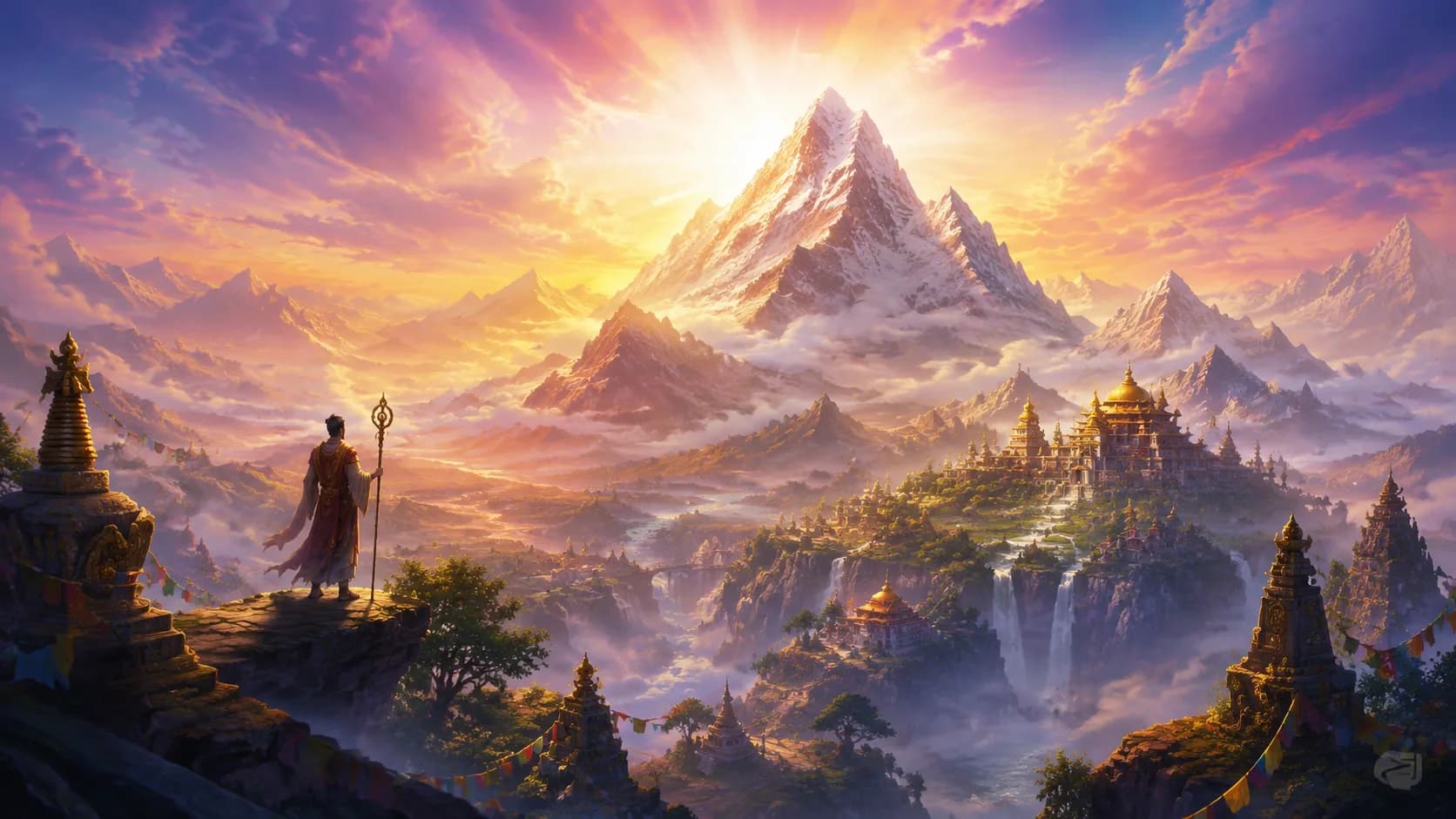
Close your eyes and imagine standing at the base of an ancient mountain. Not a mountain on a screen a mountain felt. The cold air entering your lungs. The scent of pine and wet stone. The sound of wind moving across exposed rock above the treeline, a sound unlike anything at lower elevations thinner, cleaner, almost crystalline. The silence between gusts, deeper than any silence you encounter in daily life. The pull of the trail upward. The sense that with every step higher, something inside you is changing too your breath, your attention, your awareness of yourself within a landscape that is immeasurably larger, older, and more enduring than any human concern. That experience the mountain reaching inward as you reach upward is the essence of what civilisations across thousands of years have recognised as the spiritual meaning of sacred mountains.
The spiritual meaning of sacred mountains refers to the universal human recognition of mountain peaks as axis points connecting the earthly and the transcendent natural formations that, across every major civilisation, have served as sites of pilgrimage, revelation, meditation, purification, and inner transformation. From ancient Greek sanctuaries atop Olympus and Parnassus, to the Hindu Buddhist reverence for Kailash and Meru, to the Abrahamic traditions of Sinai, Moriah, and Ararat, to the Incan solar temples of the Andes and the Shinto shrines of Fujisan sacred mountains represent the most geographically widespread and culturally persistent spiritual symbol in human history. In modern narrative meditation, sacred mountain environments are among the most powerful destinations for mental time travel, combining the calming physiological effects of nature sounds with the awe-inspiring psychological impact of vast vertical landscapes, delivered through spatial 3D audio that recreates the acoustic signature of high altitude sacred spaces echoing stone, distant wind, the silence of elevation, and the vast openness of sky to produce measurable improvements in emotional regulation, perspective taking, cognitive clarity, and the experience of transcendence that mountain pilgrims have sought for millennia.
In this comprehensive guide, you'll discover why mountains became sacred, the concept of the axis mundi, the spiritual traditions of Olympus, Kailash, Sinai, and Machu Picchu, the metaphor of inner ascent in meditation, the neuroscience of awe, how spatial audio recreates mountain environments, practical mountain meditation approaches, the connection between peaks and creative inspiration, and the modern pilgrimage movement bringing ancient mountain wisdom into contemporary mindfulness.
Key Facts: Sacred Mountains
- ••Universal Symbol: Every major civilisation has independently developed sacred mountain traditions (Greek, Hindu, Buddhist, Abrahamic, Incan, Japanese, Native American, Chinese, African), making mountains the most culturally universal spiritual symbol in human history
- ••Axis Mundi: Mountains serve as "axis mundi" (world axis), the symbolic centre where earth meets heaven, the ordinary meets the transcendent, and humans can access elevated states of consciousness through ascent, whether physical or meditative
- ••Awe Response: Mountain environments trigger the "awe response", a neurological state that reduces self-referential processing, expands time perception, decreases inflammation, and increases prosocial behaviour, making peaks naturally therapeutic environments
- ••Acoustic Signature: Mountains possess unique acoustic properties (long echoes, wind harmonics, vast silence) that spatial 3D audio can faithfully reproduce, providing the hippocampus with the environmental cues needed to construct immersive mental mountain experiences during meditation
- ••Meditation Heritage: Mountain meditation traditions span thousands of years, from Himalayan cave monasteries to Greek Olympian sanctuaries to Japanese mountain asceticism (Shugendō), establishing peaks as humanity's oldest dedicated meditation environments
- ••Inner Ascent: The metaphor of "climbing the mountain" represents the inner journey of meditation, each step representing increased awareness, clarity, and the gradual shedding of mental clutter that mirrors the physical thinning of air at altitude
Quick Answer
💡 Fun fact: There is no major civilisation in recorded history that did not look at a mountain and think: "Something sacred lives up there." The Greeks placed their entire pantheon on Mount Olympus. Hindus and Buddhists revere Mount Kailash as the centre of the universe. Moses received the Ten Commandments on Mount Sinai. The Incas built Machu Picchu on a mountain ridge to be closer to the sun. Japanese pilgrims have been ascending Mount Fuji for over a thousand years. The Navajo consider four sacred mountains the boundary pillars of their world. This isn't coincidence. It's one of the most universal spiritual patterns in human experience. Mountains, it seems, are not merely geological features. They are the Earth's invitation to look upward, and every culture that has ever accepted that invitation has found something transformative at the summit.
Why Mountains Became Sacred
The universality of sacred mountain traditions demands an explanation that goes beyond cultural diffusion these traditions arose independently on every inhabited continent, among peoples who had no contact with one another. The ancient Greeks who revered Olympus had no knowledge of the Tibetans circling Kailash, and the Incas building temples on Andean ridges had no awareness of Japanese pilgrims ascending Fuji. Yet all of them, looking at mountains, arrived at the same essential insight: these peaks are where the human world touches something greater. This convergence suggests that something about mountains themselves their physical properties, their perceptual impact, their effect on the human nervous system naturally evokes the spiritual response.
Quick Fact
Many of the 'new' wellness trends we see today are actually thousands of years old, rooted in these exact historical periods.
The most fundamental explanation is verticality. Mountains are the Earth's most dramatic vertical features, and the human brain is wired to associate upward movement with positive states. Psycholinguistic research by Brian Meier and Michael Robinson has demonstrated that humans across cultures consistently associate "up" with good, sacred, powerful, and divine, and "down" with negative, profane, and diminished. This "vertical metaphor" is not learned it appears to be built into the brain's spatial emotional mapping system, likely rooted in the embodied experience of standing upright as a sign of health and vitality. Mountains are the landscape's most emphatic expression of "up," and the brain responds to their verticality with an automatic association to elevation, aspiration, and transcendence.
Beyond verticality, mountains produce perceptual experiences that are inherently contemplative. The vast visual scale triggers the awe response a neurological state that research by Dacher Keltner and colleagues at UC Berkeley has shown to reduce self-referential thinking, expand time perception, and promote a sense of connection to something larger than the self. The altitude produces physiological changes deeper breathing, slower heart rate, increased alertness that mirror the physiological profile of meditative states. The silence of high elevations removes the sensory clutter of lowland environments, creating the perceptual conditions that contemplative traditions have always sought. And the physical effort of ascent produces a natural moving meditation rhythmic, sustained, and progressively quieting that primes the mind for introspection. Mountains don't merely symbolise spiritual experience; they produce it, through direct effects on the body and brain.
"Every civilisation on Earth looked at a mountain and thought: 'The divine lives up there.' This is either the greatest coincidence in human history, or mountains genuinely do something to the brain that makes transcendence feel closer. The neuroscience suggests it's the second one. Your hippocampus has been a mountain pilgrim since before anyone built a temple."
A philosopher walked into a wall. His students asked if it hurt. He replied, 'The wall is an illusion, but my headache is quite real.'
The Axis Mundi: Mountains as World Pillars
The concept of the axis mundi the "world axis" or "cosmic pillar" is one of comparative religion's most important discoveries, and mountains are its most common physical expression. Mircea Eliade, the great historian of religion, identified the axis mundi as a universal symbol appearing in every major tradition: a vertical structure connecting the underworld, the earthly realm, and the heavens, serving as the centre of the cosmos and the point where communication between realms becomes possible. While the axis mundi can take many forms a sacred tree (Yggdrasil in Norse tradition), a temple tower (the ziggurats of ancient Babylon), or a cosmic ladder mountains are its most natural and widespread embodiment.
In Hindu cosmology, Mount Meru (identified physically with Mount Kailash) stands at the centre of the universe, with the entire cosmos arranged concentrically around it. The gods reside at its summit, the human world occupies its middle slopes, and the subterranean realms lie beneath. This cosmological mountain is the axis around which the sun, moon, and stars revolve literally the spine of reality. The Buddhist tradition adopted and adapted this imagery: Mount Meru appears in Theravada, Mahayana, and Vajrayana cosmologies as the central feature of the universe, and Buddhist stupas (dome-shaped shrines) are architecturally modelled on the sacred mountain, making every stupa a symbolic Meru and every act of circumambulation a mountain pilgrimage in miniature.
Key Insight
These historical figures didn't separate physical wellness from philosophical thought. To them, it was all one continuous practice of living well.
The axis mundi concept reveals something profound about why narrative mountain meditation is so psychologically powerful: when you mentally ascend a sacred mountain during a guided journey, you are not merely imagining a scenic landscape. You are engaging with one of the deepest structural symbols in the human psyche a symbol that the brain recognises, at some level, as representing the possibility of connection between ordinary consciousness and something higher. The mental time travel involved in mountain meditation is not just spatial but cosmological the brain is constructing an experience of ascending toward the axis of the world, and the psychological effects expanded perspective, reduced ego identification, feelings of reverence and peace follow naturally from the depth and universality of the symbol being activated.
"Mircea Eliade spent decades studying the axis mundi. He found it everywhere: Hindu temples, Norse myths, Babylonian ziggurats, Christian cathedrals. But its most natural form was always a mountain. If the universe has a spine, it's made of rock and ice and the stubborn geological insistence on reaching upward. Your meditation practice is just continuing the tradition."

Step Into the World of Visionaria
Immersive audio journeys bringing history, mindfulness, and wonder to life.
An Epicurean, a Stoic, and a Cynic walk into a garden. The bartender says, 'Is this some kind of philosophical joke?'
Mount Olympus: Where Gods Met the Sky
In ancient Greek tradition, Mount Olympus at 2,917 metres the highest peak in Greece was the dwelling place of the twelve Olympian gods. But Olympus was not simply a narrative convenience; it was a living spiritual landscape that shaped Greek understanding of the relationship between the human and the divine. The Greeks believed that the summit of Olympus existed beyond the weather above the clouds, above rain and wind, in a realm of perpetual light and stillness. This image the serene, luminous summit above the turbulent lower slopes became one of Western civilisation's most enduring metaphors for spiritual clarity above the confusion of ordinary existence.
Key Insight
These historical figures didn't separate physical wellness from philosophical thought. To them, it was all one continuous practice of living well.
The spiritual geography of Olympus extended far beyond its physical peak. The entire Greek sacred landscape was organised around mountains: Delphi's oracle sat on the slopes of Mount Parnassus, sacred to Apollo and the Muses. Mount Helicon was the home of the Muses and the source of poetic inspiration. Mount Ida in Crete was the birthplace of Zeus. Greek sanctuaries were consistently placed at elevated positions not for defensive advantage but for spiritual proximity to the sky. The Greek spiritual experience was fundamentally an experience of looking up and climbing toward, and the mountain was its defining landscape.
For narrative meditation, the Olympian mountain tradition offers an exceptionally rich environment. The acoustic signature of a Greek mountain wind moving through pine forests, the echo of stone amphitheatres, distant goat bells, the cry of eagles is distinctive, evocative, and deeply relaxing when reproduced through spatial 3D audio. The mythological associations add a layer of narrative depth that engages the brain's story processing networks alongside its spatial navigation systems, producing a meditation experience that is simultaneously calming, imaginatively engaging, and culturally enriching. To mentally ascend Olympus during a narrative journey is to participate in a spiritual tradition that stretches back over three thousand years and the brain's response to the experience confirms that the tradition was grounded in genuine neurological effects all along.
What's an ancient intellectual's favorite exercise? Jumping to conclusions.
Mount Kailash: The Unclimbed Centre of the Universe
Mount Kailash (6,638 metres) in western Tibet is arguably the most spiritually significant mountain on Earth sacred simultaneously to four major religions: Hinduism, Buddhism, Jainism, and the Bön tradition. For Hindus, Kailash is the abode of Lord Shiva, who sits in eternal meditation at its summit with his consort Parvati. For Buddhists, it is the home of Buddha Demchok, representing supreme bliss. For Jains, it is the site where the first Tirthankara achieved spiritual liberation. For Bön practitioners, it is the seat of all spiritual power. No mountain on Earth concentrates such a density of spiritual meaning from such diverse traditions in a single physical location.
Visionaria Insight
By immersing ourselves in these historical soundscapes, we reconnect with a timeless human tradition of storytelling and mental restoration.
What makes Kailash uniquely remarkable is that no one has ever climbed it not because it is technically impossible (it is not the highest or most difficult peak in the region) but because all four traditions regard the summit as inviolably sacred. The Chinese government, which controls access, has respected this prohibition. The approved spiritual practice at Kailash is kora circumambulation, walking around the base of the mountain in a clockwise circuit (counterclockwise for Bön practitioners) that typically takes three days. The kora is understood not as a journey to the summit but as a journey around the sacred centre a practice that mirrors the meditative practice of circling a focus point, approaching transcendence through sustained devotional attention rather than direct assault.
Kailash offers narrative meditation a model of sacred landscape engagement that prioritises presence over conquest. The kora tradition teaches that the spiritual benefit of a mountain comes not from reaching the top but from being in relationship with the mountain walking in its shadow, breathing its air, feeling its gravitational and emotional pull. This relational approach translates beautifully into spatial audio meditation: a guided Kailash journey can place the listener on the kora path, with the mountain's presence felt directionally through sound wind from the peak above and to the right, water from streams below and to the left, the crunch of pilgrimage paths underfoot creating an immersive experience of being with rather than merely observing the sacred landscape.
"Mount Kailash has been sacred to four religions for thousands of years, and no one has ever stood on its summit. This makes it the ultimate meditation teacher: the point is not to conquer the peak but to walk with reverence around its base. Your hippocampus can appreciate this it builds the mountain in your mind not to scale it, but to be transformed by its presence."
A Roman walks into a bar, holds up two fingers, and says, 'Five beers, please.'
Mount Sinai: Revelation and Transformation
In the Abrahamic traditions Judaism, Christianity, and Islam Mount Sinai holds a singular place as the site of divine revelation. According to the Torah, it was on Sinai that Moses received the Ten Commandments, the foundational ethical code of Western civilisation. The mountain was enveloped in cloud and fire, its summit hidden from all but Moses, who ascended alone into what the text describes as the direct presence of the divine. The Sinai narrative established a template that would echo through millennia of Abrahamic spirituality: the mountain as the place where the human being, through solitary ascent, encounters transformative revelation.
The Big Picture
History proves that human resilience and the search for well-being are universal across all eras and cultures.
What makes the Sinai tradition particularly relevant to meditation is its emphasis on transformation through encounter. Moses ascended Sinai as one person and descended as another transformed by the experience of the summit. This pattern ascent, encounter, transformation, descent with new understanding mirrors the structure of deep meditative experience: the practitioner moves inward (ascent), encounters a state of expanded awareness (the summit), is changed by the encounter (transformation), and returns to ordinary consciousness with new perspective and insight (descent). The mountain narrative provides a narrative framework for the meditation experience itself, giving the practitioner's inner journey a spatial structure that the hippocampus can map and the mind can follow.
The acoustic environment of Sinai desert wind over bare rock, the vast silence of arid high elevations, the occasional call of a raptor circling thermal currents is profoundly different from the alpine environments of Olympus or Kailash, and spatial audio can capture this difference with remarkable fidelity. A Sinai inspired narrative journey transports the listener into the dry, expansive, sun baked silence of the desert mountain a silence that is not empty but charged with the weight of significance, the feeling that the landscape itself is paying attention. This quality what Rudolf Otto called the "numinous" is precisely what makes mountain meditation so spiritually potent, and spatial audio's ability to reproduce it is what makes modern mountain meditation accessible to anyone with a pair of headphones.
A time traveler went back to antiquity to teach them about 'holistic health.' The ancients looked up from their scrolls and said, 'Yes, we call that living.'
Machu Picchu and the Andean Mountain Tradition
The Inca civilisation built Machu Picchu at 2,430 metres on a narrow ridge between two mountain peaks Machu Picchu ("Old Mountain") and Huayna Picchu ("Young Mountain") not for military defence or agricultural production, but because the site's relationship to the surrounding mountains, the sun's path, and the flow of water created what the Incas considered a perfect convergence of sacred landscape forces. The Incas venerated mountains as apus living spiritual beings who governed weather, water, fertility, and human destiny. Each mountain had its own personality, its own relationship to the communities in its shadow, and its own role in the spiritual ecology of the Andean world.
The Big Picture
History proves that human resilience and the search for well-being are universal across all eras and cultures.
The apu tradition represents a fundamentally relational understanding of sacred mountains not as symbols pointing to something beyond themselves, but as spiritual beings in their own right, deserving of respect, reciprocity, and ongoing communication. Inca priests made offerings to the apus coca leaves, chicha (corn beer), textiles, and prayer in exchange for the mountain's continued benevolence toward the community below. This reciprocal relationship between humans and mountains created a spiritual practice that was simultaneously ecological, agricultural, communal, and contemplative, grounding spiritual experience in the living landscape rather than abstracting it into doctrine or theology.
For meditation practitioners, the Andean mountain tradition offers a powerful alternative to the "conquest" metaphor that dominates Western approaches to peaks. Instead of climbing over the mountain, the Inca tradition invites you to enter into relationship with it to feel its presence, acknowledge its power, express gratitude for its gifts, and allow its vast, ancient, weather sculpted patience to recalibrate your own sense of time and importance. A spatial audio journey set at Machu Picchu at dawn with the sound of cloud forest birds, distant waterfalls, and the whisper of wind through Incan stonework provides the brain with exactly the kind of rich, multisensory environmental input that produces deep meditative absorption and lasting emotional restoration.
Read more: The Enchanted Winter Kingdom and Its Hidden Meanings
"The Incas didn't climb mountains for the view. They climbed them to have a conversation. When you meditate with a sacred mountain through spatial audio, you're continuing that conversation except now the mountain speaks in binaural frequencies, and your hippocampus translates. The Incas would have approved of the technology, if not the headphone cables."
An Epicurean, a Stoic, and a Cynic walk into a garden. The bartender says, 'Is this some kind of philosophical joke?'
The Inner Ascent: Mountains as Meditation Metaphor
The mountain as metaphor for inner transformation is one of the oldest and most persistent images in contemplative literature. St. John of the Cross wrote "The Ascent of Mount Carmel" to describe the soul's journey toward union with the divine. Dante placed the Mountain of Purgatory at the centre of his "Divine Comedy" as the path from confusion to enlightenment. Zen Buddhism speaks of the three stages of practice: "Before I studied Zen, mountains were mountains. While I studied Zen, mountains were no longer mountains. After I attained enlightenment, mountains were once again mountains." The hero's journey itself often reaches its climax on a mountain the peak as the place of ultimate confrontation, transformation, and return with new wisdom.
Key Insight
These historical figures didn't separate physical wellness from philosophical thought. To them, it was all one continuous practice of living well.
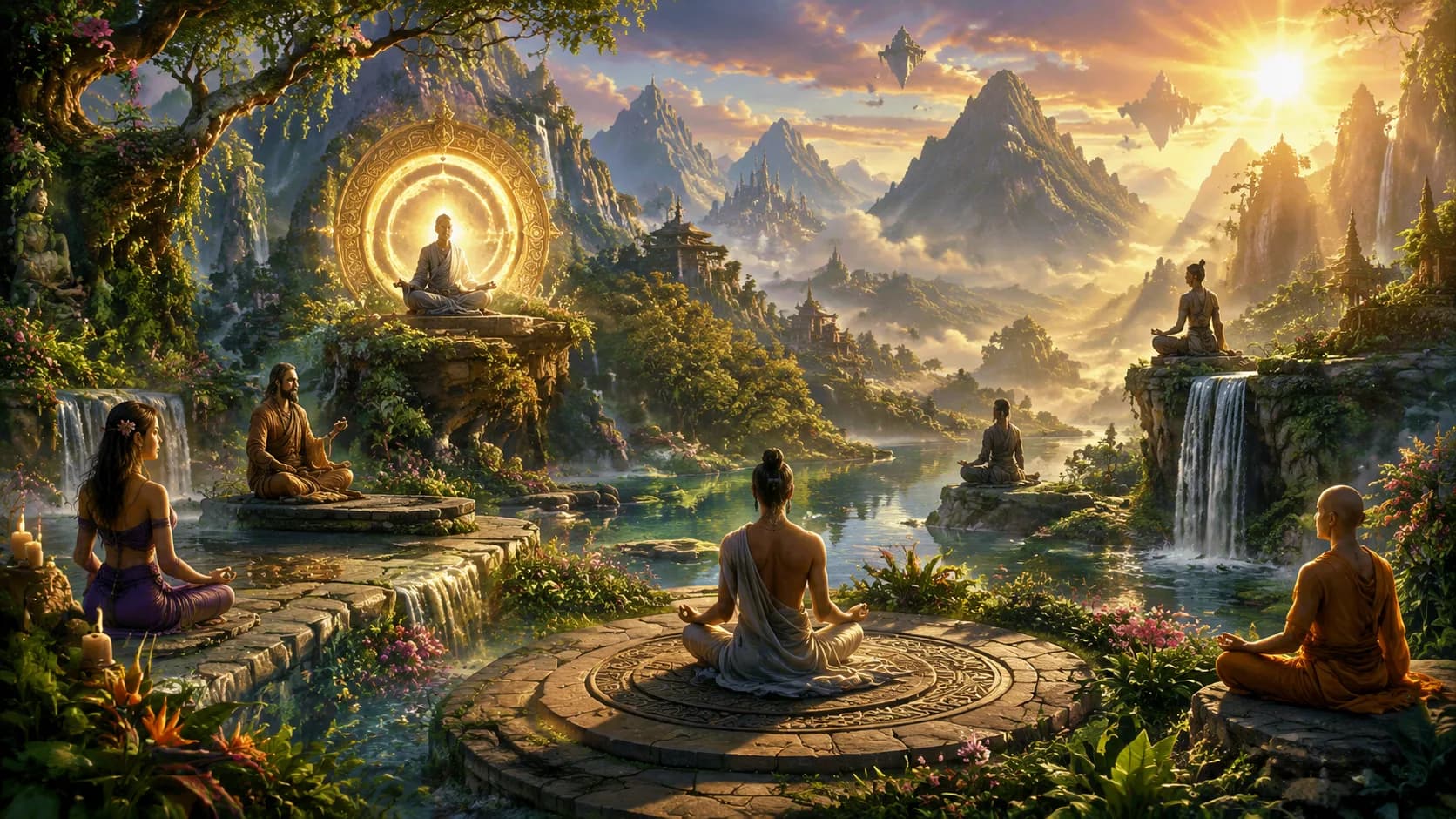
What makes the mountain metaphor so effective for meditation is its experiential accuracy. A physical mountain ascent mirrors the meditation journey with remarkable precision: the base represents the beginning busy, cluttered, surrounded by the noise and distraction of lowland life. The lower slopes represent the early stages of practice effort, concentration, the discipline of putting one foot in front of another despite discomfort. The middle elevation represents the emergence from confusion the treeline falls away, the view expands, the air clears. The high slopes represent the deepening of meditative absorption fewer thoughts, wider awareness, a growing sense of spaciousness. And the summit represents the moment of clarity and presence the 360 degree panoramic awareness that meditation teachers describe as the goal of practice: seeing everything, holding nothing, fully present in the vast openness of this moment.
Narrative mountain meditation makes this metaphor experiential rather than conceptual. Instead of intellectually understanding that meditation is "like climbing a mountain," the practitioner actually climbs mentally ascending through carefully described zones of vegetation, weather, and sound, with spatial audio shifting from dense forest acoustics to open ridge echoes to the crystalline silence of the summit. The hippocampus constructs the ascent as a spatial journey, the emotional processing systems respond to the changing environment, and the metaphor becomes embodied experience the practitioner doesn't just think about elevated awareness; they feel the elevation in their mental landscape, with all the neurological consequences that entails.
A time traveler went back to antiquity to teach them about 'holistic health.' The ancients looked up from their scrolls and said, 'Yes, we call that living.'
The Neuroscience of Awe: Why Mountains Transform the Mind
The awe response that feeling of being in the presence of something vastly larger, more powerful, or more beautiful than yourself is one of the most studied emotions in positive psychology, and mountains are among its most reliable triggers. Dacher Keltner and Jonathan Haidt defined awe as requiring two conditions: perceived vastness (the stimulus is much larger than the self) and accommodation (existing mental frameworks must expand to make sense of the experience). Mountains satisfy both conditions effortlessly: their scale is unmistakably vast, and their geological timescales, vertical drama, and atmospheric effects consistently challenge ordinary mental frameworks.
Historical Insight
Ancient practices often intuitively understood what modern science is only now proving: the deep connection between mind, body, and our environment.
Research on the awe response has revealed a constellation of neurological and physiological effects that align remarkably with the goals of meditation practice. Awe reduces activity in the default mode network's self-referential regions the same regions that meditation aims to quiet, and the same regions responsible for the "inner critic" and anxious self-monitoring that characterise stress and rumination. Awe expands time perception people experiencing awe consistently report feeling that time slows down, providing more of it to be present and attentive. Awe reduces inflammatory cytokines (IL 6 specifically), suggesting direct anti-inflammatory effects. And awe increases prosocial behaviour generosity, helpfulness, and the sense of connection to others indicating that the "small self" produced by awe is accompanied by an expanded sense of social belonging.
For mountain meditation through spatial audio, the neuroscience of awe provides a rigorous framework for understanding why the practice is so effective. When a narrative journey places the listener on a high mountain ridge with spatial 3D audio reproducing the vast acoustic signature of the environment wind sweeping across exposed rock, the distant echo of a waterfall far below, the enormity of silence stretching to the horizon the brain's awe circuitry activates. The default mode network quiets. Time perception expands. Inflammatory markers decrease. The sense of self softens. And the practitioner experiences, from the comfort of their headphones, the same neurological effects that mountain pilgrims have sought for thousands of years achieved not through physical ascent but through the brain's own mental time travel capacity, guided by narration and amplified by spatial sound.
Read more: Headspace vs Visionaria Meditation Style
"Researchers have begun to study awe, and some findings suggest it can shift how we perceive time and ourselves, though the science is still young. Mountain pilgrims discovered the same things thousands of years ago they just described it differently. When science and ancient wisdom agree this completely, the correct response is probably to find a mountain. Or put on headphones and let one find you."
Why did the historian break up with the archaeologist? Because her career was literally in ruins.
Spatial Audio and the Sound of Sacred Peaks
Mountains possess acoustic signatures as distinctive as their visual profiles. A mountain environment sounds fundamentally different from any lowland space and these acoustic differences are precisely what makes spatial audio mountain meditation so immersive. At high elevations, the reduced atmospheric density produces thinner, clearer sounds with longer reverberation echoes travel further and fade more slowly, giving the listener an acoustic sense of vastness that corresponds to the visual vastness of the landscape. The wind at altitude produces frequencies and patterns unlike lowland wind higher pitched, more variable, with a quality of emptiness that the brain recognises as "open space above." The silence between sounds is deeper and more complete than at lower elevations, where the ambient soundscape is always filled with biological, mechanical, and atmospheric noise.
Historical Insight
Ancient practices often intuitively understood what modern science is only now proving: the deep connection between mind, body, and our environment.
Spatial 3D audio can reproduce these mountain specific acoustic qualities with remarkable fidelity. The binaural processing that creates the three-dimensional sound field positions each element exactly where it would be on a mountain: wind from the direction of the exposed ridge, birdsong from the forest below, the trickle of snowmelt from a specific direction, the narrator's voice positioned as a companion beside you on the path. The hippocampus receives these spatial cues and constructs a navigable mental environment not a flat audio backdrop but a three-dimensional space with height, depth, and directionality. This is why spatial audio meditation in mountain environments produces such a powerful sense of presence: the brain's spatial processing system treats the acoustic input as evidence of a real environment, and responds accordingly with the full suite of neurological, emotional, and physiological effects that being on a mountain would produce.
Read more: The Monkey King: Journey Through Chinese Mythology (Complete Guide)

Different sacred mountains produce different acoustic experiences and narrative meditation can explore this diversity. An Olympian mountain journey features Mediterranean pine forest, cicadas, and the echo of ancient stone. A Himalayan journey offers thin, crystalline air sounds, distant prayer flags snapping in wind, and the vast silence of glaciated peaks. An Andean journey brings cloud forest birdsong, rushing mountain rivers, and the whistle of condor wings at altitude. A desert mountain journey (Sinai) delivers the most minimal acoustic palette bare wind over rock, enormous reverberations, and the almost supernatural quiet of arid high elevations. Each mountain's acoustic signature triggers slightly different neurological responses, providing practitioners with a library of meditative environments that suit different moods, intentions, and stages of practice.
Why did the historian break up with the archaeologist? Because her career was literally in ruins.
Mountain Meditation as a Daily Practice
Integrating sacred mountain meditation into a daily practice is simpler than most people expect, and the cumulative benefits are substantial. The most effective approach combines consistency (daily sessions of 10-20 minutes) with variety (different mountains and environments) a pattern that mirrors the traditional pilgrimage practice of returning to sacred sites regularly while also exploring new ones. The brain responds best to a rhythm of familiar and novel: the familiar provides the safety and depth that comes with repeated experience, while the novel provides the cognitive stimulation and hippocampal engagement that comes with exploring new environments.
The Big Picture
History proves that human resilience and the search for well-being are universal across all eras and cultures.
A practical mountain meditation progression might unfold like this: Week 1-2: Choose a single mountain journey (perhaps a gentle Alpine meadow or a Greek hillside sanctuary) and listen daily, allowing the imagery to develop naturally without forcing vividness the brain's scene construction improves with repetition. Week 3-4: Add a second mountain environment (a Himalayan ridge or a desert peak), alternating between the two and noticing the different emotional and cognitive effects each produces. Month 2-3: Expand to 3-4 mountain environments, beginning to match different mountains to different intentions a calm Alpine meadow for stress relief, a dramatic summit for perspective and awe, a forest-lined slope for creative reflection. Month 4+: Begin brief unguided sessions closing your eyes and mentally returning to a favourite mountain environment without audio to test and strengthen your independent visualization capacity.
The benefits of consistent mountain meditation practice accumulate over time in ways that mirror the research on nature exposure, meditation, and awe. Some people who practise regularly describe improved emotional resilience (the mountain's stability becomes an internalised reference point), expanded perspective (the summit view becomes a metaphor the mind returns to when problems feel overwhelming), enhanced creativity (the rich sensory environments provide imagination fuel), and a deepened sense of connection to the natural world and to human spiritual traditions spanning thousands of years. The mountain, encountered daily through spatial audio meditation, becomes an internal landscape always accessible, always stable, always offering the perspective that only altitude can provide.
"Building a mountain meditation practice is surprisingly easy. Step one: headphones on. Step two: pick a mountain. Step three: show up tomorrow and pick another mountain. Step four: notice that the mountains are changing you more than you're changing the mountains. This is, historically speaking, exactly what mountains have always done to anyone who pays attention."
Why did the inventor of the wheel win an award? Because his idea really got things rolling.
Sacred Mountains and Creative Inspiration
The connection between mountains and creativity is both ancient and neurologically grounded. The Greeks located the Muses on Mount Helicon and the poetic spring of Hippocrene on a mountainside placing the source of all artistic inspiration at altitude. Romantic poets Wordsworth, Shelley, Byron, Coleridge composed their greatest works in mountain landscapes, and explicitly credited the mountains with the expansion of perception that made their poetry possible. Chinese landscape painting (shan shui, literally "mountain water") placed mountains at the centre of the artistic tradition for over a thousand years. The Japanese concept of yūgen mysterious, profound beauty is most naturally evoked by misty mountain landscapes. Across cultures and centuries, mountains have been humanity's most reliable source of creative elevation.
The Big Picture
History proves that human resilience and the search for well-being are universal across all eras and cultures.
The neuroscience explains why. The awe response triggered by mountain environments deactivates the default mode network's self-monitoring functions and activates the creative construction systems centred on the hippocampus and lateral prefrontal cortex. This is the same neural shift that characterises "flow states" the conditions under which creative work is most productive and inspired. The vast scale of mountains produces what psychologists call "perceptual broadening" the visual and spatial experience of vastness literally broadens attention, allowing the mind to make connections between ideas that are ordinarily too distant to be noticed. Research by Amabile and colleagues has consistently shown that environments perceived as "expanding" (high ceilings, open views, vast landscapes) produce measurably more creative thinking than environments perceived as "contracting."
For creative professionals and anyone seeking to expand their inner worlds, sacred mountain meditation through spatial audio provides a daily portal to creative conditions. A 15 minute mountain journey before a creative work session primes the brain for exactly the kind of broad, associative, non-judgmental thinking that produces breakthroughs deactivating the inner critic, expanding perceptual horizons, and providing a rich reservoir of sensory impressions that the creative imagination can draw on throughout the day. It's no coincidence that the ancients placed the Muses on a mountain. The altitude physical or imagined genuinely transforms the quality of thought.
An Epicurean, a Stoic, and a Cynic walk into a garden. The bartender says, 'Is this some kind of philosophical joke?'
Modern Pilgrimage: Mountains in the Age of Mindfulness
The resurgence of mountain pilgrimage in the 21st century reflects a growing recognition that ancient spiritual practices addressed real human needs that modern life has not eliminated. The Camino de Santiago which includes significant mountain crossings through the Pyrenees has seen pilgrim numbers increase from fewer than 3,000 in 1990 to over 400,000 annually by 2024. Mount Fuji receives over 300,000 climbers per year, many of whom describe the experience in explicitly spiritual terms. Even secular mountaineering culture increasingly acknowledges what climbers call "the mountain experience" a state of expanded awareness, reduced ego, and profound peace that transcends the physical accomplishment of reaching the summit.
Did You Know?
The relentless drive to understand the world was seen not just as an academic pursuit, but as a spiritual and healing practice by the ancients.
For the vast majority of people, however, physical mountain pilgrimage remains impractical as a regular wellness practice. Mountains are geographically inaccessible to most urban populations, physically demanding, weather dependent, time consuming, and expensive to visit regularly. This is where narrative meditation with spatial audio offers a genuine alternative not as a replacement for the physical mountain experience (nothing replaces the embodied reality of altitude), but as a way to access the neurological and psychological benefits of mountain environments on a daily basis, from anywhere, without the logistical barriers that prevent most people from incorporating real mountain exposure into their regular wellness routines.
The evidence supports this approach. Research on nature exposure and virtual nature (Browning et al., 2020; White et al., 2019) has consistently shown that vivid mental imagery of natural environments produces measurable stress reduction, mood improvement, and cognitive restoration effects that are amplified by the addition of nature sounds and spatial audio. Mountain environments specifically, with their unique combination of vastness, silence, verticality, and awe-inducing scale, produce the strongest effects within the nature exposure research literature. By combining historically accurate mountain environments with spatial 3D audio processing, platforms like Visionaria are creating a form of accessible daily pilgrimage bringing the transformative power of sacred mountains to anyone with a smartphone and a pair of headphones, continuing a spiritual tradition that is as old as human civilisation itself.
"Ancient pilgrims walked for months to reach a sacred mountain. Modern pilgrims download an app, put on headphones, and arrive in twelve minutes. The mountain doesn't care how you got there. It's been offering the same gift perspective, peace, and the feeling of being wonderfully small in a wonderfully vast universe for millions of years. It can accommodate the technology upgrade."

Why Fairy Tales Still Shape Imagination Today
Discover why fairy tales still shape imagination today, from their ancient origins and the psychology of storytelling to archetypes, emotional resilience, cultural evolution, therapeutic applications, and how immersive...
Why did the historian break up with the archaeologist? Because her career was literally in ruins.
The Bottom Line
Sacred mountains represent the most universal spiritual symbol in human history revered across every civilisation as axis points connecting the earthly and the transcendent. Their spiritual meaning encompasses inner ascent, purification, awe, perspective, and the journey from ordinary consciousness to expanded awareness.
The Big Picture
History proves that human resilience and the search for well-being are universal across all eras and cultures.
This guide explored why mountains became sacred (verticality, awe, contemplative acoustics), the axis mundi concept, the traditions of Olympus, Kailash, Sinai, and Machu Picchu, the mountain as meditation metaphor, the neuroscience of awe, spatial audio's ability to recreate mountain environments, practical daily practice approaches, the creativity connection, and the modern pilgrimage movement.
"You started this article at base camp. You're finishing it at the summit knowing that every civilisation in history looked at a mountain and saw something sacred, that the neuroscience confirms they were right, and that your hippocampus has been ready for this ascent all along. The mountain is waiting. Your headphones are your hiking boots."
Experience More with Visionaria
Download the app to explore guided historical and wellness journeys.
An Epicurean, a Stoic, and a Cynic walk into a garden. The bartender says, 'Is this some kind of philosophical joke?'
This article is for educational and informational purposes only. Historical details are based on available research and may evolve as new evidence emerges.
Visionaria journeys are designed for relaxation, guided imagination, and personal enrichment. They are not a substitute for medical, mental health, legal, or professional advice.