
Commute Meditation: Transform Your Daily Journey
Ancient Roman senators famously used the slow journey by litter across the city as deliberate thinking time, dictating philosophical notes to scribes en route to the Forum. Your commute has more in common with Marcus Aurelius than you might expect.
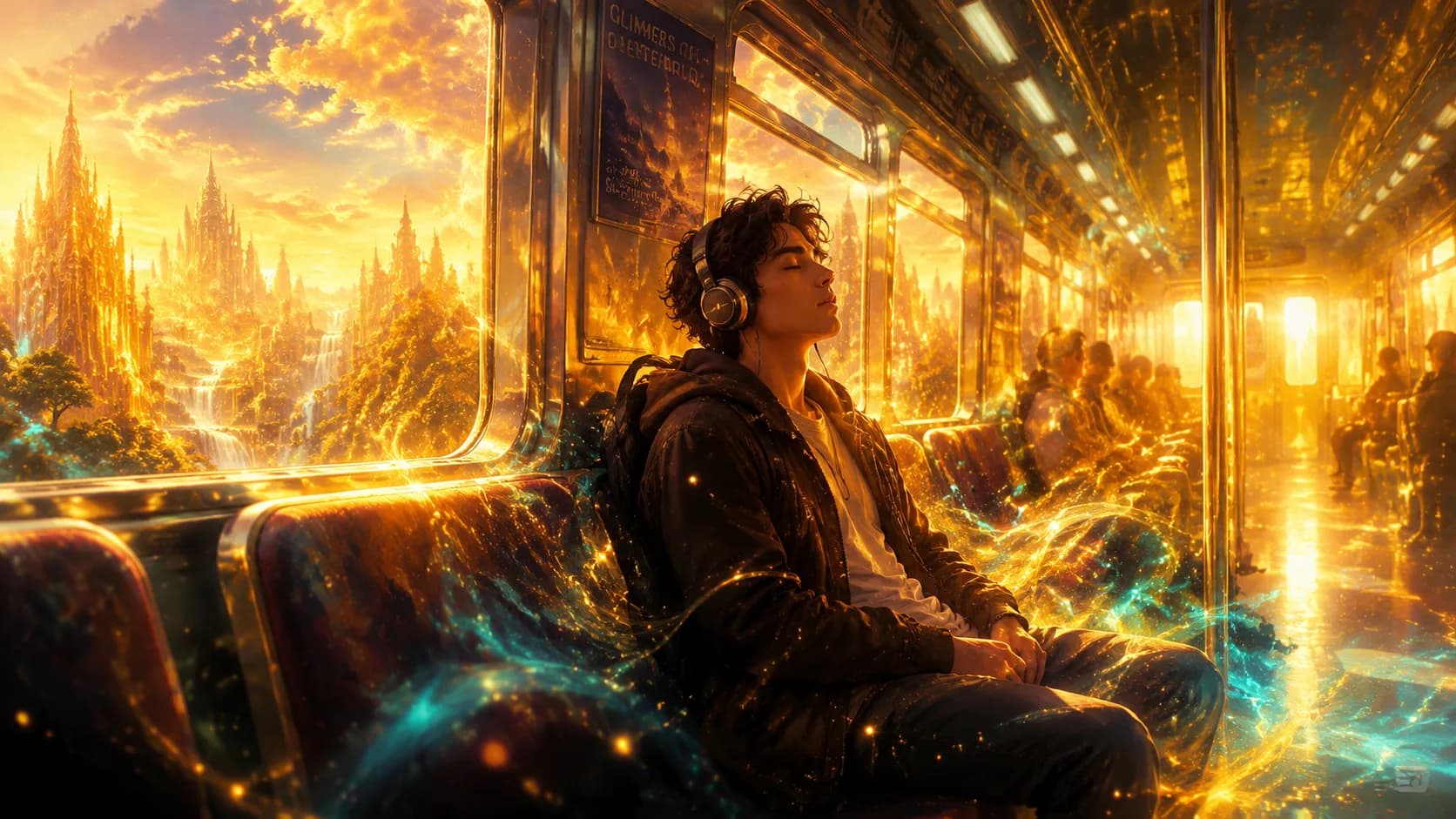
- The 234-Hour Opportunity Hiding in Plain Sight
- Already Captive, Already Wired for Escape
- Commute Meditation Works Eyes-Open (And That Is the Point)
- Why 12 to 15 Minutes Is the Sweet Spot for Commute Journeys
- The Dual Benefit: Arrive Restored, Arrive Home Peaceful
- What Kind of Content Actually Works on a Commute
- Making Commute Meditation a Lasting Habit
- Frequently Asked Questions
Commute meditation is the practice of using daily travel time, typically on trains, buses, or subways, to engage in guided audio mindfulness, immersive visualization, or narrative journeys. According to the U.S. Census Bureau (2022), the average American spends 27 minutes commuting each way, which adds up to roughly 234 hours per year of time that most people currently spend scrolling, stressing, or staring blankly at the seat in front of them. It is also, frankly, one of the most underrated wellness opportunities most of us are ignoring.
And before you ask: no, this is not about sitting cross-legged in a crowded train car with your eyes rolled back. Commute meditation is specifically designed for the eyes-open, noise-present, slightly chaotic reality of public transit. It meets you exactly where you are, headphones already in, phone already in hand, already desperate for a brief mental escape before the workday begins. For those curious about how experiential meditation differs from traditional silent practice, the commute is actually the perfect place to find out.
Key Facts About Commute Meditation
- •Average commute (one way): 27 minutes (U.S. Census Bureau, 2022)
- •Annual convertible time: 234 hours per year (both directions, 260 working days)
- •Best session length: 12 to 15 minutes for commute-matched immersive journeys
- •Suitable for: Train, bus, subway. Not recommended while driving.
- •Dual benefit: Arrive at work restored; arrive home peaceful.
Quick Answer
Commute meditation is the practice of using your daily travel time on trains or buses for guided audio mindfulness, immersive storytelling, or visualization journeys. With the average one-way commute lasting 27 minutes (U.S. Census Bureau, 2022), commuters gain up to 234 hours of restorative listening time per year, arriving at work calmer and returning home more peaceful.
The 234-Hour Opportunity Hiding in Plain Sight
Let us do the math together, because once you see it, you cannot unsee it. Twenty-seven minutes each way. Two trips per day. Two hundred and sixty working days per year. That is 234 hours annually. For context: that is nearly six standard 40-hour workweeks. You could learn a language, finish a dozen books, or, more relevantly here, rebuild an entirely different relationship with your own mind. Most people spend that time doing nothing particularly useful, which is fine, rest is valuable, but stress-scrolling through social media or replaying anxious thoughts about the meeting in two hours is not rest.
Now imagine what 27 minutes of immersivestory meditation could do for you before you even step off the train. That is not a wellness luxury. That is a straightforward cognitive investment with a clear daily return.
Quick Answer: How Much Time Is Your Commute Really Worth?
At 27 minutes each way, a standard commuter gains 234 hours of listening time per year. Used intentionally with immersive audio journeys, this converts daily friction into one of the most consistent wellness practices available, no gym bag required.
Here is the thing most productivity advice gets wrong: the goal is not to turn your commute into a second office. Listening to work podcasts or answering emails on the train keeps your nervous system in the same activated state as being at your desk. What the commute actually needs is genuine psychological transition, a mental airlock between your home self and your work self, and then again between your work self and the person who walks through the front door at home. Audio journeys do this better than almost anything else because they redirect attention completely, engaging the imagination in ways that trigger what neuroscientists call narrative transportation, a measurable state where the brain partially disengages from its current environment and inhabits the world of the story.
If you want a deeper look at the science behind why your brain treats vivid narrative as near-real experience, the research on why the brain experiences stories as reality is genuinely eye-opening. Spoiler: the same neural regions that activate during real events light up during absorbing narrative. Your 27-minute journey to the office can, neurologically speaking, be a 27-minute journey somewhere else entirely.
A Roman senator once asked his litter-bearer why he moved so slowly through the forum. 'Because, Senator, your best ideas happen between home and the senate steps.' The bearer was not wrong. He was just 2,000 years ahead of commute optimization.
Already Captive, Already Wired for Escape
Picture the average train at 8:15 in the morning. Nearly everyone has headphones in. A significant portion are staring at their phones. And almost all of them, if you asked, would admit they are not entirely sure what they are looking at. They are already seeking escape. They are already in the exact posture and attentional state that immersive audio is built for. All that is missing is the right content.
Behavioural economist Dr. Amos Tversky noted that humans in captive situations, those with limited physical freedom of movement, tend to redirect cognitive energy inward with unusual intensity. A commuter stuck on a delayed train is not just frustrated. Their brain is actively searching for a more engaging internal environment. Feed it a vivid immersive narrative and that redirected attention becomes something genuinely therapeutic, comparable to what psychologists describe in studies of the psychology of experiencing stories in meditation.
Key Insight: The Captive Audience Effect
Commuters are already wearing headphones and already seeking mental escape. This pre-existing state makes transit time one of the most receptive contexts for immersive audio meditation, because the brain has already begun the process of disengaging from its physical surroundings.
And there is a real irony here. People who would never sit down at home and say 'I am going to meditate for 25 minutes right now' will happily spend that same time on a bus with their eyes closed, completely absorbed in an audio story. Remove the self-consciousness of formal practice, place it in a context where tuning out is already socially normal, and suddenly the psychological barrier to mindfulness drops to almost nothing. This is why commute meditation has a fundamentally different adoption rate than traditional seated practice. The environment does the work.

Your Commute Is Already 234 Hours a Year
Explore immersive audio journeys designed for real people on real trains. No mat, no silence, no excuses.
Socrates reportedly did his best thinking while walking the streets of Athens. Modern commuters get the same cognitive window, they just have to fight for it against a push notification from their food delivery app.
Commute Meditation Works Eyes-Open (And That Is the Point)
Let us be clear about one thing immediately: if you are driving, this article is not for you right now. Commute meditation via immersive audio is designed for passengers, specifically those on trains, subways, buses, and trams where the body is physically safe and the eyes can stay open or gently softened without any safety concern. Please do not attempt eyes-closed visualization while operating a vehicle. Full stop.
For transit passengers, though, the eyes-open format is not a limitation. It is actually a feature. Traditional silent meditation asks you to close your eyes and focus on breath in a quiet room. Ask someone to do that on a packed commuter train at rush hour and the gap between instruction and reality becomes almost comedic. Eyes-open narrative meditation, by contrast, does not fight the environment. It layers on top of it. Your gaze softens on the window, the ambient sound of the train becomes a kind of background texture, and the audio story in your ears becomes the dominant reality your brain is processing. Researchers studying the science behind immersive audio meditation describe this as selective attentional narrowing, where rich auditory input effectively crowds out ambient sensory noise.
Important: Not for Drivers
Immersive audio journeys and guided visualization are designed for train, bus, and subway passengers only. Never use eyes-closed or deeply absorbing meditation audio while driving. This practice is built specifically for contexts where your physical safety is fully managed by someone else.
What makes eyes-open commute meditation genuinely impressive is the way spatial audio enhances it. When a binaural recording places sounds in three-dimensional space around your head, the brain instinctively begins constructing an environment to match those sounds. You are sitting on a train, but part of your perceptual apparatus is already partly somewhere else. Ancient forest. Ocean shore. The marble halls of a great library. Spatial audio essentially gives your imagination a running start, which is why the combination of narrative and 3D sound works so much faster than silent breath-counting for most people. For a closer look at how visualization journeys interact with spatial audio perception, the neuroscience is genuinely fascinating.
And while we are on the subject of noise: many people assume that the background clatter of a busy train makes meditation impossible. Actually, moderate ambient noise in the 65 to 85 decibel range has been linked by Ravi Mehta et al. (Journal of Consumer Research, University of Illinois, 2012) to better performance on creative tasks than either low (about 50 dB) or high (about 85 dB) noise levels. Your train is not the enemy of your practice. It might actually be helping.
Read more: What Is Experiential Meditation? Complete Guide to Immersive Mindfulness

A Victorian train passenger once complained that railway travel moved too fast to allow for proper contemplation. At 27 minutes each way, we have clearly solved the speed problem. Now we just need better content.
Why 12 to 15 Minutes Is the Sweet Spot for Commute Journeys
Not all meditation sessions are created equal for transit contexts. Hour-long soundscapes that slowly build atmosphere over many minutes are wonderful at home with a blanket. But on a train with an unpredictable schedule, they are a recipe for getting so relaxed you miss your stop. The commute needs something different: sessions designed to reach their full meditative depth quickly, sustain it for a satisfying middle passage, and bring you back to full alertness with intention before the journey ends.
Twelve to fifteen minutes is long enough to reach genuine narrative immersion (most people need four to six minutes for the brain to settle into a story world) while short enough to fit two sessions into a 27-minute commute with a buffer for delays or distractions. Visionaria's transit-friendly sessions are built around this window specifically, and across its library of immersive journeys, the 12 to 15 minute format consistently shows the highest completion rates among commuter users. There is a reason for that: it matches the natural arc of a commuter's attention.
The Commute-Length Formula
For a 27-minute commute: one 12-15 minute immersive journey, a two-minute arrival transition, and the remaining time as gentle ambient sound. This structure lets you go deep without risking overshooting your stop or snapping back to alertness too abruptly.
Session design also matters enormously in noisy environments. Long pauses and gentle whisper-level narration, fine at home, get swallowed entirely by the ambient sound of a busy carriage. Commute-optimised audio journeys tend to use a richer, more continuous sonic environment where narrative voice, atmospheric sound, and music layer together densely enough that no single ambient noise from the train can break the spell. Compare this to meditation content designed for long flights, which shares many of the same design principles: captive passenger, ambient noise, need for rapid engagement.
Ancient Greek philosophers measured thought in 'stades' walked. Modern mindfulness researchers measure it in session completion rates. Both agree: 12 minutes is about right before the mind starts drafting its grocery list.
The Dual Benefit: Arrive Restored, Arrive Home Peaceful
Here is what makes commute meditation genuinely different from most wellness practices: it serves two completely opposite emotional needs within the same day. Your morning commute needs to shift you from the fragmented, half-awake state of home life into focused, calm readiness. Your evening commute needs to do the exact opposite: decompress the accumulated cognitive load of the workday so you do not carry it through the front door and distribute it around your household.
These are genuinely different neurological states. Morning preparation benefits from journeys with a gradual brightening arc, clear narrative momentum, and mild sensory activation. Evening decompression benefits from journeys that are slower, more atmospheric, and gently sedative in structure. Your commute is, by definition, a transitional state. It is primed.
Morning vs Evening: Different Journeys for Different Needs
Use energising, narrative-forward journeys in the morning to build focus and readiness. Save slower, atmospheric, sensory-rich sessions for the evening commute to decompress and gently transition back into personal life. Matching session tone to commute direction is one of the simplest ways to maximise the dual benefit.
The people who feel this most acutely are parents. Arriving home still mentally inside your work day, still processing emails in the background, is something every parent of young children knows intimately. And it is genuinely unfair, both to the children and to the parent. An evening commute meditation, even 12 minutes of genuine mental transition, functions as a psychological airlock that is remarkably effective. Research from the University of Michigan (Ethan Kross, 2014) found that self-distancing, such as talking to yourself in the third person about a stressful situation, helped people manage their emotions under stress. For those interested in how this applies to family life specifically, the research onmeditation for new parents finding calm covers much of the same neuroscience.
And while we are here, there is something worth mentioning that rarely gets said in wellness writing: the evening commute meditation might actually matter more than the morning one. Most wellness content is aggressively optimistic and productivity-focused, all morning routines and peak performance. But the quality of your evening arrival, who you are when you walk through the front door, arguably shapes your personal relationships and your sleep quality more than anything you do at your desk. If you only have the attention for one commute session, go evening first.
Aristotle believed the walk home from the Lyceum was where real teaching happened. His students reportedly did their best thinking between the lecture hall and dinner. Turns out he was describing a very early commute decompression protocol.
What Kind of Content Actually Works on a Commute
Not everything that works on a meditation cushion works on the 8:12 express. Breath-focused silent practice falls apart when someone two seats away has a loud phone conversation. Body scan meditations that ask you to feel your feet on the floor become slightly absurd when you are standing in a crowded carriage gripping a handrail. What the commute needs is content that is cognitively engaging enough to hold focus against ambient distraction, yet not so demanding that it creates mental effort rather than mental relief.
Narrative journeys sit at exactly this intersection. A well-crafted audio story sets the imagination working in a direction it can follow without effort. Compare that to the strenuous task of trying to 'clear your mind' while a stranger discusses their insurance claim at volume. Narrative wins every time. Immersive story-based audio creates what researchers call a 'flow-adjacent state,' where attention is pleasurably occupied without being taxed, and where the sense of time passing accelerates dramatically. If your commute feels endless, the problem is probably the content, not the commute.
Content Checklist for Commute Meditation
Look for sessions with: rich continuous audio (no long silences), 12-15 minute runtime, vivid narrative that engages imagination actively, spatial or binaural sound design, and a clear ending that returns you to alert awareness. Avoid sessions that require eyes-closed posture, deep breath counting, or physical body-awareness exercises.
Historical and mythological settings work particularly well in noisy transit environments. Part of why is simply the vividness of the imagery involved: ancient Athens in the morning light, the halls of an Norse longhouse, the stone corridors of a forgotten library. These settings are far enough removed from the commuter's immediate sensory reality that the brain cannot confuse them with the carriage around them, creating a cleaner narrative displacement. If you have never tried listening to something like a guided imaginative journey through ancient Athens on a busy morning train, you may be surprised how completely it works. Within three or four minutes, the train sound becomes background. You are elsewhere.
Read more: How Story-Based Meditation Improves Focus

A Victorian railway official once banned reading novels on trains because he feared passengers would miss their stops. He was essentially acknowledging that fiction transports you more effectively than the locomotive. He was not wrong.
Making Commute Meditation a Lasting Habit
Most people who try commute meditation once love it. Most people who try it twice build a habit. That is genuinely unusual in the wellness space, where many people who try formal meditation find it hard to keep going. The commute sidesteps the habit formation problem almost entirely because it is anchored to an existing, non-negotiable daily behaviour. You were going to be on that train anyway. All you are adding is better content.
This article is for educational and informational purposes only. Historical details are based on available research and may evolve as new evidence emerges.
Visionaria journeys are designed for relaxation, guided imagination, and personal enrichment. They are not a substitute for medical, mental health, legal, or professional advice.