
Why You Can't Meditate (And What Actually Works Instead)
The word 'meditation' comes from the Latin meditari, meaning 'to ponder,' not 'to empty the mind,' a distinction the earliest Stoic writers understood better than most modern apps do.

Roughly one in four experienced meditators report an unpleasant or anxiety-linked effect from silent, seated practice, according to a 2017 systematic review from Brown University researcher Willoughby Britton, which means the honest answer to why can't meditate describes so many people is neurological, not a lack of effort. Genuine alternatives exist, from narrative immersion to guided visualization, and none of them require forcing an anxious mind into stillness it is not ready for.
This piece walks through why traditional meditation backfires for a real minority of people, what the research actually says about who struggles and why, and five substitute practices worth trying before giving up on calm altogether.
None of it requires shame about a habit that never stuck. It requires the right format.
Key Facts About Meditation Difficulty and Alternatives
- •Prevalence: Around 25% of regular meditators report at least one adverse effect (Britton et al., Brown University, 2017)
- •Highest-risk groups: Trauma history, ADHD, high baseline anxiety, certain temperaments
- •Top alternatives: Narrative immersion, moving meditation, guided visualization, nature exposure, sound-based practice
- •Why story works: External focus and structure reduce the internal self-monitoring that makes silence feel threatening
- •Red flag: Escalating anxiety or intrusive memories during relaxation call for a licensed professional, not another app
Quick Answer
If silent meditation makes you more anxious rather than calmer, you are not doing it wrong. Roughly 25% of practitioners report this effect, and trauma history, ADHD, and high baseline anxiety all make traditional stillness harder to sustain. Narrative immersion, moving meditation, guided visualization, nature exposure, and sound-based practice are five evidence-backed alternatives.
Why Meditation Can Backfire, and Why That Is Normal
Picture a room full of people trying to sit still and think of nothing. For most of them, that is genuinely relaxing. For a real minority, it is closer to being handed a microphone and told to stop thinking about elephants. The second group is not doing it wrong.
Adverse effects from meditation are more common than most wellness marketing admits. A widely cited 2017 systematic review from Brown University researcher Willoughby Britton and colleagues found that meditation-related difficulties, including spikes in anxiety, are reported by a meaningful share of regular practitioners, not just total beginners.
Quick Fact
A 2017 Brown University review estimated that roughly a quarter of experienced meditators report at least one unpleasant or anxiety-linked effect from the practice, a number far higher than most apps mention.
Read more: How Imagination Training Improves Mental Health

None of this means meditation is broken as a concept. It means the standard instructions (close your eyes, watch your breath, notice your thoughts) were written for one kind of nervous system, and quietly assumed everyone else would adapt to fit it.
A Spartan walks into a silent meditation retreat. The teacher says, 'find your center.' The Spartan says, 'I found it, it is wherever I am standing.'
Why Stillness Fails Some Minds, and Whose Fault It Is Not
Ask someone why their meditation habit collapsed and you will usually hear I just cannot focus, said with a small amount of shame. That framing gets the cause backward.
Four groups run into trouble with silent, unstructured stillness far more often than the general population: people with a trauma history (where an empty, unmonitored mind can surface distressing material without warning), people with ADHD, people with a high baseline of anxiety, and certain temperaments that Britton's research group has described as more prone to hyperarousal during open awareness practice.
Key Insight
Struggling with silent meditation correlates with specific, measurable traits, trauma history, ADHD, and trait anxiety, not with willpower or discipline.
This is a neurological mismatch, not a character flaw. A brain that treats unstructured silence as a threat cue is not misbehaving, it is doing exactly what a threat-detection system is built to do. Removing external input does not empty that system out. Sometimes it just turns the volume up.
Once you see it this way, the whole framing shifts from fixing yourself to finding the format your attention actually cooperates with, the same way a story-based approach to focus replaces a blank canvas with something worth looking at.

Try a Different Kind of Calm
Explore story-driven journeys built for minds that need somewhere to go.
Socrates asked his student to sit still and empty his mind for an hour. The student asked one question first. Two thousand years later, we are still on that question.
Five Alternatives to Sitting in Silence That Actually Work
Here is the good news nobody puts on the box: meditation is a category, not a single technique. If seated stillness does not work for you, you have not failed at meditation, you have only ruled out one method out of many.
Five approaches show consistent results for people who bounce off traditional practice. Narrative immersion, where attention rides a story instead of floating free. Moving meditation, like walking or repetitive craft work, which gives restless limbs a job. Guided visualization, which hands the mind a destination instead of an instruction to stop wandering.
Key Insight
Narrative immersion, moving meditation, guided visualization, nature exposure, and sound-based practice are five well-documented substitutes for silent, seated meditation.
Read more: The Power of Guided Visualization Stories

Round out the list with structured nature exposure and sound-based practice, both of which lower measurable stress markers without ever asking anyone to sit cross-legged and think of nothing. None of these are lesser versions of meditation. They are simply meditation with the friction removed.
An Athenian philosopher tried box breathing before a debate. He gave up after one round and said, 'I would rather argue with fifty people than my own lungs.'
When a Story Does What Silence Could Not
Here is the thing about narrative: it does not ask your attention to hold still, it asks your attention to follow. That single difference explains why narrative meditation reaches people that traditional instruction never does.
A wandering mind chasing a plot is not a distracted mind. It is an engaged one. Researchers studying narrative transportation, the psychological state of being absorbed in a story, have found it lowers physiological stress markers in ways that resemble the outcomes claimed for classic mindfulness, without requiring the same baseline tolerance for open, unstructured focus.
Quick Answer
Story-based practice works by giving attention an external, structured target to follow, which reduces the internal monitoring that makes silent meditation feel threatening for some people.
This is not a trick or a workaround dressed up as legitimate practice. It is simply a different route to the same nervous system outcome, one that meets people where their attention already wants to go instead of fighting it.
A monk once told a restless student, 'the mind is like a lake.' The student replied, 'mine is more like a lake during a Poseidon festival, loud, crowded, and someone is always splashing.'
Working With an ADHD Brain, Not Against It
Tell someone with ADHD to focus on nothing and watch what happens. Their attention will not go quiet. It will go looking for something more interesting, and it will usually find it within about eight seconds.
Story meditation sidesteps this instead of fighting it. Three mechanisms do the work: an external anchor (the plot) instead of an internal one (the breath), a narrative structure that keeps rewarding attention with new information, and continuous engagement rather than a single instruction repeated for twenty minutes. Neuroscience research on storytelling shows that following a plot recruits far more of the brain, simultaneously, than watching a single sensation like breath.
Key Insight
Story-based practice works with ADHD rather than against it, because it gives a fast-moving attention system new information to track instead of demanding it hold still.
Read more: Why the Brain Experiences Stories as Reality
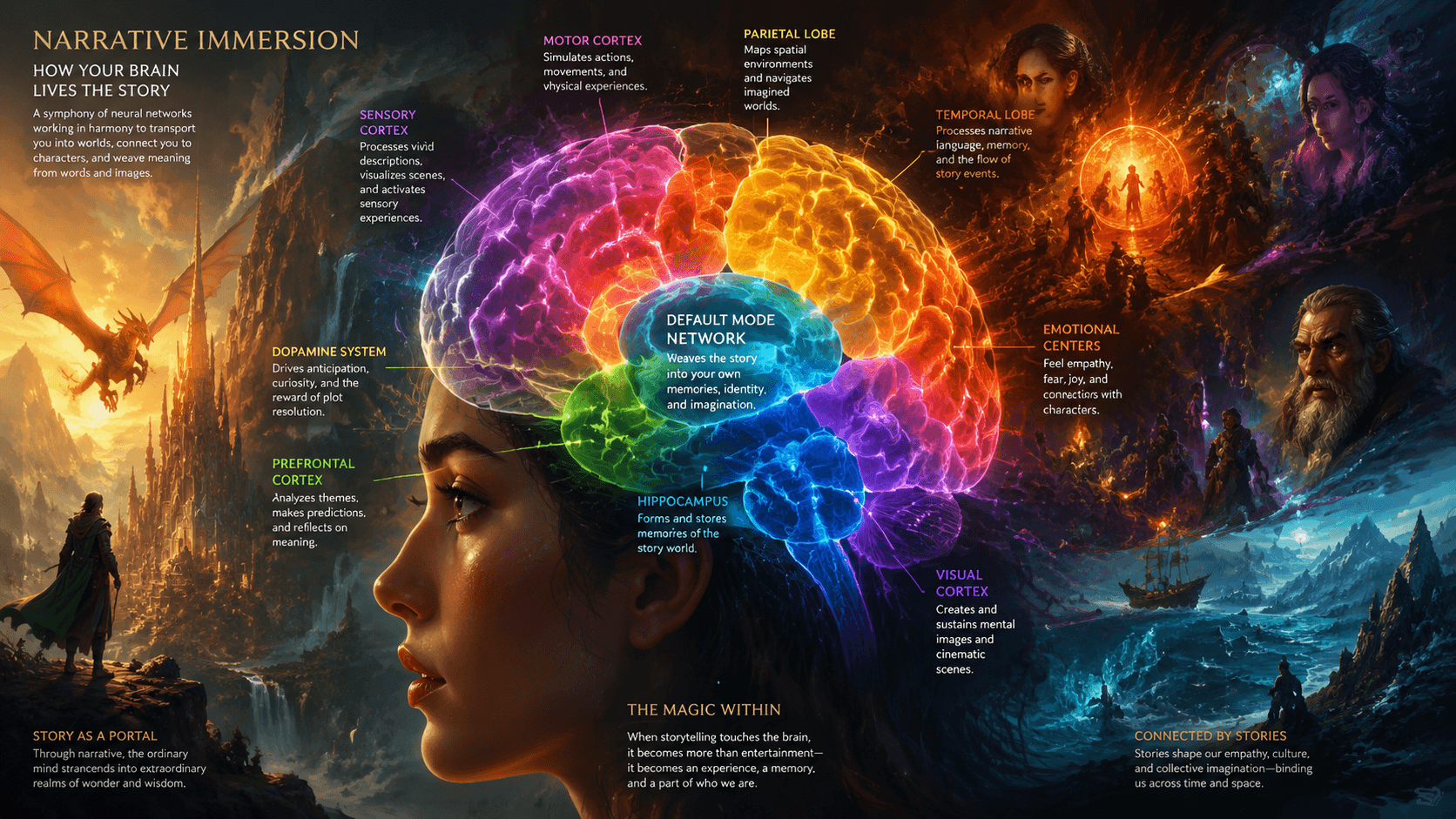
For a brain built to chase novelty, that is not a lesser form of calm. It is calm delivered in a format the brain was already built to accept, which is part of why narrative-based approaches keep showing up in ADHD-focused wellness research.
A therapist asked a patient to picture a calm beach. The patient pictured the beach, then immediately worried about the tide schedule.
When to Loop In a Professional Instead of Another App
Self-directed practice has real limits, and pretending otherwise does nobody any favors. A handful of signs suggest it is time to talk to a licensed professional before trying another self-guided technique.
Watch for anxiety that keeps climbing regardless of method, panic symptoms triggered specifically by quiet or stillness, intrusive memories surfacing during any relaxation attempt, or a general sense of feeling worse after every practice you try, not just meditation. Those patterns point toward trauma processing or a clinical anxiety condition that self-guided audio was never designed to address alone.
Key Insight
Escalating symptoms, panic tied specifically to stillness, or intrusive memories during relaxation attempts are signals to consult a licensed therapist rather than trying another self-directed technique.
Story-based practice and structured audio journeys complement professional care well for everyday stress and a restless mind. They are not a diagnostic tool and they are not a stand-in for a trained clinician when something more serious is going on, and any app that implies otherwise is overselling itself.

Story Meditation Apps Compared: Complete Guide (2026)
A closer look at how different story-based meditation apps structure their journeys, and what actually separates them.
A patient told her therapist, 'I tried meditating and now I feel worse.' The therapist said, 'good, that means you noticed something. Now let us actually look at it together.'
Your Calm Does Not Have One Shape
Start to finish, the point here is simple. If silent, seated meditation leaves you more wound up than when you started, the problem is not your discipline, and it was never a fair test of whether calm is available to you. Roughly a quarter of practitioners hit friction with the classic format, trauma history and ADHD change how a resting mind behaves, and five well-studied alternatives exist for exactly this reason.
Narrative immersion, moving practice, guided visualization, nature exposure, and sound-based technique all reach the same nervous system destination by a different road. Modern narrative meditation research keeps confirming what older traditions already suspected: attention needs somewhere to go, not just an instruction to stop moving.

How Story Based Meditation Improves Focus
A deeper look at why following a story, rather than emptying the mind, is measurably easier for many people to sustain.
If you have tried and failed at the can't meditate alternative search more than once, that is not a personal failing to fix quietly. It is a sign to change format, not effort. Visionaria builds its story-driven, spatial-audio journeys with exactly this mismatch in mind, as one option among the five above, never as a replacement for professional support when that is what is actually needed.
Find the Format That Fits You
Try a cinematic story journey built for restless minds.
A frustrated meditator finally asked her teacher, 'what if my mind just will not stop wandering?' The teacher smiled and said, 'then give it a very good story to wander through.'