
What Is an Imagination Training Practice?
🧠 Fun fact: Vividly imagining something engages some of the same brain areas as actually experiencing it, which is why imagery can feel surprisingly real. So technically, your imagination training sessions are as real as your last vacation, and require no packing.

- What Is Imagination Training? A Complete Definition
- The Science Behind Imagination Training
- How Imagination Training Differs from Traditional Meditation
- The Core Techniques of Imagination Training
- The Benefits of Regular Imagination Training
- Imagination Training for Creativity and Problem-Solving
- Guided vs. Self-Directed Imagination Training
- How Audio Technology Enhances Imagination Training
- Building Your Imagination Training Routine
- Imagination Training Across Cultures and Traditions
- Common Myths About Imagination Training
- How Visionaria Makes Imagination Training Accessible
- Why Imagination Training Matters in the Modern World
- The Bottom Line
- Frequently Asked Questions
Discover what imagination training practice is a structured approach to strengthening your mind's eye through guided visualization, sensory imagery, and narrative immersion. Learn the science, techniques, and benefits of training your imagination for creativity, focus, and well-being.
Key Facts About Imagination Training
- ••Definition: A structured practice for strengthening mental imagery, visualization, and creative exploration
- ••Scientific Basis: Neuroimaging studies confirm vivid imagination activates the same brain regions as real perception
- ••Key Benefits: Enhanced creativity, improved focus, better emotional regulation, reduced stress, sharper problem-solving
- ••Techniques: Guided visualization, sensory layering, narrative immersion, spatial audio environments
- ••Practice Time: As little as 10-15 minutes daily can produce measurable improvements within 2-3 weeks
- ••Used By: Athletes, artists, therapists, educators, meditators, and creative professionals worldwide
Quick Answer
Discover what imagination training practice is: a structured approach to strengthening your mind's eye through guided visualization, sensory imagery, and narrative immersion. Learn the science, techniques, and benefits of training your imagination for creativity, focus, and well-being.
What Is Imagination Training? A Complete Definition
Imagination training is the deliberate, systematic practice of strengthening your mind's ability to create, sustain, and manipulate mental imagery. Think of it as a gym workout for your mind's eye. Just as you might train your body through specific exercises squats for leg strength, planks for core stability imagination training uses targeted techniques to develop the neural networks responsible for visualization, creative thinking, and sensory awareness.
At its core, imagination training asks you to actively construct mental experiences rather than passively observe them. When you practice, you're not simply letting your mind wander. You're intentionally building detailed scenes, populating them with sounds, textures, and sensations, and then navigating through them with focused attention. You might find yourself walking through the streets of ancient Athens, feeling marble beneath your sandals and hearing distant conversations in the agora. Or you might explore the mythical heights of Mount Olympus, sensing the clouds parting around you as you ascend.
Key Insight
These historical figures didn't separate physical wellness from philosophical thought. To them, it was all one continuous practice of living well.
What distinguishes imagination training from ordinary daydreaming is structure, intention, and repetition. Daydreaming tends to be unfocused and reactive your mind drifts wherever circumstance or emotion takes it. Imagination training is proactive: you choose what to visualize, you set parameters for the experience, and you return to the practice consistently, building skill over time. This distinction is crucial because it's the structured nature of the practice that produces measurable neurological and psychological benefits.
The practice draws from multiple traditions and disciplines. Cognitive psychology contributes techniques for systematic visualization. Meditation traditions from Tibetan deity yoga to Ignatian spiritual exercises provide frameworks for sustained imaginative engagement. Sports psychology offers methods for multi-sensory mental rehearsal. And narrative therapy demonstrates how story-based imagination can transform emotional patterns. Modern imagination training weaves these threads together into a practice that is accessible, evidence-based, and remarkably versatile.
Imagination training isn't about "having a good imagination" it's about developing one. Research shows that visualization ability is a skill that improves with practice, not a fixed trait you're born with. People who describe themselves as "not visual" often see the most dramatic improvements because they have the most room to grow.
A time traveler went back to antiquity to teach them about 'holistic health.' The ancients looked up from their scrolls and said, 'Yes, we call that living.'
The Science Behind Imagination Training
The scientific foundation for imagination training rests on one of neuroscience's most remarkable discoveries: the brain processes vivid mental imagery using many of the same neural pathways it uses for actual perception. When you vividly imagine seeing a sunset, your visual cortex activates in patterns remarkably similar to when you actually watch one. When you imagine hearing a melody, your auditory cortex responds. This phenomenon known as neural overlap means that imagination training literally exercises the same brain systems that process real world experience.
Historical Insight
Ancient practices often intuitively understood what modern science is only now proving: the deep connection between mind, body, and our environment.
Functional MRI studies have shown that consistent imagination practice leads to structural changes in the brain. Regions associated with visualization, creative thinking, and emotional regulation particularly the prefrontal cortex, the hippocampus, and the default mode network show increased connectivity and even increased gray matter density in people who practice regularly. A 2024 meta-analysis published in Cognitive Psychology Review found that as little as 12 minutes of guided visualization per day for eight weeks produced measurable improvements in creative problem solving, working memory, and emotional resilience.
The science also reveals why multi-sensory imagination is more powerful than visual imagery alone. When you engage multiple senses during training sight, sound, touch, smell, spatial awareness you activate a broader network of brain regions, creating more robust neural pathways. This is why spatial audio technology is such a powerful catalyst for imagination training: the three-dimensional soundscape provides rich auditory scaffolding that helps the brain construct more detailed, more immersive mental environments.
Perhaps most fascinatingly, neuroplasticity research demonstrates that mentally rehearsing a skill engages many of the same brain areas as practicing it physically. A pianist who mentally practices a piece shows neural adaptation patterns nearly identical to one who practices on an actual keyboard. An athlete who visualizes a routine strengthens the same motor pathways as physical rehearsal. Mental rehearsal is widely used in sport and performance psychology, and some studies suggest that imagining a calm response in advance can make it easier to reach for in a real situation.
Brain scans revealed increased connectivity between the prefrontal cortex and the hippocampus the same networks that support innovation and insight.
"Scientists: 'Imagining a place lights up some of the same brain areas as seeing it.' Me, imagining I'm on a beach in Santorini: 'I know. And my brain says I deserve another week of vacation.'"

Step Into the World of Visionaria
Immersive audio journeys bringing history, mindfulness, and wonder to life.
Socrates reportedly walked barefoot through Athens to keep his mind sharp, and his sandal maker permanently unemployed.
How Imagination Training Differs from Traditional Meditation
If you've tried traditional meditation mindfulness, breath-focused sitting, body scanning you already have a foundation for imagination training. But the two practices differ in important ways, and understanding these differences helps you know when to use each one and how they can complement each other beautifully.
Traditional meditation typically aims to quiet the mind to reduce the flow of thoughts, cultivate non-reactive awareness, and rest in present moment experience. The classic instruction is to observe thoughts without engaging them, letting them pass like clouds across a clear sky. This approach builds equanimity, reduces reactivity, and cultivates a spacious awareness that many practitioners find profoundly peaceful. Cinematic meditation bridges both approaches.
Imagination training, by contrast, actively engages the mind's creative faculties. Instead of observing thoughts passively, you intentionally generate mental experience. You build worlds, populate them with sensory details, and navigate through them with focused curiosity. The mind isn't quiet it's working, but in a focused, pleasurable, and deeply productive way. This makes imagination training particularly well suited for people who find traditional meditation frustrating because they "can't stop thinking." In imagination training, thinking is not the obstacle it's the tool.
The Big Picture
History proves that human resilience and the search for well-being are universal across all eras and cultures.
The two practices also differ in their primary outcomes. Traditional meditation excels at developing present moment awareness, emotional regulation, and stress reduction. Imagination training excels at building creative capacity, strengthening visualization skills, enhancing narrative intelligence, and preparing the mind for novel experiences. Story-based meditation demonstrates how these outcomes can overlap the emotional depth of narrative immersion often produces the same calm that traditional meditation provides, while simultaneously training imagination and creativity.
The most effective approach for many practitioners is to use both practices. Traditional meditation to cultivate the calm, clear awareness that serves as a foundation. And imagination training to channel that awareness into creative exploration, personal growth, and the kind of vivid inner experience that makes daily life richer and more engaging. They're not competitors they're complementary dimensions of a complete mental fitness practice.
Read more: How to Experience Ancient Cities Through Meditation

"Traditional meditation: 'Empty your mind.' Imagination training: 'Fill your mind but with something amazing.' My mind: 'Finally, instructions I can actually follow.'"
Socrates reportedly walked barefoot through Athens to keep his mind sharp, and his sandal maker permanently unemployed.
The Core Techniques of Imagination Training
Imagination training encompasses several distinct techniques, each targeting different aspects of mental imagery. Understanding these techniques helps you choose the right approach for your goals and build a well-rounded practice.
1. Guided Visualization is the most accessible entry point. A narrator describes a scene in rich sensory detail, and your task is to build that scene in your mind's eye as vividly as possible. This technique is the foundation of interactive audio journeys experiences where professional narration guides you through historically accurate or fantastically imagined environments while you construct the visual, auditory, and tactile experience internally. Guided visualization is ideal for beginners because the external narrative provides structure and scaffolding for the imagination.
Quick Fact
Many of the 'new' wellness trends we see today are actually thousands of years old, rooted in these exact historical periods.
2. Sensory Layering involves systematically building up the sensory complexity of a mental scene. You might start with visual elements the shape of a room, the play of light then add sound (distant music, wind), then touch (the texture of fabric, the temperature of air), then smell (cedar, sea salt), and finally emotional tone (serenity, excitement). This technique strengthens the brain's ability to hold multiple sensory streams simultaneously, which research links to enhanced creativity and richer emotional experience.
3. Narrative Immersion uses storytelling as the vehicle for imagination training. Rather than visualizing a static scene, you enter a story a sequence of events with characters, settings, and emotional arcs. You might journey through ancient Babylon's Ishtar Gate, exploring its lapis lazuli tiles as a visiting dignitary, or walk alongside Hercules during one of his legendary trials. Narrative immersion trains the brain's capacity for empathy, perspective taking, and sequential reasoning all while providing the emotional engagement that makes practice enjoyable.
4. Open World Exploration is the most advanced technique, where you're given an environment and the freedom to explore it without a predetermined narrative. Imagine being placed in a vast library with infinite books, or standing at the entrance to an underwater city. Your imagination determines where you go, what you discover, and what happens next. This technique builds creative agency the ability to generate novel experiences from within, rather than responding to external prompts.
Read more: The Legend of Perseus and the Gorgon: Ancient Hero's Quest
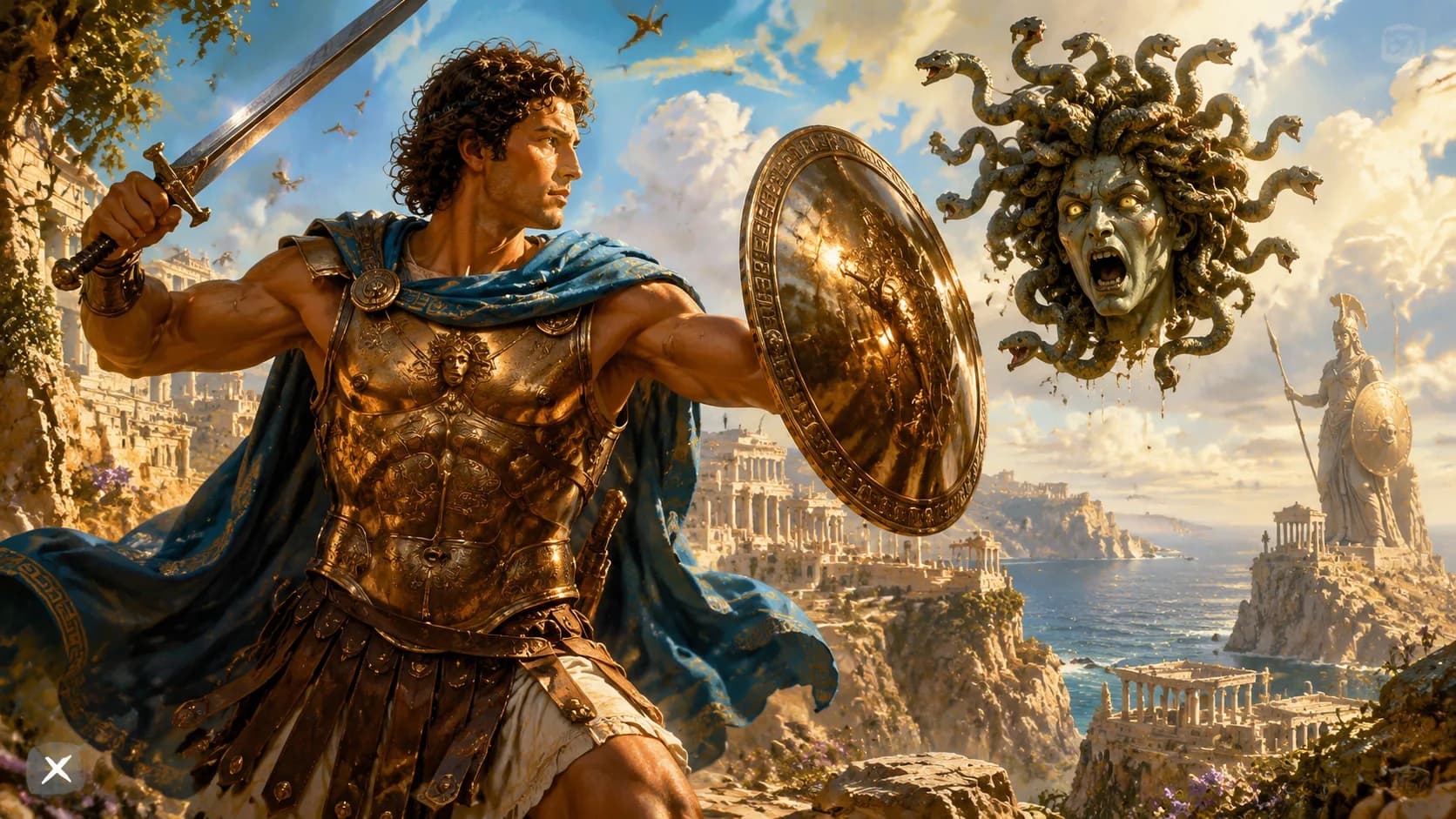
Start with guided visualization and progress toward open world exploration as your skills develop. Most practitioners find that 4-6 weeks of guided practice builds enough mental imagery strength to begin exploring more independently. Think of it like learning to paint: first you copy masters, then you paint from reference, then you create from imagination.
A philosopher walked into a wall. His students asked if it hurt. He replied, 'The wall is an illusion, but my headache is quite real.'
The Benefits of Regular Imagination Training
The benefits of consistent imagination training span cognitive, emotional, and even physical domains. While the practice might sound purely "mental," its effects ripple outward into every aspect of daily life.
Enhanced Creativity is the most widely reported benefit. Regular visualization practice strengthens the brain's ability to generate novel combinations of ideas, images, and concepts the fundamental mechanism of creative thought. Studies show that people who practice guided visualization score significantly higher on divergent thinking tests, produce more original ideas in brainstorming sessions, and report more frequent creative insights in their daily lives. This benefit extends across domains: artists, writers, engineers, entrepreneurs, and educators all report that imagination training feeds directly into their creative work.
Improved Focus and Concentration is another major benefit. Sustaining a vivid mental image requires the same attentional networks used for deep focus in any task. When you practice holding a complex imagined scene for 10-15 minutes keeping the details sharp, preventing them from dissolving you're directly training your ability to concentrate. Some people find that the focus they build during imagination training carries over to work, study, and other cognitively demanding activities.
Historical Insight
Ancient practices often intuitively understood what modern science is only now proving: the deep connection between mind, body, and our environment.
Emotional Regulation and Resilience improve because imagination training gives you practice navigating emotional landscapes in a safe environment. When you experience the tension of a narrative challenge or the awe of an imagined wonder, you're building emotional flexibility the ability to move through feelings without being overwhelmed by them. Therapists increasingly recommend guided visualization as a tool for managing anxiety, processing grief, and building confidence.
Stress Reduction is perhaps the most immediate benefit. A single imagination training session, particularly one that transports you to a serene natural setting or a historically fascinating location, can feel calming and help you slow down. The body responds to vivid imagined calm much as it responds to actual calm.
"My doctor asked what I do for stress. I said, 'I imagine I'm walking through ancient Athens.' She said, 'Is that effective?' I said, 'It's cheaper than a flight to Greece, and for a few minutes it feels almost as good.'"
Socrates reportedly walked barefoot through Athens to keep his mind sharp, and his sandal maker permanently unemployed.
Imagination Training for Creativity and Problem-Solving
The connection between imagination training and creative performance is among the best documented aspects of the practice. Creativity fundamentally depends on the brain's ability to construct novel mental representations to combine existing knowledge in new ways, to visualize possibilities that don't yet exist, and to simulate scenarios before committing to action. Imagination training directly strengthens each of these capabilities.
In creative professions, the impact is particularly striking. Writers who practice imagination training report more vivid character development, richer scene building, and a stronger connection to their narrative voice. Visual artists describe enhanced ability to pre visualize compositions before picking up a brush. Musicians find that auditory imagination training mentally hearing melodies, harmonies, and arrangements accelerates both composition and practice. And entrepreneurs report that visualization exercises help them anticipate market dynamics, envision product experiences, and communicate their vision more persuasively.
Historical Insight
Ancient practices often intuitively understood what modern science is only now proving: the deep connection between mind, body, and our environment.
For problem solving, imagination training offers a unique advantage: it allows you to mentally simulate multiple solutions before implementing any of them. Designers and engineers often "walk through" a design mentally, experiencing it from a user's perspective in vivid detail, to catch flaws before anything is built. This echoes what creativity-focused meditation practitioners describe: a trained imagination is a powerful problem solving tool.
Why did the historian break up with the archaeologist? Because her career was literally in ruins.
Guided vs. Self-Directed Imagination Training
One of the most important distinctions in imagination training is between guided and self-directed practice. Each approach offers unique advantages, and most experienced practitioners use both, depending on their goals and energy level.
Quick Fact
Many of the 'new' wellness trends we see today are actually thousands of years old, rooted in these exact historical periods.
Guided imagination training uses an external source a narrator, an audio journey, a therapist's voice to provide the framework for your visualization. The guide describes settings, introduces sensory details, and moves the narrative forward, while you do the creative work of building the mental experience. This approach is ideal for beginners because it eliminates the "blank canvas" problem the difficulty of generating rich imagery from nothing. It's also excellent for specific therapeutic goals, as a skilled guide can steer the imagination toward healing, growth promoting, or skill building scenarios. Interactive audio journeys represent the cutting edge of guided imagination, using spatial 3D audio to create rich environmental scaffolding that dramatically enhances the ease and vividness of mental imagery.
Self-directed imagination training gives you full creative control. You choose the setting, the narrative, and the pace. This approach develops creative agency the ability to generate rich, detailed, and emotionally resonant mental experiences independently. Many people find self-directed sessions especially rewarding, a little like lucid dreaming but fully conscious and intentional. Self-directed training is particularly powerful for personal growth goals: you can revisit meaningful memories with enhanced vividness, rehearse upcoming challenges with confidence, or explore entirely fictional worlds of your own creation.
The ideal progression mirrors how any skill develops: begin with guided, gradually add self-directed. Most practitioners spend their first 4-8 weeks primarily with guided sessions using guided imagination journeys then begin mixing in 5-10 minutes of self-directed exploration at the end of each session. Over time, the ratio shifts as visualization skills strengthen. Some practitioners eventually prefer self-directed practice; others continue to enjoy guided sessions for their narrative richness and the pleasure of being surprised by a story's direction. There's no "right" ratio only what serves your practice best.
"Guided imagination training: Someone drives you through a beautiful landscape. Self-directed imagination training: You're behind the wheel. Either way, the scenery is incredible and the parking is always free."
A philosopher walked into a wall. His students asked if it hurt. He replied, 'The wall is an illusion, but my headache is quite real.'
How Audio Technology Enhances Imagination Training
While imagination training can be practiced in complete silence, modern audio technology has dramatically expanded what's possible. Spatial audio three-dimensional sound that surrounds you with directional, distance-accurate audio provides the auditory dimension that the brain uses to construct immersive mental environments. When you hear birdsong from your upper left, a stream flowing at your feet, and distant thunder rolling from behind you, your brain automatically builds the corresponding spatial environment. The sound scaffolds the vision.
Research on audio-enhanced visualization shows striking results. They also maintained focus for longer periods (average session length increased from 8 to 14 minutes) and reported greater emotional engagement with the imagined scenes. The audio doesn't replace your imagination it catalyzes it, providing sensory anchors that make the creative process easier and more pleasurable.
Did You Know?
The relentless drive to understand the world was seen not just as an academic pursuit, but as a spiritual and healing practice by the ancients.
Cinematic meditation takes this principle even further by combining spatial audio with professional narrative direction, cinematic sound design, and emotionally calibrated pacing. The result is an imagination training experience that feels less like an exercise and more like stepping into a film except that you're creating the visuals yourself. This approach is particularly effective for people who are new to visualization because the richness of the audio environment does much of the heavy lifting, allowing the practitioner to focus on building their visual imagery without struggling to generate the entire sensory landscape from scratch.
Binaural beats and ambient soundscapesrepresent another audio technology used in imagination training. Some people use specific audio frequencies, such as binaural beats, hoping to encourage relaxed or dreamlike states that support visualization, though the evidence for this is mixed. When combined with narrative guidance and spatial audio, these technologies create an optimal neurological environment for imagination training a state where the brain is relaxed enough to generate freely but focused enough to maintain detailed, sustained imagery.
For optimal imagination training, use over ear headphones in a quiet environment. Spatial audio requires stereo separation to create the three-dimensional effect, and ambient noise competes with the subtle environmental sounds that help your brain build immersive mental worlds. Even mid-range headphones dramatically outperform phone speakers for this practice.
A time traveler went back to antiquity to teach them about 'holistic health.' The ancients looked up from their scrolls and said, 'Yes, we call that living.'
Building Your Imagination Training Routine
Like any meaningful practice, imagination training produces the best results when integrated into a consistent routine. The good news is that the time commitment is modest 10 to 20 minutes daily is sufficient to produce measurable improvements in visualization ability, creative thinking, and emotional well-being. Here's how to build a sustainable practice from the ground up.
Choose your time wisely. Most practitioners find that either morning or evening works best. Morning sessions set a creative, expansive tone for the day many report that problems they'd been struggling with suddenly present solutions during or after morning practice. Evening sessions, particularly with calming content like sleep storytelling journeys, promote deep relaxation and improved sleep quality. Experiment with both and notice which timing produces effects that best serve your goals.
Start smaller than you think you should. The most common reason people abandon imagination training is starting with sessions that are too long. Begin with 8-10 minute guided sessions for the first two weeks. This feels manageable and builds the habit without triggering resistance. After two weeks, gradually extend to 12-15 minutes. By week six, most practitioners comfortably enjoy 15-20 minute sessions and look forward to them as one of the highlights of their day.
Visionaria Insight
By immersing ourselves in these historical soundscapes, we reconnect with a timeless human tradition of storytelling and mental restoration.
Create a dedicated space. While you can practice imagination training anywhere, having a consistent physical space strengthens the habit through environmental association. A comfortable chair, dim lighting, and minimal distractions create conditions where your brain quickly shifts into the receptive, creative state that supports vivid visualization. Over time, simply sitting in your practice space begins to activate the neural patterns associated with imaginative engagement your brain learns that this space means it's time to create.
Track your progress. Keep a brief imagination journal just 2-3 sentences after each session noting the vividness of your imagery, any surprising creative insights, and your overall sense of engagement. After a month, you'll have concrete evidence of how your visualization abilities have grown, which powerfully reinforces the habit. Many practitioners are amazed to compare their early journal entries ("I could sort of see a blurry forest") with entries from four weeks later ("I could feel individual leaves, hear specific bird calls, and smell pine resin").
"Week 1 of imagination training: 'I think I see... something?' Week 4: 'I can count the bricks on the Parthenon and I've named three of the neighborhood cats.' Progress is delightful."
Why did the ancient physician prescribe a long walk? Because he was tired of listening to the patient complain in his office.
Imagination Training Across Cultures and Traditions
While the term "imagination training" is modern, the practice itself is ancient. Cultures around the world have developed sophisticated methods for training the imagination as a path to wisdom, healing, creativity, and spiritual growth. Understanding these traditions reveals that imagination training isn't a contemporary invention it's a rediscovery of something humans have known about for millennia.
In Tibetan Buddhist tradition, deity yoga is one of the most elaborate forms of imagination training ever developed. Practitioners construct incredibly detailed mental images of enlightened beings, complete with specific colors, ornaments, postures, and surrounding environments. These visualizations are maintained for extended periods sometimes hours and include multi-sensory elements like imagined sounds, fragrances, and physical sensations. The tradition holds that this practice doesn't merely develop the imagination but transforms the practitioner's perception of reality itself.
Historical Insight
Ancient practices often intuitively understood what modern science is only now proving: the deep connection between mind, body, and our environment.
The ancient Greeks practiced a method now called the Memory Palace (or Method of Loci), which is essentially spatial imagination training. Orators would mentally construct a familiar building, then place the elements of their speech within specific rooms. To deliver the speech, they would mentally walk through the building, retrieving each point from its imagined location. This technique, which relies on vivid spatial visualization, is still used by memory champions today and demonstrates how ancient civilizations understood the power of trained imagination.
Aboriginal Australian traditions use "Songlines" imaginative narratives that map the landscape through story and song. By learning these songlines, individuals can navigate vast distances by imagining the stories associated with each landmark. Indigenous North American traditions include vision quests that prepare practitioners through days of guided imaginative engagement. And the Sufi tradition in Islam includes muraqaba a contemplative practice that uses vivid visualization to cultivate spiritual awareness and direct connection with the divine. Each tradition confirms a universal human insight: the imagination, when trained, becomes a vehicle for transformation.
"The ancient Greeks invented the Memory Palace. The Tibetans perfected deity visualization. The Aboriginals mapped continents with imagination. And we use ours to wonder where we left our keys. Time to upgrade."
A Roman walks into a bar, holds up two fingers, and says, 'Five beers, please.'
Common Myths About Imagination Training
Despite growing scientific support, imagination training is sometimes misunderstood. Let's address the most common misconceptions so you can approach the practice with clarity and confidence.
Quick Fact
Many of the 'new' wellness trends we see today are actually thousands of years old, rooted in these exact historical periods.
Myth #1: "You need to be naturally visual to benefit." This is perhaps the most persistent misconception. While people vary in their baseline visualization ability (a small percentage have aphantasia reduced or absent mental imagery), the vast majority can develop vivid visualization through practice. Studies consistently show that people who describe themselves as "not visual" benefit more from imagination training than those with already strong visualization, because they have more room for growth. The practice builds the skill; the skill doesn't precede the practice.
Myth #2: "Imagination training is just escapism." This concern confuses disconnection with enrichment. Escapism involves avoiding reality. Imagination training engages with reality more deeply building cognitive skills, processing emotions, and developing creative capacities that directly improve daily life. Research shows that regular practitioners are more engaged with their real world responsibilities, not less, because the focus and creativity developed in practice transfer seamlessly to work, relationships, and personal projects.
Myth #3: "It's the same as daydreaming." Daydreaming is passive and unfocused the mind drifts without direction. Imagination training is active and intentional you choose what to visualize, sustain the image with focused attention, and systematically build sensory complexity. The neurological differences are measurable: imagination training activates prefrontal executive networks (associated with focus and intention) while daydreaming primarily activates the default mode network (associated with mind wandering). Both are valuable; they're just different activities.
Myth #4: "You need special equipment or training." While spatial audio technology and guided content certainly enhance the experience, the fundamental practice requires nothing more than a quiet space and your own mind. You can begin right now, with nothing but the willingness to close your eyes and build a scene. That said, tools like Visionaria's interactive audio journeys make the practice dramatically easier and more enjoyable much like how a good running shoe isn't required for running but certainly makes the experience better.
Why did the inventor of the wheel win an award? Because his idea really got things rolling.
How Visionaria Makes Imagination Training Accessible
Visionaria was built from the ground up to make imagination training accessible, enjoyable, and effective for everyone from complete beginners to experienced visualization practitioners. The app combines the latest in spatial audio technology, professional narrative design, and evidence-based storytelling psychology to create imagination training experiences that feel less like practice and more like adventure.
Did You Know?
The relentless drive to understand the world was seen not just as an academic pursuit, but as a spiritual and healing practice by the ancients.
With interactive audio journeys set in ancient cities from Athens and Sparta to Babylon, Alexandria and Troy, the app gives your imagination training practice plenty of places to explore. Each journey is crafted with archaeological and mythological accuracy, ensuring that your training is not just imaginatively rich but educationally valuable. You might walk through ancient Babylon one day and explore the Enchanted Winter Kingdom the next each experience training a different dimension of your imaginative capacity.
The cinematic meditation approach means that every journey is professionally narrated with spatial audio that surrounds you with environmental detail footsteps on cobblestones, wind through temple columns, the distant crash of waves against ancient harbor walls. This audio scaffolding makes vivid visualization dramatically easier, even for people who have never attempted imagination training before. The technology does the heavy lifting so your mind can focus on the creative, rewarding work of building your inner world.
"Visionaria: the only app where doing nothing productive looking is actually the most productive thing you'll do all day. Your boss doesn't need to know you're walking through ancient Athens on your lunch break."
What's an ancient intellectual's favorite exercise? Jumping to conclusions.
Why Imagination Training Matters in the Modern World
We live in an age of unprecedented information and diminishing imagination. The average person spends 7+ hours daily consuming visual media screens that deliver pre packaged imagery to the brain, requiring no creative effort. While this constant visual input has many benefits, it can gradually atrophy the brain's capacity to generate its own imagery. Imagination training is the antidote a practice that exercises the very neural systems that passive consumption leaves dormant.
The implications extend beyond individual well-being into the foundations of human progress. Every major innovation, artistic achievement, and social advancement in human history began as an act of imagination someone envisioning something that didn't yet exist. When we collectively lose the ability to imagine vividly and boldly, we lose the engine of progress itself. Imagination training isn't just personal development it's a contribution to humanity's creative capacity.
For children and young people, imagination training is especially vital. Research shows that unstructured imaginative play is declining, replaced by screen time that provides ready-made imagery. The result is measurable: studies report declining creativity scores among young people over the past two decades. Audio-based imagination journeys offer a compelling alternative screen-free experiences that engage the imagination powerfully while providing educational content and promoting the focused attention that children need to develop.
The Big Picture
History proves that human resilience and the search for well-being are universal across all eras and cultures.
As artificial intelligence increasingly handles routine cognitive tasks, the distinctly human capacities for imagination, empathy, and creative synthesis become more valuable than ever. Training these capacities isn't optional it's essential preparation for a future where our uniquely human gifts matter most. Imagination training is, in this sense, the most forward looking practice you can adopt: it strengthens the very abilities that will define human relevance in the decades ahead.
In an age where AI generates images, text, and music, the human ability to imagine original worlds, feel authentic emotions, and create from genuine experience becomes our most valuable asset. Imagination training doesn't compete with technology it cultivates the human capacities that technology cannot replicate.
"In the future, AI will handle all the thinking. Humans will handle all the imagining. So technically, your imagination training practice makes you more employable. You're welcome."

The Mysteries of Delphi and the Oracle Experience
Discover the mysteries of Delphi and the Oracle experience, from the Pythia's prophetic rituals and the Temple of Apollo to the Delphic Maxims, sacred ceremonies, the science behind the trance state, and how immersive...
A Roman walks into a bar, holds up two fingers, and says, 'Five beers, please.'
The Bottom Line
You've explored what imagination training is a structured, science-backed practice for strengthening your mind's capacity for vivid mental imagery, creative thinking, and emotional resilience. From the neuroscience that explains why it works to practical techniques for building your routine, from its roots in ancient wisdom traditions to its critical importance in our modern digital world, imagination training emerges as one of the most rewarding practices available to anyone with a mind and the willingness to use it.
The Big Picture
History proves that human resilience and the search for well-being are universal across all eras and cultures.
Read more: The Architecture of the Acropolis Explained

This guide covered the complete definition of imagination training, the science of neural overlap and neuroplasticity, how it differs from traditional meditation, core techniques including guided visualization and narrative immersion, possible benefits for creativity and well-being, and how interactive audio journeys make the practice accessible and enjoyable.
Experience More with Visionaria
Download the app to explore guided historical and wellness journeys.
Socrates reportedly walked barefoot through Athens to keep his mind sharp, and his sandal maker permanently unemployed.
This article is for educational and informational purposes only. Historical details are based on available research and may evolve as new evidence emerges.
Visionaria journeys are designed for relaxation, guided imagination, and personal enrichment. They are not a substitute for medical, mental health, legal, or professional advice.