
Meditation on Long Flights: Your Ultimate Sky Guide
Ancient Roman travelers on long journeys would practice a form of 'rest walking' called deambulatio, a slow, meditative stroll specifically designed to quiet the mind during transit. Even 2,000 years ago, humans understood that movement and forced stillness both have power to restore the inner world.
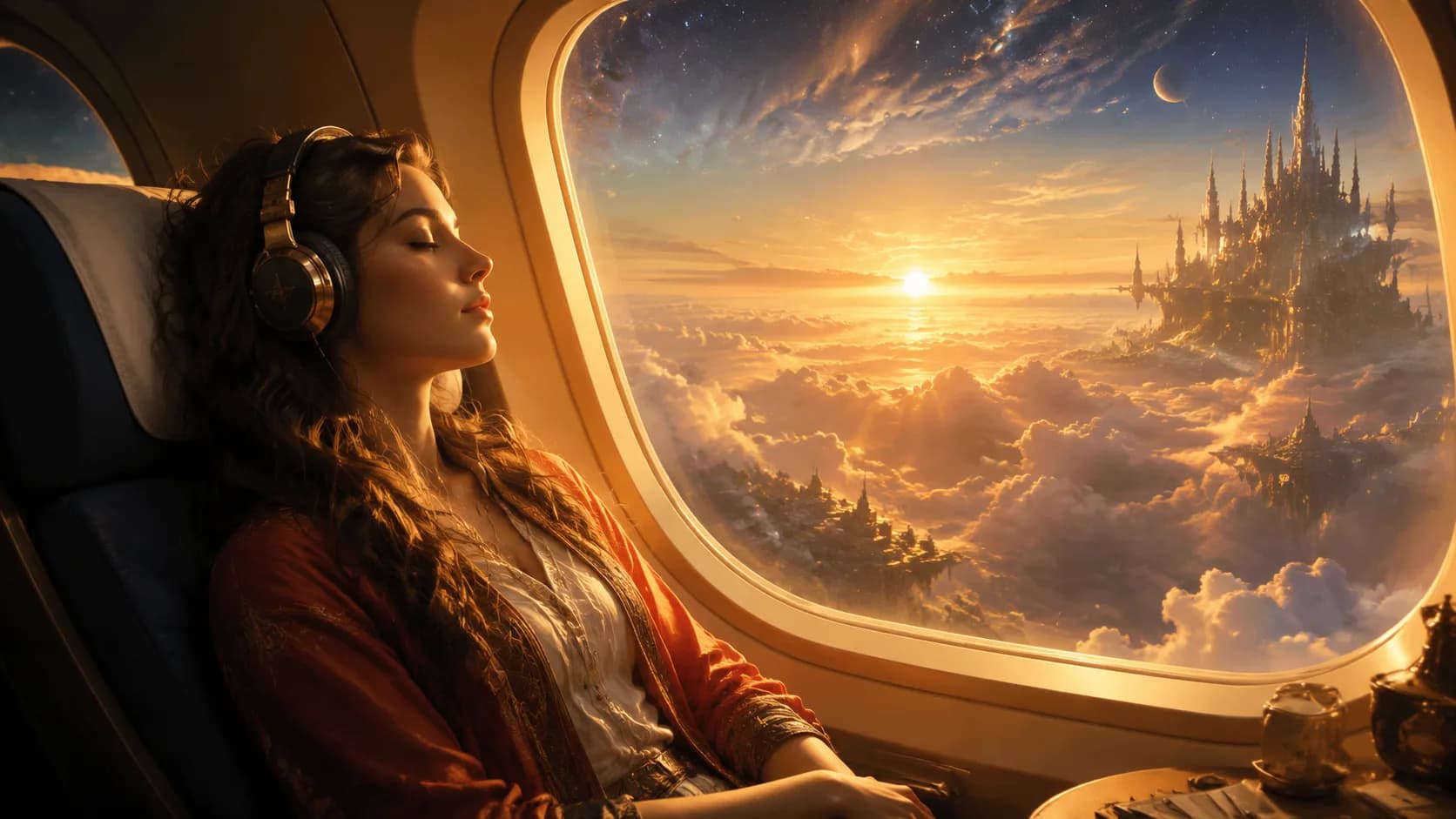
- Forced Stillness: The Hidden Gift of Long-Haul Flying
- Offline Capability: Which Apps Actually Work at 35,000 Feet
- Building the Perfect Flight Playlist: Departure to Descent
- Why Spatial Audio Hits Differently at Cruising Altitude
- The 90-Minute Sleep Cycle Strategy: Arrive Rested, Not Wrecked
- Meditation on Long Flights: Arrive at Your Destination Transformed
- Meditation on Long Flights: Your Sky-High Transformation Toolkit
- Frequently Asked Questions
Meditation on long flights involves using the enforced stillness of a 5-to-14-hour journey as a structured practice window. By combining offline audio journeys, immersive spatial sound, and alternating 90-minute sleep cycles with active guided sessions, travelers can transform what most people experience as exhausting transit into a genuine window of restorative mental calm and arrive feeling rested.
Most people treat a long flight as something to survive. Scroll, snack, watch a mediocre film, check how many hours remain, repeat. But here is the thing: a fourteen-hour flight to Tokyo or a nine-hour crossing to London is one of the rarest gifts modern life offers. Nowhere to be. No meetings. No notifications. Just you, a seat, and a sky full of stars outside the oval window. Frankly, that sounds like a meditation retreat. And with a little intention, it can become exactly that.
Key Facts About Meditation on Long Flights
- •Ideal flight length for deep practice: 5-14 hours (enough time for multiple full sleep cycles and several immersive audio journeys)
- •Sleep cycle length: 90 minutes (per Matthew Walker, University of California Berkeley, 2017)
- •Cabin noise frequency: 60-85 dB of low-frequency engine roar, which spatial audio can mask and transform
- •Offline capability: Critical. Only apps with full offline download work reliably above 35,000 feet
- •Wellness note: Audio meditation complements, not replaces, professional care for anxiety or sleep disorders
Quick Answer
Meditation on long flights means using the enforced stillness of a 5-to-14-hour journey as a structured practice window, combining offline audio journeys, spatial sound, and alternating 90-minute sleep cycles with 20-minute immersive story sessions to arrive genuinely rested rather than exhausted.
Offline Capability: Which Apps Actually Work at 35,000 Feet
Here is where most in-flight wellness plans collapse before takeoff. You queue up a beautiful guided journey, the plane reaches cruising altitude, the Wi-Fi is patchy or pay-walled, and suddenly your app is buffering at the exact moment you needed calm the most. This is not a minor inconvenience. It breaks the entire arc of a well-planned flight experience. Offline capability is non-negotiable for serious in-flight meditation, and not all apps deliver it equally.
Calm and Headspace both offer partial offline access, but their download systems can be fiddly: you need to remember to pre-download individual tracks before you leave home, and their libraries are organized for nightly use rather than long multi-hour sessions. Apps built around longer-form, cinematic audio journeys, including Visionaria with its immersive story experiences, tend to offer full album-style downloads designed specifically for extended listening. The key question to ask before any long flight is simple: can I download everything I need onto the device itself, not just cache it? If the answer requires an internet connection mid-air, keep looking.
Key Insight: Pre-Flight Download Checklist
Before boarding, download at least 6-8 hours of audio content directly to your device. Include a mix of shorter 20-minute sessions and longer 45-60 minute journeys to cover both active practice windows and sleep-adjacent listening. Never rely on airline Wi-Fi for wellness content.
And while we are here, a brief word on noise-cancelling headphones, because they are arguably the most important piece of meditation hardware you can own for flights. Bose and Sony both publish data showing their flagship models reduce ambient cabin noise by roughly 20-30 dB. That might sound modest, but it transforms the perceptual environment completely, shifting you from a loud shared space to something that feels genuinely private. Pair good noise cancellation with spatial audio and the plane effectively disappears.

Ready to Transform Your Next Long Flight?
Download Visionaria before you board and arrive somewhere completely different, inside.
Marco Polo crossed half of Asia without a single app. Granted, his journey took 24 years. Offline content downloads seem reasonable by comparison.
Building the Perfect Flight Playlist: Departure to Descent
Not all meditation is the same at 30,000 feet. Your nervous system moves through distinct phases during a long flight, and the best in-flight audio experience should track those phases rather than ignore them. Think of it as a three-act structure for your inner world, one that mirrors the arc of the journey itself.
During departure (roughly the first 60-90 minutes), your body is still buzzing. Cortisol from airport logistics, the sensory overload of boarding, and the physiological excitement of takeoff all keep your nervous system elevated. This is not the time for a silent body scan. Instead, lean into that energy with something cinematic and immersive: a richly narrated historical journey, an adventure through ancient Alexandria, a story that gives your busy mind something worthy to attach itself to. You are not trying to force calm yet. You are redirecting stimulation.
The Three-Phase Flight Playlist
Phase 1 (Departure): Energetic, narrative-rich, adventurous journeys to redirect stimulation. Phase 2 (Cruise): Mythological and deeply immersive stories for flow states and potential sleep. Phase 3 (Descent): Gentle nature soundscapes and grounding practices to prepare for arrival.
By the cruise phase, which is the long, stable middle of any transoceanic flight, your body has adjusted to the altitude, the hum of the engines has become background, and the nervous system is naturally more receptive to deeper content. Mythological journeys work exceptionally well here. Stories that take you through Olympus, ancient Norse landscapes, or across the silk roads carry a psychological depth that gently draws the mind into a dreamy, associative state, much like the drowsy moments before sleep. A 2012 review by Mary Helen Immordino-Yang and colleagues at the University of Southern California argued that the brain's default mode network, active during rest and inward reflection, helps us make meaning from experience.
Descent is its own thing entirely. Your body begins preparing for re-entry into the world, and rushing it into alert mode by switching to podcasts or news is a mistake many travelers make. Save your gentlest nature soundscapes for the final 45 minutes: ocean shores, forest rain, soft wind through high grass. These slowly walk the nervous system back toward alertness without shocking it. You arrive calm, oriented, and surprisingly present. That is a rare thing after a fourteen-hour flight, and it is entirely achievable.
Ancient Greek sailors used to sing rhythmic chants during long voyages to regulate crew morale. Turns out they were basically curating a departure playlist. Just with fewer streaming rights issues.
Why Spatial Audio Hits Differently at Cruising Altitude
Forget everything you think you know about airplane audio. Most people assume planes are terrible listening environments, and in terms of raw acoustics they are not wrong: measured cabin noise typically falls somewhere between about 60 and 85 decibels, much of it low-frequency engine and airflow noise. But here is the counterintuitive truth. That same engine roar, when combined with quality noise cancellation, creates one of the most acoustically isolated personal listening environments available outside a professional studio.
Spatial audio, meaning sound mixed in three-dimensional space rather than flat stereo, is engineered to trick the brain into perceiving a physical environment around you. Researchers at RWTH Aachen University's Institute of Technical Acoustics have spent years developing binaural techniques that recreate how sound reaches our two ears in real spaces. Put simply: your brain does not fully distinguish between hearing a waterfall through spatial audio and standing next to an actual waterfall. On a plane, where the external world has been acoustically neutralized by noise cancellation, this effect is amplified dramatically. There is nothing competing. The imagined place wins completely.
Key Insight: The Acoustic Isolation Effect
Noise-cancelling headphones reduce ambient cabin sound by 20-30 dB, creating a perceptual bubble. Inside that bubble, spatial audio becomes extraordinarily convincing because there is no competing real-world soundscape. For many people, the result is a surprisingly deep sense of immersion.
And then there is the altitude variable. Cabin pressure in commercial aircraft is maintained at the equivalent of roughly 6,000-8,000 feet above sea level. Research published in the journal High Altitude Medicine and Biology has documented that mild hypobaric conditions can subtly increase emotional sensitivity, making music feel more affecting and stories feel more vivid. Whether that is pure physiology or simply the psychological effect of being suspended between worlds, the lived experience is the same: audio on a plane, done correctly, can reach you in ways it rarely does on the ground.
Read more: Meditation for New Parents: Finding Calm in Chaos

Ancient Tibetan monks used singing bowls to create immersive sound environments for meditation. Had they discovered noise-cancelling headphones, entire monasteries might have relocated to business class.
The 90-Minute Sleep Cycle Strategy: Arrive Rested, Not Wrecked
Most long-haul travelers approach sleep as a binary: either I manage to sleep, or I do not. Both outcomes are treated as largely outside their control, somewhere between fate and seat comfort. But sleep science has a much more actionable answer, one that translates remarkably well to the airplane environment.
As Matthew Walker, professor of neuroscience and psychology at the University of California, Berkeley, explains in his 2017 book Why We Sleep, a human sleep cycle runs roughly 90 minutes. Waking mid-cycle, which is what most plane passengers do when they doze for a random hour, produces the groggy, disoriented feeling that makes long flights feel so punishing. But aligning your sleep windows to 90-minute multiples, and bookending each window with a brief, grounding audio session, changes the equation entirely.
The Alternating Cycle Protocol
On a 10-hour flight, try this structure: 20-min immersive journey to ease into rest, 90-min sleep window, 20-min gentle soundscape on waking, 90-min sleep window, 20-min mythological story for the cruise phase, then a final grounding session before descent. Total planned rest: 3 full sleep cycles.
Here is the mechanism: a well-chosen audio journey before sleep, particularly one that uses narrative transportation to shift your attention away from the anxious loop of 'am I comfortable enough to sleep,' lowers what sleep researchers call sleep onset latency. Planes may not have perfect conditions, but narrative audio quietly sidesteps most of the obstacles.
And when you wake from a properly timed 90-minute window, even at altitude, even in economy class, you wake into something that actually feels like rest. Pair that with a gentle 20-minute soundscape to reorient before the next cycle and the effect compounds across the flight. Ten hours becomes not something to survive but something to move through with genuine intention, emerging on the other side of the world feeling, almost impossibly, like yourself.
Meditation for New Parents: Finding Calm in Chaos
When stillness feels impossible, these five-minute practices restore your inner quiet fast. Perfect for transitions, whether parenthood or a long-haul flight.
Aristotle believed that sleep was the body returning to its natural state of rest after the effort of being awake. He never flew economy on a red-eye, but his instinct to protect sleep cycles was, it turns out, scientifically sound.
Meditation on Long Flights: Arrive at Your Destination Transformed
Here is an honest confession: most wellness advice for long flights is just a list of stretches and hydration reminders dressed up as wisdom. Drink water, walk the aisle, avoid caffeine after hour four. Sure. All true. But none of it addresses the deeper opportunity that long-haul travel uniquely offers, which is the chance to use a chunk of enforced stillness as a genuine reset for the mind.
When you combine the three elements covered in this guide, a library of curated audio journeys, spatial sound that isolates you from the cabin, and a structured sleep-cycle protocol, something shifts. You stop being a passenger enduring a flight and start being a traveler actively moving through an inner experience that has its own arc, its own rhythm, and its own rewards. Visionaria's library of immersive journeys was built with exactly this kind of extended, intentional listening in mind. Long-form stories that hold you for an hour or more are genuinely rare in the wellness audio space, and in the air they become something close to essential.
A Note on Wellness
Audio meditation and immersive story journeys are powerful tools for relaxation and focus, and they complement, not replace, professional care for anxiety, sleep disorders, or any medical condition. If in-flight anxiety is a significant challenge for you, please speak with a qualified healthcare provider.
At its core, meditation on long flights is about a simple and radical reframe: the flight is not the gap between your life at home and your life at the destination. It is its own space entirely. A sky room. A floating library. A rare pocket of time that belongs to no one and nothing except you. Use it well, and you arrive not just at a new place on the map, but at a slightly clearer version of yourself, which is perhaps the best kind of destination there is. For anyone looking to build this kind of practice across all the moments when life forces you to pause, the techniques for finding calm in chaotic or constrained environments translate beautifully from airplane to everyday life.
The ancient Stoics believed that any journey, however uncomfortable, was an opportunity for self-examination. Marcus Aurelius would have absolutely dominated long-haul economy class. Window seat, no WiFi, fully at peace.
Meditation on Long Flights: Your Sky-High Transformation Toolkit
Meditation on long flights is not a niche habit for wellness enthusiasts with too much carry-on space. It is, frankly, one of the most practical strategies available to any frequent flyer. Every element explored in this article, from the forced stillness of a 14-hour cabin to the neuroscience of spatial audio isolation, points toward the same conclusion: the aircraft cabin is not an obstacle to your wellbeing. Handled correctly, it becomes one of the most reliable portals to genuine mental rest you will ever find. Dr. Matthew Walker, professor of neuroscience at UC Berkeley and author of 'Why We Sleep' (2017), has long argued that horizontal rest and protected sleep cycles are among the most powerful recovery tools the human nervous system has access to. Long-haul flying, paradoxically, gives you both the time and the permission to use them. Most people squander that gift on a mediocre film they have already half-seen. You now know better.
Modern psychology has spent the last two decades catching up to something ancient travelers understood intuitively: the journey itself is part of the destination. Researchers at the University of California, Santa Barbara, including Jonathan Schooler and Jonathan Smallwood, reported in Psychological Science (2012) that letting the mind wander during an undemanding task was followed by better performance on a creative problem people had already seen. A curated flight meditation playlist that moves from energizing departure journeys through mythological cruise narratives and into calming nature descents is not entertainment. It is structured neural recovery. And the cabin environment, sealed from daylight and social interruption, provides a level of sensory consistency that most meditation teachers would struggle to engineer on the ground. Add quality headphones and a fully offline-capable app, and the conditions become extraordinary.
One final thought worth sitting with. Somewhere over the Pacific, at cruising altitude, with the cabin lights dimmed and your fellow passengers finally asleep, there is a version of you that is genuinely unreachable. No notifications. No obligations. No one asking anything. That version of you is available for maybe six to fourteen hours, depending on your route, and it will not come around again until your next long-haul flight. What you do with that window matters. Whether you choose the 90-minute sleep cycle strategy, the three-act playlist arc, or simply one well-chosen immersive journey from Visionaria's library of experiences, you are making an active choice to arrive as a more rested, more centered version of yourself. Your destination city will still be there when you land. But the quality of the person who steps off that plane? That part is entirely up to you.
Start Your First Sky-High Journey Tonight
Download Visionaria and try your first journey before you board.
A Roman senator, upon surviving his first long sea voyage, reportedly said: 'I came seeking wisdom. I found mostly seasickness and an unexpected nap. Both, it turns out, were equally instructive.'
This article is for educational and informational purposes only. Historical details are based on available research and may evolve as new evidence emerges.
Visionaria journeys are designed for relaxation, guided imagination, and personal enrichment. They are not a substitute for medical, mental health, legal, or professional advice.
Walker, Matthew. Why We Sleep: Unlocking the Power of Sleep and Dreams. Scribner, 2017.
Baird, B., Smallwood, J., Mrazek, M. D., Kam, J. W. Y., Franklin, M. S., & Schooler, J. W. Inspired by Distraction: Mind Wandering Facilitates Creative Incubation. Psychological Science, 23(10), 1117-1122, 2012.
Bor, Daniel. The Ravenous Brain: How the New Science of Consciousness Explains Our Insatiable Search for Meaning. Basic Books, 2012.
Levitin, Daniel J. This Is Your Brain on Music: The Science of a Human Obsession. Dutton, 2006.