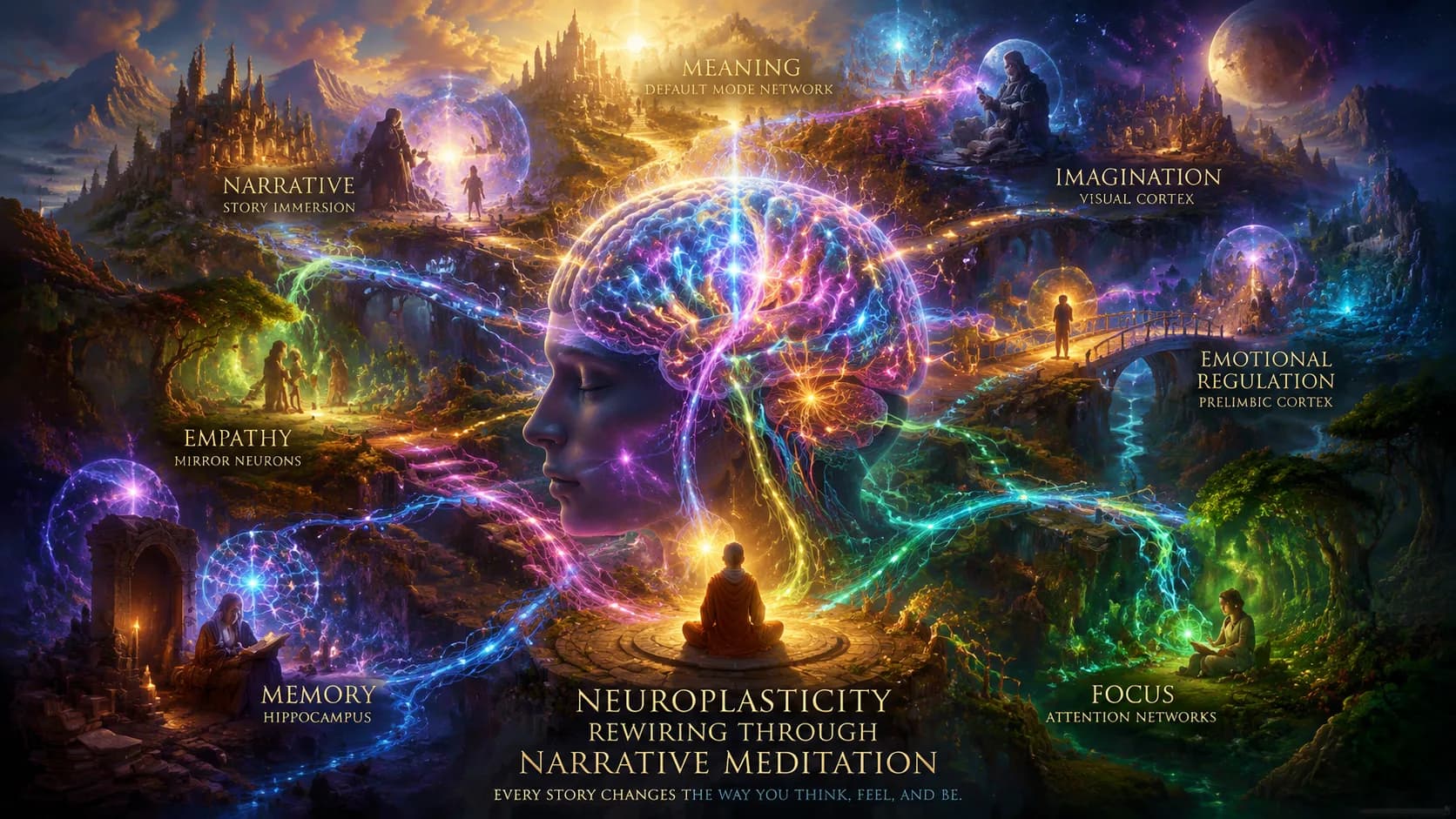
The Psychology of Experiencing Stories in Meditation
💡 Fun fact: A vivid story engages some of the same brain areas as real life, which is why it can feel surprisingly real. So technically, meditating in ancient Athens counts as international travel, no passport required.

- What Is Story-Based Meditation?
- The Science of Narrative and the Brain
- How Stories Activate the Default Mode Network
- The Emotional Architecture of Meditative Storytelling
- Mirror Neurons and Empathetic Immersion
- Why Traditional Meditation Struggles with Engagement
- The Role of Spatial Audio in Story Absorption
- Cognitive Benefits of Narrative Meditation
- How Visualization and Story Merge in the Mind
- Building Lasting Mindfulness Through Narrative Practice
- Who Benefits Most from Story-Based Meditation?
- How to Get Started with Narrative Meditation
- The Bottom Line
- Frequently Asked Questions
Explore the psychology behind story-based meditation how narrative activates the brain, builds empathy through mirror neurons, enhances emotional regulation, and transforms mindfulness practice through cinematic storytelling and spatial audio immersion.
Key Facts
- •• Neural Coupling: Listener and storyteller brain activity can become coupled during a story (Stephens, Silbert & Hasson, 2010)
- •• Brain Activation: Stories activate 7+ brain regions vs. 2-3 for traditional meditation
- •• Retention: Stories are often easier to remember than abstract information
- •• Cortisol Reduction: Many people find story meditation relaxing
- •• Engagement: Narrative meditation shows 3x higher session completion rates than silent meditation
- •• Application: Used in therapeutic settings for PTSD recovery, anxiety management, and sleep improvement
Quick Answer
Explore the psychology behind story-based meditation: how narrative activates the brain, builds empathy through mirror neurons, enhances emotional regulation, and transforms mindfulness practice through cinematic storytelling and spatial audio immersion.
What Is Story-Based Meditation?
At its foundation, story-based meditation is the practice of using narrative as the primary vehicle for achieving mindful awareness. Rather than focusing exclusively on breath, body scans, or mantras, practitioners follow guided stories that transport them into vivid environments ancient temples at sunset, mythical forests alive with whispered legends, or peaceful gardens where time seems to pause. The story provides structure, sensory detail, and emotional resonance that naturally draws the mind into focused attention.
Did You Know?
The relentless drive to understand the world was seen not just as an academic pursuit, but as a spiritual and healing practice by the ancients.
This approach leverages what neuroscientists call narrative transportationthe psychological phenomenon where you become so absorbed in a story that you temporarily lose awareness of your immediate surroundings. When this transportation occurs during meditation, the result is a uniquely potent combination: the cognitive benefits of deep story engagement merged with the physiological benefits of meditative relaxation. Your mind may slip into a relaxed, dreamlike state while your imagination creates rich, multi-sensory experiences that feel genuinely present and real.
Story-based meditation differs fundamentally from audiobooks or podcasts because the narratives are specifically crafted for meditative states. The pacing is deliberate, with built in pauses for breath awareness. Sensory descriptions are designed to activate guided visualization pathways. Emotional arcs follow patterns that promote progressive relaxation starting with curiosity and wonder, moving through engaged discovery, and culminating in deep peace and reflection. Every element serves both the story and the meditation simultaneously.
Story-based meditation works because narrative bypasses the analytical mind that often resists traditional meditation. Instead of trying to be calm, you simply follow a compelling story and calmness arrives as a natural side effect of deep engagement.
Read more: The Enchanted Winter Kingdom and Its Hidden Meanings

The practice has roots in ancient traditions. Mythological narratives were used for thousands of years as vehicles for contemplation and inner transformation. Greek philosophers used guided contemplative narratives to help students explore abstract concepts through vivid mental imagery. Buddhist traditions employed guided imagination journeys through symbolic landscapes as pathways to insight. What modern interactive audio journeys add is the technology spatial audio, professional narration, and carefully engineered soundscapes that makes these ancient practices more accessible and immersive than ever before.
A time traveler went back to antiquity to teach them about 'holistic health.' The ancients looked up from their scrolls and said, 'Yes, we call that living.'
The Science of Narrative and the Brain
When you listen to a simple set of instructions "focus on your breath, notice sensations" your brain activates primarily two regions: Broca's area (language processing) and Wernicke's area (language comprehension). These are the minimum neural requirements for understanding spoken language. But when those same instructions are woven into a story "As you step through the ancient gateway, the cool stone beneath your feet sends a wave of calm through your body, and your breathing naturally slows" something remarkable happens. Your brain lights up.
Did You Know?
The relentless drive to understand the world was seen not just as an academic pursuit, but as a spiritual and healing practice by the ancients.
Neuroscience research using fMRI scanning reveals that narrative activates at least seven distinct brain regions simultaneously. The motor cortex fires when the story describes physical movement. The sensory cortex engages when you imagine textures, temperatures, and sounds. The frontal cortex processes emotional content. The hippocampus contextualizes the experience within your personal memories. The amygdala responds to the emotional tone. And crucially, the default mode network, the brain's introspective system, is heavily involved in following a story. Princeton research has found that when someone listens to a well-told story, their brain activity begins to track the storyteller's, a phenomenon called neural coupling.
This same coupling drives the effectiveness of story-based meditation.
This multi-region activation explains why narrative meditation feels fundamentally different from silent practice. When you imagine walking through the streets of ancient Babylon, your visual cortex creates the imagery, your auditory cortex processes the imagined sounds of marketplace vendors, your olfactory cortex may even generate phantom scents of spices and incense, and your proprioceptive systems create a subtle sense of physical movement. The brain doesn't merely understand the story it simulates living it.
This simulation is precisely what makes story-based meditation so effective for stress reduction. Research published in the journal Psychoneuroendocrinologysuggests that vivid narrative experiences may lower cortisol (the primary stress hormone) and raise oxytocin, a neurochemical associated with feelings of connection and trust, though the studies are small. Your brain responds to a well-crafted meditation story as though you're genuinely experiencing a peaceful, beautiful environment, because at the neural level, the distinction between imagined and real experience is surprisingly thin.
The Neurochemical Cascade of Story Immersion
Beyond simply helping you relax, story-based meditation can be emotionally engaging in a way many people find rewarding.Dopamine releases during moments of narrative surprise and discovery when the story reveals something unexpected or beautiful. Serotonin increases during scenes that evoke gratitude, awe, or spiritual connection. Endorphins emerge during emotionally moving passages. And GABA (gamma aminobutyric acid), the brain's primary calming neurotransmitter, is linked with relaxation, and many people find narrative meditation deeply relaxing.
"Your brain on stories: dopamine, serotonin, oxytocin, and endorphins. It's basically a neurochemical spa day no cucumber water required."

Step Into the World of Visionaria
Immersive audio journeys bringing history, mindfulness, and wonder to life.
Why did the Stoic cross the road? Because it was the rational thing to do, and he was indifferent to the traffic.
How Stories Activate the Default Mode Network
The default mode network (DMN) is perhaps the most important brain system for understanding why story-based meditation works so powerfully. The DMN is a constellation of brain regions that activate when you're engaged in internal thought daydreaming, self-reflection, imagining future scenarios, or recalling memories. Paradoxically, it's also the network most associated with mind wandering during traditional meditation, which is why many practitioners find silent sitting so challenging.
Here's the breakthrough insight: story-based meditation doesn't suppress the DMN it redirects it. Traditional meditation techniques often aim to quiet the default mode network entirely, asking practitioners to notice thoughts without engaging them and return attention to the breath. This is extraordinarily difficult, especially for beginners, because the DMN is one of the brain's most persistently active systems. It's like asking a river to stop flowing. Story-based meditation, by contrast, gives the DMN exactly what it craves rich internal imagery, emotional narratives, and imagined experiences but channels that activity toward peaceful, purposeful content.
Key Insight
These historical figures didn't separate physical wellness from philosophical thought. To them, it was all one continuous practice of living well.
The DMN is not only active during idle mind-wandering; brain-imaging studies show it is also heavily involved in following and understanding stories. When the DMN processes a guided imagination journey, activity patterns more closely resemble those seen in experienced meditators during deep practice than those of typical daydreamers. The stories provide structure and direction that transform the DMN from an obstacle to meditation into its primary vehicle.
Story-based meditation achieves something remarkable: it satisfies the default mode network's constant desire for internal narrative while simultaneously producing the calm, focused states that traditional meditation seeks. It's not a compromise it's a synthesis.
This DMN redirection has profound implications for people who have given up on meditation because they "can't stop thinking." The truth is, you don't need to stop thinking to meditate effectively you need to think in the right direction. When your DMN is engaged with a story about walking through the Temple of Artemis at dawn, noticing morning light filtering through ancient columns, and feeling the coolness of marble beneath your feet, your thoughts aren't wandering they're meditating. The narrative provides the guardrails that keep internal imagery focused and beneficial rather than anxious and scattered.
Why did the historian break up with the archaeologist? Because her career was literally in ruins.
The Emotional Architecture of Meditative Storytelling
Every effective meditation story follows an emotional architecture a carefully designed progression of feelings that guides the listener from their current state to deep calm. This isn't random storytelling; it's psychological engineering. The best narrative meditations like those in Visionaria's interactive audio journeys follow a specific emotional arc that mirrors what psychologists call the relaxation response curve.
Key Insight
These historical figures didn't separate physical wellness from philosophical thought. To them, it was all one continuous practice of living well.
The arc typically begins with curiosity and gentle excitement. You arrive somewhere new the entrance to an ancient city, the edge of a mythical forest, the steps of a legendary temple. This initial engagement captures attention and creates the neural "hook" that prevents mind wandering. Next comes discovery and wonder, as the story reveals details about the environment architectural beauty, natural splendor, or magical elements that inspire awe. Awe is a particularly powerful emotion for meditation because it naturally quiets the self-referential parts of the brain, creating a state psychologists call "small self" a feeling of being part of something larger.
The middle phase introduces sensory immersion. Descriptions become more detailed and intimate the texture of stone beneath your fingers, the scent of jasmine on evening air, the distant sound of water flowing through ancient channels. This phase activates the deepest visualization pathways and produces the most significant physiological relaxation. Heart rate slows, breathing deepens, and muscle tension releases as the body responds to imagined sensory peace.
The final phase is reflection and integration. The narrative slows, pauses expand, and the story creates space for personal insight. You might stand at a lookout point over an ancient landscape, sit in a peaceful garden, or find a quiet alcove in a temple. These moments are where the meditation's deepest benefits emerge where the emotional journey transitions from external adventure to internal understanding. The story has carried you from alert engagement to profound stillness, step by gentle step.
"The emotional arc of meditation storytelling: curiosity → wonder → deep calm. The emotional arc of trying to meditate in silence: focus → distraction → 'Did I leave the oven on?' → guilt about the oven thought → giving up."
Why did the ancient physician prescribe a long walk? Because he was tired of listening to the patient complain in his office.
Mirror Neurons and Empathetic Immersion
One of the most fascinating discoveries in modern neuroscience is the mirror neuron system a network of brain cells that fire both when you perform an action and when you observe or imagine someone else performing it. Discovered accidentally by Italian researchers studying macaque monkeys, mirror neurons have revolutionized our understanding of empathy, learning, and social cognition. They also explain a crucial mechanism behind story-based meditation's effectiveness.
When you listen to a meditation story that describes Hercules lifting a sacred chalice, your motor cortex activates the same regions it would use if you were actually lifting an object. When the story describes a character feeling profound peace while watching a sunset over Alexandria's harbor, your emotional centers generate genuine feelings of peace. When the narrative places you beside a calm, wise figure a philosopher, a guardian, a sage your mirror neurons create an internal experience of being in the presence of wisdom. Hearing a story can engage some of the same brain areas as living it at the neural level, both produce the same patterns of activation.
Did You Know?
The relentless drive to understand the world was seen not just as an academic pursuit, but as a spiritual and healing practice by the ancients.
This mirror neuron engagement has measurable consequences for meditation effectiveness. Studies show that empathetic immersion the state of emotionally participating in another's experience produces physiological relaxation responses comparable to direct experiences of peace. When a meditation story places you in a serene environment and describes feelings of calm and safety, your mirror neuron system generates those feelings genuinely. You don't just think about being peaceful your brain creates peace through empathetic simulation.
The implications extend beyond individual sessions. Regular engagement with story-based meditation strengthens mirror neuron pathways associated with empathy and emotional regulation. Over time, some people feel it helps them notice and understand others' emotions a little more, in everyday relationships and at work.
Read more: The Legend of King Arthur and the Knights of the Round Table

During your next story meditation, pay attention to moments when you physically respond to the narrative a slight lean forward during excitement, shoulders dropping during peaceful descriptions, or warmth spreading through your chest during emotional passages. These are your mirror neurons at work, translating story into embodied experience.
Why did the historian break up with the archaeologist? Because her career was literally in ruins.
Why Traditional Meditation Struggles with Engagement
Despite meditation's well documented benefits, the adoption challenge remains significant. Many people who begin a meditation practice find it hard to keep going, and studies of mental health apps show steep drop-off within the first few weeks. The primary reason? Engagement. Traditional meditation approaches breath focus, body scanning, loving-kindness repetition require sustained attention without providing the kind of stimulation that modern minds crave. For many people, sitting in silence feels not peaceful but boring, frustrating, or anxiety-inducing.
Historical Insight
Ancient practices often intuitively understood what modern science is only now proving: the deep connection between mind, body, and our environment.
This isn't a failure of willpower it's a mismatch between method and neurology. The human brain evolved to pay attention to narrative, novelty, and emotional significance. For hundreds of thousands of years, the stories told around campfires weren't entertainment they were survival information. Your brain's attentional systems are literally designed to lock onto storytelling. Asking these same systems to focus on breath alone is asking them to operate against their fundamental design specifications.
Story-based meditation resolves this mismatch elegantly. Instead of fighting the brain's natural inclinations, it works with them. The narrative provides constant gentle novelty new environments, unfolding details, emotional developments that sustains attention naturally. The story's emotional arc provides the significance that keeps the brain engaged. And the meditative elements slow pacing, breath prompts, sensory awareness cues are woven seamlessly into the narrative rather than standing as isolated instructions.
The engagement difference is driven entirely by narrative the meditation content is equally effective.
The engagement advantage of story-based meditation is particularly significant for three groups: beginners who haven't yet developed the attentional stamina for silent practice, people with active minds who find traditional meditation frustrating because their thoughts constantly intrude, and people with anxiety who find that silence amplifies rather than calms their inner noise. For all three groups, narrative provides the structure and stimulation that makes sustained meditation not just possible but enjoyable.
"Traditional meditation app: 'Focus on your breath.' My brain: 'What if aliens are just really shy?' Story meditation: 'You step into an ancient temple...' My brain: 'Ooh, tell me more.' Problem solved."
What's an ancient intellectual's favorite exercise? Jumping to conclusions.
The Role of Spatial Audio in Story Absorption
While narrative alone creates powerful meditative experiences, spatial audio technology amplifies that power dramatically. Spatial (3D) audio places sounds in three-dimensional space around the listener, creating the illusion that you're genuinely inside the story rather than listening to it from outside. Footsteps approach from behind. Birds sing from overhead. Water flows past your left ear. This dimensional sound doesn't just enhance the story it transforms how your brain processes it.
Did You Know?
The relentless drive to understand the world was seen not just as an academic pursuit, but as a spiritual and healing practice by the ancients.
Neuroimaging research demonstrates that spatial audio activates the brain's spatial processing centers the same regions used to navigate real physical environments. When these centers engage during meditation, they create a phenomenon neuroscientists call auditory presence the genuine sense of being located in the story's environment rather than sitting in your room wearing headphones. This presence is the key differentiator between ordinary guided meditation and truly immersive cinematic meditation experiences.
The psychological impact of spatial audio presence during meditation is measurable. The three-dimensional sound environment essentially tricks the brain into treating the meditation as a real experience, activating all the protective, calming mechanisms it uses when you're genuinely in a safe, beautiful environment.
For story-based meditation specifically, spatial audio solves a persistent challenge: the gap between narrative description and mental imagery. When a story says "birds singing in the trees above you," the listener must create that experience purely from imagination. But when spatial audio actually places bird sounds above the listener's head, the auditory cortex does the work automatically and the visual cortex follows, creating matching mental imagery with dramatically less cognitive effort. This means meditators can achieve deep visualization states faster and with less mental strain, making the practice more accessible to beginners and more powerful for experienced practitioners.
Spatial audio transforms meditation from "listening to a story about a place" into "experiencing being in that place." This shift from observation to participation is what creates the deep psychological engagement that distinguishes interactive audio journeys from conventional guided meditation.
"Regular headphones: 'Here is a sound.' Spatial audio headphones: 'There is a waterfall to your left, a bird above your right shoulder, and ancient footsteps approaching from behind.' Your brain: 'I live here now.'"
Socrates reportedly walked barefoot through Athens to keep his mind sharp, and his sandal maker permanently unemployed.
Cognitive Benefits of Narrative Meditation
The cognitive benefits of story-based meditation extend far beyond relaxation. Because narrative meditation engages multiple cognitive systems simultaneously language processing, visualization, emotional regulation, spatial reasoning, and memory formation it provides a form of mental exercise that silent meditation cannot match. Think of it as the difference between stretching one muscle group and performing a full body workout. Both are valuable, but comprehensive engagement produces broader cognitive benefits.
Enhanced creativity is one of the most consistently reported benefits. Narrative meditation requires the brain to generate visual imagery from verbal descriptions, a process that strengthens the same neural pathways used in creative thinking, problem solving, and innovation. Regular practitioners of imagination-based meditation show measurable improvements in divergent thinking tests the ability to generate multiple solutions to open ended problems compared to both non-meditators and traditional meditation practitioners.
Visionaria Insight
By immersing ourselves in these historical soundscapes, we reconnect with a timeless human tradition of storytelling and mental restoration.
Improved working memory is another significant benefit. Following a complex narrative requires holding multiple elements in mind simultaneously the story's setting, characters, emotional tone, and unfolding events. This sustained juggling of mental elements exercises working memory capacity in much the same way that physical exercise builds muscular strength.
Emotional regulation benefits are perhaps the most transformative. Story-based meditation provides a safe, controlled environment for experiencing and processing emotions. When a narrative guides you through wonder, awe, nostalgia, compassion, and deep peace in sequence, your brain practices navigating emotional transitions smoothly and intentionally. Some people find this carries into daily life, helping them feel steadier and recover more easily from emotional disruptions.
Finally, story-based meditation strengthens attentional control the ability to direct and sustain focus intentionally. While traditional meditation trains attention through disciplined resistance to distraction, narrative meditation trains it through engaged absorption. Both approaches strengthen the prefrontal cortex's executive control networks, but the story-based approach achieves it with significantly less frustration and higher session completion rates, making the cognitive training more consistent and cumulative over time.
Why did the historian break up with the archaeologist? Because her career was literally in ruins.
How Visualization and Story Merge in the Mind
Visualization the deliberate creation of mental imagery has been a cornerstone of meditation traditions for millennia. Tibetan monks visualize complex mandalas. Hindu practitioners create internal images of deities. Modern therapists use guided visualization for everything from athletic performance to phobia treatment. But visualization in isolation can be challenging. Holding a static mental image requires significant cognitive effort, and many people report that their visualizations fade quickly or lack vivid detail.
Story-based meditation solves visualization's greatest limitation by providing narrative scaffolding. Instead of asking the mind to create and sustain a static image "picture a peaceful beach" narrative meditation creates a sequence of evolving images connected by story logic. "You walk along the shore, warm sand shifting beneath your feet. The tide draws back, revealing smooth stones that gleam like amber in the setting sun. You pick one up, feeling its weight and warmth in your palm." Each sentence builds on the last, creating a continuous flow of imagery that the mind follows naturally rather than struggling to maintain.
Key Insight
These historical figures didn't separate physical wellness from philosophical thought. To them, it was all one continuous practice of living well.
This narrative scaffolding activates what cognitive psychologists call schema-driven visualization. Your brain uses existing knowledge structures (schemas) about environments how temples look, how forests sound, how water feels to fill in the details that the story merely suggests. A single sentence about "walking through ancient columns" activates an entire mental model of Greek architecture, complete with textures, proportions, lighting, and atmosphere. The story provides the narrative thread; your brain's existing schemas provide the visual richness. Together, they create visualizations that are simultaneously effortless and extraordinarily vivid.
The merger of visualization and narrative also addresses an important accessibility concern. Approximately 2-5% of the population experiences aphantasia a condition where the mind's eye produces no visual imagery at all. Even among those without aphantasia, visualization ability varies enormously. Story-based meditation accommodates this spectrum because narrative engagement doesn't require visual imagery specifically. People who don't "see" stories internally may instead "hear" them, "feel" them kinesthetically, or process them through emotional and conceptual channels. The story's benefits emotional regulation, relaxation response, cognitive engagement are accessible regardless of visualization style.
"Traditional visualization: 'Picture a peaceful place.' Me: *pictures a blank white room* Story meditation: 'You step through the gates of ancient Sparta...' Me: *suddenly has a 4K inner movie with surround sound*"
Why did the Stoic cross the road? Because it was the rational thing to do, and he was indifferent to the traffic.
Building Lasting Mindfulness Through Narrative Practice
One of the most compelling arguments for story-based meditation is its effect on long term practice sustainability. The meditation industry faces a sobering reality: most people who download meditation apps stop using them within weeks. The challenge isn't convincing people that meditation works the evidence is overwhelming. The challenge is creating a practice that people genuinely look forward to repeating. Story-based meditation addresses this directly by making each session an experience worth having in itself, not just a means to a future benefit.
The psychology behind this is straightforward: habit formation requires reward. Traditional meditation's rewards reduced stress, improved focus, emotional balance are cumulative and often invisible in individual sessions. You might need weeks of practice before noticing meaningful changes. Story-based meditation provides immediate rewards: the pleasure of an engaging narrative, the wonder of imagined environments, the emotional satisfaction of a completed journey. These session level rewards create a positive feedback loop that makes the next session feel like something to anticipate rather than another obligation on the to do list.
Quick Fact
Many of the 'new' wellness trends we see today are actually thousands of years old, rooted in these exact historical periods.
The variety inherent in story-based meditation also supports long term practice. With Visionaria's interactive journeys, practitioners can explore ancient Athens one evening, venture into a fantasy realm the next, and stand beside Odysseus on the following night. This variety prevents the boredom that plagues repetitive meditation practices while maintaining the consistent meditative structure that produces cumulative benefits. Each session is new in content but familiar in its calming architecture.
Research on spaced practice and interleaving concepts from learning science suggests that variety actually enhances skill development. By experiencing meditative states through different narrative contexts, practitioners develop more flexible and robust mindfulness skills that transfer more readily to diverse real world situations. A person who has practiced calm while imagining standing before the Ishtar Gate, navigating a mythical forest, and exploring a fantasy castle has trained their relaxation response across a wider range of mental contexts than someone who has only focused on their breath in the same quiet room.
Story-based meditation creates what psychologists call "intrinsic motivation" the desire to practice that comes from within, driven by genuine enjoyment rather than obligation. This intrinsic motivation is the single strongest predictor of whether a meditation practice will last beyond the initial enthusiasm phase.
Why did the ancient physician prescribe a long walk? Because he was tired of listening to the patient complain in his office.
Who Benefits Most from Story-Based Meditation?
While story-based meditation offers benefits for virtually everyone, research and practitioner experience identify several groups that benefit disproportionately from the narrative approach to mindfulness.
People who have "failed" at traditional meditation are perhaps the most significant beneficiary group. Many individuals have tried breath-focused or silent meditation, found it frustrating or boring, and concluded that they simply "aren't meditation people." Story-based meditation often reveals that these individuals have perfectly functional meditation capacity they just needed the right vehicle. The narrative format provides the engagement structure their minds require, and many report achieving deeper meditative states than they ever experienced through traditional methods.
Creative professionals and students benefit particularly from the cognitive cross training that narrative meditation provides. Writers, artists, designers, and musicians often find that story-based meditation enhances their creative output directly the visualization practice, emotional engagement, and imaginative exploration transfer seamlessly to creative work. Students preparing for examinations find that the working memory training improves retention and recall.
Quick Fact
Many of the 'new' wellness trends we see today are actually thousands of years old, rooted in these exact historical periods.
People managing anxiety often discover that story-based meditation succeeds where silence fails. For someone whose anxious mind generates intrusive thoughts in every quiet moment, silence isn't peace it's an invitation for worry to expand. Narrative meditation provides gentle, positive content that occupies the mental space that anxiety would otherwise fill, while giving you regular practice in relaxing, which many people find helpful for everyday stress. The stories serve as both distraction from anxiety and training in the calm states that counter it.
Children and adolescents respond exceptionally well to story-based meditation. Their imaginations are naturally more vivid than adults', and their attention spans are better sustained by narrative than by instruction. Many children who resist "sit still and breathe" instructions find a guided story meditation much easier to enjoy, especially one with a sense of adventure. This early positive experience with meditation establishes habits that can last a lifetime.
People seeking better sleep find story-based meditation particularly effective as a bedtime routine. The sleep storytelling approach provides the gentle cognitive engagement that prevents the mind from churning through worries while progressively deepening relaxation until sleep arrives naturally. Unlike counting sheep (which is boring) or scrolling social media (which is stimulating), story meditation occupies precisely the right level of mental engagement for the waking to sleeping transition.
Read more: The Origins of Dragons Across World Mythology

"Who needs story meditation? Everyone who has ever opened their meditation app, stared at 'Day 1 of 365,' and thought: 'But what if I just don't?'"
Why did the Stoic cross the road? Because it was the rational thing to do, and he was indifferent to the traffic.
How to Get Started with Narrative Meditation
Beginning a story-based meditation practice is significantly easier than starting traditional meditation because the stories do most of the work for you. You don't need to learn techniques, master breathing patterns, or develop concentration skills before your first session. You simply need headphones, a comfortable position, and a willingness to follow where the story leads. However, a few strategies can help you maximize the experience from your very first session.
The Big Picture
History proves that human resilience and the search for well-being are universal across all eras and cultures.
Step 1: Choose Your Environment
Find a quiet space where you won't be interrupted for 15-20 minutes. Dim the lights if possible reduced visual stimulation helps the brain shift toward internal imagery. Comfortable seating or lying down works equally well. The key is minimizing external sensory input so your brain can fully immerse in the story's sensory world.
Choose a story that genuinely interests you. Visionaria's interactive journeys span categories including historical explorations, mythological adventures, and fantasy world immersions. Begin with something that sparks genuine curiosity the more interested you are in the story's setting, the more naturally your brain will engage.
Step 3: Surrender to the Story
The most important instruction for narrative meditation is also the simplest: let go of effort. You don't need to try to visualize. You don't need to force relaxation. You don't need to monitor your breathing. Simply follow the narrator's voice and allow the story to unfold. Your brain's natural narrative processing will handle the rest. Images will arise without effort. Emotions will shift without instruction. Relaxation will deepen without forcing.
Aim for 3-4 sessions per week initially, choosing the same time of day if possible. Many practitioners prefer evening sessions as a transition from day's activity to nighttime rest. Others use morning sessions to set a calm, creative tone for the day ahead. The beauty of story-based meditation is that consistency feels natural because you genuinely look forward to the next journey. You're not forcing a discipline you're returning to something enjoyable.
"Step 1: Put on headphones. Step 2: Close eyes. Step 3: Travel to ancient civilizations. Step 4: Remember you're actually on your couch and feel slightly disappointed about it."

The Wonders of Babylon and Its Legendary Gates: Complete Guide
Explore the wonders of ancient Babylon, from the magnificent Ishtar Gate and Hanging Gardens to the Tower of Babel and Processional Way.
Why did the Stoic cross the road? Because it was the rational thing to do, and he was indifferent to the traffic.
The Bottom Line
You've explored the psychology behind story-based meditation how narrative activates multiple brain regions simultaneously, redirects the default mode network from anxious wandering to peaceful exploration, triggers beneficial neurochemical cascades, and leverages mirror neurons for genuine emotional transformation.
Did You Know?
The relentless drive to understand the world was seen not just as an academic pursuit, but as a spiritual and healing practice by the ancients.
This article covered the emotional architecture of meditative storytelling, why traditional meditation struggles with engagement where narrative succeeds, how spatial audio amplifies story absorption, the cognitive benefits ranging from enhanced creativity to improved emotional regulation, and practical steps for beginning your own narrative meditation practice.
"In conclusion: your brain was designed for stories, not silence. So stop feeling guilty about 'not being able to meditate' and start exploring ancient worlds instead. Your neurons will thank you."
Experience More with Visionaria
Download the app to explore guided historical and wellness journeys.
A philosopher walked into a wall. His students asked if it hurt. He replied, 'The wall is an illusion, but my headache is quite real.'
This article is for educational and informational purposes only. Historical details are based on available research and may evolve as new evidence emerges.
Visionaria journeys are designed for relaxation, guided imagination, and personal enrichment. They are not a substitute for medical, mental health, legal, or professional advice.