
Meditation Alternatives for an Anxious Mind
Aristotle'sPeripatetic schoolgot its name from the Greek word for 'walking', because he taught philosophy while pacing the covered walkways of the Lyceum. Some historians consider it one of the earliest recorded uses of movement as a deliberate tool for clearer thinking.

Traditional meditation asks an anxious brain to sit still and hold empty attention, and for a real share of people that instruction backfires entirely. If closing your eyes and breathing deeply leaves you more wound up, not less, the fix isn't more discipline. It's a different method, closer to whatactually happens in an anxious brainduring those first few minutes.
This isn't an argument against meditation broadly. Plenty of people find real calm in silence. But for anxious minds specifically, five alternatives consistently outperform sitting still: walking,narrative immersion, progressive muscle relaxation, visualization, and sound therapy. Here's the evidence behind each, and how to figure out which one fits your particular brain.
Key Facts About Meditation Alternatives for Anxiety
- •Core problemSilent meditation demands attention anxiety already disrupts
- •Key theoryIronic process theory, Daniel Wegner, 1987
- •Five alternativesWalking, narrative immersion, muscle relaxation, visualization, sound therapy
- •Relaxation technique originEdmund Jacobson, University of Chicago, 1938
- •Best fitMatch the method to your brain type, not the other way around
Quick Answer
If sitting still and breathing deeply makes your anxiety louder instead of quieter, the problem isn't willpower.It's a mismatch of method.Walking, narrative immersion, progressive muscle relaxation, visualization, andspatial sound therapyall redirect an anxious mind toward something concrete, which for many people works better than asking attention to hold onto nothing.
When Traditional Meditation Backfires
A lot of people try meditation, feel worse within the first few minutes, and quietly conclude they're 'bad at it.' That conclusion is almost always wrong.Sitting still and monitoring the breath demands sustained, narrow attention, exactly the resource anxiety erodes first.
Psychologists studying Attentional Control Theory have found that anxiety pulls focus toward threat related cues almost automatically, making it genuinely harder to hold neutral, sustained attention on something as plain as an inhale. Ask that same brain to do 'nothing' and it doesn't go quiet. And here's the thing worth sitting with: it fills the space with whatever worry is loudest, because worry is the most familiar signal available.
Quick Insight
If your chest tightens within the first two minutes of sitting down to meditate, that reaction is information, not failure. Your attention system is asking for an active target.
This is the real reason so many meditation apps see people quietly stop within weeks. It was never really about discipline. It was a mismatch between what the technique asks for and what ananxious nervous systemcan actually offer in that moment.

A meditation teacher walks into a bar. The bartender asks what's wrong. He says, 'Nothing, I'm working on it.'
Three Alternative Paths That Actually Calm an Anxious Brain
Walking is the oldest alternative on this list by a wide margin. Aristotle's Peripatetic school taught philosophy on foot through the Lyceum's covered walkways, and modern anxious minds tend to respond the same way his students reportedly did: better focus in motion than sitting still. Movement gives excess nervous energy somewhere physical to discharge, instead of asking the body to override it through stillness.
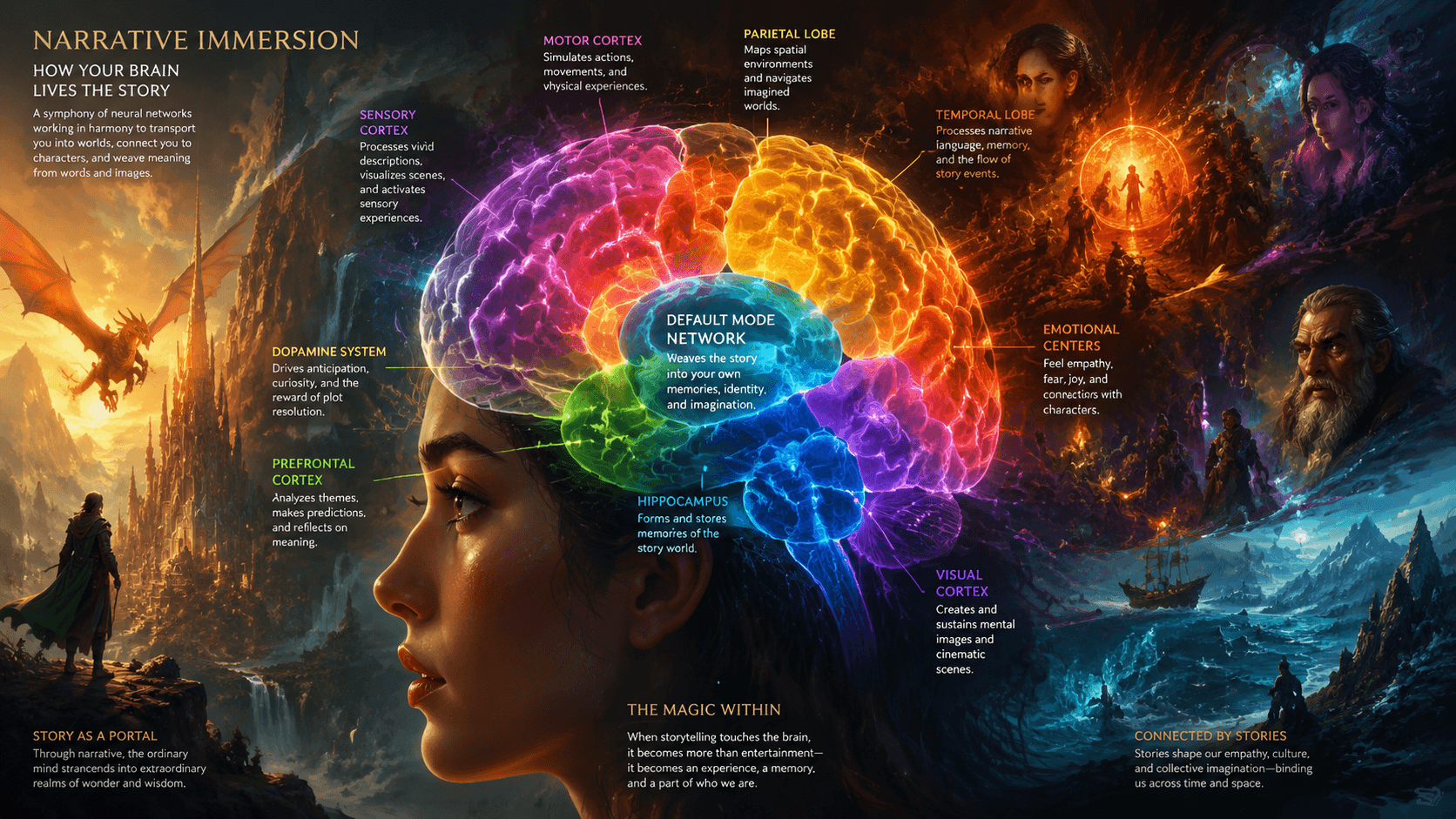
Narrative immersion is the second. Astory based sessiongives an anxious mind a concrete destination, occupying the same mental space that rumination usually claims. Psychologists Melanie Green and Timothy Brock described this as narrative transportation in 2000: an absorbing enough story shifts attention almost entirely onto its own world, and real worries lose their grip on the foreground while that's happening.
Why This Works
Rumination needs spare mental bandwidth to keep running. Movement and story both consume that bandwidth on purpose, which is why they tend to quiet an anxious mind faster than asking it to sit and do nothing.
The third path is sound therapy, specifically the immersive,fully spatial kindrather than flat background noise. Layered, directional audio gives the anxious mind more sensory detail to track, which leaves less room for the worry loop to run underneath it.
None of these three require special equipment or a quiet room. A shortwalk through an imagined ancient marketworks just as well through headphones on a real, noisy commute.
Why did the anxious philosopher pace while he thought? Sitting still felt like admitting the thoughts had won.
Two More Alternatives Worth Trying
Progressive muscle relaxation is the fourth alternative, and it's older than most people assume. Physician Edmund Jacobson developed the technique at the University of Chicago in the 1930s, built on a simple, physical insight: you cannot stay mentally tense while your major muscle groups are deliberately, sequentially relaxed. It gives the body a clear job, tense this, release that, rather than an abstract instruction to 'calm down.'
Worth Knowing
Progressive muscle relaxation works precisely because it's physical, not abstract. An anxious mind that can't simply decide to relax can often still follow a concrete instruction: clench the fist, hold, release.
Visualization is the fifth. Guidedvisualization strengthens the same neural pathwaysused in real sensory experience, which is part of why a vividly imagined scene can shift a physiological state almost as effectively as being there. Unlike breath focus, visualization gives attention a rich, evolving scene to hold onto rather than a single static sensation.
These two pair naturally. A body moving through progressive relaxation while the mind follows a visualized scene covers both the physical and the attentional side of anxiety at once, without ever asking either system to simply switch off.

The anxious mind was told to relax. It filed a formal request for more specific instructions.
Why 'Empty Your Mind' Fails an Anxious Brain
Psychologist Daniel Wegner ran a now famous experiment in 1987. He told participants not to think about a white bear for five minutes. Almost everyone thought about the white bear constantly, more often than a comparison group given no instruction at all. Trying to suppress a thought makes part of the mind quietly monitor for that exact thought, guaranteeing it keeps resurfacing.
'Empty your mind' is, functionally, a suppression instruction. For an anxious brain, the white bear is whatever's already looping: the deadline, the argument, the thing you said three hours ago. The harder you try not to think about it, the more a background process keeps checking whether you're still succeeding, and each check drags the worry back to center stage.
The Core Mechanism
Suppression asks the mind to guard an empty room. An anxious brain, tasked with guarding nothing, tends to fill that room right back up with exactly what it was told to avoid.
This is precisely why the alternatives above work better for anxious minds specifically. None of them ask the brain to guard an empty space. Each one hands it something concrete instead, a step, a scene, a muscle, a sound, which sidesteps the suppression trap entirely rather than fighting it head on.
Don't think about a white bear, the psychologist said. Reader, the bear has never once left.
Redirect, Don't Suppress: The Case for Story Meditation
Of the five alternatives, story meditation makes the suppression versus redirection distinction most vivid. Astory based sessiondoesn't ask an anxious mind to guard a blank space. It gives it a courtyard to walk through, a character to follow, somewhere to actually go, and the imagination treats that destination as genuinely worth attending to.
Displacement, Not Suppression
Redirection fills the same mental space that rumination needs to keep running, so there's no vacuum left for the worry to reclaim.
There's also a real, physiological placebo dimension worth naming. The mind's expectation of relief can itself shape how the body responds, and avividly imagined scenariocan trigger real, measurable physiological shifts, not just a subjective sense of calm. Belief and imagination aren't separate from biology here, they're part of the mechanism.
None of this requires an elaborate plot. Some of the most effective sessions are gentle, almost uneventful, a walk through a quiet garden at dusk, nothing more dramatic than that. The goal was never excitement. It was somewhere else, genuinely, to be.
Suppression fights the thought. Redirection just gives it somewhere better to be.
Match the Method to Your Brain Type
None of the five alternatives is universally best. The honest, unglamorous answer is that the right method depends on what your particular anxious mind actually needs in the moment: activity, narrative, sensation, or genuine silence.
If restlessness is the dominant feeling, start with walking or progressive muscle relaxation, both give the body something concrete to do. If your mind is the noisy part, narrative immersion or visualization will likely serve you better, since they give attention a rich scene to follow. If background noise from a busy environment is part of the problem,layered spatial soundcan mask the intrusion while still giving the mind something to track.
A Simple Self-Check
Ask which frustrates you more: sitting still, or an empty mind. The first points toward walking or muscle relaxation. The second points toward story or visualization.
It's also fine to rotate. Many people find that different alternatives suit different kinds of anxious evenings, a restless pre meeting jitter calls for movement, while a looping three a.m. spiral calls for a story with somewhere to go.

What Is Experiential Meditation? Complete Guide to Immersive Mindfulness
How experiential, immersive practice differs from traditional silent meditation.
There is no wrong alternative here. There is only the one your particular anxious brain hasn't tried yet.
The Quiet Case for a Different Method
None of this means traditional meditation is broken. It means it's built for a specific kind of nervous system, and anxious minds often aren't it.Attention needs somewhere to go.Ask it to guard an empty room and, per Daniel Wegner's white bear, it will fill that room with exactly the thought you hoped to avoid. Give it a walk, a scene, a muscle to release, or aworld to move throughinstead, and something genuinely shifts.
This lines up with where a lot of modern wellness thinking has been heading anyway: away from bare instruction and towardexperience. People rarely stick with practices that feel like homework. They stick with the ones that feel like going somewhere, even for twenty minutes, even through headphones on an ordinary evening.
Next time silence makes things worse instead of better, skip the instruction to empty your mind. Try walking, a story, or a slow visualized scene instead, and notice which one your particular brain actually settles into.

Ready to find the alternative that fits your mind?
Step into a calming, immersive session built for anxious minds.
In the end, the anxious mind didn't need silence. It needed somewhere to walk.