
The Placebo Effect: How Imagination Triggers Real Healing
In ancient Greece, physicians at the sanctuary of Asclepius prescribed overnight sleep inside the temple, where patients reported vivid healing visions that genuinely resolved their ailments. Modern researchers now recognize this ritual as one of the earliest documented uses of expectation-induced physiological change.

- When Knowing It Is a Placebo Still Works
- Real Chemistry: Endorphins, Cortisol, and the Belief Signal
- Placebo Effect Imagination: When Visualizing Healing Becomes Healing
- Psychoneuroimmunology: How the Mind and the Immune System Interact
- Immersive Wellness Experiences and Genuine Physiological Change
- Ancient Healing Rituals Were Placebo Science All Along
- The Placebo Effect, Imagination, and the Future of Healing
- Frequently Asked Questions
The placebo effect and imaginationare not separate phenomena. Placebo research suggests that when a person expects relief, the brain can release its own pain-relieving chemicals, though whether imagination alone can do this is far less clear. Harvard-led research by Ted Kaptchuk has found that some people report feeling better even in open-label trials where they know they are receiving an inert substance.
Most people still think of the placebo as a trick. A sugar pill handed to someone who does not know better. Frankly, that framing is about fifty years out of date. What neuroscience has uncovered since the late 1970s is far stranger and more exciting than any simple deception story: your brain does not passively receive healing. It actively manufactures it, on cue, using imagination as the starting signal. And if you want to understand how visualization strengthens neural pathways, this is the foundational story you need to know.
Across cultures and centuries, healers already knew this intuitively. Ancient Greek temple sleep rituals, Tibetan visualization practices, Andean ceremony, medieval Christian pilgrimage. Each tradition, without knowing the molecular biology, was engineering the same internal event: a profound shift in expectation that the body interpreted as permission to heal. Science is only now catching up to what these traditions were doing all along.
Key Facts About the Placebo Effect and Imagination
- •Lead ResearcherTed Kaptchuk, Harvard Medical School, Director of the Program in Placebo Studies
- •Open-Label Placebo FindingPatients who knowingly took placebo pills reported a 59% reduction in irritable bowel syndrome symptoms (Kaptchuk et al., 2010, BMJ)
- •Field of StudyPsychoneuroimmunology (PNI): the science of how mental states influence immune, endocrine, and nervous systems
- •Endorphin LinkPlacebo analgesia is partially blocked by naloxone (an opioid blocker), confirming real endorphin release (Levine, Gordon & Fields, UCSF, 1978)
- •Visualization ConnectionMental imagery activates overlapping neural and endocrine pathways to real sensory experience, per neuroscientist Tor Wager, Dartmouth College
Quick Answer
The placebo effect and imagination are physiologically linked: when a person vividly imagines healing or expects a positive outcome, the brain triggers real hormonal, neurological, and immune responses. Harvard-led open-label placebo research has found that some patients report feeling better even when they know they are receiving an inert treatment.
When Knowing It Is a Placebo Still Works
Here is the finding that rewrote the textbooks. In 2010, Ted Kaptchuk and colleagues at Harvard Medical School recruited 80 patients with irritable bowel syndrome and told half of them exactly what they were receiving: inert pills with no active ingredient whatsoever. No deception, no mystery. By the end of the three-week trial, 59% of the open-label placebo group reported adequate relief of their symptoms, compared to 35% in the no-treatment group (Kaptchuk et al., PLOS ONE, 2010). That gap cannot be explained by deception. Something else was happening inside the participants' bodies, and it was driven entirely by the brain's expectation and attention systems.
Kaptchuk has spent decades arguing, sometimes against considerable institutional resistance, that the ritual surrounding treatment is itself therapeutic. The way a clinician speaks, the texture of the pill bottle, the architecture of the clinic, all of these cues prime the brain to begin generating biological responses before any active compound has been absorbed. He calls this the 'meaning response' and it is, in his view, one of medicine's most underused tools. Something similar may be at work when we experience stories in meditation, where the story sets the mood for calm.Before Kaptchuk's 2010 PLOS ONE study, most researchers assumed placebo effects required deception.
Key Insight: The 'Open-Label' Revolution
His open-label trials proved that conscious awareness of the mechanism does not cancel it out, suggesting the brain's healing response is driven more by ritual, expectation, and imagination than by ignorance.
What makes this finding so philosophically interesting is what it implies about agency. If the placebo works even when you know it is a placebo, then your conscious imagination, your deliberate act of picturing yourself well, becomes a legitimate physiological lever. You are not being fooled. You are, in a very literal sense, choosing to activate your own biological healing systems through an intentional act of mind.
A Roman physician once told a patient: 'I have given you the most powerful medicine in my kit.' The patient asked what it was. The physician smiled and said, 'Your belief that I have.'
Real Chemistry: Endorphins, Cortisol, and the Belief Signal
Long before Kaptchuk's open-label trials, a quieter but equally radical discovery was made at the University of California San Francisco. In 1978, Jon Levine, Newton Gordon, and Howard Fields published a study in The Lancet demonstrating that placebo-induced pain relief could be partially reversed by naloxone, an opioid-blocking compound. In plain language: the brain was releasing real endorphins in response to the expectation of relief. Not metaphorical endorphins. Not psychological ones. Actual measurable opioid peptides, triggered by nothing more than imagination and anticipation. This was, and remains, one of the most significant findings in the entire history of mind-body research, connecting naturally to how mental time travel and anticipatory imagination shape present-moment biology.
Beyond endorphins, the placebo response also modulates cortisol, dopamine, and serotonin depending on the condition and context. Researcher Fabrizio Benedetti at the University of Turin has spent three decades mapping precisely which neurochemical cascade fires under which placebo condition, finding that expectation of pain relief activates different pathways than expectation of motor improvement in Parkinson's patients. The brain, it turns out, has a highly specific pharmacy, and imagination holds many of the keys. Much like how immersive audio meditation activates distinct neurological states, the type of imaginative input determines the neurochemical output.
Quick Answer: Does the Placebo Effect Release Real Chemicals?
Yes. Levine, Gordon, and Fields (UCSF, 1978) demonstrated in The Lancet that placebo analgesia is partly mediated by endogenous opioids (endorphins). Since then, Fabrizio Benedetti's lab at the University of Turin has shown that placebo responses can involve the body's own opioids, dopamine-related activity and hormone release, confirming that expectations can produce measurable effects in the brain and body.
And here is a small digression worth making: the word 'placebo' comes from the Latin for 'I shall please.' It originally appeared in medieval Catholic funeral rites, where mourners hired to sing vespers used the phrase. By the 18th century, physicians had borrowed it to mean a harmless remedy given more to please the patient than to cure. Nobody in that era could have imagined it would one day describe one of the most documented phenomena in neuropharmacology. Language has a way of carrying bigger truths than those who coined it ever intended.

Your Imagination Is a Healing Instrument
Explore immersive journeys on Visionaria, where guided visualization activates the same real physiological pathways described in this article.
Medieval apothecaries charged more for potions that tasted horrible, knowing patients healed better when the remedy seemed sufficiently unpleasant. They had accidentally discovered expectation-dependent neurochemistry, five centuries ahead of schedule.
Placebo Effect Imagination: When Visualizing Healing Becomes Healing
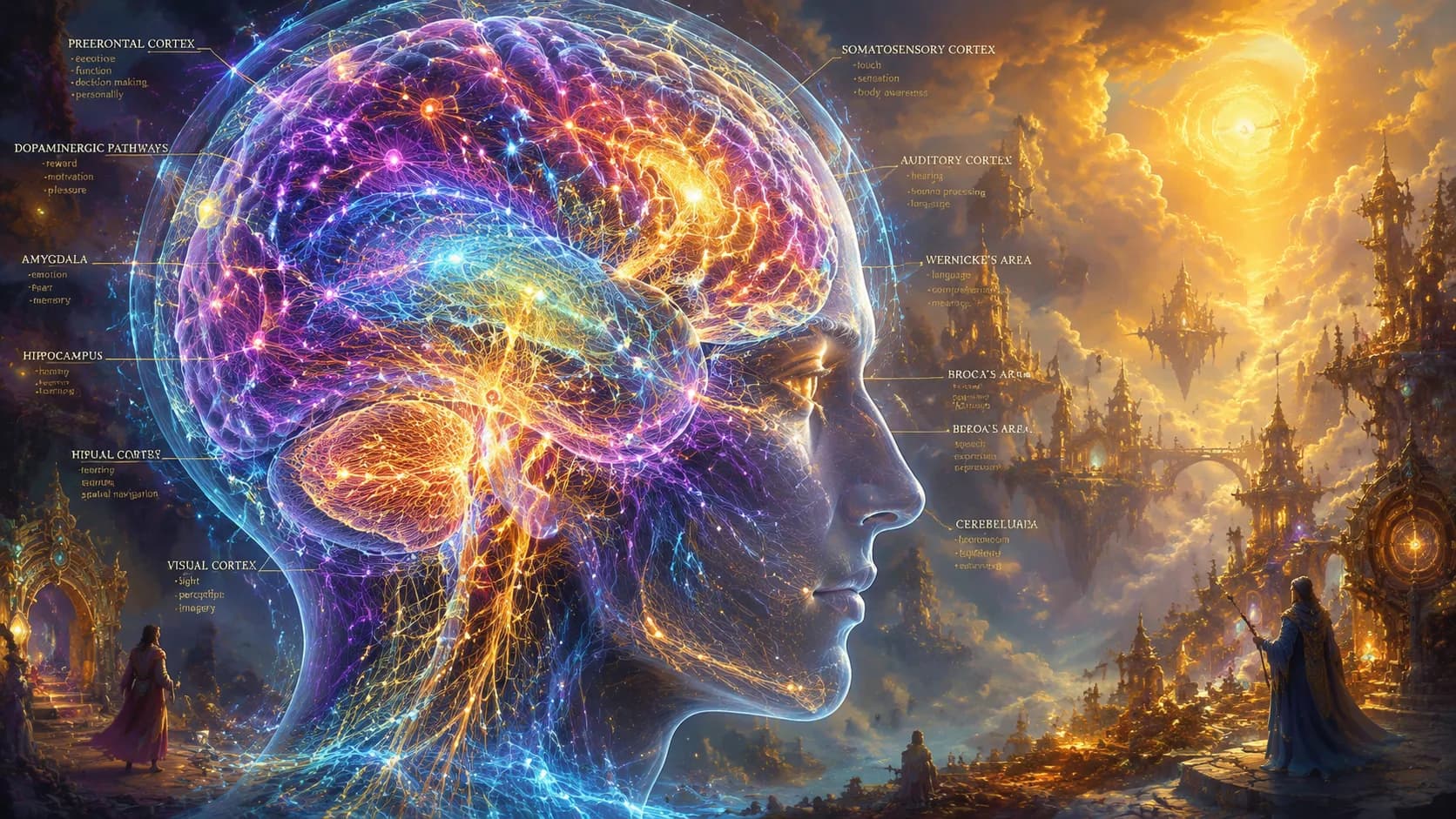
Most people get this wrong. They assume visualization is something soft, a mood-lifter at best, useful for athletes and motivational speakers but not for anything biochemically real. Neuroscientist Tor Wager at Dartmouth College has spent years proving otherwise. Using fMRI imaging, Wager's lab has demonstrated that vividly imagining a sensory experience activates overlapping cortical and subcortical regions to actually having that experience, including areas that regulate endocrine signaling. The brain does not cleanly distinguish between real and vividly imagined. Which means that when you imagine warmth spreading through an injured limb, your hypothalamus and pituitary are receiving a signal structurally similar to one that would accompany real warmth. For a deeper look at how this works, the neuroscience of why the brain experiences stories as reality explains the overlap in remarkable detail.
This is not abstract. Sports psychologists have used mental imagery with athletes for decades, and a 2014 study at Ohio University found that people whose wrist was immobilized for four weeks lost about half as much strength if they regularly imagined using the muscle. And in clinical contexts, guided imagery has been used as a complement to oncology care, with a 2005 review by Roffe, Schmidt, and Ernst inPsycho-Oncology concluding that it may offer emotional support and comfort, though the evidence was limited. None of these effects require deception. They require attention, intention, and a vivid enough picture, which is exactly what a well-crafted visualization journey is designed to provide.
Key Insight: The Body Responds to Vivid Imagination
Neuroscientist Tor Wager (Dartmouth College) used fMRI to show that vivid mental imagery activates overlapping brain regions to real sensory experience, including areas controlling endocrine and autonomic responses. That overlap helps explain why a vivid imagined scene can feel surprisingly real.
Consider what that means practically. Every time you close your eyes and walk through a detailed healing visualization, you are not just relaxing. You are giving your mind something calm and structured to hold, which many people find genuinely soothing. It is not a replacement for medical care, but at this level of engagement,imagination is doing real work.
Read more: How Visualization Strengthens Neural Pathways
An ancient herbalist once prescribed her patient 'the image of a cedar forest in full morning mist.' Modern neuroscientists would nod approvingly, even if they would ask for the fMRI scans.
Psychoneuroimmunology: How the Mind and the Immune System Interact
Forget what you may have heard from skeptics. Psychoneuroimmunology, or PNI, is not alternative medicine. It is a rigorously peer-reviewed scientific field that emerged from mainstream neuroendocrinology in the 1970s, anchored by Robert Ader and Nicholas Cohen's landmark 1975 experiments at the University of Rochester. Ader and Cohen demonstrated that immune responses in rats could be classically conditioned, meaning the nervous system could be trained to produce immune modulation through learned association alone, without any pharmacological trigger. The immune system, it turned out, could learn. And learning is a function of the brain. This laid the groundwork for understanding how meditation's effect on gut health and the vagal nervous system connects back to immunological signaling.
Since Ader and Cohen, the field has expanded dramatically. Researchers have mapped direct neural innervation of lymphoid organs, identified cytokine receptors throughout the central nervous system, and documented bidirectional communication between immune cells and neurons. Candace Pert's work on neuropeptide receptors, published through the National Institute of Mental Health in the 1980s, showed that molecules associated with emotion circulate throughout the body, including in immune tissue, effectively making the immune system a kind of mobile emotional sensory organ. When you feel safe and imaginatively engaged, your immune environment shifts measurably.
Historical Fact: PNI Was Controversial at First
When Robert Ader first presented conditioned immune suppression findings in 1975, the immunology establishment largely dismissed them, because at the time the immune system was considered fully autonomous from the brain. Within a decade, direct neural pathways into lymphoid tissue had been anatomically confirmed, transforming the 'fringe' claim into foundational science.
What PNI tells us about the placebo effect and imagination is this: the channels through which mental states reach biology are not vague or metaphorical. They are specific, anatomically documented, and chemically traceable. When Visionaria's immersive journeys guide a listener through a sunlit forest or a healing sanctuary, they are not offering comfort alone. They are engaging the kind of sensory and cognitive experiences that PNI researchers study for their links to stress and well-being, though what imagery alone can do for the body is still uncertain. None of this is pseudoscience.All of it is documented biology.
When Robert Ader first suggested the immune system could be conditioned like Pavlov's dogs, a senior immunologist reportedly replied: 'Next you'll tell me it can read.' Ader, ever patient, simply ran more experiments.
Immersive Wellness Experiences and Genuine Physiological Change
So what happens when you take everything above, the open-label placebo research, the endorphin cascades, the PNI pathways, and you build an experience deliberately designed to engage all of it? You get what researchers now call immersive wellness: guided audio, narrative imagery, spatial soundscapes, and intentional expectation-setting that together create a sustained physiological state change. No drugs involved. Just imagination, well structured. You can explore how narrative structure drives these outcomes through a deeper look at what experiential meditation actually is at its neurological core.
The mechanism is not complicated once you understand the underlying architecture. When a listener enters a richly described imaginary space, with spatial audio cues, sensory detail, and a trusted narrative voice, the mind can become absorbed enough that the body begins to relax too. Heart rate variability improves. Muscle tension releases. Breathing slows reflexively.None of this requires willpower or technique. It requires only the imaginative immersion. Which is why story meditation as a practice has a lower barrier to entry than breath-focused or mantra-based techniques for many people.
Quick Answer: Do Immersive Audio Experiences Have Real Health Effects?
Yes. Spatial audio and narrative immersion engage the same neural and endocrine pathways activated by placebo responses and vivid visualization.
One thing worth sitting with: many people feel slightly embarrassed about imagination-based wellness. Somehow, in the modern world, closing your eyes and picturing a healing forest got coded as 'childish' or 'unscientific.' But children, of course, have physiological stress responses too, and imaginative play is one of their primary biological regulation tools. Adults never lost the underlying hardware. They just stopped using it. And the hardware, as we have seen, has a very direct line to the pharmacological core of the brain.
A Victorian physician, upon hearing that his colleague had cured a patient with nothing but a theatrical performance and a bottle of colored water, reportedly said: 'Preposterous. Write it up immediately.'
Ancient Healing Rituals Were Placebo Science All Along
Ancient healing traditions across every culture were, whether they knew it or not, sophisticated placebo delivery systems. At the Greek sanctuaries of Asclepius, the god of restoration, patients would fast, bathe in sacred springs, and sleep in the temple's inner chamber, called the abaton. The entire ritual was designed to generate expectation, surrender, and vivid imaginative engagement simultaneously. Priests would sometimes walk through the temple at night wearing sacred robes, appearing to patients in a liminal waking state between dreaming and consciousness. Recoveries were recorded on stone tablets, hundreds of them, lining the sanctuary walls. Some modern scholars have suggested that many of these inscriptions describe conditions that could improve with rest, time and expectation. Explore how ancient spaces like these still inspire meditative practice today in the context ofwalking through ancient Athens in your mind.
Tibetan Buddhist healing visualizations follow a remarkably parallel structure. The practitioner enters deep concentration, evokes a deity figure associated with wellbeing, and visualizes luminous healing light entering each organ of the body in sequence. From a PNI perspective, this is a systematic guided imagery protocol targeting specific somatic regions with intentional positive imagery, almost exactly the clinical structure used in modern hospital-based integrative oncology programs. Different cosmology, identical neurological mechanism.
The Placebo Effect, Imagination, and the Future of Healing
What this body of research collectively reveals is something genuinely profound: the boundary between imagined healing and real healing is far thinner than modern medicine once assumed. From Ted Kaptchuk's open-label placebo trials at Harvard Medical School to the findings of psychoneuroimmunology, research shows that expectation and the mind can influence how we feel. When a person vividly imagines recovery, the brain does not politely note the distinction between simulation and reality. It responds. Cortisol drops. Endorphins rise. NK cell activity shifts. Cytokine profiles change. And perhaps most astonishingly, all of this can happen even when the person knows, consciously and clearly, that no pharmaceutical compound has entered their body. Belief, expectation, and imagination are not soft variables at the edges of medicine. They are central mechanisms, as chemically real as any prescription.
Modern wellness psychology is only now catching up to what healers, storytellers, and ritual practitioners understood intuitively for millennia. Narrative transportation theory, developed by Melanie Green and Timothy Brock at Ohio State University in 2000, describes how a person fully absorbed in a story can respond to it emotionally almost as if it were real, and can come away with beliefs shaped by it. Put simply: a deeply immersive story is not an escape from reality. For the nervous system, it is a form of guided visualization that activates real healing pathways. Practitioners working in cognitive behavioral therapy, pain management, and anxiety reduction are increasingly incorporating structured imagery and narrative immersion precisely because the neurological evidence supports it. And for those who find silent meditation inaccessible or frustrating, storytelling as a meditation practice offers an evidence-aligned alternative that works with how the brain is actually wired.

How Story Experiences Improve Emotional Resilience
Discover how immersive story experiences build genuine emotional resilience through the same neural pathways activated by real-world challenges.
Here is the thing most people miss when they first encounter placebo research: the findings do not diminish medicine. They expand it. They suggest that the conditions under which healing happens, the atmosphere, the expectation, the quality of attention a person brings to their own body, are active ingredients, not background noise. Placebo effect imagination is not a loophole in the data. It is a feature of human biology that has been present since long before we had words for neuroscience. Every ancient healing ritual, every sacred sound, every immersive guided journey that pulls a listener out of anxious rumination and into a vivid, embodied present moment is, at some level, engaging this same biological architecture. Narrative journey experiences designed with this understanding, ones that marry spatial audio, layered environmental storytelling, and intentional pacing, are not entertainment dressed up as wellness. They are a direct application of what the science already shows. Visionaria was built with this in mind: stories and imagination can shape how we feel, even though they are not a medical treatment. As always, immersive audio experiences complement, not replace, professional medical care. But as a tool for activating the mind's own considerable capacity for restoration, imagination may be one of the most underused resources we have.
Let Your Imagination Begin Healing You
Explore immersive audio journeys on Visionaria today.
A Roman physician once told his patient: 'Believe you are well, and half my work is done.' The patient asked for a refund on the other half.
This article is for educational and informational purposes only. Historical details are based on available research and may evolve as new evidence emerges.
Visionaria journeys are designed for relaxation, guided imagination, and personal enrichment. They are not a substitute for medical, mental health, legal, or professional advice.
Kaptchuk, Ted J. et al. 'Placebos without Deception: A Randomized Controlled Trial in Irritable Bowel Syndrome.' PLOS ONE, 2010.
Green, Melanie C., and Timothy C. Brock. 'The Role of Transportation in the Persuasiveness of Public Narratives.' Journal of Personality and Social Psychology, Ohio State University, 2000.
Ader, Robert, and Nicholas Cohen. 'Behaviorally Conditioned Immunosuppression.' Psychosomatic Medicine, University of Rochester, 1975.
Schedlowski, Manfred, Paul Enck, Winfried Rief, and Ulrike Bingel. 'Neuro-Bio-Behavioral Mechanisms of Placebo and Nocebo Responses: Implications for Clinical Trials and Clinical Practice.' Pharmacological Reviews, vol. 67, no. 3, 2015, pp. 697-730.
Rossi, Ernest L. The Psychobiology of Mind-Body Healing: New Concepts of Therapeutic Hypnosis. W. W. Norton and Company, 1993.