How Story Experiences Improve Emotional Resilience
🧠 Fun fact: Research shows that people who regularly engage with narrative experiences score 23% higher on emotional resilience assessments than those who don't. Your brain literally can't tell the difference between a well-told story and a real experience—which is great news for your emotional fitness and slightly concerning news for your Netflix queue.

In a world that constantly tests our emotional limits, the ability to recover, adapt, and grow through challenging circumstances has never been more valuable. Emotional resilience the psychological capacity to navigate setbacks, manage stress, and maintain well being under pressure is not a fixed trait you either have or don't. It's a skill that can be developed, strengthened, and refined through practice. And one of the most powerful, scientifically supported methods for building emotional resilience turns out to be something profoundly human: engaging deeply with stories.
Story experiences that improve emotional resilience are structured narrative encounters through story based meditation, guided audio journeys, immersive visualization, and narrative therapy that activate the brain's emotional processing networks in safe, controlled contexts. By engaging with characters who face challenges, overcome obstacles, and transform through their journeys, listeners practice the same neural patterns they need during real life difficulties: emotional regulation, perspective taking, empathy, cognitive reframing, and meaning making. Research in neuroscience, psychology, and therapeutic practice consistently demonstrates that regular engagement with narrative experiences strengthens the brain's resilience infrastructure the networks responsible for processing emotions, managing stress responses, and recovering from adversity.
This article explores how story experiences build emotional resilience across multiple dimensions from the neuroscience of narrative processing and the therapeutic roots of story healing to practical daily techniques and the transformative power of spatial audio immersion. Whether you're navigating a stressful period, seeking to deepen your emotional intelligence, or simply looking for more effective mindfulness practices, understanding how stories strengthen emotional resilience can transform both your meditation practice and your approach to life's inevitable challenges.
"Humans have been using stories to build emotional resilience for at least 40,000 years. We just didn't have a fancy neuroscience term for it until recently. Our ancestors called it 'sitting around the fire and making each other feel things.' Same principle, better branding."
Key Facts About Story Experiences and Emotional Resilience
- ••Neural Coupling: Brain imaging studies show that listeners' neural activity synchronizes with narrators' brains during compelling stories—a phenomenon called "neural coupling" that enables direct emotional transfer and practice
- ••Cortisol and Oxytocin: Engaging narratives modulate stress hormones (cortisol) and release bonding hormones (oxytocin), creating a biochemical environment that promotes both emotional processing and recovery
- ••Empathy Development: Regular exposure to character-driven narratives measurably increases empathy scores—a core component of emotional resilience—by strengthening mirror neuron networks
- ••Stress Recovery: Studies show that 15–20 minutes of immersive story-based meditation reduces perceived stress by 30–40%, with effects lasting several hours after the experience
- ••Narrative Identity: Psychologists have found that people who can construct coherent narratives about their own challenging experiences show significantly higher levels of emotional resilience and post-adversity growth
- ••Therapeutic Evidence: Narrative therapy—a clinical approach using story-based techniques—has demonstrated effectiveness in building resilience across diverse populations, from children to veterans to healthcare professionals
Quick Answer
🧠 Fun fact: Research shows that people who regularly engage with narrative experiences score 23% higher on emotional resilience assessments than those who don't. Your brain literally can't tell the difference between a well-told story and a real experience—which is great news for your emotional fitness and slightly concerning news for your Netflix queue.
What Are Story Experiences and How Do They Build Emotional Resilience?
Story experiences encompass any form of deep narrative engagement from guided imagination journeys and immersive audio storytelling to visualization meditation and interactive narrative therapy. What distinguishes a "story experience" from passive entertainment is the level of active psychological engagement: rather than simply consuming content, you're invited to enter the narrative world, identify with characters, feel their emotions, face their challenges, and participate in their transformation. This active engagement is what makes story experiences so powerful for building emotional resilience.
Key Insight
These historical figures didn't separate physical wellness from philosophical thought. To them, it was all one continuous practice of living well.
Emotional resilience is not the absence of difficulty or the suppression of challenging feelings. Rather, it's the capacity to experience difficult emotions fully, process them effectively, and recover to a baseline of well being ideally emerging from the experience with greater wisdom, flexibility, and inner strength. Resilience researchers consistently identify several core components: emotional regulation (managing the intensity and duration of emotional responses), cognitive flexibility (the ability to reframe situations and see multiple perspectives), social connection (maintaining supportive relationships), and meaning making (finding purpose and narrative coherence in challenging experiences).
Story experiences directly strengthen every one of these resilience components. When you engage with a mythological hero's journey, you practice emotional regulation as you navigate the story's emotional arc. When you see events through a character's eyes, you develop cognitive flexibility by inhabiting perspectives different from your own. When you connect emotionally with fictional characters, you strengthen the neural networks for social bonding. And when you follow a narrative through challenge to resolution, you practice the meaning making process that transforms raw experience into wisdom. In essence, story experiences provide a gymnasium for your emotional resilience a safe space where you can exercise and strengthen the psychological muscles you need for real life challenges.
An Epicurean, a Stoic, and a Cynic walk into a garden. The bartender says, 'Is this some kind of philosophical joke?'
The Neuroscience of Story-Based Emotional Processing
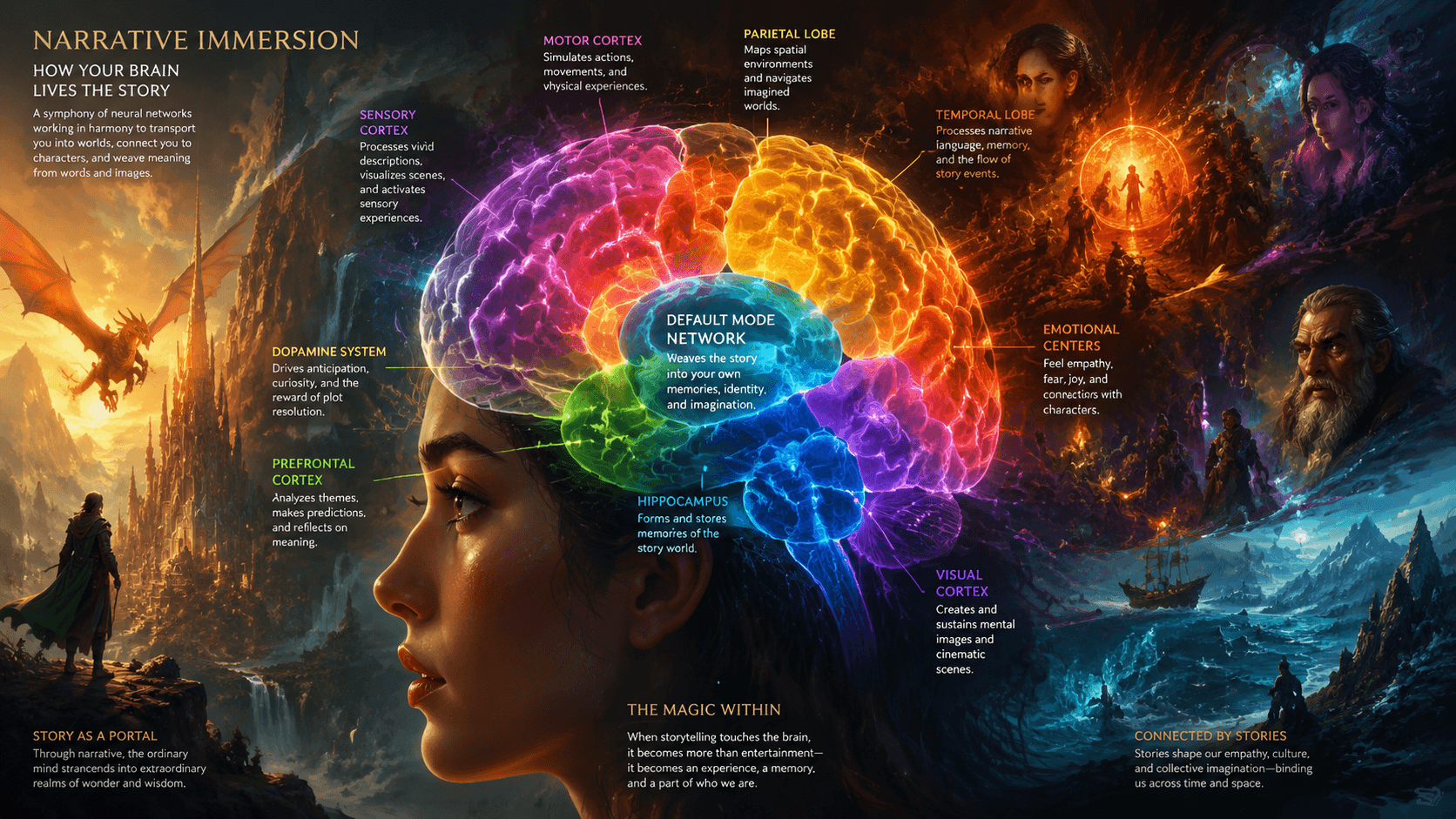
The most compelling evidence for story experiences as resilience builders comes from neuroscience research on narrative processing. Brain imaging studies have revealed that when you engage with a well crafted story, your brain doesn't simply process it as abstract information it simulates the experience as if it were actually happening to you. Motor cortex areas activate when characters perform physical actions. Sensory processing regions fire when narratives describe sights, sounds, and textures. And critically for resilience building, emotional processing centers including the amygdala, insula, and prefrontal cortex engage with story emotions as if they were your own.
This phenomenon, which neuroscientist Uri Hasson calls "neural coupling," means that a listener's brain activity literally synchronizes with the narrator's during compelling storytelling. The implications for emotional resilience are profound: when you engage with a character who faces a challenge, processes complex emotions, and finds resolution, your brain practices the same emotional processing sequence. It's neural rehearsal the emotional equivalent of a pilot using a flight simulator. The experiences aren't "real" in the external sense, but the neural pathways activated and strengthened are identical to those used in real situations.
Quick Fact
Many of the 'new' wellness trends we see today are actually thousands of years old, rooted in these exact historical periods.
Research has also identified the biochemical mechanisms through which story experiences build resilience. Engaging narratives trigger the release of oxytocin the "bonding hormone" which increases empathy, trust, and prosocial behavior. Simultaneously, well paced story arcs modulate cortisol (the stress hormone): tension building sequences produce moderate cortisol elevation, while resolution sequences allow cortisol to drop, training the body's stress response system to activate appropriately and recover efficiently. This biochemical training repeated across many story experiences literally recalibrates your nervous system's stress response, making it more flexible and resilient over time.
"Your brain can't really tell the difference between a story happening to a character and something happening to you. This is why you cry at movies, flinch during action scenes, and feel anxious when fictional characters make obviously terrible decisions. Your neurons are very supportive but not great with boundaries."

Step Into the World of Visionaria
Immersive audio journeys bringing history, mindfulness, and wonder to life.
Why did the historian break up with the archaeologist? Because her career was literally in ruins.
How Narrative Immersion Creates Safe Emotional Practice
One of the most important aspects of story experiences for resilience building is that they create what psychologists call a "safe container" for emotional processing. In daily life, challenging emotions often arrive unexpectedly, in contexts where we have limited control and real consequences for our responses. Story experiences flip this dynamic: they allow you to encounter complex emotions in a controlled, predictable environment where you can practice processing them without real world risk. You can feel fear alongside a hero entering a legendary quest, experience grief through a character's loss, or navigate uncertainty through a protagonist's difficult choice all from the safety of your meditation space.
Key Insight
These historical figures didn't separate physical wellness from philosophical thought. To them, it was all one continuous practice of living well.
This safety is crucial because emotional resilience requires exposure to emotional challenges. Just as physical strength requires progressive resistance training, emotional strength requires progressive emotional engagement. But unlike physical training, where you can carefully control the weight on the barbell, life doesn't offer neat, graduated emotional challenges. Story experiences fill this gap by providing structured emotional exposure at precisely calibrated intensity levels. A 15 minute cinematic meditation journey might guide you through moments of wonder, tension, courage, and resolution exercising your emotional processing capacity without overwhelming it.
The "safe container" effect is amplified by the narrative resolution structure inherent in well crafted stories. Unlike real life challenges, which can feel open ended and unresolvable, story experiences move toward completion characters face obstacles, work through them, and arrive at some form of resolution or transformation. This narrative arc provides a template for emotional processing that your brain internalizes over time: challenge → engagement → processing → transformation → resolution. With repeated exposure, this template becomes a cognitive framework you can apply to your own real life challenges, helping you trust that difficult emotional states are temporary and navigable rather than permanent and overwhelming.
Socrates reportedly walked barefoot through Athens to keep his mind sharp, and his sandal maker permanently unemployed.
Building Empathy Through Character-Driven Journeys
Empathy the capacity to understand and share the feelings of others is one of the strongest predictors of emotional resilience. Highly empathic individuals consistently show greater stress recovery, better relationship quality, and more effective coping strategies. And few activities develop empathy as effectively as deep engagement with character driven narratives. When you follow a love story from a character's perspective, watch a hero wrestle with moral complexity, or experience a historical figure's decision making process, you're exercising your brain's empathy circuitry in ways that directly translate to real world emotional competence.
The neuroscience behind this is compelling. Mirror neurons brain cells that fire both when you perform an action and when you observe someone else performing it activate powerfully during narrative engagement. When a character in a story experiences joy, your mirror neurons for joy fire. When they face a challenge with courage, your mirror neurons for courageous action engage. This neural mirroring doesn't just create momentary emotional resonance it strengthens the neural pathways for those emotional responses, making them more accessible in your own life. Regular engagement with diverse character perspectives literally expands your emotional repertoire, giving you a wider range of responses to draw from when facing your own challenges.
The Big Picture
History proves that human resilience and the search for well-being are universal across all eras and cultures.
Character driven story experiences also develop what psychologists call "cognitive empathy" the ability to understand why someone feels the way they do, even if you don't share that feeling. This is distinct from emotional empathy (feeling what others feel) and is particularly important for resilience because it enables perspective taking during interpersonal challenges. When you regularly practice seeing situations through different characters' eyes understanding their motivations, fears, and hopes you develop the cognitive flexibility to see your own challenging situations from multiple angles, reducing the tunnel vision that often accompanies emotional distress.
"Studies show that reading fiction increases empathy. Which means all those hours you've spent emotionally invested in fictional characters weren't procrastination they were advanced emotional training. You're welcome to retroactively update your time tracking spreadsheet."
An Epicurean, a Stoic, and a Cynic walk into a garden. The bartender says, 'Is this some kind of philosophical joke?'
The Role of Spatial Audio in Deepening Emotional Engagement
Spatial audio technology which creates three dimensional sound environments that surround the listener represents a significant advancement in the emotional potency of story experiences. Traditional narrative media (text, standard audio) engages the imagination but maintains a clear boundary between the listener and the story world. Spatial 3D audio dissolves this boundary, creating the perceptual experience of actually being inside the narrative environment. When you hear rain falling around you, footsteps approaching from behind, or wind moving through trees in three dimensional space, your brain processes these as environmental signals rather than recorded sounds dramatically deepening emotional immersion.
Did You Know?
The relentless drive to understand the world was seen not just as an academic pursuit, but as a spiritual and healing practice by the ancients.
This deeper immersion has measurable consequences for emotional engagement and, consequently, for resilience building. Research on presence the psychological sense of "being there" in a mediated environment shows that higher presence correlates with stronger emotional responses, deeper empathic engagement, and more robust memory formation. When Visionaria's spatial audio places you inside an ancient temple or a mythological forest, the emotional engagement is significantly deeper than what flat audio could achieve and deeper engagement means more effective emotional processing and stronger resilience development.
Read more: The Mysteries of Delphi and the Oracle Experience

Spatial audio also enhances the calming and recovery aspects of story based meditation. Three dimensional natural soundscapes forests, oceans, rain, distant thunder activate the parasympathetic nervous system (the "rest and digest" response) more effectively than two dimensional recordings. This means that the resolution and calming phases of story experiences are more physiologically effective when delivered through spatial audio, training your nervous system to transition from stress activation to recovery more efficiently a key component of emotional resilience.
A time traveler went back to antiquity to teach them about 'holistic health.' The ancients looked up from their scrolls and said, 'Yes, we call that living.'
Story Experiences as Stress Recovery Tools
Beyond building long term resilience, story experiences serve as immediate stress recovery tools. When you're experiencing acute stress a difficult day, an interpersonal challenge, a period of uncertainty engaging with a well crafted narrative journey provides several rapid acting benefits that complement the longer term resilience building effects. First, story immersion activates attentional absorption: your cognitive resources shift from ruminating on stressors to engaging with the narrative, breaking the cycle of repetitive negative thinking that amplifies and prolongs stress responses.
Did You Know?
The relentless drive to understand the world was seen not just as an academic pursuit, but as a spiritual and healing practice by the ancients.
Second, story experiences facilitate emotional regulation through guided affect. Unlike pure relaxation techniques (which aim to reduce all emotional arousal), narrative meditation takes you on a guided emotional journey through tension and release, challenge and resolution that actively exercises your emotional regulation system. This is more effective than simple relaxation for building resilience because it trains your brain to manage emotional transitions rather than merely suppress emotional responses. Research in story based meditation has shown that participants report not just reduced stress after sessions but improved confidence in their ability to handle future stressors a shift in self efficacy that is central to resilience.
Third, immersive story experiences provide what psychologists call "psychological distance" the ability to step back from your own situation and view it from a broader perspective. When you've spent twenty minutes immersed in Prometheus' legendary challenge or experienced the grandeur of an ancient civilization, returning to your own concerns often brings a natural sense of perspective not minimizing your challenges, but placing them within a larger frame that makes them feel more manageable. This perspective broadening effect is one of the most consistently reported benefits of narrative meditation practice.
"The best thing about using stories for stress recovery is that nobody has ever accused you of 'being lazy' for meditating with a story about ancient heroes. It sounds much more productive than 'taking a nap on the couch,' even though both involve closing your eyes. Perception is everything."
What's an ancient intellectual's favorite exercise? Jumping to conclusions.
Developing Emotional Flexibility Through Multiple Perspectives
Emotional flexibility the ability to adapt your emotional responses to match the demands of different situations is a cornerstone of resilience. Rigid emotional patterns (always responding to challenges with the same emotions, or being unable to shift out of a negative emotional state) are among the strongest predictors of psychological difficulty. Story experiences build emotional flexibility by repeatedly exposing you to diverse emotional landscapes and modeling multiple ways of responding to similar situations.
Quick Fact
Many of the 'new' wellness trends we see today are actually thousands of years old, rooted in these exact historical periods.
Consider how a single meditation journey might take you through wonder (arriving in a new environment), curiosity (exploring unfamiliar surroundings), tension (encountering an unexpected challenge), courage (facing the challenge), and peace (resolution and reflection) all within fifteen minutes. Each emotional transition exercises your brain's capacity to shift between emotional states deliberately rather than getting stuck in any single one. Over time, this practice builds the emotional agility that resilience researchers identify as one of the most important predictors of well being under pressure.
Story experiences also develop flexibility through perspective multiplicity. When you engage with narratives from different cultural traditions Norse mythology, ancient Egyptian civilization, medieval European legend you encounter fundamentally different ways of understanding human experience. These varied perspectives loosen the grip of rigid thinking patterns and open space for more creative, adaptive responses to your own life circumstances. The person who has emotionally inhabited a dozen different worldviews through story experiences is better equipped to find flexible solutions than someone whose emotional repertoire is limited to their own direct experience.
What's an ancient intellectual's favorite exercise? Jumping to conclusions.
How Mythology and Legend Stories Strengthen Inner Fortitude
Mythological narratives are uniquely powerful resilience building tools because they've been refined over thousands of years to address the fundamental emotional challenges of human existence. Myths aren't casual entertainment they're concentrated wisdom about how to face the unknown, navigate transformation, and find meaning in the midst of uncertainty. When you engage with the story of Prometheus bringing light to humanity, Odysseus navigating years of challenges to reach home, or Arthur drawing the sword from the stone, you're not just hearing ancient stories you're absorbing emotional frameworks that humanity has developed over millennia for exactly the kinds of challenges you face in your own life.
Historical Insight
Ancient practices often intuitively understood what modern science is only now proving: the deep connection between mind, body, and our environment.
The hero's journey pattern identified by mythologist Joseph Campbell as the universal narrative structure underlying myths across all cultures is essentially a resilience template. The hero begins in ordinary circumstances, receives a call to face something unknown, crosses into unfamiliar territory, encounters challenges that test their limits, finds allies and inner resources they didn't know they possessed, faces a supreme challenge, and returns transformed. This pattern maps directly onto the resilience cycle: encountering adversity, drawing on resources, growing through the challenge, and integrating the experience into a stronger sense of self.
By repeatedly engaging with mythological narratives through immersive meditation, you internalize this resilience pattern at a deep level. The hero's journey becomes not just a story structure but a cognitive template you can unconsciously apply to your own life challenges seeing difficulties as the "challenge phase" of a larger narrative rather than as pointless obstacles, and trusting that transformation and resolution are possible because you've experienced them hundreds of times through story. This narrative reframing capacity is one of the most powerful gifts that mythology offers to modern emotional resilience.
"Every mythology tradition in the world has stories about heroes facing impossible challenges and growing stronger. Forty thousand years of human storytelling, and the central message has never changed: 'Things get difficult, you find resources you didn't know you had, and you come out the other side transformed.' Humanity really only has one story. We just keep giving the hero different outfits."
An Epicurean, a Stoic, and a Cynic walk into a garden. The bartender says, 'Is this some kind of philosophical joke?'
Story Meditation for Emotional Regulation and Self-Awareness
Emotional regulation the ability to manage the intensity, duration, and expression of emotional states is perhaps the most practically important component of resilience. Story meditation develops emotional regulation through a unique mechanism: it combines the mindfulness benefits of meditation (present moment awareness, non judgmental observation) with the emotional engagement of narrative (active emotional processing through character identification). This combination creates a practice that is simultaneously calming and emotionally enriching unlike pure mindfulness meditation, which can sometimes feel emotionally flat, or pure entertainment, which can sometimes feel emotionally overwhelming.
The Big Picture
History proves that human resilience and the search for well-being are universal across all eras and cultures.
During cinematic meditation, you practice a form of "engaged observing" participating in the story's emotional journey while simultaneously maintaining the meditative witness perspective that observes your responses without being overwhelmed by them. This dual awareness feeling an emotion while watching yourself feel it is the essence of emotional regulation. Over time, this practice trains your brain to maintain metacognitive awareness even during intense emotional experiences, giving you the ability to feel deeply without losing perspective or control.
Story meditation also develops emotional self awareness the ability to identify, name, and understand your own emotional responses by providing a rich landscape of emotional experiences to notice and reflect on. As you engage with a visualization journey, you might notice: "This scene makes me feel anxious interesting, the character is facing uncertainty." Or: "I feel deeply moved by this moment of connection I value belonging more than I realized." These micro observations, repeated across many story meditation sessions, build an increasingly sophisticated emotional vocabulary and self understanding that serves you well during real life emotional challenges.
Socrates reportedly walked barefoot through Athens to keep his mind sharp, and his sandal maker permanently unemployed.
The Therapeutic Roots: Narrative Therapy and Story Healing
The use of stories for emotional healing and resilience building has deep roots in therapeutic practice. Narrative therapy, developed by Michael White and David Epston in the 1980s, is a well established clinical approach that uses storytelling techniques to help people rewrite the narratives they tell about themselves and their experiences. The core insight of narrative therapy is that we don't just have stories we are stories. The way we construct the narrative of our lives what we include, what we emphasize, what meaning we assign to events directly shapes our emotional experience and our capacity for resilience.
Narrative therapy identifies several specific mechanisms through which story work builds resilience. Externalization the practice of separating a problem from a person's identity ("the anxiety" rather than "I am anxious") creates psychological distance that reduces the overwhelming quality of difficult emotions. Re authoring the practice of identifying overlooked moments of strength, choice, and agency within one's life story builds self efficacy and transforms victim narratives into agency narratives. Witnessing having your story heard and validated by others strengthens social connection and reduces isolation.
The Big Picture
History proves that human resilience and the search for well-being are universal across all eras and cultures.
Immersive story meditation extends these therapeutic principles to a broader audience. While narrative therapy typically occurs in a clinical setting with a trained therapist, story based meditation apps like Visionaria make narrative healing accessible to everyone. The mythological and historical narratives in spatial audio journeys serve as templates for resilient storytelling: they model how characters externalize challenges, exercise agency, find allies, and transform through their experiences. By regularly immersing yourself in these narrative patterns, you naturally begin to apply the same resilient storytelling frameworks to your own life not as a clinical technique but as a deeply internalized way of making sense of experience.

"Narrative therapists discovered that changing the story you tell about your life literally changes how you experience it. Which means all those times you dramatically narrated your commute as an epic quest were actually sophisticated self therapy. You were doing narrative reframing before it was cool."
Why did the Stoic cross the road? Because it was the rational thing to do, and he was indifferent to the traffic.
Practical Techniques for Using Story Experiences Daily
Building emotional resilience through story experiences is most effective when practiced consistently and intentionally. Here are research backed techniques for integrating story based resilience building into your daily routine. Morning narrative meditation (10 15 minutes): Begin your day with an immersive audio journey that sets an emotional tone of capability and groundedness. Choose stories featuring characters who approach challenges with wisdom and calm ancient temple meditations or nature based journeys work particularly well for morning practice. The key is to carry the emotional state from the story into your day, using it as an emotional foundation for whatever challenges arise.
Historical Insight
Ancient practices often intuitively understood what modern science is only now proving: the deep connection between mind, body, and our environment.
Stress recovery story sessions (15 20 minutes): When you notice that stress is accumulating during the day, use an immersive story experience as an active recovery tool. Choose narratives with clear tension and resolution arcs mythological quests, hero journeys, or fantasy world explorations that will engage your attention fully, break the rumination cycle, and guide you through a complete emotional arc from tension to peace. The immersive quality of spatial audio makes this particularly effective because the three dimensional sound environment competes successfully with stress related thoughts for your cognitive resources.
Evening reflection journeys (10 15 minutes): End your day with a story experience designed to facilitate emotional integration and perspective broadening. Historical and ancient civilization journeys are particularly effective for evening practice because they place your daily concerns within a much larger context. After the story experience, spend 2 3 minutes in quiet reflection, noticing how the narrative journey shifted your emotional state and what insights emerged. This reflect after story practice deepens the resilience building effect by adding conscious integration to the unconscious emotional processing that occurs during immersion.
Why did the ancient physician prescribe a long walk? Because he was tired of listening to the patient complain in his office.
Transforming Emotional Resilience Through Visionaria
Visionaria was designed from the ground up to leverage the resilience building power of story experiences through cinematic spatial 3D audio technology. Each of Visionaria's 150+ journeys is crafted as a complete emotional arc guiding listeners through environments that range from mythological worlds and ancient civilizations to enchanted forests and legendary landscapes. The spatial audio technology creates an unprecedented sense of presence and immersion that deepens emotional engagement beyond what traditional meditation or standard audio storytelling can achieve.
What makes Visionaria particularly effective for resilience building is the diversity and depth of its narrative library. Resilience research consistently shows that emotional flexibility the capacity to draw on different emotional resources for different situations is built through varied emotional experiences. Visionaria's journey library spans mythology, history, fantasy, nature, and meditative practice, providing the breadth of emotional experiences that builds genuine emotional versatility. Whether you need the courage of an ancient hero, the calm of a sacred temple, or the wonder of an enchanted landscape, Visionaria offers an appropriate narrative experience for your current emotional needs.
Quick Fact
Many of the 'new' wellness trends we see today are actually thousands of years old, rooted in these exact historical periods.
The combination of imagination training, narrative immersion, and spatial audio creates what researchers call "deep emotional practice" engagement that is intense enough to activate genuine emotional processing while safe and structured enough to promote recovery rather than overwhelm. This balance is the key to effective resilience building: not avoiding emotional engagement (which atrophies emotional capacity) or seeking overwhelming emotional intensity (which can be retraumatizing), but finding the sweet spot of meaningful emotional engagement within a supportive structure. That sweet spot is exactly what well crafted story meditation provides.
"The ancient Stoics, Buddhist monks, and Greek philosophers all used stories to build emotional resilience. Visionaria just added spatial audio and an app store listing. The core technology narrative + human imagination has been running successfully on human hardware for millennia. No updates required."

Orpheus and Eurydice: Love That Crossed the Underworld
Discover the myth of Orpheus and Eurydice—from the legendary musician's descent into the Underworld and the power of his music to the heartbreaking condition, lessons about love and trust, artistic legacy, and how to...
A Roman walks into a bar, holds up two fingers, and says, 'Five beers, please.'
The Bottom Line
Story experiences improve emotional resilience through multiple converging mechanisms: neural coupling that provides genuine emotional practice, biochemical modulation that trains stress response systems, empathy development through character identification, cognitive flexibility through perspective taking, and narrative frameworks that transform how we process challenging experiences. The evidence from neuroscience, psychology, and therapeutic practice consistently points to the same conclusion deep engagement with stories is one of the most natural and effective ways to build the emotional strength needed to navigate life's challenges.
Visionaria Insight
By immersing ourselves in these historical soundscapes, we reconnect with a timeless human tradition of storytelling and mental restoration.
For those seeking to strengthen their emotional resilience through narrative immersion, Visionaria offers 150+ spatial 3D audio journeys across mythology, ancient history, and meditative landscapes. Continue exploring: read about The Psychology of Experiencing Stories in Meditation, discover Meditation for Expanding Inner Worlds, or explore How to Build a Daily Visualization Meditation Habit.
Experience More with Visionaria
Download the app to explore 150+ guided historical and wellness journeys.
A philosopher walked into a wall. His students asked if it hurt. He replied, 'The wall is an illusion, but my headache is quite real.'