The Link Between Imagination and Creativity
💡 Fun fact: Einstein famously said "Imagination is more important than knowledge." He also played violin to unlock creative breakthroughs, which either proves the power of imaginative practice or simply that geniuses need hobbies too.
- What Is the Link Between Imagination and Creativity?
- The Neuroscience of Imagination and Creative Thinking
- How Imagination Fuels the Creative Process
- Visualization: The Bridge from Imagination to Creation
- The Role of Daydreaming in Creative Breakthroughs
- Imagination Training: Strengthening Your Creative Mind
- How Story-Based Meditation Enhances Creative Thinking
- Famous Creators Who Used Imagination Practices
- Practical Exercises to Boost Imagination and Creativity
- The Science of Flow States and Creative Imagination
- How Technology Amplifies Imaginative Capacity
- Building a Daily Imagination-Creativity Practice
- The Bottom Line
- Frequently Asked Questions
Every painting began as a mental image. Every invention started as a "what if." Every novel existed first as a scene in someone's mind. The relationship between imagination and creativity is one of the most fundamental connections in human cognition and one of the most misunderstood. For centuries, both imagination and creativity were treated as mysterious gifts bestowed upon a fortunate few. Today, cognitive neuroscience reveals a different picture: imagination and creativity are deeply interconnected brain processes that can be understood, trained, and systematically strengthened by anyone willing to practice.
The link between imagination and creativity refers to the cognitive relationship in which imagination the ability to form mental images, sensations, scenarios, and concepts not directly present to the senses provides the essential raw material for creativity the process of generating novel, valuable ideas, solutions, and works. Neuroscience research demonstrates that both faculties rely on overlapping brain networks, particularly the default mode network (DMN), and that strengthening imagination through deliberate practices like visualization meditation, story-based immersion, and sensory imagery exercises directly enhances creative capacity across all domains from art and music to science, engineering, and everyday problem solving.
This article explores the full scope of the imagination creativity connection from the neuroscience of mental imagery and the role of daydreaming in creative breakthroughs to practical exercises, famous creators' imagination practices, and how modern story-based meditation technology can amplify both your imaginative and creative abilities. Whether you're an artist, entrepreneur, student, or anyone seeking to unlock greater creative potential, understanding this link is the first step to transforming how your mind works.
"Imagination is essentially your brain's internal movie studio except the budget is unlimited, the special effects are free, and the director keeps wandering off to think about what's for lunch."
Key Facts About Imagination and Creativity
- ••Shared Neural Network: Imagination and creativity both activate the default mode network (DMN): the same brain regions light up whether you're daydreaming, visualizing, or generating creative ideas
- ••Trainable Skills: Both imagination vividness and creative output improve with deliberate practice: studies show 15-20 minutes of daily visualization can measurably enhance creative thinking within 4-6 weeks
- ••Meditation Boost: Open-monitoring meditation increases divergent thinking (idea generation) by up to 40%, while focused meditation improves convergent thinking (idea selection)
- ••Daydreaming Benefit: Constructive daydreaming activates 41% more brain regions than focused task work, generating novel associations that fuel creative breakthroughs
- ••Flow State Connection: The most productive creative states ("flow") emerge when imagination and focused attention collaborate: the DMN generates possibilities while the executive network evaluates them in real time
- ••Universal Capacity: Creativity is not limited to "artistic" people. Engineers, scientists, teachers, and entrepreneurs all use the same imagination-to-creativity pipeline, just applied to different domains
Quick Answer
💡 Fun fact: Einstein famously said "Imagination is more important than knowledge." He also played violin to unlock creative breakthroughs, which either proves the power of imaginative practice or simply that geniuses need hobbies too.
What Is the Link Between Imagination and Creativity?
To understand the imagination creativity connection, it helps to define both terms precisely. Imagination is the cognitive capacity to form mental representations images, sounds, sensations, scenarios, and concepts that are not currently being perceived by the senses. It is the mind's ability to simulate experiences, explore counterfactuals ("what if?"), and construct internal worlds. Creativity, by contrast, is the process of taking those mental representations and transforming them into something novel and valuable a work of art, an innovative solution, a new business model, a scientific hypothesis, or even a particularly elegant dinner recipe.
Did You Know?
The relentless drive to understand the world was seen not just as an academic pursuit, but as a spiritual and healing practice by the ancients.
The relationship between them is one of supply and selection. Imagination generates possibilities an endless stream of mental images, associations, combinations, and scenarios. Creativity is the process of filtering those possibilities, identifying the most promising ones, and developing them into finished outputs. Without imagination, creativity has nothing to work with it's like trying to cook without ingredients. Without creativity, imagination remains unfocused a kaleidoscope of vivid images that never coalesce into something meaningful. The most powerfully creative individuals are those who possess both rich, flexible imaginations and the disciplined skills to evaluate, refine, and manifest what their imaginations produce.
This insight has profound practical implications. If creativity depends on imagination as its raw material, then strengthening your imagination directly enhances your creative capacity. And unlike the romantic myth of creativity as an unpredictable flash of inspiration, modern research confirms that imagination can be systematically trained through visualization exercises, meditation practices, narrative immersion, and deliberate sensory imagery work. The more vivid, detailed, and flexible your imagination becomes, the richer the palette from which your creativity can draw.
Why did the Stoic cross the road? Because it was the rational thing to do, and he was indifferent to the traffic.
The Neuroscience of Imagination and Creative Thinking
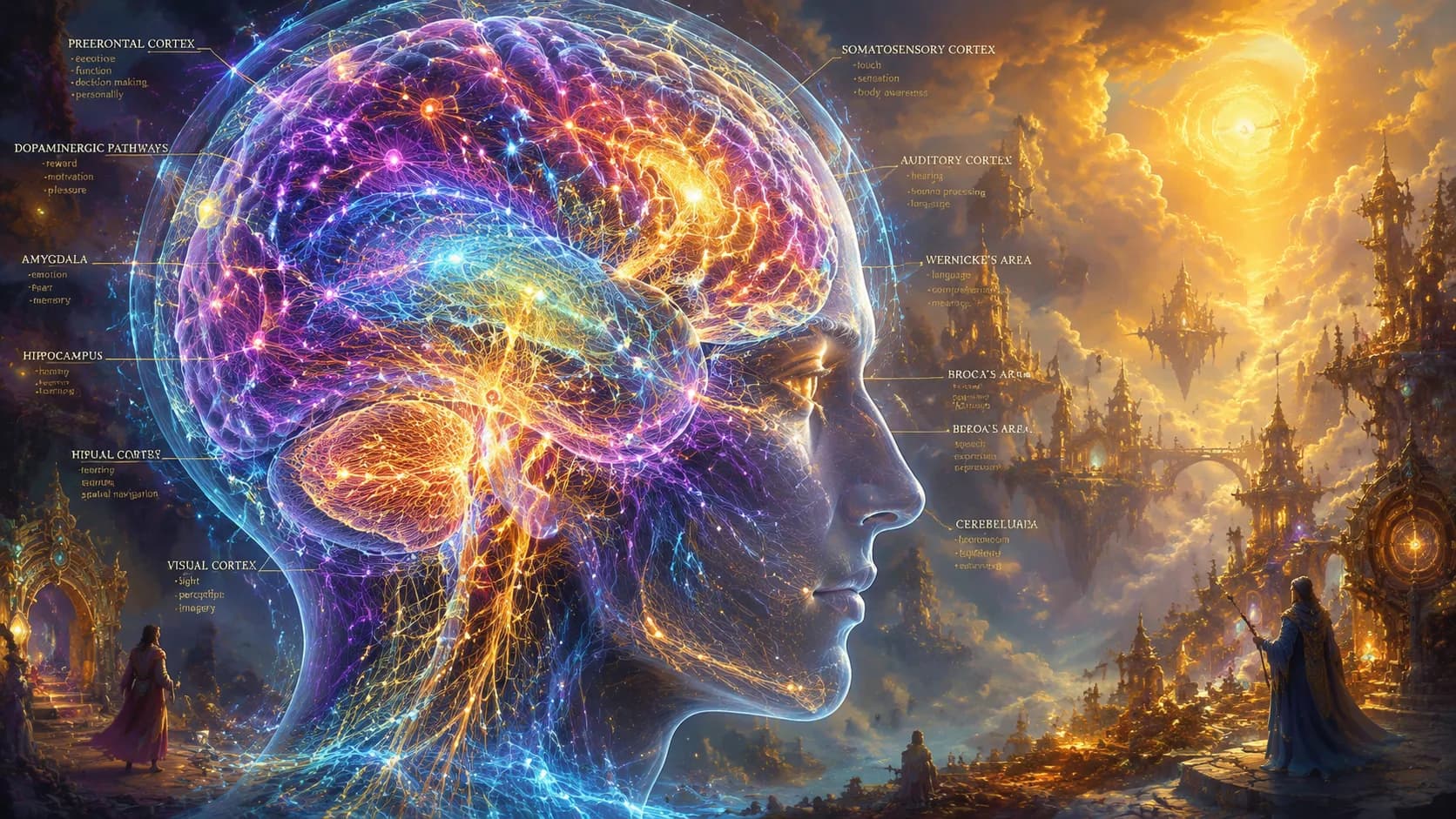
Modern neuroimaging has revealed that imagination and creativity share a remarkable amount of neural real estate. The default mode network (DMN) a system of interconnected brain regions including the medial prefrontal cortex, posterior cingulate cortex, and angular gyrus was once dismissed as the brain's "idle mode," active only when we weren't doing anything useful. Researchers now understand that the DMN is the brain's imagination engine: it activates during daydreaming, mental simulation, memory recombination, and scenario planning. It is the network that allows you to imagine being somewhere else, remember past experiences vividly, and construct possible futures all fundamental ingredients of creative thought.
Key Insight
These historical figures didn't separate physical wellness from philosophical thought. To them, it was all one continuous practice of living well.
What makes creative thinking neurologically distinctive is the dynamic interaction between three major brain networks. The DMN generates possibilities and associations. The executive control network (centered on the prefrontal cortex) evaluates, filters, and refines those possibilities. And the salience network (centered on the anterior insula) acts as a switch, directing attention between internal imagination and external task demands. In highly creative individuals, brain scans suggest that these three networks communicate more fluidly, with imaginative and evaluative systems working together rather than taking turns, producing what researchers describe as "creative cognition."A 2018 study led by Roger Beaty and published in the Proceedings of the National Academy of Sciences identified a pattern of brain connectivity, a so-called high-creative network, that could predict people's scores on a creative-thinking task in new groups of participants.
Crucially, this connectivity pattern was not fixed: participants who engaged in regular imagination-based practices including meditation, visualization, and narrative exercises showed increased connectivity in this network over time. This finding confirmed what psychologists had long suspected: creativity is not a fixed trait but a trainable capacity, and the training path runs directly through imagination.
"Scientists discovered the brain has a 'creativity network.' This is exciting news for everyone and slightly alarming for those of us who assumed our creative struggles were due to a missing brain region rather than insufficient practice."

Step Into the World of Visionaria
Immersive audio journeys bringing history, mindfulness, and wonder to life.
Why did the Stoic cross the road? Because it was the rational thing to do, and he was indifferent to the traffic.
How Imagination Fuels the Creative Process
The creative process whether it produces a painting, a business strategy, a scientific theory, or a poem typically follows a recognizable sequence, and imagination plays a critical role at every stage. The classic model, first described by Graham Wallas in 1926, identifies four phases: Preparation (gathering information and skills), Incubation (allowing ideas to simmer below conscious awareness), Illumination (the "aha!" moment when a solution or idea emerges), and Verification (testing and refining the idea). Imagination is the engine driving the first three stages and its quality directly determines the richness of what emerges.
Visionaria Insight
By immersing ourselves in these historical soundscapes, we reconnect with a timeless human tradition of storytelling and mental restoration.
During Preparation, imagination allows you to absorb and mentally simulate the problem space visualizing possibilities, imagining how different components might interact, and building internal models of the challenge you're addressing. An architect imagines how light will move through a building. A novelist imagines how a character would feel in a specific situation. A software designer imagines how a user will navigate an interface. This mental simulation work is preparation's secret weapon it allows you to explore far more possibilities mentally than you could ever test physically.
During Incubation the period when you step away from a problem and let it percolate imagination works beneath conscious awareness, recombining stored memories, knowledge fragments, and sensory experiences into novel patterns. This is why creative breakthroughs so often occur during walks, showers, or that half asleep moment before dawn: the default mode network is free to make unexpected connections when the executive control network relaxes its grip. And during Illumination, the creative insight arrives as a mental image a sudden visualization of the solution, the completed design, or the missing piece. The richer and more practiced your imagination, the more vivid, detailed, and actionable these illumination moments become.
A time traveler went back to antiquity to teach them about 'holistic health.' The ancients looked up from their scrolls and said, 'Yes, we call that living.'
Visualization: The Bridge from Imagination to Creation
Visualization the deliberate practice of creating detailed mental images is perhaps the most direct bridge between imagination and creativity. Unlike passive daydreaming, visualization is directed, intentional, and increasingly detailed. When you visualize, you're not just idly wondering "what if?" you're constructing a complete mental prototype of something that doesn't yet exist, testing it against your knowledge and aesthetic sense, and iterating on it before committing any resources to physical creation. This is why visualization is used extensively in fields from architecture and industrial design to athletic performance and therapeutic healing.
The power of visualization for creativity lies in its ability to make abstract ideas concrete. When you visualize a creative project seeing the colors, feeling the textures, hearing the sounds, imagining the spatial relationships you engage the same sensory processing regions that would activate if you were experiencing the real thing. Brain scans show that vivid mental imagery activates the visual cortex, auditory cortex, and somatosensory cortex in patterns remarkably similar to actual perception. This means that detailed visualization is a form of practice your brain rehearses the creative output before you produce it, identifying potential problems and discovering possibilities that abstract thinking alone would miss.
Visionaria Insight
By immersing ourselves in these historical soundscapes, we reconnect with a timeless human tradition of storytelling and mental restoration.
Daily visualization meditation specifically strengthens this bridge. For creative professionals and aspiring creators alike, regular imagination practice may be a worthwhile addition to their routine.
"Visualization is essentially mental prototyping with zero material costs. If only someone had told Renaissance painters they could have just imagined the ceiling of the Sistine Chapel and saved themselves the scaffolding."
Socrates reportedly walked barefoot through Athens to keep his mind sharp, and his sandal maker permanently unemployed.
The Role of Daydreaming in Creative Breakthroughs
For decades, daydreaming was dismissed as a waste of cognitive resources a sign of distraction, laziness, or inattention. Modern neuroscience has dramatically revised this view. Constructive daydreaming the mind's tendency to wander into imagined scenarios, alternate possibilities, and mental simulations is now recognized as one of the brain's most important creative functions. When the mind wanders, the default mode network becomes highly active, forming novel associations between disparate memories, ideas, and sensory experiences that the more focused, analytical parts of the brain would never connect.
Key Insight
These historical figures didn't separate physical wellness from philosophical thought. To them, it was all one continuous practice of living well.
Some of history's most celebrated creative breakthroughs emerged directly from daydream-like states. Kekulé reportedly visualized the ring structure of benzene after daydreaming about a snake seizing its own tail. Newton's gravitational insights followed periods of idle reflection. Mary Shelley conceived Frankenstein during a waking vision. Paul McCartney heard the melody of "Yesterday" in a dream. These anecdotes reflect a pattern that neuroscience now confirms: the incubation period of creativity relies on the same neural processes as daydreaming unconstrained mental simulation, free association, and the recombination of stored experiences into novel configurations.
Importantly, not all daydreaming is equally creative. Researchers distinguish between positive constructive daydreaming (playful, exploratory mental wandering with vivid imagery) and guilty dysphoric daydreaming (anxious, repetitive rumination about problems). The former enhances creativity; the latter does not. Story-based meditation offers a structured path to the constructive variety: it provides a narrative framework that guides mental wandering into rich, detailed, exploratory territory while preventing it from collapsing into anxious rumination. This may be one reason some meditators feel their creative thinking benefits: they're regularly practicing the constructive daydreaming mode.
Why did the historian break up with the archaeologist? Because her career was literally in ruins.
Imagination Training: Strengthening Your Creative Mind
Imagination training is the deliberate, structured practice of strengthening your capacity for mental imagery and it represents one of the most effective investments you can make in your creative abilities. Just as physical training develops muscles, imagination training develops the neural pathways underlying mental imagery, scenario simulation, and creative association. The principle is straightforward: the more often you practice forming vivid, detailed, multi-sensory mental images, the more naturally and powerfully your imagination operates and the richer the raw material it supplies to your creative processes.
Effective imagination training programs typically progress through four levels of increasing complexity. Level 1: Sensory imagery practicing visualizing specific objects, sounds, textures, and smells with increasing vividness and detail. Level 2: Scene construction building complete mental environments (a forest, a city, a historical setting) with spatial relationships, lighting, and atmosphere. Level 3: Narrative immersion placing yourself within imagined stories, experiencing them from a first person perspective with emotional engagement. Level 4: Creative synthesis using trained imagination to generate novel combinations, solutions, and artistic visions by deliberately recombining elements from different domains.
Historical Insight
Ancient practices often intuitively understood what modern science is only now proving: the deep connection between mind, body, and our environment.
A 2004 review of creativity training programs in the Creativity Research Journal (Scott, Leritz and Mumford) found that well-designed training generally improves performance on tests of creative thinking, including the number, variety and originality of ideas. Crucially, these improvements transferred across domains: artists improved their scientific problem solving, and engineers improved their aesthetic judgment. This cross-domain transfer confirms that imagination training strengthens a general cognitive capacity, not just a domain specific skill making it valuable for anyone seeking to enhance their creative thinking, regardless of profession.
"Imagination training is the only workout where lying on the couch with your eyes closed counts as productive exercise. Finally, a fitness regime we can all commit to."
A time traveler went back to antiquity to teach them about 'holistic health.' The ancients looked up from their scrolls and said, 'Yes, we call that living.'
How Story-Based Meditation Enhances Creative Thinking
Story-based meditation occupies a unique position at the intersection of imagination training and creativity enhancement. Unlike traditional breath-focused meditation (which primarily trains attention) or open monitoring meditation (which primarily trains awareness), narrative meditation actively engages the imagination by guiding practitioners through vivid, multi-sensory story environments ancient temples, mythological quests, natural landscapes, and fantastical realms while simultaneously inducing the relaxed, open mental state associated with creative insight.
This combination is neurologically powerful. Story-based meditation activates the default mode network (through narrative imagination), the salience network (through emotional engagement with the story), and the sensory processing regions (through guided multi-sensory imagery) all while the meditative state reduces activity in the dorsolateral prefrontal cortex, the brain region responsible for self-censorship, judgment, and the inner critic that so often blocks creative expression. The result is a mental state that closely resembles the optimal conditions for creative thinking: vivid imagination combined with reduced inhibition and enhanced associative fluency.
Did You Know?
The relentless drive to understand the world was seen not just as an academic pursuit, but as a spiritual and healing practice by the ancients.
Visionaria's cinematic meditation approach takes this further by using spatial 3D audio to create truly immersive story environments. When you hear sounds arriving from specific directions footsteps behind you, birdsong overhead, water flowing to your left your brain constructs a three-dimensional mental space that is far more vivid and detailed than what verbal description alone can achieve. This level of immersive imagination training represents the cutting edge of creativity enhancement: technology assisted imagination practice that trains your mental imagery system while simultaneously relaxing the psychological barriers to creative expression.
"Story meditation is like a guided tour of your own imagination except the tour guide has a soothing voice, the scenery is spectacular, and there's no gift shop at the end. Just expanded creative capacity, which is arguably more valuable than a keychain."
Why did the ancient physician prescribe a long walk? Because he was tired of listening to the patient complain in his office.
Famous Creators Who Used Imagination Practices
Some of history's most celebrated creative minds deliberately cultivated their imaginations through practices remarkably similar to modern imagination training. Albert Einstein famously conducted "thought experiments" (Gedankenexperimente) detailed mental simulations in which he would imagine riding alongside a beam of light or falling in an elevator, using vivid sensory imagery to explore the implications of physics problems that couldn't be solved through mathematics alone. His theory of special relativity emerged directly from one such thought experiment: imagining what the world would look like at the speed of light.
Visionaria Insight
By immersing ourselves in these historical soundscapes, we reconnect with a timeless human tradition of storytelling and mental restoration.
Nikola Tesla took visualization even further. He reported the ability to construct and test complete machines entirely in his imagination rotating components, measuring stresses, identifying design flaws all before committing anything to paper. He claimed he could run his imaginary machines for weeks, then inspect them for wear, finding the exact same results as physical testing would produce. While Tesla's claims may have been somewhat exaggerated, his approach reflects a profound truth: vivid, detailed imagination is a form of cognitive prototyping that can dramatically accelerate the creative process.
In the arts, Beethoven composed entire symphonies in his head during walks through the Vienna woods, and continued creating masterworks even after losing his hearing demonstrating that his inner auditory world was as vivid and detailed as any external sound. Frida Kahlo painted directly from the intense imagistic visions produced by her emotional and physical experiences. Steve Jobs practiced Zen meditation and credited his ability to "see around corners" imagining products that didn't yet exist to his meditation practice's effect on his creative intuition. In each case, the pattern is the same: deliberate imagination practice fueled extraordinary creative output across vastly different domains.
Why did the ancient physician prescribe a long walk? Because he was tired of listening to the patient complain in his office.
Practical Exercises to Boost Imagination and Creativity
Strengthening the imagination creativity connection doesn't require expensive tools or years of training. Here are evidence-based exercises that you can begin practicing today, each targeting different aspects of the imagination creativity pipeline:
Did You Know?
The relentless drive to understand the world was seen not just as an academic pursuit, but as a spiritual and healing practice by the ancients.
1. The Five Sense Visualization (5 minutes daily). Close your eyes and imagine a specific environment a sunlit ancient temple, a forest clearing, a bustling market. Systematically engage each sense: What do you see? (Light, colors, shapes, movement.) What do you hear? (Birdsong, footsteps, wind.) What do you feel? (Temperature, textures, ground beneath your feet.) What do you smell? (Stone, flowers, incense.) What might you taste? (Salt air, fresh water.) Spend one minute on each sense, building as much detail as possible. This exercise strengthens sensory imagery the foundation of creative visualization.
2. The "What If?" Cascade (10 minutes). Start with any ordinary object or situation and ask "What if?" five times in succession, each time building on the previous answer. Example: "What if chairs could talk?" → "What if chairs remembered everyone who sat in them?" → "What if chairs in a museum told stories of every visitor?" → "What if museums became alive with the voices of millions of past visitors?" → "What if we could hear the emotional imprint left by every person who ever occupied a space?" Each step exercises associative thinking the ability to chain ideas together in novel ways.
3. Cross-Domain Analogy Practice (15 minutes). Choose two completely unrelated domains (e.g., Norse mythology and cooking; astronomy and dance; ancient architecture and software design) and generate as many meaningful analogies between them as possible. This exercises remote association the ability to find connections between distant concepts, which is one of the strongest predictors of creative ability. 4. Story-Based Meditation (15-20 minutes). Use an app like Visionaria to engage in a guided narrative meditation journey, building full sensory scenes in your mind while maintaining the relaxed awareness of meditation. This integrates imagination training with the neurological conditions that promote creative insight.
Read more: What Is Cinematic Meditation? A New Era of Mindfulness
"The 'What If?' Cascade is how you get from 'What if cats could drive?' to a viable business plan in five steps. Results may vary. Cats are notoriously unreliable business partners."
Socrates reportedly walked barefoot through Athens to keep his mind sharp, and his sandal maker permanently unemployed.
The Science of Flow States and Creative Imagination
Flow the psychological state of complete absorption in a challenging activity, first described by Mihaly Csikszentmihalyi is widely recognized as the optimal state for creative production. During flow, time seems to disappear, self-consciousness fades, and creative output increases dramatically in both quality and quantity. What neuroscience has recently revealed is that flow states involve a unique collaboration between imagination and focused attention that resembles neither pure daydreaming nor pure concentration, but rather a dynamic interplay between both modes.
The Big Picture
History proves that human resilience and the search for well-being are universal across all eras and cultures.
In flow, the default mode network (imagination) and the executive control network (focused attention) operate simultaneously rather than alternating. Brain imaging studies show that during flow, the prefrontal cortex undergoes a phenomenon called "transient hypofrontality" a temporary reduction in activity in the self-monitoring, self-critical regions of the brain, while the regions associated with pattern recognition, sensory processing, and imaginative simulation remain highly active. The result is a state where creative ideas flow freely without the usual interference of self-doubt, overthinking, and perfectionism.
Critically, research shows that people with stronger imaginations enter flow states more easily and remain in them longer. This makes intuitive sense: flow requires the ability to fully immerse yourself in a task, which is essentially an exercise in sustained imagination maintaining a vivid, detailed mental model of what you're creating as you create it. Meditation practices that train sustained attention and vivid imagery particularly story-based meditation directly build the cognitive infrastructure that supports flow. Some studies have found that people who practise mindfulness tend to report flow experiences more often, although the research is still limited.
Why did the inventor of the wheel win an award? Because his idea really got things rolling.
How Technology Amplifies Imaginative Capacity
While imagination is fundamentally a biological capacity, technology can dramatically amplify its training and expression. Spatial 3D audio technology, for example, creates immersive soundscapes that stimulate the imagination far more powerfully than traditional two channel stereo. When sounds arrive from specific spatial positions footsteps approaching from behind, thunder rolling across the sky, a voice whispering from the left the brain automatically constructs a three-dimensional mental model of the environment. This "assisted imagination" trains the same neural pathways as unassisted visualization but provides a richer, more detailed sensory scaffold to build upon.
Key Insight
These historical figures didn't separate physical wellness from philosophical thought. To them, it was all one continuous practice of living well.
The implications for creativity are significant. Story-based meditation apps like Visionaria use spatial audio, professional narration, and carefully designed narrative structures to create imagination training sessions that are both more immersive and more accessible than traditional visualization practices. For people who struggle with "blank mind" during visualization a common challenge for beginners audio-guided imagination provides the scaffolding needed to develop imagery skills progressively. As proficiency grows, practitioners find that their unassisted imagination also strengthens, much as training wheels help develop the balance that eventually makes them unnecessary.
Beyond audio, emerging technologies like binaural beats, neurofeedback, and guided journaling appsoffer additional pathways to imagination creativity enhancement. Binaural beats, audio frequencies some believe can nudge brainwave patterns, are sometimes used to encourage the relaxed, dreamy states associated with creative ideation, though the evidence is mixed. Neurofeedback allows users to observe their own brain activity in real time, learning to recognize and reproduce the neural patterns associated with imaginative engagement. Together, these technologies are creating a new field that might be called"creativity engineering" the systematic use of technology to enhance human creative capacity through trained imagination.

"Technology for imagination training: because sometimes your brain needs headphones, a comfortable chair, and a soothing voice telling it to imagine ancient temples before it agrees to be creative. We've all been there."
A philosopher walked into a wall. His students asked if it hurt. He replied, 'The wall is an illusion, but my headache is quite real.'
Building a Daily Imagination-Creativity Practice
The most important insight from the research on imagination and creativity is that both are skills that improve with consistent daily practice not occasional bursts of effort. Building a sustainable daily imagination creativity practice doesn't require hours of dedicated time; it requires small, regular investments that compound over weeks and months into significantly enhanced cognitive capacity. Here's a framework for building such a practice, based on the principles discussed throughout this article.
Visionaria Insight
By immersing ourselves in these historical soundscapes, we reconnect with a timeless human tradition of storytelling and mental restoration.
Morning (5-10 minutes): Imagination warm up. Begin your day with a brief visualization exercise. This could be the Five Sense Visualization described earlier, a short guided visualization meditation, or simply spending five minutes with your eyes closed, building a detailed mental image of a place you find inspiring a historical city, a natural landscape, or an imaginary environment. This primes the default mode network for creative engagement throughout the day.
Midday (2-3 minutes): Micro imagination breaks. Several times during the day, pause for 2-3 minutes of deliberate mental imagery. Imagine a creative challenge from a different perspective. Visualize a project at a more advanced stage of completion. Practice the "What If?" cascade for a few steps. These micro-breaks activate the incubation process, allowing your unconscious mind to work on creative problems while your conscious attention is elsewhere. Evening (15-20 minutes): Immersive story meditation. End your day with a Visionaria journey a cinematic meditation that exercises your imagination through rich, multi-sensory narrative immersion while simultaneously relaxing your body and mind. This practice strengthens imagination, promotes creative dreaming, and prepares the brain for the nocturnal memory consolidation that often produces morning creative insights.
The key to sustaining this practice is making it enjoyable, not obligatory. Imagination training should feel like play, not work because it literally is play, the cognitive kind that humans evolved to engage in. Track your creative output over time (ideas generated, projects completed, problems solved) and you'll likely notice measurable improvements within four to six weeks. The imagination creativity connection is real, it is trainable, and the returns on consistent practice are extraordinary.
"A daily imagination practice of 25 minutes adds up to over 150 hours per year. That's 150 hours of building creative superpowers while sitting comfortably with your eyes closed. If that's not the best productivity hack ever invented, we don't know what is."
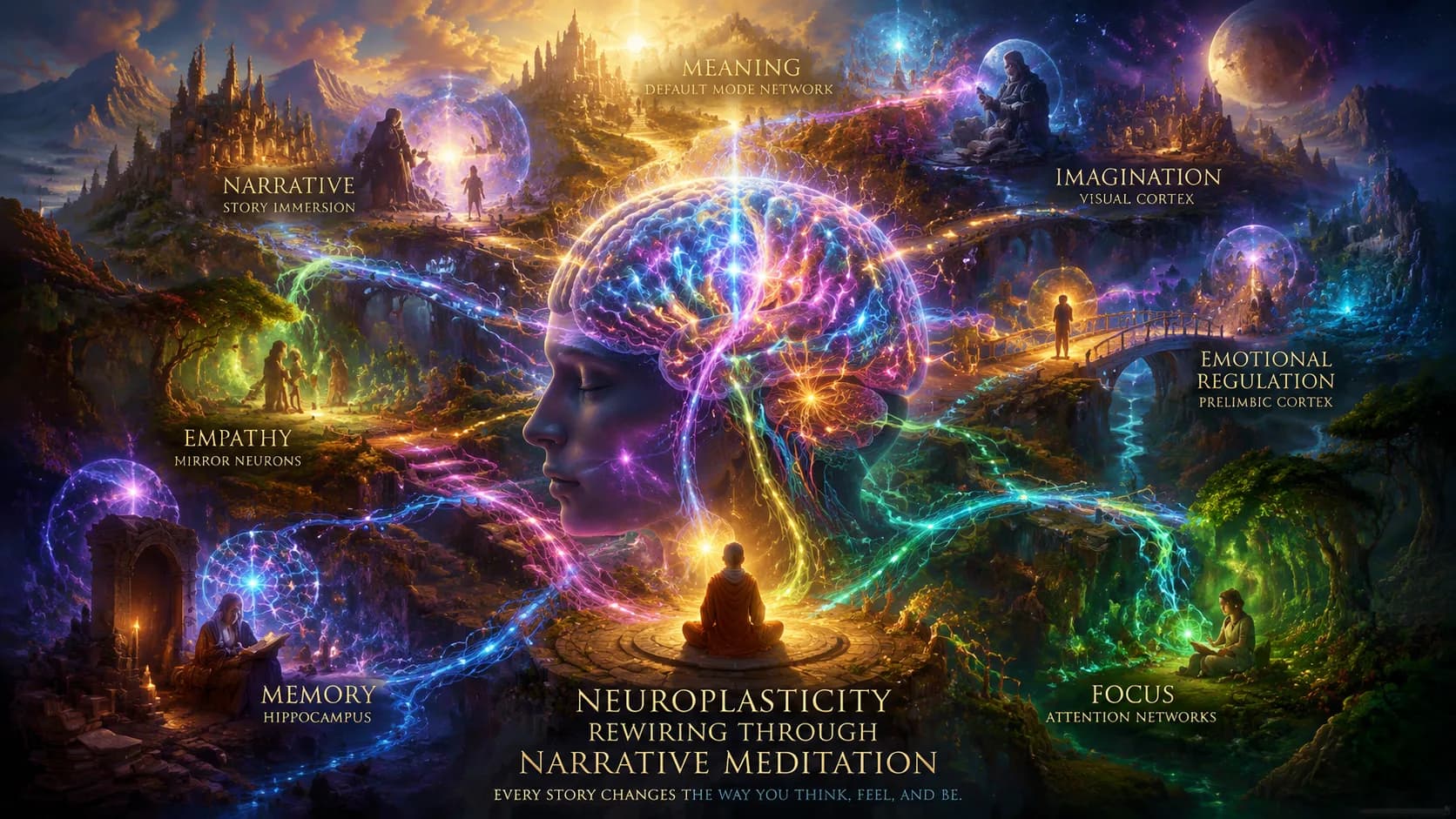
How Narrative Meditation Rewires the Brain: Neuroplasticity, Story-Based Mindfulness & Immersive Audio
Discover how narrative meditation rewires the brain, from neuroplasticity and story-driven mindfulness to default mode network restructuring, emotional regulation circuits, spatial audio immersion, and how immersive au...
Why did the Stoic cross the road? Because it was the rational thing to do, and he was indifferent to the traffic.
The Bottom Line
Imagination and creativity are not separate gifts given to fortunate individuals they are deeply interconnected cognitive processes that share neural networks, develop through practice, and enhance each other in a virtuous cycle. The richer your imagination, the more raw material your creativity has to work with. The more you exercise creative selection and refinement, the more purposefully your imagination generates relevant, vivid possibilities.
Did You Know?
The relentless drive to understand the world was seen not just as an academic pursuit, but as a spiritual and healing practice by the ancients.
This article explored the neuroscience behind the imagination creativity connection, the role of visualization and daydreaming, practical exercises for strengthening both capacities, and how modern story-based meditation technology offers one of the most effective paths to enhanced creative thinking. For anyone ready to strengthen their imagination and unlock greater creative potential, Visionaria offers spatial 3D audio journeys designed to train your mind's eye while deeply relaxing your body.
Continue exploring: read about What Is an Imagination Training Practice?, discover Meditation for Expanding Inner Worlds, or explore The Sacred Temples of Ancient Egypt.
Experience More with Visionaria
Download the app to explore guided historical and wellness journeys.
What's an ancient intellectual's favorite exercise? Jumping to conclusions.
This article is for educational and informational purposes only. Historical details are based on available research and may evolve as new evidence emerges.
Visionaria journeys are designed for relaxation, guided imagination, and personal enrichment. They are not a substitute for medical, mental health, legal, or professional advice.