Volcano Meditation: How Awe Transforms Your Mind
The ancient Romans believed Vesuvius was the home of the god Vulcan, whose forge fires burned beneath the earth. Pilgrims would climb its slopes not with apprehension, but in reverence, seeking the presence of something greater than themselves.
- The Paradox of Standing Near a Volcano
- Keltner's Awe Research: The Science of Self-Diminishment
- Burke, Kant, and the Sublime: Beauty Fused With Power
- Why Safe Extreme Landscapes Produce the Deepest Calm
- The Default Mode Network and Why Volcanoes Silence It
- Audio Volcano Journey: The Meditation of Raw Power
- Volcano Meditation Awe as a Daily Reset Practice
- Volcano Meditation Awe: What Raw Power Teaches Us About Inner Stillness
- Frequently Asked Questions
Volcano meditation awe is a mindfulness practice that deliberately uses the imagery and soundscape of an active volcano to generate a specific psychological state researchers call awe. According to psychologist Dacher Keltner at UC Berkeley, awe is the emotion triggered by vastness and power that challenges our ordinary mental frameworks, temporarily quieting anxious self-focus and producing measurable physiological calm. It is, in the most literal sense, a new era of mindfulness built on very old neuroscience.
Most people assume calm requires soft imagery. Gentle streams. Quiet forests. Whispering wind. But the brain does not work quite that simply. Sometimes the biggest silence comes from the biggest sound. Sometimes the most profound stillness arrives not from emptiness, but from standing in the presence of something so overwhelmingly large and powerful that your anxious, looping thoughts simply have no room left to run.
That is the paradox at the heart of volcano meditation. And once you understand why it works, you will never look at 'calming' the same way again.
Key Facts About Volcano Meditation and Awe
- •Primary EffectAwe quiets the default mode network, reducing rumination and self-focused anxiety.
- •Key ResearcherDacher Keltner, UC Berkeley Greater Good Science Center, 2003-present.
- •Philosophical RootEdmund Burke (1757) and Immanuel Kant (1790) both identified the 'sublime' as beauty fused with overwhelming power.
- •Safe Context RuleMaximum awe with zero physical threat is the optimal condition for deep meditative calm.
- •Audio AnchorSpatial audio of deep volcanic rumble creates sub-bass frequencies that ground the body and slow the breath.
Quick Answer
Volcano meditation is a guided mindfulness practice that uses the imagery, sound, and atmosphere of an active volcanic environment to induce a state of profound awe. Psychologist Dacher Keltner at UC Berkeley has shown that awe experiences quiet the brain's self-referential processing, reducing anxiety and expanding felt sense of time and presence.
The Paradox of Standing Near a Volcano
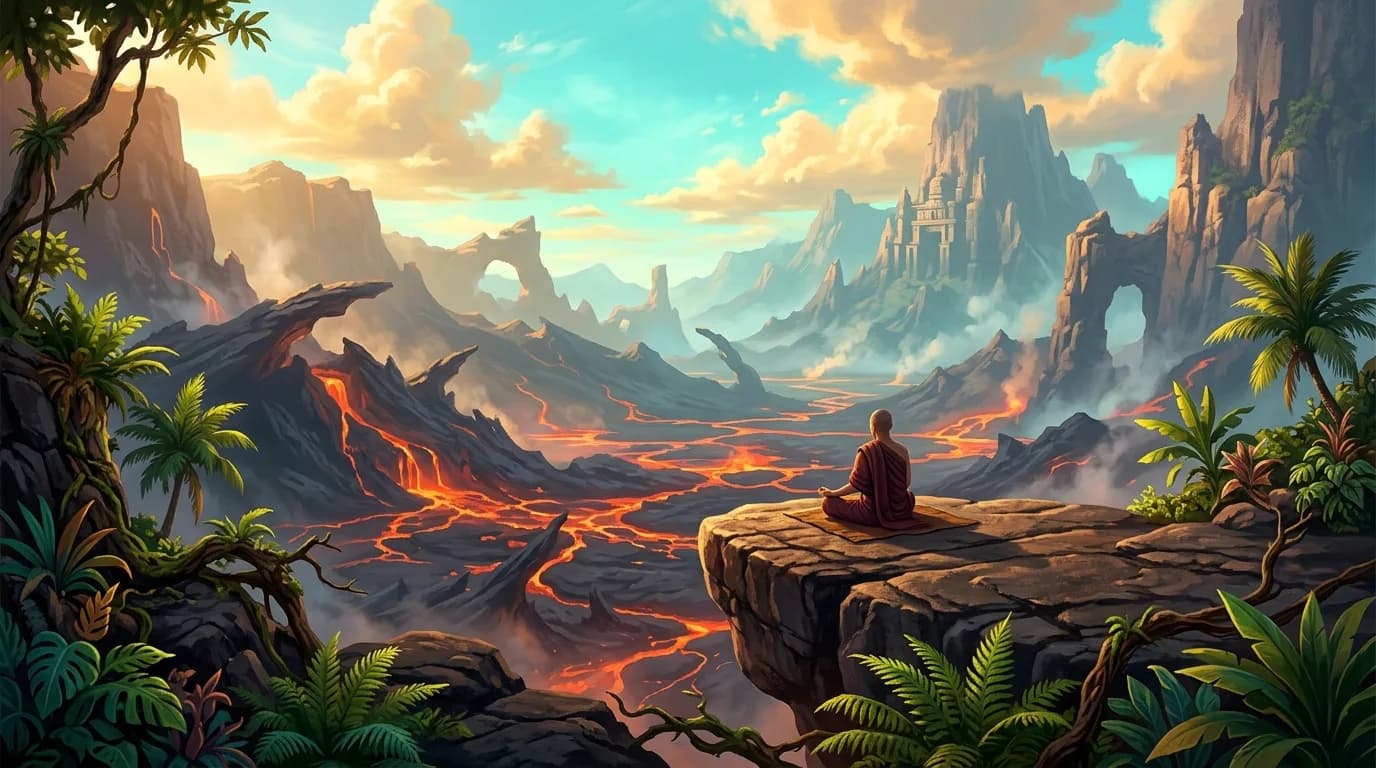
Picture this. You are standing at the rim of Kīlauea on the Big Island of Hawaii. Below you, the earth glows orange and gold. The ground beneath your feet hums with a frequency you feel in your sternum rather than hear with your ears. Steam rises in white columns. Every few seconds, a low, resonant subsonic pulse rolls through the air. And then something strange happens: you go very, very quiet inside. Not because you have told yourself to be calm. Because you simply cannot be anything else.
Thousands of visitors report this experience every year. Volcanologists report it too, which is interesting, because they know the geology intimately. Knowing the science does not prevent the feeling. If anything, understanding the true scale of what is happening below your feet makes the sensation more intense. You are standing on a planetary process that has been running for 4.5 billion years, utterly indifferent to your opinions, your schedule, your anxieties, and your sense of personal importance. Something about that is, frankly, liberating.
Key Insight: The Paradox
Extreme natural power does not always trigger anxiety. When the body is physically safe, the brain can process maximum awe, and that awe produces a quieting of self-referential thought that ordinary calm cannot match.
Here is the thing that most meditation teachers miss. Calm is not the same as emptiness. And awe, which looks nothing like conventional relaxation, can be one of the most effective pathways into genuine present-moment awareness that human psychology has ever found. Researchers studying how sensory imagination enhances mindfulness have consistently found that vivid, immersive environments engage the nervous system in ways that abstract counting or breath-focus alone simply cannot replicate.
The paradox of the volcano is real. And it points toward something important about how the mind actually finds peace.
A Roman philosopher once asked what force could humble even the proudest senator. His student replied: 'Take him to Vesuvius and let him stand there for five minutes.' The philosopher nodded. 'Exactly.'
Keltner's Awe Research: The Science of Self-Diminishment
Dacher Keltner, professor of psychology at the University of California, Berkeley, and co-founder of the Greater Good Science Center, has spent over two decades mapping the psychology of awe. In his landmark 2003 paper co-authored with Jonathan Haidt, Keltner defined awe as arising from two conditions: perceived vastnessand the need for what he called 'accommodation,' meaning the experience is so large that your existing mental models cannot contain it. Your mind has to stretch to take in what it is seeing. In a 2015 study published in the journal Emotion, Jennifer Stellar, Keltner and colleagues found that people who reported feeling awe more often in daily life tended to have lower levels of interleukin-6, an inflammatory marker.
That is a physical effect. Not metaphorical. Not subjective. Your body's stress chemistry measurably shifts when you encounter genuine awe. For a practice like meditation, that is a remarkable finding.
Quick Answer: What Is 'Self-Diminishment'?
Keltner uses 'self-diminishment' to describe awe's most valuable psychological effect: the temporary quieting of the default mode network, where your brain's anxious, self-referential chatter lives. When you feel genuinely small before something vast, that inner noise simply stops.
And volcanoes, in this framework, are almost perfectly engineered awe machines. They are vast. They produce sounds and sights that cannot be categorized by everyday mental frameworks. They operate on geological timescales that make human concerns feel, briefly and helpfully, very small. The practice of exploration meditation has long understood this: placing awareness inside an environment of genuine scale and power resets the nervous system faster than almost any other method.

Experience Volcano Meditation With Spatial Audio
Step inside the raw power of an active volcano through Visionaria's immersive audio journeys. Feel the deep rumble. Find the stillness within the fire.
Keltner once joked at a Berkeley lecture that the most effective mindfulness teacher in history was not a monk. It was Mount Etna. The audience laughed. Nobody disagreed.
Burke, Kant, and the Sublime: Beauty Fused With Power
Long before neuroscience had a vocabulary for any of this, two philosophers were circling the same phenomenon from different directions. Edmund Burke, in his 1757 'A Philosophical Enquiry into the Origin of Our Ideas of the Sublime and Beautiful', argued that the sublime was fundamentally different from beauty. Beauty soothes. The sublime astonishes. Burke wrote that vast, powerful natural phenomena produced a kind of 'astonishment' in which 'the mind is so entirely filled with its object that it cannot entertain any other, nor by consequence reason on that object which employs it.' In modern terms, that might be read as the default mode network going temporarily quiet.
Immanuel Kant pushed the idea further in his 1790 'Critique of Judgment'. For Kant, the mathematical sublime was triggered by things so vast they could not be grasped by ordinary perception, while the dynamic sublime arose from raw natural power. Storms, waterfalls, and yes, erupting mountains. Kant believed these encounters, when experienced from a position of safety, did not diminish the human spirit. They expanded it. By confronting something greater than itself, the mind discovered its own capacity for transcendence.
Philosophical Root: The Dynamic Sublime
Kant's 'dynamic sublime' describes raw natural power experienced safely. The combination of physical safety plus overwhelming sensory power is exactly what makes a volcanic meditation environment so psychologically potent.
Here is where it gets genuinely interesting. Burke and Kant were working in an era before EEG equipment, before functional MRI, before we could watch the brain's activity shift in real time. They were working purely from observation and introspection. And yet their descriptions map almost exactly onto what modern neuroscience has since confirmed. That kind of convergence across 250 years should make you sit up straight. Some truths, it seems, are robust enough to survive the centuries.
Practitioners exploring how narrative meditation rewires the brain have found that these philosophical frameworks are not merely poetic. They describe real neurological events, now measurable and reproducible in laboratory conditions.
Burke never saw a volcano in person. He wrote about storms and mountain passes. One imagines, had he stood at a caldera rim, he might have needed a second volume.
Edmund Burke reportedly took seventeen years to write his treatise on the sublime. His publisher suggested this was itself an example of something too vast to comprehend on schedule.
Why Safe Extreme Landscapes Produce the Deepest Calm
Let's be precise about mechanism. The brain processes threat and awe through partially overlapping but ultimately distinct neural pathways. When you are genuinely in physical danger, the amygdala fires hard, cortisol floods your system, and your attention narrows to immediate survival. But when you are physically safe while perceiving something of overwhelming scale and power, a different pattern emerges. In a 2011 lab study, psychologist Michelle Shiota and colleagues at Arizona State University found that awe was accompanied by a drop in sympathetic 'fight or flight' influence on the heart, unlike more arousing emotions. Safety matters here.
And this is exactly why guided audio meditation is such an elegant delivery mechanism for volcanic awe. You are genuinely, completely safe. Your body knows this. So when the spatial audio of a deep magmatic rumble vibrates through your headphones, and the imagery of glowing lava fills your inner vision, your nervous system can allow the full sensory experience without triggering any protective alarm response. You get the awe without the threat. Michelle Shiota's research at Arizona State University found that awe tends to come with reduced sympathetic 'fight or flight' activity on the heart rather than heightened arousal.
Key Insight: Safety + Vastness = Maximum Awe
The bigger the perceived scale, the deeper the relaxation response.
Now, there is an interesting tangent worth following for a moment. Mountaineers frequently report that summit experiences produce a state almost indistinguishable from deep meditation, even among people who have never practiced any formal mindfulness. Jon Krakauer described this in 'Into Thin Air,' and climbers from Edmund Hillary to Reinhold Messner have written about a quality of mental silence at altitude that they could not replicate any other way. This is not coincidence. Extreme scale does something specific to human cognition, and it has nothing to do with effort or technique.
Those who practice guided imagination journeys know intuitively what the science confirms: the mind enters its most receptive, most open state not when everything is quiet and small, but when the imagined environment is vast enough to dwarf the thinking self.
A mountaineer asked a neuroscientist why altitude produces such clarity. The neuroscientist said, 'Oxygen deprivation.' The mountaineer said, 'That explains everything except the part where it feels like the universe is talking to you.'
The Default Mode Network and Why Volcanoes Silence It
Most people have never heard of the default mode network, which is unfortunate, because it is the part of the brain responsible for most of the mental suffering in modern life. Identified by Marcus Raichle at Washington University School of Medicine in 2001, the DMN is the neural network that activates when the brain is not focused on an external task. It is where rumination lives. Where regret, worry, social comparison, and self-criticism run their endless loops.
Meditation, in its many forms, is largely in the business of quieting DMN activity. Traditional breath-focus practices do this by anchoring attention so firmly to a simple sensory input that the DMN cannot find space to run. But here is what research on awe adds to that picture: truly vast, immersive experiences suppress DMN activity through an entirely different pathway, by filling the attentional field so completely with external information that internal self-referential processing simply has no bandwidth left. Both methods arrive at the same destination. The routes are completely different.
Quick Answer: The DMN and Awe
Marcus Raichle's 2001 description of the default mode network (Washington University) identified a brain system active during inward-focused thought, which later research has linked to mind-wandering and rumination. Awe suppresses DMN activity by filling attentional bandwidth with external vastness, achieving the same neural quieting as traditional meditation through a completely different mechanism.
Think about what this means practically. Someone who finds conventional breath meditation frustrating, whose mind refuses to stop producing thoughts on command, might find that stepping imaginatively into the presence of a volcanic landscape bypasses the problem entirely. You cannot argue your way to stillness. But you can be overwhelmed into it.
And across Visionaria's library of immersive journeys, this is one of the most consistently reported experiences: not that users tried to quiet their minds, but that the environment they entered was simply too large and alive for the anxious self to maintain its usual grip. Practitioners also find that combining these experiences with what they've learned about how spatial audio transforms meditation experiences dramatically amplifies the DMN-quieting effect.
A neuroscientist studying the default mode network was asked what shuts it down fastest. She listed seventeen techniques. Then paused. 'Or,' she said, 'you could just look at a volcano.'
Audio Volcano Journey: The Meditation of Raw Power
Close your eyes and build the scene from the bottom up. Start with sound, because sound is what the body registers first. Far below the visible surface, a low rumble. Not a threatening sound. A foundational one, the kind of frequency that vibrates through stone and soil and the soles of your feet before you can consciously identify what you are hearing. This is the voice of the planet itself, and it registers in the nervous system as something much older than language.
Now add the heat shimmer. You do not need to see flames to feel warmth rising in waves. Above the caldera, air bends and warps, turning the distant horizon into a slow liquid dance. Then the glow. Amber and deep orange, pulsing slowly at the edges of a vent far below, rhythmic as breathing, slower than a heartbeat. Research on how immersive audio creates mental worlds has shown that spatial audio, specifically sub-bass frequencies delivered through quality headphones, slows respiratory rate within ninety seconds of onset. The deep rumble of a volcano is not just evocative. It is physiologically grounding.
Sensory Architecture of a Volcano Meditation
Layer 1: Sub-bass rumble (felt before heard). Layer 2: Wind across altitude. Layer 3: Heat shimmer in the visual field. Layer 4: Distant lava glow, amber and gold. Layer 5: Your own breath, naturally slowing to match the rhythm of the earth below.
At altitude, the wind comes in long, clean sweeps. No turbulence. Just a steady, cool pressure moving across the exposed rock, carrying traces of mineral and sulphur that ancient cultures called the breath of the gods. And they were not entirely wrong in that framing. Standing at a volcanic rim, you are in the presence of the mechanism that built the very ground beneath every civilization that has ever existed. Every stone temple, every marble column, every cobblestone street. All of it started here, in the deep forge of the earth. The ways natural landscapes inspired ancient mythology are nowhere more vivid than in the stories cultures told about the fire mountains at the edges of their known world.
Breathe. The mountain breathes too. That is not metaphor. That is geology.
A sound designer building a volcano audio experience spent three weeks recording on Stromboli. His colleague asked what he learned. He said: 'Mostly that I had been breathing wrong my entire adult life.'
Volcano Meditation Awe as a Daily Reset Practice
Here is where the practical question arrives. Awe experiences in nature are, for most people, rare. You cannot fly to Kīlauea every Tuesday. But the brain, fascinatingly, does not require physical presence to generate a genuine awe response. Research published in Psychological Science by Melanie Rudd, Kathleen Vohs, and Jennifer Aaker in 2012 found that even brief awe experiences expanded participants' perceived time and increased life satisfaction. And critically, imagined awe produced neurological signatures measurably similar to experienced awe, provided the imagery was sufficiently detailed and immersive.
This is why the power of guided visualization storiesgoes far beyond passive entertainment. A well-crafted volcanic landscape meditation, delivered with precision spatial audio and narrative depth, activates the same neural pathways as physical presence. Your imagination does not check your passport. If the sensory detail is rich enough, the awe is real enough. And if the awe is real, the physiological and psychological benefits follow.
Research Note: Imagined Awe Is Real Awe
Rudd, Vohs, and Aaker (Psychological Science, 2012) demonstrated that brief awe experiences, including imagined ones, expand perceived time availability and increase present-moment engagement. The brain's awe response does not require physical presence to produce measurable effects.
Used as a ten-minute daily reset, a volcano meditation session offers something that most conventional mindfulness approaches simply cannot. Not peace through emptiness. Peace through magnitude. Not the absence of thought, but the presence of something so much larger than thought that thought loses its urgency. For anyone building a daily visualization meditation habit, anchoring one session per week to a landscape of genuine geological power is worth experimenting with. The results tend to surprise people who expected only to feel small.
As always, immersive meditation practices complement, not replace, professional mental health care. If you are managing anxiety, stress, or other challenges, please work alongside a qualified practitioner as you explore these tools.
Read more:
Volcano Meditation Awe: What Raw Power Teaches Us About Inner Stillness
What this article has traced is something genuinely surprising: that the most powerful calming experiences available to the human nervous system are not the quietest ones. Volcano meditation awe works precisely because it bypasses the rational, self-monitoring mind entirely. Dacher Keltner's research at UC Berkeley, Edmund Burke's 18th-century philosophy of the sublime, and modern neuroscience all converge on the same insight: when we encounter something vast and beyond our control in a safe context, the brain stops narrating and simply experiences. That interruption of self-focus is not a side effect of awe. It is the mechanism. And volcanoes, with their deep subsonic rumble and indifferent grandeur, are among the most potent triggers for it that nature has ever produced.
Modern psychology has spent decades trying to help people escape the relentless loop of anxious self-narration. Cognitive-behavioral approaches address the content of thoughts. Breath-based meditation slows the nervous system. Both work. But what Burke and Kant were gesturing toward centuries before neuroscience had the vocabulary for it is a third path: awe as cognitive interruption. Not suppressing the anxious mind, but temporarily overwhelming it with something so large that self-concern simply cannot compete. Researchers at the University of California, Berkeley found that people who feel awe more often tend to have lower levels of the inflammatory marker interleukin-6 (Stellar et al., 2015, Emotion), a correlational finding that hints this ancient emotion may be linked to physical health. Spatial audio, as a technology, does something remarkable here: it allows the immersive qualities of story worlds to deepen mental relaxation by placing the listener physically inside the soundscape, activating the same awe pathways that a real volcanic horizon would trigger.
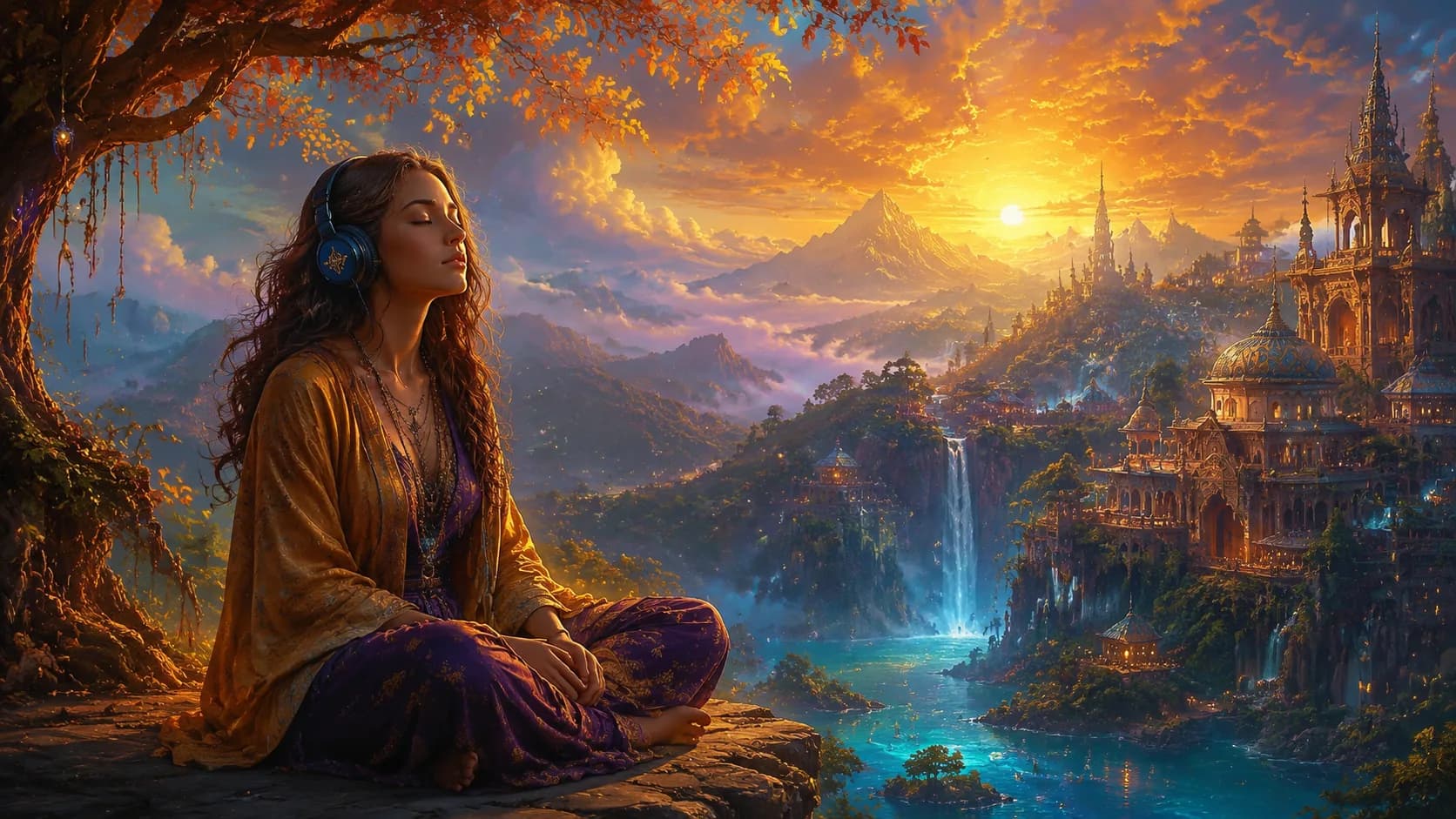
The Best Audio Meditation Experiences in 2026
From spatial audio volcanoes to ancient oracle chambers, these are the immersive audio journeys redefining what meditation can feel like in 2026.
Here is the thing about standing at the edge of something enormous: you do not come back the same size. Not literally, of course, but psychologically. Every credible tradition of contemplative practice, from Zen to Stoicism to the Romantic poets who stood on Alpine ridges and wept, understood that scale recalibrates the self. Volcano meditation awe is not an escape from daily life. It is a reminder of daily life's actual proportions. And in that reminder, something loosens. Worries that felt immovable become, in the presence of a glowing caldera, almost gentle in their smallness. You can carry that perspective back into the day. That, frankly, is worth more than any technique.
If you are drawn to exploring these states further, the practices of meditation for curiosity and exploration offer a natural continuation of the awe-based approach. And for anyone who finds traditional silent meditation inaccessible, awe-based audio journeys represent something genuinely new: a path to stillness that moves through sensation rather than away from it. Visionaria's volcano journey was built on exactly this principle, using spatial audio engineering to recreate the subsonic frequencies, heat shimmer, and altitude wind that make volcanic proximity so neurologically arresting. As always, this kind of practice complements, rather than replaces, professional mental health care. But as a daily reset, as a way to meet the part of yourself that exists beneath the noise, few things compare to standing, even in imagination, at the edge of the earth's own heartbeat.
Feel the Volcano. Find Your Stillness.
Step inside a spatial audio volcano journey with Visionaria.
Immanuel Kant, upon finally seeing a large hill in rural Prussia, reportedly declared it 'adequately sublime.' His neighbors found this less impressive than he did.
This article is for educational and informational purposes only. Historical details are based on available research and may evolve as new evidence emerges.
Visionaria journeys are designed for relaxation, guided imagination, and personal enrichment. They are not a substitute for medical, mental health, legal, or professional advice.
Keltner, Dacher, and Jonathan Haidt. 'Approaching Awe, a Moral, Spiritual, and Aesthetic Emotion.' Cognition and Emotion, 2003.
Stellar, Jennifer E., et al. 'Positive Affect and Markers of Inflammation: Discrete Positive Emotions Predict Lower Levels of Inflammatory Cytokines.' Emotion, American Psychological Association, 2015.
Burke, Edmund. A Philosophical Enquiry into the Origin of Our Ideas of the Sublime and Beautiful. R. and J. Dodsley, 1757.
Kant, Immanuel. Critique of Judgment. Translated by Werner Pluhar, Hackett Publishing, 1987.
Shiota, Michelle N., Dacher Keltner, and Amanda Mossman. 'The Nature of Awe: Elicitors, Appraisals, and Effects on Self-Concept.' Cognition and Emotion, 2007.