
Cave Meditation: Humanity's Oldest Sacred Practice
The Malta Hypogeum, carved around 3600 BCE, produces a standing resonance of exactly 111 Hz inside its main chamber. Archaeoacoustician Dr. Iegor Reznikoff confirmed this frequency corresponds to activity patterns associated with relaxed, meditative brain states.
- Humanity's First Sacred Spaces: Lascaux, Altamira, Ajanta
- Why Caves Produce Altered States of Consciousness
- The Psychological Descent: Going Underground, Going Inward
- Cave Acoustics: The Resonance That Rewires the Brain
- The Audio Cave Journey: A Cave Meditation for Modern Life
- Cave Meditation Practice: Bringing the Stone Into Your Life
- Cave Meditation: A Legacy Written in Stone and Silence
- Frequently Asked Questions
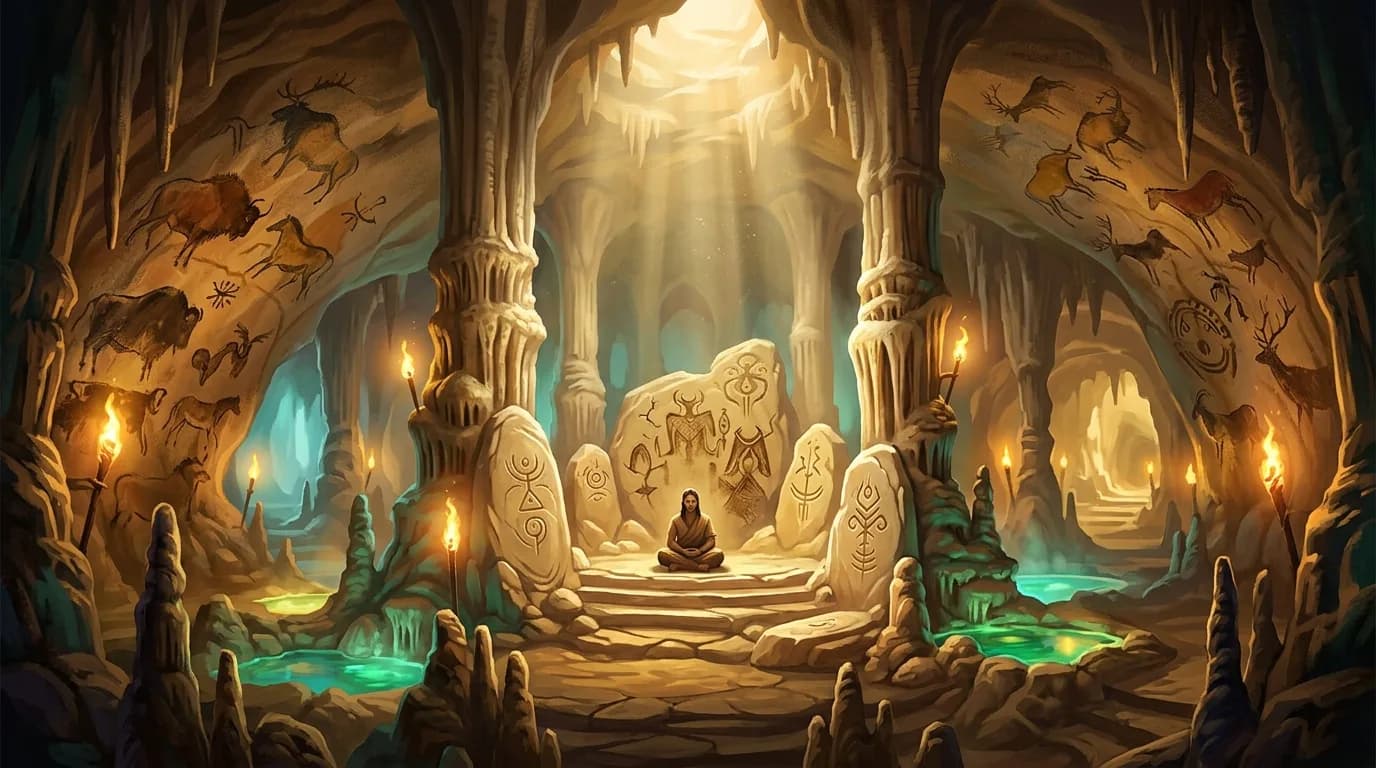
Cave meditation is the practice of entering underground cave environments to cultivate deep stillness, altered awareness, and inner reflection. Humans have used caves as sacred spaces for at least 40,000 years, long before any temple, monastery, or meditation hall was ever built. From the painted chambers of Lascaux and Altamira to the sculpted rock sanctuaries of Ajanta, the cave was humanity's original place of deep inner exploration.
And here is the thing: our ancestors were not hiding in caves out of necessity when they painted those magnificent animals on the walls. They were going deliberately inward. Archaeologists and cognitive scientists now broadly agree that Paleolithic cave art was created during rituals involving altered states of consciousness. Caves were not shelters. They were cathedrals. They were the first meditation chambers our species ever designed, and the science of what they do to the human mind is, frankly, astonishing.
Key Facts About Cave Meditation
- •Oldest evidence: Lascaux cave paintings date to approximately 17,000 years ago; ritual use of caves extends back 40,000+ years.
- •Malta Hypogeum resonance: Produces a standing 111 Hz frequency, linked to meditative brain states by archaeoacoustician Dr. Iegor Reznikoff.
- •Sensory deprivation effect: Many people find time in darkness deeply quiet and restful, and sensory deprivation research dating back to the 1960s has long explored its effects on the mind.
- •Cave temperature: Deep caves maintain a constant temperature equal to the average annual surface temperature of their region, creating a uniquely stable sensory environment.
- •Universal pattern: Cave ritual sites appear independently on every inhabited continent, from the painted caves of France to the rock sanctuaries of Zimbabwe.
Quick Answer
Cave meditation is the practice of using underground cave environments to induce deep meditative and altered states of consciousness. Humans have practiced ritual and contemplation in caves for at least 40,000 years, from the painted chambers of Lascaux and Altamira to the carved underground temples of Ajanta and Malta's Hypogeum. Caves produce altered states through total darkness, specific resonance frequencies, stable temperatures, and complete sensory isolation from the surface world.
Humanity's First Sacred Spaces: Lascaux, Altamira, Ajanta
Picture this: you are standing at the entrance of Lascaux, somewhere around 17,000 years ago. You are not carrying a torch for warmth. You are carrying it because you intend to go as deep as possible into the earth, past the point where daylight has any meaning, and you are going to paint. Not quickly. Not carelessly. You will spend hours in chambers so narrow you can barely turn around, rendering horses and aurochs with a precision that still astonishes professional artists today. Why? Archaeologist David Lewis-Williams, in his landmark 2002 work 'The Mind in the Cave,' argued that Upper Paleolithic cave artists were entering altered states through sensory deprivation, rhythmic sound, and fasting, and that the cave walls were understood as a membrane between the everyday world and a deeper one.
Altamira in northern Spain tells the same story from a different mountain. Its famous ceiling, painted with extraordinary bison around 36,000 years ago in some sections, required artists to lie on their backs in confined darkness for extended periods. Cognitive archaeologist Dr.
Key Insight: Why the Deepest Chambers?
Across Lascaux, Altamira, and dozens of other sites, the most significant paintings cluster in the deepest, most acoustically resonant, and most isolated interior chambers. Researchers interpret this as intentional: the deeper the space, the more complete the sensory transformation.
Ajanta, carved into a horseshoe-shaped cliff in Maharashtra, India, between roughly 200 BCE and 480 CE, represents a different chapter of the same instinct. Buddhist monks spent generations sculpting and painting those 30 cave halls not as residences but as meditation environments engineered with extraordinary care. Each chamber's proportions, the placement of stupas, the treatment of light entering from carved doorways: all of it was designed to move the meditating mind toward stillness. Ajanta is arguably the world's most sophisticated surviving example of intentional sacred cave architecture.
An ancient Paleolithic artist, a Buddhist monk, and a modern meditator walk into a cave. The monk says 'This is a place for enlightenment.' The meditator says 'This is a sensory deprivation chamber.' The Paleolithic artist just starts painting, because some truths do not need explaining.
Why Caves Produce Altered States of Consciousness
Let us get precise about the neuroscience. A deep cave is not merely dark. It is a total negation of the sensory conditions your nervous system evolved to process. No wind. No variation in temperature. No birdsong, traffic noise, or flickering light. No horizon. No sky. The brain, deprived of its constant incoming stream of environmental data, does something remarkable: it turns inward and begins generating its own signal. Researcher John Zubek at the University of Manitoba, a pioneer of sensory deprivation research, found that after one or more days spent in darkness and silence, participants' brainwave rhythms had measurably slowed. This is not mysticism. It is neuroscience.
Temperature matters more than most people realize. Deep caves maintain a constant temperature year-round, generally equivalent to the mean annual surface temperature of their region. Lascaux holds a steady 13 degrees Celsius regardless of whether it is midsummer or the depths of winter above. Your body stops spending energy on thermoregulation. Your nervous system stops processing thermal variation. One more source of sensory noise is eliminated, and the mind quiets a corresponding fraction further.
Quick Answer: What Makes a Cave Neurologically Different?
Four factors combine to make caves uniquely powerful for altered states: total darkness (eliminating visual cortex overload), constant temperature (stopping thermoregulatory processing), specific acoustic resonance (stimulating relaxation-linked brain frequencies), and complete isolation from surface stimuli (allowing the default mode network to shift into deep inward focus).
And then there is the humidity and the smell. Underground air carries a distinct mineral scent, damp stone, calcite, ancient earth, that is completely unlike any surface environment. Olfactory inputs bypass the thalamus and connect directly to the limbic system, the brain's emotional and memory center. Entering a cave does not just change what you see. It changes what your entire nervous system believes about where you are, which is precisely what makes immersive sensory journeys so neurologically potent when recreated through spatial audio.

Descend Into the Stone. Begin Your Cave Meditation Journey.
Visionaria's spatial audio cave journeys recreate the resonance, the dripping water, the layered silence of ancient sacred caves. Your underground sanctuary is waiting.
Ancient cave meditator to a friend: 'I went underground to find myself.' Friend: 'Did it work?' Cave meditator: 'Well, I am still here, which I suppose is the point.'
The Psychological Descent: Going Underground, Going Inward
Every major spiritual tradition independently chose the cave as its central metaphor for self-knowledge. Plato's Allegory of the Cave in the Republic frames the entire journey toward wisdom as a descent into underground shadows followed by an emergence into light. In Hindu mythology, sacred caves across the Himalayas are understood as gateways to the inner self. Jesus, in Christian tradition, emerged from a cave. Muhammad received the first revelation in the Cave of Hira. Zoroaster spent years in contemplation in a cave. The Buddha himself found enlightenment seated against an immovable earthen foundation. This is not coincidence.
Jungian psychologist James Hollis, writing in 'The Middle Passage' (1993), described the descent into the unconscious as the defining psychological movement of genuine growth. Going down before going up. Going in before going out. Every culture that independently developed a cave-based spiritual practice was pointing at the same inner geography: the idea that the most important journey you will ever take is not outward across the surface of the world but downward into yourself. And for the record, this connects directly to what makes guided imagination journeys so psychologically resonant, because a well-structured audio journey can recreate that descent in complete safety.
Cross-Cultural Pattern: The Universal Cave Symbol
Caves appear as symbols of transformation, initiation, and self-knowledge across Greek philosophy, Hindu tradition, Islamic mysticism, early Christianity, Taoist practice, and indigenous cultures on every inhabited continent. Comparative mythologist Joseph Campbell identified the cave descent as one of the most consistent features of the world's hero narratives, appearing in cultures with no known contact with one another.
Here is an aside that deserves its own moment: the Eleusinian Mysteries of ancient Greece, which ran for nearly two thousand years and counted Plato, Aristotle, and Marcus Aurelius among their participants, culminated in a multi-day underground ceremony. Initiates reported profound personal transformations. Classics scholar Walter Burkert, in 'Ancient Mystery Cults' (Harvard University Press, 1987), described these rites as producing genuine psychological shifts through sensory manipulation, fasting, and ritual darkness. Ancient Athens' most respected minds traveled regularly to undergo a designed underground experience. Different technology, same fundamental human need.
Sure, the modern mind might resist the metaphor. But the body does not. Put yourself in genuine darkness and silence, and something very old in your nervous system begins to settle, as if it recognizes the conditions under which it was shaped over hundreds of thousands of years. The cave is not an external place. It is a posture of consciousness. And learning to access that posture, whether underground or through transformative spatial audio, is one of the most powerful things a meditator can do.
Read more: The Mysteries of Delphi and the Oracle Experience
Plato, upon emerging from explaining his Cave Allegory: 'So you see, the cave represents our limited perception of reality.' Student: 'Master, could you perhaps have used a sunnier metaphor?' Plato: 'I could have. But I had already booked the cave.'
Cave Acoustics: The Resonance That Rewires the Brain
Most people know caves are dark. Far fewer know they are sonic instruments. Archaeoacoustician Dr. Iegor Reznikoff spent years in the 1980s and 1990s mapping the acoustic properties of French Paleolithic cave sites. His research, published in the Bulletin de la Societe Prehistorique Francaise (1988), produced a remarkable finding: at Lascaux, Font-de-Gaume, and a dozen other sites, the concentration of painted images correlated with extraordinary precision to the chambers with the highest resonance and reverberation. The paintings were placed where the sound was most powerful. Not where the light was best. Not where the walls were smoothest. Where the echo was most profound.
But the Malta Hypogeum is in a category of its own. Carved into limestone beneath the island of Malta around 3600 BCE, this three-level underground temple complex contains a chamber known as the 'Oracle Room.' Sing or speak inside it, and the acoustic response is not merely impressive. It is physiologically active. Researchers including Dr. Paolo Debertolis of the University of Trieste and colleagues, publishing in 2015, measured a strong double resonance at about 70 Hz and 114 Hz in the Hypogeum's so-called Oracle Room. This is not a random frequency. It sits in the range associated with the suppression of the left hemisphere's analytical functions and the activation of a more diffuse, creative, relaxed mode of awareness, the same cognitive shift targeted by narrative meditation practices today.
The 111 Hz Effect: What Science Says
Dr. Ian Cook of UCLA and colleagues, in a small 2008 pilot study published in Time and Mind: The Journal of Archaeology, Consciousness and Culture, used EEG to show that listening to a 110 Hz tone was linked to a shift from left-sided to right-sided prefrontal activity. In plain terms: the analytical, linear, self-critical mind quiets, and a more receptive, associative, and emotionally open mode of processing activates. The ancient architects of Malta may not have known the neuroscience, but they knew the effect.
Reverberation time is another factor. Most modern rooms have a reverberation time of 0.3 to 0.5 seconds. A concert hall designed for maximum acoustic experience hovers around 2 seconds. Deep limestone caves can sustain reverberation for 8 to 10 seconds, meaning a single handclap continues to sound for nearly ten full seconds before fading. Clap your hands in Lascaux's main hall and the sound returns to you from every direction, wrapped in itself, layered, almost musical. Researchers studying the connection between audio and consciousness describe prolonged reverberation as one of the most reliable non-chemical triggers for altered awareness ever documented.
Read more: How Immersive Audio Creates Mental Worlds: The Science of Spatial Sound and Imagination

A Neolithic architect reviewing the Malta Hypogeum plans: 'We need the resonance at exactly 111 Hz.' Apprentice: 'How do we know if we have hit it?' Architect: 'If everyone in the chamber suddenly looks profoundly at peace, that is probably it.'
The Audio Cave Journey: A Cave Meditation for Modern Life
Most of us will never meditate inside a Paleolithic painted chamber. Most of us live nowhere near a limestone cave. But here is what makes the modern moment genuinely extraordinary: spatial audio technology has reached a point where the acoustic signature of a specific cave environment can be captured, modeled, and reproduced with enough fidelity to produce measurable neurological responses in a listener wearing headphones in their own living room. Not a vague approximation. A genuinely immersive reconstruction. The science of cinematic meditation rests on exactly this insight: that the brain responds to a vividly constructed sensory environment with real physiological effects, regardless of whether that environment is physically present or acoustically recreated.
Imagine the descent. A slow, measured intake of breath. Then: the sound of footsteps on uneven stone, each step producing a slightly different resonance from the floor below. The first drip of water echoes from somewhere above and to the left, then again from deeper ahead. You hear your own breath return to you from the surrounding stone, not loudly, but noticeably, as if the cave itself is listening. Spatial audio darkness is a sound design concept where the absence of ambient surface noise, combined with layered cave acoustics, creates a sense of profound enclosure that is deeply settling to the nervous system, the acoustic equivalent of a weighted blanket.
The Sounds That Define a Cave Meditation
A well-designed cave meditation audio journey layers five key sonic elements: slow dripping water with extended cave reverb, low-frequency stone resonance (ideally around 111 Hz), the subtle sound of breath returning from stone walls, deep geological silence between sounds (not digital silence, but a living acoustic quiet), and occasional distant harmonic tones that carry the specific frequency signatures of limestone and calcite chambers. Each element targets a different aspect of nervous system relaxation.
Immersive journeys such as a slow descent into a cave can offer a different way in for listeners who find it hard to quiet the mind through conventional breath-focused practices. And that matters, because a substantial portion of adults who attempt traditional silent meditation report anxiety, frustration, or a sense of failure rather than calm. For those people, giving the brain something specific and immersive to descend into, as our ancestors did, is often the path that finally works. Researcher Melissa Tully at the University of New Mexico, in a 2018 paper on sensory-based meditation alternatives, found that directed sensory experiences reduced self-reported anxiety in participants who had previously failed with open-awareness meditation techniques.

How Spatial Audio Transforms Meditation Experiences
Spatial audio does not just sound different. It rewires how your nervous system processes stillness, distance, and presence. Here is the science behind why it works.
A modern meditator, emerging from a cave audio journey: 'I went inward for twenty minutes.' Skeptical friend: 'With headphones on?' Meditator: 'The 40,000-year-old tradition did not specify headphone policy.'
Cave Meditation Practice: Bringing the Stone Into Your Life
Now for the practical. Whether you have access to an actual cave, a sensory deprivation float tank, or simply a quiet room and good headphones, the principles of cave meditation practice are transferable. Darkness first. Even a sleeping mask produces a meaningful reduction in visual cortex activation. Complete your light-elimination before you begin, because the transition from light to dark is its own signal to the nervous system, a cue that says: surface time is over, descent begins. Researchers studying cognitive reset through meditation consistently identify this transition cue as one of the most powerful tools available for rapid induction of deep relaxation.
Temperature and posture matter too. A cave environment is cool and still. Setting your room to a slightly cooler temperature before practice, around 18 to 20 degrees Celsius, can meaningfully accelerate the settling of the nervous system. Lie on your back or sit with a stable, supported spine. The Ajanta monks did not sit on bare stone out of ascetic preference. They understood that physical stability removes a layer of bodily monitoring that otherwise keeps the mind partly occupied.
Quick Start: Your First Cave Meditation Session
Darken the room completely. Lower the temperature slightly. Put on good headphones with spatial audio capability. Choose a cave-environment audio journey. Set a gentle intention: not to achieve anything, but simply to descend. Give yourself a minimum of twenty minutes. The first ten are surface noise clearing. The second ten are where the cave begins to reveal itself. Do not evaluate the experience until you have surfaced completely.
A note worth making, because wellness content has a habit of overpromising: cave meditation is a powerful contemplative practice that complements, rather than replaces, professional mental health care. If you are navigating significant anxiety, depression, or trauma, please work with a qualified therapist or counselor alongside any meditation practice. What these ancient practices offer is genuine and valuable, but they are tools, not treatments. Build your daily visualization meditation habit as one part of a broader architecture of wellbeing.
Forty thousand years ago, someone walked into a cave in southern France and did not leave for hours. They went somewhere inside themselves that they could not reach on the surface. They left paintings that still move us, still puzzle us, still carry an unmistakable charge of meaning. Cave meditation, whether practiced in actual stone chambers or through the extraordinary acoustic tools now available, is not a trend. It is a homecoming. The oldest form of inner exploration meditation humanity ever practiced is still waiting for you, just below the surface of things.
A 21st-century cave meditator, reviewing the practice online: 'Five stars. Would recommend. Have been doing essentially the same thing as a Paleolithic shaman for three weeks now. My therapist says this is fine.'
Cave Meditation: A Legacy Written in Stone and Silence
For more than 40,000 years, human beings have understood something that modern neuroscience is only now beginning to articulate: that going underground is one of the most reliable ways to go inward. From the painted chambers of Lascaux and Altamira to the carved rock monasteries of Ajanta, every civilization that encountered a cave recognized it as a threshold, a place where the ordinary self softens and something deeper becomes audible. And they were not wrong. Total darkness removes visual noise. Constant temperature removes bodily distraction. Resonant stone frequenciesdo something to how we feel, and many visitors describe a deep sense of stillness. Cave meditation is not a new trend with an ancient aesthetic. It is the oldest wellness technology our species ever discovered, and it has been waiting, patiently, inside every tradition that ever asked a human being to sit still and look inward.
Modern psychology has arrived at the same conclusions through very different corridors. Researchers at the Laureate Institute for Brain Research in Tulsa, who study flotation in sensory-reduced tanks, have reported that participants come out feeling more relaxed and describe being more aware of sensations inside the body, such as breathing and heartbeat, rather than what is happening outside it. Ancient cave practitioners in India, Greece, and Malta did not have fMRI machines. But they had stone walls, absolute quiet, and thousands of years of accumulated observation. In many ways, they had more. Consider, for a moment, how powerfully the metaphor of descent shapes practices like narrative-based meditation, where the listener travels inward through sound and story rather than through literal stone, arriving at the same quiet center by a different path.

Meditation for Creativity and Imagination Expansion
How stillness unlocks the creative mind, and why the oldest meditation traditions have always known it.
What strikes me most, after spending time with this subject, is not any single archaeological finding or acoustic measurement. It is the sheer unanimity of the impulse. Every culture. Every continent. Every era. Someone always walked into the cave. Someone always sat down in the dark. Someone always came out changed. That is not coincidence and it is not superstition. It is our species recognizing, again and again, that the most profound interior journeys require us to first remove the exterior ones. Sound is the bridge. Specifically, spatial audio designed to recreate the acoustic signature of underground chambers, the drip of water somewhere in the dark, the low resonant hum that seems to come from the stone itself, the silence that presses gently against the ears, gives the modern practitioner something genuinely rare: a reproducible gateway into the same shifted state that Paleolithic artists, Buddhist monks, and Greek oracle-seekers found by walking into the earth. Visionaria was built around exactly this kind of immersive guided visualization, using sound not as background decoration but as the primary vehicle of transformation. Forty thousand years of human wisdom, carried through headphones. That is something worth sitting with. As always, cave meditation and immersive audio journeys complement, and do not replace, professional mental health care. But as a daily practice for anyone drawn to stillness, to stone, to the ancient and the inward, there are very few things that come closer to the original source.
Enter the Cave. Begin Your Inward Journey.
Start your first cave meditation with Visionaria today.
A Paleolithic artist returns home after a long session at Lascaux. His partner asks where he has been. 'In the cave,' he says. 'Meditating.' She stares at him. 'You painted 200 bison on the wall.' He shrugs. 'It was a very deep session.'
This article is for educational and informational purposes only. Historical details are based on available research and may evolve as new evidence emerges.
Visionaria journeys are designed for relaxation, guided imagination, and personal enrichment. They are not a substitute for medical, mental health, legal, or professional advice.
Iegor Reznikoff and Michel Dauvois. 'La dimension sonore des grottes ornees.' Bulletin de la Societe Prehistorique Francaise, 1988.
Rupert Till. 'Sound Archaeology: Terminology, Palaeolithic Cave Art and the Soundscape.' World Archaeology, Vol. 46, No. 3, 2014.
Rupert Till. 'An Archaeoacoustic Study of the Hal Saflieni Hypogeum on Malta.' Antiquity, Vol. 91, No. 355, 2017.
Antonio Beltrán (ed.). 'The Cave of Altamira.' Harry N. Abrams, 1999.
Justin Feinstein et al. 'Examining the Short-Term Anxiolytic and Antidepressant Effect of Floatation-REST.' PLOS ONE, Laureate Institute for Brain Research, 2018.