
How to Experience Ancient Cities Through Meditation
💡 Fun fact: When neuroscientists put experienced meditators in fMRI machines during guided ancient city visualization, they discovered that the hippocampus, the brain's spatial navigation centre, activated in patterns remarkably similar to those of someone physically walking through an unfamiliar city. Your brain doesn't just imagine the Parthenon. It constructs a walkable, explorable mental map of ancient Athens, complete with spatial orientation, turning corners, and recognising landmarks. Remembering a city you've visited and vividly imagining one you haven't draw on some of the same brain areas, including the hippocampus, which is why imagined places can feel surprisingly real.
- What Is Ancient City Meditation?
- The Neuroscience Behind Mental Time Travel to Ancient Places
- Preparing Your Mind for an Ancient City Journey
- Walking Through Ancient Athens in Meditation
- Experiencing Ancient Sparta Through Guided Visualization
- Discovering Babylon's Hanging Gardens in Your Mind
- The Role of Spatial Audio in City Meditation
- How Historical Accuracy Enhances Meditation Depth
- Building a Regular Ancient City Meditation Practice
- Common Challenges and How to Overcome Them
- Comparing Ancient City Meditation to Traditional Approaches
- Getting Started with Visionaria's Ancient City Journeys
- The Bottom Line
- Frequently Asked Questions
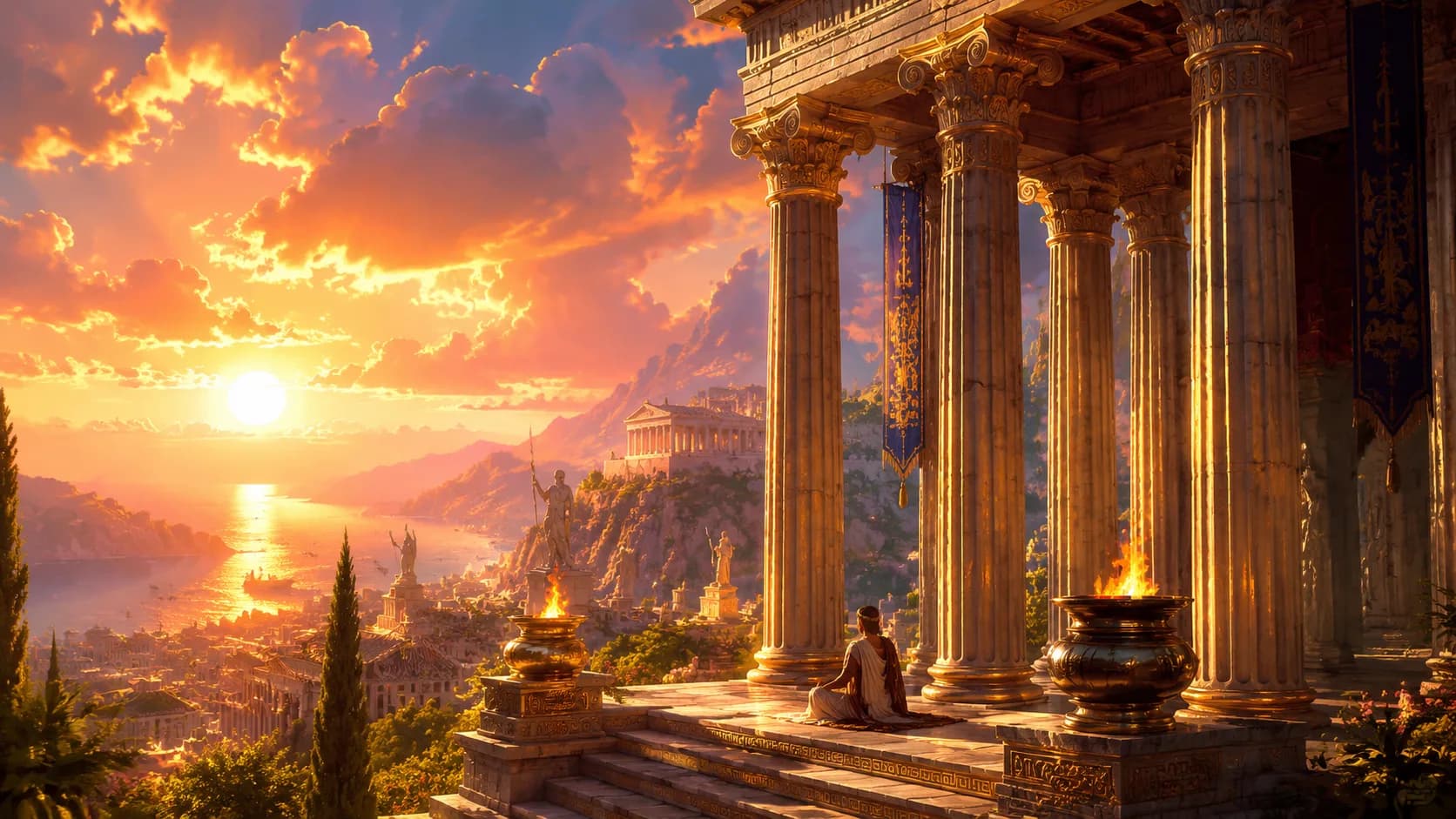
Close your eyes for a moment. Imagine standing on the Acropolis of Athens in the 5th century BCE. The marble beneath your sandals is warm from the afternoon sun. Below you, the agora buzzes with philosophers debating, merchants negotiating, and the mingled scent of olive oil and roasting lamb drifting upward. The Parthenon, not the weathered ruin of postcards but newly built, brilliantly painted in reds and blues and golds, towers behind you. A breeze carries the distant sound of a lyre from the Theatre of Dionysus. You are, for this moment, genuinely there.
Ancient city meditation is a guided visualization practice that uses narrative storytelling, historically accurate environmental detail, and spatial audio technology to transport practitioners into immersive recreations of ancient citiesincluding Athens, Sparta, Babylon, Troy, Rome, and Alexandria. Unlike traditional meditation techniques that focus primarily on breath awareness or body scanning, ancient city meditation engages the practitioner's full sensory imagination through vivid descriptions of architectural spaces, marketplace sounds, cultural activities, and environmental textures. The approach draws on the idea that a vivid story engages many parts of the mind at once, from imagined movement and sensations like warmth, texture, and scent to a mental map of the place and the emotional richness of the experience. This comprehensive neural engagement naturally suppresses the default mode network responsible for rumination and anxiety, making ancient city meditation one of the most effective and accessible forms of experiential mindfulness available today.
In this complete guide, you'll learn exactly how ancient city meditation works, explore the neuroscience that makes it so effective, discover specific techniques for experiencing Athens, Sparta, and Babylon in your mind, understand the role of spatial audio in creating deep immersion, and find practical advice for building a regular practice that transforms both your meditation experience and your understanding of history.
"Traditional meditation says 'sit still and watch your breath.' Ancient city meditation says 'put on headphones and walk through the Athenian agora in 432 BCE while Socrates argues nearby.' Both are meditation. One of them has significantly better scenery. Your hippocampus knows the difference and it prefers the one with the Parthenon."
Key Facts: Ancient City Meditation
- ••Multi-sensory immersion: Ancient city meditation engages 5+ sensory modalities simultaneously: visual (architecture, light), auditory (marketplace, music), tactile (marble warmth, breeze), olfactory (incense, food), and proprioceptive (walking, climbing), creating a depth of presence that single-focus meditation cannot match
- ••Hippocampal activation: fMRI studies show that vivid spatial visualization activates the hippocampus in patterns similar to actual physical navigation: your brain builds a genuine cognitive map of the ancient city, complete with landmarks, turns, and spatial relationships
- ••Beginner-friendly: Unlike traditional meditation which requires sustained attentional effort, narrative city meditation directs attention automatically through story interest and environmental richness, making it one of the most accessible meditation formats for complete beginners
- ••Default-mode network suppression: When multiple brain regions are engaged in constructing an ancient city experience, the neural network responsible for worry, rumination, and self-critical thinking has fewer available resources, producing natural, effortless calm
- ••Educational co-benefits: Practitioners develop genuine historical knowledge alongside meditation skills, understanding ancient architecture, culture, daily life, and philosophy through experiential rather than academic learning
- ••journeys available: Visionaria offers guided ancient city meditations set in Athens, Sparta, Babylon, Troy and Alexandria, each rendered in immersive spatial 3D audio
Quick Answer
💡 Fun fact: When neuroscientists put experienced meditators in fMRI machines during guided ancient city visualization, they discovered that the hippocampus, the brain's spatial navigation centre, activated in patterns remarkably similar to those of someone physically walking through an unfamiliar city. Your brain doesn't just imagine the Parthenon. It constructs a walkable, explorable mental map of ancient Athens, complete with spatial orientation, turning corners, and recognising landmarks. Remembering a city you've visited and vividly imagining one you haven't draw on some of the same brain areas, including the hippocampus, which is why imagined places can feel surprisingly real.
What Is Ancient City Meditation?
Ancient city meditation is a form of experiential meditation that uses the richly detailed environments of historical cities as the focus of mindful awareness. Instead of asking practitioners to concentrate on a single object of attention breath, a mantra, a candle flame ancient city meditation provides an entire world to explore mindfully: streets to walk, temples to enter, marketplaces to observe, gardens to sit in, and horizons to contemplate. The narrative guides your attention through this world systematically, directing awareness to specific sensory details while maintaining the gentle, present-focused quality that defines all effective meditation.
Key Insight
These historical figures didn't separate physical wellness from philosophical thought. To them, it was all one continuous practice of living well.
The practice draws on three converging traditions. First, guided visualization a well-established meditation technique where a narrator directs the practitioner's imagination through a specific scenario. Second, historical reconstruction the scholarly practice of recreating ancient environments based on archaeological evidence, primary sources, and expert analysis. Third, spatial audio technology the use of binaural and HRTF processed sound to position audio elements in three-dimensional space around the listener, creating the auditory experience of actually being present in a physical environment.
When these three elements combine, the result is a meditation experience that is qualitatively different from anything available through traditional approaches. You don't just relax you travel. You don't just calm your mind you fill it with the extraordinary richness of humanity's greatest civilisations. And as the neuroscience confirms, this comprehensive engagement produces deeper relaxation, stronger presence, and more lasting benefits than approaches that engage fewer cognitive systems.
"Explaining ancient city meditation to a traditional meditator is like explaining colour television to someone who owns a radio. 'But I can already listen to things!' Yes, absolutely. But what if you could also see them, walk through them, smell them, and feel the sunlight on your face? Your brain doesn't just process the ancient city it inhabits it. And inhabiting a beautiful place turns out to be extraordinarily good for your mental health."
Why did the inventor of the wheel win an award? Because his idea really got things rolling.
The Neuroscience Behind Mental Time Travel to Ancient Places
The neuroscience of ancient city meditation centres on a remarkable brain capability that researchers call mental time travel the ability to project yourself into past or imagined environments and experience them as though they were present reality. This capacity is primarily governed by the hippocampus, the seahorse-shaped structure in your temporal lobe that handles both memory formation and spatial navigation. When you vividly imagine walking through ancient Athens, your hippocampus constructs a genuine cognitive map of the environment positioning the Parthenon to your left, the agora below, the Theatre of Dionysus behind you. This map is neurologically indistinguishable from one created by actual physical navigation.
Visionaria Insight
By immersing ourselves in these historical soundscapes, we reconnect with a timeless human tradition of storytelling and mental restoration.
But the hippocampus is only the beginning. Vivid city visualization simultaneously activates the sensory cortices (generating phantom sensations of warmth, texture, scent, and taste), the motor cortex (simulating the physical experience of walking, climbing steps, and turning corners), the auditory cortex (processing the spatial audio environment of the city), and the prefrontal cortex (integrating all of this into a coherent, meaningful experience). Research at University College London, including work by Eleanor Maguire and Demis Hassabis, has linked the hippocampus to imagining new scenes as well as remembering real ones.
The meditation benefit arises from a simple but powerful principle: the brain has finite cognitive resources. When 7-12 regions are engaged in constructing and navigating an ancient city, the default mode network (DMN) the neural system responsible for mind wandering, self-referential worry, rumination about the past, and anxiety about the future is naturally suppressed because its usual cognitive bandwidth has been recruited for city exploration. You don't have to try to stop anxious thoughts. Your brain is too busy calculating where the Athenian agora is relative to the Acropolis to generate them.

Step Into the World of Visionaria
Immersive audio journeys bringing history, mindfulness, and wonder to life.
Why did the historian break up with the archaeologist? Because her career was literally in ruins.
Preparing Your Mind for an Ancient City Journey
Before embarking on an ancient city meditation, a few minutes of preparation significantly enhances the depth and quality of the experience. The goal of preparation isn't to "empty your mind" (a common misconception about meditation) but rather to prime your neural systems for maximum receptivity creating the conditions where your brain can fully engage with the coming visualization.
Step 1: Physical Setup (2 minutes). Find a comfortable position seated or reclined. Use stereo headphones (essential for spatial audio positioning). Ensure the room is quiet and you won't be disturbed for 15-25 minutes. Dim the lights if possible reduced visual input frees cognitive resources for internal visualization. Close your eyes.
Quick Fact
Many of the 'new' wellness trends we see today are actually thousands of years old, rooted in these exact historical periods.
Step 2: Breath Settling (2-3 minutes).Take five slow, deep breaths. Each inhale should last about 4 seconds, and each exhale about 6 seconds. The extended exhale can help you feel calmer, shifting you from alert mode to receptive mode. Don't force this let the rhythm establish naturally. By the fifth breath, you should notice a subtle shift in physical tension.
Step 3: Sensory Priming (1-2 minutes). Before the guided journey begins, gently scan your current sensory experience: the temperature of the air on your skin, the pressure of the chair or floor beneath you, the ambient sounds beyond your headphones. This brief sensory awareness exercise primes the sensory cortices essentially "warming up" the brain systems that will be most active during the city meditation. When the narrator begins describing Mediterranean warmth and marble textures, your sensory cortices will be ready to generate vivid simulation because you've just been practicing sensory awareness with real stimuli.
"Preparing for ancient city meditation is like stretching before a run not strictly required, but doing it makes everything work better. Five slow breaths and a minute of sensory awareness are the equivalent of a mental warm up lap. Your hippocampus appreciates the courtesy. It's about to build an entire ancient civilisation from scratch, and it likes to know you're taking this seriously."
Why did the inventor of the wheel win an award? Because his idea really got things rolling.
Walking Through Ancient Athens in Meditation
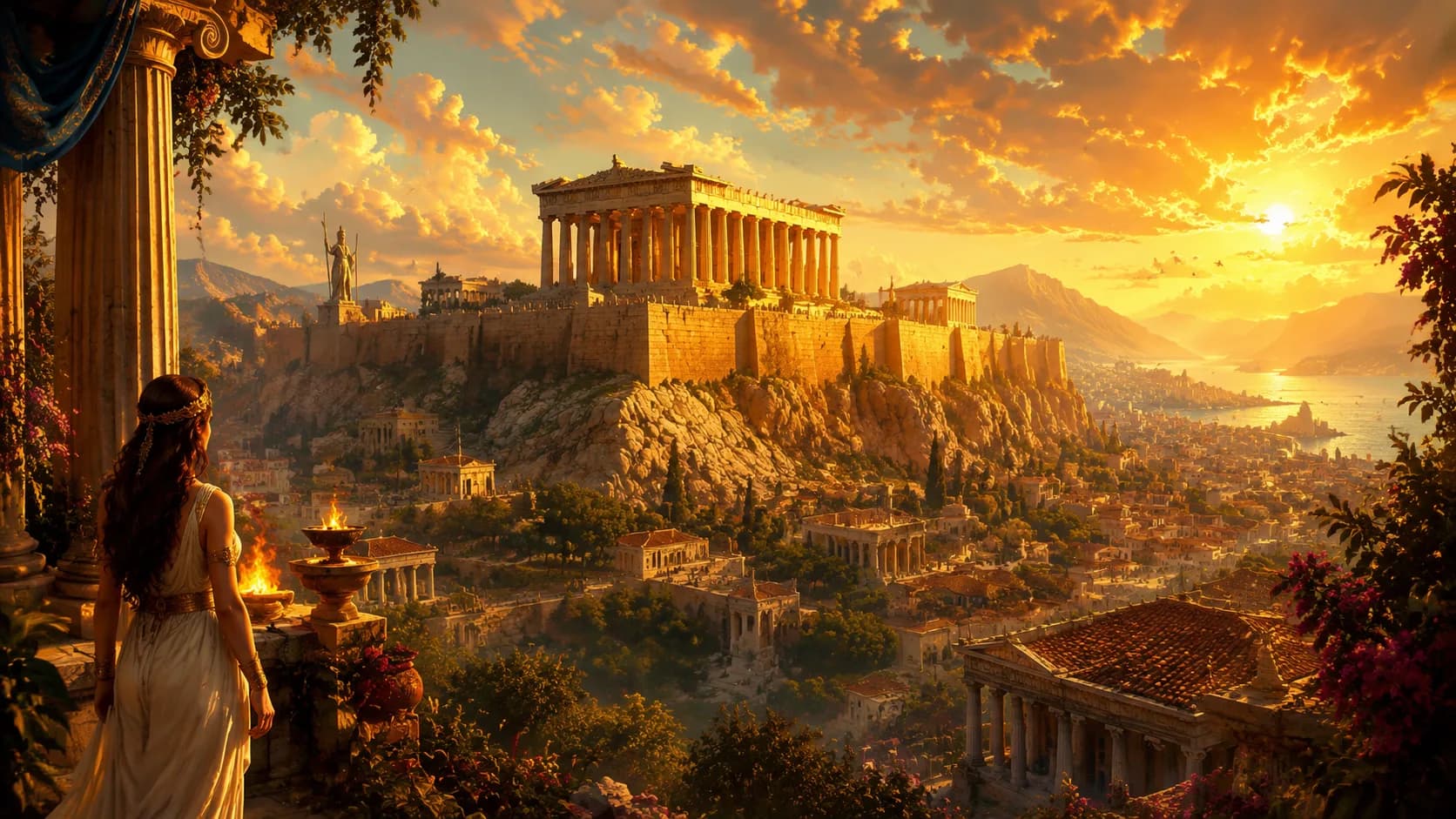
Ancient Athens is perhaps the ideal city for meditation exploration because it combines extraordinary architectural beauty, rich sensory environments, and the intellectual legacy of the world's most influential civilisation. The Athens of the 5th century BCE the Golden Age under Pericles offers a meditation environment of unparalleled richness: the newly completed Parthenon gleaming in polychrome glory atop the Acropolis, the bustling agora where Socrates debated, the Theatre of Dionysus where the great tragedies premiered, and the quiet olive groves of the Academy where Plato taught.
Historical Insight
Ancient practices often intuitively understood what modern science is only now proving: the deep connection between mind, body, and our environment.
A typical Athens meditation journey might begin at the Dipylon Gate the grand entrance to the city from the northwest. In spatial audio, you hear the bustle of arriving travellers, the creak of ox carts, the calls of gatekeepers. The narrator guides you through the Kerameikos (the potters' quarter), where you hear the rhythmic sound of wheels turning and smell the earthy scent of wet clay. Moving toward the agora, the audio environment shifts: voices multiply, debate echoes from stoa columns, the clatter of bronze coins marks commercial transactions. The spatial positioning lets you sense the physical layout voices to your left, a fountain behind you, temple bells ahead.
The meditation deepens as you ascend the Acropolis. The path steepens (your motor cortex simulates the climb), the city sounds diminish below, and the acoustic space opens dramatically as you emerge onto the plateau. Here, the narrator describes the Parthenon in its original splendour not the white marble ruin tourists see today, but a brilliantly painted temple with vivid red, blue, and gold decorations, with the 12 metre statue of Athena Parthenos visible through the columns, gold and ivory gleaming in the Mediterranean light. This moment of visual revelation where historical knowledge transforms your imagination is where ancient city meditation becomes genuinely transportive.
🏛️ Athens Meditation Highlights
Key environments you'll experience: The Agora (marketplace debates and commerce in 3D audio), The Parthenon (original polychrome colours revealed), The Theatre of Dionysus (acoustic perfection 15,000 seats, every whisper audible), Plato's Academy (olive groves and philosophical contemplation), and The Pnyx (where Athenian democracy was practiced on a hillside overlooking the city). Each space offers a different meditation quality from energising social immersion to profound contemplative stillness.
A Roman walks into a bar, holds up two fingers, and says, 'Five beers, please.'
Experiencing Ancient Sparta Through Guided Visualization
If Athens represents the intellectual dimension of ancient city meditation, Ancient Sparta represents the physical and disciplinary dimension offering a meditation experience centred on strength, resilience, simplicity, and the extraordinary landscape of the Eurotas valley. Sparta's meditation environment is fundamentally different from Athens: where Athens overwhelms with architectural splendour and intellectual richness, Sparta impresses with austere beauty, natural grandeur, and an atmosphere of focused determination that translates powerfully into mindfulness practice.
A Sparta meditation typically begins in the Eurotas valley, with Mount Taygetus rising dramatically to the west and Mount Parnon to the east a natural amphitheatre of extraordinary scale. The spatial audio positions mountain winds sweeping through the valley, the river Eurotas flowing nearby, and the distant sounds of the agoge training grounds. Unlike Athens's marble and painted surfaces, Sparta's sensory palette emphasises natural textures dust beneath sandals, sun-warmed stone, the sharp scent of wild thyme growing on the hillsides, and the cool water of mountain streams.
Did You Know?
The relentless drive to understand the world was seen not just as an academic pursuit, but as a spiritual and healing practice by the ancients.
The meditation value of Sparta lies in its unique capacity to cultivate inner strength and discipline through environmental resonance. When you meditate within the landscape of a civilisation that valued perseverance, resilience, and unwavering focus above all else, those qualities infuse the meditation experience itself. Research on heroic narrative meditation shows that engaging with stories of strength and determination activates mirror neuron networks, producing measurable increases in self-efficacy and resilience. Sparta's environment provides this naturally every stone, every mountain vista, every training ground sound reinforces the psychological qualities the meditation cultivates.
"The ancient Spartans were famous for using few words they invented the concept of being 'laconic' (from Laconia, Sparta's region). So a Spartan meditation is appropriately direct: big mountains, clean air, flowing river, focused mind. No unnecessary ornament. No philosophical rambling. Just you, the landscape, and a very clear sense of inner strength. It's meditation the Spartan way: minimal words, maximum impact."
A time traveler went back to antiquity to teach them about 'holistic health.' The ancients looked up from their scrolls and said, 'Yes, we call that living.'
Discovering Babylon's Hanging Gardens in Your Mind
Ancient Babylon offers the most sensory-rich and exotic of the ancient city meditation experiences. Where Athens is marble and olive trees and philosophical debate, Babylon is glazed blue brick, palm lined avenues, the perfume of jasmine gardens, and the deep hum of Mesopotamian civilization at its zenith. The Babylon of Nebuchadnezzar II (605-562 BCE) was the largest city in the world a metropolis of approximately 200,000 people, protected by massive walls and centred on architectural wonders that defined the concept of magnificence for the ancient world.
Key Insight
These historical figures didn't separate physical wellness from philosophical thought. To them, it was all one continuous practice of living well.
The meditation begins at the Ishtar Gate the monumental entrance to the city, covered in brilliant blue glazed bricks and decorated with golden lions, bulls, and dragons (mushhushshu) in moulded relief. In spatial audio, the scale of the gate becomes viscerally real: the echo of your footsteps changes as you pass through the massive archway, the acoustic space opens dramatically as you emerge onto the Processional Way a broad avenue flanked by 12 metre walls decorated with sixty lions in striding poses. The sensory richness is overwhelming: date palms rustle overhead, incense drifts from nearby temples, and the distant sound of the Euphrates provides a constant watery undertone.
The centrepiece of the Babylon meditation is the Hanging Gardens one of the Seven Wonders of the Ancient World. Whether the Gardens existed as described remains scholarly debate, but for meditation purposes, their imagined reality is extraordinarily powerful: tiered terraces of lush vegetation rising above the flat Mesopotamian plain, irrigated by an engineering marvel of water screws and aqueducts, filled with exotic plants, flowering vines, and the constant sound of cascading water. This environment combines the calming properties of nature visualization (extensively documented in environmental psychology) with the awe-inspiring scale of ancient engineering producing a meditation space that is simultaneously deeply restful and genuinely magnificent.
Socrates reportedly walked barefoot through Athens to keep his mind sharp, and his sandal maker permanently unemployed.
The Role of Spatial Audio in City Meditation
Spatial audio is the technological element that transforms ancient city meditation from "guided imagination" into "immersive experience." Traditional guided visualization relies entirely on the practitioner's ability to generate internal imagery from verbal descriptions. Spatial audio adds an environmental dimension that the brain processes as genuinely external creating the auditory experience of being physically present in a three-dimensional space.
The technology works through Head-Related Transfer Functions (HRTF) mathematical models of how sound is filtered by the human ear, head, and torso before reaching the eardrum. By applying HRTF processing to each audio element, sound designers can position any sound anywhere in 3D space around the listener: a bird singing above and to the left, a fountain bubbling at knee height to the right, distant temple bells ahead. The brain's auditory cortex processes these spatial cues automatically and involuntarily you don't have to try to perceive the 3D positioning; your brain does it for you, just as it does in real world environments.
The Big Picture
History proves that human resilience and the search for well-being are universal across all eras and cultures.
For ancient city meditation specifically, spatial audio provides three critical functions. First, place construction the 3D soundscape builds the physical environment of the city around you, with walls creating echoes, open spaces producing reverberation, and enclosed spaces dampening ambient sound. Second, movement simulation as the narrative describes walking through the city, the spatial audio moves in corresponding patterns, with marketplace sounds approaching, passing beside you, and receding behind. Third, presence deepening the consistent, physically accurate spatial audio environment creates the neurological state of "presence" the felt sense of genuinely being in a real place rather than imagining one.
"Regular guided meditation describes an ancient marketplace. Spatial audio meditation puts you in the middle of one, with vendors calling from specific positions, footsteps passing behind you, and a fountain splashing at your two o'clock. Your auditory cortex doesn't know it's fake. It processes the sounds exactly as it would process real environmental audio. The result: your brain builds an actual spatial map of ancient Athens and charges you no airfare."
A Roman walks into a bar, holds up two fingers, and says, 'Five beers, please.'
How Historical Accuracy Enhances Meditation Depth
One of the distinguishing features of ancient city meditation through Visionaria is its commitment to historical and archaeological accuracy. The ancient cities you explore aren't fantasy environments they're reconstructions based on scholarly research, archaeological evidence, primary historical sources, and expert consultation. This accuracy isn't merely academic pride; it directly enhances the meditation experience in measurable ways.
Did You Know?
The relentless drive to understand the world was seen not just as an academic pursuit, but as a spiritual and healing practice by the ancients.
Research in cognitive psychology demonstrates that coherent, internally consistent environments produce stronger immersion than environments that contain contradictions or implausibilities. When every detail of the ancient city "makes sense" when the architecture follows known building techniques, when the sounds match documented cultural practices, when the sensory environment reflects the climate and geography of the actual location the brain's reality monitoring systems reduce their interference, allowing deeper immersion. Implausibilities, by contrast, trigger the prefrontal cortex's error detection systems, pulling you out of the experience to evaluate "that doesn't seem right."
This means that historically accurate details like knowing that the Parthenon was painted in vivid colours, that Spartan homes were deliberately modest despite the city's military prowess, that Babylon's Ishtar Gate was covered in brilliant blue glazed brick aren't just interesting facts. They're immersion amplifiers. Each historically accurate detail that surprises or enlightens you (most people don't know the Parthenon was painted) deepens the meditation experience because it represents genuine discovery new information that engages the dopamine-driven novelty-seeking circuits of the brain, maintaining engagement and preventing the attention drift that undermines so many meditation sessions.
What's an ancient intellectual's favorite exercise? Jumping to conclusions.
Building a Regular Ancient City Meditation Practice
Like any meditation practice, ancient city meditation delivers its deepest benefits through regular, consistent practice. While a single session produces immediate relaxation and mood enhancement, the cumulative effects improved emotional regulation, reduced baseline anxiety, enhanced creative thinking, and stronger visualization capacity develop over weeks and months of repeated practice.
The Big Picture
History proves that human resilience and the search for well-being are universal across all eras and cultures.
Recommended schedule for beginners: Start with 3 sessions per week, each 10-15 minutes. Use a different ancient city for each session this prevents the visualization from becoming routine while building a diverse "library" of mental environments you can access during unguided practice. After 2-3 weeks, increase to 4-5 sessions, and begin extending session length to 15-25 minutes. With regular practice, some people find they can settle into the immersive visualization state within the first few minutes of a session, faster than in their early sessions.
Progressive skill development: As you practise, your visualization capacity strengthens naturally. Early sessions may produce general impressions of the ancient environment "I sort of see the columns." Within a few weeks, the imagery becomes more detailed, vivid, and multi-sensory. With experience, some people find they can sense their ancient surroundings more fully: seeing, hearing, feeling, and even smelling them in vivid detail. This progression reflects genuine neural development the brain's visualization networks strengthen with use, just as muscles strengthen with exercise.

"Building an ancient city meditation habit is easier than building a regular gym habit, because nobody at the ancient Athenian agora is judging your form. The cities are always there, always welcoming, and always sunlit. You just put on headphones, close your eyes, and let your hippocampus do the travel planning. It's the only holiday that costs nothing, requires no packing, and leaves you calmer than when you started."
What's an ancient intellectual's favorite exercise? Jumping to conclusions.
Common Challenges and How to Overcome Them
While ancient city meditation is more accessible than traditional approaches, practitioners occasionally encounter challenges particularly in the early stages. Understanding these challenges (and their straightforward solutions) helps maintain motivation and accelerate progress.
"I can't visualise clearly."This is the most common concern, and it's almost always temporary. Visualization is a skill, not a talent it improves with practice. Research suggests that a few percent of people have aphantasia (little or no ability to form mental images), and the vividness of mental imagery varies widely among everyone else. The spatial audio helps enormously: your brain constructs environmental imagery automatically in response to 3D sound positioning, even if deliberate visualization feels difficult. Focus on the auditory and physical sensations first the visual dimension typically develops naturally within 3-5 sessions.
Did You Know?
The relentless drive to understand the world was seen not just as an academic pursuit, but as a spiritual and healing practice by the ancients.
"My mind still wanders during the journey." Some mind wandering is normal and doesn't indicate failure. The key difference between ancient city meditation and traditional approaches is that the narrative provides a natural anchor to return to. When you notice your attention has drifted, simply re-engage with the narrator's voice and the spatial audio environment the city is still there, and you can step back into it immediately. Unlike breath meditation, where returning to focus can feel effortful, returning to an ancient city feels like going back to an interesting place. Most practitioners find that their wandering to engagement ratio improves dramatically within 2-3 weeks.
Read more: The Myth of Hercules and the Hero's Journey: Complete Guide to Greek Mythology's Greatest Legend
"I fall asleep during sessions." Falling asleep indicates that your body is relaxed and your stress levels are dropping which is actually a sign the meditation is working. If you'd prefer to stay awake, try meditating at a different time (morning sessions produce the most alert engagement), sitting upright rather than lying down, and choosing more dynamic journeys (bustling marketplace scenes rather than quiet garden meditations). Over time, as your body adjusts to the deep relaxation state, you'll develop the ability to remain relaxed but awake a state meditators call relaxed alertness.
Why did the Stoic cross the road? Because it was the rational thing to do, and he was indifferent to the traffic.
Comparing Ancient City Meditation to Traditional Approaches
Ancient city meditation and traditional meditation are not competitors they're complementary practices that develop different (but overlapping) skills and produce different (but overlapping) benefits. Understanding how they compare helps practitioners build a balanced practice that leverages the strengths of each approach.
Attention mechanism: Traditional breath meditation develops focused attention the ability to sustain concentration on a single object despite distractions. Ancient city meditation develops open monitoring and narrative engagement the ability to maintain diffuse awareness across a complex, multi-sensory environment. Both are valuable attention skills. Traditional meditation is like weightlifting for concentration; city meditation is like exploring a fascinating museum both develop different aspects of cognitive fitness.
Did You Know?
The relentless drive to understand the world was seen not just as an academic pursuit, but as a spiritual and healing practice by the ancients.
Accessibility: Traditional meditation has a well-known challenge with beginners: many people find sustained attention on a single focus (breath, mantra) difficult, boring or frustrating at first, and stop. Ancient city meditation shows significantly higher retention rates because narrative interest provides automatic engagement your attention is held by the story, the environment, and the unfolding discovery of the ancient city, rather than requiring willful concentration. For people who have "tried meditation and it didn't work," ancient city meditation offers a fundamentally different entry point.
Brain activation: Breath meditation primarily activates the somatosensory cortex, anterior cingulate, and insular cortex important regions, but a relatively narrow activation pattern. City meditation activates those regions plus the auditory cortex, motor cortex, all five sensory cortices, hippocampus, prefrontal cortex, and mirror neuron networks. The broader activation pattern means more comprehensive default mode network suppression and potentially deeper relaxation for the same session length.
"Comparing traditional meditation to ancient city meditation is like comparing swimming laps to scuba diving. Swimming laps builds technique and endurance important skills. Scuba diving immerses you in an entirely different world an experience that's so engaging you forget you're exercising. Ancient city meditation is the scuba diving of mindfulness. You're still getting all the benefits of meditation. You're just also exploring a coral reef made of Athenian marble."
Why did the Stoic cross the road? Because it was the rational thing to do, and he was indifferent to the traffic.
Getting Started with Visionaria's Ancient City Journeys
Visionaria makes ancient city meditation accessible to everyone through its library of immersive spatial audio journeys covering the ancient world's most extraordinary cities. Each journey is built on archaeological research, crafted by expert narrators, and rendered in spatial 3D audio that positions 50-100+ individual sound elements around you in three-dimensional space. Getting started takes less than five minutes.
Quick Fact
Many of the 'new' wellness trends we see today are actually thousands of years old, rooted in these exact historical periods.
For your first session, we recommend starting with Athens its combination of visual splendour, diverse environments (agora, Acropolis, Academy, theatre), and rich sensory detail provides the broadest introduction to what ancient city meditation can achieve. After 2-3 Athens sessions, explore Sparta for a contrasting experience centred on natural landscape and inner strength, then Babylon for exotic sensory richness. As you build your practice, you'll discover which ancient cities resonate most deeply with your meditation goals intellectual contemplation, physical resilience, sensory pleasure, or mythological storytelling.
Walking Through Ancient Athens in Your Mind: How Imaginative Journeys Through the Acropolis, Agora & Plato's Academy Rebuild Focus & Deepen Calm
Discover how walking through ancient Athens in your mind (from the Parthenon and Agora to the Theatre of Dionysus and Plato's Academy) uses spatial audio meditation to rebuild focus, deepen calm, and expand historical u...
Why did the historian break up with the archaeologist? Because her career was literally in ruins.
The Bottom Line
You've explored how to experience ancient cities through meditation from the neuroscience of mental time travel and hippocampal spatial mapping, through practical preparation techniques, to detailed journeys through Athens, Sparta, and Babylon. You've learned why spatial audio transforms guided visualization into genuine immersion, how historical accuracy deepens the meditation experience, and how to build a regular practice that develops both mindfulness skills and historical knowledge.
Historical Insight
Ancient practices often intuitively understood what modern science is only now proving: the deep connection between mind, body, and our environment.
Through Visionaria, all of this is available right now ancient city journeys in immersive spatial audio, waiting for you to close your eyes, put on headphones, and step into civilisations that changed the world. Your hippocampus is ready to navigate. Your sensory cortices are ready to explore. The ancient cities are waiting.
"Every ancient city was once alive bustling with people, echoing with voices, warm with sunlight, rich with the scent of cooking and incense and sea air. They haven't disappeared. They've simply moved from the physical world into the extraordinary realm of human imagination where spatial audio, historical knowledge, and guided meditation can bring them back to vivid, immersive, walkable life. Close your eyes. Put on headphones. The Parthenon is waiting. And it's still painted in brilliant colours."
Experience More with Visionaria
Download the app to explore guided historical and wellness journeys.
Why did the inventor of the wheel win an award? Because his idea really got things rolling.
This article is for educational and informational purposes only. Historical details are based on available research and may evolve as new evidence emerges.
Visionaria journeys are designed for relaxation, guided imagination, and personal enrichment. They are not a substitute for medical, mental health, legal, or professional advice.