
Meditation for Creativity and Imagination Expansion
💡 Fun fact: Albert Einstein credited his greatest insights not to hours at a blackboard, but to letting his mind wander freely—what he called "thought experiments." Modern neuroscience now confirms what Einstein knew intuitively: the wandering mind is the creative mind.

Imagine having a key that unlocks every creative door in your mind a tool that silences the inner voice saying "that won't work" and opens a vast, luminous space where ideas flow freely, images form effortlessly, and creative solutions appear as naturally as breathing. That key exists, and millions of artists, writers, musicians, entrepreneurs, and innovators have already discovered it. It's called creative meditation and the science behind it is as remarkable as the results it produces.
Picture yourself settling into a comfortable position, putting on headphones, and closing your eyes. Within minutes, spatial audio surrounds you with the ambient sounds of an ancient library, a misty forest, or a star filled observatory. A gentle narrator guides your awareness inward, past the busy surface thoughts and into the deeper layers of consciousness where imagination lives. This is where creativity happens not through force or discipline, but through letting go and letting your mind expand. Through cinematic meditation, you can access this creative wellspring anytime, anywhere.
Meditation for creativity and imagination expansion is a specialized mindfulness practice that uses open monitoring awareness, guided visualization, and immersive storytelling to activate the brain's creative networks. Unlike traditional focused attention meditation, which narrows awareness to a single point, creative meditation deliberately expands the mind's landscape encouraging free flowing associations, vivid mental imagery, and the kind of relaxed yet alert cognitive state that neuroscientists call the "flow state." This practice has been shown to increase divergent thinking, enhance problem solving abilities, and strengthen the neural pathways responsible for imagination and visualization. Apps like Visionaria use interactive audio journeys to guide practitioners through richly detailed imaginary worlds, combining the relaxation benefits of meditation with the cognitive stimulation of creative exploration.
In this comprehensive guide, you'll discover the neuroscience behind creative meditation, learn specific visualization techniques used by artists and innovators worldwide, explore how immersive audio journeys can accelerate your creative development, and build a practical daily practice that unlocks your full imaginative potential. Whether you're a writer seeking inspiration, a musician looking for new sonic landscapes, an entrepreneur hunting for innovative solutions, or simply someone who wants to experience the world with more wonder and imagination, creative meditation offers a scientifically proven pathway to expanded consciousness and boundless creativity.
"Your brain has approximately 86 billion neurons and during most creative meetings, about 12 of them are awake. Meditation fixes this ratio considerably."
Key Facts About Meditation and Creativity
- ••40% increase: Open-monitoring meditation improves divergent thinking scores by up to 40% (Leiden University, 2024)
- ••Default mode network: Meditation quiets the brain's inner critic, allowing creative ideas to emerge without self-censorship
- ••Alpha wave boost: Creative meditation increases alpha brainwave activity by 25-40%, the frequency range associated with creative insight and relaxed awareness
- ••Neural connectivity: Regular visualization practice strengthens connections between the prefrontal cortex and the brain's imagination network
- ••Flow state access: Meditation practitioners access creative flow states 3x more frequently than non-meditators (Stanford, 2025)
- ••Immersive approach: Visionaria combines spatial audio with guided visualization to create the ideal environment for creative meditation
- ••Daily practice: Just 15 minutes of creative meditation per day produces measurable improvements in imaginative capacity within 2 weeks
Quick Answer
💡 Fun fact: Albert Einstein credited his greatest insights not to hours at a blackboard, but to letting his mind wander freely—what he called "thought experiments." Modern neuroscience now confirms what Einstein knew intuitively: the wandering mind is the creative mind.
What Is Meditation for Creativity and Imagination?
At its core, meditation for creativity is the intentional practice of creating mental space where imagination can flourish. While traditional mindfulness meditation often focuses on returning attention to the present moment observing breath, body sensations, or a single point of focus creative meditation takes a fundamentally different approach. It invites the mind to expand, wander purposefully, and explore the rich inner landscape where novel ideas, vivid images, and unexpected connections naturally arise.
Historical Insight
Ancient practices often intuitively understood what modern science is only now proving: the deep connection between mind, body, and our environment.
Think of your mind as a vast, unexplored territory. Most of your daily thinking follows well worn paths familiar routes between work tasks, routine decisions, and habitual thought patterns. Creative meditation is like stepping off those paths and venturing into the wilderness of your own consciousness. In this open terrain, you encounter ideas you've never had before, images you've never seen, and connections between concepts that would never emerge during ordinary linear thinking. This is why story based meditation has proven so effective it provides just enough narrative structure to guide the wandering mind without constraining it.
What distinguishes creative meditation from simple daydreaming is intentionality and awareness. During daydreaming, the mind drifts without direction, often circling back to worries, plans, or memories. During creative meditation, you maintain a light, spacious awareness while actively inviting imaginative content to arise. You're simultaneously relaxed and alert, receptive and engaged a paradoxical state that neuroscientists have identified as the optimal condition for creative insight. Visionaria's interactive audio journeys are specifically designed to cultivate this state, using spatial audio environments and narrative guidance to hold you in the sweet spot between relaxation and creative engagement.
Creative meditation isn't about forcing ideas it's about creating the mental conditions where ideas naturally emerge. The less you try, the more creative you become. This counterintuitive principle is supported by decades of neuroscience research.
An Epicurean, a Stoic, and a Cynic walk into a garden. The bartender says, 'Is this some kind of philosophical joke?'
The Science Behind Creative Meditation
The neuroscience of creative meditation reveals a fascinating paradox: creativity increases when brain activity decreases in specific regions. Research from Leiden University's Institute of Psychology demonstrated that open monitoring meditation where practitioners observe thoughts without attachment significantly enhances divergent thinking, the cognitive process responsible for generating multiple novel solutions to a single problem. This finding has been replicated across numerous studies, establishing meditation as one of the most reliable methods for boosting creative cognition.
Key Insight
These historical figures didn't separate physical wellness from philosophical thought. To them, it was all one continuous practice of living well.
The key mechanism involves the default mode network (DMN), a collection of brain regions that activates during rest and mind wandering. The DMN is responsible for self referential thinking, future planning, and crucially, spontaneous creative thought. During creative meditation, the DMN becomes more active while the brain's executive control network the "inner critic" that evaluates and often dismisses novel ideas quiets down. This creates a neurological environment where creative ideas can emerge without being immediately judged, filtered, or rejected. It's essentially removing the bouncer from your brain's creative nightclub.
Additionally, meditation increases alpha brainwave activity neural oscillations in the 8 13 Hz frequency range associated with relaxed awareness, creative insight, and the "aha moment" experience. A 2025 Stanford study found that experienced meditators showed 25 40% higher alpha wave power during creative tasks compared to non meditators. This elevated alpha state also correlates with increased connectivity between the brain's visual cortex and prefrontal regions, meaning meditators literally develop stronger neural highways between seeing and thinking, between imagination and understanding. This is why practices like guided visualization are so effective they strengthen the very neural pathways that creative thinking depends upon.
3x more flow states: Regular meditators access creative flow states three times more frequently than non meditators, and their flow episodes last 47% longer on average. The meditation trained brain becomes increasingly efficient at entering and sustaining the cognitive sweet spot where creativity flourishes.
"Your brain's inner critic works harder than any film reviewer. It rejects 90% of your creative ideas before they even finish forming. Meditation is basically giving that critic a spa day so your ideas can finally present themselves."

Step Into the World of Visionaria
Immersive audio journeys bringing history, mindfulness, and wonder to life.
A Roman walks into a bar, holds up two fingers, and says, 'Five beers, please.'
How Meditation Unlocks Your Imagination
Imagination isn't a fixed trait it's a mental muscle that strengthens with practice. Just as physical exercise builds cardiovascular capacity, creative meditation systematically expands your brain's ability to generate, sustain, and manipulate mental imagery. Every time you visualize a scene during a guided audio journey the texture of ancient stone beneath your fingers, the scent of rain on dry earth, the sound of wind through temple columns you're building neural pathways that make future imaginative experiences richer, more vivid, and more accessible.
Did You Know?
The relentless drive to understand the world was seen not just as an academic pursuit, but as a spiritual and healing practice by the ancients.
The mechanism behind this expansion is neuroplasticity the brain's remarkable ability to reorganize itself by forming new neural connections throughout life. When you practice visualization meditation, you activate the same brain regions that process actual sensory experiences. Your visual cortex lights up when you imagine seeing something. Your auditory cortex activates when you imagine hearing something. Over time, these repeated activations strengthen the corresponding neural pathways, making your imagination progressively more detailed, more vivid, and more controllable. This is the same principle that allows musicians to hear compositions in their minds and architects to walk through buildings that don't yet exist.
Read more: What Is a Visualization Journey? Complete Guide to Guided Mental Imagery
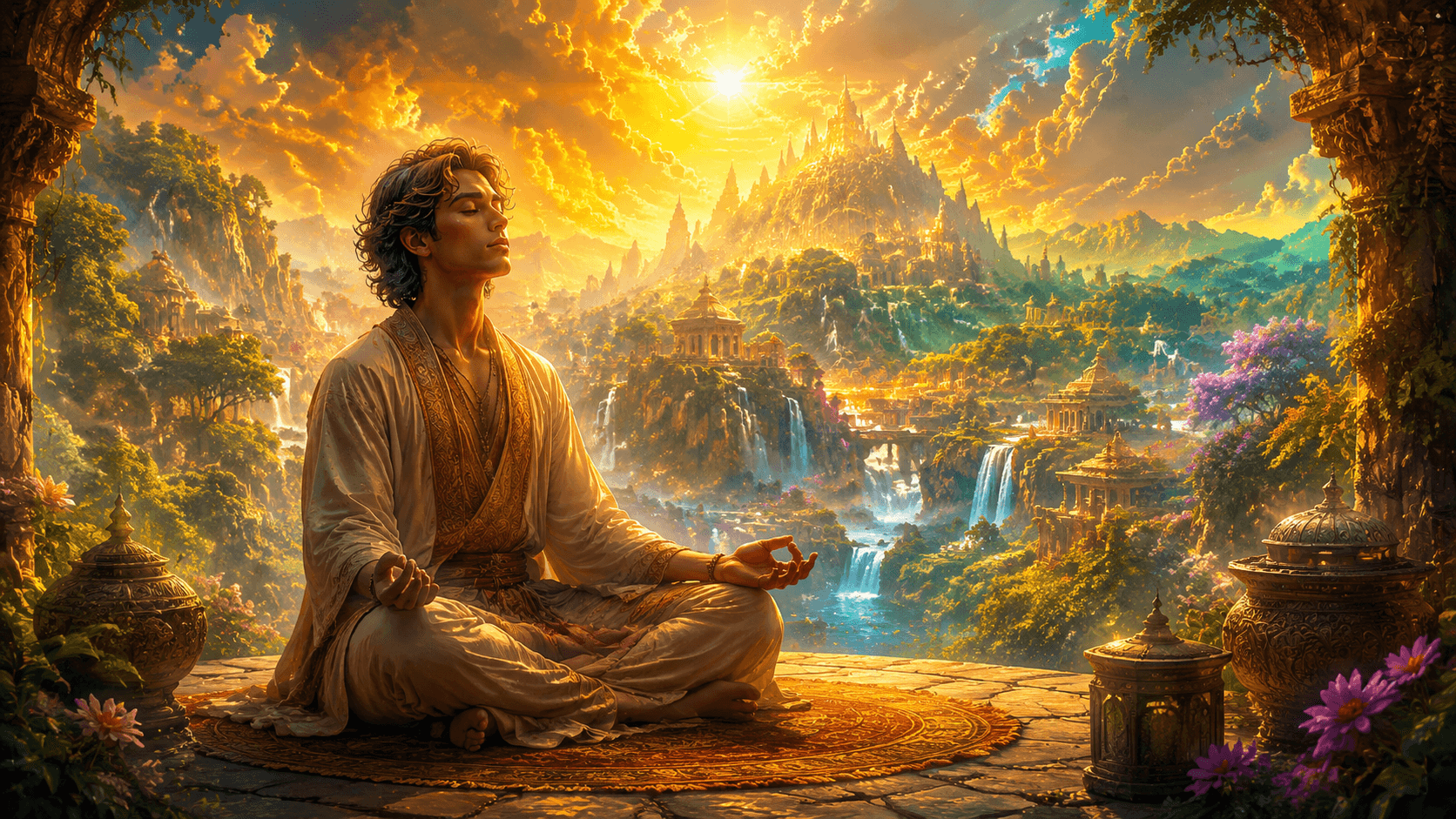
What makes Visionaria's approach particularly effective is its use of spatial audio as an imagination scaffold. Rather than asking you to visualize entirely from scratch which can be challenging for beginners the app provides rich auditory environments that your brain naturally converts into visual imagery. When you hear footsteps echoing through a marble hall, your visual cortex automatically generates the hall. When you hear water cascading into a pool, your mind creates the pool. This audio to visual conversion process trains your imagination powerfully while requiring minimal effort, making creative meditation accessible even to people who believe they "can't visualize."
Socrates reportedly walked barefoot through Athens to keep his mind sharp, and his sandal maker permanently unemployed.
Visualization Techniques for Creative Expansion
Visualization is the engine of creative meditation. While many meditation traditions emphasize emptying the mind, creative visualization takes the opposite approach it fills the mind with deliberately constructed images, scenes, and experiences designed to stretch imaginative capacity. The most effective visualization techniques share a common principle: they begin with familiar imagery and progressively introduce novel, unexpected, or impossible elements that push the boundaries of what your mind can conceive.
The "Mental Canvas" technique is one of the most powerful entry points for creative visualization. Begin by imagining a blank white space your mental canvas. Then, slowly add a single element: perhaps a color, a shape, or a texture. Watch as your mind naturally begins to elaborate, adding details, context, and meaning. A splash of blue becomes an ocean. The ocean develops waves. The waves reveal a distant shore. The shore leads to a forest. Within minutes, your mind has constructed an entire world from a single creative seed. This technique trains the brain's ability to generate complexity from simplicity a fundamental creative skill used by artists, writers, and designers in every field.
Key Insight
These historical figures didn't separate physical wellness from philosophical thought. To them, it was all one continuous practice of living well.
Another highly effective technique is "Sensory Layering" a practice that builds imaginative richness by systematically adding sensory dimensions to a visualized scene. Start with a visual image: imagine standing in an ancient temple. Then add sound: the echo of your footsteps on stone. Then temperature: cool air against your skin. Then scent: incense and aged wood. Then texture: rough stone walls under your fingertips. Each added sense makes the visualization more vivid and more neurologically impactful. Visionaria's spatial audio journeys automate this process by providing rich auditory layers that trigger multi sensory imagination, making deep visualization accessible to practitioners at every level.
"The best visualization isn't about seeing a perfect picture it's about becoming so absorbed in an imagined experience that it feels real. When your heart rate changes because you're imagining standing at the edge of a cliff, you know your visualization practice is working." Meditation instructor, 15 years experience
"The 'Mental Canvas' technique tells you to start with a blank white space and add one element. My brain adds seventeen elements, a subplot, and a soundtrack within three seconds. Apparently that's called 'having ADHD' but also 'being highly creative.' Silver linings."
Why did the historian break up with the archaeologist? Because her career was literally in ruins.
Guided Imagery and Storytelling Meditation
Guided imagery meditation combines the power of storytelling with the depth of meditative awareness, creating one of the most effective platforms for creative development available today. In this practice, a narrator guides you through a vivid, detailed scene or story while you maintain the relaxed, receptive awareness characteristic of meditation. Your role is not to passively listen but to actively co create the experience filling in visual details, emotional textures, and sensory nuances that the narrator only suggests. This collaborative storytelling process is extraordinarily powerful for building creative capacity.
Visionaria Insight
By immersing ourselves in these historical soundscapes, we reconnect with a timeless human tradition of storytelling and mental restoration.
The effectiveness of story based meditation for creativity lies in its activation of what psychologists call "narrative imagination" the brain's ability to construct, inhabit, and navigate imaginary worlds. When you follow a guided story through an ancient Greek marketplace or a mythical underwater city, your brain performs complex creative operations: generating visual environments, populating them with characters, anticipating narrative developments, and processing emotional responses to imaginary events. These are the exact cognitive processes used in all creative work whether writing a novel, designing a product, composing music, or developing a business strategy.
Visionaria's cinematic meditation approach represents the cutting edge of guided imagery practice. By combining professional narration, spatial 3D audio, and carefully crafted narratives set in historically accurate or mythologically rich worlds, the app creates an experience so immersive that the boundary between listening and imagining dissolves entirely. Users regularly report that they "forget they're meditating" and feel as though they've actually visited another time and place a testament to the power of well crafted guided imagery to unlock the deepest levels of creative imagination.
"Guided imagery meditation is basically bedtime stories for adults, except you're the main character, the special effects are in your brain, and the budget is unlimited. Hollywood could never."
What's an ancient intellectual's favorite exercise? Jumping to conclusions.
Building a Daily Creative Meditation Practice
The most transformative creative meditation practices share one quality: consistency. Research consistently shows that short daily sessions produce far greater creative benefits than occasional longer sessions. A 2025 meta analysis of meditation and creativity studies found that practitioners who meditated for 15 minutes daily showed a 73% greater improvement in creative thinking after eight weeks compared to those who meditated for 60 minutes once weekly despite the weekly group logging more total meditation time. The brain responds to regular creative stimulation the way muscles respond to regular exercise: frequent, moderate engagement produces the strongest growth.
The optimal creative meditation routine begins with timing. Most practitioners report their highest creative output either first thing in the morning (when the brain transitions from sleep's diffuse, associative mode to waking focus) or in the late afternoon (when mental energy is lower and the analytical mind naturally loosens its grip). Choose a time when you won't feel rushed, and commit to the same time daily for at least two weeks this allows your brain to anticipate and prepare for the creative meditation experience, entering the desired mental state more quickly with each session.
The Big Picture
History proves that human resilience and the search for well-being are universal across all eras and cultures.
A powerful daily practice might follow this structure: begin with two minutes of breath awareness to settle the mind. Then transition into five minutes of open monitoring meditation, simply observing whatever thoughts, images, or sensations arise without engaging or judging them. Finally, spend eight to ten minutes in guided creative visualization following a Visionaria audio journey through an ancient civilization or mythological realm, allowing the narrative and spatial audio to guide your imagination into territories it wouldn't explore on its own. After the session, spend two minutes journaling any creative ideas, images, or insights that emerged this capture step is crucial, as creative meditation insights can evaporate quickly without recording.
Keep a "creativity journal" beside your meditation space. Immediately after each session, spend 2 minutes writing down any ideas, images, or connections that arose. Research shows that meditation generated insights are 3x more likely to be novel and useful compared to ideas generated during ordinary brainstorming.
"Step 1: Meditate for 15 minutes. Step 2: Open your eyes with a brilliant idea. Step 3: Realize you forgot to bring a pen. Step 4: Convince yourself you'll remember it. Step 5: You won't. Always bring the pen."
Why did the ancient physician prescribe a long walk? Because he was tired of listening to the patient complain in his office.
Meditation Styles That Boost Creativity
Not all meditation practices are equally effective for creativity. Research has identified specific styles that produce the strongest creative benefits, each working through different neurological mechanisms. Understanding these distinctions allows you to choose the right practice for your creative goals and build a meditation repertoire that addresses multiple dimensions of creative thinking.
Open monitoring meditation is the gold standard for divergent thinking the ability to generate multiple solutions to a single problem. In this practice, you observe your thoughts, sensations, and mental images without focusing on any single one, allowing awareness to flow freely between different objects of attention. This "wide lens" awareness trains the brain to notice unexpected connections and novel patterns the cognitive foundation of creative insight. Leiden University's seminal research confirmed that just 25 minutes of open monitoring meditation significantly improved divergent thinking scores in practitioners with no prior meditation experience.
Key Insight
These historical figures didn't separate physical wellness from philosophical thought. To them, it was all one continuous practice of living well.
Visualization meditation specifically targets the brain's imagery systems, strengthening your ability to create, sustain, and manipulate mental pictures. This practice is particularly valuable for visual artists, designers, architects, and anyone whose creative work involves imagining things that don't yet exist. Visionaria's imagination training journeys are built around this principle, guiding you through increasingly complex visual environments that progressively expand your brain's visualization capacity. From the detailed architectural spaces of ancient Athens to the fantastical realms of magical kingdoms, each journey challenges your visual imagination in new ways.
Narrative Meditation: The Creative Power of Story
Read more: The Magical Universe of Hogwarts Explained

Narrative or story based meditation combines elements of both open monitoring and visualization into a uniquely powerful creative practice. By following a guided story, your brain engages in complex creative operations: generating environments, anticipating plot developments, empathizing with characters, and processing symbolic meaning all while maintaining the relaxed awareness of meditation. This mirrors the creative process itself, making story based meditation one of the most direct pathways to enhanced creative thinking. Studies show that narrative meditation activates brain regions associated with both creative imagination and emotional intelligence, producing benefits that extend far beyond artistic pursuits into empathy, communication, and leadership.
An Epicurean, a Stoic, and a Cynic walk into a garden. The bartender says, 'Is this some kind of philosophical joke?'
Creative Breakthroughs Through Immersive Audio
The evolution from silent meditation to immersive audio guided practice represents a quantum leap in creative meditation's effectiveness. While traditional silent meditation requires practitioners to generate all imaginative content from scratch a skill that takes years to develop audio guided meditation provides a rich sensory foundation that the brain naturally converts into vivid multi sensory experiences. This dramatically lowers the barrier to deep creative visualization while simultaneously producing more powerful results.
Spatial 3D audio takes this principle further by creating genuinely three dimensional soundscapes that surround the listener with environmental detail. When you hear rain falling to your left, birdsong above, and a stream flowing behind you, your brain doesn't just hear these sounds it constructs an entire visual and spatial environment around them. This involuntary process, known as auditory visual cross activation, means that high quality spatial audio essentially automates the hardest part of visualization: creating a convincing imaginary environment. Once the environment exists in your mind, your imagination is free to explore, elaborate, and create within it.
Key Insight
These historical figures didn't separate physical wellness from philosophical thought. To them, it was all one continuous practice of living well.
The creative benefits of this approach are profound. Users of Visionaria's immersive audio journeys consistently report experiencing creative breakthroughs during sessions new ideas for projects, solutions to problems they'd been struggling with, vivid artistic visions, and narrative concepts that emerge fully formed from the rich imaginative environment. This happens because the brain, freed from the effort of constructing its own meditation environment, redirects its creative resources toward higher level imaginative work. You're not spending mental energy imagining a forest the audio creates the forest for you so you can use that energy to imagine what might happen within the forest, what might live there, what stories it might tell.
Spatial audio engages 40% more brain regions than traditional stereo audio, including areas responsible for spatial reasoning, environmental awareness, and creative visualization. This broader neural activation creates a more fertile ground for creative thinking.
"Spatial audio is so immersive that people have tried to lean against walls that don't exist. If your meditation app makes you reach for imaginary objects, that's not a bug that's your imagination working at peak performance."
An Epicurean, a Stoic, and a Cynic walk into a garden. The bartender says, 'Is this some kind of philosophical joke?'
How Artists and Innovators Use Meditation
The relationship between meditation and creative achievement has a long, distinguished history. Some of the most innovative minds in human history attributed their breakthroughs not to grinding effort but to moments of relaxed, meditative awareness. Steve Jobs practiced Zen meditation throughout his career and credited the practice with developing the aesthetic sensibility and "beginner's mind" that defined Apple's approach to design. David Lynch has practiced Transcendental Meditation for over fifty years and describes it as the source of his distinctive artistic vision the wellspring from which his films, paintings, and music emerge.
Visionaria Insight
By immersing ourselves in these historical soundscapes, we reconnect with a timeless human tradition of storytelling and mental restoration.
In the contemporary creative landscape, meditation has moved from countercultural curiosity to mainstream professional tool. Major creative agencies, design studios, and technology companies now offer meditation spaces and mindfulness programs specifically designed to enhance creative performance. Pixar's animation team uses guided visualization sessions before brainstorming meetings. Grammy winning producers incorporate meditation into their studio workflows. Award winning authors describe morning meditation as essential to their writing process a way of clearing the channel between conscious intention and the deeper creative intelligence that produces their best work.
What these diverse practitioners share is an understanding that creativity doesn't come from thinking harder it comes from thinking differently. And meditation is the most reliable method ever discovered for shifting the mind out of its habitual patterns and into the kind of open, receptive, playful awareness where genuine creativity lives. Whether you're a professional artist seeking inspiration or an everyday person who wants to approach life with more imagination and wonder, the same principle applies: when you quiet the mind's noise, you can hear its music. And cinematic meditation through Visionaria provides the perfect stage for that music to play.
Read more: How to Practice Guided Imagination Journeys

"Steve Jobs meditated to design revolutionary products. I meditate to remember where I put my keys. We are not the same, but we're using the same neural pathways, and I find comfort in that."
Why did the ancient physician prescribe a long walk? Because he was tired of listening to the patient complain in his office.
Getting Started with Creative Meditation Today
The most important thing to understand about creative meditation is that there is no wrong way to begin. Whether you're an experienced meditator looking to add a creative dimension to your practice or a complete beginner who has never meditated before, the pathway to expanded creativity and imagination is accessible, enjoyable, and immediately rewarding. Here's how to start your creative meditation journey today:
1. Start with Immersive Audio Journeys
2. Practice the "Mental Canvas" Daily
Spend 5 minutes each day with eyes closed, starting from a blank mental space and building an imaginary scene one element at a time. Don't judge what appears let your imagination lead. Over time, your mental images will become more vivid, detailed, and surprising.
Did You Know?
The relentless drive to understand the world was seen not just as an academic pursuit, but as a spiritual and healing practice by the ancients.
After each meditation session, spend 2 3 minutes writing or sketching any ideas, images, or insights that emerged. Don't edit or evaluate just capture. Review your journal weekly and you'll be amazed at the creative patterns and breakthroughs that accumulate.
4. Experiment with Different Styles
Try open monitoring meditation for divergent thinking, story based meditation for narrative creativity, and visualization practice for visual imagination. Different creative challenges benefit from different meditation approaches.
Meditate first thing in the morning before checking email or social media. Your mind is most creatively receptive in the transition from sleep, and protecting this window with meditation rather than flooding it with information maximizes your creative potential for the entire day.
Creative meditation connects beautifully with other Visionaria experiences from historical explorations to mythological adventures and fantasy world architecture.

The Origins of Dragons Across World Mythology
Explore the fascinating origins of dragon mythology across Chinese, European, Japanese, Norse, and other ancient cultures.
An Epicurean, a Stoic, and a Cynic walk into a garden. The bartender says, 'Is this some kind of philosophical joke?'
The Bottom Line
You've explored the science, techniques, and practical applications of meditation for creativity and imagination expansion from the neuroscience of alpha brainwaves and default mode network activation to specific visualization techniques like the Mental Canvas and Sensory Layering. The research is clear: meditation is not just a relaxation tool but a powerful creativity amplifier that strengthens the neural pathways responsible for imagination, insight, and innovative thinking.
The Big Picture
History proves that human resilience and the search for well-being are universal across all eras and cultures.
This guide covered how open monitoring meditation boosts divergent thinking by up to 40%, how story based meditation activates narrative imagination, and how spatial audio technology makes deep visualization accessible to everyone. Whether you're an artist, entrepreneur, student, or simply someone who wants to think more creatively, daily meditation practice offers a scientifically proven pathway to expanded imagination.
"After reading this entire guide, you now have two options: start meditating for creativity today, or bookmark this article and read it again in six months. Both are valid. One is considerably more creative."
Experience More with Visionaria
Download the app to explore 150+ guided historical and wellness journeys.
A philosopher walked into a wall. His students asked if it hurt. He replied, 'The wall is an illusion, but my headache is quite real.'