
Sleep Meditation for a Racing Mind That Works
The famous white bear behind ironic process research came from Fyodor Dostoevsky, who wrote in 1863 that if you set yourself the task of not thinking of a polar bear, it will come to mind every minute.

- Why a Racing Mind Keeps You Awake at Night
- Why 'Empty Your Mind' Backfires: The White Bear Problem
- Why Sleep Meditation for a Racing Mind Needs Somewhere to Go
- Four Sleep Meditation Styles Compared for an Overactive Brain
- The Ancient World Wind-Down: A Step-by-Step Technique
- Making the Technique Stick (and When to Get Help)
- A Calmer Path to Sleep for a Busy Mind
- Frequently Asked Questions
The best sleep meditation for a racing mind gives your thoughts a calm place to go instead of asking them to stop. Insomnia research names mental arousal, not tight muscles, as the main obstacle for many poor sleepers. In a 2002 Oxford trial, imagery-based distraction worked better than general distraction.
You know the scene. Lights off, phone down, body heavy, and then your brain decides this is the perfect moment to replay a conversation from 2014, draft tomorrow's emails and wonder whether you locked the back door. Most meditation advice says relax and clear your mind. For anyone with an overactive brain at bedtime, that is like telling a dog to stop thinking about the sausage on the table.
Below: why the 'empty your mind' instruction backfires, what the research says about four popular techniques, and a step-by-step ancient world wind-down you can try tonight.
Key Facts About Sleep Meditation for a Racing Mind
- •Core problem: Racing thoughts (cognitive arousal) rather than physical tension, per Lichstein and Rosenthal (1980) and Harvey (2002)
- •Why 'clear your mind' fails: Ironic process theory, Daniel Wegner (white bear study 1987, theory 1994)
- •Best-supported redirect: Imagery distraction, Harvey and Payne, Behaviour Research and Therapy (2002)
- •Techniques compared: Body scan, slow breathing, progressive muscle relaxation, story-based meditation
- •First-line insomnia treatment: CBT-I, American College of Physicians guideline (2016)
Quick Answer
For a mind that will not switch off, story-based imagery usually works better than trying to clear your head. Daniel Wegner's white bear studies showed that pushing thoughts away makes them come back. In Allison Harvey and Suzanna Payne's 2002 Oxford trial, picturing a calm, detailed scene helped people with insomnia fall asleep faster.
Why a Racing Mind Keeps You Awake at Night
Sleep scientists have a less poetic name for the 2 a.m. thought carousel: cognitive hyperarousal. In 1980, psychologists Kenneth Lichstein and Ted Rosenthal asked people with insomnia what kept them awake. They blamed mental activity far more often than physical tension. Bodies were tired enough. Minds were still at the office.
Allison Harvey, then at the University of Oxford, built this into her influential cognitive model of insomnia in 2002. Her argument is simple and a little uncomfortable. Worry raises arousal, arousal makes you watch for signs that you are not sleeping, and the watching produces more worry. It is a loop, and your bedroom clock is its favourite prop.
Key Insight
For many light sleepers, the body is ready long before the mind is. A technique that only relaxes muscles leaves the real problem, the running commentary, untouched.
Here is the thing most sleep tips miss. A racing mind is not broken. It is doing its daytime job at the wrong hour, scanning for unfinished business. Think of it as an employee nobody told the shift was over. Then the question changes from 'how do I switch it off' to 'what do I give it to do instead'.
Read more: Bedtime Stories for Adults: The Sleep Science Explained

Short version: the problem lives in attention, so the fix has to live there too.
Ancient Greek insomniacs had one advantage. When Hypnos, god of sleep, failed to turn up, they could blame a specific deity instead of their inbox.
Why 'Empty Your Mind' Backfires: The White Bear Problem
Try this. For the next ten seconds, do not think about a white bear. Go on. The experiment comes from Daniel Wegner, the social psychologist who later taught at Harvard. In 1987 he and his colleagues ran it properly. People told to suppress the bear reported it popping up again and again, and those who suppressed first thought about it even more afterwards. Psychologists call that a rebound effect.
Wegner later formalised this as ironic process theory (1994). Every act of mental control runs two processes. An operator looks for anything that is not the white bear. A monitor keeps checking for the white bear to make sure you are succeeding. When you are tired or stressed, the operator gives out first. The monitor keeps going. Guess which one wins at midnight.
Quick Answer
'Clear your mind' asks the brain to watch for thoughts so it can remove them, and the watching brings those thoughts straight back. Fatigue makes the effect stronger, not weaker.
Wegner even tested sleep directly. In a 1996 study with Michael Ansfield and Richard Bowser, people told to fall asleep as fast as possible while hearing loud, distracting music took longer to drift off than people given no such instruction. Effort became the obstacle. If you have ever lain there thinking 'sleep, sleep, sleep now', you already know the result.
None of this means meditation fails. One instruction fails, and it happens to be printed on half the wellness posters online. If you have decided you are simply bad at meditation, the instruction may have been the problem, not you.

Give Your Mind Somewhere to Go Tonight
Swap the silence for a slow, cinematic story world and let sleep arrive.
Dostoevsky set the white bear challenge in 1863. Psychologists have been failing it professionally ever since.
Why Sleep Meditation for a Racing Mind Needs Somewhere to Go
If suppression feeds the loop, the obvious alternative is redirection. You stop guarding the door and give attention a room it actually wants to be in. Readers have always known this. Nobody has to try not to think about work while absorbed in a good novel.
Allison Harvey and Suzanna Payne tested the idea in a 2002 trial. People with insomnia were split into three groups. One learned imagery distraction (picturing a calm, engaging scene in detail), one got general distraction instructions, and one got none. The imagery group reported falling asleep faster and having fewer unwanted thoughts than either of the others.
Why Imagery Works
A detailed scene takes up the same mental workspace that worries need. Pictures, sounds and textures crowd out the verbal chatter without any struggle.
Why imagery and not, say, mental arithmetic? Harvey's explanation was that a vivid scene is absorbing enough to fill limited working memory, yet pleasant enough not to raise arousal. Counting sheep fails that test. It is too boring to hold attention, so worries slip back in through the gaps. A story, with places, sounds and gentle forward motion, sits in the sweet spot.
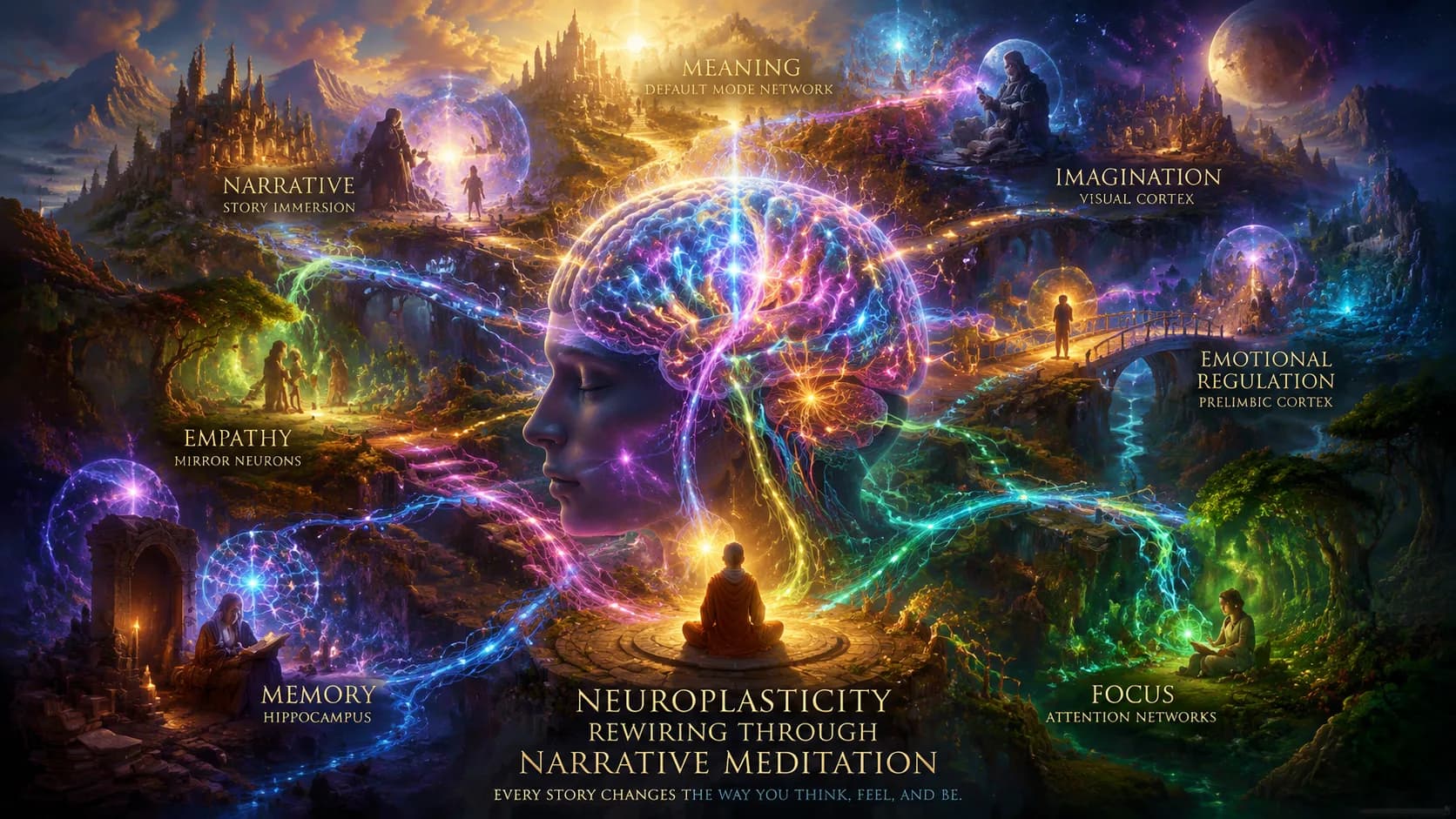
Narrative meditation stretches that principle into a full experience: a slow, guided walk through somewhere specific, with nothing to solve. Good sound helps, because audio coming from a believable direction makes a scene easier to inhabit. Here is a plain explanation of how spatial audio places you inside a scene.
Scheherazade kept a king awake for 1,001 nights with stories. Modern sleep science politely suggests using them the other way round.
Four Sleep Meditation Styles Compared for an Overactive Brain
Body scan. You move attention slowly from toes to scalp, noticing sensation without changing it. In a 2014 randomised trial in the journal Sleep, Jason Ong and colleagues tested a mindfulness program for insomnia that uses practices like this. Compared with self-monitoring, it reduced pre-sleep arousal and insomnia severity. The catch for racing minds is that a body scan offers a thin thread of attention, and busy thoughts snap it easily, especially in week one.
Breathing techniques. Slow breathing, roughly five to six breaths a minute, nudges the nervous system toward its rest-and-digest mode. A 2018 review led by Andrea Zaccaro in Frontiers in Human Neuroscience linked slow breathing to higher heart rate variability and greater relaxation. Patterns like 4-7-8, popularised by physician Andrew Weil, are easy to learn. But counting breaths is a close cousin of counting sheep. After a few cycles, the thoughts wander back.
At a Glance
Body scan and breathing calm the body well. Progressive relaxation is the most structured. Of the four, only story-based imagery is designed to occupy the thinking mind itself.
Progressive muscle relaxation. Chicago physician Edmund Jacobson set out the method in his 1938 book Progressive Relaxation: tense a muscle group, then release it, working through the body. It is widely studied and a standard part of insomnia treatment. It shines when the tension is physical. When the noise is mental, you can end up with very relaxed calves and a very busy forehead.
Story-based meditation. A narrated journey through a calm, detailed place. Its evidence comes from imagery distraction research like Harvey and Payne's, plus wider work on narrative absorption. Of the four, it is the one built for cognitive arousal, because the story fills the very channel worries use. Its weakness? A gripping plot will keep you up, so pacing matters more than drama. If you are still choosing, a comparison of immersive meditation options sets out the formats side by side.
Jacobson spent decades teaching people to relax one muscle at a time. Presumably the eyebrows came last, being the most stubborn citizens of the face.
The Ancient World Wind-Down: A Step-by-Step Technique
This practice builds on the imagery research and uses a historical setting, because ancient cities make perfect sleep scenery: detailed, slow and blissfully free of email. Step one: settle. Lie down, let three exhales run longer than the inhales, and drop your jaw. Step two: choose your city at dusk. Athens as the agora empties, a Babylonian garden terrace, a Roman street as the shops close. Pick one and stay there all night.
Step three: arrive through the senses. Before you move, collect one sound (a fountain, sandals on stone), one smell (bread, olive oil, dust cooling after the heat) and one texture (warm marble under your palm). Step four: walk slowly. Take an ordinary route, past a potter's stall and along a colonnade toward a quiet courtyard. No quests. No villains. Nothing to solve.
Key Insight
Low stakes are the secret ingredient. The scene should be interesting enough to hold attention and boring enough that nothing in it asks you to stay awake.
Step five: hand worries to the scene. A thought about tomorrow will turn up. Do not push it away, because that is the white bear trap. Notice it, picture setting it in a merchant's basket, and turn back to the street. Step six: let the world dim. Lamps get lit. Footsteps thin out. Your walking slows until you are just sitting on a warm step, listening to water.
Read more: Walking Through Ancient Athens in Your Mind

Step seven: stop steering. At some point the story starts telling itself, and the scenes turn slightly odd and illogical. Let them. That drift is often the doorway into light sleep, and a guided audio version can carry you there without any effort to keep the narration going.
The poet Juvenal grumbled that night-time wagon traffic made sleep in Rome a luxury for the rich. Your imaginary Rome, mercifully, has banned the carts.
Making the Technique Stick (and When to Get Help)
Give it a week before you judge it. The first night or two can feel awkward, because building a scene takes effort when you are new to it. With practice the city tends to load faster, like a familiar route home. Repeating the same setting helps. Familiar is soothing.
Pair it with the basics that make any sleep practice easier: a consistent wake time, a dim last hour, and the phone out of reach. Some people like a soft layer of sound underneath, such as rain or distant surf. If your own imagination runs thin, a library of calm nature places can supply that backdrop.
Wellness Note
Story-based meditation complements professional care. It does not replace it. If poor sleep lasts for weeks, talk to a doctor or a sleep specialist.
That note matters. Chronic insomnia is a medical condition. In 2016 the American College of Physicians recommended cognitive behavioural therapy for insomnia (CBT-I) as the first-line treatment for adults. Imagery and story techniques sit comfortably alongside CBT-I but do not replace it. Persistent racing thoughts can also be a sign of anxiety worth discussing with a professional.
And if a night goes badly? Get up, sit somewhere dim for a while, and come back when you feel sleepy. Then return to the same street you left. It will still be there.

How to Fall Asleep in 10 Minutes Using Guided Visualization
A practical guide to using guided visualization to shorten the time it takes to fall asleep.
In earlier centuries, many Europeans slept in two shifts and sometimes visited neighbours in between. Your wind-down asks for far less socialising.
A Calmer Path to Sleep for a Busy Mind
Put the pieces together and the picture is clear. Racing thoughts are an attention problem, so the best sleep meditation for a racing mind works on attention. Wegner's white bear shows why suppression rebounds, and Harvey's research shows why imagery redirects. Body scan, breathing and progressive relaxation each have their place, but story-based meditation suits the busy thinker best.
Remember
Do not wrestle with thoughts. Out-compete them with a slow, detailed, low-stakes scene, and let the scene fade on its own.
Modern psychology keeps coming back to something storytellers always knew: narrative absorption is one of the gentlest ways to quiet the inner critic. In 2000, Melanie Green and Timothy Brock described transportation into stories: a good narrative draws attention away from the reader's own concerns. Bedtime is when that pull is most welcome.
Tonight you do not need to win against your own brain. You only need to give it a street to walk, a fountain to hear, and permission to wander off-script.

Meditation for Sleep Using Storytelling Journeys
How storytelling journeys turn bedtime meditation into something a busy mind can follow.
Visionaria was built around that idea, with cinematic journeys through places like Athens and Babylon that give an overactive mind somewhere to go. Whether you use an app or your own imagination, the principle is the same. The kindest sleep meditation for a racing mind is not silence. It is a slow story you are happy to fall asleep in the middle of.
Trade Racing Thoughts for a Quiet Ancient Street
Slow, story-led journeys designed to help a busy mind drift off.
Ovid wrote that the god of sleep lived in a cave where no rooster crowed and no dog barked. Clearly the original sleep hygiene consultant.
This article is for educational and informational purposes only. Historical details are based on available research and may evolve as new evidence emerges.
Visionaria journeys are designed for relaxation, guided imagination, and personal enrichment. They are not a substitute for medical, mental health, legal, or professional advice.