The Magical Wizarding School Explained
💡 Fun fact: Picture a castle school whose staircases move on their own, the only kind of school where "I got lost" is a legitimate excuse for being late to class.
Discover the School of Wizardry: castle schools of magic in folklore and fantasy, their founding legends, houses, enchanted architecture, curriculum, creatures and hidden secrets. Explore why this archetype inspires millions and how to imagine one in meditation.
Key Facts About the School of Wizardry
- ••Founded: Typically long ago, by a circle of legendary wizards whose values still shape the school
- ••Location: A remote castle in wild hills or mountains, hidden from ordinary eyes by powerful enchantments
- ••Houses: Students are often sorted into houses or towers that become a second family
- ••Students: Young witches and wizards who arrive as beginners and leave as trained practitioners of magic
- ••Notable Feature: Moving staircases, a great hall for feasts, secret passages, and a dark forest at the edge of the grounds
- ••Cultural Impact: Rooted in folklore such as the Scholomance legend and a staple of modern fantasy novels, films, games, and immersive meditation experiences
Quick Answer
💡 Fun fact: Picture a castle school whose staircases move on their own, the only kind of school where "I got lost" is a legitimate excuse for being late to class.
What Makes the School of Wizardry a Magical Universe?
The School of Wizardry is far more than a school it is a living, breathing magical ecosystem that has fascinated readers and listeners for generations. What sets this archetype apart from other fictional settings is the extraordinary depth of world building it invites. Every corridor has a story, every classroom holds a secret, and every professor carries decades of wisdom and mystery. The castle itself seems to possess a form of consciousness, revealing hidden passages to those who need them and concealing dangers from those who are not yet ready to face them.
The genius of a castle school of magic lies in its ability to function simultaneously as a symbol of belonging, a center of learning, and a fortress of wonder. Students arrive as uncertain youngsters clutching their acceptance letters and depart years later as accomplished young witches and wizards who have faced challenges that tested their character, resilience, and compassion. A house system creates instant communities, shared challenges forge lasting bonds, and old traditions connect generations of magical families across centuries of shared heritage. This is why, much like the enduring appeal of King Arthur's legendary court, the School of Wizardry resonates with universal human longings for belonging and purpose.
Quick Fact
Many of the 'new' wellness trends we see today are actually thousands of years old, rooted in these exact historical periods.
What truly elevates the School of Wizardry above other fictional institutions is its emotional authenticity. The friendships formed within its walls feel genuine, the rivalries carry real stakes, and the lessons learned extend far beyond spell casting into territories of moral courage, empathy, and self discovery. The best wizard-school stories teach that the most powerful magic of all is not found in wands or potions but in the choices we make and the people we choose to stand beside.
Schools of magic appear in folklore, novels, films and games, making the castle school one of the most widely recognized settings in fantasy. Its appeal transcends cultural boundaries because it speaks to the universal human desire for wonder, knowledge, and community.
Why did the inventor of the wheel win an award? Because his idea really got things rolling.
The Founding Legend: The Wizards Who Built a School
Wizard-school stories love a founding myth. It is usually set long ago, in an era when the magical and non magical worlds were beginning to grow apart, when a circle of the most talented wizards of their age came together with a shared vision: to create a safe haven where young witches and wizards could learn to harness their abilities without fear of persecution. Folklore has a darker mirror of the idea in the Scholomance, the legendary school hidden in the mountains of Transylvania where the Devil himself was said to teach the secrets of nature and magic to a few chosen students. In fantasy, each founder brings a different philosophy, and those convictions shape the school for centuries to come.
Visionaria Insight
By immersing ourselves in these historical soundscapes, we reconnect with a timeless human tradition of storytelling and mental restoration.
The knightly founder, a figure of courage and chivalry, believes bravery is the highest virtue and seeks students who show daring, nerve, and nobility of spirit. Founders like this are often linked to a legendary enchanted sword, an echo of Excalibur and the sword in the stone. They value those who stand firm in the face of adversity, much like the legendary knights of the Round Table who championed honor above all else.
The welcoming founder brings a philosophy of radical inclusivity. Where others seek specific traits, this founder welcomes every student willing to learn, valuing hard work, patience, and kindness above innate talent. In the stories, this spirit lives on in the warmest corners of the castle: the kitchens, the firesides, the tables where everyone has a seat. The approach mirrors the very best traditions of mentorship, believing that every student, regardless of background, deserves the opportunity to discover their potential.
The scholar-architect, celebrated for extraordinary intellect and creativity, prizes wisdom, learning, and wit above all other qualities. In many tales this is the mind behind the castle itself, weaving in enchantments so that no two trips through its halls are ever exactly the same. The scholar's influence can be seen in every library, every classroom, and every challenge that rewards creative thinking over brute force.
The wild founder, a keeper of the old ways, brings knowledge of herbs, weather, and the creatures of the forest. Folklore's cunning folk and hedge witches kept this kind of practical village magic alive for centuries, and in fantasy the wild founder ties the school to the land around it. Their legacy is the greenhouse, the forest path, and the reminder that magic grows from nature as much as from books. Somewhere in the grounds, the stories hint, their oldest secrets are still waiting to be found.
"A few wizards walk into a Highlands real estate meeting. One wants a tower, one wants a dungeon, one wants a library, and one just wants everyone to feel welcome. Somehow, they all agreed on one castle. That's the real magic."

Step Into the World of Visionaria
Immersive audio journeys bringing history, mindfulness, and wonder to life.
Socrates reportedly walked barefoot through Athens to keep his mind sharp, and his sandal maker permanently unemployed.
School Houses and Their Enduring Legacy
The sorting ceremony is perhaps the most defining moment in a young wizard's school life. In many stories, newcomers stand before the entire school while an ancient enchanted object examines their qualities, aspirations, and innermost values to decide where they belong for the years ahead. The ritual connects every generation of students to those who came before them, creating an unbroken chain of shared identity and mutual support. The idea has real roots: British boarding schools have long divided pupils into houses that live, eat, and compete together.
Houses of Virtue: Sorting by Character
The most familiar model groups students by temperament. Each house stands for a virtue its members aspire to. Colours, crests, and mottos turn those values into symbols students can rally around, much like the heraldry of medieval knights, and common rooms hidden behind secret doors or passwords make belonging feel earned. At its best, a house is not a box but an invitation: a set of ideals to grow into rather than a label to hide behind. Houses like this have produced many celebrated heroes in fantasy, figures who changed the course of their stories through courage and conviction.
Houses of the Hearth: A Second Family
For students far from home, the house becomes a family. Shared tables, shared rooms, and shared traditions turn strangers into siblings. Stories often describe the common room as the most comfortable and welcoming place in the castle, filled with warm earth tones, cozy armchairs, a crackling fire, and plants that thrive in the gentle light. It is where a quiet strength is built: the friendships that hold when genuine adversity arrives.
Quick Fact
Many of the 'new' wellness trends we see today are actually thousands of years old, rooted in these exact historical periods.
Towers of Study: Sorting by Discipline
Other magical schools divide students by the kind of magic they practise rather than by character. Towers or colleges devoted to different arts of magic echo the real colleges of Oxford and Cambridge and the guilds of medieval craftsmen, where apprentices learned a single trade under a master. This model rewards specialists: the inventors, the scholars, and the creative thinkers who make groundbreaking discoveries in magical theory and innovation. To reach the top of such a tower, a student may first have to solve a riddle, a fitting challenge for a place that values the mind above all else.
Rival Houses: Why Every School Needs a Challenger
Many wizard-school stories put a rivalry at their heart. A rival house can stand for ambition, pride, or a different idea of power. Its common room is often imagined somewhere dramatic: deep underground, at the top of a storm-battered tower, or behind a door no one else can find. A good rivalry does not make one side simply wicked. It produces talented, determined characters whose choices test the heroes and whose strategic brilliance leaves lasting marks on the school's history.
Online sorting quizzes are a popular way for readers to imagine where they would belong in a school of magic, and the answers often say more about what people value than about magic itself. Courage, kindness, curiosity, and ambition all have their devoted fans.
An Epicurean, a Stoic, and a Cynic walk into a garden. The bartender says, 'Is this some kind of philosophical joke?'
The Castle: Architecture and Enchanted Spaces
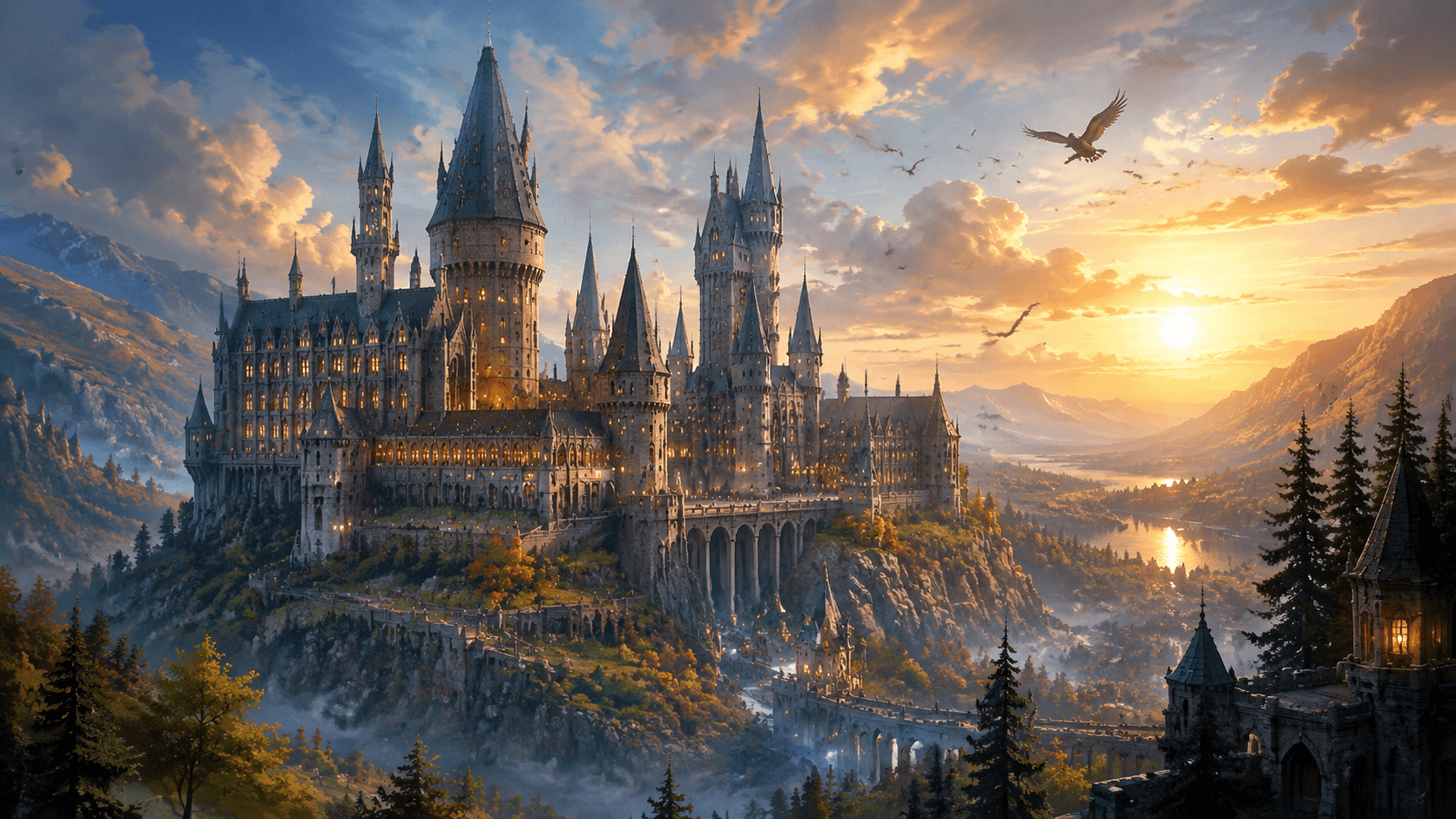
The castle itself is a character in the story a vast, ancient structure perched on a cliff beside a dark lake, its turrets and towers silhouetted against a highland sky. A classic school of wizardry contains staircases beyond counting, many of which move, shift direction, or lead to different places depending on the day of the week. The architecture defies ordinary physics: rooms expand and contract, corridors appear and disappear, and entire wings of the building can seemingly rearrange themselves overnight. This living quality makes the castle school one of the most fascinating magical architectural spaces ever imagined.
The Great Hall serves as the heart of school life. Its high vaulted roof, lit by torches and tall windows, frames starlit nights, dramatic sunsets, and gentle snowfall during winter feasts. Long house tables stretch the length of the hall, and the teachers' table overlooks it all from a raised platform. The Great Hall hosts the welcome feast, holiday celebrations, examinations, and the year end ceremonies, making it a space that carries centuries of accumulated memories and traditions.
Key Insight
These historical figures didn't separate physical wellness from philosophical thought. To them, it was all one continuous practice of living well.
Beyond the Great Hall, the castle unfolds into an extraordinary maze of classrooms, towers, dungeons, courtyards, and hidden chambers. A tower for stargazing offers sweeping views of the grounds and surrounding mountains. Greenhouses hold magical plants from every corner of the globe. An aviary high in the walls houses the school's messenger birds. And deep beneath the castle, passageways lead to chambers that few students ever discover, sealed away for centuries and accessible only under extraordinary circumstances.
The castle grounds extend the magical experience far beyond the building's walls. A dark, ancient forest, home to centaurs, unicorns, and countless other magical beings, borders the school, offering both wonder and caution to those brave enough to explore its depths. A deep lake stretches before the castle, its waters said to hide merfolk and stranger things still. Meanwhile, a cottage at the edge of the woods, where the kind groundskeeper lives, serves as a comforting beacon for students seeking wisdom, friendship, or simply a cup of oversized tea.
"A school of wizardry has no Wi Fi, but honestly when the stars shine through your tower window and your paintings gossip about your love life, who needs social media?"
A Roman walks into a bar, holds up two fingers, and says, 'Five beers, please.'
The Curriculum of Magic: What Students Learn
The curriculum of a school of wizardry is designed to transform raw magical talent into disciplined, ethical expertise across a wide range of magical disciplines. Newcomers begin with core subjects that lay the foundation for all advanced magic, and as they progress through the years, they have the opportunity to specialize in areas that match their talents and interests. The educational philosophy balances theoretical understanding with practical application, ensuring that graduates are not merely knowledgeable but genuinely competent in their craft.
Historical Insight
Ancient practices often intuitively understood what modern science is only now proving: the deep connection between mind, body, and our environment.
Additional subjects include Herb lore (the study of magical plants), Magical history (the legends, wars, and great discoveries of the magical past), Astronomy (mapping celestial bodies and their magical influences), and the care of magical creatures, a subject that teaches students to understand, respect, and safely interact with beings from hippogriffs and phoenixes to griffins and dragons. Older students may add electives such as fortune telling, ancient runes, alchemy, and star lore, allowing students to tailor their education to their unique strengths and career ambitions.
The wizard-school curriculum mirrors the best aspects of real world education: it combines theoretical knowledge with hands on practice, encourages curiosity and independent thinking, and recognizes that true mastery comes not from memorizing facts but from understanding principles deeply enough to apply them creatively.
What's an ancient intellectual's favorite exercise? Jumping to conclusions.
Magical Creatures and Beings of the Castle Grounds
The lands surrounding a school of wizardry are home to an astonishing diversity of magical creatures, from majestic and benevolent beings to shy, elusive species that rarely reveal themselves to humans. The forest alone may shelter centaurs who possess profound astronomical wisdom, unicorns whose horns medieval lore believed could cure poison, and winged horses that recall Pegasus of Greek myth. This ecosystem of wondrous creatures adds extraordinary depth to the archetype, reminding students that the magical world extends far beyond spells and wands. Similar themes of humans coexisting with extraordinary beings appear throughout world mythology's dragon traditions.
Hippogriffs magnificent creatures with the front half of an eagle and the hind quarters of a horse, made famous by Italian Renaissance poetry, are a favourite in magical creature lessons. Approaching one requires patience and respect, teaching students valuable lessons about respect, humility, and earning trust from beings who possess their own dignity and intelligence. Phoenixes, among the rarest and most powerful creatures of myth, symbolize renewal and hope, rising again from their own ashes and inspiring courage in the pure of heart.
Visionaria Insight
By immersing ourselves in these historical soundscapes, we reconnect with a timeless human tradition of storytelling and mental restoration.
A deep lake may harbor merfolk who keep their own culture, language, and governance beneath the waters. Giant spiders lurk in the darkest reaches of the forest, while household spirits, cousins of the brownies of British folklore, quietly keep the kitchens running and raise questions of their own about who serves and why. Even the castle itself plays host to ghostly residents: wandering monks, restless knights, and the grey ladies of British ghost lore each carrying centuries of wisdom and unresolved stories that connect the present to the deep past.

"The dark forest at the edge of the grounds is off limits for a reason, yet somehow every student visits it at least once. It's basically the magical school equivalent of reading the terms and conditions and clicking 'I agree' anyway."
Why did the Stoic cross the road? Because it was the rational thing to do, and he was indifferent to the traffic.
Broomstick Games: The Sport That Unites a School of Magic
No exploration of a school of wizardry is complete without flying on broomsticks, the exhilarating aerial pastime that serves as one of the archetype's most beloved traditions. The image is older than any novel: witches riding brooms through the night sky appear in European folklore and art from the late Middle Ages. In fantasy schools, flying becomes play, from races around the towers and aerial obstacle courses to team ball games played high above a pitch and daring treasure hunts in the clouds, where quick eyes and steady nerves matter more than raw speed.
Did You Know?
The relentless drive to understand the world was seen not just as an academic pursuit, but as a spiritual and healing practice by the ancients.
Flying contests between houses are among the most fiercely contested events at a school of magic, generating excitement, school spirit, and occasionally dramatic rivalries that echo through the corridors long after the final whistle. Matches take place on a great pitch ringed by tall stands where spectators cheer, gasp, and occasionally duck as stray balls fly in unexpected directions. The sport demands extraordinary athletic skill, strategic thinking, teamwork, and raw courage, as players navigate at high speeds while executing complex maneuvers hundreds of feet above the ground.
Beyond the physical competition, broomstick games serve a deeper social function in the archetype. They bring students from different backgrounds together, create opportunities for unlikely heroes to emerge, and teach valuable lessons about perseverance, sportsmanship, and the importance of working together toward a common goal. The flying pitch, like the Great Hall, is one of those rare spaces where house rivalries transform from sources of tension into celebrations of healthy competition and mutual respect.
"Broomstick games are the only sport where a match can last five minutes or five months. Imagine explaining that to a TV scheduling department: 'We might need the channel until Thursday. Or March.'"
Why did the historian break up with the archaeologist? Because her career was literally in ruins.
Enchantments, Spells, and Protective Charms
Every school of wizardry runs on a vast system of spells, enchantments, and protective charms that range from the everyday practical to the extraordinarily powerful. Students learn these magical techniques progressively, beginning with simple charms like a spell for light (a soft glow at the tip of the wand) and a levitation charm (lifting a feather into the air) before advancing to complex defensive magic, transformation spells, and even the creation of their own enchantments. The educational approach emphasizes not just the mechanical execution of spells but the intent, focus, and ethical responsibility behind every use of magic.
The castle itself is protected by some of the most powerful enchantments imaginable. Wards against teleportation stop anyone from simply appearing inside the grounds, while concealment charms, among the most complex spells in any wizard's repertoire, can render an entire location invisible to anyone not entrusted with its secret. The castle's protective enchantments were layered over centuries by generations of skilled witches and wizards, creating defenses so deeply woven into the stonework that they have become part of the building's very essence.
Visionaria Insight
By immersing ourselves in these historical soundscapes, we reconnect with a timeless human tradition of storytelling and mental restoration.
The guardian charm stands out as perhaps the most emotionally meaningful kind of magic a school could teach. Picture a protective light or guardian spirit that answers only when you focus on your happiest, most powerful memory, a modern echo of folklore's amulets, guardian spirits, and the witch's familiar. The idea beautifully encapsulates the archetype's philosophy: that the most potent magic emerges not from raw power but from the depth of our positive emotions and our capacity for hope. It represents the idea that joy, love, and cherished memories are themselves forms of protection against the challenges we face.
🎯 How-To: Casting Your Own "Guardian Charm"
While we can't teach you actual magic, the principle behind a guardian charm mirrors real mindfulness techniques: focusing on your happiest memory creates genuine positive neurological effects. Try it now close your eyes, recall your most joyful moment, and notice how your mood shifts. That's real world magic through cinematic meditation.
Why did the Stoic cross the road? Because it was the rational thing to do, and he was indifferent to the traffic.
The School of Wizardry Through the Seasons: A Year of Wonder
The wizard-school experience unfolds across a full academic year, and each season transforms the castle and its grounds into something entirely new. Autumn brings the arrival of new students, by steam train, boat, or enchanted carriage, the spectacular welcome feast in the Great Hall, and the sorting ceremony. The grounds blaze with copper and gold as the forest puts on its magnificent autumnal display, and students settle into their new classes with a mixture of excitement and nervous anticipation. The air grows crisp, flying trials begin, and the castle seems to hum with renewed energy as another year of magical education commences.
Did You Know?
The relentless drive to understand the world was seen not just as an academic pursuit, but as a spiritual and healing practice by the ancients.
Winter transforms the castle into a wonderland of snow and enchantment. The Great Hall is decorated with towering evergreen trees, fairy lights flicker among their branches, and garlands of holly and mistletoe adorn every corridor. The midwinter feast is legendary: tables groan with roast dinners, flaming puddings, and crackers that produce far more impressive surprises than ordinary ones. Students who stay at school over the holidays experience the castle at its most intimate and magical, with snow falling softly past tall windows and the warmth of common room fires creating a profound sense of belonging.
Spring brings exam preparation, longer days, and the emergence of magical creatures from their winter retreats. The greenhouses burst with activity as plants awaken and students tend to increasingly demanding botanical specimens. Spring also brings the height of the flying season, with championship matches drawing the entire school to the pitch for afternoon contests that can decide the year's house standings. The lake thaws, the forest grows dense with new foliage, and the castle grounds become a favorite study location for students seeking fresh air between revision sessions.
Summer concludes the academic year with final examinations, the end of year feast, and the awarding of the house trophy, a moment that celebrates not just academic achievement but the collective spirit, courage, and kindness demonstrated by each house throughout the year. Students set off on the long journey home, carrying with them new knowledge, deeper friendships, and the bittersweet understanding that the magical world continues to turn even during the summer months when they return to their ordinary lives.
"Wizard-school exams include a practical component where you actually perform magic under pressure. Suddenly, your university finals don't seem quite so intimidating, do they?"
A philosopher walked into a wall. His students asked if it hurt. He replied, 'The wall is an illusion, but my headache is quite real.'
Why the School of Wizardry Continues to Inspire Millions
From folklore to modern fantasy, the school of wizardry remains one of the most beloved settings in storytelling. Its enduring appeal stems not from the spectacle of magic alone but from the deeply human stories that unfold within its walls. At its core, the archetype is about belonging the universal longing to find a place where you are accepted, challenged, and valued for who you truly are. Every student who receives their acceptance letter experiences the same thrill: the revelation that they are not ordinary, that they belong to a world of wonder and possibility that was waiting for them all along.
Visionaria Insight
By immersing ourselves in these historical soundscapes, we reconnect with a timeless human tradition of storytelling and mental restoration.
The school's emphasis on choice over destiny resonates powerfully across cultures and generations. The best wizard-school stories teach that your character is defined not by your bloodline, your house, or the expectations placed upon you, but by the decisions you make when it matters most. This philosophy that courage, kindness, and integrity are more powerful than talent or circumstance mirrors the values celebrated in timeless mythological traditions from Arthurian legend to global mythology. It is a message that transcends the boundaries of fiction and speaks directly to the challenges of real life.
The archetype has also inspired a remarkable global community of readers, players, and creators. Fantasy conventions draw enthusiasts every year. Real castles and historic colleges in many countries let visitors walk through corridors and great halls that feel lifted from a school of magic, while festivals, games, and interactive experiences let fans play at being students of wizardry. Most relevant to our exploration are immersive audio journeys that allow listeners to experience magical worlds through guided imagination and spatial audio technology.
"Many of us grew up waiting for a letter from a school of magic that never came. Closing your eyes with spatial audio all around you is the closest most of us will get to walking its corridors."
A philosopher walked into a wall. His students asked if it hurt. He replied, 'The wall is an illusion, but my headache is quite real.'
How to Imagine a School of Wizardry Through Immersive Audio
For those who have always dreamed of walking through enchanted castle corridors, modern technology offers an extraordinary way to bridge the gap between imagination and experience. Interactive audio journeys use spatial 3D sound technology to create the sensation of truly being inside magical environments. When you put on headphones and close your eyes, the audio positions sounds all around you footsteps echoing on stone floors to your left, a crackling fireplace behind you, the distant chime of a clock tower above creating a sense of genuine presence that engages your brain in the same way as a real physical experience.
Visionaria's interactive audio journeys currently take you into ancient cities such as Athens and Troy using this same immersive technology. There is no wizard-school journey in the app, but the same techniques work for any setting: put on headphones, close your eyes, and let guided imagination help you build your own enchanted castles, mysterious forests, and magical academies that capture the same sense of wonder, discovery, and belonging. Combined with cinematic meditation techniques and guided imagination practices, these experiences offer both entertainment and genuine mindfulness benefits.
Did You Know?
The relentless drive to understand the world was seen not just as an academic pursuit, but as a spiritual and healing practice by the ancients.
The connection between the school of wizardry and imagination based meditation runs deeper than you might expect. Research shows that vivid mental imagery activates many of the same neural pathways as real experience, meaning that when you imagine walking through a magical castle with spatial audio guiding your senses, your brain responds with genuine feelings of awe, calm, and wonder. This is precisely why fantasy themed audio journeys have become one of the fastest growing categories in mindfulness apps they transform the act of meditation from a discipline into an adventure, much like story based meditation improves focus through narrative engagement.
"We can't promise a letter from a school of magic will ever arrive. But with spatial audio headphones, you can imagine a great hall at any age and nobody will judge you for being forty three and still waiting."

The Story of the Trojan Horse and the Fall of Troy
Discover the story of the Trojan Horse and the fall of Troy—from the origins of the legendary Trojan conflict and Odysseus's brilliant stratagem to archaeological evidence at Hisarlik, Homer's Iliad, the heroes of Tro...
A time traveler went back to antiquity to teach them about 'holistic health.' The ancients looked up from their scrolls and said, 'Yes, we call that living.'
The Bottom Line
You've explored the School of Wizardry as an archetype: its founding legends, its houses and rivalries, its enchanted castle architecture, its magical curriculum, the wondrous creatures that inhabit its grounds, the thrill of flying on broomsticks, and the hidden secrets that have captivated readers for generations.
Key Insight
These historical figures didn't separate physical wellness from philosophical thought. To them, it was all one continuous practice of living well.
This article covered how the castle school of magic works as both a fictional setting and a profound symbol of belonging, courage, and the transformative power of knowledge. Whether you are drawn to bravery, loyalty, wisdom, or ambition, the School of Wizardry offers something meaningful for everyone.
To experience magical worlds yourself through immersive audio, download the Visionaria app and explore fantasy castle journeys, mythological realms, and cinematic meditation experiences that bring the wonder of magical worlds to life through spatial 3D audio.

"Remember: You may not have a wand, but you do have headphones and in the modern age, that's basically the same thing. Cast a guardian charm and send your stress away."
Experience More with Visionaria
Download the app to explore guided historical and wellness journeys.
An Epicurean, a Stoic, and a Cynic walk into a garden. The bartender says, 'Is this some kind of philosophical joke?'