The Story of the Trojan Horse and the Fall of Troy
💡 Fun fact: The Trojan Horse is history's most celebrated strategic surprise: a single wooden structure that accomplished what ten years of continuous campaigning could not. If only the Trojans had read the reviews first: "Beautiful craftsmanship, suspiciously large, one star. Do NOT bring inside your city walls."
- The Origins of the Trojan Conflict
- The Greek Champions of the Campaign
- The Defenders of Troy
- Ten Years Outside the Walls
- The Wooden Horse: Odysseus's Masterstroke
- The Night That Changed Everything
- The Fall of Troy: A Civilisation Transformed
- Archaeological Evidence: Did Troy Really Exist?
- Homer, Virgil, and the Literary Legacy
- Lessons from Troy: Strategy, Patience, and Ingenuity
- Troy's Legacy in Modern Culture
- Experiencing Ancient Troy Through Immersive Meditation
- The Bottom Line
- Frequently Asked Questions
Imagine standing on the windswept plains of northwestern Anatolia, looking up at the towering walls of one of the Bronze Age's mightiest citadels. For ten years, the greatest champions of the Greek world have camped outside these walls, unable to breach them. And then, on a morning like any other, the Greek forces are gone. Their ships have sailed. Their campfires are cold. All that remains is an enormous wooden horse, standing alone on the empty plain. What happens next will become the most famous story in Western civilisation.
The story of the Trojan Horse and the fall of Troy is one of mythology's most enduring narratives a tale of strategic brilliance, heroic courage, divine intervention, and the dramatic conclusion of the ancient world's most legendary campaign. Originating in the oral traditions of Bronze Age Greece and preserved through Homer's Iliad, the Odyssey, and Virgil's Aeneid, the Trojan narrative encompasses the conflict's origins in a divine beauty contest, ten years of campaigning featuring the greatest heroes of Greek and Trojan legend, and its resolution through Odysseus's brilliant stratagem the wooden horse. The story explores themes of cleverness over strength, the consequences of pride, the role of fate, and the transformation of civilisations. Archaeological excavations at ancient Mediterranean sites including Hisarlik in modern Turkey confirm that a Bronze Age city consistent with Homer's Troy existed and experienced significant upheaval around 1180 BCE, lending historical weight to mythology's most dramatic narrative. Through immersive audio journeys, you can now walk Troy's legendary streets, stand inside its walls, and experience the most famous night in mythological history through spatial audio and guided imagination.
In this comprehensive guide, you'll discover the full story of the Trojan Horse from the origins of the conflict and the heroes on both sides, through ten years of legendary campaigning, to the construction of the horse, the night Troy fell, archaeological evidence, literary legacy, enduring cultural impact, and how to experience ancient Troy through experiential meditation.
"The Trojan Horse is the original 'thinking outside the box' except the box was a horse, and it was very much inside the city. Odysseus didn't outfight Troy. He out thought it. And 3,200 years later, we're still talking about his creative solution to an apparently impossible problem."
Key Facts: The Trojan Horse & the Fall of Troy
- ••Duration of the campaign: The Trojan conflict lasted ten years according to Homer, one of the longest sustained military engagements in mythological tradition, reflecting the scale and significance the ancients attributed to this legendary confrontation
- ••The Horse stratagem: Devised by Odysseus (known for his cunning), the wooden horse concealed approximately 30-40 elite Greek champions. The Trojans brought it through their gates believing it to be a sacred offering to Athena
- ••Archaeological confirmation: Heinrich Schliemann's 1870s excavations at Hisarlik (northwestern Turkey) revealed a multi-layered Bronze Age settlement. Troy VIIa, dated to approximately 1180 BCE, shows evidence of upheaval consistent with the mythological timeline
- ••Literary sources: The story is preserved across multiple ancient texts: Homer's Iliad (c. 750 BCE), the Odyssey, Virgil's Aeneid (c. 19 BCE), the Little Iliad, and the Sack of Ilium, each contributing different perspectives on the same events
- ••Cultural impact: The phrase "Trojan Horse" has entered virtually every modern language as a metaphor for deceptive strategy, and the expression "beware of Greeks bearing gifts" (timeo Danaos et dona ferentes) from Virgil remains in active use 2,000 years later
- ••Divine involvement: The gods played active roles throughout. Aphrodite, Apollo, and Ares supported Troy, while Athena, Hera, and Poseidon favoured the Greeks, making the conflict a stage for both human heroism and celestial drama
Quick Answer
💡 Fun fact: The Trojan Horse is history's most celebrated strategic surprise: a single wooden structure that accomplished what ten years of continuous campaigning could not. If only the Trojans had read the reviews first: "Beautiful craftsmanship, suspiciously large, one star. Do NOT bring inside your city walls."
The Origins of the Trojan Conflict
The story begins not on a plain but on a mountaintop and not with mortals but with gods. According to mythological tradition, the Trojan conflict originated at the wedding feast of Peleus and Thetis, where every deity of Olympus was invited except Eris, the goddess of discord. Offended by the slight, Eris tossed a golden apple inscribed "For the Fairest" among the guests, sparking a rivalry between Hera, Athena, and Aphrodite that would reshape the mortal world.
Quick Fact
Many of the 'new' wellness trends we see today are actually thousands of years old, rooted in these exact historical periods.
Zeus, unwilling to judge between three powerful goddesses, delegated the decision to Paris, a prince of Troy renowned for his beauty and fairness. Each goddess offered a bribe: Hera promised dominion over all of Asia, Athena offered wisdom and prowess in every endeavour, and Aphrodite offered the love of the most beautiful mortal woman in the world Helen of Sparta, wife of King Menelaus. Paris chose Aphrodite's gift. He sailed to Sparta, was received as an honoured guest by Menelaus, and departed with Helen an act that violated the sacred laws of xenia (guest friendship) that bound the ancient Greek world together.
Menelaus called upon the Oath of Tyndareus a pact made years earlier by all of Helen's former suitors to defend whichever man won her hand. This oath bound virtually every king and champion in Greece to Menelaus's cause, including the cunning Odysseus of Ithaca, the mighty Ajax, the brilliant Diomedes, and the supreme commander Agamemnon of Mycenae, Menelaus's brother. A vast fleet of over a thousand ships assembled at Aulis, representing the most formidable coalition the mythological Greek world had ever seen. Their destination: the wealthy, heavily fortified city of Troy on the coast of Anatolia.
The origins of the conflict thus weave together divine vanity, mortal desire, sacred obligations, and the complex web of alliances that characterised the Bronze Age Mediterranean. What began as a squabble among goddesses over a golden apple would culminate, ten years later, in the most famous stratagem in mythological history.
"The entire Trojan conflict ten years, thousands of heroes, the greatest stories ever told started because someone forgot to invite one goddess to a party. If there's a lesson here, it's this: always check your guest list twice. Especially if any of the guests can throw magical apples."
Why did the historian break up with the archaeologist? Because her career was literally in ruins.
The Greek Champions of the Campaign
The Greek coalition assembled at Troy comprised the most extraordinary collection of heroes in mythological tradition. Achilles, son of the sea nymph Thetis and the mortal Peleus, was the greatest champion of his age swift, nearly invulnerable, and driven by an intense desire for lasting glory (kleos). His legendary prowess made him the single most formidable presence on either side, and Homer's Iliad centres on his anger, his withdrawal from the campaign, and his eventual return following the loss of his beloved companion Patroclus. Achilles embodied the Greek ideal of the warrior hero: magnificent, passionate, and conscious that his choice of a glorious but brief life over a long but obscure one gave every moment heightened meaning.
Did You Know?
The relentless drive to understand the world was seen not just as an academic pursuit, but as a spiritual and healing practice by the ancients.
Odysseus of Ithaca the man who would ultimately devise the Trojan Horse represented a completely different kind of heroism. Where Achilles excelled through physical supremacy, Odysseus excelled through metis: cunning intelligence, strategic thinking, and the ability to see solutions invisible to others. Homer describes him as polytropos "the man of many turns," adaptable, resourceful, and endlessly inventive. It was Odysseus who recruited the reluctant Achilles, Odysseus who counselled patience during the long years of campaigning, and Odysseus who conceived the stratagem that would finally bring Troy's walls down not through force, but through the most brilliant act of creative ingenuity in mythological history.
Agamemnon, king of Mycenae, served as supreme commander a role that required managing the egos, rivalries, and competing interests of dozens of independent kings. His leadership was imperfect: his quarrel with Achilles over the captive Briseis nearly cost the Greeks their campaign. Ajax the Greater (Ajax Telamonius) was the Greeks' most reliable defender enormous, courageous, and immovable, described by Homer as "a wall of bronze." Diomedes, king of Argos, was perhaps the campaign's most consistently brilliant individual champion the only mortal to successfully challenge gods in combat, engaging both Aphrodite and Ares with remarkable courage during the great engagements described in the Iliad.
The Greek heroes represent a remarkable diversity of heroic models: Achilles (physical supremacy and passionate intensity), Odysseus (intellectual brilliance and strategic patience), Ajax (steadfast reliability and defensive strength), and Diomedes (versatile courage and individual excellence). The Trojan narrative suggests that great enterprises require all these forms of heroism working together strength alone cannot achieve what strategy, patience, and ingenuity can accomplish.

Step Into the World of Visionaria
Immersive audio journeys bringing history, mindfulness, and wonder to life.
An Epicurean, a Stoic, and a Cynic walk into a garden. The bartender says, 'Is this some kind of philosophical joke?'
The Defenders of Troy
Troy's champions were equally extraordinary and in many ways, Homer portrays them with greater sympathy than their Greek counterparts. Hector, eldest son of King Priam, was Troy's greatest champion and, for many readers across the centuries, the most admirable figure in the entire narrative. Where Achilles sought personal glory, Hector fought to protect his family, his city, and his people. His farewell to his wife Andromache and infant son Astyanax on the walls of Troy one of the most moving scenes in all of literature reveals a man who understood the stakes of the conflict, loved his family profoundly, and met his obligations with quiet courage. Hector represents the heroism of responsibility: the person who stands firm not for glory but because others depend on them.
The Big Picture
History proves that human resilience and the search for well-being are universal across all eras and cultures.
Paris, whose choice of Aphrodite's gift initiated the conflict, is portrayed with greater complexity than his popular reputation suggests. Handsome, charming, and skilled with the bow, Paris lacked Hector's martial prowess but possessed his own form of courage and his actions, whatever their consequences, were influenced by divine forces beyond mortal control. King Priam embodied the dignity and sorrow of a ruler watching his magnificent city face an existential challenge his scenes with Achilles in Book 24 of the Iliad, where he goes to recover Hector's body, represent one of the most emotionally powerful encounters in world literature.
Aeneas, son of Aphrodite and the mortal Anchises, survived the fall of Troy and according to Virgil's Aeneid carried his elderly father on his back through the burning city, eventually founding the lineage that would establish Rome. Cassandra, Priam's daughter, possessed the gift of true prophecy but was cursed by Apollo so that no one would believe her warnings. She foretold the Horse's deception, screaming that enemies hid within but the Trojans, bound by their curse of disbelief, ignored her. Cassandra's story resonates across millennia as a parable about the consequences of ignoring inconvenient truths.
"Cassandra literally told everyone exactly what was inside the horse. Nobody listened. She is the patron saint of every person who has ever said 'I told you so' and meant it with cosmic level frustration. Three thousand years later, people are still not checking suspicious gift horses."
A philosopher walked into a wall. His students asked if it hurt. He replied, 'The wall is an illusion, but my headache is quite real.'
Ten Years Outside the Walls
The decade-long campaign at Troy was not a continuous engagement but a complex, prolonged series of encounters, negotiations, raids on surrounding cities, internal disputes, divine interventions, and individual contests between champions. Troy's massive walls legendarily built by Poseidon and Apollo proved impregnable to direct assault, forcing the Greeks into a protracted campaign of attrition that tested alliances, patience, and morale on both sides.
Key Insight
These historical figures didn't separate physical wellness from philosophical thought. To them, it was all one continuous practice of living well.
Homer's Iliad focuses on a few crucial weeks in the tenth year specifically, the wrath of Achilles and its consequences. When Agamemnon takes Briseis (a captive woman awarded to Achilles) for himself, Achilles withdraws from the campaign entirely, and the Greek position deteriorates rapidly. The Trojans, led by Hector, press their advantage, driving the Greeks back to their ships. Only when Achilles' beloved companion Patroclus enters the fray wearing Achilles' own armour and is subsequently overcome by Hector does Achilles return to the field. His encounter with Hector, the culmination of the Iliad, is one of literature's most dramatic moments: the two greatest champions, each knowing the stakes, meeting in single combat before the walls of Troy.
Beyond the Iliad's focused narrative, the broader Trojan cycle describes many other dramatic events: the arrival and loss of the Amazon queen Penthesilea, who championed Troy's cause; the coming of Memnon, king of the Ethiopians, a formidable ally; the contest over Achilles' armour between Ajax and Odysseus; and the theft of the Palladium Athena's sacred statue, whose presence within Troy was believed to guarantee the city's protection. Each of these events chipped away at Troy's defences and morale, setting the stage for Odysseus's ultimate stratagem.
According to Homer's catalogue of ships in Book 2 of the Iliad, the Greek expedition comprised 1,186 ships carrying warriors from 29 distinct regions of Greece the largest naval assembly described in any ancient text and a testament to the extraordinary coalition that the conflict inspired.
Why did the inventor of the wheel win an award? Because his idea really got things rolling.
The Wooden Horse: Odysseus's Masterstroke
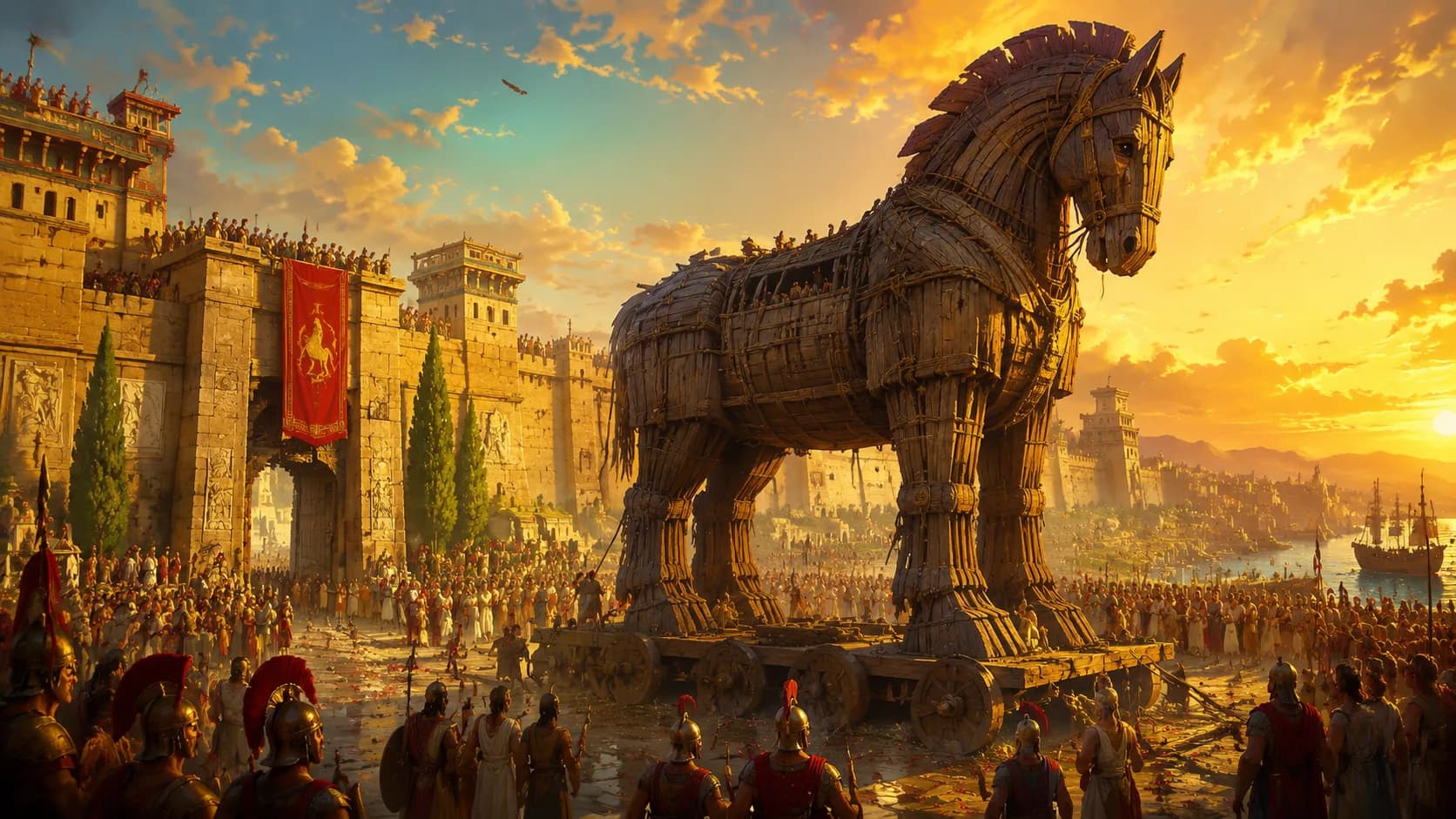
After ten years of campaigning had failed to breach Troy's walls, Odysseus conceived the stratagem that would become the most famous in human history. The plan was breathtaking in its audacity and elegance: the Greeks would construct an enormous wooden horse, large enough to conceal a select force of their finest champions inside its hollow belly. The rest of the Greek army would sail away, disappearing over the horizon to the nearby island of Tenedos. The horse would be left on the plain before Troy's gates, inscribed with a dedication to Athena as a sacred offering.
Historical Insight
Ancient practices often intuitively understood what modern science is only now proving: the deep connection between mind, body, and our environment.
The construction was entrusted to Epeius, a master craftsman guided (according to tradition) by Athena herself. The horse was enormous ancient sources describe it as large enough to hold between 23 and 50 warriors, depending on the account. Its exterior was crafted with deliberate beauty: polished wood, carved details, and the inscription that would serve as its cover story. Inside, the hidden chamber was equipped for silence warriors would wait in darkness, controlling every breath, for as long as necessary.
The plan's genius lay in its psychological precision. Odysseus understood Troy's culture: the Trojans revered the gods, respected sacred offerings, and had reason after ten years of sustained pressure to believe the Greeks might finally have withdrawn. The horse exploited three simultaneous vulnerabilities: religious piety (the offering to Athena demanded respect), desire for closure (the Trojans desperately wanted the campaign to be over), and pride (bringing such a magnificent object inside the walls would symbolise Troy's triumph). Every element was calculated to make the Trojans want the horse inside their city and to make anyone who argued otherwise seem foolish or impious.

"Odysseus's plan required the Greeks to build a giant horse, fill it with soldiers, pretend to leave, and trust that the Trojans would voluntarily bring the world's most suspicious gift inside their impregnable fortress. The remarkable thing isn't that the plan was crazy. It's that it worked. Flawlessly. This is either the greatest strategic mind in history or the luckiest. Homer suggests both."
Why did the ancient physician prescribe a long walk? Because he was tired of listening to the patient complain in his office.
The Night That Changed Everything
When the Trojans discovered the horse and the empty Greek camp, a great debate erupted. Laocoön, a priest of Poseidon, famously warned: "I fear Greeks, even bearing gifts" (timeo Danaos et dona ferentes) and hurled his spear at the horse's side. Cassandra screamed her prophecies. But Sinon, a Greek agent deliberately left behind, performed his role with consummate skill. He told the Trojans a carefully constructed story: he was a deserter, he said, abandoned by the Greeks; the horse was an offering to Athena, built deliberately too large to fit through Troy's gates so the Trojans couldn't claim its divine protection. This last detail was masterful it practically dared the Trojans to prove Sinon wrong by making the horse fit.
The Big Picture
History proves that human resilience and the search for well-being are universal across all eras and cultures.
Virgil describes how two great serpents emerged from the sea and overwhelmed Laocoön and his sons an event the Trojans interpreted as divine punishment for disrespecting the sacred offering. With their most vocal critic silenced by apparent divine intervention, the Trojans made their fateful decision: they breached their own walls, widening the Scaean Gate to bring the horse inside. That evening, Troy celebrated. The ten year campaign was over. The enemy was gone. The horse stood in the city's heart as a trophy of their endurance.
Under cover of darkness, with Troy asleep after hours of celebration, the concealed warriors made their move. Odysseus, Neoptolemus (Achilles' son), Diomedes, Menelaus, and the other hidden champions descended from the horse via a rope lowered from a hidden trapdoor. They moved swiftly and silently through Troy's sleeping streets. Their first objective was the gates which they opened wide. On Tenedos, watching for the signal fire, the Greek fleet was already sailing back. Within hours, the Greek forces streamed through the open gates of the city that had resisted them for a decade. Ancient civilisation's most legendary stronghold fell in a single night.
Why did the historian break up with the archaeologist? Because her career was literally in ruins.
The Fall of Troy: A Civilisation Transformed
The fall of Troy represents one of mythology's most profound moments of civilisational transformation. In a single night, one of the Bronze Age's wealthiest, most culturally sophisticated cities transitioned from a proud, independent power into memory and legend. The event's magnitude reverberates through both Greek and Trojan mythological traditions for the Greeks, it was the culmination of their greatest collective enterprise; for the Trojans, it was the end of an era and the beginning of a diaspora that would, according to Virgil, ultimately give rise to Rome itself.
Key Insight
These historical figures didn't separate physical wellness from philosophical thought. To them, it was all one continuous practice of living well.
The transformation of Troy was not merely physical but spiritual and cultural. The city's fall represented the end of an age the transition from the heroic era of champions and gods walking among mortals to a diminished world where such figures existed only in song and story. Homer and his successors understood that Troy's story was fundamentally about the impermanence of human achievement: that even the mightiest walls, the most courageous defenders, and the most magnificent civilisation cannot stand forever against the forces of change, cleverness, and fate.
Read more: Meditation for Expanding Inner Worlds: Complete Guide to Growing Your Imagination

Yet Troy's transformation was also generative. Aeneas, carrying his father Anchises on his back and leading his young son Ascanius by the hand, escaped the fallen city and after years of wandering described in Virgil's Aeneid established the foundation from which Rome would rise. In Virgil's vision, Troy did not simply end; it was transplanted, its cultural DNA carried westward to seed a new and even greater civilisation. This makes the Trojan narrative not just a story of endings but of continuity and renewal the mythological equivalent of a phoenix emerging from its own transformation.
Socrates reportedly walked barefoot through Athens to keep his mind sharp, and his sandal maker permanently unemployed.
Archaeological Evidence: Did Troy Really Exist?
Yes with qualifications. The archaeological evidence for Troy's existence is compelling, though the relationship between the physical site and Homer's narrative remains a subject of scholarly discussion. In the 1870s, German archaeologist Heinrich Schliemann, guided by a literal reading of Homer, began excavating a mound at Hisarlik in northwestern Turkey. He discovered not one city but nine successive settlements built on top of each other, spanning from approximately 3000 BCE to 500 CE three thousand years of continuous habitation at a single strategically critical location.
Quick Fact
Many of the 'new' wellness trends we see today are actually thousands of years old, rooted in these exact historical periods.
The layer most consistent with Homer's Troy is Troy VIIa, dated to approximately 1180 BCE. This level shows evidence of significant upheaval: fire damage, hastily reinforced walls, storage jars buried in house floors (suggesting preparation for extended pressure), and artefacts consistent with a major Bronze Age settlement. The city occupied a commanding position overlooking the Dardanelles the narrow strait controlling sea traffic between the Aegean and the Black Sea explaining why it would have been both wealthy (from controlling trade) and a strategic target.
Modern excavations led by Manfred Korfmann (1988-2005) revealed that Troy was significantly larger than Schliemann believed with a lower city extending well beyond the citadel, housing perhaps 5,000-10,000 people at its peak. This makes it consistent with Homer's description of a major urban centre capable of sustaining a prolonged campaign. Whether the wooden horse was literal, metaphorical (perhaps representing a siege engine, or a horse-prowed ship), or purely literary, the archaeological record confirms that a powerful Bronze Age city existed at precisely the location Homer described, and that it experienced dramatic upheaval at approximately the date tradition assigns to the fall of Troy.
The archaeological site of Troy (Hisarlik) is located in Çanakkale Province, northwestern Turkey, approximately 30 km from the modern city of Çanakkale. It overlooks the Dardanelles strait and has been a UNESCO World Heritage Site since 1998. Visitors today can walk among the excavated ruins of nine superimposed cities spanning three millennia.
"Schliemann went looking for a mythological city that most scholars said didn't exist, dug exactly where Homer said it would be, and found it. Nine versions of it, in fact, stacked like archaeological pancakes. The academic establishment's response was essentially: 'Well, yes, but you used the wrong digging technique.' Fair point but also, he found Troy."
An Epicurean, a Stoic, and a Cynic walk into a garden. The bartender says, 'Is this some kind of philosophical joke?'
Homer, Virgil, and the Literary Legacy
The Trojan narrative is preserved across multiple literary masterworks, each contributing a different dimension to the story. Homer's Iliad (composed c. 750-700 BCE) doesn't describe the horse or Troy's fall at all it focuses on a few weeks in the conflict's tenth year, centring on Achilles' anger and its consequences. Yet the Iliad establishes the emotional and thematic foundation for everything that follows: the humanity of both sides, the role of the gods, the meaning of heroism, and the weight of mortality.
Homer's provides the most famous Greek account of the horse itself, told in flashback by multiple narrators. Menelaus describes Helen walking around the horse and mimicking the voices of the warriors' wives testing whether anyone inside would break discipline. Odysseus describes the tense silence within, the self-control required, and the moment of emergence. These accounts have the quality of survivors' testimony vivid, emotionally charged, and shaped by the magnitude of what was experienced.
Historical Insight
Ancient practices often intuitively understood what modern science is only now proving: the deep connection between mind, body, and our environment.
Virgil's Aeneid (c. 29-19 BCE) provides the most detailed and emotionally devastating account, told from the Trojan perspective by Aeneas himself. Book 2 of the Aeneid describes the horse's arrival, Laocoön's warning, Sinon's deception, the serpents, the celebration, the night emergence, and the transformation of the city all through the eyes of a man watching his world end. Virgil's account is the primary source for most subsequent retellings and has shaped how Western culture imagines Troy's final night for over two thousand years.
The Epic Cycle a collection of poems now mostly lost but summarised by ancient commentators filled in the broader narrative: the Cypria described the conflict's origins, the Little Iliad covered events between the Iliad and the fall, the Sack of Ilium (Iliou Persis) described the fall itself, and the Returns (Nostoi) described the Greek heroes' homeward voyages. Together, these works created a comprehensive mythological narrative that has been retold continuously for over three millennia.
Why did the historian break up with the archaeologist? Because her career was literally in ruins.
Lessons from Troy: Strategy, Patience, and Ingenuity
The Trojan Horse story has been studied by military strategists, business leaders, psychologists, and storytellers for millennia because its lessons transcend its specific context. At the deepest level, the story teaches that the most impregnable defences can be overcome not by greater force but by greater understanding of the defender's psychology. Odysseus didn't try to build a bigger battering ram. He built something the Trojans would willingly bring inside their own walls.
Patience as strategy: The Greeks campaigned for ten years before the horse stratagem emerged. The story validates long term strategic thinking the willingness to endure prolonged difficulty while seeking the right moment and the right approach. In modern terms, the Trojan Horse represents the principle that creative breakthroughs often require sustained engagement with apparently insoluble problems. The solution that ended the conflict didn't come in year one or year five. It came in year ten, after every conventional approach had been exhausted.
Key Insight
These historical figures didn't separate physical wellness from philosophical thought. To them, it was all one continuous practice of living well.
The vulnerability of assumptions: Troy fell because the Trojans assumed they understood what the horse was a sacred offering, a sign of departure, a trophy to be claimed. The story teaches that our most dangerous vulnerabilities lie not in what we don't know but in what we're certain about that turns out to be wrong. Imagination training develops exactly the cognitive flexibility that might have helped the Trojans see the horse for what it really was: not a gift, but a question that demanded more careful examination.
"The single most important lesson from the Trojan Horse: when someone leaves you an unexpected gift after ten years of trying to get through your door, maybe don't immediately bring it into your living room. The Trojans needed a good returns policy. And possibly a structural engineer."
A Roman walks into a bar, holds up two fingers, and says, 'Five beers, please.'
Troy's Legacy in Modern Culture
The Trojan Horse story has permeated modern culture so thoroughly that its metaphors have become part of everyday language. A "Trojan horse" in cybersecurity refers to malicious software disguised as legitimate directly echoing Odysseus's stratagem. In politics, business, and strategy, "Trojan horse" describes any apparently benign initiative that conceals a hidden purpose. The phrase "beware of Greeks bearing gifts" is used worldwide, often by people who've never read Virgil, demonstrating the story's remarkable cultural persistence.
Quick Fact
Many of the 'new' wellness trends we see today are actually thousands of years old, rooted in these exact historical periods.
In cinema, the 2004 film Troy (starring Brad Pitt as Achilles) brought the narrative to a new generation, grossing nearly $500 million worldwide. The film compressed the ten year campaign into weeks and adjusted mythological elements, but its core appeal the spectacle of heroes on both sides, the dramatic story of Hector, the ingenuity of the horse demonstrated that the story's emotional power remains undiminished after three millennia. Television series including the BBC's Troy: Fall of a City (2018) have explored the narrative with greater fidelity to the source material.
In narrative meditation and story-based experiences, Troy offers extraordinary immersive potential. The sensory richness of the setting bronze age architecture, the Anatolian coastline, the sounds and textures of an ancient city at its peak creates an ideal environment for multi-sensory experiential practice. Walking Troy's streets through spatial audio meditation connects practitioners with one of humanity's foundational narratives while providing the deep relaxation and present moment absorption that characterise effective mindfulness practice.
Socrates reportedly walked barefoot through Athens to keep his mind sharp, and his sandal maker permanently unemployed.
Experiencing Ancient Troy Through Immersive Meditation
Imagine closing your eyes and finding yourself standing on Troy's walls at dusk. The Aegean stretches to the horizon, wine dark as Homer described it. Below, the Scamander River winds through the plain where heroes once faced each other. You hear the sound of wind through the narrow streets, the distant clang of bronze from a craftsman's workshop, the murmur of voices in a language three thousand years old. Through spatial 3D audio, the ancient city comes alive around you not as a museum reconstruction, but as a living, breathing place where the greatest stories in Western civilisation unfolded.
Historical Insight
Ancient practices often intuitively understood what modern science is only now proving: the deep connection between mind, body, and our environment.
Interactive audio journeys through Troy recreate the city's sensory world using archaeological evidence, historical scholarship, and immersive audio technology. You can walk the sacred precinct near the Scaean Gate, stand in the throne room where Priam held court, explore the markets where merchants traded goods from across the Bronze Age Mediterranean, and experience the night of the horse from inside the walls. The spatial audio positions sounds in three-dimensional space around your head footsteps on stone, birdsong from the citadel gardens, the ambient soundscape of a thriving ancient metropolis.
The meditation component transforms historical exploration into experiential mindfulness practice. As you explore Troy's streets, you naturally enter a state of present moment absorption the rich sensory detail of the imagined environment occupies the same cognitive resources that anxiety and rumination typically use. The result is a dual benefit: you learn about one of history's most fascinating civilisations while achieving the deep relaxation and focused awareness that characterise effective meditation. Troy's story with its themes of patience, ingenuity, impermanence, and renewal provides meaningful content for reflection that enriches the meditation experience far beyond simple relaxation.
"We can't send you back in time to Bronze Age Troy. But we can put you inside an acoustically perfect recreation of it, with spatial audio birdsong positioned over the Scamander plain, the ambient sounds of a living ancient city, and a narrative that guides you through the same streets where Hector said goodbye to his family. Close your eyes. Put on headphones. The walls of Troy are waiting."

How to Train Your Imagination With Meditation
Learn how to train your imagination with meditation, from visualization techniques and guided imagery to sensory expansion, spatial audio, narrative meditation, creative thinking, emotional resilience, daily routines,...
A time traveler went back to antiquity to teach them about 'holistic health.' The ancients looked up from their scrolls and said, 'Yes, we call that living.'
The Bottom Line
You've explored the complete story of the Trojan Horse and the fall of Troy from the golden apple and the Judgment of Paris, through the Greek and Trojan champions, ten years of legendary campaigning, Odysseus's masterstroke, the night the horse opened, Troy's transformation, archaeological confirmation at Hisarlik, and the literary legacy that has shaped Western civilisation for three millennia.
Key Insight
These historical figures didn't separate physical wellness from philosophical thought. To them, it was all one continuous practice of living well.
The Trojan Horse remains the world's most famous example of strategic ingenuity a reminder that cleverness, patience, and understanding human psychology can accomplish what brute force cannot. And through Visionaria, you can now walk the streets of this legendary city, hear the sounds of the Bronze Age Mediterranean, and experience one of humanity's greatest stories as an immersive, meditative journey.
"Three thousand two hundred years after a wooden horse ended the greatest campaign in mythology, the story still captivates us. Not because of the horse itself, but because of what it represents: that the most formidable challenges yield not to the strongest blow but to the most creative mind. Odysseus didn't outfight Troy. He out imagined it. And imagination, as it turns out, is the most powerful force in the ancient world and in your own mind."
Experience More with Visionaria
Download the app to explore guided historical and wellness journeys.
Why did the ancient physician prescribe a long walk? Because he was tired of listening to the patient complain in his office.
This article is for educational and informational purposes only. Historical details are based on available research and may evolve as new evidence emerges.
Visionaria journeys are designed for relaxation, guided imagination, and personal enrichment. They are not a substitute for medical, mental health, legal, or professional advice.