Romeo and Juliet: The Story That Defined Love
💡 Fun fact: Shakespeare never visited Verona, yet his imagined version of the city is so powerful that over 1,000 love letters are sent to "Juliet" in Verona every year, and a dedicated team of volunteers replies to every single one.
- What Is Romeo and Juliet?
- The Ancient Origins of Star-Crossed Love
- Shakespeare's Revolutionary Transformation
- The World of Verona: Renaissance Italy Reimagined
- The Montagues and Capulets: Family and Loyalty
- Love at First Sight: The Power of Instant Connection
- Friar Lawrence and the Hidden Wisdom
- How Romeo and Juliet Shaped Western Romance
- Romeo and Juliet in Music, Art, and Film
- The Psychology of Forbidden Love Stories
- Experiencing Romeo and Juliet Through Meditation
- Why Romeo and Juliet Still Matters Today
- The Bottom Line
- Frequently Asked Questions
Romeo and Juliet is a dramatic romance by William Shakespeare, believed to have been composed between 1594 and 1596, telling the story of two young members of feuding noble houses the Montagues and Capulets in Renaissance Verona, who fall deeply in love despite their families' generations long rivalry. The tale traces its roots through Italian Renaissance novellas by Luigi da Porto and Matteo Bandello, Arthur Brooke's 1562 English poem, and ultimately to the ancient myths of Pyramus and Thisbe from Ovid's Metamorphoses. The story has been adapted into more than 150 operas, dozens of films, ballets by Prokofiev and others, and inspired the language of love itself in Western civilization.
This article explores the full journey of Romeo and Juliet from its mythological origins in ancient Rome to its Renaissance transformation, its psychological depth, its extraordinary cultural legacy, and how you can experience the emotional world of the story through immersive story meditation. Whether you're encountering this tale for the first time or rediscovering it with fresh eyes, the story of Romeo and Juliet continues to reveal new layers of meaning about love, loyalty, family, and the transformative power of human connection.
"Shakespeare wrote Romeo and Juliet in about two years. Humanity has been arguing about whether Romeo was genuinely in love or just dramatically impulsive for the 430 years since. Neither side is winning, and that's precisely the point."
Key Facts About Romeo and Juliet
- ••Written: Approximately 1594-1596 by William Shakespeare in London, England
- ••Setting: Verona and Mantua, Italy, Renaissance period (though Shakespeare never visited Italy)
- ••Source Material: Arthur Brooke's 1562 poem, Matteo Bandello's 1554 novella, and ultimately Ovid's Pyramus and Thisbe
- ••Cultural Impact: Over 150 operas, 75+ film adaptations, and the most-performed Shakespeare play worldwide
- ••Famous Line: "What's in a name? That which we call a rose by any other name would smell as sweet"
- ••Legacy: Coined the term "star-crossed lovers" and redefined how Western culture understands romantic love
Quick Answer
💡 Fun fact: Shakespeare never visited Verona, yet his imagined version of the city is so powerful that over 1,000 love letters are sent to "Juliet" in Verona every year, and a dedicated team of volunteers replies to every single one.
What Is Romeo and Juliet?
At its heart, Romeo and Juliet is the story of two young people who discover that love recognizes no boundaries not family allegiance, not social expectation, not generational grudges, and not even the walls that separate their worlds. Romeo Montague and Juliet Capulet meet at a masked ball in Verona, fall instantly and irreversibly in love, and secretly marry with the help of Friar Lawrence. When a chain of misunderstandings and escalating tensions between their families leads to a series of dramatic events including Romeo's banishment and a desperate plan involving a sleeping potion the story reaches its famously poignant conclusion.
Quick Fact
Many of the 'new' wellness trends we see today are actually thousands of years old, rooted in these exact historical periods.
What makes the play extraordinary isn't just the plot which Shakespeare borrowed from earlier Italian sources but the language, psychological insight, and emotional architecture that Shakespeare built around the story. Romeo and Juliet gave the English language some of its most beautiful poetry: the balcony scene's exploration of identity beyond names, Juliet's famous soliloquy about the arbitrary nature of labels ("What's in a name?"), and Mercutio's dazzling Queen Mab speech about the nature of dreams. These moments transcend the story itself, becoming part of humanity's shared vocabulary for describing love, longing, and the tension between individual desire and collective expectation.
The play is structured around profound contrasts light and darkness, love and animosity, youth and age, haste and patience, private desire and public duty. Shakespeare uses these tensions not merely for dramatic effect but to illuminate something essential about the human experience: the most transformative emotions often arise in the spaces between opposing forces. Romeo and Juliet's love is so powerful precisely because it exists in a world that makes it nearly impossible and that impossibility, paradoxically, is what makes it feel so urgently, beautifully real.
Read more: The Monkey King: Journey Through Chinese Mythology (Complete Guide)
"Romeo and Juliet is essentially a story about two teenagers who fall in love at a party and then make increasingly elaborate plans to avoid telling their parents. In fairness, every generation since has deeply related to this plot."
What's an ancient intellectual's favorite exercise? Jumping to conclusions.
The Ancient Origins of Star-Crossed Love
The story of Romeo and Juliet didn't begin with Shakespeare it began in the mists of ancient mythology. The earliest recognizable ancestor of the tale is Pyramus and Thisbe, told by the Roman poet Ovid in his Metamorphoses around 8 CE. In Ovid's version, two young lovers in Babylon communicate through a crack in the wall separating their houses, plan a secret meeting, and lose each other through a dramatic misunderstanding involving a lioness and a stained veil. The parallels to Romeo and Juliet are unmistakable Shakespeare even references the story directly in A Midsummer Night's Dream, where it becomes a play within a play performed by amateur actors.
Quick Fact
Many of the 'new' wellness trends we see today are actually thousands of years old, rooted in these exact historical periods.
The story traveled through centuries of Italian literary tradition before reaching Shakespeare. In 1476, Masuccio Salernitano wrote a tale of secret marriage, exile, and sleeping potions in his Novellino. Luigi da Porto transformed this into Historia novellamente ritrovata di due nobili amanti (1530), setting the story specifically in Verona, naming the lovers Romeo and Giulietta, and establishing the feuding Montecchi and Cappelletti families names drawn from real Veronese clans mentioned by Dante Alighieri in the Divine Comedy. Matteo Bandello expanded the tale in 1554, adding the character of the Nurse and deepening the emotional complexity.
Arthur Brooke brought the story to English readers in 1562 with his long narrative poem The Tragical Historye of Romeus and Juliet Shakespeare's primary source. Brooke's version unfolds over nine months and moralizes heavily against the lovers' impetuousness. Shakespeare's genius was to compress the timeline to just five days, strip away the moralizing, and replace Brooke's plodding verse with some of the most incandescent poetry ever written. In doing so, he transformed a cautionary tale into a celebration of love's power one that audiences have embraced for over four centuries.

Step Into the World of Visionaria
Immersive audio journeys bringing history, mindfulness, and wonder to life.
A time traveler went back to antiquity to teach them about 'holistic health.' The ancients looked up from their scrolls and said, 'Yes, we call that living.'
Shakespeare's Revolutionary Transformation
When Shakespeare took up the Romeo and Juliet story, he was already an accomplished playwright, but this work marked a creative leap in his treatment of love, language, and dramatic structure. His most radical innovation was making the lovers psychologically complex and emotionally authentic in ways his sources never attempted. Romeo doesn't just fall in love he undergoes a visible emotional transformation. In the play's opening scenes, he's infatuated with Rosaline, speaking in tired Petrarchan clichés. The moment he sees Juliet, his language shifts entirely: suddenly he speaks with genuine wonder, authentic emotion, and a poetic freshness that signals real connection rather than performative romance.
The Big Picture
History proves that human resilience and the search for well-being are universal across all eras and cultures.
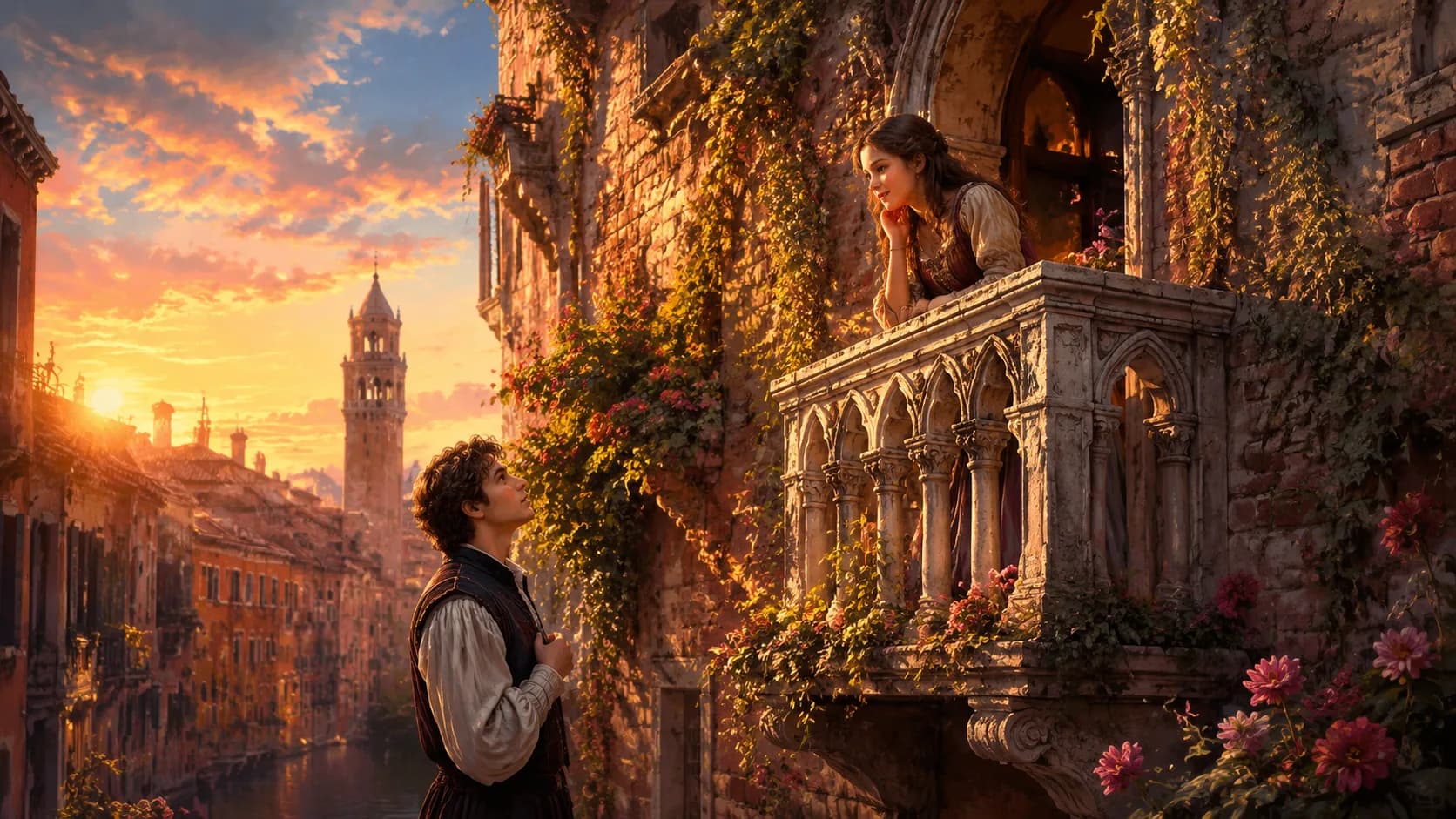
Juliet, meanwhile, is one of Shakespeare's greatest achievements as a character. Barely fourteen years old yet astonishingly articulate, she combines intellectual brilliance with emotional courage in ways that were revolutionary for female characters of the era. Her famous balcony soliloquy "What's in a name?" isn't merely romantic; it's a philosophical meditation on identity, convention, and the arbitrary nature of the social categories that divide us. Juliet sees through the superficial labels of "Montague" and "Capulet" to the essential person beneath, and her willingness to act on that insight makes her arguably the play's bravest character.
Shakespeare also transformed the supporting cast from cardboard figures into unforgettable personalities. Mercutio's Queen Mab speech is a standalone masterpiece of fantastical storytelling an aria about the fairy queen who visits sleepers and shapes their dreams, flowing from whimsy into darkness in a way that mirrors the play's own trajectory. The Nurse provides earthy comic relief while also representing the gap between the older generation's pragmatic view of marriage and the young lovers' idealistic passion. Even Tybalt, the Capulet cousin whose temper drives the play's central crisis, is given enough humanity that audiences understand him even as they wish he would choose peace.

"Shakespeare compressed nine months of source material into five days of drama. Modern screenwriters spend nine months trying to compress their scripts into two hours. The man was efficient, we'll give him that."
A Roman walks into a bar, holds up two fingers, and says, 'Five beers, please.'
The World of Verona: Renaissance Italy Reimagined
Shakespeare's Verona is less a geographical location than a state of mind a city of extremes where passionate love and passionate hostility coexist in the same narrow streets, where masked balls and public confrontations happen within hours of each other, and where the summer heat itself seems to amplify every emotion to its breaking point. Shakespeare had almost certainly never visited Italy, yet his imagined Verona captures something essential about the Renaissance Italian city state: a place where family honor, personal passion, public reputation, and religious authority all competed for dominance in a confined urban space.
Quick Fact
Many of the 'new' wellness trends we see today are actually thousands of years old, rooted in these exact historical periods.
The real Verona of the late Middle Ages and Renaissance was indeed a city of feuding families and political intrigue. The Montecchi (Montagues) and Cappelletti (Capulets) were genuine historical clans, though there's little evidence they feuded in the specific way Shakespeare describes. What's historically authentic is the broader pattern: Italian cities like Verona, Florence, and Siena were riven by factional conflicts between Guelph and Ghibelline supporters, and these rivalries could persist for generations, touching every aspect of civic life from marriage alliances to which side of the street you walked on.
Today, Verona has fully embraced its literary identity. Juliet's House (Casa di Giulietta) at Via Cappello 23 draws over a million visitors annually, complete with a famous balcony (added in 1936 and probably nothing to do with any historical Capulets) and a bronze statue of Juliet whose right breast has been polished to a shine by thousands of hands seeking luck in love. The Club di Giulietta a group of volunteers answers every letter addressed to Juliet that arrives in Verona, continuing a tradition that inspired the 2010 film Letters to Juliet. The city proves that the most powerful places in the world are sometimes the ones that exist primarily in the imagination.
Why did the Stoic cross the road? Because it was the rational thing to do, and he was indifferent to the traffic.
The Montagues and Capulets: Family and Loyalty
At the center of Romeo and Juliet lies a question that resonates across every culture and every era: what happens when loyalty to your family conflicts with the desires of your heart? The Montagues and Capulets are locked in a feud so old that neither family can remember what started it Shakespeare deliberately leaves the origin vague, suggesting that inherited animosity often outlives its original cause. The servants, the young men, the patriarchs, and even the women of both houses are expected to maintain the rivalry simply because it has always existed. The feud is less a conflict than a cultural inheritance, passed down like a family heirloom that no one remembers buying but everyone feels obligated to display.
Shakespeare uses the family dynamic to explore how collective identity can override individual conscience. Romeo's close friend Mercutio isn't even a Montague he's a kinsman of Prince Escalus yet he's drawn into the conflict by loyalty and bravado. Tybalt, the "Prince of Cats," is driven less by personal animosity toward Romeo than by an inherited sense of family honor that demands he respond to any perceived insult. Even Juliet's Nurse, who genuinely loves her charge, ultimately advises Juliet to abandon Romeo and marry Paris not because she's heartless but because pragmatic survival within the family structure matters more to her generation than romantic idealism.
Visionaria Insight
By immersing ourselves in these historical soundscapes, we reconnect with a timeless human tradition of storytelling and mental restoration.
The play's most powerful insight about family is its conclusion: it takes the loss of the next generation to finally reconcile the older one. Lord Montague and Lord Capulet, standing over their children's still forms, recognize what their feud has cost them and the audience recognizes something universal about how communities often fail to see the consequences of their conflicts until those consequences become undeniable. The families' reconciliation is bittersweet: peace comes, but at a price that illuminates how much better it would have been to choose understanding from the beginning.
"The Montagues and Capulets couldn't remember why they were feuding. They just kept going out of habit. If social media had existed in Renaissance Verona, they'd have been subtweeting each other for centuries."
Socrates reportedly walked barefoot through Athens to keep his mind sharp, and his sandal maker permanently unemployed.
Love at First Sight: The Power of Instant Connection
Romeo and Juliet's first meeting at the Capulet ball is one of the most famous scenes in all of literature and one of the most carefully crafted. Shakespeare structures their initial exchange as a shared sonnet: fourteen lines of dialogue divided between two speakers who complete each other's thoughts with perfect rhythmic and thematic harmony. Romeo speaks four lines, Juliet responds with four, they exchange two lines each, and then share a closing couplet. The form itself tells us everything about their connection: these are two minds that fit together like rhyming words, completing each other's sentences before they even know each other's names.
Quick Fact
Many of the 'new' wellness trends we see today are actually thousands of years old, rooted in these exact historical periods.
The concept of love at first sight has ancient roots the Greeks called it theia mania, divine madness sent by the gods. Shakespeare treats it with characteristic complexity, neither fully endorsing nor dismissing the idea. Romeo arrives at the ball already "in love" with Rosaline, speaking in artificial, borrowed poetry. The moment he sees Juliet, his language transforms: "Did my heart love till now? Forswear it, sight! / For I ne'er saw true beauty till this night." The shift from performative romance to genuine astonishment is one of the play's most psychologically acute moments Romeo doesn't just fall in love; he recognizes what real feeling is for the first time.
Modern psychology research has explored whether love at first sight is real or retrospective illusion and the evidence suggests it can be both. What psychologists call "instant attraction" involves rapid, subconscious assessment of physical cues, but genuine love requires the kind of mutual self-disclosure and vulnerability that Romeo and Juliet achieve in their balcony scene. Shakespeare seems to understand this intuitively: the ball provides the spark, but it's the balcony where both lovers reveal their true selves, stripped of masks and family names that ignites the lasting flame. The story reminds us that connection begins with seeing, but love begins with being seen.
A time traveler went back to antiquity to teach them about 'holistic health.' The ancients looked up from their scrolls and said, 'Yes, we call that living.'
Friar Lawrence and the Hidden Wisdom
Friar Lawrence is one of Shakespeare's most fascinating supporting characters a well meaning Franciscan friar whose knowledge of herbs, philosophy, and human nature makes him the play's wisest figure, yet whose plans ultimately go awry in ways he never anticipated. When Romeo and Juliet separately seek his help, the Friar agrees to marry them secretly, hoping that their union will reconcile the feuding families. His motivation is genuinely compassionate: he sees in their love an opportunity for healing that generations of political negotiation have failed to achieve.
Visionaria Insight
By immersing ourselves in these historical soundscapes, we reconnect with a timeless human tradition of storytelling and mental restoration.
The Friar's famous herb garden speech "Within the infant rind of this small flower / Poison hath residence and medicine power" provides the play's central metaphor. Everything in nature contains both healing and harm; what matters is how it's used. This principle applies not just to his botanical knowledge but to love itself, to family loyalty, to the city of Verona, and to the human heart. Romeo and Juliet's love is simultaneously the most beautiful thing in the play and the catalyst for its most dramatic events and Friar Lawrence understands this duality better than anyone, even as he proves unable to control it.
The Friar's plan involving a sleeping potion that mimics the appearance of passing is the play's most suspenseful element and its most poignant commentary on the gap between good intentions and unforeseeable outcomes. He represents the limits of wisdom in a world governed by passion, timing, and chance. His character reminds audiences that even the best laid plans can be undone by a delayed letter, a moment of panic, or the simple fact that human hearts don't follow the same logic as herbal recipes. In a guided imagination journey through the play, Friar Lawrence's garden becomes a powerful space for meditating on the duality of all living things.
"Friar Lawrence's plan involved fake potions, secret messages, and perfect timing. In modern terms, he was basically trying to coordinate a surprise party via carrier pigeon. What could possibly go wrong?"
Why did the Stoic cross the road? Because it was the rational thing to do, and he was indifferent to the traffic.
How Romeo and Juliet Shaped Western Romance
It's difficult to overstate how profoundly Romeo and Juliet has shaped Western culture's understanding of romantic love. Before Shakespeare's play, the dominant literary model for love was courtly romance a medieval tradition in which a knight devoted himself to an unattainable lady through acts of valor and poetic devotion. Love was aspirational, idealized, and fundamentally one sided. Romeo and Juliet replaced this model with something revolutionary: mutual, passionate, egalitarian love between two people who choose each other freely, speak to each other as equals, and value their emotional bond above social obligation.
Did You Know?
The relentless drive to understand the world was seen not just as an academic pursuit, but as a spiritual and healing practice by the ancients.
The play essentially invented the modern romance narrative as we know it. Nearly every great love story written since from Beauty and the Beast to Pride and Prejudice to today's romance novels and films follows a pattern Shakespeare established: two people who shouldn't be together overcome obstacles to prove that love is stronger than circumstance. The specific obstacles change class, geography, supernatural identity, parental disapproval but the fundamental structure remains Romeo and Juliet's. Shakespeare didn't just write a love story; he wrote the template for love stories.
The play also gave Western culture its vocabulary of romance. "Star-crossed lovers," "wherefore art thou," "parting is such sweet sorrow," "a rose by any other name" these phrases have transcended their original context to become universal expressions. The balcony scene became the archetypal image of romantic declaration. The concept of love powerful enough to overcome family opposition became a narrative expectation. Even the idea that true love involves risk and sacrifice that the depth of feeling is measured by what you're willing to give up owes much of its cultural power to Shakespeare's treatment of Romeo and Juliet's story.
An Epicurean, a Stoic, and a Cynic walk into a garden. The bartender says, 'Is this some kind of philosophical joke?'
Romeo and Juliet in Music, Art, and Film
No literary work in history has inspired more artistic adaptations than Romeo and Juliet. In music alone, the story has generated masterpieces across every genre: Prokofiev's sweeping 1935 ballet score (whose "Dance of the Knights" theme has become synonymous with dramatic tension), Tchaikovsky's passionate 1870 fantasy overture, Berlioz's dramatic symphony Roméo et Juliette, Gounod's beloved opera, and Bernstein's West Side Story which transplants the feuding families to 1950s New York as rival street communities. Even popular music returns endlessly to the theme: Taylor Swift's "Love Story," Dire Straits' "Romeo and Juliet," and The Killers' "Romeo and Juliet" all draw directly from Shakespeare's well.
In visual art, the story has captivated painters for centuries. Ford Madox Brown's Pre-Raphaelite depiction of the balcony scene, Delacroix's passionate interpretation, and Frank Dicksee's luminous 1884 painting of the final farewell have become iconic images of romantic love. These artworks demonstrate the story's unique visual power it offers painters scenes of extraordinary emotional intensity: the masked ball, the moonlit balcony, the secret marriage, the final reunion in the tomb. Each scene is a self-contained dramatic composition that artists have reimagined in every style from Baroque to contemporary.
Did You Know?
The relentless drive to understand the world was seen not just as an academic pursuit, but as a spiritual and healing practice by the ancients.
Romeo and Juliet is often described as one of the most filmed plays of all time, with screen versions dating back to 1908. Franco Zeffirelli's lush 1968 version set a standard for faithful Shakespeare adaptation, while Baz Luhrmann's frenetic 1996 Romeo + Juliet reimagined the story in a stylized modern setting with Leonardo DiCaprio and Claire Danes. West Side Story (1961 and 2021) remains perhaps the most successful cultural transplant. Animated versions, Bollywood adaptations, gnome-themed retellings (Gnomeo & Juliet), and even a fantasy world reimagining have demonstrated that the story's emotional core transcends any specific setting, language, or era.
"Romeo and Juliet has been adapted as a ballet, an opera, a musical about New York street communities, a Leonardo DiCaprio film, and a movie about garden gnomes. Shakespeare would either be incredibly proud or incredibly confused. Probably both."
An Epicurean, a Stoic, and a Cynic walk into a garden. The bartender says, 'Is this some kind of philosophical joke?'
The Psychology of Forbidden Love Stories
Why do forbidden love stories captivate us so deeply? The psychology behind narrative engagement offers fascinating answers. Psychologists have identified what they call the "Romeo and Juliet Effect" a well-documented phenomenon in which parental or social opposition to a romantic relationship actually increases the intensity of the lovers' feelings. When external forces try to separate two people, the resulting psychological reactance our instinctive resistance to having our freedom restricted amplifies attraction and emotional bonding. Shakespeare didn't have the terminology, but he understood the mechanism perfectly.
Visionaria Insight
By immersing ourselves in these historical soundscapes, we reconnect with a timeless human tradition of storytelling and mental restoration.
On a deeper level, forbidden love stories activate our mirror neurons more powerfully than stories of easy romance. When we encounter characters facing impossible choices love versus family, heart versus duty, individual truth versus collective expectation our brains simulate those dilemmas as if we were experiencing them ourselves. This neural mirroring produces intense emotional engagement, which is why audiences have been moved to tears by Romeo and Juliet for over four centuries. The story doesn't just tell us about love; it makes us feel it, viscerally and personally, through the mechanism of narrative empathy.
The story also taps into what psychologist Carl Jung called the archetypal pattern of the "coniunctio" the sacred union of opposites. Romeo and Juliet represent not just two individual lovers but two opposing principles (masculine and feminine, Montague and Capulet, aggression and tenderness) seeking integration. At a symbolic level, their love represents the human yearning for wholeness the desire to transcend the divisions within ourselves and our communities. This archetypal dimension is why the story resonates across cultures: it speaks to something universal about the human condition, not just about Italian Renaissance teenagers.
A Roman walks into a bar, holds up two fingers, and says, 'Five beers, please.'
Experiencing Romeo and Juliet Through Meditation
Story-based meditation apps offer a uniquely powerful way to experience Romeo and Juliet not as a text to be analyzed but as a world to be inhabited. Through spatial 3D audio, you can stand in the Capulet ballroom as music swirls around you, step onto the moonlit balcony with the sounds of Verona's nighttime below, or walk through Friar Lawrence's herb garden as birdsong and the scent descriptions transport you to Renaissance Italy. This immersive approach transforms literary appreciation into embodied experience.
Visionaria's cinematic meditation approach is particularly suited to Romeo and Juliet because the play is already structured as a series of vivid, sensory-rich scenes each one a natural meditation setting. The masked ball becomes a meditation on presence and disguise. The balcony scene becomes a practice in vulnerability and authentic communication. Friar Lawrence's garden becomes a contemplation of duality and transformation. The final scene in the Capulet monument becomes a profound meditation on reconciliation and the price of prolonged conflict.
Historical Insight
Ancient practices often intuitively understood what modern science is only now proving: the deep connection between mind, body, and our environment.
Research on meditation for expanding inner worlds shows that narrative meditation activates both the brain's empathy circuits and its relaxation response simultaneously making it possible to experience deep emotional engagement without stress. For lovers of Shakespeare, this means experiencing the play's most moving moments with the heightened sensitivity of a meditative state: every word more vivid, every emotion more accessible, every image more luminous. It's the closest you can come to experiencing the story as its original audiences did live, present, and fully surrendered to the power of the tale.
"Meditation on the balcony scene involves closing your eyes and imagining you're in Verona under the moonlight. It's essentially what Romeo was doing when he should have been going home. At least when we do it, we call it mindfulness practice."
A Roman walks into a bar, holds up two fingers, and says, 'Five beers, please.'
Why Romeo and Juliet Still Matters Today
In 2026, the themes of Romeo and Juliet feel more relevant than ever. We live in an era of deepening divisions political, cultural, generational, ideological where inherited animosities are amplified by social media algorithms and echo chambers that didn't exist in Shakespeare's time. The Montagues and Capulets of today don't carry swords in Verona's streets; they carry smartphones and post in competing online communities. But the underlying dynamic is identical: groups defined by opposition to each other, with individuals caught between loyalty to their tribe and the recognition that the "enemy" is fundamentally human.
Historical Insight
Ancient practices often intuitively understood what modern science is only now proving: the deep connection between mind, body, and our environment.
Romeo and Juliet reminds us that love in its broadest sense, as empathy, connection, and the willingness to see another person fully has always been the antidote to tribalism. The lovers don't overcome the feud through argument, negotiation, or force. They overcome it simply by recognizing each other's humanity across a divide that everyone around them insists is uncrossable. This is precisely the insight that narrative psychology shows stories can provide: by experiencing someone else's perspective through story, we develop the empathy that makes real world bridges possible.
The story also matters because it celebrates the courage of authenticity. Romeo and Juliet choose to be true to their feelings in a world that demands they conform to inherited roles. They refuse to let family names define who they can love. In an age when social pressure, algorithmic curation, and cultural polarization constantly push us toward predetermined identities, the radical act of choosing your own heart of defining yourself by what you love rather than what you oppose is as revolutionary now as it was in Shakespeare's Verona. That's why we keep telling this story: not because it's old, but because it's eternally, urgently new.
"Four hundred years later, Romeo and Juliet's message remains: love is stronger than labels. Their families finally got the memo. We're still working on it. But hey at least we have the app now."

How to Train Your Imagination With Meditation
Learn how to train your imagination with meditation, from visualization techniques and guided imagery to sensory expansion, spatial audio, narrative meditation, creative thinking, emotional resilience, daily routines,...
A philosopher walked into a wall. His students asked if it hurt. He replied, 'The wall is an illusion, but my headache is quite real.'
The Bottom Line
Romeo and Juliet is more than a play it is the foundational love story of Western civilization, a tale that evolved from ancient myth through Italian Renaissance novellas into Shakespeare's immortal masterpiece. Its power lies not in its plot twists but in its radical assertion that genuine human connection can transcend every barrier society constructs. Four centuries after it was written, the play continues to teach us about love, loyalty, the cost of inherited animosity, and the courage required to choose your heart over your tribe.
Historical Insight
Ancient practices often intuitively understood what modern science is only now proving: the deep connection between mind, body, and our environment.
This article explored the story's journey from Ovid's Pyramus and Thisbe to Shakespeare's Verona, its revolutionary character development, its extraordinary cultural legacy in music, art, and film, and the psychology that explains its enduring emotional power. For those who want to experience the world of Romeo and Juliet beyond the page, Visionaria offers immersive audio journeys through spatial 3D audio that place you inside the streets, ballrooms, and gardens of Renaissance Verona.
Continue exploring timeless stories: read about The Story Behind Beauty and the Beast, discover The Most Legendary Quests in Mythology, or explore The Legend of King Arthur.
"Shakespeare wrote the greatest love story ever told, and he didn't even have autocorrect. Meanwhile, the rest of us struggle to compose a decent text message. Some things never change and some things, like this story, were never meant to."
Experience More with Visionaria
Download the app to explore guided historical and wellness journeys.
What's an ancient intellectual's favorite exercise? Jumping to conclusions.
This article is for educational and informational purposes only. Historical details are based on available research and may evolve as new evidence emerges.
Visionaria journeys are designed for relaxation, guided imagination, and personal enrichment. They are not a substitute for medical, mental health, legal, or professional advice.