
The True Origins of Jack and the Beanstalk: Ancient Roots, Hidden Symbolism & the Fairy Tale That Changed Storytelling
💡 Fun fact: Jack and the Beanstalk is roughly 5,000 years old, meaning it was already an ancient story when the Pyramids of Giza were still under construction. The giant had been saying "Fee-fi-fo-fum" for millennia before anyone thought to write it down.
- What Is the Story of Jack and the Beanstalk? A Complete Definition
- Ancient Roots: The Tale's Origins in World Mythology
- The Symbolism of the Beanstalk: Growth, Ambition, and Transformation
- Giants in Folklore: What the Giant Really Represents
- Jack as the Archetypal Trickster Hero
- How the Story Changed Through Centuries of Retelling
- The Magic Beans: Economy, Trust, and Leaps of Faith
- Comparative Mythology: Jack's Cousins Around the World
- Victorian Morality and the Reshaping of Jack's Adventure
- The Psychology of Climbing: Why We Love Vertical Journeys
- Jack and the Beanstalk in Modern Storytelling and Meditation
- Experiencing the Legend: Immersive Audio Journeys Through Fairy Tales
- The Bottom Line
- Frequently Asked Questions
Jack and the Beanstalk (also classified as ATU 328: "The Boy Who Stole the Ogre's Treasure") is one of the oldest continuously told stories in human civilization, with roots traced by folklorists to Proto-Indo-European oral traditions approximately 5,000 years ago. The tale follows a young protagonist who exchanges the family's last possession for magic beans, climbs a miraculous beanstalk into a realm above the clouds, encounters a fearsome giant, uses cleverness rather than strength to acquire transformative treasures, and returns home changed. Far from a simple children's story, Jack and the Beanstalk encodes ancient wisdom about courage, resourcefulness, the journey from innocence to experience, and the universal human aspiration to transcend ordinary limitations themes that connect it to heroic journeys found in every culture on Earth.
In this comprehensive guide, you'll discover the tale's true origins in ancient Indo-European mythology, decode the rich symbolism of the beanstalk and the giant, explore Jack's role as a trickster hero, trace how the story transformed through centuries of retelling, compare Jack's adventure with remarkably similar tales from cultures around the world, examine the psychological power of vertical journeys, and learn how modern storytelling meditation and spatial audio technology are bringing these ancient fairy tales to vivid, immersive life.
"Jack traded a cow for magic beans and got a castle in the sky. Most of us trade forty hours a week for a studio apartment. Who's the real fairy tale here?"
Key Facts About Jack and the Beanstalk
- ••Age: Approximately 5,000 years old, traced to Proto-Indo-European oral traditions through phylogenetic analysis by folklorists at Durham University and the New University of Lisbon
- ••Classification: Aarne-Thompson-Uther tale type ATU 328 ("The Boy Who Stole the Ogre's Treasure"), with related variants in ATU 328A and ATU 328B
- ••First Published Version: "The History of Jack and the Bean-Stalk" appeared in Benjamin Tabart's 1807 collection, though the tale circulated orally for millennia before
- ••Global Variants: Similar tales exist in Norwegian ("The Ash Lad"), Japanese ("Issun-bōshi"), Indian ("The Brave Little Tailor"), Georgian, Zulu, and dozens more cultures
- ••Core Symbolism: The beanstalk represents the axis mundi (world tree): a universal mythological symbol connecting the earthly realm to the divine or extraordinary
- ••Psychological Archetype: Jack embodies the "trickster hero": a figure who succeeds through cleverness, courage, and quick thinking rather than physical strength
Quick Answer
💡 Fun fact: Jack and the Beanstalk is roughly 5,000 years old, meaning it was already an ancient story when the Pyramids of Giza were still under construction. The giant had been saying "Fee-fi-fo-fum" for millennia before anyone thought to write it down.
What Is the Story of Jack and the Beanstalk? A Complete Definition
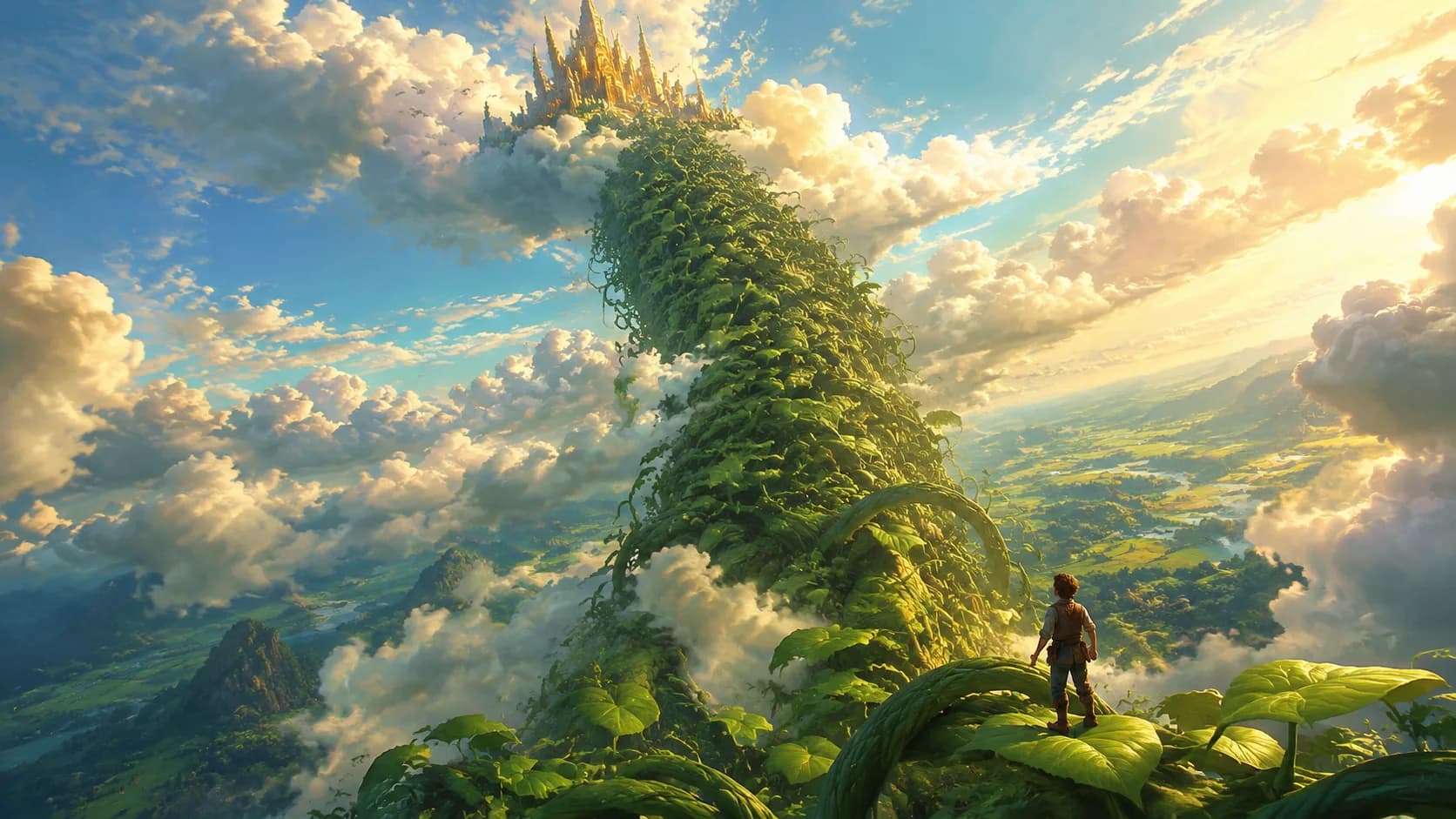
In its most familiar form, Jack and the Beanstalk tells the story of a poor boy named Jack who lives with his mother and their only remaining possession a cow. When the cow stops giving milk, Jack's mother sends him to market to sell it. Along the way, Jack meets a mysterious stranger who offers him magic beans in exchange for the cow. Jack accepts the trade, and when his furious mother throws the beans out the window, they grow overnight into a towering beanstalk reaching into the clouds. Jack climbs the beanstalk and discovers a magnificent realm above, home to a fearsome giant and his wife. Through cleverness and courage, Jack acquires three treasures a bag of gold, a hen that lays golden eggs, and a singing golden harp before descending and chopping down the beanstalk, ensuring the giant cannot follow.
Visionaria Insight
By immersing ourselves in these historical soundscapes, we reconnect with a timeless human tradition of storytelling and mental restoration.
Yet this familiar version polished and simplified for Victorian nurseries represents merely the most recent chapter in a story that has been told for thousands of years. Beneath its fairy tale surface, the narrative contains profound mythological architecture: the axis mundi (world tree connecting earthly and celestial realms), the trickster hero (who succeeds through wit rather than force), the threshold crossing (ascending from the known world into the unknown), and the transformative return (coming home changed, carrying gifts that reshape ordinary reality). These elements connect Jack's adventure to the deepest structures of the hero's journey as described by mythologist Joseph Campbell a pattern that appears in virtually every storytelling tradition on Earth.
Understanding Jack and the Beanstalk's true origins transforms it from a bedtime story into a window into the collective imagination of humanity. When you know that this same narrative has been told by firesides in India, Scandinavia, Japan, West Africa, and the British Isles each culture dressing the same archetypal skeleton in different cultural clothing the tale reveals something extraordinary about what it means to be human: our shared longing to reach beyond our current circumstances, our admiration for cleverness over brute strength, and our deep intuition that taking a courageous leap into the unknown is the path to genuine transformation.
"Jack and the Beanstalk is basically the world's oldest startup story. Boy invests everything in something nobody else believes in, climbs impossibly high, and comes back rich. Silicon Valley just added PowerPoints."
Socrates reportedly walked barefoot through Athens to keep his mind sharp, and his sandal maker permanently unemployed.
Ancient Roots: The Tale's Origins in World Mythology
In 2016, a landmark study by anthropologist Jamie Tehrani of Durham University and folklorist Sara Graça da Silva of the New University of Lisbon applied phylogenetic analysis, a technique borrowed from evolutionary biology, to trace the ancestry of fairy tales across Indo-European language families. Their research, published in the Royal Society Open Science journal, produced a startling result: Jack and the Beanstalk, classified as ATU 328, could be traced back approximately 5,000 years to the period when Proto-Indo-European peoples were still a single cultural group. This means the tale predates the divergence of Greek, Celtic, Germanic, and Sanskrit languages making it older than Homer's epics, older than the Sanskrit Vedas, and roughly contemporary with the earliest construction at ancient architectural sites that we now consider the dawn of civilization.
Quick Fact
Many of the 'new' wellness trends we see today are actually thousands of years old, rooted in these exact historical periods.
The study revealed that the core motif a young person ascending to another realm and stealing treasures from a powerful supernatural being exists across virtually every branch of the Indo-European family tree, suggesting it was already a well-established narrative when these cultures began diverging. The tale's remarkable persistence demonstrates something extraordinary about human storytelling: certain narratives are so perfectly shaped to express universal human experiences that they survive not merely for generations but for millennia, crossing every boundary of language, culture, geography, and religion. When a parent tells their child the story of Jack tonight, they are participating in an unbroken chain of storytelling that stretches back to the Bronze Age a chain as old as the earliest ritual practices of our species.
Beyond the Indo-European tradition, remarkably similar tales appear in cultures with no direct historical connection: in Sub Saharan African folklore, in Native American oral traditions, in Australian Aboriginal Dreamtime narratives, and in Polynesian mythology. This independent emergence suggests that the Jack and the Beanstalk story pattern resonates with something truly fundamental in human psychology not merely a cultural inheritance but a reflection of universal cognitive and emotional structures. The tale survives because it perfectly encodes experiences every human faces: the transition from childhood dependence to adult agency, the necessity of taking risks, the discovery that cleverness can overcome seemingly impossible obstacles, and the transformative power of venturing beyond familiar boundaries.

Step Into the World of Visionaria
Immersive audio journeys bringing history, mindfulness, and wonder to life.
Why did the historian break up with the archaeologist? Because her career was literally in ruins.
The Symbolism of the Beanstalk: Growth, Ambition, and Transformation
The beanstalk itself is the tale's most powerful symbol, and understanding its mythological significance transforms the story from simple fantasy into profound metaphor. In comparative mythology, the beanstalk is a variation of the axis mundi the "world axis" or "world tree" that appears in virtually every mythological system on Earth. The Norse had Yggdrasil, the great ash tree connecting the nine realms. Hindu cosmology describes Mount Meru, the cosmic mountain at the centre of the universe. The Mayan ceiba tree connected the underworld, the human world, and the heavens. In every case, these vertical structures represent the connection between ordinary existence and the extraordinary the path between the world as we know it and the world as it could be.
Jack's beanstalk carries all of these resonances. It grows from discarded seeds things considered worthless by conventional wisdom (Jack's mother throws them away in frustration) and overnight becomes the most extraordinary thing in the world. This is the tale's first great teaching: transformation begins with what others dismiss. The magic beans look like nothing. The people around you think they're worthless. But planted in fertile ground and given time, they produce growth that reaches beyond imagining. This symbolism connects directly to the experience of inner world expansion the discovery that the seeds of extraordinary experience are already within us, waiting to be cultivated through practices like imagination training and meditative exploration.
Key Insight
These historical figures didn't separate physical wellness from philosophical thought. To them, it was all one continuous practice of living well.
The beanstalk's vertical orientation is equally significant. Across human cultures, upward movement represents aspiration, growth, transcendence, and the expansion of consciousness. When Jack climbs, he is enacting the universal human desire to rise above current circumstances to see further, understand more, and access possibilities invisible from ground level. The climb is challenging (the beanstalk is enormous, the height is dizzying, the destination unknown), but the rewards are proportional to the courage required. This vertical symbolism resonates with the experience of storytelling meditation, where some people describe a sense of rising, expanding, or lifting into broader awareness during immersive narrative experiences.
"The beanstalk is essentially the world's first elevator zero carbon footprint, unlimited floors, and the penthouse comes with a golden harp. Modern architects could learn something."
Why did the Stoic cross the road? Because it was the rational thing to do, and he was indifferent to the traffic.
Giants in Folklore: What the Giant Really Represents
The giant at the top of the beanstalk is far more than a large person with a fondness for grinding bones. In the vast landscape of world mythology, giants represent the overwhelming forces that stand between us and what we desire forces that seem impossible to overcome through ordinary means. The Norse Jötnar, the Greek Titans, the Celtic Fomorians, the Hindu Asuras every tradition peoples its mythological landscape with beings of enormous power who guard treasures, block passages, and test the worthiness of those who would claim something extraordinary. The giant is, in psychological terms, the embodiment of every obstacle that seems too big to face: fear, poverty, powerlessness, the terrifying magnitude of the unknown.
Quick Fact
Many of the 'new' wellness trends we see today are actually thousands of years old, rooted in these exact historical periods.
What makes Jack's giant particularly interesting is the specific treasures he guards. The bag of gold represents material security the end of poverty and want. The hen that lays golden eggs represents self-sustaining abundance not just wealth but the capacity to generate wealth continuously. And the golden harp represents beauty, art, and cultural richness the things that make life meaningful beyond mere survival. Together, these three treasures describe a complete picture of human flourishing: security, prosperity, and soulful enrichment. The giant hoards all three, keeping them locked away in his castle above the clouds. This is the tale's second great teaching: the things that could transform your life are guarded by the very fears that seem too large to confront.
The famous chant "Fee-fi-fo-fum, I smell the blood of an Englishman" has been traced to at least the 16th century, appearing in Thomas Nashe's Have with You to Saffron-Walden (1596) and later in Shakespeare's King Lear. But the motif of a supernatural guardian who detects intruders by smell appears in folklore traditions worldwide, from the Cyclops Polyphemus in Homer's Odyssey to ogres in Indian fairy tales. This suggests that the "fee-fi-fo-fum" element preserves an ancient narrative device the moment when the hero is nearly discovered by the very force they're trying to outwit that has been thrilling audiences for thousands of years. The tension of that moment will the giant find Jack? remains as effective today as it was around ancient Mediterranean firesides.
What's an ancient intellectual's favorite exercise? Jumping to conclusions.
Jack as the Archetypal Trickster Hero
Jack belongs to one of mythology's most beloved character types: the trickster hero a figure who succeeds not through strength, nobility, or divine favour but through wit, audacity, and the willingness to break conventional rules. The trickster appears in virtually every world mythology: the Norse Loki, the West African Anansi, the Native American Coyote, the Greek Hermes, the Polynesian Maui. What connects all these figures and connects them to Jack is the principle that cleverness can overcome power, that the small and seemingly insignificant can triumph over the large and apparently invincible.
Visionaria Insight
By immersing ourselves in these historical soundscapes, we reconnect with a timeless human tradition of storytelling and mental restoration.
Jack's trickster nature reveals itself at every turn of the story. He trades the cow for beans an apparently foolish exchange that turns out to be inspired. He enters the giant's castle uninvited violating every rule of propriety but following the deeper logic of opportunity. He hides from the giant with the wife's help using social connection rather than force. And he steals the treasures one at a time across three visits, demonstrating patience, strategic thinking, and the crucial understanding that transformation happens incrementally rather than all at once. In every instance, Jack succeeds because he is adaptable, quick thinking, and unafraid of unconventional approaches qualities that mythological traditions worldwide associate with the creative, boundary crossing energy that makes genuine transformation possible.
This trickster archetype resonates deeply with modern psychology's understanding of creative problem solving and resilience. Research shows that the ability to think flexibly, challenge assumptions, and find unconventional solutions to seemingly impossible problems exactly the qualities Jack demonstrates are among the strongest predictors of psychological wellbeing and life satisfaction. The trickster hero doesn't fight the system head on; they find the gaps, the overlooked angles, the creative possibilities that more conventional approaches miss. This is why the trickster is so often the protagonist in fairy tales told to children: the stories aren't just entertainment but training in the cognitive flexibility that will serve them throughout life. When modern story world meditation invites you to inhabit a character facing challenges, it activates these same creative problem solving networks in the brain.
"Jack's entire strategy is: sneak in, take the good stuff, run away really fast. It's basically the world's first heist movie, except the getaway vehicle is a plant."
What's an ancient intellectual's favorite exercise? Jumping to conclusions.
How the Story Changed Through Centuries of Retelling
The Jack and the Beanstalk we know today is the product of centuries of narrative evolution, with each era reshaping the tale to reflect its own values, anxieties, and aspirations. The earliest recorded English version Benjamin Tabart's "The History of Jack and the Bean Stalk" (1807) is notably different from later versions. In Tabart's telling, a fairy appears to explain that the giant had originally stolen the treasures from Jack's own father, making Jack's theft an act of righteous reclamation rather than opportunistic adventure. This framing reflected early 19th century concerns about property rights and moral justification: the audience needed to believe Jack was restoring justice, not simply taking what wasn't his.
Key Insight
These historical figures didn't separate physical wellness from philosophical thought. To them, it was all one continuous practice of living well.
The version that became canonical Joseph Jacobs' 1890 retelling in English Fairy Tales stripped away Tabart's justifying fairy and presented the story in a leaner, more ambiguous form closer to its oral roots. Jacobs, a folklorist influenced by the Brothers Grimm, understood that the tale's power came from its mythological directness, not from moral explanation. In his version, Jack climbs because the beanstalk is there. He takes the treasures because they're extraordinary. He chops down the beanstalk because otherwise the giant will follow him. The moral complexity is Jack a hero or an opportunist? is left for the listener to resolve, just as it had been around firesides where mythological tales were shared for millennia.
Between and beyond these published versions, the tale continued to evolve in oral tradition, pantomime, illustration, and eventually film and television. Victorian pantomimes made Jack a swashbuckling hero and the giant a comic villain. Twentieth century illustrated editions softened the story further, emphasizing wonder over danger. Major animation studios and countless other filmmakers have reimagined the tale for contemporary audiences. Each adaptation reveals what its era values: courage, cleverness, moral clarity, ambiguity, spectacle, or psychological depth. But the core architecture remains unchanged across every version because the story isn't really about Jack, or beans, or giants. It's about the universal human experience of facing the seemingly impossible, taking the leap anyway, and discovering that you're capable of far more than you believed.
Why did the ancient physician prescribe a long walk? Because he was tired of listening to the patient complain in his office.
The Magic Beans: Economy, Trust, and Leaps of Faith
The magic beans are the tale's most deceptively simple symbol and perhaps its most profound. On the surface, the exchange seems foolish: Jack trades the family's last valuable asset (a cow that, though no longer productive, still has market value) for a handful of beans from a stranger. Every sensible person in the story particularly Jack's mother sees this as disastrous naivety. The beans look worthless. The stranger's claim sounds absurd. The exchange violates every principle of rational economic behaviour. And yet, as the story reveals, it is the most transformative transaction in Jack's life.
This moment encodes a deep and ancient insight about the nature of meaningful change. Genuine transformation the kind that lifts you into an entirely different life almost always requires letting go of something familiar and functional in exchange for something that looks like nothing but contains infinite potential. The beans represent every unconventional choice, every creative risk, every moment of trusting intuition over conventional wisdom. In modern language, we might call this the "leap of faith" principle": the understanding that the most valuable opportunities often arrive disguised as terrible ideas, and the courage to act on them separates those who transform their lives from those who remain where they are. This principle echoes through ancient wisdom traditions worldwide.
Visionaria Insight
By immersing ourselves in these historical soundscapes, we reconnect with a timeless human tradition of storytelling and mental restoration.
There's also a subtler economic allegory embedded in the beans. The cow represents the old economy reliable but exhausted, no longer producing what the family needs. The beans represent new possibility unproven, seemingly irrational, but containing the seeds of exponential growth. Jack's mother, representing the voice of pragmatic caution, wants to maximize value within the existing system (sell the cow for the best price). Jack, responding to something less rational but perhaps more wise, abandons the fading system entirely and bets everything on something new. The tale suggests that both responses are understandable but only one leads to the beanstalk. For modern readers, this resonates with the experience of cultivating curiosity: the willingness to explore unfamiliar possibilities rather than clinging to the safely known.
Read more: Story Meditation Apps Compared: Complete Guide (2026)
"Jack's mother threw the beans out the window in frustration. And that's how the greatest opportunity in fairy tale history got planted. Parenting tip: don't throw away your children's weird projects."
A Roman walks into a bar, holds up two fingers, and says, 'Five beers, please.'
Comparative Mythology: Jack's Cousins Around the World
One of the most remarkable aspects of Jack and the Beanstalk is how many closely parallel stories exist in cultures with no direct historical contact. In Norway, the collection of Asbjørnsen and Moe includes tales of the "Ash Lad" (Askeladden) a youngest son considered foolish by his family who climbs to extraordinary realms and outwits trolls and giants through cleverness rather than strength. In Japan, the tale of Issun bōshi ("One Inch Boy") follows a tiny hero who grows magically, confronts an oni (demon/giant), and wins treasures through wit and courage. In the Georgian tradition, heroes climb enormous trees or mountains to reach the sky realm of the devi (giants), steal magical objects, and return transformed.
Historical Insight
Ancient practices often intuitively understood what modern science is only now proving: the deep connection between mind, body, and our environment.
These parallels extend far beyond Europe and Asia. Zulu folklore contains tales of young heroes who climb to the sky realm and outwit powerful beings. Native American traditions across multiple nations include stories of ascent to upper worlds, encounters with powerful guardians, and transformative returns. The Aboriginal Australian Dreamtime includes narratives of climbing to the sky country and bringing back knowledge or objects of power. In each case, the core pattern is identical: an unlikely hero, a vertical journey, a powerful guardian, treasures won through cleverness, and a return that transforms ordinary life. This global distribution suggests that the Jack and the Beanstalk pattern is not merely a cultural inheritance but a reflection of universal human psychological needs the same needs that make legendary quests compelling across every civilization.
Comparative mythologist Joseph Campbell would recognize the Jack pattern as a clear expression of his monomyth or "hero's journey": the departure from the ordinary world, the crossing of the threshold into the extraordinary, the encounter with supernatural forces, the seizure of the boon (treasure), and the transformative return. Campbell argued that this pattern appears universally because it mirrors the psychological process of genuine personal growth the same process that modern storytelling meditation harnesses by immersing listeners in narrative journeys that naturally guide them through these archetypal stages.
What's an ancient intellectual's favorite exercise? Jumping to conclusions.
Victorian Morality and the Reshaping of Jack's Adventure
The Victorian era (1837-1901) profoundly reshaped Jack and the Beanstalk, and understanding these changes reveals how every generation reads its own concerns into ancient stories. The Victorians were deeply uncomfortable with a hero who simply steals from a giant their culture prized moral clarity, proper behaviour, and justified action. Benjamin Tabart's 1807 version had already begun the moralisation process by adding the fairy who explains the giant had originally robbed Jack's father, but Victorian retellings went further. Some versions made the giant explicitly wicked a tyrant who had oppressed the countryside. Others emphasised Jack's poverty more heavily, framing his actions as survival rather than opportunism. The goal was always the same: to ensure that Jack was morally unimpeachable, a proper hero for proper children.
Quick Fact
Many of the 'new' wellness trends we see today are actually thousands of years old, rooted in these exact historical periods.
The Victorian transformation also affected the tale's gender dynamics. In older oral versions, the giant's wife plays a more complex role sometimes actively helping Jack as an ally, sometimes described as a figure with her own grievances against the giant. Victorian versions typically reduced her to a passive, sympathetic domestic figure kind but powerless, reflecting the era's restrictive views of women's roles. Similarly, Jack's mother evolved from a pragmatic, sometimes angry character (who in some oral versions curses Jack with considerable vividness) into a gentle, worried, grateful mother whose primary role is to validate Jack's heroism. These changes, while they may seem minor, demonstrate how fairy tales serve as mirrors of social values each era seeing its own reflection in the narrative's flexible surface.
Perhaps the most significant Victorian addition was the emphasis on the story as moral instruction. Pre Victorian oral tellings treated the tale as entertainment, wonder, and implicit life wisdom the same way ancient mythological traditions transmitted knowledge through narrative rather than explicit teaching. The Victorians, with their passion for moral education, added explicit lessons: courage is rewarded, laziness is punished, providence favours the bold. While these additions served their era's pedagogical goals, they also flattened the tale's original mythological ambiguity the very quality that had allowed it to survive and resonate for five thousand years. Modern retellings, including immersive audio adaptations, increasingly return to this older, richer, more ambiguous version of the tale understanding that great stories teach not by lecturing but by inviting the listener to inhabit the experience and draw their own meaning from it.
An Epicurean, a Stoic, and a Cynic walk into a garden. The bartender says, 'Is this some kind of philosophical joke?'
The Psychology of Climbing: Why We Love Vertical Journeys
Jack's climb up the beanstalk taps into one of the most powerful psychological motifs in human storytelling: the vertical journey. Across cultures and throughout history, ascending whether up a mountain, a tree, a tower, or a beanstalk symbolises growth, aspiration, the expansion of perspective, and the pursuit of transcendence. Psychologist Abraham Maslow's hierarchy of needs is itself a vertical metaphor, with self-actualisation at the peak. Dante's moves from the depths of the Inferno upward through Purgatorio to the heights of Paradiso. Mountain pilgrimages from Mount Olympus to Mount Sinai to Mount Kailash use physical ascent as a metaphor for spiritual elevation.
Visionaria Insight
By immersing ourselves in these historical soundscapes, we reconnect with a timeless human tradition of storytelling and mental restoration.
Neuroscience offers intriguing insights into why vertical journeys resonate so deeply. Research on embodied cognition the theory that abstract thinking is grounded in physical experience shows that humans naturally associate "up" with positive states. We say we're feeling "up," that our spirits are "high," that we're "on top of the world." Brain imaging studies demonstrate that merely imagining upward movement activates neural circuits associated with positive emotion, motivation, and approach behaviour. When Jack climbs the beanstalk, listeners don't just follow a character they neurologically simulate the ascent themselves, producing genuine sensations of elevation, hope, and expanding possibility. This is the same mechanism that makes story world meditation so effective: the brain processes vivid narrative description as though the experience were real.
The beanstalk climb also represents what psychologists call the "flow channel" the optimal zone between challenge and skill where human performance and satisfaction peak. The climb is difficult but not impossible. It requires courage but is achievable. There is danger (the height, the unknown destination, the eventual giant) but also excitement and wonder (the clouds parting, the new world revealing itself). This balance between challenge and capability is precisely what makes the sequence so narratively satisfying and psychologically engaging and it's the same balance that skilled cinematic meditation designers aim for when creating immersive audio journeys that guide listeners through progressively deeper states of relaxation and imaginative engagement.

"Jack climbed a beanstalk into the clouds and faced a giant. You climbed out of bed this morning and faced a Monday. Honestly? Both qualify as heroic."
Why did the historian break up with the archaeologist? Because her career was literally in ruins.
Jack and the Beanstalk in Modern Storytelling and Meditation
The 21st century has seen a remarkable renaissance in the way we engage with fairy tales, and Jack and the Beanstalk stands at the centre of this transformation. Modern retellings have moved far beyond the simplified Victorian version, embracing the tale's mythological depth, psychological complexity, and universal relevance. Stephen Sondheim's musical Into the Woods famously explored what happens after "happily ever after," treating fairy tale characters including Jack as complex figures navigating the consequences of their choices. Neil Gaiman, Marina Warner, and Angela Carter have all explored fairy tales as living mythology stories that speak differently to each generation because they encode truths too complex for simple moral statements.
Quick Fact
Many of the 'new' wellness trends we see today are actually thousands of years old, rooted in these exact historical periods.
Perhaps the most innovative modern development is the application of fairy tale narratives to wellness and meditation. The emerging field of narrative meditation recognises that fairy tales like Jack and the Beanstalk are not just stories but psychological maps structured journeys through archetypal experiences that produce real cognitive and emotional effects. When experienced through spatial audio technology with the sounds of the beanstalk creaking around you, wind rushing past as you climb, the giant's footsteps reverberating through your headphones the ancient tale becomes an immersive meditation experience that engages the same neural networks as traditional mindfulness practice while being dramatically more accessible and enjoyable.
Applications like Visionaria are pioneering this approach, creating audio experiences that transform mythology and fairy tales into guided journeys through the imagination. The ancient campfire storytelling tradition where tales like Jack and the Beanstalk transported listeners to other worlds is being reborn in a form that's simultaneously more immersive (thanks to spatial audio) and more intentionally therapeutic (thanks to meditation science). The result is something genuinely new: the 5,000 year old story of a boy, some beans, and a beanstalk to the sky, experienced from the inside out, producing the same wonder that has captivated listeners since the Bronze Age, now in a form designed to help you relax and unwind.
Why did the inventor of the wheel win an award? Because his idea really got things rolling.
Experiencing the Legend: Immersive Audio Journeys Through Fairy Tales
The transformation of fairy tales into immersive audio experiences represents a full circle return to how these stories were originally experienced not read silently from a page but heard, felt, and lived through the power of the voice and the listener's imagination. When you experience Jack and the Beanstalk through spatial audio, you don't merely hear about the beanstalk you hear it growing around you, leaves unfurling in three-dimensional space, the creak of the massive stalk as wind passes through it. You don't just learn that Jack climbed into the clouds you feel the ascent, with sounds shifting beneath you, wind increasing, the world below growing distant and quiet. The giant's footsteps don't approach from the page they approach from behind you, each one a seismic rumble that your brain processes as a real spatial event.
Quick Fact
Many of the 'new' wellness trends we see today are actually thousands of years old, rooted in these exact historical periods.
This sensory richness is not mere spectacle it serves the same therapeutic purpose that fairy tale storytelling has served for millennia. When the brain is fully absorbed in a vivid narrative experience, it enters states of relaxed alertness that neuroscience associates with emotional processing, creative insight, and stress recovery. The combination of compelling narrative (which captures attention), beautiful sound design (which relaxes the nervous system), and imaginative engagement (which activates the brain's default mode network) produces an experience that is simultaneously entertaining and restorative a combination that the ancient storytellers understood intuitively and that modern science is only now beginning to quantify.
For anyone curious about experiencing fairy tales this way, the path is simple: headphones, a comfortable position, and an open imagination. Applications like Visionaria offer libraries of immersive audio journeys drawing on mythology, fairy tales, ancient cities, and legendary landscapes each designed to transport you beyond ordinary awareness into the same states of wonder that Jack experienced at the top of his beanstalk. The view from up there, it turns out, is just as magnificent through headphones as it was around a Bronze Age campfire. Perhaps even more so because now the story wraps around you in three dimensions, and the giant's castle feels genuinely, thrillingly real.
"Five thousand years of storytelling, and we finally figured out how to put you inside the beanstalk. The ancient storytellers would be impressed. The giant would be concerned."

The Mystery of Hidden Monk Temples Around the World
Discover the mystery of hidden monk temples around the world, from cave sanctuaries and cliff-side monasteries to forest temples and mountain-top retreats.
Why did the ancient physician prescribe a long walk? Because he was tired of listening to the patient complain in his office.
The Bottom Line
Jack and the Beanstalk is far more than a children's fairy tale it is one of the oldest continuously told stories in human civilization, with roots reaching back 5,000 years to Proto-Indo-European oral traditions. The tale's remarkable survival across millennia and its independent emergence in dozens of cultures worldwide testify to its profound resonance with universal human experience: the desire to transcend ordinary limitations, the power of cleverness over brute strength, and the transformative potential of courageous leaps into the unknown.
Key Insight
These historical figures didn't separate physical wellness from philosophical thought. To them, it was all one continuous practice of living well.
This guide explored the tale's ancient origins, the beanstalk's symbolism as the axis mundi, the giant as embodiment of overwhelming obstacles, Jack's trickster hero archetype, the story's evolution through centuries of retelling, the magic beans as symbols of transformative risk, remarkably similar tales from cultures worldwide, Victorian moralisation and its effects, the psychology of vertical journeys, the tale's role in modern storytelling and meditation, and how immersive audio technology is bringing this ancient story to vivid three-dimensional life.
"Jack started with a cow and ended with a golden harp, a magic hen, and the best story of all time. Five thousand years later, we're still talking about it. That's the real magic."
Experience More with Visionaria
Download the app to explore guided historical and wellness journeys.
Why did the historian break up with the archaeologist? Because her career was literally in ruins.
This article is for educational and informational purposes only. Historical details are based on available research and may evolve as new evidence emerges.
Visionaria journeys are designed for relaxation, guided imagination, and personal enrichment. They are not a substitute for medical, mental health, legal, or professional advice.