
Launch special: Visionaria Premium is free—all cinematic journeys with spatial 3D audio.
🇺🇦 Support Ukrainian creators on Patreon — help us make a difference
Launch special: Visionaria Premium is free—all cinematic journeys with spatial 3D audio.
🇺🇦 Support Ukrainian creators on Patreon — help us make a difference
Young love's power to transcend all boundaries in Renaissance Verona
Experience the legendary love of Romeo & Juliet, whose passion transcended all boundaries in Renaissance Verona and whose story became literature's most enduring celebration of true devotion.
💕 What is the Romeo & Juliet experience?
A 17-minute Beginner spatial audio meditation that transports you to Renaissance Verona to experience Shakespeare's most famous love story. Witness their first meeting, the iconic balcony scene, and young love's power through immersive 3D soundscapes featuring period music, romantic settings, and passionate devotion.
"Warning: May cause sudden desire to declare love from balconies, appreciation for poetic language, and wondering why modern dating lacks Renaissance romance. (Shakespeare set unrealistic standards.)"
"Side effects include quoting Shakespeare at inappropriate moments, evaluating modern romance against 16th-century standards, and sudden urge to visit Verona. (Balcony not included.)"
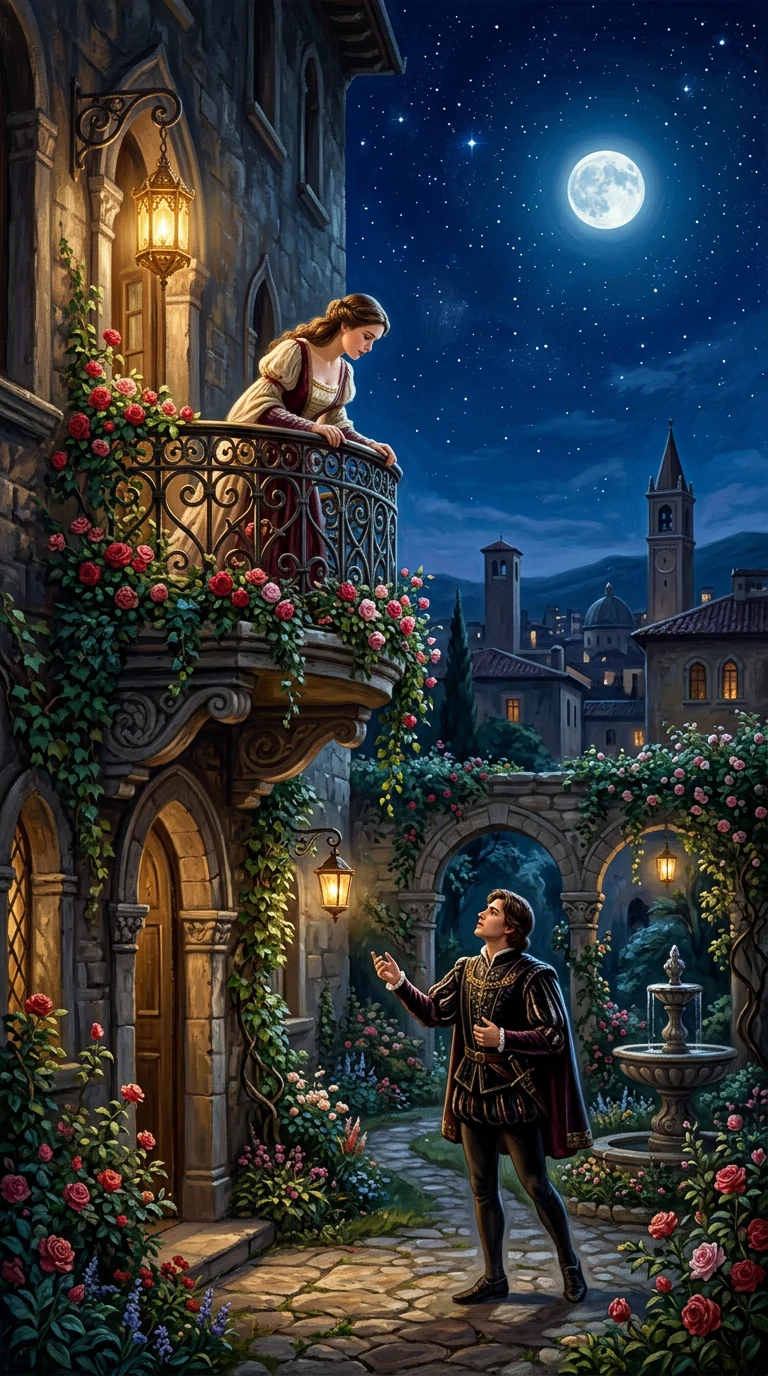
Romeo Montague and Juliet Capulet, the central figures of William Shakespeare's most beloved play (written around 1594-1596), represent one of literature's most enduring celebrations of young love's purity, passion, and transformative power. Set in Renaissance Verona during the late 14th century, their story depicts two young people from feuding families—the Montagues and Capulets—who experience instant and profound connection at a family celebration. Romeo, a passionate young nobleman known for his poetic sensibility and deep emotions, meets Juliet, an intelligent and courageous young woman, at a Capulet masquerade ball and both experience immediate recognition of profound connection. Shakespeare's masterful portrayal explores love's power to transcend social divisions, the courage young hearts can possess, and devotion's ability to inspire hope even in challenging circumstances. The famous balcony scene (Act II, Scene 2) where Romeo declares "But soft! What light through yonder window breaks? It is the east, and Juliet is the sun" has become perhaps the most iconic romantic moment in all of literature. Verona itself, with its narrow cobblestone streets, elegant stone balconies, romantic piazzas, and Renaissance architecture, provides the perfect backdrop for their love story—a city that still draws countless visitors seeking to experience the romance Shakespeare immortalized. The play draws from earlier Italian sources including Matteo Bandello's 1554 tale and Arthur Brooke's 1562 poem "The Tragical History of Romeus and Juliet," but Shakespeare transformed the story into timeless exploration of love's intensity, the conflict between individual desire and social expectation, and passion's power to make even the youngest hearts capable of profound devotion. Their relationship demonstrates how love can emerge unexpectedly and transform one's entire world in a single moment—a truth that resonates across centuries. The story has inspired countless adaptations across theatre, opera, ballet, film, and music, from Prokofiev's ballet to Bernstein's West Side Story to numerous modern retellings, proving that Shakespeare's insight into young love's purity and power remains eternally relevant. Romeo and Juliet endure not because of surrounding conflicts but because Shakespeare captured something essential about romantic passion—its intensity, its courage, its hope, and its ability to reveal our deepest capacity for connection and devotion.
Their first meeting at the Capulet masquerade ball represents one of literature's most beautiful depictions of instant connection. Romeo, attending the celebration with friends, sees Juliet across the crowded room and immediately recognizes something profound. Shakespeare captures this moment with exquisite poetry: "Did my heart love till now? Forswear it, sight! For I ne'er saw true beauty till this night." This isn't shallow attraction but immediate soul recognition—the sense that you've found someone who changes everything in an instant.
When they speak for the first time, Shakespeare crafts their conversation as a shared sonnet—their words interlocking perfectly, completing each other's thoughts and rhythms. This poetic device reveals their natural harmony, how effortlessly they connect, how their minds and hearts align instantly. The famous exchange "If I profane with my unworthiest hand / This holy shrine, the gentle sin is this" demonstrates sophistication beneath youthful passion—they're not just attracted but intellectually and spiritually matched.
"Meeting your soulmate at a party and speaking in spontaneous shared sonnets: Relationship goals or Shakespeare showing off? (Probably both.)"
The balcony scene (Act II, Scene 2) has become perhaps the most iconic romantic moment in all of literature. After the ball, Romeo cannot leave—drawn back to the Capulet estate, he finds Juliet on her balcony, thinking herself alone, speaking her feelings to the night: "O Romeo, Romeo, wherefore art thou Romeo?" (meaning "why are you Romeo?"—why must you be a Montague?). When Romeo reveals his presence, what unfolds is passionate dialogue about love transcending names and families.
"What's in a name? That which we call a rose / By any other name would smell as sweet," Juliet muses—arguing that Romeo's essential self matters more than his family identity. Their conversation explores profound themes: individual identity versus social category, choosing love despite obstacles, and devotion's power to make even young hearts capable of courage. They make commitments to each other that very night, demonstrating the intensity Shakespeare attributed to young love when it's genuine rather than mere infatuation.
What makes their love compelling isn't just passion but clarity and determination. Juliet especially shows remarkable strength—she knows her mind, speaks her feelings honestly, and commits fully despite understanding the challenges. This isn't naive young love but love that possesses surprising wisdom about what matters most. Shakespeare portrays young people capable of profound devotion, worthy of being taken seriously rather than dismissed as merely infatuated.
Their secret marriage conducted by Friar Lawrence represents their commitment to making their love real despite family opposition. They don't just declare feelings but act on them, accepting risks because their connection feels worth everything. This courage—choosing love over safety, connection over convenience—makes them inspiring rather than foolish. They demonstrate that young love, when genuine, can possess remarkable bravery and conviction.
Their immediate profound connection demonstrates love at first sight as soul recognition—seeing someone who changes everything in a single moment.
Shakespeare expresses their love through exquisite poetry—showing that passionate feeling inspires beautiful expression and elevated language.
They choose each other despite family opposition, demonstrating that love gives even young hearts courage to stand for what matters most.
"Their relationship moved from first meeting to secret marriage in about 24 hours. (Not recommended for modern dating, but it worked for them.)"
Experience Shakespeare's Verona through cutting-edge 3D audio that places you in their romantic world
Your journey begins approaching Verona as evening falls—the beautiful Renaissance city in northern Italy that Shakespeare chose as setting for his most famous love story. The spatial audio captures this atmosphere: church bells ringing across the city, market vendors closing their stalls, musicians playing period instruments in the piazzas, the bustle of Renaissance street life, cobblestone streets echoing with footsteps and conversations, and in the distance, the magnificent Capulet estate where the masquerade ball is beginning.
As you enter the Capulet celebration, the soundscape transforms to festive atmosphere: Renaissance dance music played on lutes, viols, and recorders, guests conversing in elegant Italian and period English, the rustle of silk gowns and velvet doublets, laughter and celebration filling the great hall, servants moving through the crowd, and beneath it all, the moment when Romeo and Juliet first see each other—time seeming to slow as their eyes meet across the room.
You witness the famous balcony scene with unprecedented immersion: standing in the Capulet garden, you hear Romeo's voice calling up from the cobblestone street below while Juliet's voice descends from her balcony above. The spatial audio places you perfectly to experience their conversation's three-dimensional reality—nightingales singing from specific garden locations, fountains flowing nearby, the gentle sounds of Verona's night creating romantic backdrop for Shakespeare's most beautiful poetry brought to life.
"Our sound designers studied Renaissance instruments to accurately recreate period music. (Spotify doesn't have a 'late 14th-century Verona' playlist yet.)"
The journey explores accessible Beginner themes that everyone can understand: What is love at first sight? How does passion give us courage? Why does young love feel so intense and pure? Can devotion transcend social boundaries? These questions emerge naturally through experiencing their story rather than being abstractly presented. The spatial audio makes Shakespeare's insights immediate and emotionally resonant.
You'll experience Verona's romantic settings that mirror their emotional journey: the crowded ball where connection feels electric despite surrounding chaos, the intimate balcony scene where two people create private world within public space, secret garden meetings where love blossoms away from disapproving eyes, and Friar Lawrence's cell where commitment becomes real. Each location enhances thematic exploration through spatial audio that makes settings emotionally significant.
Background soundscapes enhance meaning: when exploring instant connection, you hear the ball's chaos fading as they focus only on each other. When contemplating love transcending boundaries, you hear family sounds distant while their voices remain intimate and close. When examining young love's purity, you hear nightingales and fountains creating naturally romantic atmosphere. The 3D audio makes abstract concepts viscerally felt rather than intellectually explained.
The journey concludes with reflection on timeless themes—their story has been retold for over 400 years not because of surrounding complications but because Shakespeare captured something essential about love itself. The purity of young passion, the courage devotion inspires, the hope that connection brings, the power of choosing each other despite obstacles—these truths transcend centuries. You leave carrying insights about love's transformative potential and the beauty of following your heart.
Experience literature's most iconic romantic scene through 3D spatial positioning
Witness their instant recognition across the crowded Capulet ball
Period-accurate music, architecture, and ambient sounds of 14th-century Italy
His most beautiful romantic language brought to life through spatial audio
"We considered including actual Renaissance Italian but settled for Shakespeare's English. (Your high school English teacher would approve.)"
Themes from Romeo and Juliet that remain relevant across centuries
Romeo and Juliet's instant connection represents more than superficial attraction—it's soul recognition, the sense of meeting someone who fundamentally changes your understanding of connection. Shakespeare doesn't present this as shallow infatuation but as profound recognition of compatibility, harmony, and mutual understanding that can indeed happen in a moment when two compatible souls meet.
The lesson: Trust your heart's immediate responses. While wisdom counsels getting to know people gradually, there's also truth in recognizing special connection when you encounter it. Their story validates the experience many have felt—seeing someone and knowing instantly that this person matters, that this connection is different, that everything has changed. Not all instant attractions prove meaningful, but some genuinely are—and Romeo and Juliet remind us not to dismiss such experiences as merely foolish or naive when they feel profoundly real.
What makes Romeo and Juliet inspiring is their courage to choose love despite family opposition. They don't let social categories, family feuds, or expected loyalties prevent them from following their hearts. Juliet's question "What's in a name?" argues powerfully that individual identity matters more than social category—that who someone truly is transcends the labels society assigns them.
The lesson: Love requires courage to honor connection over convention. Many relationships face opposition—from families who disapprove, cultures that judge, circumstances that complicate. Romeo and Juliet model how to respond: acknowledge obstacles honestly, count the cost realistically, then choose according to your deepest values rather than others' expectations. They show that honoring genuine connection sometimes means standing against pressure, that following your heart can require bravery, and that young people are capable of such courage when love is real.
Shakespeare portrays Romeo and Juliet not as foolish children but as young people capable of genuine profound devotion. Their love isn't dismissed as mere teenage infatuation but honored as real, meaningful, and worthy of respect. Juliet especially shows remarkable clarity about her feelings, strength in expressing them, and wisdom in understanding what matters most—she knows her own heart with admirable certainty.
The lesson: Age doesn't determine capacity for genuine feeling. Modern culture often dismisses young love as necessarily shallow or temporary, but Romeo and Juliet remind us that young people can experience profound emotions, make committed choices, and possess surprising wisdom about relationships. Their story validates every young person who has felt deeply and been told their feelings aren't real or important. Young love can be genuine, meaningful, and transformative—deserving respect rather than condescension.
Shakespeare gives Romeo and Juliet some of literature's most exquisite romantic poetry—showing that love inspires elevated language, that passion makes us want to express feeling beautifully. "But soft! What light through yonder window breaks? It is the east, and Juliet is the sun" demonstrates how love transforms perception, making the beloved seem radiant, magical, transformative of one's entire world.
The lesson: Love makes poets of us all. When we feel deeply, we seek beautiful ways to express that feeling—through words, gestures, creativity. Romeo and Juliet remind us that romantic passion naturally inspires poetic expression, that wanting to tell your beloved they're like the sun or that their name doesn't define them is natural outpouring of profound emotion. Their story validates the impulse to express love creatively and beautifully rather than treating such expression as embarrassing or excessive.
"Their love advice book would be titled: 'How to Fall Completely in Love in 24 Hours.' (Results may vary. Shakespeare's talent for poetry not included.)"
Those experiencing first love, instant attraction, or passionate devotion who want validation that their feelings are real and meaningful. Romeo and Juliet honor young love's intensity rather than dismissing it as mere infatuation.
Literature lovers discovering Shakespeare through new medium, students studying the play seeking deeper emotional connection, or anyone who appreciates poetic language and wants to experience his words brought to life through spatial audio.
People whose relationships face family disapproval, cultural barriers, or social expectations. The journey validates the courage required to choose love despite opposition and provides framework for honoring connection over convention.
Anyone drawn to classic romance, poetic expression of love, or beautiful love stories. Perfect for those who appreciate passion, devotion, and emotional depth—or anyone seeking inspiration to express their own feelings more beautifully.
Those planning to visit Verona, Italy seeking deeper connection to the city's romantic legacy, or anyone who has visited and wants to re-experience the atmosphere through Shakespeare's lens. Perfect preparation or beautiful remembrance.
New to cinematic meditation who want accessible entry point through familiar story. Romeo and Juliet's universal themes and Beginner-level approach make it perfect introduction to spatial audio meditation combining literature, history, and mindfulness.
"Also perfect for anyone who's ever wanted to quote Shakespeare at their beloved but wasn't sure how to work it into conversation naturally. (Now you'll have practice.)"
Everything you need to know about this journey with Romeo & Juliet
"We consulted Shakespeare scholars for accuracy. They had many opinions about the balcony scene's exact blocking. (We used creative license.)"
Explore more legendary romances and passionate tales
Download Visionaria and witness Shakespeare's most beautiful love story.
"The only app where you can experience the balcony scene from the actual balcony perspective. (No climbing required, Shakespeare's poetry included.)"