
Palace of
Menelaus
👑 "Where Helen's beauty sparked a thousand ships and legendary romance."
The Palace of Menelaus was the royal residence of King Menelaus of Sparta (reigned c. 1190-1155 BCE, according to Greek mythology), husband of Helen of Troy, whose abduction by Paris of Troy sparked the Trojan War. Located in ancient Sparta, Greece, near the Menelaion sanctuary on the east bank of the Eurotas River, this Bronze Age palace complex (Late Helladic period, c. 1300-1100 BCE) served as the seat of Spartan royal power. Archaeological excavations at the Menelaion site have revealed Mycenaean-era structures, pottery, and votive offerings, confirming that Menelaus and Helen were worshipped as divine heroes in this location from the Archaic period onward, blending historical architecture with legendary mythology.
Key Facts About Palace of Menelaus
- Location: Menelaion site, ancient Sparta, Greece
- Period: Late Helladic (Mycenaean), c. 1300-1100 BCE
- Famous For: Home of Menelaus and Helen, origin of Trojan War
- Excavations: British School at Athens (1973-1980)
- Sources: Homer's Odyssey, Pausanias, archaeological evidence
The Palace of Menelaus stood as the Spartan counterpart to Troy's royal citadel. While the Palace of Priam in Troy housed the Royal Treasury that motivated Greek invasion and witnessed the Trojan Horse deception, Menelaus' palace represented the wronged Greek king's seat of power whose wife's abduction launched a thousand ships. This Bronze Age palace rivalry shows how Mycenaean royal architecture (both Sparta's Menelaion and Troy's citadel) functioned as stages for epic narratives of honor, betrayal, and warfare, with Helen's movement between these two palace complexes (Sparta → Troy → return to Sparta) structuring the entire Trojan War mythology through architecture.
The Palace of Menelaus exemplified Late Bronze Age Mycenaean palatial architecture in mainland Greece, forming part of a network of legendary royal residences including the Palace of Priam in Troy (his enemy's citadel across the Aegean where the abduction of Helen sparked their decade-long war). These two Bronze Age palace complexes, though enemies in Homer's narrative, shared similar Mycenaean/Anatolian architectural traditions (megaron throne rooms, colonnaded courtyards, palatial treasuries), demonstrating how Late Helladic royal architecture transcended political rivalries and created a common elite culture across the Aegean Bronze Age world.
🏛️ What is the Palace of Menelaus experience?
An imaginative journey to the royal palace of Menelaus and Helen of Troy. Picture bronze gates opening, marble halls echoing, Helen's private gardens, and the weight of leadership after the Trojan War. It is not a Visionaria episode yet; the app's Troy series follows Helen's story from the other side.
What You'll Experience
Walk through bronze gates into the palace where Helen of Troy lived and King Menelaus ruled. Experience royal grandeur, mythological romance, and the bittersweet aftermath of the legendary Trojan War.
Free to start • Available on iOS & Android
⚔️ "Royal drama: where love met legend."
What You'll Experience
A royal journey through the palace where mythology, romance, and power converged in ancient Sparta.
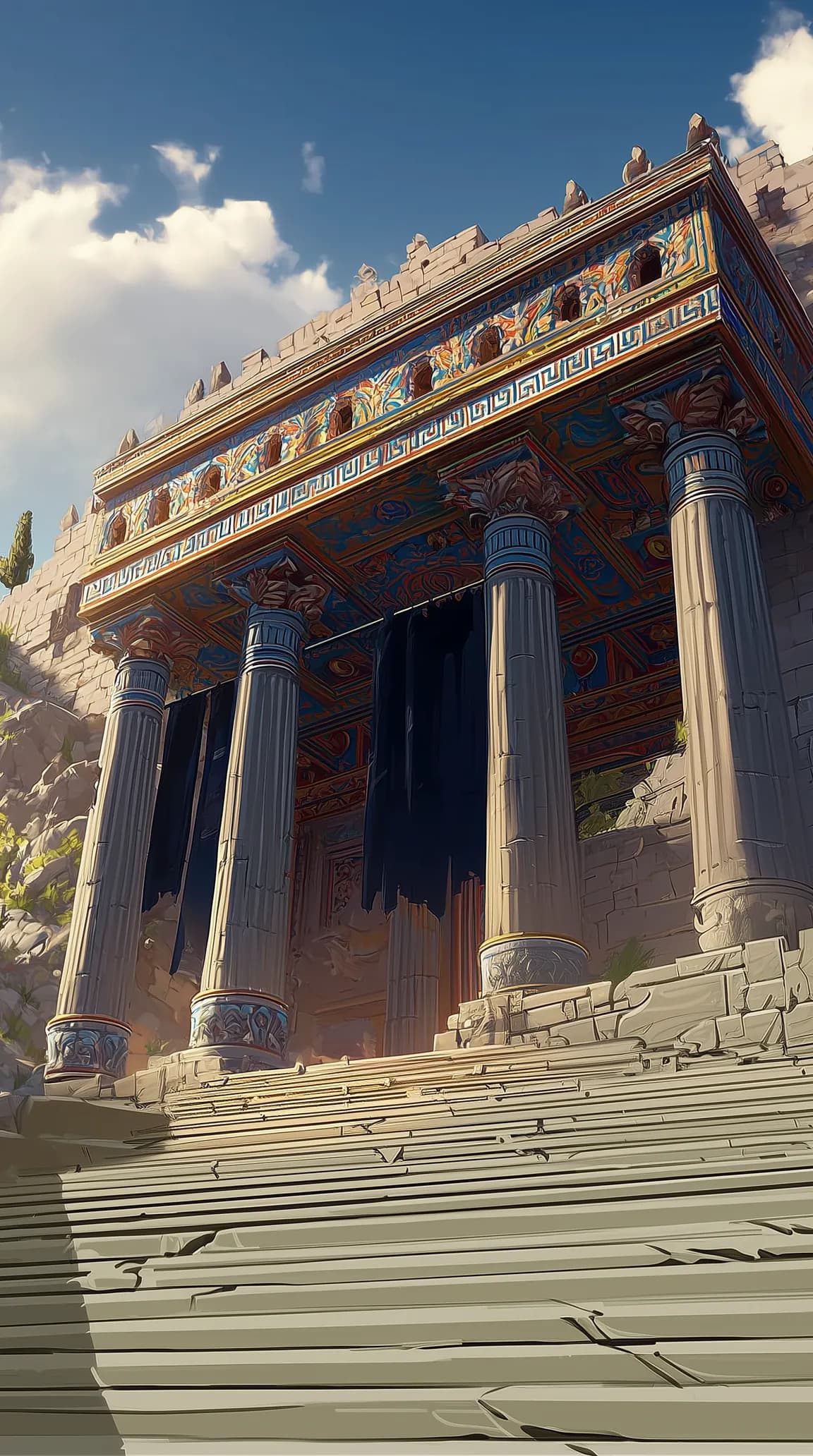
As massive bronze gates swing open with a resonant groan, you step into the Palace of Menelaus, halls that have witnessed both legendary love and terrible war. Marble columns soar overhead, their surfaces gleaming in torchlight. Guards snap to attention as you pass, their bronze armor catching the light. This is not merely a building; it's the heart of Spartan royalty, where Helen of Troy once walked and where a king carried the weight of both kingdom and heartbreak.
You'll move through the throne room where Menelaus receives counsel, hearing the measured cadence of royal decisions. Then into Helen's private garden, a sanctuary of fountains and flowering vines where beauty and melancholy intertwine. Distant echoes of the Trojan War surface in subtle sounds, reminders of the price paid to reclaim what was lost. Finally, as evening descends, you'll witness a king's solitude under stars, contemplating legacy, love, and the complex nature of destiny.
In your imagination, you'll hear bronze gates echoing from specific directions, marble footsteps reverberating through vast halls, courtly conversations surrounding you in positioned locations, fountains splashing in Helen's garden to your left, and the peaceful cricket chorus of Spartan evenings. This is meditation meets mythology, where ancient grandeur becomes deeply personal and emotionally resonant.
💕 "When your wife starts a war, but you still love her."
Experience Royal Sparta Through Immersive Storytelling
🏛️ "Palace life: part royal court, part Greek mythology."
This imaginative journey isn't a breathing exercise. It's transportation into one of history's most legendary royal palaces at its peak.
Immersive Setting
A Royal Place Brought to Life
This imaginative journey transports you to the palace of King Menelaus and Helen of Troy in ancient Sparta, not as archaeological ruins, but as a living royal residence bustling with guards, courtiers, and the echoes of legendary romance. The palace stands as a symbol of both royal power and the complex dynamics of love, duty, and destiny.
Instead of generic nature sounds or abstract visualization, this imaginative journey recreates a specific mythological location: bronze gates that echo with authority, marble halls that soar to painted ceilings, Helen's private garden where fountains splash among flowering vines, and the throne room where a warrior-king made decisions that shaped Sparta's destiny.
Every element (from the resonant groan of bronze gates to the acoustics of marble corridors) draws on archaeological research into Mycenaean palaces and Homer's epic descriptions, creating an immersive meditation environment that serves both as relaxation and mythological education.
Where history meets legendary romance
3D Spatial Audio
Visionaria's episodes use spatial audio and spatial sound design to place you inside a scene. Here, imagine the palace: bronze gates echoing from specific positions, marble footsteps reverberating through halls, courtiers conversing to your left, and fountains splashing to your right.
This isn't passive reading. It's active presence. Picturing the space around you creates the sensation of truly standing in ancient Sparta's most legendary palace, an immersive meditation experience built from imagination.
Guided Narrative Storytelling
This visualization meditation describes royal architecture, courtly life, and mythological elements with vivid detail that activates your imagination while maintaining a calm, meditative pace.
The story balances historical education with mindfulness practice, inviting personal reflection on themes like love, duty, and the aftermath of war, universal values that connected ancient rulers to their subjects and connect you to your own relationships and life choices.
"Bronze gate sound: regal AF."
The Real History Behind Your Journey
Where mythology meets archaeology in the legendary palace of Sparta's most famous couple
👑 "Not your average living room. Royal problems only."
The Legend
Menelaus & Helen
Menelaus was the legendary King of Sparta and brother of Agamemnon, the High King of Mycenae. Helen, his wife, was renowned as the most beautiful woman in the ancient world, so beautiful that Paris of Troy's abduction of her sparked the legendary Trojan War. Homer immortalized their story in The Iliad and The Odyssey, making them central figures in Greek mythology.
Key Figures:
- • Menelaus: King of Sparta
- • Helen: Most beautiful woman in Greece
- • Paris: Prince who sparked the war
- • Agamemnon: Menelaus' brother, High King
The War
Trojan War Connection
The Trojan War began when Paris, prince of Troy, abducted Helen from this very palace, an act that violated sacred guest-friendship laws and sparked a ten-year conflict involving all of Greece.
This legendary palace was part of Bronze Age Greece's network of royal centers, which included the Palace of King Priam at Troy (where Paris brought Helen), the Palace of Nebuchadnezzar in Babylon, and the Royal Residence of Cleopatra in Alexandria, each a center of political power where personal decisions shaped the fate of empires.
The Abduction (c. 1194 BCE)
Paris took Helen from Sparta, starting the war
10 Years of Conflict
Greece united to reclaim Helen from Troy
The Reunion (c. 1184 BCE)
Menelaus and Helen returned to Sparta
⚔️ "The face that launched a thousand ships."
Archaeological Evidence
The Palace: Myth Meets Reality
While Menelaus and Helen are primarily mythological figures, archaeological excavations at ancient Sparta have uncovered palatial ruins from the Bronze Age that match Homer's descriptions. These Mycenaean palace complexes featured the kind of architectural elements imagined in this journey: massive bronze-reinforced gates, marble-clad halls with painted columns, private gardens with fountains, and separate throne rooms for conducting royal business.
The British School at Athens and other institutions have conducted extensive excavations revealing that Bronze Age Sparta was indeed a significant palatial center. This fascinating overlap between mythology and archaeology allows our journey to be both imaginatively rich and historically grounded.
💍 "Where love met legend and legend met stone."
About This Imaginative Journey:
The palace on this page draws on Homer's epics, Pausanias and archaeological research into Mycenaean Laconia; the scenes inside it are imagined. We believe history enhances meditation: when a journey is rooted in real places and well-documented mythology, it becomes more meaningful, educational, and respectful to the civilizations we honor.
Unique Approach
Beyond Traditional Meditation
👑 "Where royalty met reality…"
A new paradigm for mindful exploration
Most meditation apps ask you to focus on your breath, observe your thoughts, or listen to calming music. While valuable, these approaches don't work for everyone. Some minds crave engagement, story, purpose, and meaning during relaxation.
This cinematic imagination app takes a revolutionary approach: it positions you as the hero of your own story, experiencing legendary civilizations firsthand. Instead of "breathe in for four counts," you're invited to "walk through the bronze gates where Helen once lived." Instead of "clear your mind," you're asked to "witness the palace where love and war intertwined."
You're not just meditating. You're experiencing royal Spartan life, feeling the presence of Helen of Troy, and connecting with a civilization that valued both power and beauty. This invites calm, absorbed focus through engagement rather than emptiness, imagination rather than void, and mythological connection rather than abstract mindfulness.
This makes Visionaria perfect for people who find traditional breathing meditation boring, prefer story-based relaxation, love history and mythology, or simply want meditation that feels more like an adventure than an exercise.
More Spartan Journeys
Explore more legendary sites and stories of ancient Sparta.
👑 "Crown not included, imagination required."


Your Questions Answered
Everything you need to know about this journey
Walk Where Legends Were Made
Download Visionaria and follow Helen's story to Troy. Your mythological journey awaits.
"Palace intrigue included, no crown required."