
Launch special: Visionaria Premium is free—all cinematic journeys with spatial 3D audio.
🇺🇦 Support Ukrainian creators on Patreon — help us make a difference
Launch special: Visionaria Premium is free—all cinematic journeys with spatial 3D audio.
🇺🇦 Support Ukrainian creators on Patreon — help us make a difference
The Erechtheion (Greek: Ἐρέχθειον) is an ancient Greek temple located on the Acropolis of Athens, Greece, constructed between 421-406 BCE in the Ionic order. Dedicated to both Athena Polias (Athena of the City) and Poseidon-Erechtheus, this architecturally complex temple marks the legendary site where Athena and Poseidon competed for patronage of Athens—Athena's gift of an olive tree (still symbolically present) won over Poseidon's saltwater spring (marked by trident marks in the rock). The temple is most famous for its Porch of the Caryatids, featuring six draped female figures (caryatids) serving as supporting columns, representing Athenian maidens. The Erechtheion housed the ancient wooden cult statue of Athena Polias, considered the city's most sacred religious object, and served as the center of Athenian state religion during the classical period.
The Erechtheion represents the pinnacle of Ionic temple architecture, part of Athens' Acropolis temple complex alongside the Temple of Athena Nike (celebrating Athenian military victory with Nike's wings) and near the monumental Parthenon (dedicated to Athena Parthenos in Doric grandeur)—together these three temples showcased different architectural orders (Ionic, Doric) and different aspects of Athena's divine persona (city protector, war goddess, virgin patron), demonstrating how Classical Athens used sacred architecture to express complex theological and civic identities.
"Six marble ladies doing the heavy lifting while tourists Instagram them. Athena's still winning that bet."
"The only place where you can say 'those columns are having a bad hair day' and be archaeologically accurate."
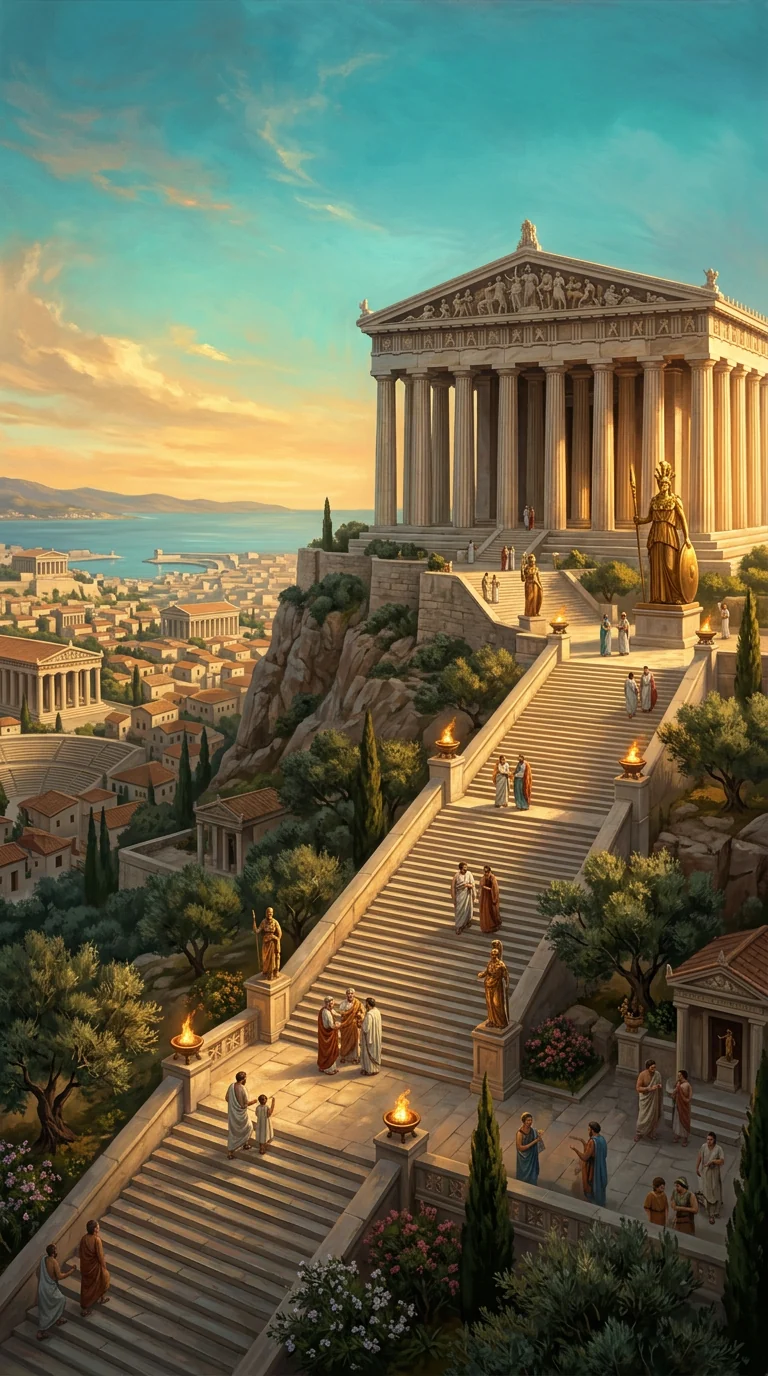
Every detail based on archaeological evidence and ancient sources
🏛️ "Poseidon brought saltwater. Athena brought groceries. Democracy chose wisely."
421-406 BCE
Athena and Poseidon competed for Athens' patronage on this exact spot. Poseidon struck rock with his trident, creating saltwater. Athena planted an olive tree, offering wisdom and prosperity. The gods judged Athena's gift superior.
Sacred Artifacts:
Iconic Architecture
Six sculpted maidens serve as columns—each over 2 meters tall. They're architectural marvels: functional columns that are also masterpieces of art.
Engineering Brilliance
One leg straight to bear weight, other bent for grace
Current Location
5 in museums, 1 lost, replicas on temple
💪 "Holding up roofs since 406 BCE. Still graceful."
"The Caryatids have been working overtime for 2,400 years without a union break."
Cinematic Journey
You begin standing before the Caryatid Porch, gazing up at six sculpted maidens whose serene faces have watched Athens for 2,400 years. The narrator describes in second person: "You see the folds of her dress, carved so finely they seem to move in the breeze."
The journey guides you through irregular temple levels: the north porch where Poseidon's trident struck marble, the sanctuary where priestesses tended Athena's statue, the tomb of Erechtheus beneath. Each space has distinct acoustics rendered in 3D—echoing chambers, wind through columns, distant chanting.
3D spatial audio positions sounds around you. When the narrator says "to your left, the olive tree," you hear rustling from that direction. Your brain interprets spatial cues as physical presence—you're not listening to a story, you're standing there.
🏺 "Close your eyes. You're in ancient Athens now."
This isn't a documentary or audio tour. It's a meditation that transports your mind to ancient Athens, using cinematic storytelling and 3D spatial audio to create presence and emotional connection.
You begin standing before the Caryatid Porch, gazing up at the six sculpted maidens whose serene faces have gazed over Athens for 2,400 years. The narrator describes their features in second person: "You see the folds of her dress, carved so finely they seem to move in the breeze. You notice the weight she carries with such grace." The spatial audio makes you feel you're truly there.
The journey guides you through the temple's irregular levels: the north porch where Poseidon's trident allegedly struck marble, leaving a visible mark; the sanctuary of Athena Polias where priestesses tended the sacred olive wood statue; the tomb of Erechtheus beneath the floor. Each space has distinct acoustics rendered in 3D: echoing stone chambers, wind through marble columns, distant chanting.
You'll experience the Pandroseion courtyard where Athena's sacred olive tree grows, symbolizing her victory over Poseidon. The narrator recounts the myth not as history, but as if you're witnessing it: "You hear Poseidon's trident crack against stone. You see Athena kneel to plant the first olive sapling." Ancient myth feels immediate and present.
The climax places you at sunrise, when golden light first touches the Caryatids' faces, and you understand why ancient Athenians believed gods walked among them. The experience doesn't explain the Erechtheion intellectually; it makes you feel what it meant to the people who built it.
3D spatial audio is the technological foundation that makes this journey work. Unlike stereo sound (left/right), spatial audio positions sounds in three-dimensional space around you. When the narrator says "to your left, you see the olive tree," you hear rustling leaves from that exact direction. When wind moves through the columns, it sweeps around you in realistic space.
The audio landscape includes layered environmental sounds: footsteps on ancient stone changing acoustics as you move between temple chambers; distant sacred chants echoing from the Parthenon nearby; birds circling above the Acropolis; the subtle creak of the marble Caryatids under their eternal burden. Your brain interprets these spatial cues as physical presence, even with eyes closed.
The narrator's voice isn't omnipresent—it comes from beside you, like a knowledgeable companion walking the temple with you. When you pause before Poseidon's trident mark, the narrator's voice sounds reflective and close. When describing the distant view of Athens below, the voice opens up with awe. This positional narrative makes the guide feel like a person, not a recording.
Binaural recording techniques capture how sound naturally reaches human ears: slightly different in timing and tone between left and right ears. Your brain uses these micro-differences to construct spatial awareness. Combined with meditative pacing and second-person narrative, the result is full sensory immersion. You're not listening to a story about the Erechtheion. You're standing there.
Active Imagination
Spatial Sound
Real History
Emotional Connection
Visionaria isn't traditional mindfulness. It's cinematic imagination meditation—storytelling that engages your mind so fully that mindfulness happens naturally through active visualization.
Traditional meditation asks you to "empty your mind." Visionaria gives your mind something richer: compelling mythological journeys through ancient temples.
✨ "Traditional meditation: 'Clear your mind.' Visionaria: 'Imagine marble maidens.' Guess which works."
For 12 minutes, you're not scrolling or solving problems:
You're standing at the Erechtheion in classical Athens. Your nervous system downregulates naturally. You return refreshed, having traveled 2,400 years without leaving your chair.
Traditional meditation asks you to "observe your thoughts" or "focus on your breath." Visionaria gives your mind something richer: a compelling narrative journey through a real historical place. Your imagination is fully engaged visualizing the Caryatids, the marble surfaces, the olive tree, the view of ancient Athens. This active imagination creates mindfulness organically—you're so absorbed in the experience that racing thoughts naturally quiet. It's meditation disguised as adventure, making it accessible to people who find traditional meditation boring or difficult.
You'll learn real history about the Erechtheion—the Athena-Poseidon myth, the architectural uniqueness, the Caryatids' structural function—but not through dry narration. You learn by experiencing it emotionally. When you "see" Athena plant the olive tree, you understand why ancient Athenians valued wisdom over raw power. When you "feel" the weight the Caryatids bear, you appreciate their grace as both art and engineering. Education sticks when it's tied to emotion, and Visionaria makes ancient history feel personally meaningful.
Modern life is exhausting: constant notifications, decision fatigue, information overload. Visionaria offers structured mental escape that's healthy and rejuvenating. For 12 minutes, you're not scrolling feeds or solving problems. You're standing on the Acropolis in 420 BCE, watching sunlight illuminate marble maidens. Your nervous system downregulates naturally. Your perspective widens. You return to the present moment refreshed, having traveled 2,400 years without leaving your chair. It's escapism that enriches rather than numbs.
You don't need meditation experience, knowledge of Greek history, or special skills. Just headphones, 12 minutes, and willingness to close your eyes. The journey meets you where you are: history enthusiasts appreciate the authenticity; meditation seekers value the mindfulness; stressed professionals enjoy the mental break; curious minds love the storytelling. It's designed for human brains, which naturally love good stories set in fascinating places. If you can imagine, you can experience Visionaria.
"It's like time travel, but you don't need a DeLorean or have to explain the space-time continuum to anyone."
Dive deep into the Erechtheion's unique multi-level design, the engineering of the Caryatids, and the Athena-Poseidon myth. Experience history through spatial immersion, not textbooks.
If traditional "breathe and observe" meditation feels boring, try cinematic meditation. Engage your imagination so fully that mindfulness happens naturally through story.
Escape Zoom fatigue and decision overload. Spend 12 minutes in ancient Athens, let your nervous system reset, and return to work refreshed and focused.
Can't visit Athens right now? Experience the Erechtheion through immersive audio. Perfect for armchair travelers or those planning future trips who want to preview the site emotionally.
Make Greek history tangible and memorable. Use Visionaria as a teaching tool to help students emotionally connect with ancient architecture and mythology beyond memorizing dates.
No prerequisites needed. If you're curious about the Caryatids, Greek myths, or ancient temples, this journey meets you where you are and makes the past feel immediate and alive.
"Also perfect for people who wanted to be Indiana Jones but ended up in accounting. This is your chance."
Explore more ancient Athens experiences through spatial audio meditation.
Everything you need to know about this journey
Download Visionaria and start your journey today.
"Those six marble ladies have been working overtime for 2,400 years. Time to give them the appreciation they deserve."