Launch special: Visionaria Premium is free—all cinematic journeys with spatial 3D audio.
🇺🇦 Support Ukrainian creators on Patreon — help us make a difference
Launch special: Visionaria Premium is free—all cinematic journeys with spatial 3D audio.
🇺🇦 Support Ukrainian creators on Patreon — help us make a difference
Wisdom from the God of Thunder on strength, duty, and sacred protection
Experience Thor, God of Thunder and protector of humanity, in this journey through righteous strength, sacred duty, and the courage to defend what matters.
⚡ What is the Thor in Asgard experience?
A 23-minute Advanced spatial audio meditation that transports you to Thor's hall in Asgard for a profound dialogue about strength, duty, and protection. Experience thunderous wisdom through immersive 3D soundscapes featuring rolling thunder, crackling lightning, and the voice of the mightiest defender of the Nine Realms.
"Warning: May cause sudden urge to lift heavy things while shouting 'By Odin's beard!' (Thor takes full responsibility for this.)"
"Side effects include increased appreciation for thunderstorms, protective instincts toward the vulnerable, and wondering if you need a mythical hammer."
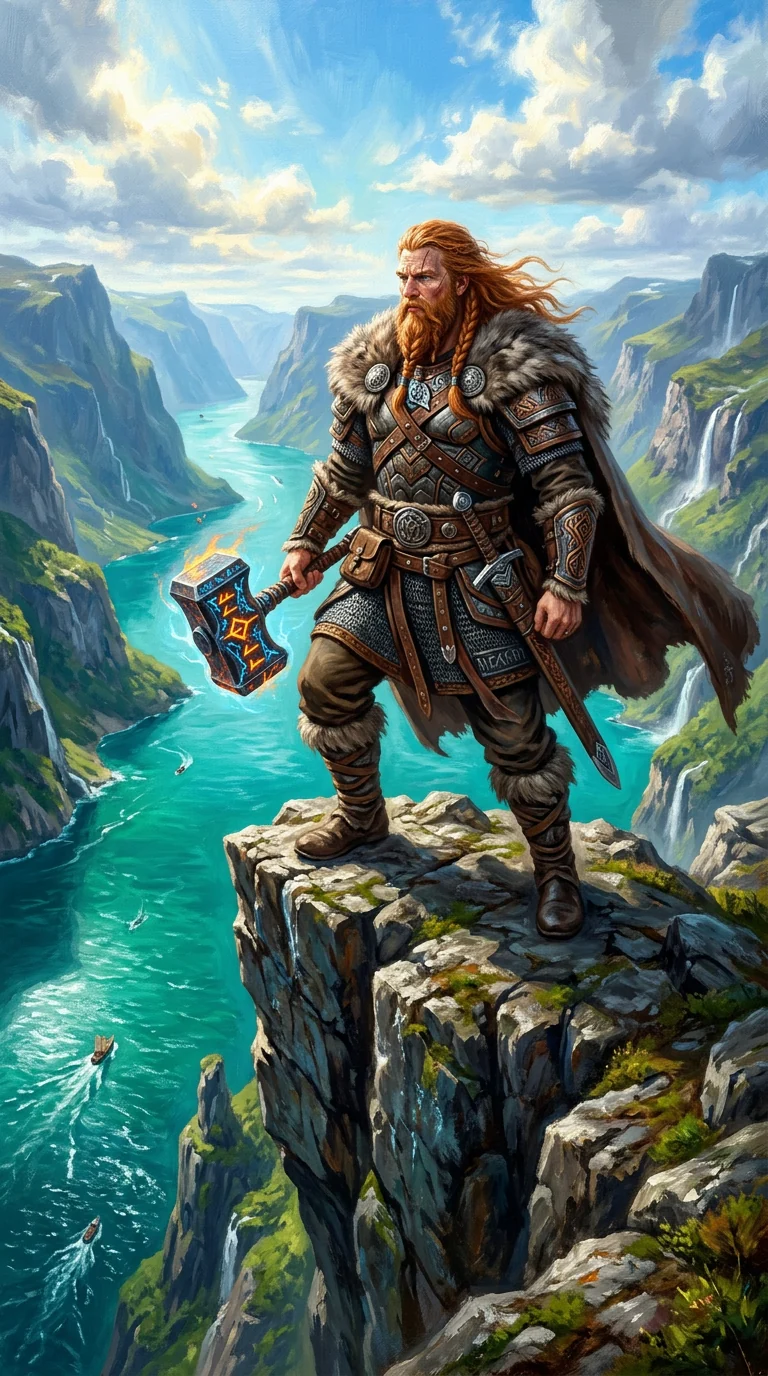
Thor (Old Norse: Þórr) is the God of Thunder, Lightning, Storms, Oak Trees, Strength, Protection of Humanity, and Hallowing in Norse mythology—one of the most beloved and widely worshipped deities across ancient Scandinavia. Son of Odin (the All-Father and king of the Aesir gods) and Jord (personification of Earth itself), Thor wielded Mjolnir, the legendary hammer forged by dwarven smiths that could level mountains yet always returned to his hand. Husband to Sif, the golden-haired goddess of fertility, father to Modi (Courage) and Magni (Strength), Thor defended both Asgard (realm of the gods) and Midgard (Earth) from giants, monsters, and forces of chaos threatening cosmic order. According to the Prose Edda and Poetic Edda (compiled around 1220 CE from earlier oral traditions dating to the Viking Age 793-1066 CE), Thor dwelled in Bilskirnir (Lightning Crack)—the largest hall in Asgard with 540 rooms—located in the realm of Thrudheim (Place of Strength). Unlike many gods who relied on cunning and manipulation, Thor represented straightforward strength, unwavering honor, fierce loyalty, and the sacred duty to stand between civilization and chaos. Thursday (Thor's Day) is named in his honor. Common people especially revered Thor as their defender against cosmic threats beyond mortal capability—a protector whose power existed entirely to serve and shield others.
Thor's role in Norse cosmology extended far beyond simple warrior deity—he embodied the principle of protective strength, power that exists entirely to serve and defend others. While his father Odin pursued knowledge through sacrifice and cunning, Thor represented straightforward strength applied with unwavering purpose. When giants threatened Asgard or monsters endangered Midgard, Thor responded with Mjolnir in hand—not for glory or personal gain, but because protection was his sacred duty.
The ancient Norse people, particularly farmers and common folk, revered Thor above even Odin. While the All-Father appealed to kings and poets, Thor defended everyone equally—his protection extended to all who dwelled in Midgard, regardless of status or power. When storms raged across Scandinavia, people saw Thor riding his chariot drawn by goats Tanngrisnir and Tanngnjóstr, his hammer creating thunder as he hunted giants who threatened the cosmic order. These weren't random displays but active protection against chaos.
"Thor's job description: 'Defend everything and everyone, forever, without rest.' (He never complained. That's the thing about Thor.)"
Mjolnir, Thor's hammer, symbolized more than destructive power—it represented consecration and hallowing. At weddings, Thor's hammer blessed the union. At births, children received protection under Mjolnir's sign. When new homes were built or ships launched, Thor's blessing ensured safety. The hammer that could shatter mountains also sanctified and protected, embodying the paradox of strength that nurtures rather than dominates.
His relationship with Sif, the golden-haired goddess, revealed another dimension of Thor's character. While tales emphasize his strength and thunder, his devotion to Sif demonstrated fierce loyalty and protective love. When Loki cut Sif's golden hair as a prank, Thor's rage wasn't mere anger but righteous fury at harm to one under his protection—forcing Loki to make amends by commissioning even more magnificent golden hair from dwarven craftsmen.
Yet beneath his reputation as straightforward warrior lies profound wisdom: Thor understood that true strength serves rather than dominates. Unlike gods who wielded power for personal ambition, Thor's entire existence centered on standing between those he protected and the forces that threatened them. His strength wasn't about proving superiority but about being the barrier between chaos and civilization, willing to face any threat so others wouldn't have to.
Thor's power exists entirely to protect others—strength that serves rather than dominates, authority that defends rather than controls.
Protection isn't occasional heroism but constant vigilance—Thor teaches that true duty never ends because threats never cease.
Overwhelming capability wielded with restraint—Thor demonstrates that true power lies in choosing when NOT to unleash your full strength.
"Thor's performance review: 'Successfully defended Nine Realms for millennia. Never asked for a vacation.' (Overachievers gonna overachieve.)"
Experience Asgard through cutting-edge 3D audio that places you in Thor's hall with thunder rolling overhead
Your journey begins on Bifrost, the rainbow bridge connecting Midgard to Asgard. The spatial audio captures this transition—mortal sounds fading, divine resonances emerging, the crystalline shimmer of the bridge beneath your feet creating unique acoustic properties. Heimdall, the watchman of the gods who can hear grass growing and see to the edge of the Nine Realms, acknowledges your passage with his great horn Gjallarhorn echoing across dimensions.
As you enter Asgard proper, the soundscape transforms: divine thunder rolling across eternal skies where storms never truly end, distant training grounds where Einherjar (chosen warriors) prepare for cosmic challenges, the rustle of Yggdrasil's branches (the World Tree connecting all realms), and beneath it all, the hum of divine power that permeates every stone and breath in this celestial realm.
You approach Bilskirnir—Thor's hall in Thrudheim, the largest structure in Asgard with 540 rooms. Lightning flashes create stark illumination against storm-dark skies. Thunder announces the god's presence not as threat but as protective power. The great doors open, and Thor's voice resonates from within, welcoming you to dialogue few mortals experience—conversation with the defender of all realms.
"Our sound designers recorded actual thunderstorms, then added mythological resonance. The thunder gods from three pantheons had notes. We incorporated them all."
Inside Bilskirnir, the acoustics shift to vast enclosed space—Thor's voice carries weight and warmth simultaneously, thunder rumbling outside while lightning illuminates massive pillars carved with tales of protection and valor. Rain drums on the hall's roof in rhythmic patterns. Distant chambers echo with the sounds of Thor's family and allies, creating the sense of living divine household rather than isolated throne room.
Thor addresses sophisticated themes that simple "be strong" advice cannot capture: What does it cost to be everyone's protector? How do you maintain your own needs when everyone depends on your strength? Can you be both powerful and vulnerable? What happens when your entire identity centers on serving others' safety? How do you find rest when vigilance feels necessary? He doesn't offer easy answers but rather invites you into the complexity itself—the weight he's carried across millennia.
The dialogue includes powerful paradoxes drawn from Thor's experience: strength that admits limitation, protection that allows others their own struggles, duty balanced with self-care, the loneliness of being needed rather than simply wanted, and how to honor your power without becoming what you oppose. Strategic silences allow contemplation, with only distant thunder and rain filling the space for reflection.
Background soundscapes enhance the teaching: when discussing burden of duty, you hear Mjolnir's weight—the hammer resting but never truly inactive, always ready. When exploring protective instinct, thunder builds then dissipates as Thor demonstrates controlled power. When contemplating service versus self-sacrifice, the storm outside mirrors internal emotional complexity—power that must be constantly managed, never simply unleashed.
Vast chambers create unique acoustics where thunder resonates with protective purpose
Positioned in 3D space demonstrating controlled elemental power
Rain and wind moving through three-dimensional soundscape around you
Words carrying thunderous authority tempered with protective warmth
"We considered adding a 'summon Mjolnir' feature but our lawyers had concerns. (Something about property damage and liability.)"
Thor shares perspectives earned across millennia of defending the Nine Realms
Thor explores the fundamental difference between power wielded for personal glory versus strength that exists entirely to serve and protect others. Many possess capability, but few dedicate that capability wholly to others' welfare. Thor's entire existence centers on standing between those he protects and the forces threatening them—not for fame, not for reward, but because protection is his sacred purpose.
"Strength without service is merely violence," Thor teaches. "True power measures itself not by what it can destroy but by what it chooses to defend. Anyone can break things. The question is: what are you willing to protect even when the cost seems unbearable?" This reframes strength from dominance to guardianship, from proving superiority to shouldering responsibility others cannot carry.
Thor addresses directly those who carry protective roles—parents, caregivers, leaders, first responders, anyone who's made themselves the barrier between others and harm. There's profound loneliness in being the one everyone depends upon for safety and strength. People see your power but rarely the weight you carry. They rely on your unwavering presence without recognizing you also have limits, needs, vulnerabilities.
"The hardest part isn't facing giants," Thor reflects. "It's that you can never truly rest. When you've made yourself indispensable to others' survival, when becomes your moment? How do you honor your own needs when everyone depends on your strength?" He doesn't offer simple solutions but validates the complexity—duty's burden is real, and pretending it's always noble and never crushing serves no one. True honor includes acknowledging the cost.
Perhaps Thor's most paradoxical teaching: true power lies in choosing when NOT to unleash your full strength. Mjolnir could level mountains, but Thor wields it with precision—matching force to need rather than demonstrating maximum capability. Anyone can use overwhelming power indiscriminately. Restraint while possessing overwhelming capability—that's genuine mastery.
"The mark of strength isn't what you can do," Thor explains. "It's what you choose not to do. Every time I wield Mjolnir with precision rather than devastation, every time I intimidate rather than eliminate, every time I defend without destroying—that's power serving purpose rather than ego." This applies beyond physical strength: emotional power wielded with care, intellectual capability used to enlighten rather than dominate, authority that protects rather than controls. The question isn't "Can you?" but "Should you?"
Thor confronts a dangerous pattern among protectors: conflating duty with self-sacrifice to the point of self-destruction. Yes, protection requires dedication and sometimes personal cost. But duty that destroys the protector ultimately fails those being protected. If defending others means neglecting yourself until you break, you've created vulnerability rather than strength.
"Even Mjolnir requires maintenance," Thor observes. "Even divine strength has limits. Honoring those limits isn't weakness—it's wisdom. The defender who never rests, never tends their own needs, never acknowledges their humanity... they don't last. And then who defends what they protected?" This challenges the cultural narrative that true protectors never need anything for themselves. Thor advocates sustainable strength—fierce duty balanced with genuine self-care, protection that includes protecting your own capacity to protect.
"Thor's self-care routine: Occasionally letting Loki cause minor chaos so he has something to fix. (Healthy outlets are important.)"
Parents, caregivers, first responders, security professionals, military members, social workers—anyone whose role centers on defending or protecting others. Thor validates the weight of constant vigilance while teaching sustainable strength that doesn't require self-destruction.
Managers, executives, community organizers, elected officials who understand leadership as service rather than dominance. Thor demonstrates authority that protects rather than controls, power wielded for others' benefit rather than personal glory.
Anyone who's always the strong one—the rock everyone leans on, the person who never asks for help, the one expected to have endless capacity. Thor addresses the loneliness and burden of being needed rather than simply wanted, validating that even defenders have limits.
Those exploring their relationship with power and capability—how to wield strength without becoming dominating, how to be powerful yet humble, how to use capability to serve rather than control. Thor models power with purpose.
Anyone wrestling with obligation, responsibility, and the weight of duty—especially when that duty feels crushing. Thor doesn't diminish duty's importance but teaches to honor it without martyrdom, to serve without self-destruction.
Fans of Viking culture, Norse mythology, and Thor's complex character beyond popular media. This journey brings Thor's psychological depth alive—the protector's burden, the defender's loneliness, the warrior's wisdom that straightforward strength can embody profound understanding.
"Also perfect for anyone who's ever wanted to dramatically raise a hammer while thunder crashes. (We support your dreams.)"
Everything you need to know about this journey with Thor
"We asked Thor to answer these questions, but he said 'Actions speak louder than words.' (We got him to speak anyway.)"
Explore more conversations with the gods of Asgard
Download Visionaria and begin your journey to Asgard today.
"The only app where you can get life advice from someone who's literally fought giants. (Results may vary.)"